
If you're staring at a bank of storefront glass, office entry doors, or a lodge full of big picture windows and wondering why they still look smeared after cleaning, the answer usually isn't hiding in a miracle bottle. The problem is the gap between the commercial glass cleaner formula and the finished result on the glass.
Large panes expose every mistake. A solution that seems fine on a bathroom mirror can flash dry on sunlit exterior glass, leave residue around edges, or drag under a rubber blade. Add wind, pollen, hard water, oxidized frames, screens full of dust, and foot traffic at every entry, and the chemistry alone stops being the whole story.
Professional window cleaners learned that lesson a long time ago. Commercial glass cleaner was first introduced to the public in the 1940s, which marked a turning point in professional cleaning and laid the groundwork for the formulated products used today, as noted in this history of glass cleaners. The product got better. The equipment and methods had to improve with it.
That application gap matters even more in Northern Arizona. Fine dust, seasonal pollen, snowmelt residue, and intense sun all punish glass. A formula can help loosen grime and control drying, but it can't compensate for poor blade control, dirty sleeves, neglected screens, or mineral-heavy rinse water.
At Pine Country Window Cleaning, that difference has been clear since 1999. Flagstaff native David Kaminski built the company into Flagstaff's largest window cleaning company by focusing on the whole system, not just the soap. That means squeegees, ladders, poles, pure-water brushes, screen removal, screen cleaning, and careful reinstallation with every service. It also means treating each home and commercial property with care, protecting surrounding frames, sills, and interiors while delivering the finish customers notice.
Beyond the Bottle The Truth About a Perfect Commercial Shine
A common starting assumption is that if glass looks bad, a stronger cleaner is needed. Sometimes that's partly true. More often, the issue is that the glass needs the right combination of formula, tools, and technique.
A professional cleaner doesn't judge a job by the label on the bottle alone. We look at what is on the glass, how hot the surface is, whether the panes are interior or exterior, what type of frame surrounds them, and how the water behaves when it hits the surface. Greasy fingerprints on lobby doors need a different approach than wind-driven dirt on a second-story commercial facade.
The three-part system that actually works
A streak-free finish usually depends on three things working together:
- The formula: It has to cut oils, loosen grime, and leave minimal residue.
- The equipment: Squeegees, applicator sleeves, extension poles, ladders, and pure-water systems change how that formula performs on the glass.
- The technique: Angle, pressure, overlap, edge detailing, and timing decide whether the pane dries clean or dries ugly.
Practical rule: The bigger the pane, the less forgiving bad technique becomes.
That's why a bottle that seems acceptable for a tiny interior touch-up often falls apart on commercial work. Large exterior windows don't reward casual wiping. They reveal every leftover surfactant, every mineral trace, and every stop-and-start pass.
What the formula can do, and what it can't
The formula can dissolve fingerprints. It can suspend dirt. It can help water sheet off the glass instead of clinging in patches.
It cannot fix a nicked squeegee blade, contaminated scrubber sleeve, loaded screen track, or hard-water rinse. It also can't make ladder work safer, improve reach on high glass, or protect nearby landscaping and interior flooring. Those outcomes come from trained hands and proper equipment.
On residential work, that difference shows up in the details customers care about most. Screens get removed, cleaned, and reinstalled properly. Sills and frames get attention. Entry areas stay protected. Commercial properties need the same discipline, just at a larger scale and with tighter expectations.
Deconstructing a Professional Glass Cleaner Formula
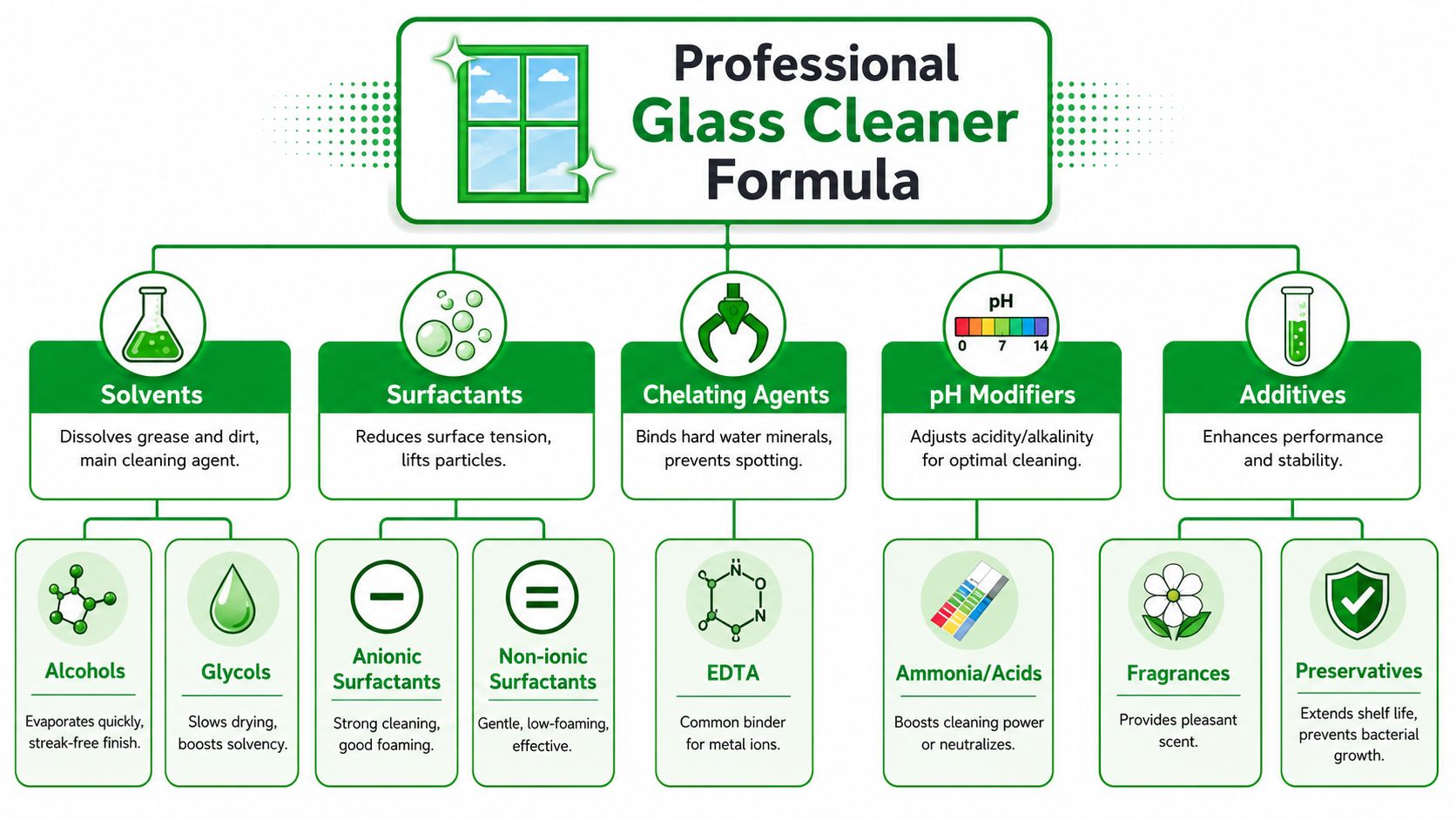
A good commercial glass cleaner formula works like a small crew. One ingredient loosens greasy residue. Another keeps minerals from redepositing. Another helps the solution spread evenly. Another controls drying speed so the glass cleaner doesn't flash off before the technician can finish the pass.
The parts that do the heavy lifting
The most important components in a professional mix are usually the solvents. In professional formulations, expert data indicates 3–5% glycol ethers for dwell time, 5–20% alcohol for rapid drying, and 0.2–5% nonionic surfactants to lift dirt without foam or residue, according to Yeser Chem's guide to crafting the perfect glass cleaner formula.
That balance matters.
- Alcohols: These help the solution evaporate fast enough to reduce streaking.
- Glycol ethers: These slow things down just enough so oily residue has time to release from the surface.
- Nonionic surfactants: These break surface tension and help suspend dirt so it can be moved off the glass instead of smeared around.
If you want a broader look at how professionals think about solution choice, this guide to the best professional window cleaning solution is a useful companion.
Why pH and water quality matter
Professional formulas also live in a narrow operating range. The pH typically stays between 7 and 10, which is strong enough to help remove greasy soils without becoming unnecessarily harsh on surrounding materials. Go outside that range and problems start showing up as streaks, residue, or compatibility issues on sensitive surfaces.
Distilled water also plays a more critical role than commonly assumed. Professional formulations commonly use 90% to 97% distilled water by weight as the base. Water is not just filler. It carries the active ingredients, helps distribute them evenly, and affects whether the finished pane dries clean or dries spotted.
A formula can be chemically sound and still perform poorly if the water introduces minerals back onto the glass.
The supporting ingredients most people overlook
The less glamorous parts of the mix do important work too.
| Component | What it does on the glass |
|---|---|
| Chelating agents | Bind hard-water minerals so they don't leave deposits behind |
| pH modifiers | Keep the cleaner in the useful range for soil removal |
| Preservatives | Help maintain product stability over time |
| Fragrance and color | Mostly user-facing features, not core cleaning performance |
In production, sequence matters too. Water goes in first, then chelating agents, then solvents, then surfactants, then pH adjustment, then preservatives and fragrance. That order helps the batch stay uniform and avoids problems like separation or poor solubility. In other words, the formula isn't just about ingredients on a label. It's about how they work together.
Why Store-Bought Cleaners Fail on Commercial Properties
The biggest problem with store-bought window cleaners isn't that they're useless. It's that they're built for a different job.
They're usually fine for occasional consumer use on small, manageable panes. Commercial glass is another world. Large surfaces dry unevenly, show every line in direct sun, and collect a mix of traffic film, airborne dust, residue from screens, and outdoor contaminants that consumer products don't handle especially well once the square footage grows.
Where household products fall short
A professional cleaner needs the solution to behave predictably under a squeegee. Many household products aren't designed around that kind of application. They may leave more residue, dry too fast in heat, or feel grabby when a blade passes over the surface.
The chemistry window is tighter on commercial work too. The pH of a commercial glass cleaner needs to stay between 7 and 10, because products that drift outside that balance can contribute to mineral deposits and streaking on large exposed surfaces. That's why professionals are careful about formula choice, not just brand familiarity. For a practical comparison of outside cleaning approaches, see what works best for exterior window cleaning.
The method mismatch is just as bad
The product isn't the only issue. The application method causes just as many failures.
Using a spray bottle with a rag on commercial windows creates a few predictable problems:
- You move dirt around: Without enough controlled solution and proper extraction, grime gets redistributed instead of removed.
- Edges stay dirty: Frames, corners, and gasket lines trap residue.
- Drying becomes uneven: Broad panes dry in patches, especially in sun or wind.
- Lint and fibers show up: Wiping materials often leave visible debris on clean glass.
On commercial glass, wiping is usually a polishing step at most. It isn't the primary removal method.
That's also why we never recommend treating serious window cleaning like a paper-towel chore. Professional work depends on scrubbers, rubber blades, poles, ladders, and purified-water systems. The equipment removes soil with control. The formula just supports that process.
A Simple Formula for Small Interior Touch-Ups
There is a place for a basic homemade mix. It's just a very small place.
For a fingerprint on an interior office door, a smudge on a conference room sidelight, or a quick touch-up before guests arrive, a simple solution can work. It should be treated as a stopgap, not as a replacement for professional window cleaning on full panes, exterior glass, or anything heavily soiled.
A basic touch-up mix
A simple interior touch-up mix should center on distilled water, because professional formulations use distilled water as the base and using tap water can leave mineral scale and streaks. Keep the mix mostly distilled water, add a small amount of isopropyl alcohol, and only a tiny amount of dish soap so you get a bit of surfactant action without creating a residue problem.
The key is restraint. Too much soap is where DIY mixes usually go wrong.
- Use distilled water as the base: That's the clean carrier.
- Add a small amount of isopropyl alcohol: It helps with evaporation and oily fingerprints.
- Add only a drop of dish soap: More soap doesn't mean cleaner glass. It usually means more detailing and more streaks.
Where this works, and where it doesn't
This kind of mix is acceptable for tiny interior corrections. It isn't the answer for whole houses, storefront glass, sun-baked exterior panes, post-construction debris, screen dust, or mineral staining.
It also won't replace professional technique. Even a modest interior touch-up goes better when the glass is lightly cleaned, the edges are controlled, and the material touching the glass is clean and lint-free.
Keep homemade glass cleaner for the small, low-risk stuff. Once the job involves exterior glass, height, heavy buildup, or a customer's first impression, the standard needs to change.
The Professional System Formula Application and Equipment
The same commercial glass cleaner formula can give two completely different results depending on how it's applied. That's the part most people miss. A professional result comes from controlled contact, controlled extraction, and clean follow-through.
Why the squeegee process matters
In professional formulations, isopropyl alcohol is a critical solvent because its rapid evaporation helps prevent streaking during the squeegee process, which lets technicians move efficiently across large panes. That only pays off if the rest of the system is right.
A proper setup usually includes:
- Applicator sleeve or scrubber: Used to loosen soil evenly across the pane.
- Professional squeegee: The rubber blade removes solution from the glass instead of pushing it around.
- Holster and detailing cloths: Keep tools accessible and edges controlled.
- Extension poles and ladders: Allow safe access and consistent blade angle on taller sections.
For a closer look at the gear professionals rely on, this overview of commercial window cleaning equipment breaks down the core tools.
A technician isn't just dragging rubber across glass. Blade angle, pressure, overlap, and the cleanliness of the rubber all affect whether the pane finishes clean. A worn edge leaves lines. Too much pressure creates chatter. Bad body position causes missed strips and corner residue.
Pure water changes the game on many exteriors
On many exterior jobs, especially higher or harder-to-reach panes, the best answer isn't more chemical. It's purified water.
Water-fed pole systems use purified water delivered through a brush head to scrub the glass and rinse it clean without leaving mineral spots behind. That approach can reduce or eliminate the need for traditional soap-based formulas on certain exterior surfaces. For modern commercial routes and many residential exteriors, that's one of the biggest advances in the trade.
Here's a good example of that equipment in action.
The finish depends on everything around the glass too
Clean glass doesn't stay convincing if the screens, tracks, and frames are neglected. Professional service means handling the whole opening, not just the shiny center.
That includes work many customers don't realize matters until they see the difference:
- Screens come out first: Dirty screens shed dust right back onto freshly cleaned glass.
- Screens get cleaned and reinstalled: That step protects the final result and improves airflow and appearance.
- Sills and frames get attention: Dirt in the frame line telegraphs carelessness even if the pane is spotless.
- The property gets respected: Floors, landscaping, trim, and furnishings need protection during the job.
A clean pane is the visible outcome. The professional system behind it is what makes that outcome repeatable.
When to Call Flagstaffs Window Cleaning Experts
Some jobs are small enough for a quick interior touch-up. Most aren't.
If the glass is high, wide, exposed to weather, covered in screen dust, or important to how your property presents itself, professional service stops being a luxury. It becomes the practical option. That goes double for hotels, retail storefronts, medical buildings, campuses, car dealerships, and homes with tall atriums or hard-to-reach windows.
The real dividing line is risk and consistency
A professional cleaner brings more than a bottle and a ladder. The job also requires safety training, route planning, the right access equipment, and the judgment to choose between traditional squeegee work and purified-water cleaning.
For many properties, the question isn't whether someone can attempt the work. It's whether they can do it:
| Requirement | Why it matters |
|---|---|
| Safe access | High windows and difficult elevations require trained use of ladders, poles, or lifts |
| Correct method selection | Different glass, soil loads, and exposures need different approaches |
| Consistent finish quality | Commercial properties can't afford random streaks and missed edges |
| Property care | Frames, screens, landscaping, flooring, and entry areas need protection |
The larger and more visible the glass, the less room there is for improvising.
Why local experience matters in Flagstaff
Flagstaff glass takes a beating. Windblown dust, pollen, snow, and big temperature swings all show up on windows fast. The right service company needs to understand those local conditions and have the tools to match them.
Pine Country Window Cleaning is Flagstaff's largest window cleaning company. It was started by Flagstaff native David Kaminski, and the company has been in business since 1999. That local history matters because Northern Arizona properties aren't generic. Cabins, custom homes, hotels, storefronts, campus buildings, and high-access commercial sites all call for different planning and equipment.
The company handles residential and commercial work with in-house lifts, trained technicians, and the kind of process that protects the property while producing the finish customers expect. That includes removing screens, cleaning them, and reinstalling them with every service. It also includes caring for the home or facility itself, not just the glass.
If you're managing a commercial property, maintaining a vacation home, preparing a listing, or trying to keep a residence looking sharp through dust and weather, the formula matters. But the result depends on the people and equipment applying it.
If you want clean glass without the guesswork, get a free estimate from Pine Country Window Cleaning. They serve Flagstaff, Munds Park, and Northern Arizona with professional window cleaning for homes, cabins, storefronts, hotels, campuses, and high-access commercial properties.