
High windows are easy to ignore until the light changes. Then the dust shows up, the pollen haze looks permanent, and every hard-water spot stands out against a blue Flagstaff sky. A lot of homeowners and property managers look up at those panes and wonder the same thing. Can this be cleaned safely from the ground, or is it time to bring in a pro?
In Northern Arizona, that question matters more than it does in milder climates. High altitude, dry air, strong sun, windblown dust, winter grime, and wildfire ash all change how glass gets dirty and how it should be cleaned. A method that works on a mild suburban window in another market can leave spotting, residue, or streaking here.
This is professional guidance, so it skips the household shortcuts. High windows are cleaned with squeegees, extension poles, ladders, and pure-water brushes, not with a rag, spray bottle, or newspaper. The right method depends on height, access, glass condition, weather, and whether the operator can do the job without creating a fall hazard.
That's the dividing line. Some jobs are reasonable for a careful, equipped DIYer. Some aren't. Knowing the difference protects your glass, your home, and the person doing the work.
Your Guide to Sparkling High Windows in Flagstaff
If you're standing in the driveway looking up at second-story glass over a pitched roof, or trying to figure out how to clean clerestory windows above a stairwell, you're already dealing with the hardest part of window cleaning for high windows. Access decides everything.
In Flagstaff, dirt doesn't land on glass in a simple way. Fine dust can cling to dry panes. Snowmelt can leave mineral residue. Ash after a wildfire season can smear if it isn't loosened first. Intense sun speeds up drying, which is why the same soap-and-wipe approach people use indoors falls apart on exterior high windows. Professional results come from controlling water, contact, angle, and runoff.
What professional cleaning actually includes
A proper high-window service isn't just glass cleaning. It also means caring for the property while the work is being done.
- Screen handling matters: We remove screens, clean screens, and reinstall them with every service.
- Home protection matters: Good crews watch where hoses run, where ladders are set, and how tools move around siding, landscaping, stone, and trim.
- Method matters: Exterior high glass is usually cleaned with either a pure-water brush system or a traditional scrubber-and-squeegee setup on extension poles, depending on the job.
Practical rule: If a method sounds easy but doesn't mention access, water quality, or fall protection, it probably isn't a professional method.
Flagstaff native David Kaminski started Pine Country Window Cleaning in 1999, and that local history matters because high-window work here is never generic. The best approach for a mountain home in Pine Canyon, a cabin in Munds Park, or a commercial property near downtown Flagstaff isn't the same. The climate, the elevation, and the building design change the job.
Assess the Job and Understand the Risks
The first thing a professional does isn't clean. It's assess. Height alone doesn't determine risk. A second-story window over flat, open ground can be manageable with the right gear. A lower window over a steep slope, brittle landscaping, or a metal roof edge can be a worse setup.
Window cleaning for high windows is one of the most hazardous building-maintenance activities. An analysis of 88 window-cleaning accidents by OSHA over 15 years found that 62 resulted in fatalities, meaning roughly 70% of recorded accidents were fatal, with a significant share occurring during high-rise work, according to this OSHA accident summary discussed in the window cleaning trade community.
What gets checked before any tool comes out
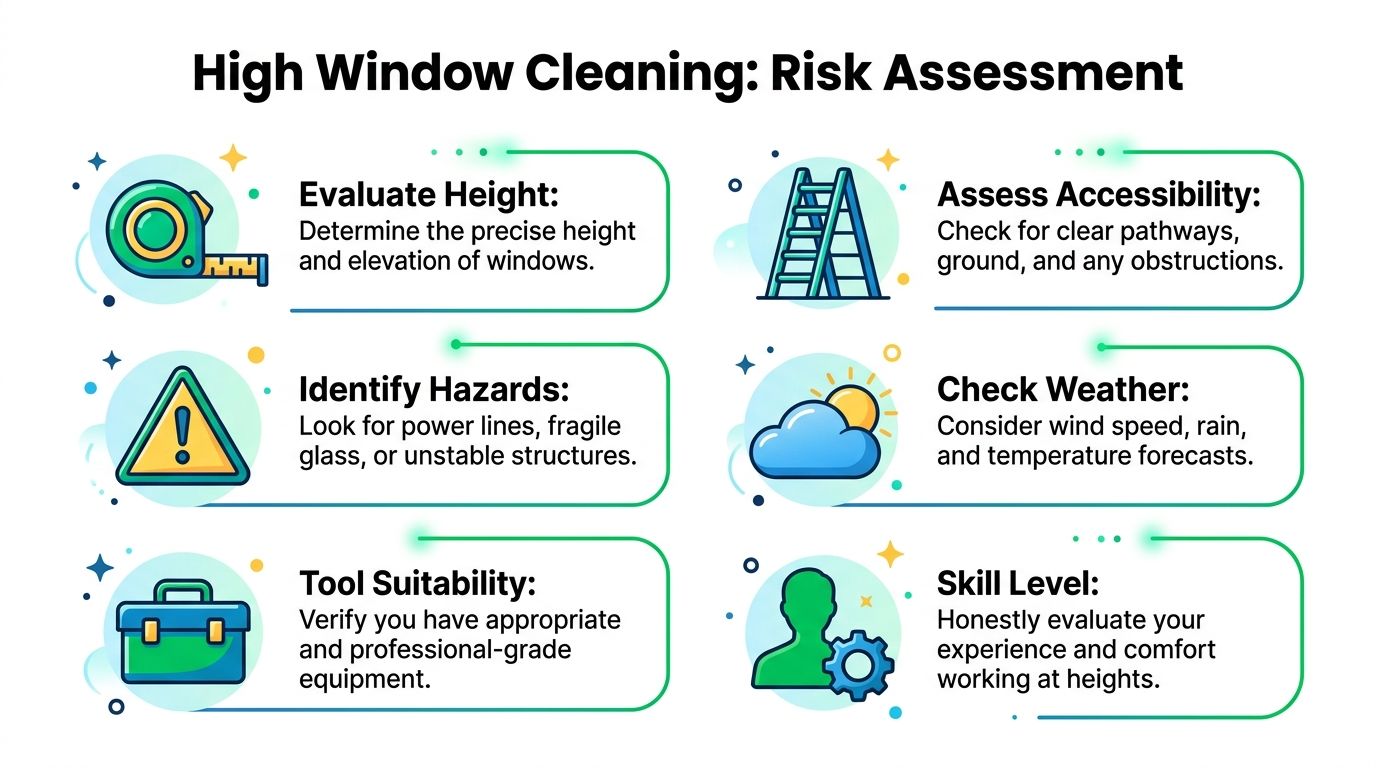
A real assessment is specific. It isn't just asking, “Can I reach it?”
- Height and drop exposure: The concern isn't only how high the glass is. It's what happens if the operator loses footing, overreaches, or drops a tool.
- Ground conditions: Gravel, snowpack, wet soil, decorative rock, and sloped pavers all affect ladder stability and pole control.
- Obstructions: Roof overhangs, balconies, awnings, solar installations, and tree limbs can make the window harder to approach cleanly.
- Electrical hazards: Nearby service lines change the plan immediately.
- Glass type and condition: Delicate coatings, failing seals, and already-damaged panes need a different touch.
The problems most DIY guides skip
A lot of homeowners focus on whether they can physically get a brush or squeegee to the glass. Professionals also ask whether they can do it while keeping three things under control: body position, tool angle, and exit path.
That last part gets overlooked. If the window is accessible only by climbing onto a roof section, leaning out from an interior landing, or setting a ladder where it can't be safely footed, the job has already moved out of DIY territory.
The dangerous moment is often not the cleaning pass. It's repositioning, carrying tools, or trying to correct a missed spot from the wrong stance.
Flagstaff conditions make risk assessment stricter
Wind matters more at height. So does temperature. Cold mornings can leave slick surfaces around shaded entries and decks. Afternoon sun can create glare that hides residue and changes footing conditions as frost or snowmelt breaks down. On custom homes around Flagstaff, you also see a lot of terrain-driven architecture. Split grades, retaining walls, and raised entries make “simple” access deceptive.
A practical checklist looks like this:
- Can the window be reached from stable ground?
- Can the tool stay square to the glass without overreaching?
- Can the operator move and reset safely for every pane?
- Is there any reason the weather could change the risk during the job?
- If something goes wrong, is there a controlled way down and out?
If any one of those answers is weak, it's time to stop treating it as a cleaning problem and start treating it as an access problem.
A Professional Approach for Ambitious DIYers
Some homeowners can safely handle lower high windows, especially first-story tall glass and certain second-story exteriors with clear ground access. The key is using professional tools and accepting the limitations of those tools. This isn't rag work. It's a trade process.
The only DIY methods worth considering
There are really two workable approaches for non-professionals who stay within safe limits.
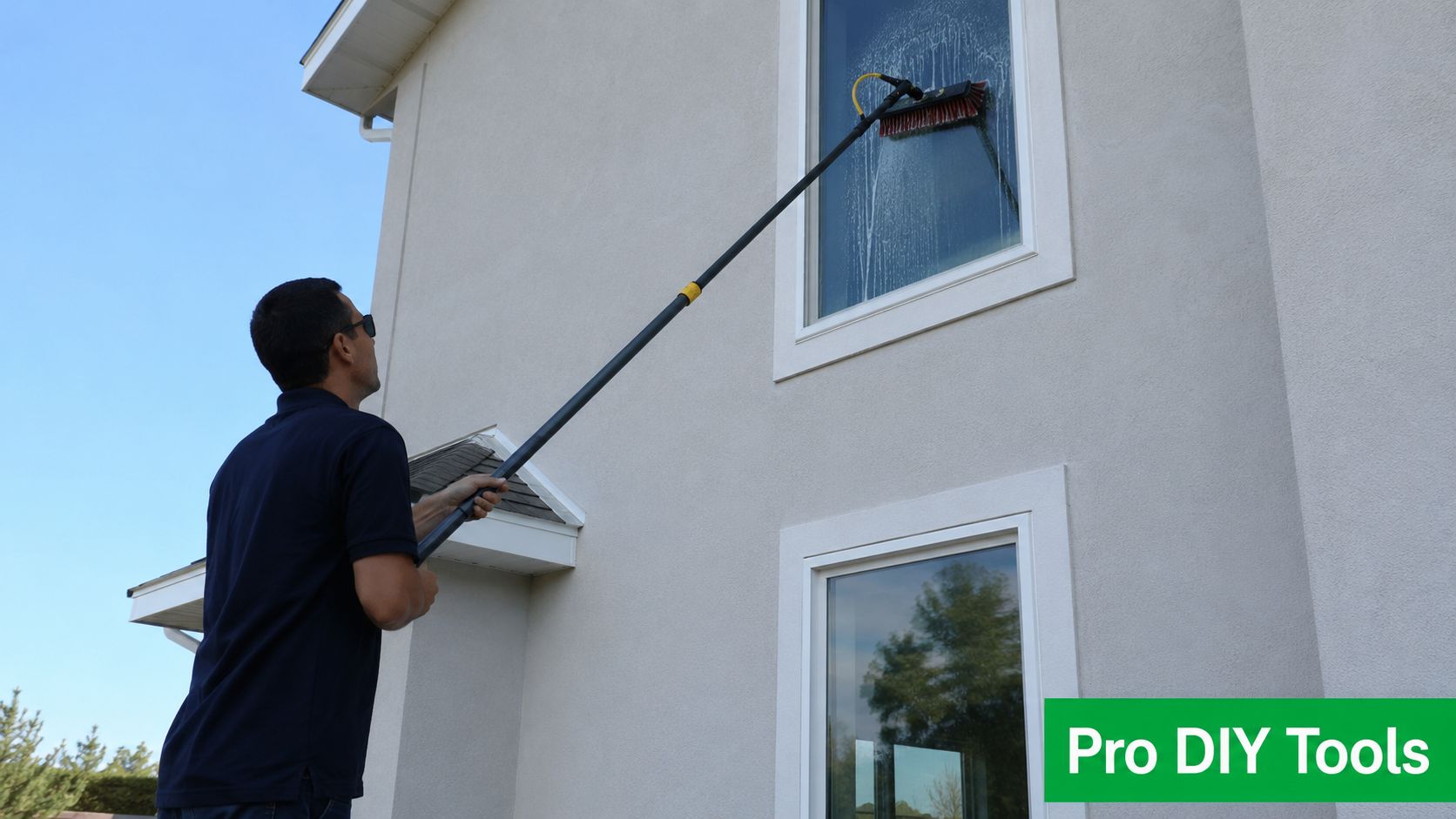
The first is a pure-water system with a water-fed pole and brush. This works well for exterior glass where spotting is the main concern. The second is a traditional extension-pole setup with a washer, professional squeegee, and detail cloth for edges that can be reached without bad body mechanics.
For many homeowners, pure-water cleaning is the safer and more forgiving option because it reduces the need to detail every pass by hand. If you're trying to understand the range of options for hard-access glass, Pine Country's guide to cleaning hard-to-reach windows gives a useful overview of where each method fits.
The sequence that actually works
Professional exterior cleaning follows a consistent pattern: wet, scrub, rinse, then finish correctly. The order matters.
- Wetting the pane: Start by getting the glass fully wet. Dry dust and ash shouldn't be dragged around the surface.
- Scrubbing with overlap: Use controlled, overlapping passes so you don't leave dirty lanes behind.
- Rinsing clean: If you're working with pure water, rinse thoroughly and let the water sheet off.
- Squeegee finishing when appropriate: On traditional work, close out with top-to-bottom pulls and clean edge management.
Trade guidance also points to the importance of deionized or softened water for exterior work. On properly rinsed exterior glass, water with total dissolved solids below 10 ppm eliminates visible spotting on 90% to 95% of surfaces, and a trained top-to-bottom squeegee method can achieve 95% to 98% streak-free yield when paired with deionized water and microfiber edge detailing, according to this cleaning-method reference.
Technique is where most DIY attempts break down
Extension-pole squeegee work looks simple from the ground. It isn't. Professional squeegee technique with an extension pole requires maintaining a consistent blade pressure of 8 to 12 N per linear centimeter and a 15 to 20° tilt angle to achieve visually acceptable results on over 90% of glass surfaces. Inconsistent angles can reduce acceptable outcomes to as low as 65%, based on field guidance summarized here.
That's why a professional clears a clean edge first, keeps the rubber flush, overlaps each pull, and resets before the angle collapses. The farther the pole extends, the more skill it takes to keep that contact even.
Good pole work feels controlled. If the head is chattering, skipping, or twisting, the setup is wrong or the operator is outside their range.
What ambitious DIYers should avoid
Don't assume a longer pole solves the problem. Past a certain point, control drops faster than reach improves. Tall windows over landscaping, bay projections, metal roofs, and recessed façades are where people start chasing missed spots instead of cleaning systematically.
A few practical limits matter:
- Skip improvised attachments: If the head, blade, or brush isn't made for pole work, it won't stay consistent on the glass.
- Don't clean in direct sun when you can avoid it: Fast drying makes residue and drag worse.
- Don't work around architecture that forces leaning or blind angles: If you can't see the blade edge, you can't judge the pass.
- Don't mistake training videos for field readiness: Real control comes from repetition.
For people who want a more formal understanding of trade technique, even from another market, training for aspiring Australian window cleaners is a useful example of how the craft is taught as a skill set rather than a household chore.
When to Hire a Professional Window Cleaner
Some high-window jobs are not DIY projects with better tools. They are professional access jobs. The line usually appears when the glass sits above practical pole range, when architecture blocks a clean working angle, or when the route to the window creates liability before cleaning even starts.
Many homeowner guides suggest telescoping poles but fail to address the significant regulatory, liability, and insurance issues involved with high-window work. That gap leaves property owners underinformed about the real risks, even though OSHA classifies fall hazards as a leading cause of serious injuries in maintenance sectors, as noted by Consumer Reports in its discussion of high-window cleaning.
Clear signs the job needs a pro
Hire out the work when any of these show up:
- The windows are above practical residential access: Once the job moves beyond controlled pole work or standard safe ladder positioning, the risk shifts quickly.
- The building design creates awkward approach angles: Atriums, glass over stair towers, deep setbacks, and curved façades usually need specialized access.
- Ground conditions are unreliable: Snow, slope, loose rock, decorative beds, and narrow side yards all make equipment placement harder.
- You need lift access: Boom lifts, scissor lifts, and atrium lifts are tools, but they also bring operating requirements and site-planning demands.
- The property exposure is high: Hotels, campuses, dealerships, retail storefronts, and occupied commercial properties require tighter control around pedestrians, vehicles, and operations.
DIY versus hiring a professional
| Factor | DIY (with Pro Tools) | Hiring Pine Country Window Cleaning |
|---|---|---|
| Access | Limited to windows that can be reached from stable ground with controlled pole work | Can address difficult heights and access conditions with specialized equipment, including lift-based access where appropriate |
| Safety responsibility | Homeowner carries the decision-making burden on setup, conditions, and personal risk | Crew handles access planning, equipment use, and safety procedures as part of the service |
| Glass quality | Results depend heavily on operator skill, water quality, and tool control | Better suited for difficult panes, awkward angles, and large runs of exterior glass |
| Liability exposure | Property owner may not fully understand insurance and regulatory issues tied to elevated work | Professional service reduces the chance of turning a cleaning task into a liability problem |
| Time and disruption | Often takes longer, especially with resets and corrections | More efficient on multi-window elevations and complex layouts |
For buildings that go beyond standard residential access, high-rise window cleaning services show the kind of equipment and planning involved in true work at height.
Why equipment alone doesn't make it safe
A lift in the driveway doesn't solve judgment problems. Somebody still has to inspect the surface conditions, plan the operating path, protect landscaping and hardscape, manage overhead clearance, and know when weather makes the setup unsafe. The same goes for ladders. A good ladder is only useful when the footing, angle, tie-in, and work position are right.
Hiring a professional makes sense the moment access becomes the main challenge instead of the dirt on the glass.
That's especially true on Flagstaff homes built into hillsides or commercial properties with active foot traffic. The cleaning itself may be straightforward. The approach rarely is.
How to Choose a Qualified Flagstaff Window Cleaner
Hiring a window cleaner isn't just about finding someone with a squeegee and a truck. For high windows, you're hiring judgment, equipment discipline, and local experience. In Flagstaff, local experience matters because climate changes the work.
Local climate, such as in high-elevation Flagstaff, significantly impacts window cleaning. Intense UV, rapid temperature swings, and seasonal dust and ash accelerate mineral spotting. A cleaning regimen has to account for those local factors, which most generic guides overlook, as discussed in this Flagstaff-specific climate and maintenance reference.
The checklist that separates a real pro from a gamble
Ask direct questions. A qualified company should be able to answer them plainly.
- Insurance and safety training: Ask for proof of insurance and ask how crews handle access to height and jobsite safety.
- Equipment matched to the building: The company should already know whether your property calls for ladders, poles, pure-water systems, or lift access.
- Local track record: Reviews from Flagstaff-area homeowners, property managers, and commercial clients matter more than generic claims.
- Clear scope of work: You should know whether screens are included, whether tracks or frames are included, and how access limitations are handled.
- Respect for the property: Good crews protect floors, landscaping, furniture, trim, and entry points while they work.
For local service businesses in general, online visibility often reflects how seriously they treat their market. This piece on how contractors can win better jobs with local SEO is useful because it explains why established local companies tend to invest in reputation, communication, and service consistency.
What local expertise looks like in practice
A Flagstaff cleaner should understand more than glass. They should understand what's on the glass. Windblown dust behaves differently than sticky pollen. Ash needs to be loosened before it's pushed around. Hard-water spotting may require a different maintenance rhythm than a homeowner expects. Snow season also changes access. Frozen ground, runoff, and shaded walkways all affect the schedule and setup.
Pine Country Window Cleaning was started by Flagstaff native David Kaminski in 1999, and that longevity shows up in practical service details. The company removes screens, cleans screens, and reinstalls them with every service. The crew also works with the kind of access equipment that high and awkward windows often require, including boom lifts, scissor lifts, and a 95-foot atrium lift.
That kind of equipment matters less as a selling point than as a sign that the company understands access planning as part of the trade.
A quick look at the type of residential work involved helps:
Small details tell you a lot
Watch how a company talks about the job. Professionals discuss method, access, timing, and surface conditions. They don't reduce everything to “we clean windows.” They should also be comfortable explaining how they protect landscaping, how they move through the home, and how they handle screens and delicate areas around the glass.
A careful company usually sounds careful before the work starts.
That matters on custom homes, cabins, and occupied commercial properties where the glass is only one part of the customer experience.
Protecting Your Investment with Regular Maintenance
High-window cleaning works better as maintenance than as rescue. Once mineral spotting, organic film, dust buildup, and runoff marks sit on glass for too long, every cleaning becomes more labor-intensive and the risk of permanent surface issues goes up.
Industry research indicates that glass not cleaned at least every 6 to 12 months can accumulate mineral deposits that may, over time, increase the risk of coating degradation or localized etching, especially in climates with hard water and windblown dust, according to this discussion of glass-cleaning frequency in the trade.
Why regular service pays off in Flagstaff
Flagstaff glass takes a beating from dust, snow residue, UV exposure, and seasonal debris. Waiting until the windows look obviously bad often means the buildup is already bonded more tightly to the surface. Regular service keeps the work in the maintenance zone instead of the restoration zone.
A sensible schedule depends on location, exposure, and use. Storefronts, view homes, short-term rentals, and properties exposed to open wind usually need more attention than sheltered homes in dense tree cover. If you want a baseline for timing, Pine Country's page on how often windows should be cleaned is a practical starting point.
Routine care also protects the rest of the service. Screens stay functional, frames stay cleaner, and the whole job takes less correction from one visit to the next.
If you're looking at high windows and aren't sure whether the job calls for poles, ladders, lift access, or a maintenance plan that fits Flagstaff's climate, contact Pine Country Window Cleaning for a free, no-obligation estimate. You'll get a practical assessment, careful service, and a crew that understands how to protect your home while delivering clean glass.