
If your windows are staring back at you through pine pollen, high-desert dust, and maybe a little wildfire ash, the question isn't whether pure-water cleaning works. The question is whether you should rent the setup for one hard job, or bring in a crew that already runs the gear every week and knows how Flagstaff water behaves on glass. A water fed pole system rental can be the right move for a one-time cabin cleanup, a seasonal commercial spike, or a first pass at pure-water work before you spend four figures on equipment you may not use often.
The smart move is to rent only after you've matched the pole, filtration, and workflow to the building. That's where most first-timers get tripped up. They book a tall pole they don't need, or they show up with a kit that can't keep up with local water quality, then wonder why the glass doesn't dry clean.
Why Rent a Water Fed Pole System in the First Place
A rental makes sense when the job is real, but the need is temporary. That can mean a one-off post-construction cleanup, a seasonal push after monsoon dust, or a homeowner who wants to see how pure-water cleaning handles their place before buying a full kit. It also helps contractors and facility managers avoid tying up cash in gear that might sit for weeks between uses.
In Flagstaff, that trade-off shows up fast. Municipal water can leave more spotting than crews expect, wildfire ash changes how fast glass soils over, and pine-sap pollen can turn a quick exterior wash into a second pass if the rinse water is not dialed in. A water fed pole system rental gives you a way to handle that kind of job without buying equipment for work that may only come up a few times a season. If you are comparing a one-off rental against calling Pine Country to handle it, the right answer usually comes down to how much glass there is, how much setup time you can spare, and whether you want the learning curve on your own clock.
The market side supports that logic. A 2025 report valued the global water-fed pole clean window service market at USD 1,951.2 million in 2024, with projection to USD 3,500 million by 2035 and a 5.4% CAGR from 2025 to 2035. Separate market tracking for the niche shows enough search demand and product activity to make the rental path worth considering for occasional users, while professional-grade systems are still commonly described as costing $1,500 to $4,000 to buy. WiseGuyReports market data
What rental solves that buying doesn't
A rental lets you test the workflow before you commit. You find out quickly whether you can manage hose routing, brush pressure, and purification checks without wasting a full day learning on the clock. That matters more here than in flatter, wetter places, because a sloped driveway or a windy ridgeline lot can turn a simple rinse into a handling problem.
The right rental also helps you see whether your own pace matches the job. If the glass is mostly exterior, reachable from the ground, and spread across a cabin, storefront, or office with awkward access, rental gear can keep the work moving without dragging ladders across rock, gravel, or planter beds. If you are still building out your toolkit, it helps to compare the rental against the basic items on this list of professional window cleaning tools so you know what else you may need before the first rinse.
Practical rule: if the job is short-term or seasonal, rent it. If you are building a route that needs the system week after week, compare ownership costs against the rental quote and decide from there.
Pure water also changes the safety equation. Guidance on water-fed poles says they can reduce ladder use on residential jobs and shorten the time needed compared with traditional squeegee methods. That is a real advantage on steep driveways, uneven pavers, and the access problems that show up across Northern Arizona. Window Cleaner water-fed pole guidance
The limitation is just as important. Pure water does not remove bonded construction haze, heavy mineral crust, or neglected glass that needs a slower first pass. A rental is a tool for exterior cleaning, not a fix for every dirty pane. If you are using a compact pole setup on lighter-duty work, you can also find the 42 inch pole for Ryobi at find the 42 inch pole for Ryobi.
Sizing Your Pole to the Building You Need to Clean
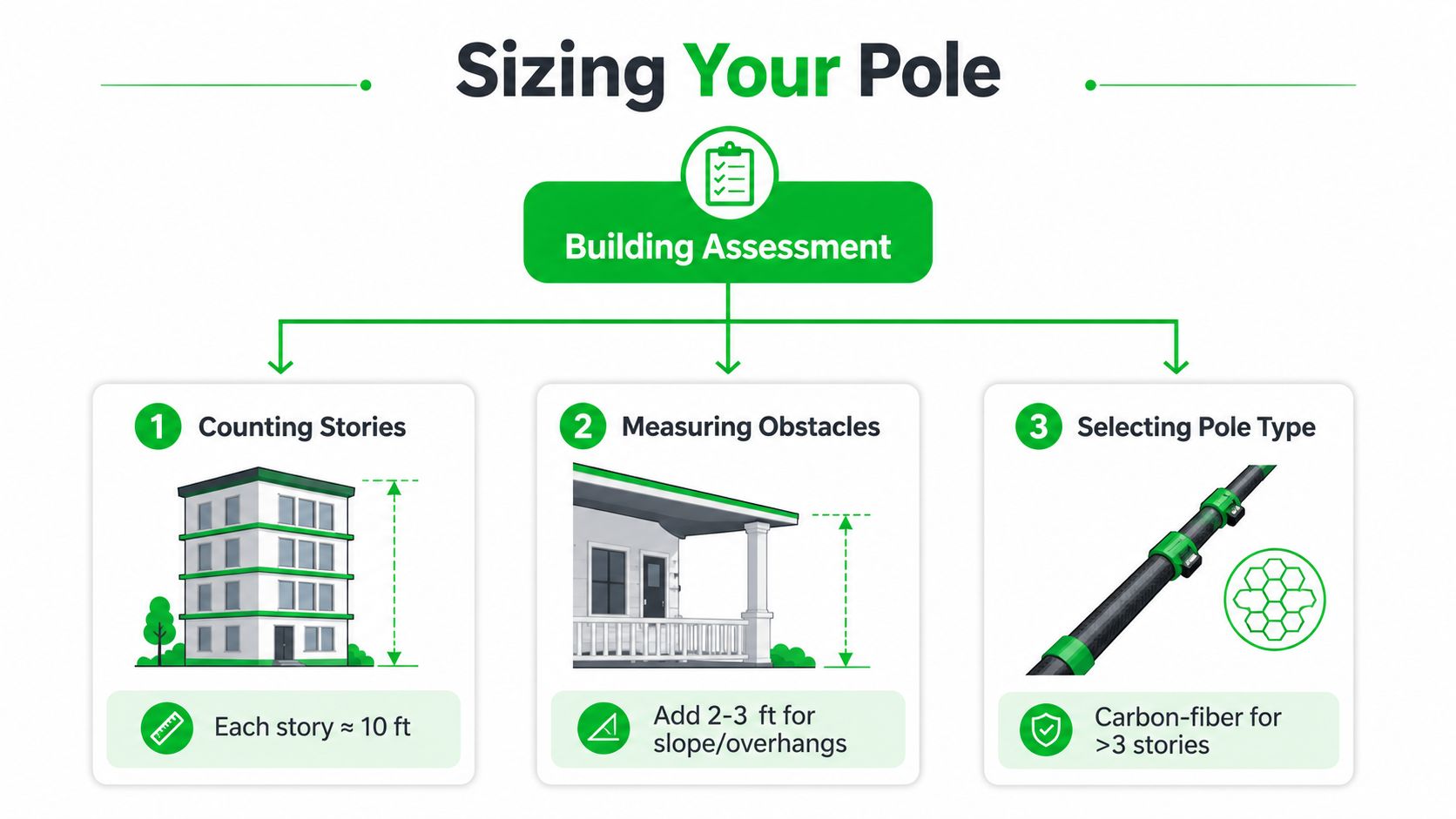
A rental fits best when you know the job before you pick the gear up. Walk the property first, count the usable height, then add the reach lost to slope, deck railings, porch overhangs, retaining walls, and the downhill side of the lot. In Flagstaff and Munds Park, the ground often tilts enough that a simple story count misses the mark.
I tell crews to choose the shortest pole that still keeps them off a ladder. Go too long and the pole gets harder to control, the brush loses pressure on the glass, and your arms wear out faster on pine-sap pollen or high-desert dust. Go too short and you end up back on a step ladder, which defeats the point of renting a ground-based system.
Match the pole to the job
For many residential jobs up to 40 ft, a 1/4-inch ID pole hose is described as standard, and the brush flow range sits around 0.5 to 0.8 GPM. That is enough context to keep the setup workable on normal homes and plenty of cabins, where control matters more than brute force. Window Cleaner water-fed pole guidance
A simple sizing check keeps you from renting the wrong rig:
- Two-story home: A shorter telescopic pole usually makes the most sense, because you still want steady brush pressure and a pole that is not fighting you on every pass.
- Three-story cabin: Stiffer carbon-fiber sections or a more rigid modular setup start to matter, especially on the downhill side where reach can fool you. If you are matching a compact pole to lighter duty work, you can find the 42 inch pole for Ryobi.
- Two-story commercial with awning: Measure the awning projection, then add enough reach to work above it without standing too far back from the glass.
- Four-story hotel: Rental can still make sense, but only if the pole stays rigid enough to keep the brush under control on the upper panes.
If you have to lean the pole hard just to touch the glass, the pole is too short for the job or too soft for the height.
The design choice matters too. A modular pole is easier to break down for transport, while a telescopic pole is faster to extend on-site. For long runs and taller work, carbon-fiber sections usually make more sense because they keep the pole steadier when you are working from the ground, and they pair well with the kind of toolkit laid out in this practical window cleaning tools guide.
If the building is high, awkward, or exposed to wind, do not force a self-run rental just because the counter has one available. That is where a professional crew makes more sense, especially if the job also includes screens, fragile trim, or hard-to-reach architectural glass.
Choosing the Right Filtration and Pure-Water Setup
If you're rinsing pine sap, pollen, and Flagstaff dust off second-story glass, the pole is only half the setup. The part that decides whether the glass dries clean is the filtration stage. TDS means total dissolved solids, the minerals and dissolved material left in the water after treatment.
Pure-water window cleaning works best when the water reaching the brush is near 0 ppm TDS. That is what gives you a clean dry-down instead of residue on the glass. In practice, the source water matters less than the water quality at the end of the system, which is important in a place like Flagstaff where municipal supply, hard-water deposits, and wildfire ash can all show up in the rinse.
Pick the filtration tier that matches your water
Rental shops usually offer a simple DI unit, a RO/DI two-stage system, or a trailer-style setup for heavier use. In Northern Arizona, the choice comes down to how hard your source water is and how long you need to keep the water pure before the resin or membrane starts working harder. If the water is mineral-heavy, the fuller setup usually gives you a steadier run and less risk of spotting halfway through a job.
| Filtration Tier | Best Source Water | Approx. Output TDS | Typical Use |
|---|---|---|---|
| DI-only resin unit | Lower-mineral water, short jobs | Near 0 ppm when resin is fresh | Light residential or short rental runs |
| RO/DI two-stage system | Broader range of tap water | Near 0 ppm after polishing | Longer jobs, mixed water conditions |
| Trailer-mounted setup | Heavier-duty commercial jobs | Near 0 ppm with maintained filtration | Multi-stop or larger properties |
The biggest mistake is renting the largest cart in the yard just because it looks professional. What matters is whether the rinse stays pure long enough to finish the glass without chasing spots. A cheap handheld TDS meter is worth carrying, because it shows you when the water quality starts slipping before you waste time blaming the brush, the soap, or the glass.
If you want a practical reference for how operators compare water treatment choices and cleaning chemistry, Pine Country Window Cleaning's guide to best professional window cleaning solution is worth a look.
Where to Rent Locally and the Questions to Ask
In Northern Arizona, you'll usually find water-fed pole kits through janitorial supply houses, window-cleaning specialty shops, equipment rental yards, and online ship-to-you providers. The trade-off is simple. Local pickup gives you a better chance to inspect the pole, while ship-to-you can be convenient if the rental house doesn't keep the exact brush or length you need.
For Flagstaff and the surrounding area, I'd start by asking the rental desk how they handle service if something fails mid-job. That matters more than glossy brochures. Pine Country Window Cleaning's crew works on this gear daily, so they're a practical reference point for which configurations hold up on local water and weather, even if you're only using them as a sanity check before you book.
Questions that separate a good rental from a headache
- What pole lengths do you have in stock? Don't assume the website is current.
- What brush comes with it? Soft, general-purpose, or something stiffer for heavier debris.
- How long is the hose? Short hose lengths create awkward setup problems fast.
- How fresh is the resin or filtration media? If they can't answer clearly, keep looking.
- Do you include a TDS meter? If not, bring your own.
- What happens if a fitting leaks or the pump quits? The answer should be specific.
You're also looking for signs that the shop understands real field use. A rental counter that can explain hose routing, pole break-down, and rinse checks usually knows what works. One that just hands you the box and shrugs probably rents a lot of gear that comes back dirty and half-sorted.
If you need more context on the broader equipment side, Pine Country's commercial window cleaning equipment page gives a clean example of how professional crews think about the whole setup, not just the pole itself.
Pricing, Duration, and What a Fair Quote Looks Like
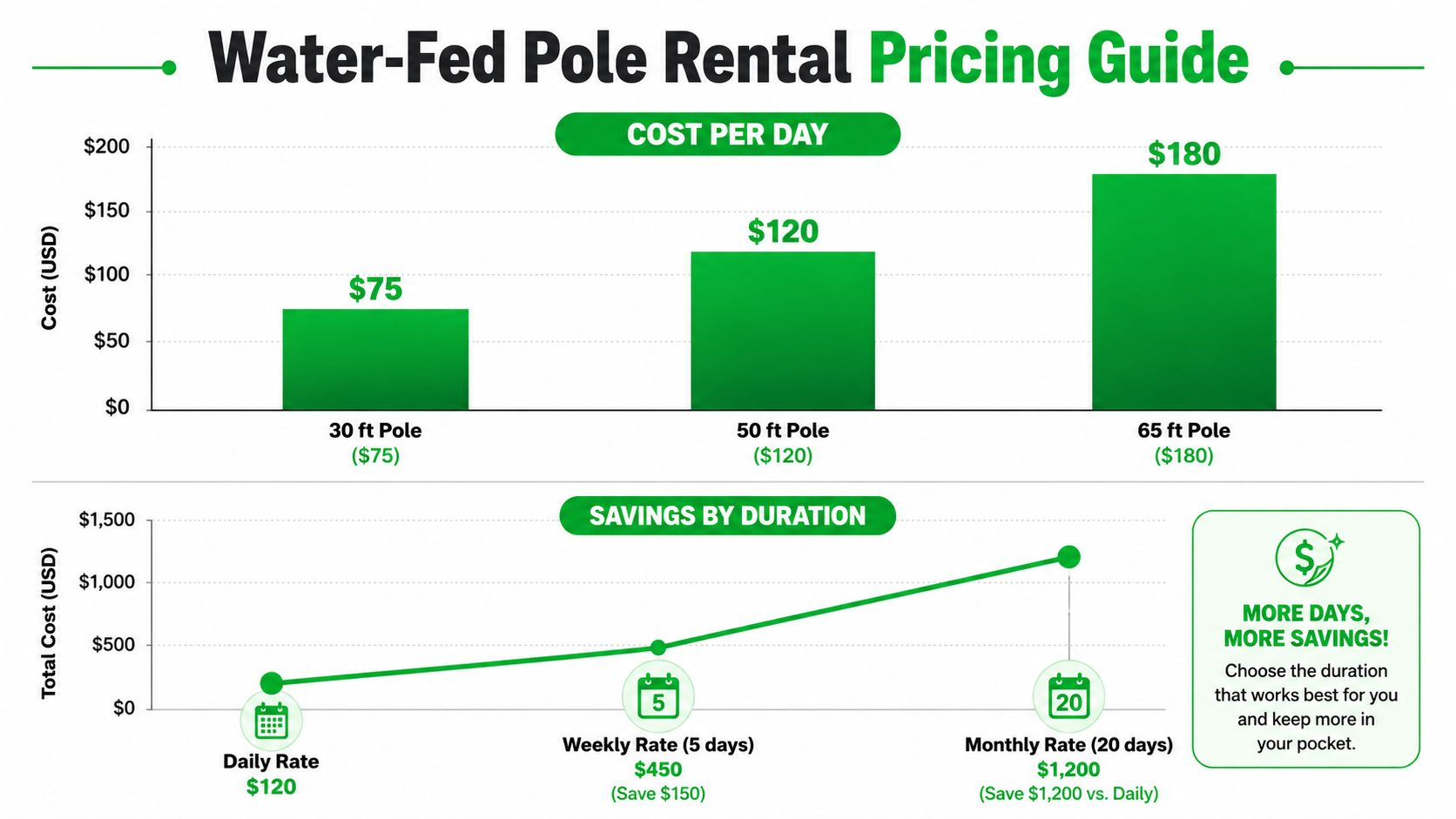
Rental pricing changes fast once pole reach and rental length change. One professional provider listed a 1-operator system at €99.99/day for poles under 10 m, €114.99/day for 10 to 16 m, and €160.99/day for poles over 16 m, with multi-day pricing falling to €52.99/day, €69.99/day, and €106.99/day respectively for 10+ days. Another provider listed standard hire at £87.50 for 1 day, £131.25 for 2 days, and £175.00 for a week. Professional rental pricing Latvia rental pricing example
That spread tells you the important thing. You're not just paying for a pole. You're paying for reach, filtration, and the amount of time the shop expects the gear to be off the shelf.
What should be in the quote
A fair quote should spell out delivery or pickup, fuel charges if they exist, damage waiver, lost-hose fees, and resin replacement if the DI tank is exhausted. Those add-ons are where a cheap day rate turns into an expensive return invoice. If the shop can't put the return rules in writing, you're taking on more risk than you should.
| Quote Item | What to Confirm |
|---|---|
| Rental length | Day, multi-day, or week |
| Pole reach | Exact working height, not just model name |
| Filtration | DI-only, RO/DI, or trailer setup |
| Included accessories | Brush, hose, meter, fittings |
| Return policy | Cleaning, damage, missing parts, resin use |
For a Flagstaff renter, the cleanest way to compare quotes is by job length. A one-day rental should only make sense if the work is tight and local. A three-day rental becomes smarter when travel, setup, and weather flexibility matter. Weekly pricing is usually the better value for multi-property runs or commercial work with more than one stop.
The video below is useful if you want a quick visual on how pricing shifts with setup choices.
Pickup, Transport, and Safe On-Site Setup
A 20- to 35-foot modular pole doesn't travel like a broom. It needs room in the vehicle, padding between sections, and enough tie-down discipline that it doesn't slam around on Forest Pines or I-17 potholes. A pickup bed, van, or SUV with the rear seats folded can work, but the sections need to be secured so clamps, fittings, and brush heads don't get abused in transit.
On-site, the setup should be calm and methodical. Hose routing matters because a loop across a walkway becomes a trip hazard in about ten seconds. Before touching the glass, rinse the brush so you're not dragging grit from the head onto the first pane.
Clean sequence on the building
- Start with water supply: Make sure the source is feeding properly before you raise the pole.
- Extend from the base upward: For poles over 10 m, the safe habit is to set it vertically from the bottom up.
- Work the top panes first: Then shorten the pole and move downward in rows.
- Keep the pole perpendicular: Body-rocking works better than lifting with your arms.
- Let the rinse finish the job: The final rinse has to be the last thing touching the glass.
The most common rental mistake is overworking the glass after the rinse. That puts dirt right back where the pure water just cleaned it off.
A strong rental day still depends on simple habits. Keep the hose clear of doorways, avoid swinging the brush through trim, and don't yank long sections down fast when you're collapsing the pole. That's where the instability shows up, especially on taller work.
If you're doing a job with mixed access or you're trying to keep traffic areas clean and safe, the better move may be to let a professional crew handle the whole exterior instead of piecing together a rental solution.
Troubleshooting Streaks, Spots, and Mid-Job Failures
Most rental problems show up first in the finish. If the glass dries with a hazy or spotty look, check the water quality before you blame the brush, the pole, or the glass. Water-fed systems are built to run on RO/DI-treated water near 0 ppm TDS, so if the output climbs, the rinse stops drying clean even when the scrubbing looks fine.
In Flagstaff, that issue shows up fast because the municipal supply already carries hard-water load, then the air adds altitude, heat, and seasonal ash. A system that looks fine on the shop floor can start leaving light spotting once the resin is tired or the flow drops. That matters on pine-sap pollen, on high-desert dust, and on post-fire residue that hangs around longer than people expect.
The next mistake is scrubbing after the final rinse. That habit comes from traditional window work, but pure-water cleaning depends on the rinse doing the finish work. Once the soil is lifted and the glass has been flushed clean, keep moving instead of polishing the pane with the brush. If residue is already bonded on adjacent surfaces, the best marine water spot remover can help with stubborn mineral marks, though it is a separate step from the wash itself.
What fails in the field
- TDS creep: The resin is getting spent, so check the meter before the residue shows up on the glass.
- Hard-water spotting: Flow dropped, or the rinse is not staying pure long enough to sheet off the pane.
- Mid-job clog: Roof grit, pollen clumps, or dirty filter screens can choke the line.
- Streaking: Usually caused by touching the glass too much after the rinse.
If you notice the glass drying with a faint mineral haze, do not keep pushing through the route and hope it clears. Recheck the water path from the tank to the brush head, then look at the meter again. In Northern Arizona, a small change in flow can show up as spotting long before the system looks like it has failed.
What you can fix and what needs a swap
A leaking hose joint can often be tightened or reseated on-site if you have the right fittings. A brush clogged with roof grit can usually be rinsed out between properties. A pump that keeps cycling wrong, or filtration that will not recover, is usually a rental-shop problem, not something you patch in the field.
For a one-off residential job in Flagstaff, that is where the rental decision gets real. If you are on a tight schedule, dealing with ash fallout, or trying to clean around traffic without babysitting the setup, calling Pine Country Window Cleaning, a Flagstaff-based crew in business since 1999, can make more sense than troubleshooting a borrowed system for the afternoon.
Between stops, keep the system productive by flushing the hose, checking the TDS meter, and looking at the brush head and end caps before you pack up. That small walkaround saves a lot of grief on the second and third property, especially when the water is already working against you.
When you return the gear, do a clean, honest check. Make sure the brush is intact, the hose couplings are present, the resin tank is in the condition the shop expects, the end caps are not missing, and everything is stored cleanly. That is how you get the deposit back without a fight.
The rent-vs-buy decision comes down to frequency. If you use a professional setup more than a handful of times a year, ownership starts to compete with the $1,500 to $4,000 buy-in range cited for professional-grade systems. If you are a homeowner, cabin owner, or property manager who wants a streak-free result without learning the equipment, hiring a crew like Pine Country Window Cleaning, a Flagstaff-based crew in business since 1999, is often the cleaner move.