

You've got a stack of quotes in your inbox, the job is already half sold, and the core question is which estimate looks professional enough to trust with your glass, screens, ladders, and siding. In Flagstaff, a vague “window cleaning” number usually loses to a document that shows the customer exactly what's included, what's excluded, and why the price changes from a single-family home to a cabin, storefront, or post-construction cleanup.
A cleaning estimate template does more than name a price. It lays out labor, supplies, task scope, access issues, frequency, and the terms that protect both sides, which is why the structure matters so much for window and exterior work in Northern Arizona. Residential cleaning benchmarks commonly land around $0.10 to $0.20 per square foot for standard maintenance cleaning, or about $150 to $260 for a typical 2,000 sq ft home, while deeper work often runs higher at $0.15 to $0.30 per square foot or $200 to $450 for an average home, according to Billdu's professional cleaning estimate guidance. For a business that quotes exterior glass, screen handling, and height access, a template that shows the logic behind the number is usually easier to sell than a verbal price.
That's even more true when the quote needs to explain why one house takes a simple pole job and another needs ladders, pure-water brushes, screen removal, and extra care around landscaping. If you want a practical filter for deciding what belongs in the quote, this guide to choosing cleaning services in Flagstaff is a useful companion to the estimate itself. For more exact pricing math, I also keep a calculator open when I'm building related service quotes, including thecalcs home services tool, because small scope differences change the final number fast.
Why a Generic Cleaning Quote Falls Flat in Flagstaff
A homeowner in Forest Highlands can get three quotes that all say “Window cleaning, $XXX,” and still learn almost nothing. One bid might include screen removal, screen cleaning, and reinstalling every screen. Another might skip tracks, ignore skylights, and exclude hard-to-reach glass. If the only visible difference is price, the cheapest number wins, even when the job underneath it isn't the same.
That's where a proper cleaning estimate template earns its keep. It doesn't just list a total, it captures the scope, height access, screens, frequency, and exclusions that make one job easy and another job time-consuming. A structured estimate also doubles as a record of what was agreed to, which matters when a customer later remembers an add-on that was never included.
Practical rule: if the customer can't tell what changed the price, the estimate isn't finished yet.
For window and exterior work in mountain towns, that structure matters more than it does for basic housekeeping. Northern Arizona weather, second homes, cabin occupancy, and hard-to-access glass create more variables than a generic home-cleaning quote usually handles. A template that spells out labor, materials, specific tasks, and additional services keeps the conversation grounded in facts, not assumptions, and that usually converts better than a fast verbal number.
A written estimate also fits the way customers compare service providers now. They want a clean document they can save, forward, and approve without another call. If your quote reads like a contract instead of a note scribbled after a walkthrough, the customer has less room to wonder what happens next. The next step is to build that document from the top down, then fill it with line items that match the work.
Building the Cleaning Estimate Template From the Top Down
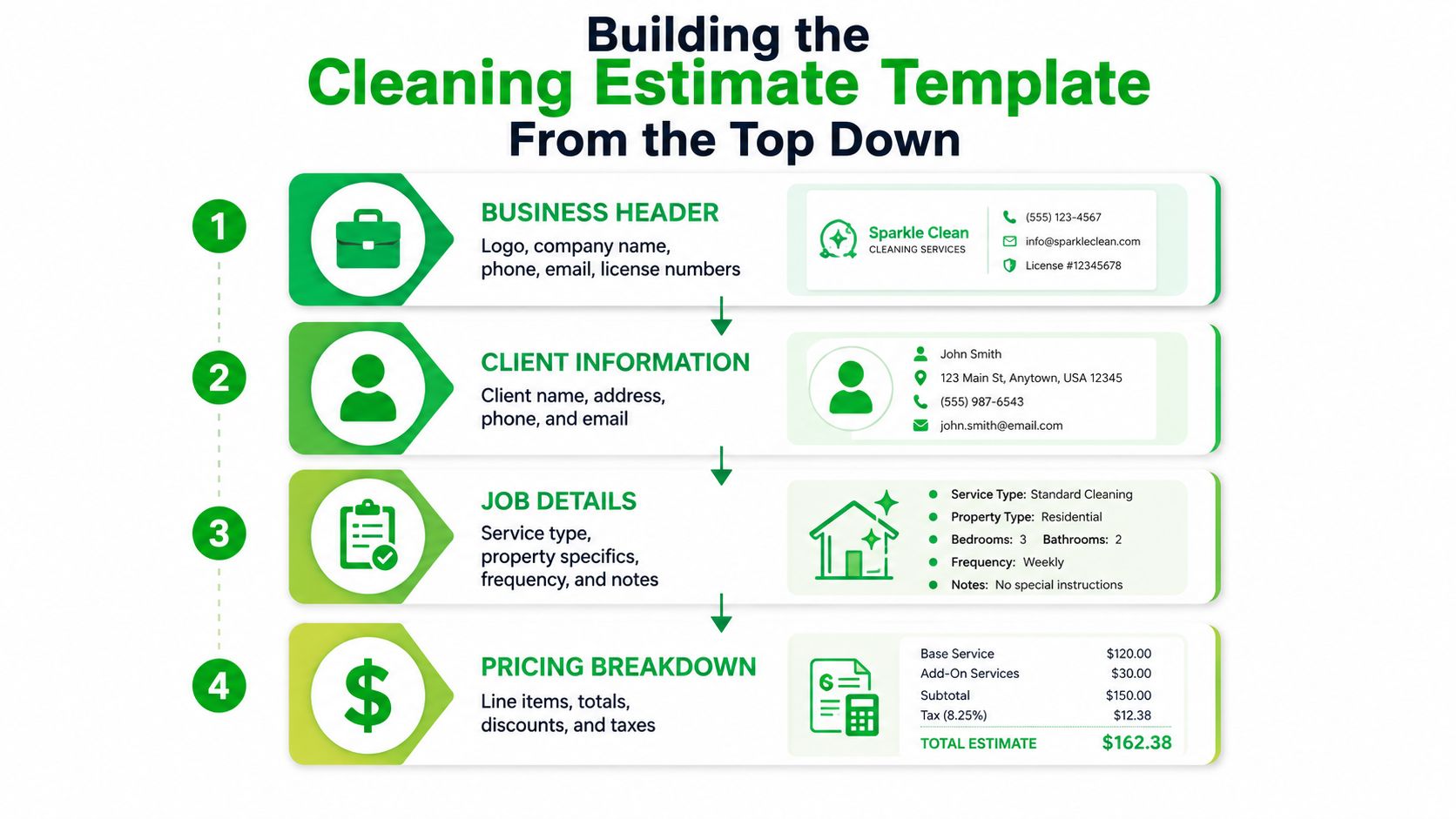
Start with identity, not pricing
The header comes first because it tells the customer who's quoting the job. Put the company name, logo, phone, email, and any license or credential details at the top so the estimate feels like a real business document, not a text message in disguise. That same header protects the business later, because if a customer forwards the estimate to a property manager, builder, or spouse, the source stays visible.
Next, add the client name, property address, and a reliable contact method. That sounds basic, but second homes and cabins create a lot of address confusion, especially when the billing contact isn't the same person who met you on site. A unique estimate number and date issued solve a second problem, because repeat customers can come back months later and reference the exact quote instead of describing “the one for the place in Munds Park.”
The date also needs a validity window. Cleaning costs shift with labor and supplies, and a quote without an expiration date invites delay. When the customer waits too long, you end up honoring old pricing or rewriting the whole thing.
Put the job details in the order the customer reads them
After the header and identifiers, define the property and the service. List service type, room counts or window counts, and any access notes that affect the work. For a window company, that means calling out things like second-story access, skylights, screens, enclosed patios, and any furniture or landscaping that changes how the crew works around the home.
A good estimate should also show the scope of work in plain language. Industry guidance calls for a line-item workflow with business and client identifiers, scope by room or zone, an estimate number, itemized services, subtotal, taxes, terms, and acceptance space, which helps reduce ambiguity and keeps follow-up cleaner than a loose verbal quote Never Miss HQ's template guide. For recurring clients, especially cabins and second homes, that number-based structure matters because the same property may come up again with a different frequency or access setup.
Close the form with the pricing block and signature line. The best templates leave no doubt about who approved the work, what was included, and what happens if the scope changes mid-job. That's the backbone of a quote that can also function as an authorization record.
Line Items That Make Window and Exterior Cleaning Estimates Accurate
Most generic cleaning templates break the work into too few buckets. For exterior and window jobs, you need separate rows for the tasks that consume time, equipment, and risk. A pane-by-pane or service-by-service breakdown makes the estimate easier to defend, and it's the only way to keep the number honest when access changes from a ground-floor ranch to a multi-story building.
Use separate rows for each billable task
A window and exterior estimate should distinguish between interior glass, exterior glass, screen removal and cleaning, screen reinstallation, window tracks and sills, skylights, gutter cleaning, downspout flushing, pressure washing of walks and siding, and post-construction glass cleaning. That separation matters because each category carries different labor time, setup, and equipment needs. Screens take time to remove, clean, and reinstall. Skylights and upper panes often require ladders, poles, or pure-water brushes. Pressure washing is a different service with different wear, runoff, and prep.
Practical rule: if the crew needs different tools or access to complete it, it should usually be a separate line item.
The way you label the row matters as much as the row itself. “Exterior windows” is too vague for a customer comparing bids. “Exterior glass, first and second story, screens removed and cleaned, tracks included” tells the truth without forcing a back-and-forth call. That level of clarity is what keeps scope creep from sneaking in later.
Build the price around the driver, not the title
For each line item, identify the actual price driver. It might be pane count, square footage, soil level, access equipment, or how many screens need handling. Commercial guidance from templates for cleaning and service work emphasizes square footage, room counts, service frequency, crew size, and equipment or supply charges so estimates can be compared consistently across jobs YourAspire's cleaning estimate template guidance. For window work, you're doing the same thing, just with a different access profile and a lot more vertical risk.
This is also where I keep the template short on purpose. A customer doesn't need a paragraph under every row, they need a clean line item and a unit basis they can understand. If you want to see a related cost driver breakdown for residential window work, this cost factors guide is the kind of reference that lines up with how experienced crews price real jobs. The template should make it obvious why a skylight, a screen package, or a post-construction add-on raises the total.
| Common Window and Exterior Cleaning Line Items | Price Driver | Typical Unit |
|---|---|---|
| Interior glass | Pane count, access, furniture movement | Per pane or per opening |
| Exterior glass | Height, pole work, ladder use, soil level | Per pane or per opening |
| Screen removal and cleaning | Screen count, condition, reinstall time | Per screen |
| Screen reinstallation | Window count, fit, access | Per screen or per window |
| Tracks and sills | Debris buildup, detail work | Per window |
| Skylights | Height, roof access, safety setup | Per skylight |
| Gutter cleaning | Linear run, roof access, debris volume | Per section or linear foot |
| Downspout flushing | Number of downspouts, clog severity | Per downspout |
| Pressure washing | Surface area, prep, runoff control | Per area |
| Post-construction glass cleaning | Adhesion, scraping risk, detail time | Per pane or project |
Filled Estimate Examples for Three Flagstaff Jobs
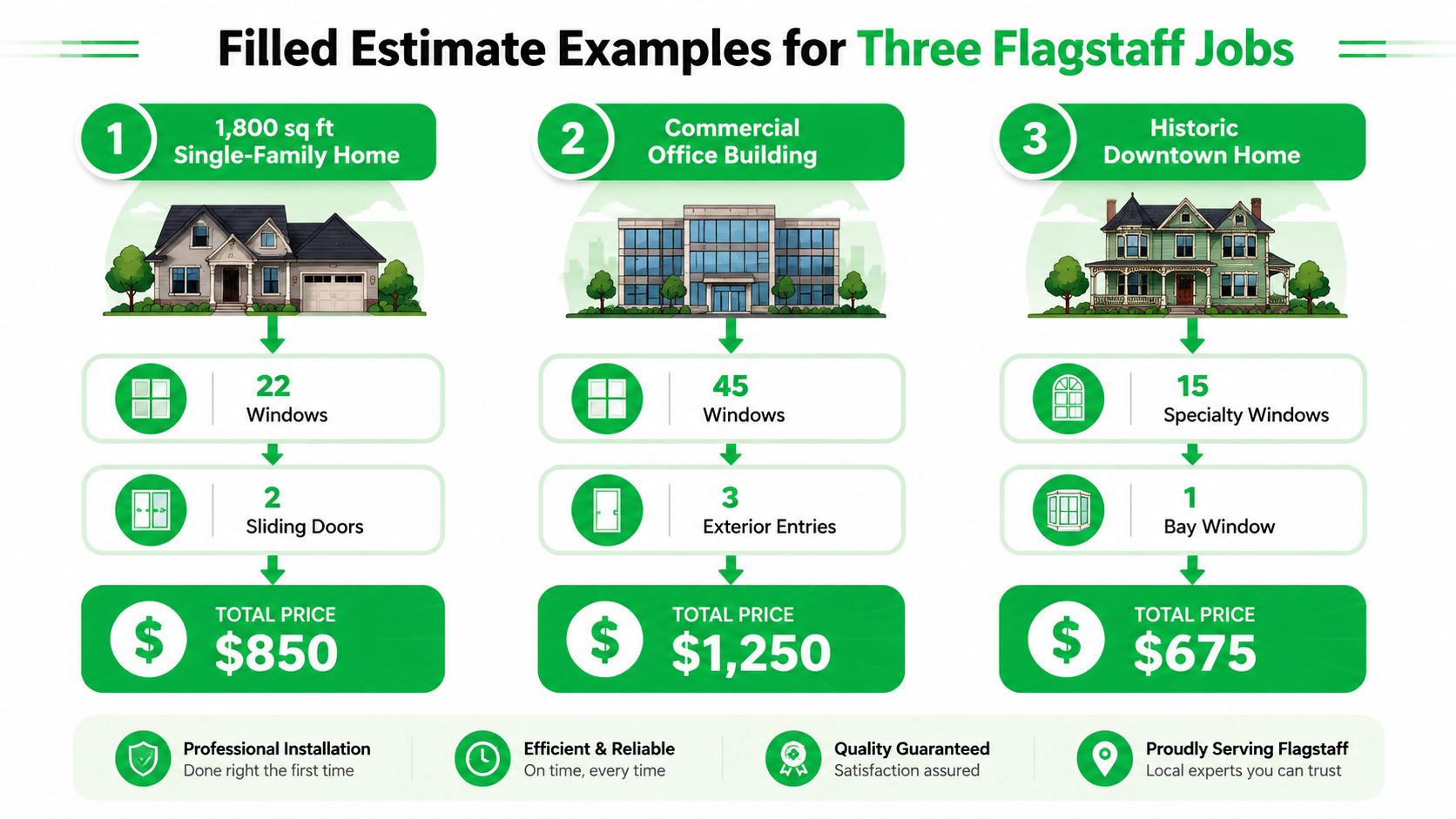
Single-family home with screens and skylights
A 1,800 sq ft home in Flagstaff Ranch with 22 windows, 2 skylights, and full screen service needs a quote that shows the work in layers. The estimate would list the window glass separately from screen removal, cleaning, and reinstall, then add a line for the skylights because they're not the same thing as a standard pane. That structure tells the homeowner why the job takes longer than a simple exterior wash and keeps the pricing tied to visible tasks.
The estimate should also state what's included in the home itself, such as tracks and sills, and what isn't. If the crew is not handling paint removal or mineral staining, say so. That matters because customers often assume “window cleaning” means every blemish disappears, and that's where complaints start. A clean estimate prevents that misunderstanding before it grows teeth.
Cabin with gutters and a deck wash
A Munds Park cabin usually has different problems than a suburban house. Pine pollen, roof runoff, and decks that need a wash-out make the quote feel less like a window job and more like a small exterior restoration. That's where the template should separate gutter cleaning from pressure washing, instead of hiding both under one generic exterior number.
If the cabin is a seasonal property, frequency and access need to be explicit. A one-time service with a closed-up cabin is not the same as recurring maintenance on an occupied home. The cleaner the scope, the fewer callbacks you get when the owner compares the quote to a neighbor's spring tune-up.
Four-story commercial building with lift access
A four-story NAU-area building needs a completely different structure. Boom-lift mobilization, high-rise labor, and quarterly frequency should all appear as separate line items, because the equipment and schedule drive the cost as much as the glass itself. In bigger properties, the estimate is often selling predictability, not just a one-time cleaning.
Commercial template guidance says recurring work should spell out cadence and equipment or supply charges clearly so jobs can be compared across sites Tofu's cleaning estimate templates. That matches the way managers buy exterior maintenance. They're not just approving a total, they're approving a service pattern, a safety setup, and a repeatable scope that won't change with every visit.
Terms, Conditions, and Payment Options That Protect the Job
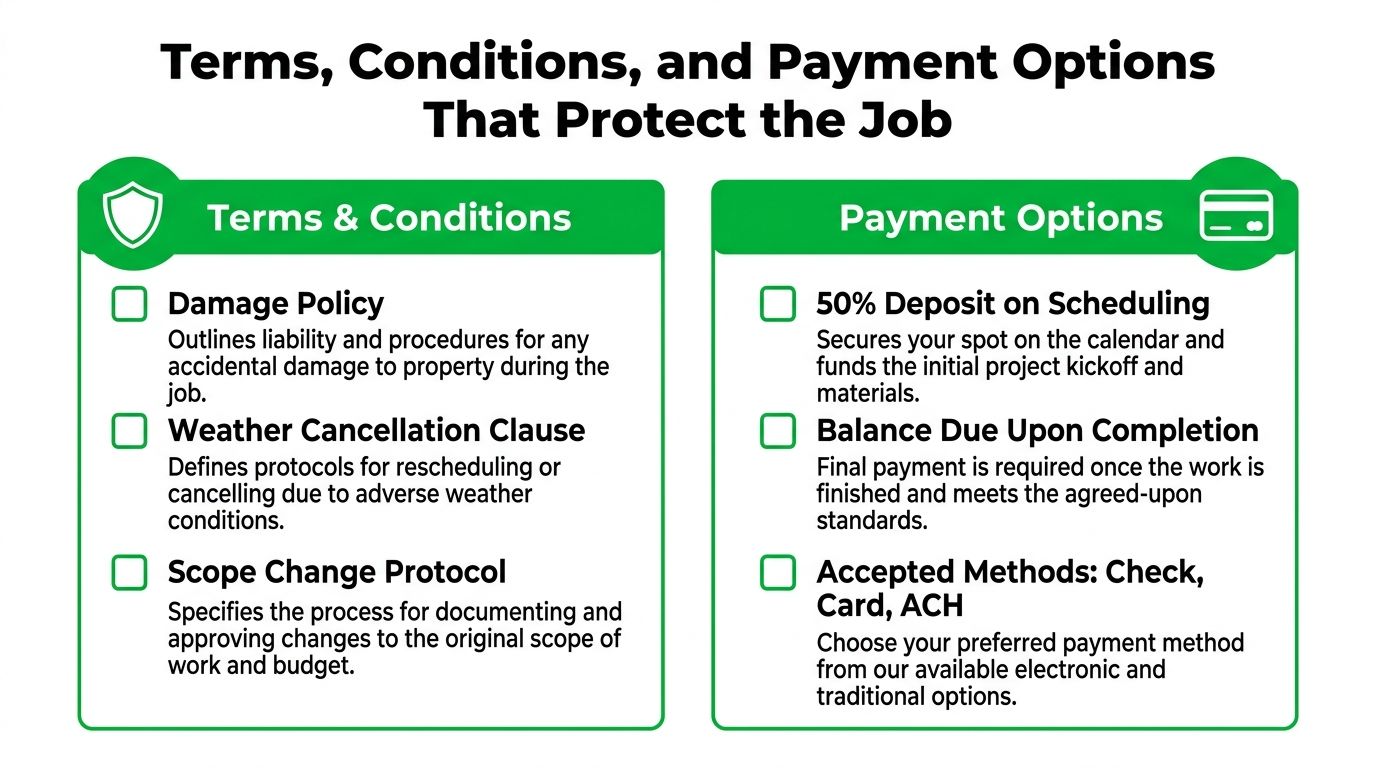
The bottom half of the estimate is where profit gets protected or leaked away. If the quote doesn't say how deposits work, when payment is due, or what happens when weather shuts the job down, you end up negotiating after the crew is already on site. That's a bad place to negotiate.
A solid template should include a deposit or trip-charge policy, accepted payment methods, and any commercial billing terms such as net-7 or net-30. It should also spell out weather rescheduling language, exclusions for paint, hard-water stains, or construction debris, and a signature line that turns the estimate into an acceptance record. Jobber's cleaning estimate guidance recommends a detailed description of the work and frequency, what is and isn't included, a validity window, terms and conditions, and a space for client signature so approved work can start cleanly Jobber's cleaning estimate template.
Practical rule: if the estimate doesn't say what happens when the scope changes, the scope will change.
I also like to borrow one idea from field-service paperwork: make the exclusions obvious. If you want a broader agreement example for exterior work, this pressure washing service agreement template shows the same logic in a different service line. The point isn't to sound legalistic. It's to keep both sides from guessing.
Use clear language like this:
Weather and access
“Service may be rescheduled due to unsafe weather, roof conditions, or blocked access.”
Exclusions
“This estimate does not include paint removal, hard-water stain removal, or post-construction scraping unless listed above.”
Payment
“Payment is due upon completion unless commercial terms have been approved in writing.”
Scope changes
“Any work added after approval will be quoted before completion.”
Customers usually accept firm terms when they're short, visible, and consistent. That's especially true on larger homes and commercial buildings, where the estimate has to support scheduling as much as pricing.
Email and Text Follow-Up Templates That Win the Job
The first 72 hours after sending an estimate are where most of the conversion work happens. A customer who liked the walkthrough can still drift, get busy, or compare you against two other quotes they barely read. The follow-up has to be polite, specific, and short enough that it feels easy to answer.
Same-day send
Subject: Your window cleaning estimate is ready
Hi [Name], thanks again for the walkthrough today. I've attached your estimate, and it breaks out the glass, screens, and any access-related items so you can see exactly what's included.
If you'd like to move forward, just reply here and I'll get you on the schedule.
Text version: Thanks again for your time today. I just sent your estimate and can answer any questions if you want to move forward.
Three-day nudge
Subject: Quick follow-up on your estimate
Hi [Name], just checking in on the estimate I sent over. If anything in the scope needs a second look, I'm happy to clarify it before you decide.
If timing is the main question, I can also hold a slot while you review it.
Text version: Quick follow-up on the estimate I sent. Happy to clarify anything or hold a slot if timing is the issue.
Seven-day closeout
Subject: Final follow-up on your estimate
Hi [Name], I'm closing the loop on the estimate from earlier this week. If you want to get the job on the calendar, reply here and I'll take care of the next step.
If you've chosen another provider, no problem at all. I appreciate the chance to quote the work.
Text version: Final follow-up on your estimate. If you want to book, reply here and I'll handle it.
For silent estimates, the phone script stays simple. “Hi [Name], this is [Your Name] with [Company]. I'm calling about the estimate I sent for your windows. If the price looked high, I can walk through the scope with you so you can compare it item by item.” That avoids a discount reflex and keeps the conversation on scope, where it belongs.
If you're building a broader outreach system, cleaning mailers via Sendvo is a helpful resource for understanding how estimates fit into a wider lead-follow-up process. The message stays the same either way, the customer needs a clear next step, not a hard sell.
The Final Checklist Before You Hit Send
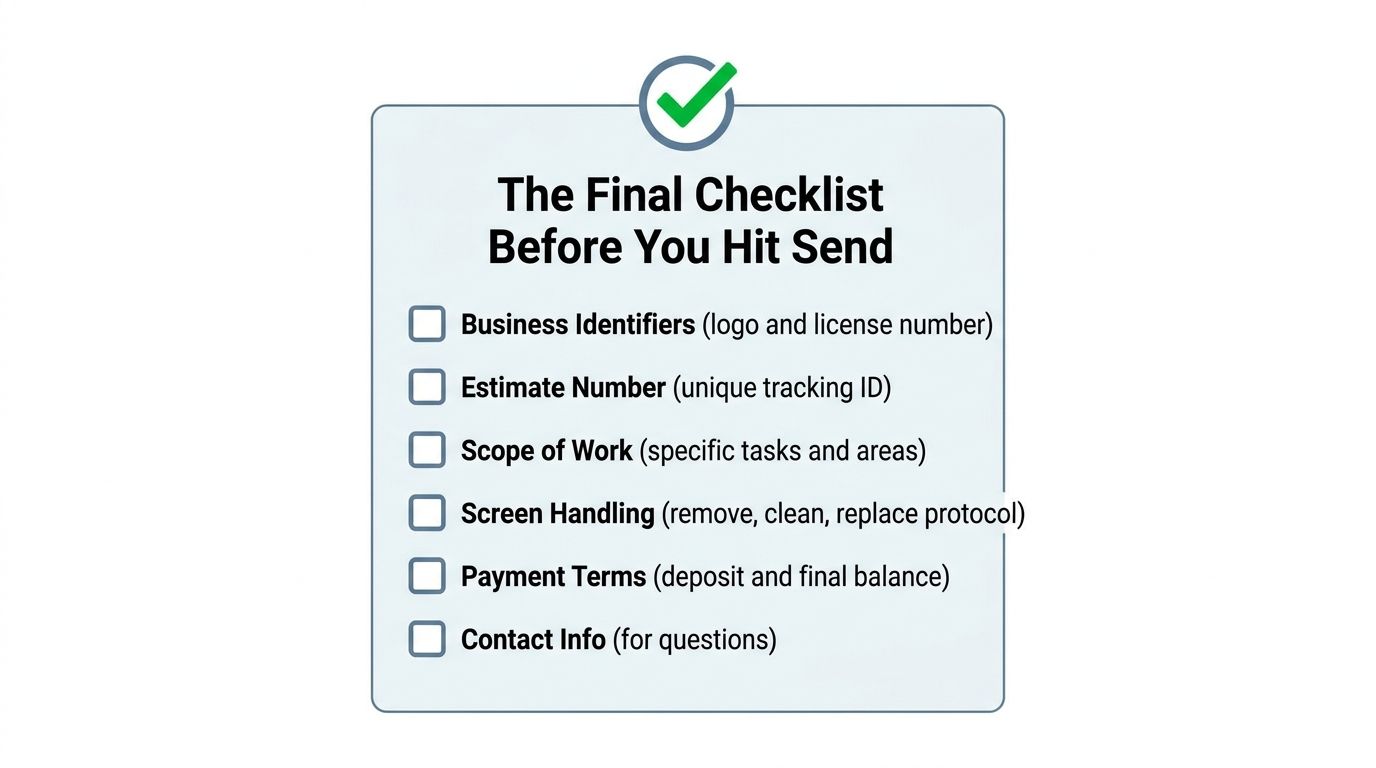
A winning estimate should always include business identifiers so the customer knows who they're hiring. It needs an estimate number for tracking, a scope of work that names the exact tasks, and screen handling language that says remove, clean, and reinstall. Those details prevent disputes before they start.
It also needs payment terms, a validity window, and contact info for questions. That's the difference between a quote that gets filed and one that gets approved. The estimate is a sales document, but it's also a record of what the crew will do.
Before you send it, check each item once:
- Business Identifiers: Confirms the quote came from a real company, not a loose note.
- Estimate Number: Makes follow-up and re-quotes easy to track.
- Scope of Work: Stops scope creep by naming the job clearly.
- Screen Handling: Avoids confusion about what happens to screens.
- Payment Terms: Reduces slow payment and billing disputes.
- Contact Info: Makes it easy for the customer to ask one last question.
A clean, professional cleaning estimate template is one of the fastest upgrades a service company can make. It helps you close more window jobs because it shows the customer the work, the logic, and the boundaries in one place.
If you want a quote that already reflects Flagstaff access, screens, ladders, poles, pure-water brushing, and the way Northern Arizona weather changes exterior work, reach out to Pine Country Window Cleaning. We've been serving local homes and businesses since 1999, and we build estimates the same way we clean, with clear scope, careful communication, and respect for your property.