
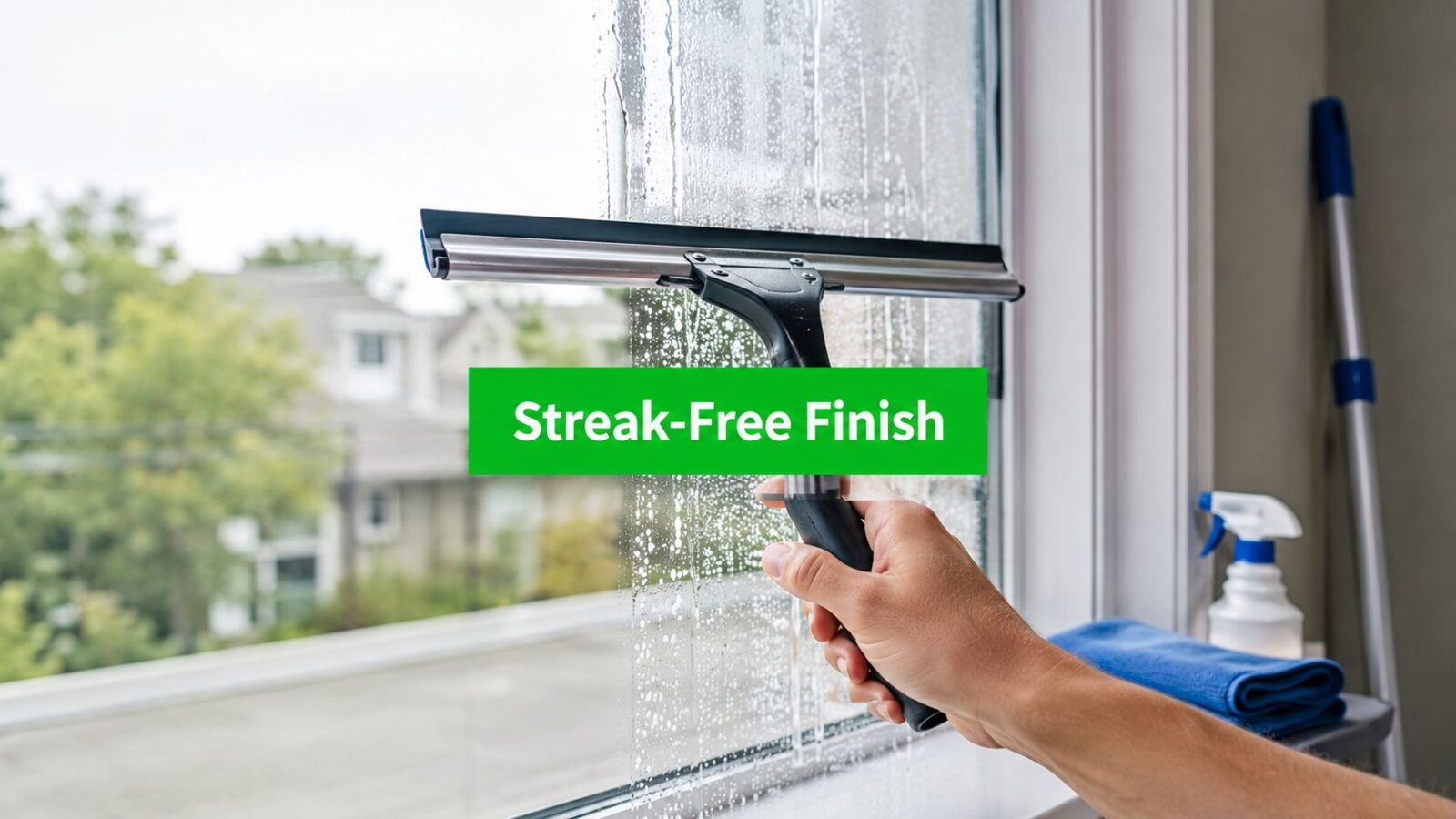
You spend an afternoon on the glass, step back, and somehow the windows look worse. There's lint in the corners, streaks across the middle, and a hazy film that only shows up once the sun hits it.
That happens because window cleaning isn't a spray-and-wipe job. Clean glass comes from the right tools, the right sequence, and a little restraint. Too much soap, the wrong cloth, dirty water, or rushed technique will leave marks every time.
Professional window cleaners don't treat glass like a random household surface. We treat it like a finish that shows every shortcut.
Beyond Windex and Paper Towels
Paper towels feel convenient, but they fight against the result you want. They leave lint, drag soil around instead of lifting it cleanly, and fall apart on edges and tracks. Spray-and-wipe glass cleaners have the same problem. They make the pane look wet and active, but they don't give you the controlled water movement that a squeegee does.
That's why professionals build the process around home window cleaning tools that work together. A washer loosens and suspends grime. A squeegee removes the liquid before it can dry unevenly. A microfiber detail towel catches the last trace of moisture at the frame and corners.
Why the old method fails
The biggest DIY mistake isn't effort. It's using a method that was never designed for a flawless finish on full windows.
A professional result depends on removing dirty solution from the glass in one controlled motion. If you wipe solution around with absorbent paper, you leave behind residue. Then the sun finds every missed swipe.
Practical rule: If the tool can't move water cleanly off the pane, it won't deliver professional-looking glass.
There's also a mindset issue. People think of window cleaning as a basic chore, but the trade itself tells a different story. In the United States, the window washing industry generated about $2.9 billion in revenue in 2024, with 35,344 businesses operating in the sector, according to IBISWorld's U.S. window washing industry data. That matters because the tools used on homes come out of a mature service industry, not a casual aisle of general-purpose cleaning supplies.
What professionals do differently
Professionals simplify the process instead of adding more products. The goal is controlled contact, controlled water, and clean removal. That usually means:
- A real washer or scrubber to wet the pane evenly
- A quality squeegee with sharp rubber
- Minimal soap so the glass doesn't carry residue
- Dry microfiber towels for edges and detail work
- A safe access plan before anyone reaches for height
If you're comparing methods, this guide on the best outside window cleaner gives a useful practical starting point.
In Flagstaff, that professional standard has been shaped over years of real field work. Pine Country Window Cleaning was started in 1999 by Flagstaff native David Kaminski, and that long view matters because mountain homes, cabin windows, screens, sap, and hard water all punish sloppy technique fast.
Your Essential Professional Toolkit
A good window cleaning kit isn't a pile of gadgets. It's a system. Every tool handles one part of the job, and when one piece is wrong, the whole finish suffers.
Start with the blade
The squeegee is the center of the kit. Not because it looks professional, but because it controls the outcome. The rubber edge needs to be clean, straight, and sharp enough to pull water off the glass without skipping.
Cheap squeegees usually fail in two ways. The rubber is too soft and chatters, or too stiff and leaves lines. Either problem gets blamed on the user when the issue is the blade.
The washer, sometimes called a scrubber or applicator, does the prep work. It wets the pane evenly and breaks loose grime before the rubber touches the surface. Without that step, the squeegee drags contaminants and leaves a mess behind.
The rest of the kit matters more than people think
The bucket doesn't need to be fancy, but it does need to be stable and large enough for the washer to load evenly. The cleaning solution should be light. More soap doesn't mean more clean. It usually means more residue and more detailing afterward.
Then come the towels. Not bath towels, not paper towels, and not old T-shirts. You want clean microfiber towels reserved for glass work and edge detailing only.
If you're adding privacy film after the glass is properly cleaned, this guide on how to install window privacy film is useful because film installation punishes dust, lint, and leftover edge moisture.
The Professional's Core Window Cleaning Tools
| Tool | Primary Use | Pro Tip |
|---|---|---|
| Squeegee | Removes solution from glass in controlled passes | Replace or rotate rubber as soon as it starts leaving fine lines |
| Washer or scrubber | Applies solution and loosens dirt | Fully wet the pane, but don't flood the frame indoors |
| Bucket | Holds solution and loads the washer evenly | Keep solution clean. Dirty water puts soil right back on the glass |
| Mild cleaning solution | Cuts grime without leaving heavy residue | Use less soap than you think you need |
| Microfiber towels | Detail edges, frames, and any small misses | Keep separate towels for glass and for sill or track grime |
Good glass work looks simple because the tool choices are disciplined.
What belongs in a serious home setup
For homeowners who want a legitimate kit, keep it tight:
- One quality squeegee with replaceable rubber
- One washer with a sleeve that holds water
- One bucket dedicated to window work
- Several microfiber towels kept clean and dry
- An extension pole only if your reachable windows justify it
For homeowners who'd rather skip buying and storing the full setup, commercial window cleaning equipment and methods show the kind of tools used when access and glass area go beyond basic hand work.
The Four-Step Professional Cleaning Method
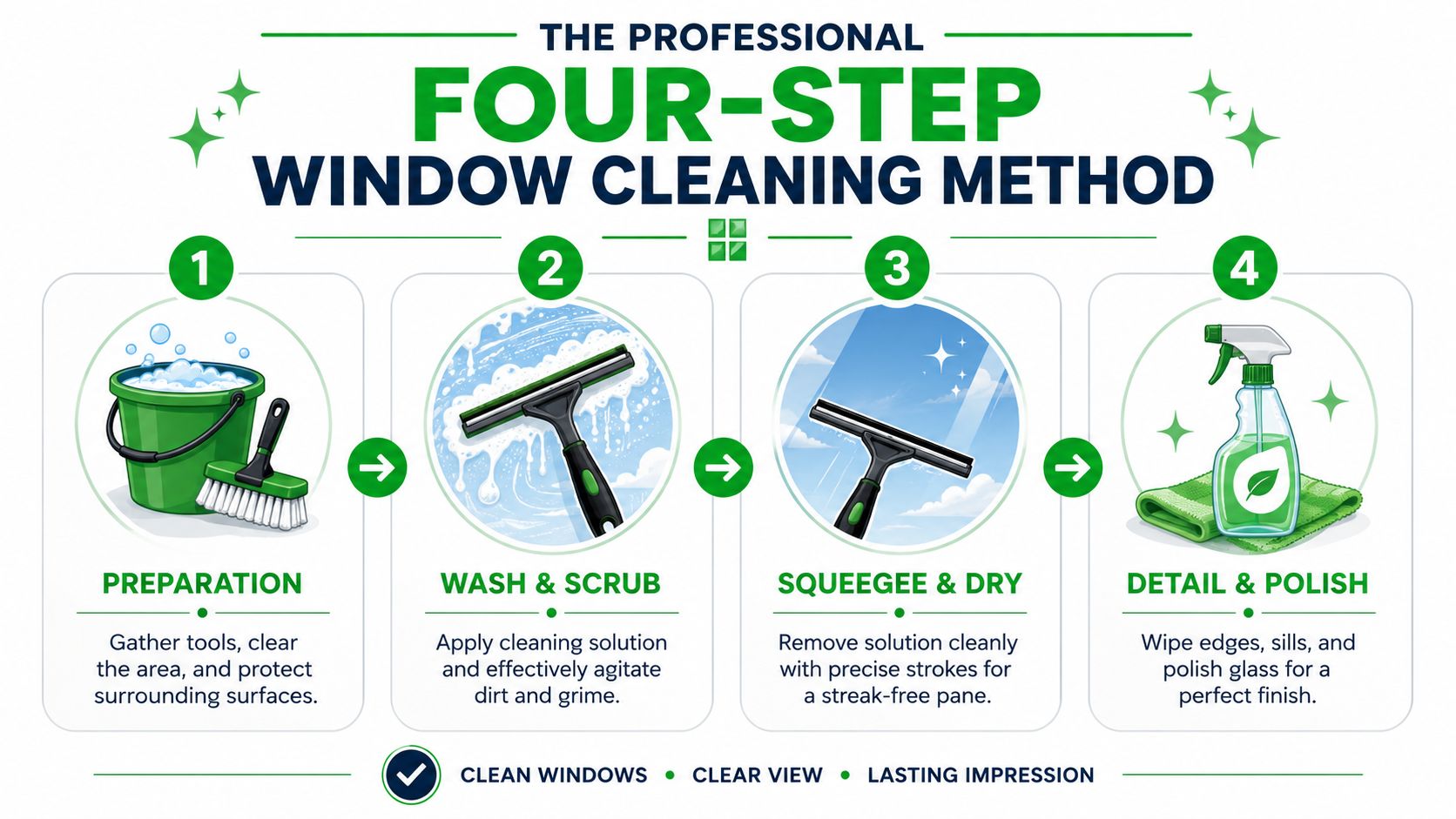
Professional window cleaning isn't complicated. It is precise. The workflow that produces consistent glass is prep → apply solution → squeegee → detail, and expert guidance also notes that the squeegee should be held at about a 30° angle to the glass, with the blade wiped dry after every pass to prevent chatter and streaking, as outlined in this professional window cleaning method guide.
Preparation comes first
Before the glass gets wet, the sill, frame edge, and track need attention. Loose dirt turns into muddy runoff the second water hits it. Indoors, protect the floor and nearby trim. Outdoors, clear cobwebs, dust, and debris so you aren't dragging them onto the pane.
Screens matter here too. A professional service removes screens, cleans them separately, and reinstalls them correctly. That's the clean way to handle the job because a dirty screen can make freshly cleaned glass look dusty within minutes.
Apply solution with control
The washer should wet the full pane evenly. You want enough solution to lubricate the glass and suspend grime, but not so much that you're fighting runoff.
Use a light detergent mix. Heavy soap creates drag and leaves residue behind the blade. It also makes detailing take longer.
- Wet the pane fully so the rubber glides
- Scrub problem areas where bugs, pollen, or film have built up
- Keep runoff manageable especially on interior glass
- Work in shade when possible so solution doesn't flash-dry on the pane
The pull makes or breaks the result
Whether people become proficient with squeegees or abandon them hinges on proper technique. The blade angle, pressure, and path all matter. Hold the squeegee at a slight working angle, keep the rubber in full contact, and pull smoothly enough that the water leaves in one clean sheet.
Overlap your passes. If you leave a narrow wet line between strokes, it will show when the glass dries.
Wipe the blade after every pass. A perfect stroke with a dirty edge still leaves a line.
Detailing is not re-cleaning
Detailing means catching the last moisture at the perimeter, corners, and sill. It does not mean rubbing the whole pane again. If you start wiping the center of the glass with a towel, you've left the professional method and gone back to smearing.
Use a dry microfiber towel to touch the edge lightly. Then check the window from an angle, not just straight on. That's where misses show up.
Tackling Height and Stubborn Grime
A ground-floor picture window and a second-story exterior pane are not the same job. The tools change because the risks and mechanics change.

Extension poles change the technique
An extension pole is the first upgrade when standard hand work stops reaching safely. It lets you clean from the ground or from a more stable position, but it also removes some control. Your angle is farther away, your pressure is less direct, and every movement gets exaggerated at the far end.
That means technique has to tighten up. Short, deliberate passes work better than broad swinging motions. Keep the tool head square to the pane as much as possible and avoid overreaching just because the pole can technically extend farther.
Independent guidance on indoor-safe exterior access makes an important point. Often, the key issue isn't which tool is best, but whether the window can be reached safely and effectively at all, especially on second-story, vaulted, or hard-to-reach windows. That's the practical question behind guides like this one on how to clean high windows.
Scrapers solve specific problems
Some contamination won't wash off. Paint specks, tree sap residue, insect remains, and stuck-on debris often need a scraper. Used correctly, a scraper can save a pane. Used carelessly, it can damage glass or drag grit across the surface.
A scraper belongs in skilled hands when:
- Debris is bonded to the glass and won't release with a washer
- The blade is clean and fresh so it doesn't drag contaminants
- The glass surface has been wetted first to reduce friction
- You know the surface is appropriate for scraping
This is also where a lot of homeowners cross the line from cleaning into risk.
Ladders raise the stakes fast
Ladders aren't just taller extension poles. Once you add height, body position, roof lines, landscaping, and uneven ground, window cleaning becomes access work. A steep lot, decorative rock, deck edge, or narrow side yard can turn a normal-looking house into a bad ladder setup.
For a visual example of how professionals approach glass at height, this walkthrough is useful:
What usually works for ambitious DIY:
- Reachable first-story exteriors
- Second-story glass that can be cleaned from inside
- Pole work where footing stays solid and square
What usually doesn't:
- Windows above roofs, slopes, or landscaping
- Atrium and vaulted glass
- Tight access where the tool angle is compromised
- Any setup that depends on leaning away from the ladder
Notes for Window Cleaning in Northern Arizona
Northern Arizona exposes every weak point in your process. Dry air speeds evaporation. Strong sun makes soap flash on the glass. Pine pollen, sap, windblown dust, and mineral-heavy spotting all stack onto the same pane.

Hard water changes the whole job
Many streak complaints get blamed on the squeegee when the culprit is water quality or technique. Bob Vila's testing notes that many streak issues come from incorrect technique or contaminated water, and that hard water can leave mineral spotting after evaporation, which is one reason pure-water systems can be more effective on larger glass areas in some situations, as discussed in this window squeegee and technique guide.
In Flagstaff and the surrounding area, that matters. If the water leaves minerals behind, the glass can spot even after decent hand work. That's why professional crews often shift from a basic manual setup to water-fed and pure-water systems when the property, water source, or amount of glass calls for it.
Pine sap and pollen need patience
Sap is sticky, but the bigger issue is what people do next. They scrub too aggressively, spread it wider, or attack it dry. Pollen creates a different problem. It turns into a fine slurry that rides the rubber and soils the blade edge.
The better approach is controlled agitation and frequent tool cleaning.
- Loosen first instead of grinding contamination into the glass
- Keep blades and towels clean so sap and pollen don't transfer pane to pane
- Watch the frame edges because runoff carries residue into corners
- Clean screens too since dusty screens can dull the finished look
On mountain homes, the window isn't the only surface that needs attention. The screen often tells the truth about how much airborne debris is really there.
Sun and dry air punish slow work
If you clean in direct sun, the solution can dry before the blade reaches it. Then the window gets blamed for streaking when the problem lies with pace and conditions.
In Northern Arizona, professionals adjust the workflow around the environment. We work the shaded side when possible, control the amount of solution, and choose methods that match the glass size and contamination level. On large homes, cabins, and exposed properties, that local judgment matters as much as the tool itself.
When to Call Flagstaff's Window Cleaning Professionals
There's a point where buying more home window cleaning tools stops being practical. That point usually arrives before homeowners expect it.
The issue isn't ambition. It's access, safety, and finish quality. Independent guidance on hard-to-reach glass makes the point clearly. DIY tools become a safety problem when the primary challenge is whether the window can be reached safely and effectively at all, especially on second-story, vaulted, or steep-lot properties, as noted in this guidance on inside-safe access for hard-to-reach windows.
The clearest signs the job has outgrown DIY
Some windows are still good DIY candidates. Others aren't worth forcing.
Call a professional when you're dealing with:
- Second-story exteriors with poor ground conditions
- Vaulted, atrium, or stairwell glass
- Mineral spotting that keeps coming back
- Heavy sap, post-construction residue, or stubborn debris
- Large homes with many screens, tracks, and difficult access points
If the glass itself is damaged, cloudy between panes, or the frame condition is part of the issue, it also helps to look at expert window repairs from Pacific Builders before assuming cleaning alone will solve the problem.
What professional service changes
A trained crew doesn't just bring better tools. They bring a repeatable process, access planning, and the judgment to know which method fits the window.
That includes details homeowners often underestimate:
- Screen care with removal, cleaning, and proper reinstallation
- Home protection with careful handling around floors, trim, and furnishings
- Safer access using poles, ladders, and specialized equipment appropriately
- Consistent finish checks so misses don't show up later in the afternoon light
Pine Country Window Cleaning handles residential and commercial window cleaning in Northern Arizona, including screen removal, screen cleaning, and reinstallation as part of the service workflow.
For homeowners in Flagstaff, Munds Park, Forest Highlands, Pine Canyon, and other nearby communities, the value is simple. You don't have to guess whether the pole is long enough, whether the ladder angle is safe, or whether the spots are soap, minerals, or damaged glass. You get clean windows without turning your weekend into an access problem.
If your windows are easy to reach, a good squeegee, washer, microfiber towels, and disciplined technique can get you solid results. If the glass is high, heavily spotted, screen-covered, or part of a larger mountain home, it makes more sense to hand it off to Pine Country Window Cleaning. Since 1999, the team has served Northern Arizona with respectful in-home service, careful screen handling, and the equipment needed for everything from everyday residential glass to hard-to-reach windows on complex properties.