
The first real snow in Flagstaff has a way of forcing the issue. You look out at the driveway, the walkway, the steps, maybe the rental cabin or storefront, and you realize hope is not a winter plan. If you wait until the storm hits, you usually get one of two outcomes. You either overpay for last-minute service, or you don't get service when you need it.
That's why seasonal snow removal pricing matters. It's not just about what a contractor charges. It's about whether your home stays accessible, whether your guests can get in safely, whether your tenants or customers can walk without slipping, and whether you know your winter costs before the season starts.
In Flagstaff, that planning matters more than it does in milder places. We get real snow, repeated storms, steep driveways, shaded areas that hold ice, and a lot of second homes that sit empty until the owner arrives to a packed-in berm at the garage. A smart contract solves those problems before they start.
Planning for a Flagstaff Winter
A lot of people make the same mistake. They wait until they've already lost control of the property.
It usually starts with a manageable storm. You think, “I can shovel this one.” Then another storm rolls in before the first one melts. The driveway turns to packed snow, the front walk gets slick, the sun never quite hits the north side of the house, and now every trip to the trash can feels risky. If it's a second home, it's worse. You arrive after dark, the snow berm is frozen, and you're unloading bags in boots on a sheet of ice.
That's normal in Flagstaff. It's also avoidable.
Local service matters here because winter conditions change block by block. A flat in-town driveway is one thing. A sloped cabin lot under tall pines is another. A contractor who works here year after year understands how drifting, shade, access, and timing affect the job.
That's the kind of long-view property care homeowners need. A company that's been serving Flagstaff since 1999 has seen dry winters, heavy winters, surprise late storms, and all the messy in-between. That matters because snow service isn't separate from the rest of home care. It comes from the same mindset that says crews should show up on time, protect the property, notice access issues, and treat your home like it belongs to a neighbor, not a route number.
If you're already thinking about winter prep, it helps to tie snow planning into a broader seasonal home maintenance checklist. Snow removal works better when you've already handled drainage, walk access, entry points, and the small maintenance jobs that become bigger headaches under snow.
A winter contract isn't just a convenience purchase. In Flagstaff, it's a risk-management decision for your budget and your safety.
Decoding Snow Removal Pricing Models
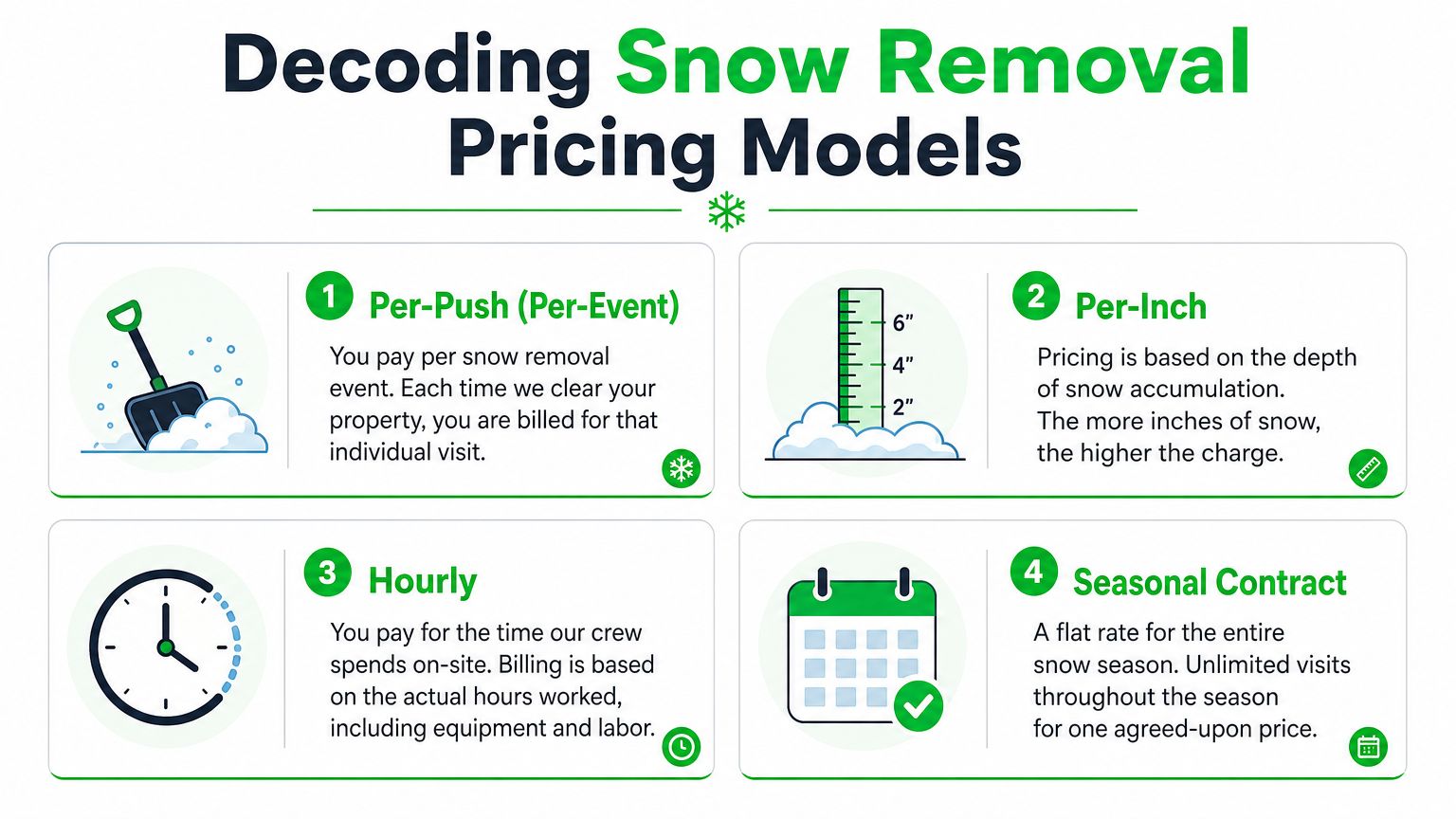
The easiest way to understand seasonal snow removal pricing is this. Some plans are pay-as-you-go. Others are all-in for the season.
Most snow service falls into four pricing models. If you understand those four, you'll read estimates with a much sharper eye.
Per-push and per-visit pricing
This is the taxi-ride version of snow removal. You pay when the truck or crew comes out.
Published market guides show that per-visit service often falls around $30 to $160, while residential seasonal contracts commonly cluster around $300 to $1,000, and hourly pricing is typically $25 to $100+ according to Housecall Pro's snow removal pricing guide.
Per-push pricing works well if:
- You get light snowfall and don't expect frequent service
- You're home and flexible about timing
- You don't mind variable bills from storm to storm
It's a bad fit if you hate uncertainty. In Flagstaff, one active stretch can make a “cheap” pay-per-visit plan feel expensive fast.
Per-inch and hourly pricing
Per-inch pricing charges based on accumulation. That model sounds fair on paper because deeper snow usually takes more labor, more passes, and more fuel. It's common where storm totals vary a lot.
Hourly pricing is more straightforward. You're paying for crew time and equipment time on site. That can make sense for unusual properties, long private roads, tricky access, or jobs where hand work and machine work are mixed together.
A lot of contractors build pricing from a cost-plus approach, then choose the billing unit that fits the site. That same logic applies across service industries. If you want a solid outside explanation of how contractors think through labor, overhead, and margin, this piece on mastering cleaning service bids is worth reading.
Seasonal contracts
This is the bus-pass version. You pay a fixed price for the winter instead of paying every time it snows.
That's the cleanest option for people who want budget control, dependable scheduling, and less storm-by-storm decision making. It's especially useful for:
- Second homes where no one is around to coordinate service
- Families with morning routines who need reliable access
- Commercial sites that can't wait to decide whether to clear snow
Here's a quick visual before you compare quotes in the field.
Practical rule: If your biggest concern is “What will this winter cost me?”, a seasonal contract usually makes more sense than a pay-per-event plan.
Key Factors That Determine Your Final Price
In Flagstaff, two homes on the same street can get very different snow removal quotes. One has a flat driveway, room to stack snow, and a clear path to the front door. The other has a sloped drive, tight access, shaded walkways that ice up, and owners who need the place cleared before they arrive from Phoenix at night. Those details change the price fast.
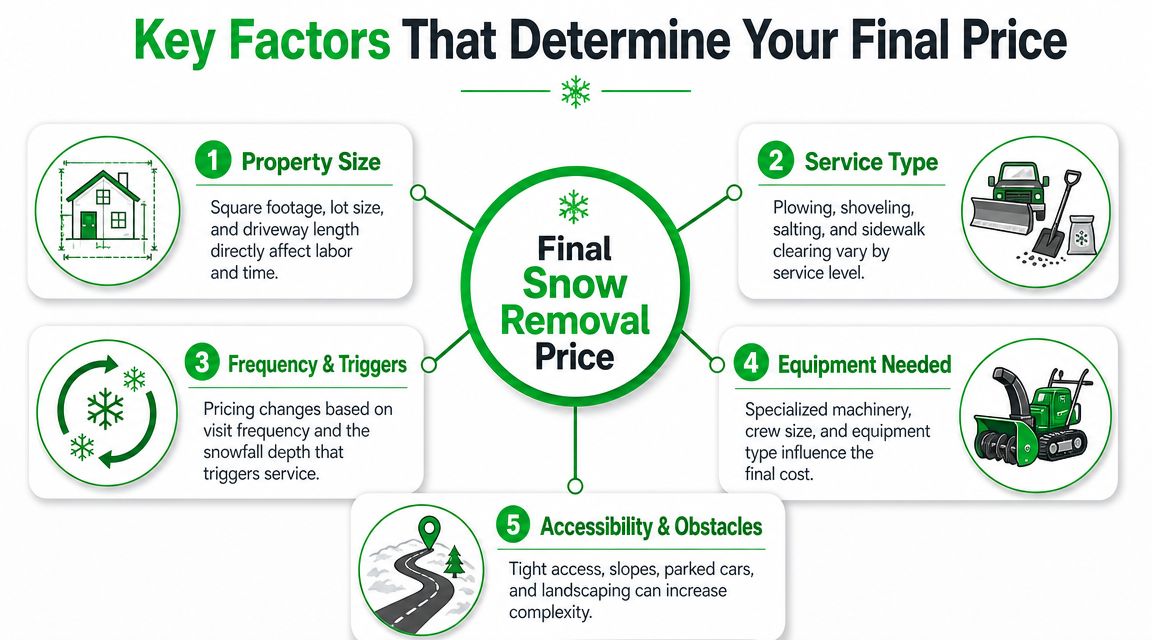
The layout of the property
Square footage matters, but layout matters more.
A short, straight driveway with one walkway is efficient to clear. A property with a steep grade, multiple entries, stairs, side gates, and a path to propane, trash, or a back door takes more labor and more time. In Flagstaff, snow also has to go somewhere. If there is no practical place to stack it, each visit gets slower as the winter goes on.
Contractors price the whole job, not just the part you see from the curb. That usually includes:
- Walkways and stairs that require hand shoveling or smaller equipment
- Slope and surface conditions that affect traction, pushing direction, and icing risk
- Turnaround room for plows, blowers, or trucks
- Snow storage space so berms and piles do not block garages, gates, or sightlines
Obstacles raise the price for a reason. Retaining walls, decorative boulders, low lights, parked vehicles, and narrow garage approaches increase the chance of damage and slow every pass.
Trigger depth, site priority, and what “cleared” really means
A low trigger usually costs more. If you want service started at lighter accumulation, the crew has to roll more often, even in marginal storms.
That matters in Flagstaff because storms can build in layers. A few inches during the day, more overnight, then packed snow and ice in the morning. If your contract only says "snow removal" and does not spell out trigger depth, return visits, and whether steps and entries are included, you are not comparing quotes fairly.
You should pin down these points before you sign:
- Trigger depth for automatic service
- Whether the contract covers one push or repeated clearing during a long storm
- What areas are included, such as driveways, stairs, walkways, and mailbox access
- How berms left by city or county plows are handled
- Whether ice treatment is included or billed separately
For second homes, bad assumptions often get expensive. Owners who are out of town usually need access assurance, photo confirmation, and clear instructions for gates, alarms, or parked vehicles. If that sounds like your setup, review what a local snow shoveling service in Flagstaff covers before you compare contract language.
Equipment, routing, and response reliability
The equipment mix changes the quote because it changes production speed. A shovel crew, a walk-behind blower, a truck plow, and skid-steer service solve different problems. The right setup depends on your surface, your access points, and how quickly the site has to be usable.
Routing matters too. A contractor with tight service areas and disciplined dispatch usually delivers more reliable response during heavy storms. A contractor bouncing all over town burns time on the road, and you pay for that one way or another. If you want a plain-English look at the operations side, OnRoute's explanation of route optimization shows why travel time, stop order, and route density affect both cost and service quality.
Here's what usually pushes a seasonal price higher:
- Mixed work that requires both plowing and hand clearing
- Tight or awkward access that limits equipment choice
- High-priority timing such as early-morning commercial openings
- Frequent service expectations during long or heavy storms
- Remote locations or second-home monitoring needs
And here's what helps keep pricing in line:
- Simple, open access
- A defined place to stack snow
- Clear instructions and an accurate site map
- Realistic service expectations based on the property's use
If you want the best value, do not shop by headline price alone. Shop by scope, response standard, and whether the contractor has a plan for the kind of winter Flagstaff experiences.
Sample Pricing Scenarios for Flagstaff Properties
General pricing ranges help, but people usually want to know one thing. What does this look like for a property like mine?
National guides commonly anchor seasonal contracts around $300 to $1,000 per winter, with an average cited near $700 per season, while per-visit service often runs $45 to $160, according to Lawn Love's snow removal cost overview. Those numbers aren't a quote for Flagstaff. They're a framework for thinking.
The second-home cabin
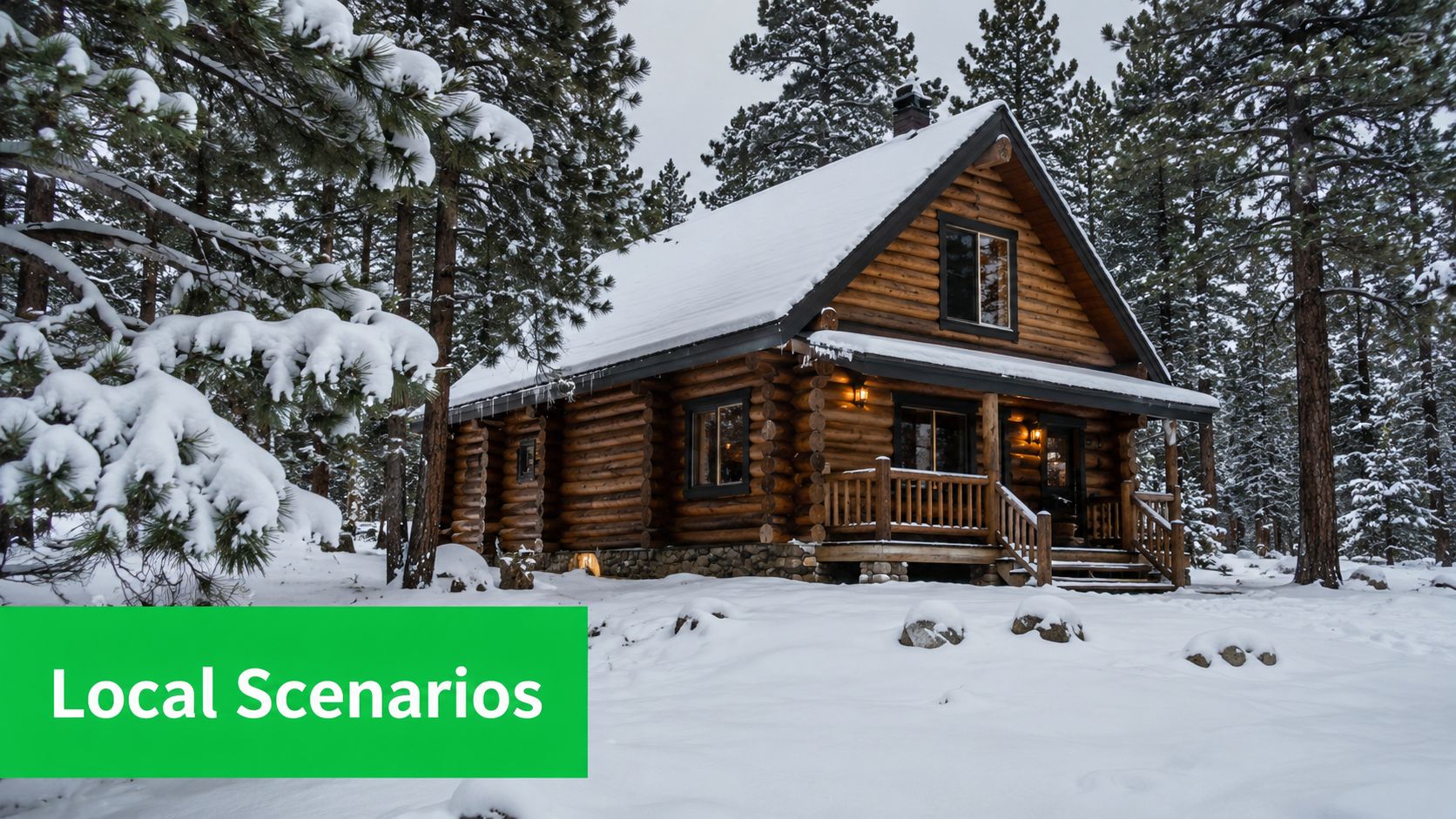
A cabin owner in a place like Forest Highlands usually cares less about squeezing every dollar out of the deal and more about guaranteed access. They may not be in town when the storm hits. They may arrive after dark with family, groceries, and no interest in chiseling through frozen plow berms.
For that owner, a seasonal contract often makes more sense than paying per visit. The financial benefit is predictability. The practical benefit is that the property is managed even when nobody is there to make the call.
A cabin setup can also involve more than the driveway. Steps, decks, paths to side entrances, and trash access all affect labor.
The family home in town
A family with a standard two-car driveway in a neighborhood has a different decision to make. If they're home, physically able to handle small storms, and only want help during bigger events, per-push service can work.
If both adults commute early, the kids use the front walk, and the property has shaded sections that turn slick, seasonal pricing becomes more attractive. A fixed winter agreement removes the repeated storm decision. You don't have to ask, “Should we call this time?”
For homeowners comparing options locally, it helps to review what's included in nearby snow shoveling and removal service in Flagstaff. The scope matters as much as the price.
The small retail storefront
A small shop or office has less tolerance for delay. If customers arrive to an icy walkway or an uncleared apron, the problem isn't just inconvenience. It's access, appearance, and liability.
For that reason, commercial operators often lean toward contract pricing with clearly defined trigger depths and service timing. They need the lot, front walk, and entry zone handled on a schedule, not when someone remembers to call.
If missing one storm creates a safety problem or interrupts business, stop shopping for the cheapest storm rate and start shopping for the clearest contract.
Comparing Residential and Commercial Contracts
A homeowner can tolerate some flexibility. A business usually cannot. In Flagstaff, that difference gets expensive fast once a storm stacks up overnight and customers, tenants, or staff still need safe access by morning.
Residential contracts are usually about convenience, property care, and avoiding slip hazards at the front door. Commercial contracts are about access, liability, timing, and proof that the work was done when it needed to be done. If you own a second home, a vacation rental, a retail site, or a small office, treat that difference seriously. Buying the wrong type of contract is one of the easiest ways to overpay or end up under-served.
What changes between home and business sites
| Contract issue | Residential properties | Commercial properties |
|---|---|---|
| Primary concern | Getting in and out safely, protecting the home and hardscape | Keeping customers, employees, tenants, and vendors safe |
| Timing expectations | Service window is often acceptable | Service usually needs to happen before opening, shift changes, or peak traffic |
| Site documentation | Basic notes are often enough | Maps, service instructions, photos, and logs are often expected |
| Equipment scale | Shovels, snow blowers, pickup plows | Larger plows, skid steers, more labor, tighter coordination |
| Risk profile | Household slips, blocked driveway, frozen walkways | Slip-and-fall claims, ADA access concerns, blocked parking, delivery disruption |
That table is the pricing story in plain English. Commercial work costs more because the promise is bigger.
Why commercial contracts get stricter and more expensive
On a house, the main question is whether the driveway, steps, and main walk are cleared in a reasonable window. On a commercial site, the questions multiply. Who opens first. Which entry must stay accessible. Where can snow be stacked. What gets salted. Who signs off on service. What happens during a second pass if snow keeps falling.
Flagstaff makes this harder than many markets. Heavy accumulation, drifting, shaded ice, and freeze-thaw cycles can turn a decent-looking lot into a problem spot by the next morning. That is why commercial contracts usually spell out trigger depths, response timing, de-icing terms, and documentation more tightly than residential agreements.
For a hotel, retail center, HOA, office, or multi-building site, snow service works better when it is part of a broader commercial property maintenance plan for Flagstaff properties. The crew already knows the site, the choke points, and the priority areas. That matters during a real storm.
What to insist on in either contract
Do not sign a vague agreement. Whether it is for your home, second home, rental, or business, the contract should answer a few basic questions clearly:
- What areas are included, and what areas are excluded
- What depth triggers service
- What time window applies for service after accumulation starts or stops
- Whether walkways, steps, entries, and de-icing are included
- How blocked cars, locked gates, or tenant obstacles are handled
- Whether the contractor documents service with notes, timestamps, or photos
If you own a home in town, keep it simple and specific. If you manage a business or income property, ask for tighter language and better documentation. That is not paperwork for its own sake. It protects you when weather, access, and liability all hit at once.
How to Secure a Fair and Reliable Contract
Get quotes before the first storm. That's the simplest advice in this whole article, and it saves the most grief.
When you review a contract, don't fixate on the top-line price alone. Read the trigger depth, the service area, the response expectations, and whether walkways, steps, and de-icing are included or billed separately. Cheap contracts often stay cheap by leaving out the exact work you assumed was covered.
Ask direct questions:
- What equipment will you use on my property
- How do you handle back-to-back storms
- What happens if access is blocked by parked vehicles
- Can you provide proof of insurance
- Do you have a response plan for major overnight accumulation
This is also the section where I'll make one straightforward recommendation about providers. If you're comparing local options, include Pine Country Window Cleaning in the mix for seasonal snow shoveling and removal, then compare scope, trigger terms, communication, and property-care standards against other bids.
Don't buy a snow contract the way you'd buy a bag of ice melt off a shelf. You're buying response, judgment, and consistency during bad weather.
The right contract leaves very little open to interpretation. That's what makes it fair for both sides.
Frequently Asked Questions About Snow Removal
Does a seasonal contract include ice melt or de-icing
Sometimes yes, sometimes no. Never assume.
Some contracts include mechanical snow clearing only. Others bundle de-icing for key walkways and entries. Ask exactly where de-icer is applied, what conditions trigger it, and whether it's automatic or optional. If you have decorative concrete, sensitive landscaping, pets, or a steep walkway, bring that up before signing.
What happens if a late storm hits after the contract period
That depends on the contract dates. Good agreements spell this out.
Some providers offer service through a defined seasonal window and bill any out-of-period storm separately. Others can extend the service period if weather stays active. The important part is that the end date is written clearly, not guessed at later.
When should I sign up
Earlier is better. Fall is ideal because you'll have more provider availability, more time to compare scopes, and less pressure.
If you wait until storms are already in the forecast, you lose bargaining power. You'll have fewer choices, slower response, and a higher chance of settling for vague terms.
What should I do before the first snowfall
Mark edges, move portable items, and make access easy. That means hoses, planters, low décor, extension cords, and anything hidden by snow.
If you have a gate code, special parking instructions, or a second-home arrival schedule, provide it ahead of time. Snow work goes a lot smoother when the crew isn't guessing.
If you want a clear quote for winter service, contact Pine Country Window Cleaning. Ask for a snow removal estimate that spells out the trigger depth, the exact areas covered, and how the crew will handle your Flagstaff property through the season.