
If you're looking for a cleaner because the last company showed up late, skipped details, or left you wondering whether anyone was coming at all, you're asking the right question. Individuals often believe they need a better cleaning result. Yet, they usually need a more reliable service.
In Flagstaff, that difference matters. A mountain home, a rental turnover, a storefront, or a campus-facing commercial property doesn't just need someone who can wash glass or tidy surfaces. It needs a company that communicates clearly, arrives when scheduled, works safely, and treats the property with care from the first call to the final walkthrough.
What Reliable Cleaning Services Really Mean
You book a service for Friday because guests arrive that evening. By noon, no one has confirmed the appointment, your call goes to voicemail, and now you're deciding whether to wait, cancel, or start doing the work yourself. In this business, that is the difference between a company that cleans and a company that is reliable.
Reliable cleaning service means the work is organized before a technician ever steps onto the property. The office answers calls. Appointments are confirmed. Arrival windows are realistic. Scope and pricing are explained in plain language. If weather, road conditions, or access issues affect the schedule, you hear about it early enough to adjust your day.

Clean results are only one part of the job
The cleaning industry is large, and large markets always include a wide spread in service quality. In its cleaning services market report, Fortune Business Insights states that the global cleaning services market was valued at USD 451.63 billion in 2023, with North America holding 37.52% of that market in 2023.
That size does not create consistency. Operating systems do.
A dependable company has a process for scheduling, dispatching crews, documenting special instructions, and following up when something changes. It also has a real plan for missed calls and after-hours inquiries, because reliability often breaks down at the first point of contact, not at the mop bucket or squeegee. For a useful look at that side of operations, this article on how AI answering services help businesses explains why responsiveness is now part of service quality.
Respect for the property is part of reliability
On paper, two companies can offer the same task list. In practice, one protects floors, labels screens, notes a sticking latch, and closes the gate so the dog does not get out. The other leaves you with clean glass and three new problems.
That trade-off matters in Flagstaff. Mountain weather, wind, pine pollen, snow runoff, and steep access points change how jobs should be planned and what equipment should be on the truck. A reliable crew accounts for those conditions instead of improvising on site.
Here is the standard I use. If a company talks only about the final result and says little about communication, access, equipment, or problem handling, you are hearing half the story. Real reliability includes showing up prepared, working safely, protecting the property, and leaving the customer certain about what was done.
That is what reduces stress. That is what people are hiring for.
Verifying Credentials and Safety Protocols
Before you compare prices, verify whether the company should be on your property at all. A polished estimate doesn't replace proper coverage or training.
For straightforward interior cleaning, missing paperwork is a risk. For ladder work, exterior glass, gutter clearing, roofline access, or commercial work, it's a much bigger one.

What to ask for before approving service
Ask for proof, not verbal reassurance. At minimum, a legitimate provider should be able to discuss and document the basics below.
- General liability insurance helps protect against property damage claims.
- Workers' compensation coverage matters if someone gets hurt while working on your property.
- Local business licensing shows the company is operating as an actual business, not a side job with no accountability.
- Employee screening practices matter because reliability includes trust in who enters your home or jobsite.
- Written scope of work prevents confusion about what's included and what isn't.
If a company hesitates, gets defensive, or says "don't worry about it," that's enough information.
Safety matters more on specialized jobs
Not every cleaning job carries the same level of risk. Ground-level residential work is one thing. A cabin with awkward terrain, a hotel entrance, a campus building, or high glass with difficult access is another.
Industry-adjacent guidance for exterior cleaning businesses points out that for properties with complex access like cabins, high-rises, or campuses, reliability is tied to equipment and training. A service's investment in in-house lifts or OSHA-trained technicians is a useful signal for high-risk work, as discussed by Angels Cleaning Service NW.
That point gets missed in a lot of generic articles. They treat all cleaning as interchangeable. It isn't.
A company can be polite and still be the wrong fit for elevated or access-heavy work.
What good safety practices look like in the field
A professional crew should be able to explain how they handle job planning, not just the cleaning itself. Look for answers like these:
| What you ask | What a solid answer sounds like |
|---|---|
| How do you handle high access work? | They mention ladders, poles, lifts, access limits, and site planning. |
| Are technicians trained for this kind of job? | They can speak clearly about safety training and procedures. |
| What happens if conditions change? | They pause, reschedule, or adjust equipment instead of improvising unsafely. |
For specialized exterior work, equipment is part of the credential. A crew that owns and knows how to use the right access tools will usually give you a more dependable result than a crew trying to "make it work" with whatever fit in the truck that morning.
Matching the Service to Your Property's Needs
The biggest hiring mistake I see is treating every cleaning company as if it offers the same thing. It doesn't. The right fit depends on the property, the surface, the access, and the stakes if something goes wrong.
A one-story house with simple windows needs one level of service. A pine-covered cabin with screens, hard-water residue, and tricky exterior access needs another. A post-construction project needs another.
Window cleaning is a good example
Professional window cleaning isn't spray-and-wipe work. It uses the right tools for the glass, frame, and access conditions.
Here's the difference:
| Amateur approach | Professional approach |
|---|---|
| Rag, paper towel, or household glass spray | Squeegees, scrubbers, extension poles, ladders, and pure-water brushes |
| Smears residue around on exterior soil and pollen | Lifts dirt and rinses cleanly for a clearer finish |
| Often skips tracks, frames, and screens | Addresses the whole window assembly with care |
| Struggles on large panes and sun-exposed glass | Handles scale, angle, and mineral buildup more effectively |
That matters in Northern Arizona. Exterior glass collects more than fingerprints. It gets dust, pollen, hard-water spotting, insect debris, and weather exposure. Household methods usually leave behind residue or streaking once the sun hits the pane.
A proper service also handles screens correctly. Removing them carelessly bends frames. Leaving them dirty defeats the purpose of washing the glass. Professional work includes removing screens, cleaning them, and reinstalling them properly so the whole window system looks right when the job is done.
Other services also require the right method
The same principle applies beyond windows.
- Gutter cleaning: A provider should be able to clear debris, check flow, and address downspouts instead of just scooping visible material near the top edge.
- Pressure washing: The right machine and technique depend on the surface. Too much pressure can scar wood, etch softer material, or force water where it shouldn't go.
- Post-construction cleanup: This isn't standard maintenance cleaning. Debris, adhesive, dust, and construction residue need a different process and more care.
- Dryer vent service: This is a safety and maintenance issue, not just a dust issue. If that applies to your property, review what a dedicated dryer vent cleaning service in Flagstaff should involve before you book.
Match specialization to the risk
Pine Country Window Cleaning is one local option for properties that need window cleaning, gutter cleaning, pressure washing, and post-construction window work handled with professional access equipment rather than basic household tools.
The cheapest bid often assumes the easiest version of the job. Your property may not be the easiest version.
Reliable cleaning services aren't generic. They match the method to the building.
Your Vetting Checklist Questions to Ask and Red Flags to Avoid
A short phone call can tell you a lot if you ask the right questions. Most bad service experiences leave clues before the crew ever arrives.
Start by listening for specificity. Good companies answer clearly. Weak ones stay vague, rush the call, or keep steering the conversation back to price alone.
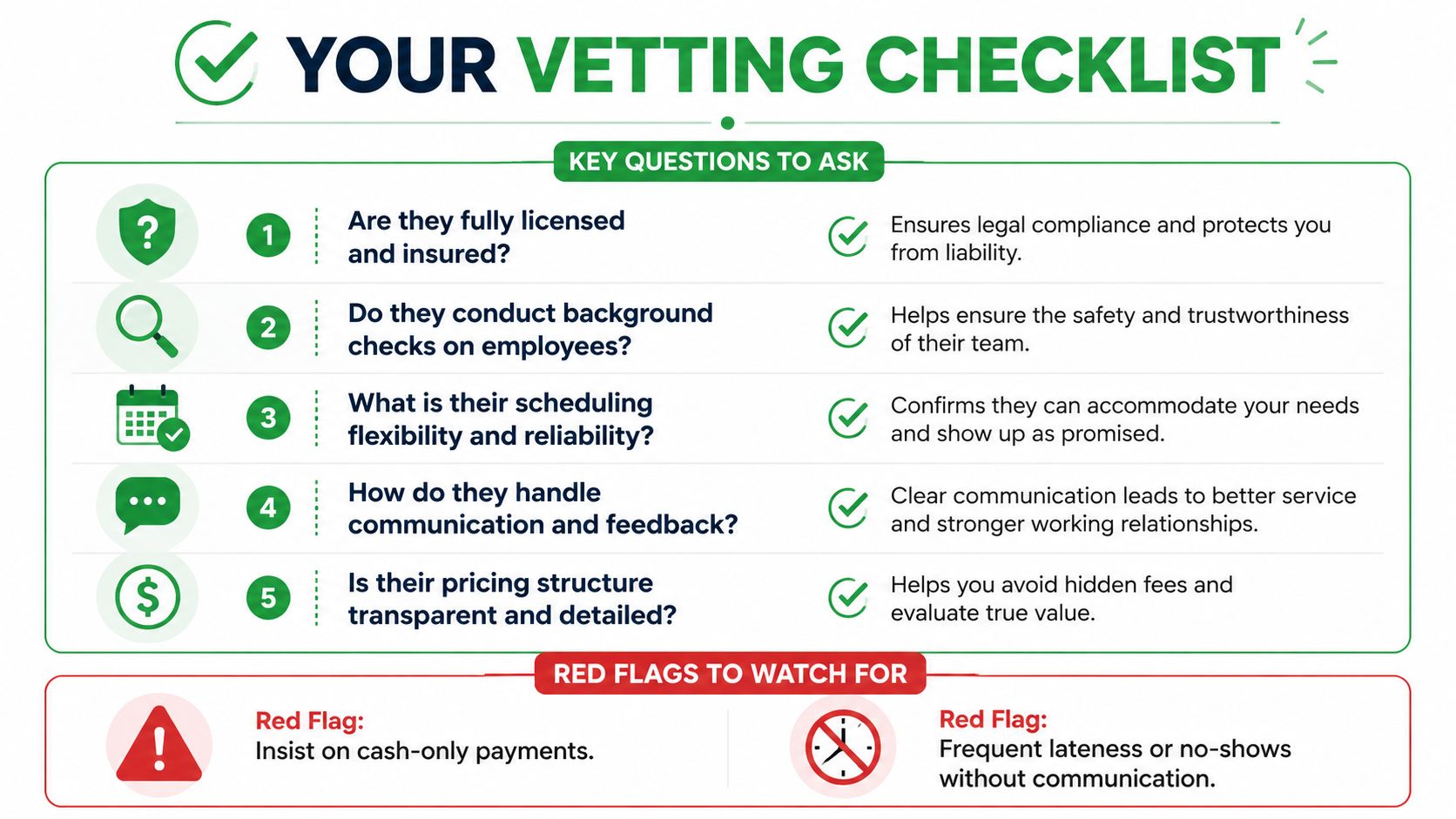
Five questions worth asking
How do you build the estimate?
You want to know whether they price from actual scope, access, condition, and labor, or whether they throw out a number and hope it works.What happens if you're running late or weather changes the job?
The answer should include communication, not excuses.Who will be on the property?
Ask whether crews are employees, whether they're screened, and whether the company can tell you how teams are supervised.What tools do you use for this kind of work?
On windows, listen for professional tools like squeegees, poles, ladders, and pure-water systems where appropriate. On exterior jobs, listen for access planning and surface-specific methods.How do you make sure quality stays consistent?
This is one of the best questions because it gets past sales language. Servicon identifies customer retention, cleaning efficiency, employee productivity, cost of service, and client acquisition as key professional cleaning metrics in its guide to metrics that indicate cleaning service success. A company that thinks in systems will usually have a stronger answer than one that just says, "We do a good job."
For readers managing short-term rentals, turnover standards add another layer. A property can be clean and still not be guest-ready if the process is sloppy. This ultimate vacation rental cleaning checklist is a useful comparison point when you're evaluating whether a provider understands operational consistency.
A simple script for the first call
You don't need to sound like an expert. Keep it direct.
"I'm looking for reliable service, not just the lowest price. Can you walk me through how you estimate the job, what equipment you use, and how you handle scheduling changes?"
That question alone filters out a lot of weak fits.
Here is a practical example of how to think through service selection and standards:
If you're comparing local options, it also helps to review a company's stated service categories and scope. A page listing cleaning services in Flagstaff can tell you whether the company works on the kinds of properties you manage.
Red flags that should slow you down
- Cash-only pressure with no written invoice.
- Vague insurance answers or reluctance to provide documentation.
- No clear arrival window and no explanation of how delays are communicated.
- One-size-fits-all promises for jobs that obviously have different access or safety demands.
- Household methods for professional work such as trying to discuss exterior window cleaning as if it's just spray and wiping.
A reliable company won't mind careful questions. That's usually a sign you're the kind of customer they want.
Why Local Expertise Matters in Flagstaff and Munds Park
A company can have decent general skills and still be the wrong fit for Northern Arizona. Flagstaff and Munds Park create their own cleaning problems, scheduling problems, and access problems.
Pine needles don't behave like broadleaf debris. High-country weather doesn't behave like low-desert weather. Cabins, second homes, and mountain neighborhoods often need a different level of planning than an easy in-town stop.
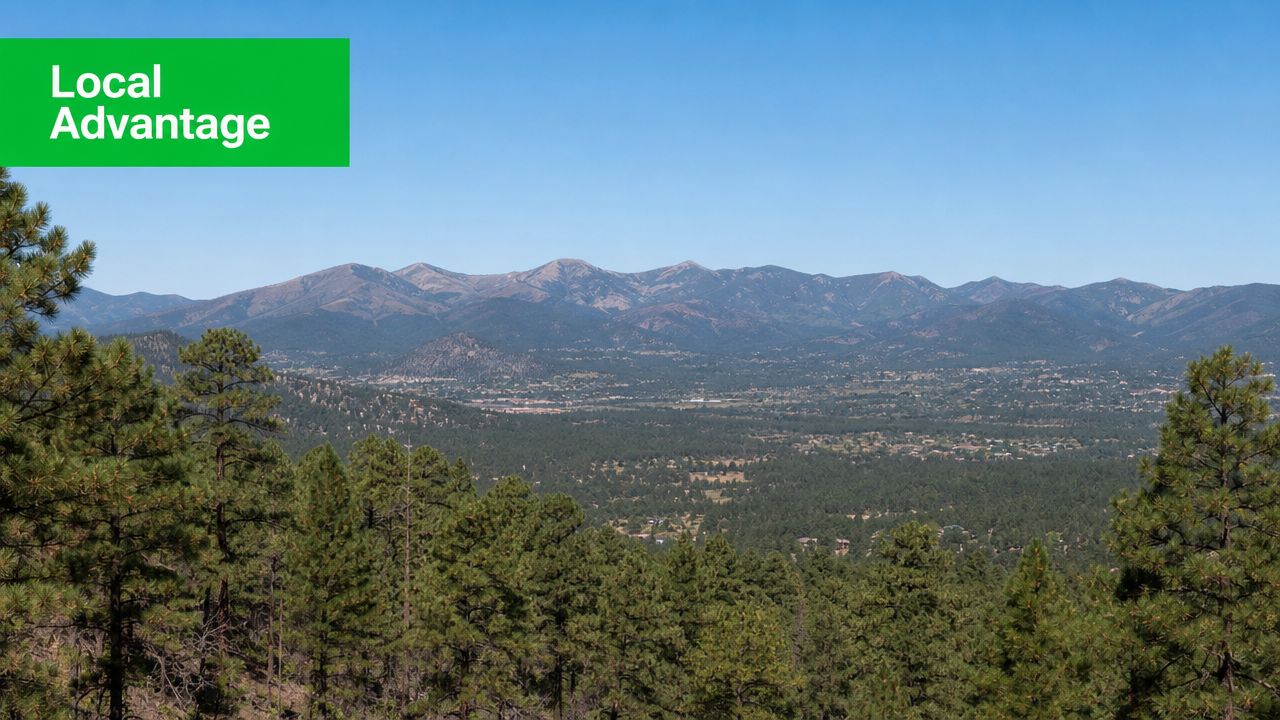
Local conditions change the job
In this area, debris and weather shape the work.
- Pine needles and roof runoff can pack into gutters and downspouts in a way that requires more than surface clearing.
- High-altitude sun exposes streaks and residue fast, especially on large panes.
- Monsoon season can turn minor drainage issues into urgent maintenance issues.
- Cabin access and terrain often make simple jobs less simple once crews arrive.
That local reality is one reason generic advice falls short. It doesn't account for mountain homes, seasonal properties, or neighborhoods where scheduling and access can shift with weather and occupancy.
Long-term local knowledge reduces surprises
The U.S. janitorial market is crowded. IBISWorld reports 1,254,202 janitorial services businesses in the U.S. in 2026, which helps explain why customers need to vet providers carefully in a fragmented market, according to its janitorial services business count page.
In a crowded field, local knowledge becomes a practical filter.
A company that has worked in Flagstaff for years will usually recognize the warning signs earlier. It will know which neighborhoods have access challenges, which seasons clog gutters fastest, and why one property needs poles while another needs lift planning. That's not marketing language. That's the difference between a smooth job and a frustrating one.
In mountain towns, reliability often comes from familiarity with the environment as much as familiarity with the toolset.
For gutters, that local experience matters a lot because debris type, roof pitch, and storm timing all affect service needs. If that's part of your property care plan, it's worth reviewing what dedicated gutter cleaning in Flagstaff typically includes.
Flagstaff native David Kaminski started this business in 1999, and that matters because long-term local work builds pattern recognition. You learn what weather does here. You learn what cabins need before the owner asks. You learn how to care for homes in a place where pine, dust, snow, sun, and summer storms all take a turn.
Building a Partnership for Long-Term Property Care
A storm rolls through, guests are due Friday, and the cleaner you used last time does not answer the phone. The underlying problem isn't the dirt. It is the lack of a system.
Long-term property care works better when a service knows the property and runs a disciplined operation. That means keeping gate codes and access notes on file, showing up in the agreed window, sending updates when weather changes the plan, and bringing the right equipment for the job instead of improvising on site. In Flagstaff and Munds Park, that last part matters more than many owners expect. Pine needles, snow, wind, dust, steep access, and seasonal occupancy all change how work should be scheduled and performed.
What a long-term relationship should feel like
A dependable service relationship has a few clear signs:
- Communication is specific. You know when the crew is coming, what is included, and who to call if plans change.
- The process stays consistent. The result does not depend on which technician happened to be available that day.
- Property notes are retained. Screens, finishes, tricky locks, drainage concerns, ladder access, and pet instructions are documented and used on future visits.
- Scope is discussed transparently. A company says when buildup, hard water, roof debris, or safety conditions call for more than a quick maintenance visit.
That is what saves time over the course of a year.
Reliable service also reduces wear on the property. Careful crews protect screens, avoid damaging landscaping, use the correct tools on glass and frames, and know when a surface needs a lighter touch. Owners notice the clean windows. The bigger value is fewer mistakes, fewer callbacks, and less supervision.
For homeowners, that means the house is ready when family arrives. For property managers, it means fewer scheduling problems and fewer surprises between turnovers. For commercial properties, it means maintenance gets handled without disrupting staff or customers.
Choose a cleaning company the same way you choose any trade partner you plan to keep. Look for steady communication, safe work practices, good records, and the equipment to handle the property you have. Since 1999, Pine Country Window Cleaning has built many client relationships that way. The work gets easier when the crew already knows the site, the standards, and the risks.