If you manage a building in Flagstaff, you've probably had this moment. You step into the parking lot, look up at the glass, and see exactly what Northern Arizona leaves behind. Summer dust, pollen, hard water spotting, storm residue, and the film that collects after snowmelt dries out.
At ground level, dirty windows look like a maintenance task. At height, they become a safety operation. That distinction matters more than most property owners realize, especially when the question is how to clean high rise windows without trading appearance problems for injury risk, liability exposure, or damage to the building itself.
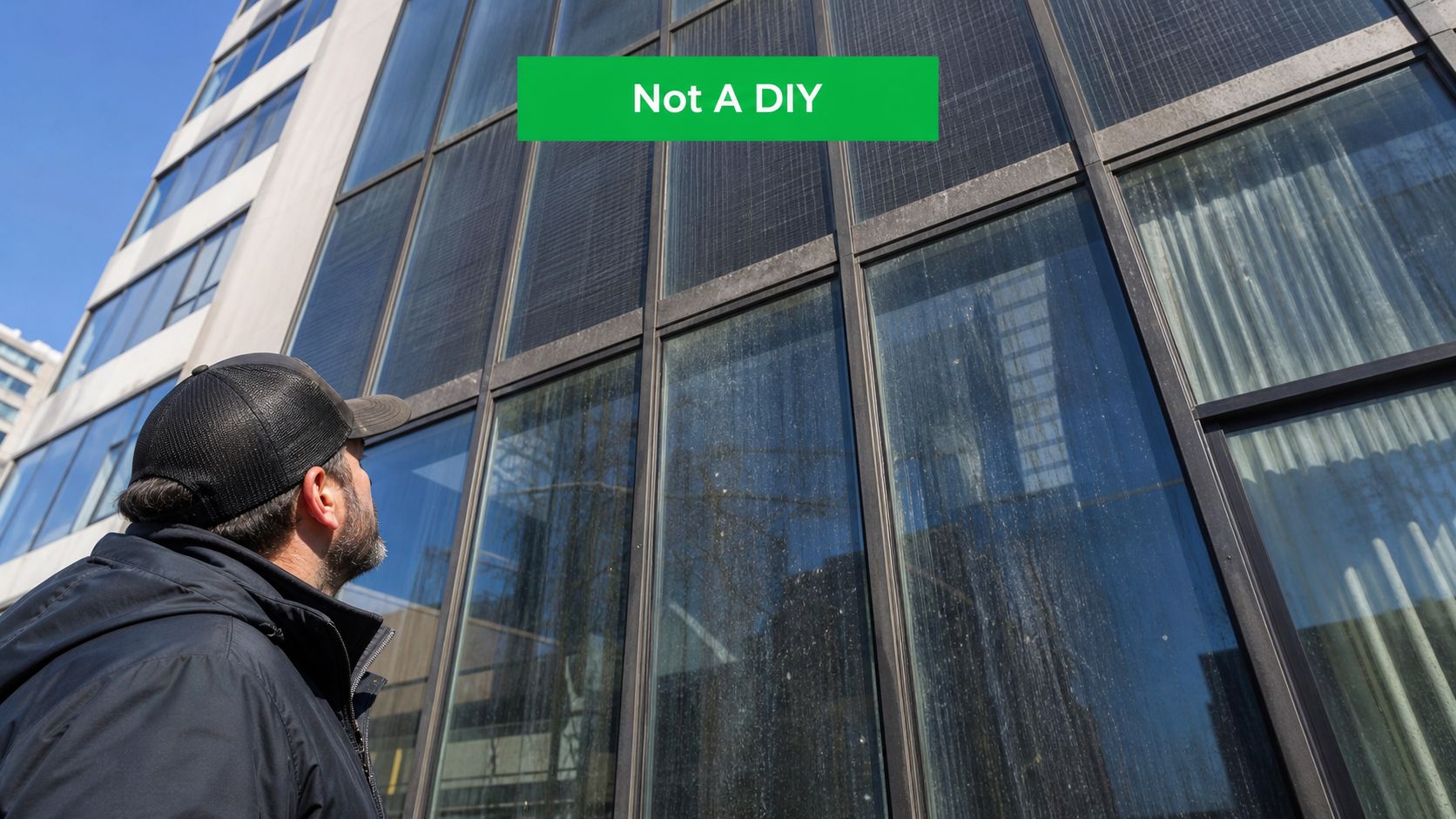
The View from Above Why High Rise Cleaning Is Not a DIY Job
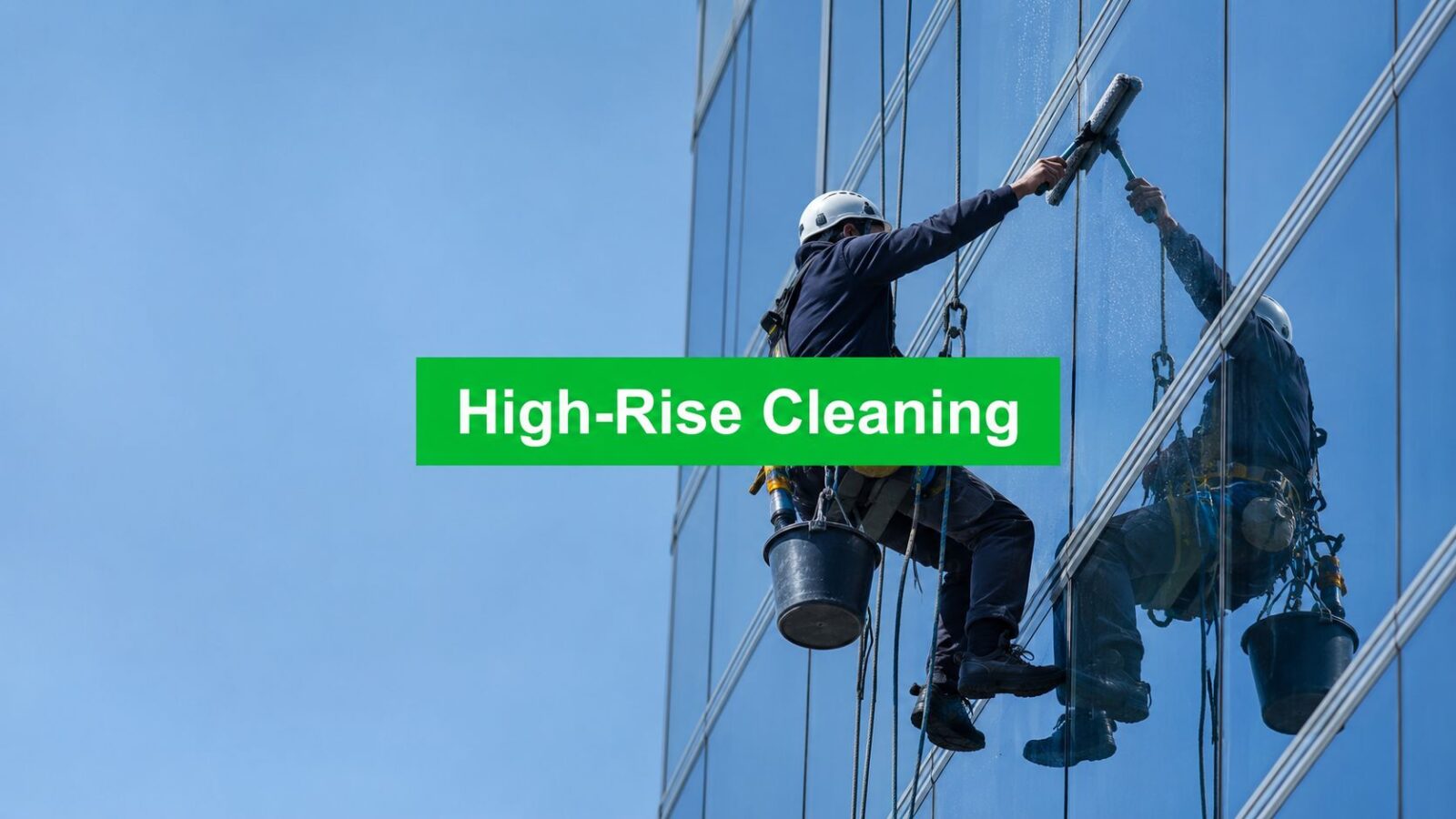
The first thing to understand is simple. High-rise window cleaning is not an advanced version of household window cleaning. It's a specialized trade built around access, fall protection, weather judgment, and disciplined technique.
That's why any serious conversation about how to clean high rise windows has to start with risk, not soap and glass. High-rise window cleaning is classified among the top 10 most dangerous civilian jobs in the United States, with falls accounting for more than 60% of all fatalities in the field according to OSHA data. In 2024 alone, 57 workers in the U.S. died while cleaning high-rise windows (OSHA-related data reference).
Why the danger changes everything
A homeowner may look at upper glass and think about extension poles, ladders, or pressure washers. A professional looks at anchor points, access routes, wind exposure, pedestrian traffic below, facade design, and whether the job should be done from the ground, from a lift, or by rope access.
That's the gap between casual advice and actual field work.
Practical rule: If the plan starts with “I think I can reach it,” it's not a professional plan.
In Flagstaff, that judgment matters even more. Mountain weather changes quickly. Buildings often sit on sloped lots, uneven terrain, or tight access points near landscaping, stonework, decks, and parked vehicles. What looks manageable from the driveway can be unsafe once you account for footing, elevation changes, and glass that's harder to reach than it appears.
What property managers should take from that
A clean result is only part of the job. The primary standard is whether the work can be performed without exposing workers, residents, pedestrians, or the property itself to avoidable danger.
That's why experienced teams don't treat high windows as a weekend task. They treat them as controlled work at height. In Flagstaff, that approach has defined operations for years. David Kaminski, a Flagstaff native, started the company in 1999, and the work has always depended on careful planning, reliable crews, and respect for the homes and buildings being serviced.
For a property owner, that's the key takeaway. You don't need a DIY tutorial. You need to understand how the job is done correctly, so you can hire a crew that approaches it like a safety-critical trade instead of a side job.
The Professional Toolkit Equipment and Access Methods
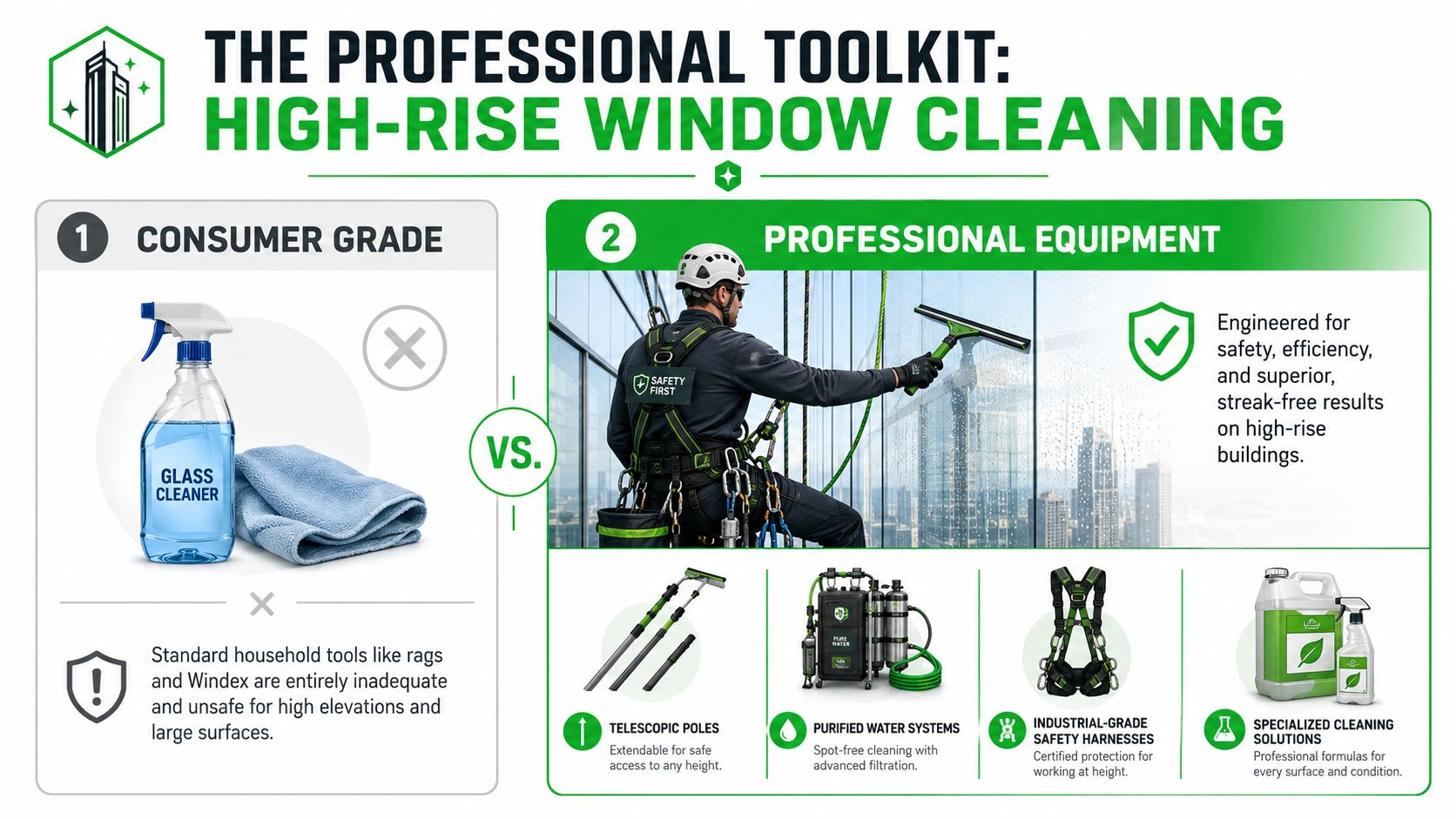
Forget rags, newspaper, and blue spray bottles. Those belong in consumer cleaning guides, not on a high-window project. At height, the right tool isn't just about finish quality. It's about reach, control, stability, and reducing the number of risky movements a technician has to make.
What professionals actually use
For most exterior glass, the core setup includes professional squeegees, scrubbers, extension poles, pure-water brush systems, rated ladders, and mechanical access equipment when the building geometry demands it. Different facades call for different methods. Deep set windows, atrium glass, storefront curtain walls, and upper-level residential panes all behave differently in the field.
Pure-water systems are especially useful on buildings where ground-based cleaning is possible. They let crews scrub and rinse from below without climbing to every pane. Traditional scrubber-and-squeegee methods still matter, especially where detailing, edge work, or interior access requires close control.
One local example is Pine Country's high-rise window cleaning equipment, which includes boom lifts, scissor lifts, and a 95-ft atrium lift for difficult interior and exterior glass. That kind of owned equipment changes what a crew can safely access without improvising.
Ladders are still part of the system
Ladders aren't obsolete. They're just often misunderstood. A professional ladder setup uses the correct material, rating, angle, and placement for the site conditions.
OSHA Standard 1926.502 requires that all ladder-based window cleaning at heights above 10 feet must use ladders with a minimum 375-pound load rating and non-conductive fiberglass construction when working near electrical fixtures, with a 4:1 base-to-height ratio enforced for stability (Flagstaff professional cleaner reference).
That's a good example of why homeowner logic breaks down at height. The question isn't “Do I own a ladder?” It's “Is this the right ladder, with the right rating, on the right surface, at the right angle, for this exact access problem?”
High Rise Access Methods Compared
| Method | Best For | Pros | Cons |
|---|---|---|---|
| Extension poles with squeegee or brush | Reachable glass from stable ground | Low setup impact, efficient for many elevations, less invasive | Limited by building design, angle, and obstructions |
| Pure-water pole systems | Exterior glass with accessible perimeter | Ground-based cleaning, reduced spotting, strong for routine maintenance | Not ideal for every stain type or every architectural detail |
| Fiberglass ladders | Targeted access to specific windows | Precise hand work, useful for lower high windows and detail work | Setup demands careful footing, angle, and site judgment |
| Boom lifts and scissor lifts | Commercial buildings, facades, difficult elevations | Stable working platform, strong reach, good for repetitive sections | Access can be limited by terrain, overhead clearance, and site layout |
| Atrium lift | Tall interior glass and specialized spaces | Reaches areas other equipment can't, controlled indoor access | Requires trained operation and planning around interior traffic |
| Rope access | Facades where lifts or platforms aren't practical | Flexible access on complex buildings | Highest planning burden, heavy certification and anchor requirements |
Consumer tools fail on high windows for the same reason consumer ladders fail on technical jobs. They weren't designed for the task.
The primary lesson for property managers is that access method comes first. Cleaning technique comes second. Any company worth hiring should be able to explain why it chose a pole system, lift, ladder, or rope setup for your specific building, and what trade-offs come with that choice.
Safety First Planning and Staging the Job Site
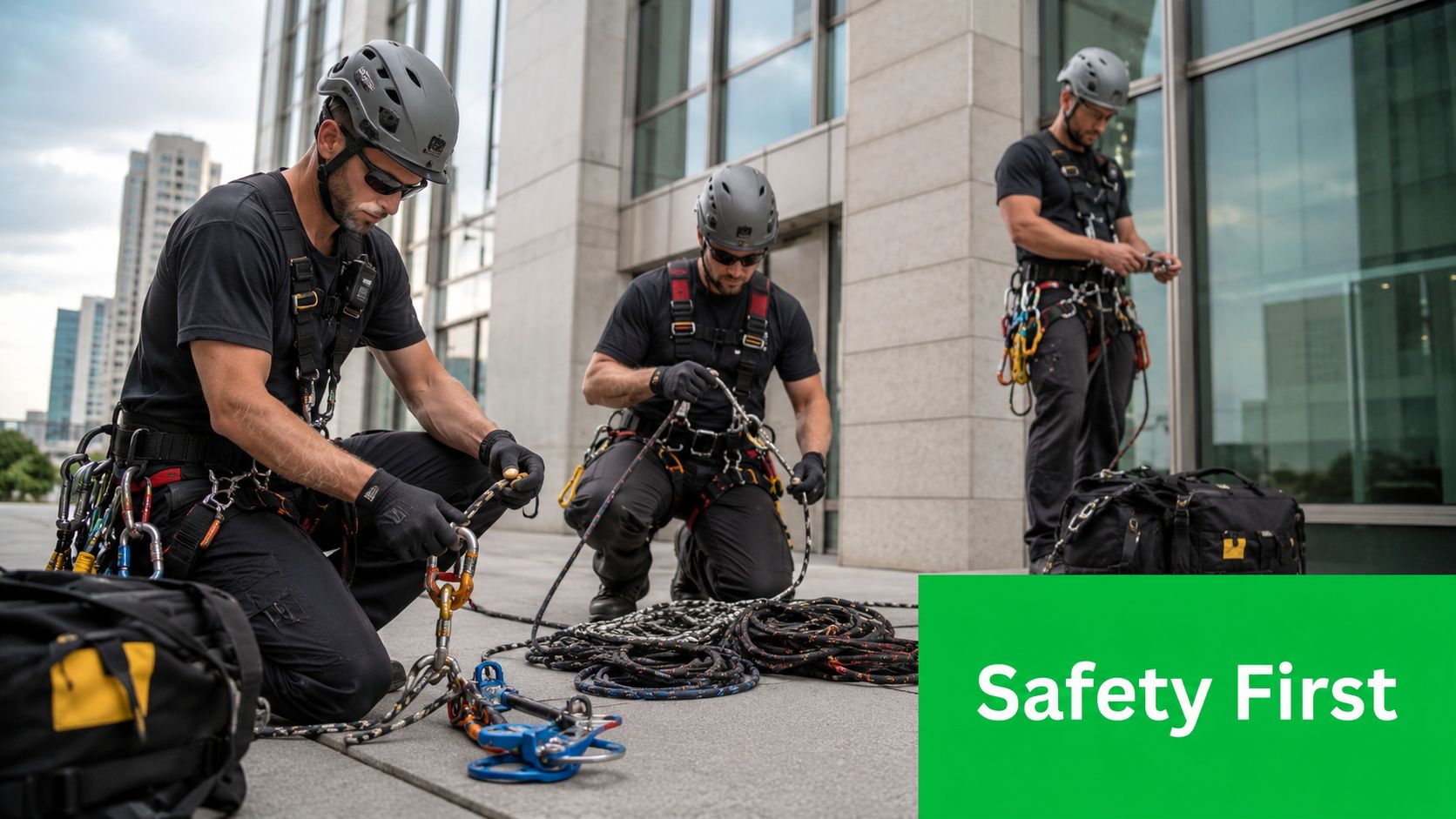
The job starts before anyone unloads a squeegee. On a real high-rise project, the first phase is planning, because the clean glass only happens if the site can be worked safely in the first place.
A rushed crew looks at the windows. A disciplined crew looks at the entire environment around the windows.
The pre-work checklist that matters
Professionals begin with a site assessment. That means checking building access, roof conditions where relevant, anchor locations, facade obstacles, power lines, pedestrian flow, landscaping, traffic lanes, and the safest way to move gear in and out.
It also means paperwork with teeth behind it. Common pitfalls in high-rise window cleaning include neglecting individual site risk assessments and method statements (RAMS), which are mandatory for professional providers, and improper anchor system rigging that fails to establish redundant safety lines for rope access (high-rise safety methods reference).
That sentence may sound technical, but the practical meaning is straightforward. If a company skips the planning document and rigs casually, it's already cutting corners on the part of the job most likely to prevent a bad outcome.
Weather and ground control are part of the cleaning job
In Flagstaff, weather decisions can't be treated as an afterthought. Crews need to monitor wind, incoming storms, rain, and lightning. They also need to know when to stop. Good operators don't “push through” because a schedule is tight.
On the ground, staging matters just as much. A professional site setup often includes:
- Drop zones and perimeters: Cones, caution markers, and controlled access below the work area keep residents, guests, employees, and pedestrians out of the fall zone.
- Equipment layout: Hoses, poles, ladders, and lift paths are placed so the crew doesn't create trip hazards while moving quickly.
- Protected surfaces: Sensitive landscaping, entry mats, interior floors, and nearby fixtures need protection before the first pane is touched.
If the public can walk under the work area, the crew has to manage that risk before cleaning starts.
Why this separates professionals from hobbyists
Many accidents don't come from the visible part of the job. They come from poor setup. An unstable ladder on uneven grade. An anchor point that wasn't verified. A worker moving around a corner without a redundant line. A gust that turns a manageable task into a dangerous one.
The buildings around Flagstaff add their own complications. Cabin-style homes may have steep approaches and irregular lots. Commercial sites may have busy walkways or limited lift access. Hotels and campus buildings often require work to be staged around occupants, deliveries, and operating hours.
That's why training and routine matter. Before the cleaning even begins, the crew should already know where they can stand, how they'll access each section, how they'll protect people below, and what condition will cause them to stop. Clean windows are the visible result. The true craft is the control behind them.
The Pine Country Process From Screens to Squeegees
A lot of people think window cleaning starts on the glass. It usually starts with everything attached to the glass.
Screens hold dust, pollen, and debris that can blow right back onto a freshly cleaned window. That's why the service should include removing screens, cleaning them, and reinstalling them properly. Pine Country Window Cleaning does that with every service, because leaving dirty screens in place undercuts the final result and ignores part of what the customer is looking at every day.
Screens first, glass second
On residential and mixed-use properties, screen work is one of the easiest ways to tell whether a company is just moving fast or working thoroughly. A careful crew removes each screen without twisting the frame, cleans the mesh and edges, keeps the set organized, and reinstalls everything securely.
That step also reflects how a company treats the property. Indoors, technicians should work cleanly around floors, trim, and furnishings. Outdoors, they should protect landscaping and avoid dragging tools across siding, stone, or decking.
The actual cleaning technique
For traditional hand-cleaned glass, the standard professional sequence is consistent. Wet the pane with a scrubber, loosen the soil, detail trouble spots, and pull the water off with a squeegee using controlled, overlapping strokes. The overlaps matter because they prevent lines and leave the glass uniform instead of patchy.
Frames and edges matter too. If the frame still carries grime, oxidation, or runoff, the window won't look finished even if the center of the pane is clear.
A typical professional workflow looks like this:
- Remove and clean the screen so debris doesn't contaminate the finished glass.
- Scrub the pane and frame to break loose dirt, pollen, and buildup.
- Squeegee with overlapping passes for a streak-free finish.
- Detail edges and corners where drips and residue tend to hide.
- Reinstall the screen carefully so the full assembly looks clean, not just the glass.
Where pure water fits in
Some buildings are better served by a pure-water brush system. That method is especially useful on exterior glass where ground-based access is safer and more efficient.
Professional high-rise window cleaning using pure-water brush systems eliminates the need for chemical detergents by leveraging water's natural surfactant properties at 180°F, which reduces mineral residue by 94% compared to tap water methods. For property owners dealing with spotting and mineral film, that's one reason pure water has become such a valuable tool (professional pure-water window cleaning details).
Clean glass isn't just about what you remove from the pane. It's also about what you don't leave behind.
That matters in Flagstaff, where windborne dust and mineral-heavy residue can make shortcuts obvious fast. The best results come from matching the method to the building, not forcing one system onto every project. Some windows need hand work with a squeegee. Some are ideal for pure water. On many properties, the right answer is both.
Navigating Regulations and Insurance Requirements
Property managers usually ask two different questions when they hire a high-rise window cleaning company. Can they do the work well, and can they do it without creating a liability problem for the building owner.
The second question is the one that deserves more attention.
What compliance actually means on a high-rise job
“Fully insured and compliant” shouldn't be treated like a marketing phrase. It should mean the contractor can explain how it handles risk assessment, fall protection, crew training, documentation, and job stoppage decisions when conditions aren't safe.
The regulatory framework governing high-rise window cleaning, including OSHA standards and ANSI/IWCA I-14.1, mandates thorough risk assessments, specific wind speed limits (below 25 mph for rope access), and documented anchor point load capacities (work at height regulatory guidance).
That matters because compliance isn't limited to what happens on the glass. It includes the planning file, the access choice, the anchor documentation, the rescue readiness, and the crew's ability to work within those limits instead of improvising around them.
What building owners should verify
For a property manager or HOA board, due diligence should include more than a price quote. Ask practical questions:
- Insurance scope: Does the contractor carry the right coverage for this type of work, including workers' compensation and liability protection relevant to work at height?
- Training and certification: Who on the crew is qualified for the chosen access method, and who supervises the work?
- Anchor and access documentation: If rope access or specialized fall protection is involved, can the company speak clearly about anchors, load ratings, and redundancy?
- Job-specific planning: Are they assessing your property, or are they giving the same generic answer they give everyone else?
For managers who oversee broader building safety responsibilities, Overton Security's compliance resource is a useful reference point for understanding how life-safety compliance fits into overall facility risk management.
Why cheaper isn't cheaper when something goes wrong
The lowest bid can become the most expensive choice if the contractor cuts corners. A crew that doesn't document properly, doesn't train properly, or doesn't carry the right protection can shift risk back onto the property owner in ways that aren't obvious until there's an incident.
That's why many owners prefer contractors who can discuss high-rise work as both a cleaning service and a building-risk issue. If you're evaluating providers, high-rise window cleaning services should be judged on their access plan, safety discipline, insurance readiness, and communication, not only on how fast they can get a crew on site.
Why DIY Is a Non-Starter for Flagstaff Properties
For a one-story kitchen window, DIY is a normal decision. For high windows on a mountain home, hotel, mixed-use building, or multi-level residence, it stops being a cleaning choice and becomes a hazard calculation.
That's especially true around Flagstaff, Pine Canyon, Forest Highlands, Flagstaff Ranch, and Munds Park, where access often means sloped driveways, uneven soil, retaining walls, snow-affected surfaces, and architecture that places glass above decks, stair runs, or landscaping instead of clean, flat ground.
The common shortcuts that go bad
The usual temptation is to simplify the problem. Buy a long pole. Lean a ladder where it seems stable. Spray from below. Try a pressure washer on the upper panes. That approach ignores the things professionals account for automatically, including angle of reach, frame integrity, glass type, runoff control, and the danger of shifting footing at height.
Pressure washers are a good example. In the wrong hands, they can force water where it shouldn't go and can damage glass or surrounding materials. Even when the person on the ground avoids a fall, they can still create an expensive repair.
Why local conditions make the risk worse
Flagstaff homes and commercial properties don't sit in a uniform environment. Wind, elevation, dust, snowmelt, and terrain all change the job. Even reaching the setup point can be awkward. A ladder that feels steady on a flat suburban walkway may be a terrible choice on mountain grade or decorative stone.
High windows don't become safe because they're on a home instead of a downtown tower.
That's one reason local experience matters. A crew that works regularly in Northern Arizona understands how weather moves through the day, how debris accumulates on screens and frames, and how to protect a property that may include stained wood, custom stone, or sensitive landscaping.
The responsible decision
If you're a homeowner, the right conclusion is simple. If you're a property manager, it's even simpler, because you're also responsible for everyone around the work area. The sensible move is to hire a trained, insured crew with the right access equipment and a process that protects the building while delivering clean glass.
Flagstaff's largest window cleaning company was started by Flagstaff native David Kaminski, and it's been in business since 1999. That kind of local continuity matters because it reflects more than longevity. It reflects a way of working that values care for the customer, care for the home, dependable scheduling, and respect for the fact that every high-window job carries real consequences if handled poorly.
If you've been looking up at dusty, streaked, or hard-to-reach glass and wondering how to clean high rise windows, the honest answer is this. You don't solve it with household tools and optimism. You solve it with training, planning, access equipment, and a crew that knows how to protect both people and property while doing the work right.
If you want a practical assessment of your windows, access challenges, and safest cleaning method, contact Pine Country Window Cleaning for a free, no-obligation estimate. You'll get clear communication, careful service, and a team that respects your home or property from the first screen removal to the final pane.