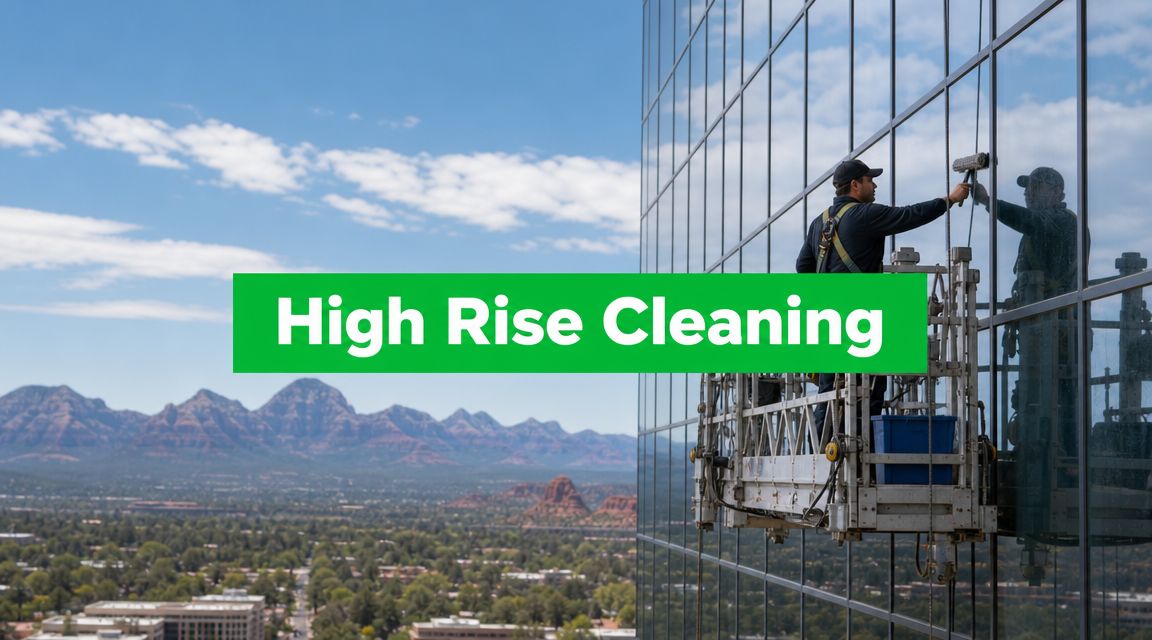
If you're responsible for a multi-story building in Flagstaff or anywhere in Northern Arizona, you already know the problem. The glass starts to dull, the upper elevations collect dust and runoff, tenants notice, and suddenly a simple maintenance item turns into a logistics and liability question.
At ground level, window cleaning looks straightforward. At height, it isn't. High rise work depends on access equipment, trained crews, building geometry, weather judgment, and inspection discipline. That's why professional window cleaning has moved far beyond a bucket and rag. If you want a useful primer on standard professional methods for homes and businesses, Sparkle Tech's window cleaning guide is a solid place to start. High rise work builds on that foundation, but the equipment and planning are much more specialized.
The industry itself reflects that shift. A major change in high rise window cleaning equipment was the move from manual rope-and-chair methods to engineered suspended systems, and modern high-rise cleaning technology is commonly designed for buildings with 5+ stories. Some automatic systems advertise productivity of over 30,000 square feet per hour and claim 90% labor savings, which shows how far mechanized access has changed the work (IPC Worldwide high-rise automatic window cleaning system).
Why Professional High Rise Equipment Matters
Property managers usually start with one question. How do we get the glass clean without creating a bigger problem than the dirt itself?
That question matters more in Northern Arizona because access conditions vary so much. One property may have a broad frontage and plenty of setup room. Another may have tight pedestrian areas, landscaping, a steep approach, or a glass section tucked under an overhang. Equipment choice changes with every one of those details.
Height changes the job
Once a building reaches true high rise conditions, cleaning stops being a simple labor task and becomes an access operation. The work has to account for fall protection, anchor points, load handling, swing control, rescue planning, and how tools and water behave at elevation.
A poor equipment match creates predictable problems:
- Slow production: Crews spend more time moving and resetting than cleaning.
- Limited reach: Corners, setbacks, and recessed glass get skipped or left spotty.
- More site disruption: Ground closures and tenant inconvenience increase.
- Higher risk exposure: The job becomes harder to supervise and harder to control.
Practical rule: In high rise work, the wrong access method costs more than the right one ever will.
Professional tools protect the building, too
Property managers often focus on safety first, as they should. But equipment choice also affects the building itself. A suspended platform can spread load and carry tools in a controlled way. Rope access can reduce contact points on a complicated façade. Water-fed systems can clean accessible glass from the ground with less disturbance around entries and landscaping.
That matters when you're trying to protect finishes, maintain public access, and keep the job quiet enough for an occupied property.
What experienced crews look for
Before equipment is selected, a competent contractor should evaluate:
- Roof conditions: Available anchors, parapet design, and access points
- Façade shape: Flat runs, setbacks, atriums, angled glass, or decorative features
- Ground conditions: Pedestrian traffic, parking, and lift positioning
- Cleaning scope: Full exterior, partial elevations, glass only, or detailed frame work
High rise window cleaning equipment isn't just about reaching the glass. It's about reaching it in a way that fits the building.
A Guide to High Rise Window Cleaning Systems
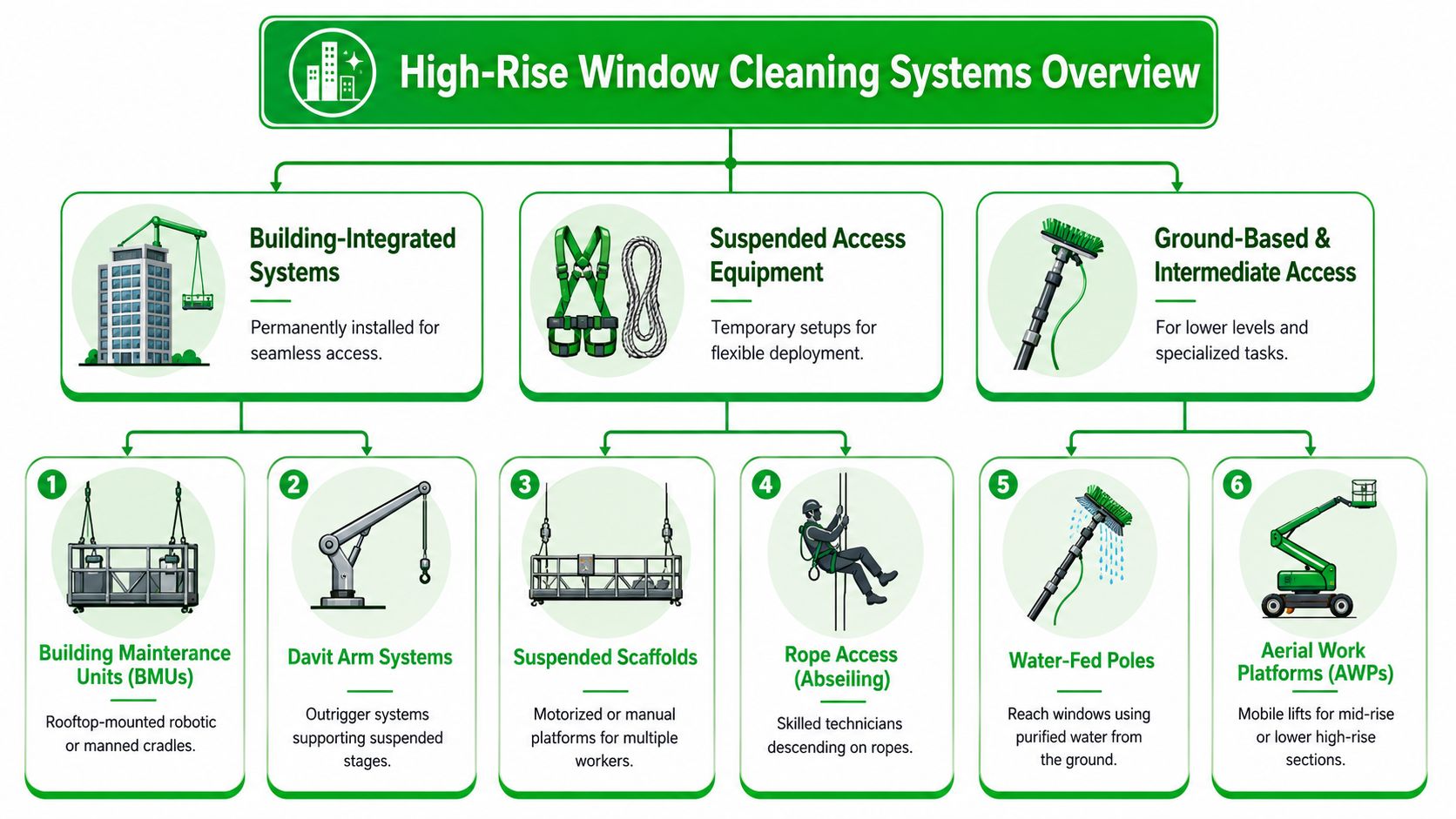
There isn't one universal machine for every building. The equipment falls into a few main categories, and each solves a different access problem.
The size of the market tells you how established this equipment category has become. Global window cleaning equipment sales revenue was estimated at $3.2 billion in 2023, and the U.S. had 35,344 businesses in 2024 in the industry, reflecting a mature, equipment-dependent trade (window cleaning industry statistics compiled by Gitnux).
For a closer look at the tools used in commercial settings, commercial window cleaning equipment gives a useful overview of the categories crews work with on active jobs.
Building-integrated systems
Some buildings are designed with access equipment in mind. The main example is a Building Maintenance Unit, often shortened to BMU. Think of it as a rooftop-mounted exterior access system that can move workers and tools down the face of the building in a controlled way.
These systems make sense when the building has regular maintenance needs and the façade supports that kind of planned access. On the right structure, they reduce setup time and keep movement more predictable.
Suspended access equipment
This category includes swing stages, suspended scaffolds, and davit-supported platforms. A swing stage works a bit like an elevator on the outside of the building. Workers stand on a suspended platform, then raise or lower it along the elevation.
This is often the practical answer for broad vertical runs of glass. The platform carries people, water, tools, and detailing gear together, which helps when the scope goes beyond quick glass touchups.
Rope access systems
Rope access uses trained technicians descending on ropes with harnesses and controlled descenders. On some buildings, this is the cleanest way to reach isolated or awkward sections without building out a large suspended system.
Rope access shines where architecture gets complicated. It can work around fins, recesses, narrow reveals, and upper-level glass sections that don't line up cleanly with a platform path.
Broad, repetitive glass elevations usually reward mechanized access. Complex elevations usually reward flexibility.
Ground-based and intermediate access
Not every difficult section needs ropes or a platform. Water-fed poles use purified water and a brush head to clean glass from the ground or from a lower access position. They're excellent for lower and mid-level windows where reach is possible and the façade is open enough for brush work.
Aerial work platforms, including boom lifts and scissor lifts, fill the gap between ground systems and full high rise access. They help on podiums, atriums, canopies, and mid-rise sections where vertical access is needed but a roof rig isn't the best fit.
Swing Stages vs Rope Access Pros and Cons
This is the comparison property managers ask about most often. Both methods are common. Neither is automatically better. The right answer depends on how the building is shaped and how the site operates.
Industry guidance is consistent on the main tradeoff. Suspended platforms and BMUs are ideal for carrying workers and tools along uniform tower façades, while rope access is selected when access points are limited or the façade is irregular (high rise office window cleaning guidance).
When a swing stage makes more sense
A swing stage is usually the stronger choice on a building with large, flat, repetitive elevations. The platform gives the crew a stable working surface and lets them move with their tools, water, and detail equipment in one system.
That stability matters when the scope includes more than a quick wash. If the crew needs to work carefully through frames, ledges, or heavier buildup across a long run of glass, a platform often delivers smoother production.
A swing stage also tends to work better when:
- The façade is uniform: Long vertical drops and consistent window lines favor platform travel.
- The crew needs tool capacity: More gear can move with the workers.
- The job benefits from shared workspace: Multiple technicians can work from the same suspended unit.
When rope access wins
Rope access is often the better fit when the building shape fights the platform. Setbacks, curved sections, recessed windows, decorative projections, and limited roof rigging areas all push the decision toward ropes.
The main advantage is mobility. A trained rope technician can work into places that would be awkward, slow, or impractical with a wide suspended platform.
Rope access tends to fit when:
- Access points are limited: Roof conditions don't support efficient platform movement.
- The glass is broken up by architecture: Irregular geometry favors independent movement.
- Ground disruption needs to stay tighter: Some sites can't give up much staging area.
If a crew has to fight the building all day, the equipment choice was probably wrong.
Equipment at a Glance Suspended vs. Rope Access
| Feature | Swing Stage / Suspended Platform | Rope Access / Bosun's Chair |
|---|---|---|
| Best building type | Broad, uniform façades | Irregular or hard-to-reach façades |
| Worker position | Stable shared platform | Individual rope-supported position |
| Tool handling | Strong for carrying tools and materials | Better for lighter, more streamlined kits |
| Setup logic | Needs suitable suspension and path planning | Needs solid anchor strategy and rope plan |
| Movement style | Smooth vertical travel on planned drops | Flexible movement around complex geometry |
| Typical limitation | Less efficient on setbacks and odd forms | Less ideal for large uniform production runs |
A significant mistake is treating this as a cost-only decision. The cheapest setup on paper can become the most expensive one once delays, incomplete access, or repeated mobilizations show up.
Reaching Heights with Lifts and Water-Fed Poles
A lot of commercial glass in Northern Arizona sits outside true skyscraper conditions. Hotels, campus buildings, medical offices, dealership fronts, entry towers, atriums, and mixed-height structures often need something different from a roof-suspended system.
That's where lifts and purified-water systems earn their keep.
Water-fed poles for accessible glass
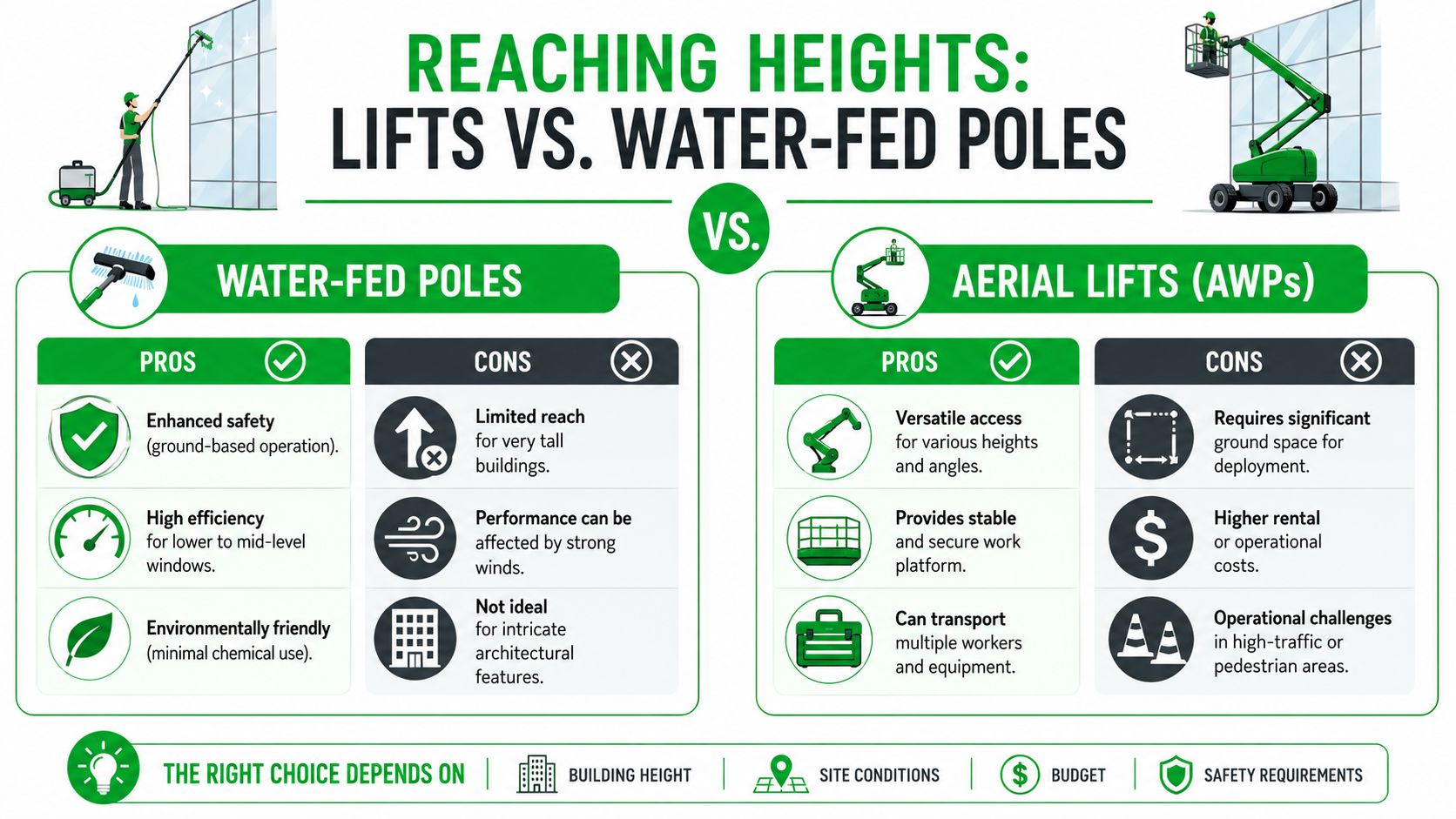
A modern water-fed pole system pushes purified water through an extendable pole to a brush head. The brush loosens dirt, the purified water rinses, and the glass dries without the mineral spotting you'd expect from untreated water.
This method works well when the windows are reachable from the ground or another safe lower position. It's efficient on exterior glass where there isn't deep buildup, and it's especially useful around entrances, lower façades, and buildings where constant foot traffic makes larger access equipment harder to manage.
Water-fed poles are less useful when the architecture gets fussy. Deep recesses, heavy ledges, overhead obstructions, or sharply angled glazing can limit brush contact and rinse quality.
Aerial lifts for awkward mid-height work
Boom lifts and scissor lifts solve a different problem. They put the technician on a platform that can move to the glass, which is helpful when the work area sits above the practical range of poles but doesn't justify a suspended platform from the roof.
Common examples include:
- Atrium glass: Interior or exterior sections that need positioning at height
- Canopies and overhangs: Places where a straight pole angle won't clean effectively
- Mixed-height buildings: Sections where only part of the property needs access at height
- Detail work: Frames, edges, and glass that need close hand work with a squeegee and scrubber
One practical example is Pine Country Window Cleaning, which states that it uses in-house boom lifts, scissor lifts, and a 95-ft atrium lift for hard-to-reach commercial work. That kind of equipment mix is useful on properties that have several access conditions on the same site.
What works and what doesn't
Water-fed poles work best when the building lets you stay on the ground. Lifts work best when you need a worker at the glass.
The wrong choice usually shows up fast:
- Pole used too high: Poor brush pressure, weak rinse control, and inconsistent results
- Lift used where site space is tight: Traffic conflicts, slow repositioning, and more disruption
- No hybrid plan: Crews waste time forcing one tool across every elevation instead of matching tools to each zone
OSHA Standards and Equipment Inspection Checklists
For a property manager, the equipment itself is only half the decision. The other half is whether the crew using it treats safety as routine discipline instead of sales language.
That starts with training, job planning, and inspections. High rise cleaning involves suspended work, fall protection systems, powered access equipment, and live occupied properties. If a contractor is vague about inspection routines, rescue planning, or operator qualifications, that's a warning sign.
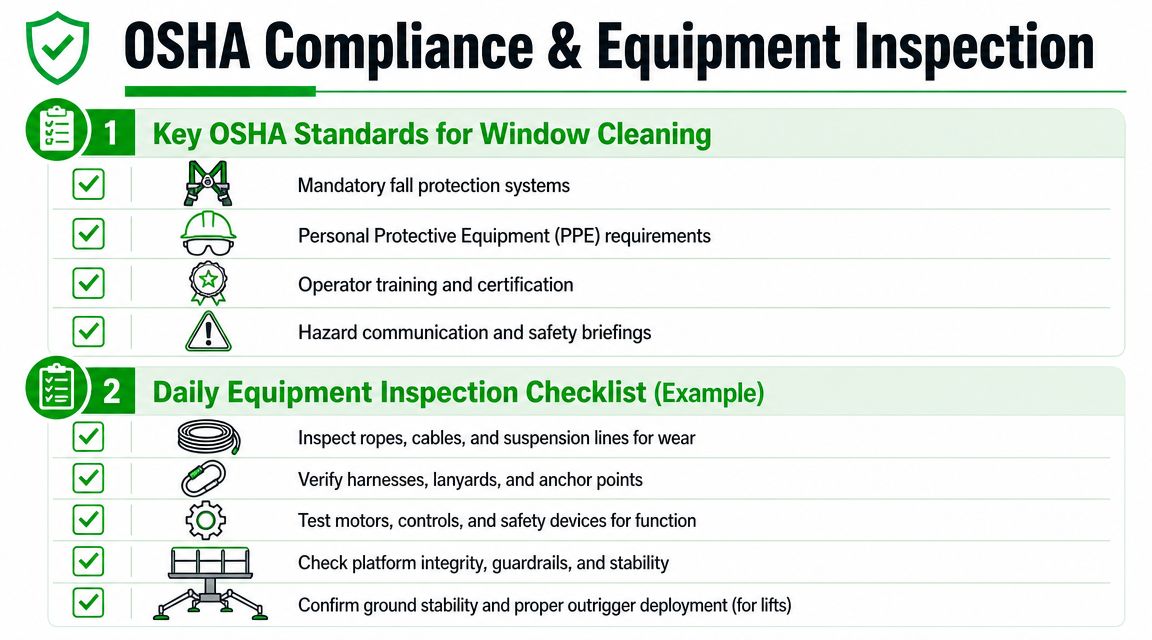
A serious contractor should also be able to describe the scope of service clearly. Reviewing commercial window cleaning services can help you frame what questions to ask about access method, crew training, and site control before the work starts.
What should be checked every day
Inspection shouldn't be a vague promise. It should be a checklist.
A daily pre-work review commonly includes:
- Ropes and cables: Check for wear, abrasion, damage, and proper setup
- Harnesses and connectors: Verify fit, condition, and compatibility with the system in use
- Anchors and tie-in points: Confirm suitability and secure attachment
- Motors and controls: Test function before the platform leaves the ground
- Platform condition: Guardrails, boards, tie-backs, and stability all need review
- Lift setup: Ground condition, outriggers, and operating envelope need confirmation
Safety paperwork isn't the safety program. The safety program is what the crew checks, tests, and refuses to shortcut before work begins.
This short video gives a useful visual reference for professional safety thinking around work at height:
What property managers should ask
You don't need to be a rope-access specialist to screen a contractor. Ask practical questions.
- Who trained the crew? You want clear answers about OSHA-related safety training and equipment competency.
- What gets inspected before use? A professional should answer without hesitation.
- What is the rescue plan? If someone is suspended or equipment stops, there needs to be a real procedure.
- How is the site controlled? Pedestrian management matters as much as rooftop procedure on occupied buildings.
The safest contractor usually isn't the one with the biggest promise. It's the one with the most disciplined routine.
A Property Manager's Decision Framework
Most guides stop at naming the equipment. That doesn't help much when you're standing on your own property trying to figure out what fits the building.
A better approach is to screen the job in sequence.
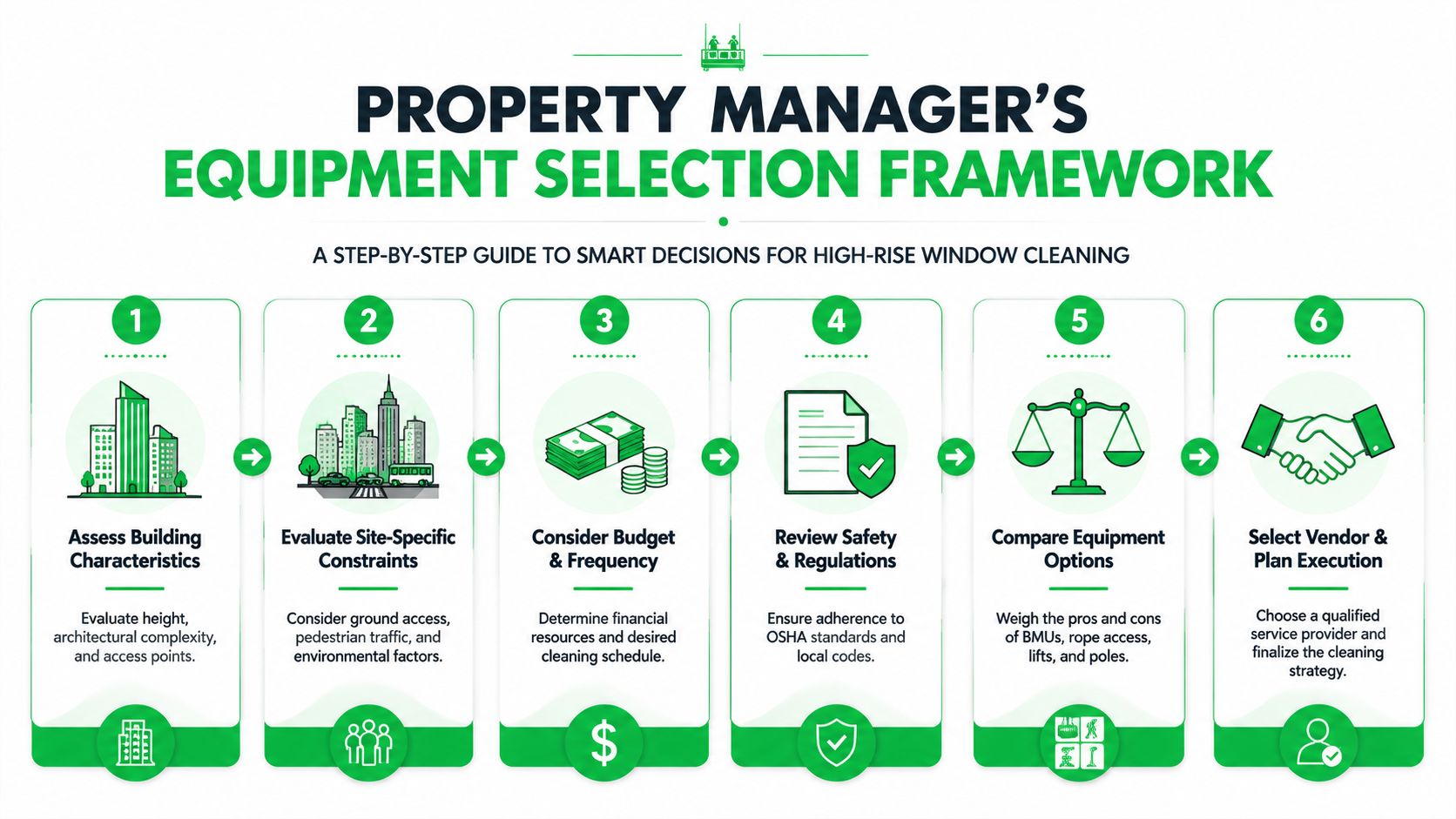
Industry guidance often misses the role of building geometry, even though method selection is driven by access constraints. Neutral guidance notes that rope access is used for hard-to-reach surfaces, raised platforms are used when rope access isn't feasible, and water-fed poles are mainly suited to lower windows. It also points to anchor points and platform mobility as critical variables that are often overlooked (efficient techniques and equipment for high-rise building window cleaning).
Ask these questions in order
How tall is the area that needs cleaning?
Don't classify the whole property by its tallest point. Separate lower glass, mid-level sections, atriums, and true high rise elevations.Is the façade uniform or irregular?
A flat glass wall points you toward suspended access. Setbacks, corners, angled panels, and recessed sections push the decision toward ropes or a mixed-method plan.What roof access exists?
The presence or absence of anchors, parapet compatibility, and rigging space can rule methods in or out quickly.What happens at ground level?
Busy sidewalks, valet zones, landscaping, and narrow fire lanes affect whether lifts or large staging areas are practical.
Match the tool to the condition
A simple decision path looks like this:
| Building condition | Most likely fit |
|---|---|
| Lower, open, reachable glass | Water-fed pole system |
| Mid-rise section with space for setup | Boom lift or scissor lift |
| Tall, broad, repetitive façade | Swing stage or BMU |
| Irregular, hard-to-reach upper glass | Rope access |
Watch for mixed-method buildings
Many properties need more than one access method. That's normal.
A common example is a building with accessible lower storefront glass, an atrium section above a canopy, and upper elevations with setbacks. One tool won't handle that efficiently. A contractor should be able to divide the property by zone and explain why each zone gets a different method.
The best equipment plan isn't the one with the fewest tools. It's the one that fits the building without forcing unsafe or inefficient workarounds.
If you use this framework before requesting bids, you'll get better conversations and better proposals.
When to Hire a Pro in Flagstaff and Northern Arizona
High rise window cleaning isn't a task to hand off casually to an in-house team or a low-bid vendor with vague paperwork. The equipment is specialized, the setup is building-specific, and the risk sits with every decision made before the first worker leaves the ground.
That matters even more in Flagstaff and Northern Arizona, where properties range from campus buildings and hotels to mixed-use sites with difficult access and changing weather. You need a contractor that understands not just glass cleaning, but roof access, lift planning, traffic control, and how to work around occupied buildings without damaging screens, landscaping, entries, or interior spaces.
For local properties, high rise window cleaning should be handled by a trained, insured crew that can match the method to the structure. Around homes and lower-rise properties, the same standard applies. Professional service should include protecting the property, removing screens, cleaning screens, and reinstalling them correctly when the job is done.
Since 1999, Flagstaff native David Kaminski's company has worked in this market long enough to know that good results come from the right equipment, disciplined safety habits, and respect for the customer's property.
If you need a practical plan for exterior glass on a high rise, hotel, campus building, storefront, or custom home, Pine Country Window Cleaning can help you evaluate the access conditions and choose the right approach for the job.