A facility manager in Flagstaff can stand in front of a five-story atrium and see the problem immediately: dust on the upper panes, mineral marks around the mullions, and no obvious way to reach the glass without interrupting tenants. The harder question isn't whether the windows need washing. It's who can reach them legally, with which access system, under what site conditions.
That's the practical meaning of how to clean commercial windows. The squeegee technique matters, but it comes after the building survey, hazard review, equipment choice, and work plan. A single-story storefront, a three-story medical office, and a tower with suspended access may all have different cleaning solutions because the access method changes the crew, training, insurance, schedule, and safety controls.
Why Commercial Window Cleaning Is a Compliance Decision First
A property manager looking up at an atrium curtain wall isn't choosing between a bucket and a spray bottle. They're choosing between a ladder, a lift, a ground-based pure-water system, a suspended platform, or rope access. Each option creates a different job scope before a technician washes the first pane.
Commercial window cleaning has been formalized through safety standards for decades. OSHA identified the ANSI/ASME 39.1-1987 standard as providing criteria for safely cleaning windows on buildings, while later OSHA interpretations recognized earlier ANSI window-cleaning guidance as an industry reference. The ANSI A39.1-1969 standard represented an early dedicated safety reference, and the ANSI/IWCA I-14.1 standard, introduced in 2001, became another major milestone. OSHA later noted that proposed fall-protection rules mirrored many of its provisions. OSHA and ANSI window-cleaning guidance shows how the trade moved from voluntary guidance toward formal safety expectations over more than three decades.
The building determines the method
A ground-level retail corridor might be handled with a water-fed pole and purified water, keeping workers on the pavement and limiting disruption. A three-story office may need a stabilized ladder, scissor lift, or boom lift, depending on terrain and reach. A taller façade may require a suspended platform, building maintenance unit, or trained rope-access team.
That decision affects more than safety paperwork. A lift requires access for delivery, a level operating surface, overhead clearance, and a plan for pedestrians. Rope work requires independent systems, rescue capability, anchor verification, and weather limits. Suspended platforms require building systems that can support the equipment and a documented inspection process.
Practical rule: Start with the façade, roof, ground conditions, and obstructions. Choose the cleaning technique only after the access plan is defensible.
The rest of the job follows from that choice. The method controls how much water can be used, where runoff can go, how long tenants lose access to sidewalks or rooms, and which technicians are qualified to perform the work. Commercial glass cleaning is therefore a height-and-code decision first, and a wash-and-squeegee decision second.
The Safety Standards Every Property Manager Should Know
Safety standards can sound abstract until they appear on a job site. An anchor inspection becomes a technician checking roof documentation before descending. A fall-protection rule becomes a crew refusing to work from an improvised ladder near an exposed edge. OSHA's window-cleaning materials describe building-maintenance platforms and swing-stage systems as primary equipment for cleaning taller structures, while also addressing anchor strength and fall exposure. OSHA's interpretation of window-cleaning requirements is a useful starting point for facility managers reviewing a vendor's plan.
The numbers have a job-site meaning
The most important anchor figure is 5,000 pounds. Written confirmation is required that rooftop anchor points can support that load for suspended access and rope-descent systems. That doesn't mean a crew should locate a convenient roof attachment and begin work. It means the building owner and contractor need reliable documentation showing that the designated anchorage is suitable.
OSHA materials also identify fall-protection thresholds of 4 feet in general industry and 6 feet in construction-related work, with the applicable requirement depending on the work classification and conditions. A manager should ask the contractor to explain which standard governs the project rather than assuming every height is treated identically.
| Standard | Threshold | What It Means On Site |
|---|---|---|
| Rooftop anchorage | 5,000 pounds | The contractor needs written confirmation that anchor points can support suspended or rope-descent work. |
| General industry fall protection | 4 feet | Work at relatively modest heights can still require protective controls in general industry settings. |
| Construction-related work | 6 feet | Construction classifications may trigger a different fall-protection threshold. |
Documents matter as much as equipment
A professional crew should be able to discuss training, rescue planning, equipment inspection, and the building's designated access points in plain language. Facility managers can also review practical ladder controls in Pine Country's ladder safety requirements, then compare those expectations with the vendor's site-specific plan.
Digital safety systems can help teams document operating limits, inspections, and approvals. For organizations managing broader equipment controls, RapidStart's guidance on how to configure RapidClaw safety settings offers useful context for setting operational safeguards. It doesn't replace OSHA compliance or a competent person's assessment, but it illustrates why safety settings should be configured before work begins, not after an incident.
The visible behavior is simple: qualified workers inspect the access system, confirm the hazard controls, protect people below, and stop when conditions exceed the plan. A clean pane never justifies bypassing those steps.
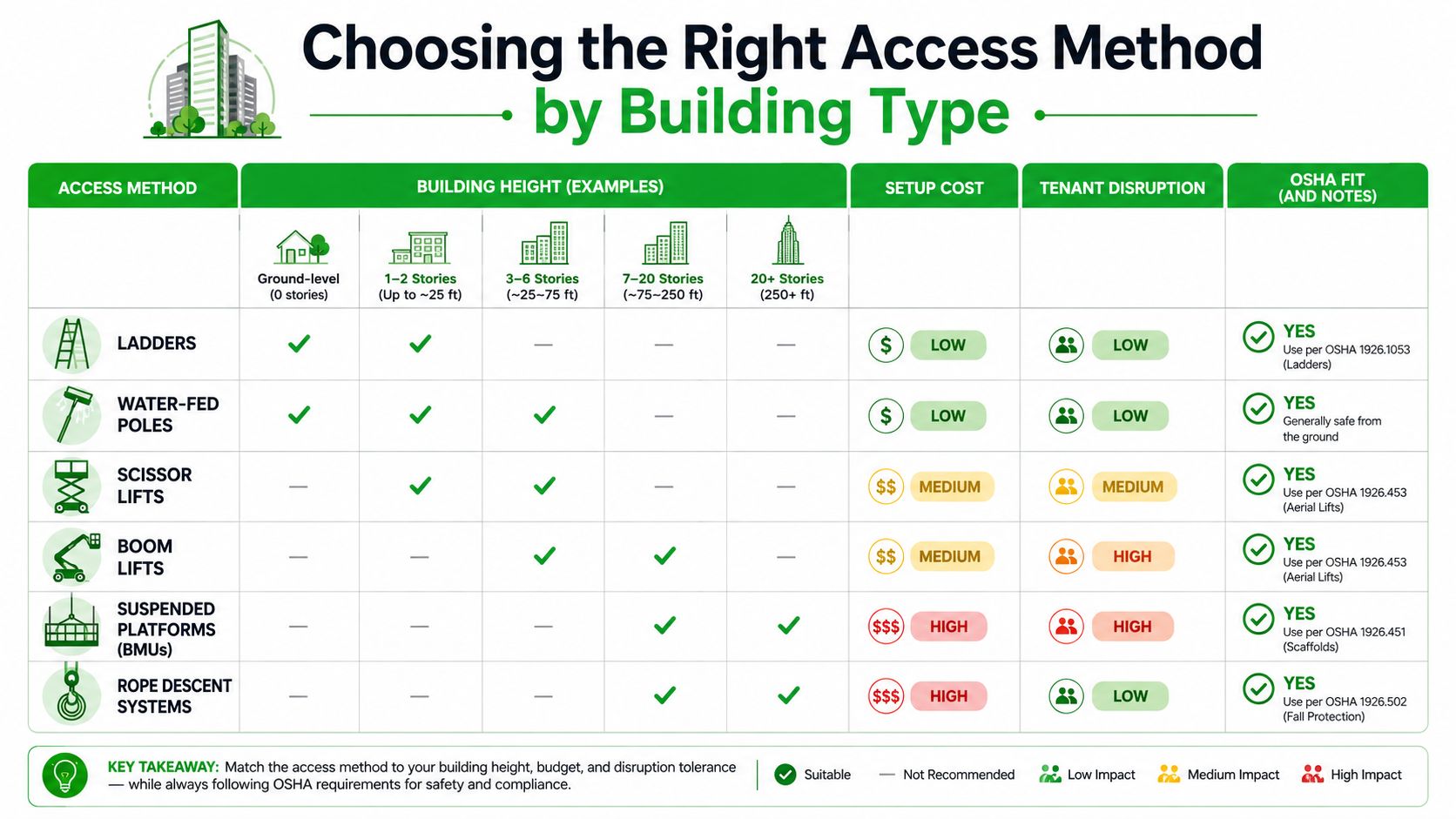
Choosing the Right Access Method by Building Type
Access selection starts with three measurements: height, ground slope, and overhead obstruction. Add roof access, glass configuration, pedestrian traffic, and tenant sensitivity, and the right method usually becomes clear.
Water-fed poles are often the cleanest answer for ground-level and lower façades. Purified or deionized water travels through a telescoping pole to a brush head, and the low mineral content is intended to dry without spotting. Commercial systems can reach about 70 feet from the ground, according to the National Window Cleaning Authority's equipment overview. The method reduces ladder movement and keeps technicians out of many higher work positions, but it becomes less practical where wind, recessed glass, architectural projections, or heavily soiled surfaces interfere with brush control.
Ladders remain useful for limited low-rise work, but they need a stable surface, proper setup, and a narrow scope. They're a poor substitute for a lift when the technician must repeatedly lean, reposition, or work around pedestrians.
Match the machine to the site
A scissor lift works well on a sufficiently flat, firm surface when the façade requires mostly vertical access. It offers a stable platform, though delivery, barricades, and floor loading can become concerns. A boom lift reaches around corners and over landscaping more effectively, but it needs appropriate pavement, clearance, and a plan for overhead hazards.
Suspended platforms and building maintenance units serve taller façades when engineered roof systems are available. They can provide efficient, repeatable access, but the building owner must maintain suitable anchorages and inspection records. Rope descent systems can reduce equipment staging and tenant disruption, yet they demand two independent rope systems, qualified technicians, rescue training, and careful weather monitoring. Industry guidance identifies IRATA or SPRAT certification as relevant for rope-access work. This commercial window-cleaning safety guide also cites a federal OSHA analysis reporting 88 window-cleaning accidents over 15 years, including 62 fatalities, with ladder mishaps identified as the leading cause.
The cheapest access method on the estimate isn't automatically the lowest-cost method for the building.
For managers comparing bids, commercial window cleaning equipment provides a useful vocabulary for discussing squeegees, poles, lifts, and pure-water brushes. Ask each vendor to state the planned access system, setup area, tenant impact, weather limits, and contingency if the primary method can't be used.
The Pro-Grade Cleaning Workflow for Storefronts and Low-Rise Glass
For a storefront or low-rise building, the work begins before the glass gets wet. Secure the work zone, place warning signs or barriers where needed, and keep pedestrians away from ladders, hoses, buckets, and falling debris. Dry-brush or dust the frames and sills first, because wetting loose grit can turn a simple wash into abrasive scrubbing.
Prepare the glass and solution
A working crew typically applies a neutral, non-streaking commercial surfactant through a bucket applicator or a water-fed pole system. For pole-fed work, distilled or deionized water helps reduce mineral spotting. The practical sequence is top to bottom, so runoff lands on glass that hasn't received its final pass instead of dirtying completed panels.
For standard squeegee work, wet the pane evenly, agitate stuck-on soil with a suitable non-abrasive pad, and keep the channel clean. The squeegee blade should be in good condition, because a nick or hardened edge leaves a trail that looks like a glass defect.
Pull clean passes
Use overlapping strokes rather than trying to cover the pane with isolated pulls. Professional guidance recommends about a 1.5-inch overlap between squeegee strokes to minimize missed edges and streaks. Commercial window-cleaning workflow guidance also recommends wiping the blade after each pass.
On a smaller storefront pane, an S-pattern can keep the blade moving efficiently. Start near the upper corner, maintain steady pressure, and avoid repeatedly recutting the same line. The exact overlap may vary with the channel width and pane layout, but the principle stays consistent: leave no dry gap between passes.
What causes callbacks: Missed edges, lint or dirty detailing cloths, and frame runs account for many avoidable complaints. The remedy is rarely more chemical. It's cleaner tools, controlled blade work, and a proper final detail.
Finish by wiping the perimeter, corners, sills, frames, and mullions with a clean detail cloth. Use a non-abrasive pad only where the frame material permits it. On pole-fed work, rinse thoroughly with purified water and inspect from multiple angles before moving the equipment. In Northern Arizona, mineral residue can become especially visible when water dries quickly on sun-warmed glass, so the final rinse and visual check deserve as much attention as the initial wash.
Screen Care as Part of Every Commercial Service
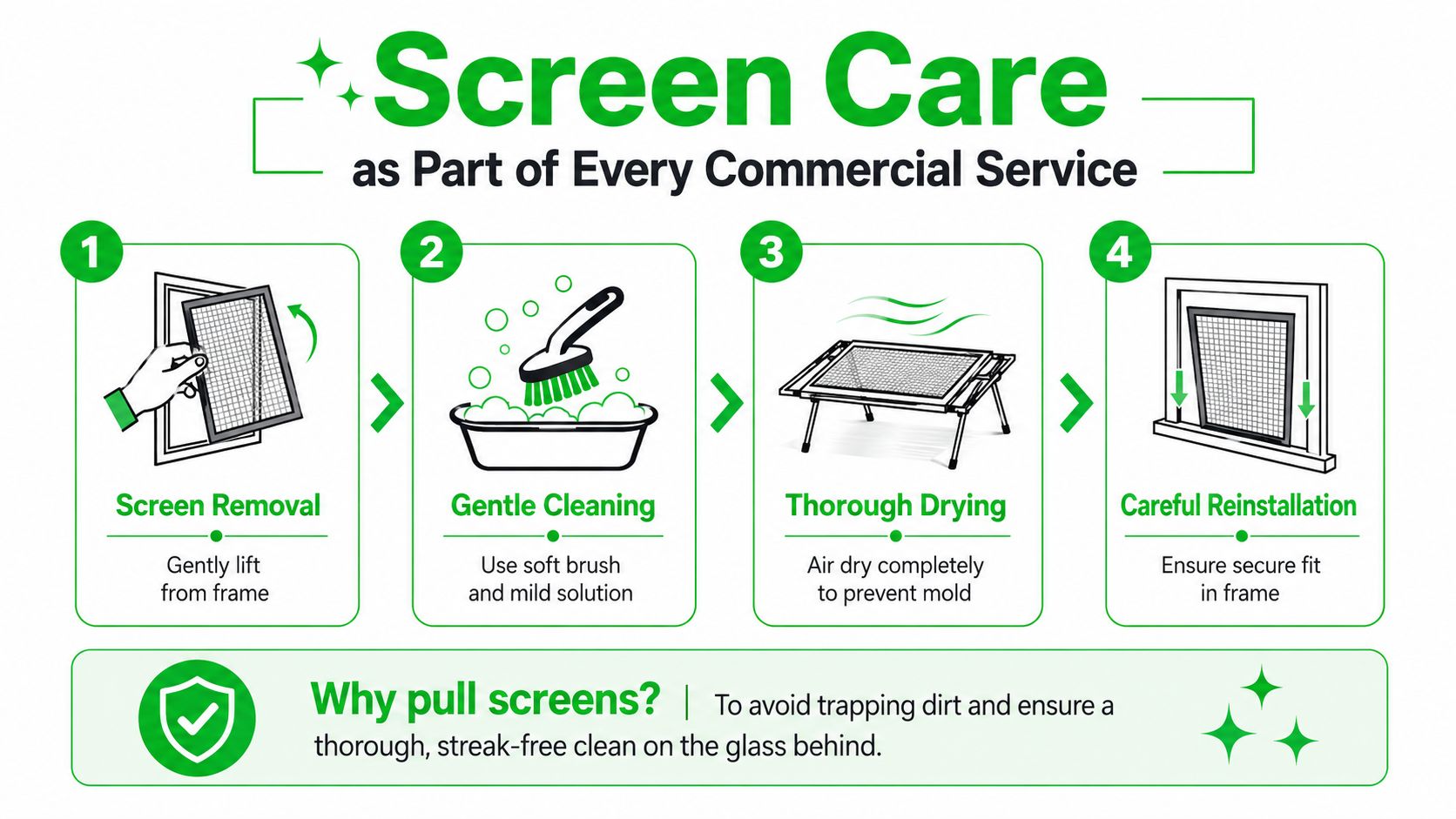
Screens should come out before the glass is cleaned. Removing them first prevents loosened dust and pollen from mixing with cleaning solution and splashing back onto freshly washed panes. It also gives the technician a chance to inspect each screen on the ground instead of discovering a bent frame or torn mesh while balancing at the window.
Keep screens in order as they're removed so each one returns to the correct opening. Check the frame for bends, inspect the mesh for tears, and look at the spline for sections that have pulled loose. A screen that doesn't sit squarely may need repair before reinstallation, and forcing it into the frame can make the damage worse.
Clean gently and dry completely
Use a soft brush or vacuum brush to remove loose dust. Rinse with plain water through a low-pressure hose or gentle spray. High pressure can damage the mesh or push it out of the spline groove, as explained in guidance on removing and cleaning window screens.
Northern Arizona spring winds can load screens with fine dust and pine pollen, so aggressive blasting often creates more problems than it solves. Gentle brushing, controlled rinsing, and a patient inspection protect the mesh while removing the material that affects airflow and appearance.
Screens should be allowed to air-dry fully before they go back into the frame. Screen-cleaning guidance from The Spruce recommends removing screens, cleaning them separately, and reinstalling them only after they're completely dry. Wet screens can trap moisture against the sill and encourage mildew or corrosion over time.
Screen handling belongs in the written scope. Ask whether removal, cleaning, drying, inspection, and reinstallation are included in the service price or billed separately. Pine Country Window Cleaning describes screen removal, cleaning, and reinstallation as part of every service, and its commercial screen-cleaning guidance reflects that same careful sequence.
Building a Maintenance Schedule That Actually Works
A useful schedule follows exposure and access, not a generic calendar. Storefronts beside busy roads, entrances, and parking areas collect visible soil faster than protected upper façades. Interior atriums may stay cleaner than exterior glass, but fingerprints, construction dust, and HVAC-borne residue still affect appearance.
For many Flagstaff properties, a starting schedule looks like this:
| Building Type | Recommended Frequency | Key Driver |
|---|---|---|
| Storefronts and ground-floor retail | Quarterly | Foot traffic, dust, entryway contact, and visible street exposure |
| Mid-rise office glass | Semiannual | Façade exposure, tenant expectations, and access planning |
| High-rise exterior faces | At minimum semiannual | Access-system scheduling, wind exposure, and accumulated exterior soil |
| Atrium interior glass | Annually | Interior dust, fingerprints, and architectural visibility |
These are planning recommendations, not substitutes for a site assessment. A retail property may need more frequent touch-ups around entrances, while a sheltered office can sometimes maintain its appearance with fewer intensive visits. A written route plan also lets the contractor coordinate lifts, sidewalk protection, tenant notices, and interior access without last-minute disruption.
Build around Northern Arizona conditions
Spring pollen and dust can justify an additional cleaning visit. Mid-summer monsoon conditions and haboobs can quickly undo exterior work, so scheduling should include a weather call-out rather than forcing crews to work in unsafe wind or clean immediately before a major dust event. Winter brings a different limitation, because frozen sills and cold surfaces can restrict outdoor work when water may freeze or create slip hazards.
Give vendors the same baseline
A facility manager can issue a short pre-job checklist:
- Access documentation: Confirm anchor inspection records, lift certification, or the planned ladder controls.
- Training evidence: Request proof of relevant fall-protection, lift, suspended-scaffold, or rope-access training.
- Weather limits: Define wind, precipitation, freezing conditions, and the process for postponement.
- Site hazards: Identify slopes, overhead lines, fragile roofs, pedestrian routes, landscaping, and tenant-sensitive areas.
- Protection plan: Confirm barricades, runoff control, interior floor protection, and communication with occupants.
- Scope clarity: List glass, frames, sills, screens, tracks, interior panes, and any excluded restoration work.
The best schedule is one a vendor can execute safely and a manager can audit afterward.
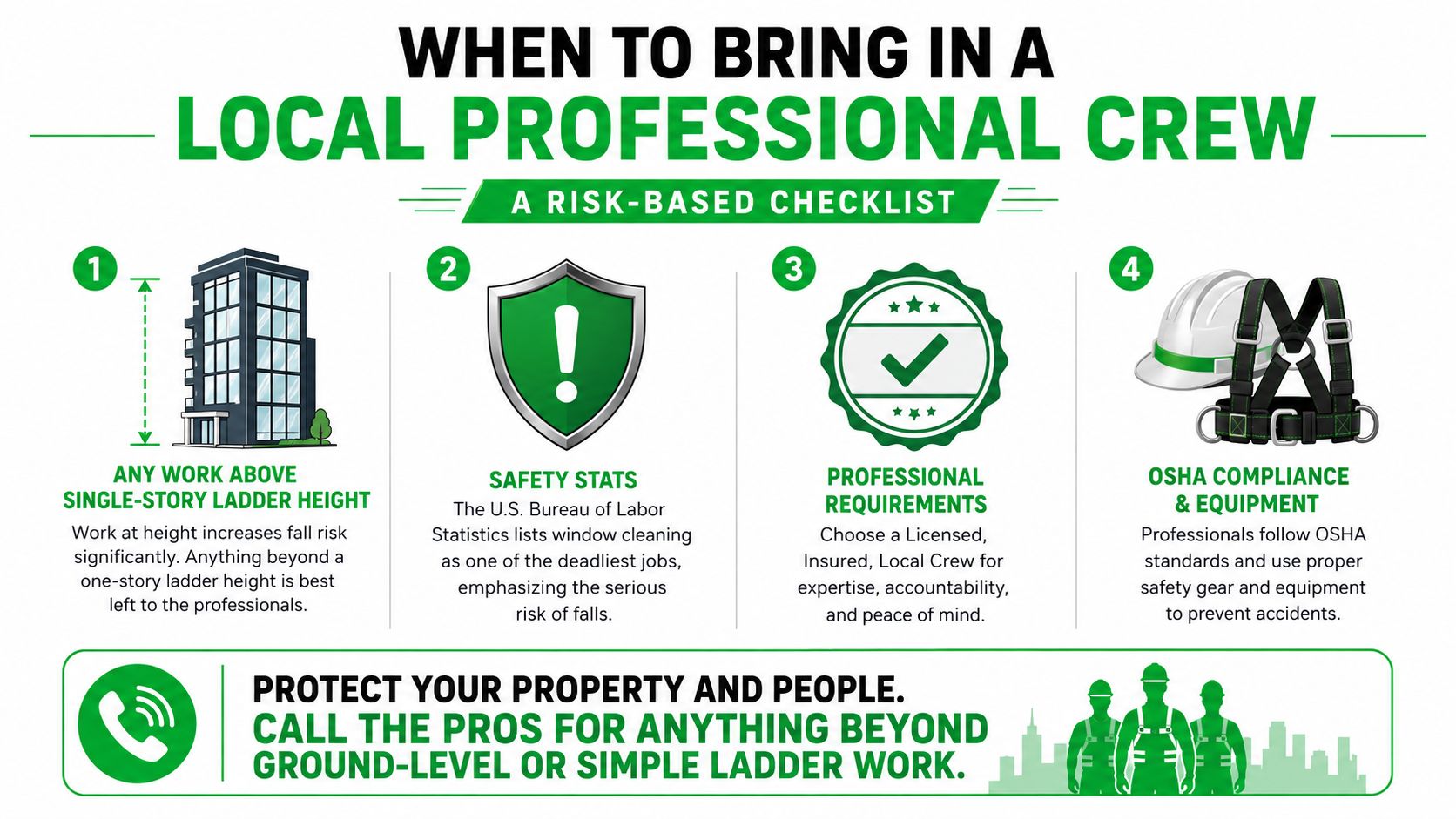
When to Bring in a Local Professional Crew
Anything above simple single-story ladder work deserves a professional access review. Window cleaning carries serious fall exposure, and the industry safety record cited in commercial window-cleaning coverage includes 88 accidents over 15 years, with 62 fatalities. The commercial window-cleaning safety overview identifies ladder mishaps as the leading cause in that cited analysis.
That context matters when an employee climbs a second-story ladder to reach a transom. The company may inherit exposure involving worker training, equipment selection, supervision, property damage, and workers' compensation. A quarterly contract can look expensive beside an in-house task until the manager accounts for lift delivery, setup time, lost productivity, a fall, or a compliance problem.
Use a practical hiring screen
Before approving a vendor, ask for:
- Insurance certificates: Confirm general liability and workers' compensation coverage.
- Relevant training: Request documentation for lift operation, fall protection, suspended scaffolds, or rope access where applicable.
- Written planning: Look for a site-specific hazard assessment and fall-protection plan.
- Comparable references: Check work on similar façades, tenant environments, campuses, hotels, or medical facilities.
- Equipment capability: Verify that the contractor has the access equipment and rescue resources required for the building.
- Local operating knowledge: Ask how the crew handles sidewalk protection, permits, closures, weather delays, and tenant communication.
Northern Arizona conditions make local experience useful. High winds can ground a lift, monsoon humidity can affect drying and spotting, and dust can change the cleaning plan between a protected courtyard and an exposed commercial corridor. A Flagstaff-based crew also understands the practical coordination required around local properties and public walkways.
Pine Country Window Cleaning states that it began in 1999, was started by Flagstaff native David Kaminski, and has grown into Flagstaff's largest window cleaning operation. Its described equipment includes squeegees, poles, ladders, screen tools, boom lifts, scissor lifts, and a 95-foot atrium lift. For managers who also need broader building-response resources, directories covering vetted commercial restoration contractors can help distinguish documented, insured providers from unqualified general labor.
The right contractor protects more than the glass. They protect occupants, technicians, sidewalks, finishes, schedules, and the owner's compliance position.
Pine Country Window Cleaning handles commercial glass for storefronts, offices, medical buildings, hotels, dealerships, campuses, and difficult atrium areas using professional squeegees, ladders, poles, pure-water brushes, and in-house lift equipment. For a building-specific access review and estimate in Northern Arizona, visit Pine Country Window Cleaning and schedule a crew that will care for the property as carefully as it cleans the glass.