

You notice it after an October storm. Water sheets over the gutter edge, the downspout makes no convincing sound, and a quick look from the ladder shows what Flagstaff roofs collect so well: a tight plug of pine needles, cone pieces, and wet grit packed above the first elbow.
Cleaning the gutter channel isn't enough. The vertical downspout is the hidden choke point, and a partial blockage can back water toward the roof edge, siding, fascia, landscaping, and foundation. The reliable approach is to clear the outlet, flush the full vertical run, inspect the discharge, and escalate carefully when the problem has moved below grade.
Why Flagstaff Downspouts Clog Faster Than You Think
Flagstaff's ponderosa pine and Gambel oak neighborhoods shed material through much of the year. Fine needles, bark, seed debris, and roof grit collect in the gutter, then funnel toward the outlet during late-summer monsoon storms and fall needle drop. On the short, steep roof runs common in mountain subdivisions, debris often reaches the downspout before it can spread along the gutter line.
That creates a different cleaning problem from a light leaf load in a lowland neighborhood. Pine needles interlock, absorb moisture, and settle into a dense mass. Once the material reaches the outlet throat or the first elbow, water pressure from an ordinary garden hose may only open a narrow channel through the plug.
Freeze and thaw make a small blockage worse
Flagstaff's cold-weather cycles add another layer. Water trapped inside a partially blocked downspout can freeze, expand, and press debris harder against the throat and elbow. The fitting may survive, but the next storm finds less usable space and pushes water back toward the roof edge.
That's why a downspout deserves attention as a drainage component, not as a cosmetic accessory. Commercial and residential maintenance guidance treats downspout cleaning as routine preventive work and recommends flushing the vertical path with each cleaning. For most homes, the commonly cited baseline is two cleanings per year, usually in spring and fall, with more frequent service when trees, storms, or heavy rainfall increase the debris load. Networx's gutter and downspout maintenance guidance explains the seasonal reasoning behind that baseline.
Practical rule: On a pine-heavy roof, don't stop when the gutter looks empty. Confirm that water travels through the downspout and leaves the property where it should.
If you're comparing drainage approaches or repair options beyond Northern Arizona, a resource on Front Range gutter contractors can help explain how contractors evaluate gutter layout, outlets, and discharge planning. The same principle applies here: the visible channel is only one part of the system.
Tools and Safety Gear to Gather First
Set up everything on the ground before you put a foot on the ladder. The basic kit is straightforward, but each item solves a problem that shows up on Flagstaff roofs.
- Extension ladder: Choose one rated for the working height, and use it on firm, level ground. A stabilizer or standoff keeps the ladder rails off the gutter face, which helps prevent dents in older K-style aluminum gutters.
- Non-slip footwear: Wear shoes with a clean, grippy sole suited to the surface you'll encounter. Shingles, tile, pine dust, and water don't make a forgiving combination.
- Heavy work gloves: Wet pine duff can hide sharp fasteners, broken shingle pieces, and metal edges. Gloves also give you a better grip on a downspout elbow.
- Gutter scoop and plastic drop sheet: The scoop lifts compacted material without grinding it into the gutter coating. A drop sheet protects soil, pavers, and planting beds from a wet pile of needles and sludge.
- Bucket with a hook: Keep debris separate from tools, and avoid repeatedly climbing down to retrieve items. Never improvise a sharp hook or hang a heavy container where it can pull the ladder sideways.
- Garden hose with an adjustable nozzle: Start with controlled flow. High pressure can help after the blockage loosens, but forcing water into a solid plug can drive debris deeper or create splashback.
- Plumber's snake or handheld drum auger: This is for a blockage that water alone won't move. For deeper obstructions, technical guidance recommends a drum auger with roughly 25 feet of cable. STU Tools' downspout cleaning guidance outlines that escalation and related setup precautions.
- Wet-dry vacuum: A vacuum can be more useful than a hose when winter ice has left standing water or soggy debris in the pipe. Use it from an accessible opening rather than trying to seal an awkward connection with excessive force.
Make the ladder setup non-negotiable
Wear safety glasses whenever you're loosening a clog or flushing from above. Keep a second person on the ground to steady the ladder and watch the discharge area. For portable ladder placement during window-cleaning work, HSE guidance uses a 75-degree angle, described as 1 meter out for every 4 meters up. Pine Country's ladder safety requirements provide additional context for deciding whether the setup is appropriate.
Do not step onto a roof just to save a ladder reposition. If the ladder can't reach the outlet safely, the access problem has already become part of the job.
The Top-Down Cleaning Workflow
Start where the gutter meets the downspout. Remove several feet of pine needles and shingle grit by hand or with a scoop before adding water. Clear 2 to 4 feet on both sides of the outlet so loose debris does not wash into the pipe. A controlled water test lasting 30 to 60 seconds, as outlined in Clean Pro Gutter Cleaning's downspout workflow, shows whether the passage remains open.
Check the discharge end before flushing. Remove the splash block, grate, or accessible extension connection and confirm where water should exit. That inspection prevents you from feeding water into a blockage farther down the system.
Set the hose at the top and start with moderate flow. Watch the lower elbow and discharge point for steady movement. If the gutter level rises, stop and allow it to drain before increasing flow. On pine-needle-heavy roofs, gradual pressure carries loosened material through without packing it tighter at a bend.
Follow the water all the way out
Increase pressure only after water begins moving. A pressure washer is a poor first choice because it can separate a weak fitting, drive water behind the fascia, or shift a compacted plug into the elbow.
According to Clean Pro Gutter Cleaning, a top-down flush resolves about 70 to 80 percent of clogs. The remaining blockages generally need augering, vacuum extraction, or both. Use that figure to set expectations, not to justify forcing water into a pipe that is backing up.
Once the downspout runs freely, rinse the gutter channel toward the outlet. Check seams, straps, elbows, and the discharge area for leaks, shifting, or water reaching the foundation. Work carefully to protect your home while cleaning gutters, including siding, fascia, windows, and planted areas below the work zone.
Pine Country applies the same exterior-care mindset used in window cleaning: protect the home, respect the property, and stop when access or the blockage exceeds what can be handled safely. If a ladder cannot provide a safe working position, or water still backs up after a controlled flush, hand the job to a professional.
The downspout is clean only when water travels from the roof edge to its discharge point. A clear opening alone proves very little.
Diagnosing Stubborn Clogs by Location
Water tells you where to look. If the gutter fills while the discharge stays dry, the obstruction is downstream of the outlet. If water comes through weakly but the pipe never backs up completely, you may be dealing with a narrowed passage, a partially compacted column, or a mechanical restriction at a connection.
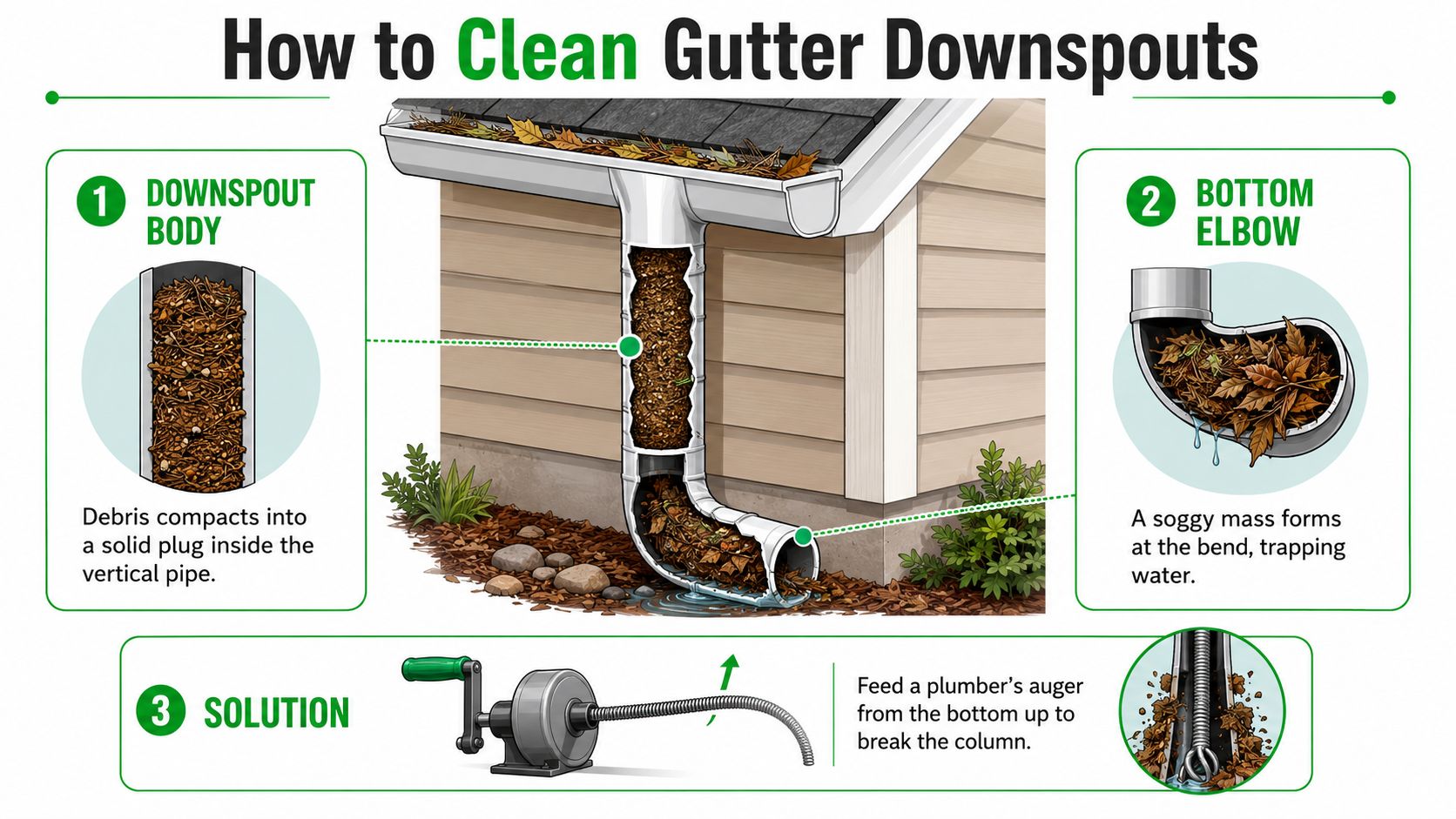
The vertical body
A vertical clog often consists of pine duff and shingle grit packed into a long column. If top-down flushing doesn't restore flow, remove the accessible bottom extension and feed a handheld auger upward. Work the cable steadily, retract it to bring debris out, then flush again.
Avoid jamming the cable aggressively. Downspouts are often made from thin metal or plastic, and a sharp turn can catch the auger. If the pipe sections are accessible, separating the lower elbow may give you a cleaner access point than forcing the tool from the roof.
The elbow
The first bend is a common collection point because wet debris changes direction there. A soggy mass can lodge against the inside radius, leaving enough space for a trickle but not enough for storm flow. Loosen the straps or connection hardware only when you can support the sections and reseal them properly afterward.
Feed the auger through the opened section, remove the compacted material, and run a controlled hose test. If flow improves immediately, the elbow was the restriction. If it doesn't, look farther downstream rather than repeating the same action.
The underground extension
A slow pop-up outlet, daylight exit, or buried extension points to a different problem. The blockage may be below grade, but so might a crushed pipe, separated fitting, insufficient slope, or restricted outlet. Home Depot guidance separates vertical downspout cleaning from underground drain diagnosis and recommends measuring water and timing how quickly it drains rather than assuming a clear vertical pipe means the whole system works. Home Depot's gutter cleaning guidance covers that distinction.
For a stubborn buried restriction, clear the outlet, flush from above, then consider a wet-dry vacuum, handheld drum auger, or sewer jetter. One technical recommendation places a jetter nozzle at least 1 foot into the opening before turning on water, which helps limit splashback and improves cutting action. If soggy ground appears beside the buried route, stop treating it as a simple clog. That may indicate a separated or crushed line.
A Seasonal Maintenance Rhythm That Actually Works
Flagstaff maintenance works better when it follows debris and weather rather than a generic calendar reminder. After the main fall pine drop, clear the outlets before a hard freeze. Trapped moisture can freeze inside a restricted fitting and leave the downspout less able to handle the next storm.
Late winter deserves a quick inspection, especially at north-facing elbows and discharge points near snow berms. Clear packed snow away from the outlet and look for signs that ice or shifting debris has stressed a seam.
Build the habit around local weather
Before monsoon activity, flush every downspout and watch the discharge. A slow outlet can redirect a large storm load against a foundation or saturate planting areas beside the home. A lighter midsummer check after strong wind events can catch fresh needles and cone fragments before they settle into a hard plug.
For most homes, two cleanings per year remains the widely used baseline, while heavily wooded or storm-exposed properties may need three to four cleanings per year. Properties near dense foliage, and some commercial buildings with higher debris loads, may require service quarterly or every 2 to 3 months. Lancaster PA Roofing's gutter maintenance guide describes how tree coverage and exposure compress the interval.
A practical Flagstaff rhythm is a deeper cleanup after fall needle drop and another before monsoon season, with visual checks after major weather. The exact dates can shift with the season. Consistency matters more than waiting for a dramatic overflow.
More property-care ideas are available in Pine Country's seasonal gutter maintenance guidance, especially if you're coordinating gutter, downspout, and exterior cleaning around a cabin or second home.
When to Call Pine Country for Help
DIY downspout work makes sense when the outlet is reachable, the home is a single story, the ladder can sit securely, and another person can spot it. The calculation changes quickly on a two-story home, a steep roof, or any property where a dropped tool could damage a deck, glass, delicate landscaping, or a finished entry.
Persistent overflow after careful augering and flushing is another clear handoff point. The restriction may be a crushed underground line, a separated fitting behind the gutter, a slope problem, or a connection blocked beyond normal reach. Continuing to force water or cable into that system can turn diagnosis into repair.
Safety and property care are part of the service
Professional equipment changes what can be inspected without improvisation. A crew may use commercial-grade vacuums, jetter capability, stabilizing equipment, and access methods suited to difficult ladder work. The aim isn't just to make the gutter look clean. It's to keep water away from fascia, walls, foundations, walkways, and plantings while limiting the chance of injury.
Pine Country Window Cleaning has served Northern Arizona since 1999 and was started by Flagstaff native David Kaminski. The company's exterior-care approach includes window cleaning with squeegees, ladders, poles, and pure-water brushes, along with removing, cleaning, drying, and reinstalling screens during window service. Cornell EHS guidance prohibits ladder use for certain high interior windows when the interior surface is more than 35 feet above the nearest interior floor or equivalent ladder-base surface, a useful reminder that height can make a task unsuitable for a homeowner. Cornell's window-washing safety program explains that threshold.
Pine Country's downspout cleaning service fits when the work requires safer access, thorough flushing, or equipment beyond a hose and hand auger. Paying for a planned service is easier to justify than dealing with an emergency caused by a fall, damaged gutter, or missed underground blockage.
Pine Country Window Cleaning can clean gutters and downspouts, flush the vertical runs, and verify that water discharges properly away from your Flagstaff or Munds Park property. Visit Pine Country Window Cleaning to request a free estimate or schedule exterior care with a crew that respects your windows, landscaping, fascia, and foundation.