
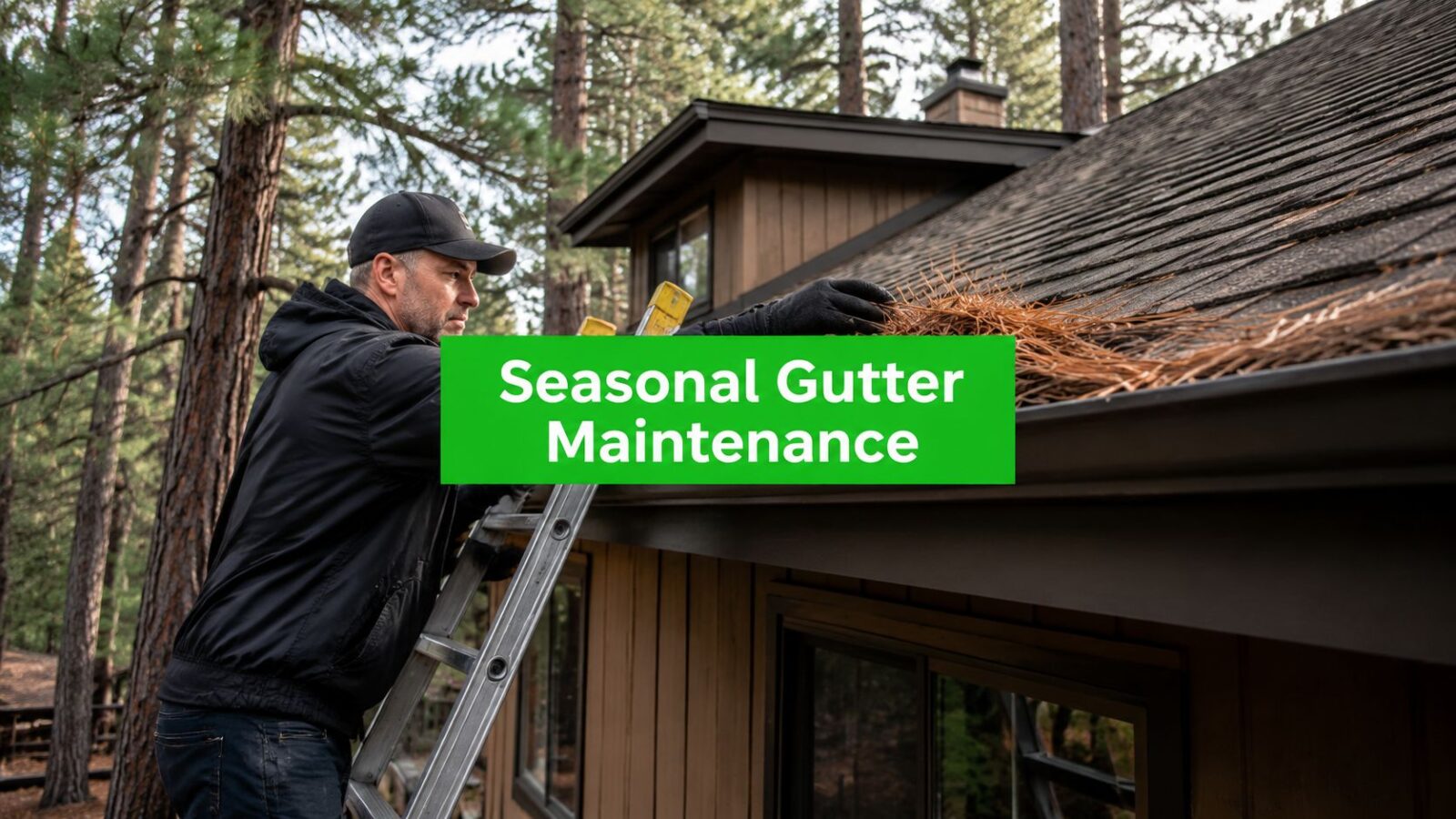
You can usually tell when a Flagstaff gutter is about to cause trouble before the first real problem shows up. Pine needles collect in the corners after a dry stretch. Monsoon rain hits hard and water sheets over the edge instead of moving through the downspouts. Then winter arrives, snow sits, the sun melts part of it in the afternoon, and the overnight freeze turns a small blockage into an ice problem.
That cycle is familiar across Flagstaff, Munds Park, Forest Highlands, and the neighborhoods tucked into the pines. Seasonal gutter maintenance here isn't the same as it is in lower, milder climates. Our altitude, tree cover, summer storms, and winter freeze-thaw swings demand a schedule that fits Northern Arizona, not a generic checklist copied from somewhere else.
Why Your Flagstaff Home Needs More Than a Fall Cleanup
A lot of Flagstaff gutter problems start the same way. You get through fall cleanup, winter seems quiet, then a summer storm hits hard and water jumps the gutter because pine needles, roof grit, and packed debris have been building for months.

That is why the usual spring-and-fall advice falls short in Northern Arizona. Up here, the problem is not just how much precipitation a home gets. The main issue is timing. Pine needles drop outside the leaf season, monsoon rain tests drainage all at once, and winter freeze-thaw cycles turn minor clogs into overflow, ice, and fascia damage.
I have been cleaning gutters around Flagstaff since 1999, and the pattern is consistent. A house under dense pine cover in Country Club or Forest Highlands can need attention well before a typical fall service window. A home with a shaded roofline on the north side may hold snow longer, drain slower, and show stress in different spots than the house next door.
Why generic advice falls short here
National advice is built for milder climates and broader schedules. Flagstaff homes deal with altitude, tree cover, steep rooflines, sudden monsoon runoff, and winter snow load. Those conditions change how debris collects and how fast a small blockage becomes a repair.
The trade-off is simple. Cleaning too rarely saves time in the short term, but it raises the chance of overflow at the worst moment. Cleaning on a schedule that matches your trees, roof design, and exposure usually costs less than fixing stained siding, damaged fascia, or drainage problems near the foundation.
Gutters also do not fail by themselves. Roof runoff, downspout discharge, window wells, screens, and ground drainage all work together, which is why a seasonal home maintenance checklist for Flagstaff properties is a practical place to start.
Practical rule: In Flagstaff, gutter maintenance should follow your lot conditions and weather exposure, not a generic calendar.
Local experience matters
Pine Country Window Cleaning was founded in Flagstaff in 1999 by David Kaminski. That local history matters because mountain homes require careful ladder setup, attention to steep grades, and a clear read on where debris collects first after wind, storms, and snow.
Property care matters just as much as cleaning. Screen removal, screen cleaning, and proper reinstallation all affect how a home sheds water and how easily developing problems are spotted during routine exterior service.
And once water starts going where it should not, the repair bill climbs fast. If you are thinking about prevention more broadly, this guide on how to protect your Ocala home from leaks makes the same point from another angle. Catch water issues early, before they spread into bigger structural and interior problems.
The Northern Arizona Four-Season Gutter Maintenance Plan
A Flagstaff maintenance plan works better when you stop thinking in two seasons and start thinking in four. The broad national rule is often one to three cleanings a year, but homes in high-pine areas like Flagstaff may need 3+ cleanings annually because pine needles clog gutters in summer and early fall, according to this discussion of climate-driven gutter schedules.

Spring thaw and runoff check
Once snow and ice have mostly cleared, inspect for compacted winter debris, loose hangers, separated seams, and downspouts that drained poorly through the cold months. Spring is the time to remove what winter left behind and make sure runoff can move freely before heavier warm-weather rain starts.
This is also when hidden damage shows up. Sagging sections, drips at joints, and stained fascia often become visible after the first proper flush.
Early summer before monsoon season
This is the step many homeowners miss. By early summer, roofs and valleys can already be feeding gutters with pine needles, catkins, pollen, cones, and grit. Left in place, that dry material turns into a heavy sludge once monsoon storms arrive.
For many Northern Arizona homes, this is the difference between a gutter system that handles a storm and one that overflows at every corner.
- Clear pine-heavy sections first. Rooflines under ponderosa pines usually load fastest.
- Test downspouts with water. A gutter can look open from above and still have a packed elbow below.
- Check splash zones. If runoff lands near walkways, patios, or the foundation, redirect it before monsoon rain exposes the weakness.
Skip the pre-monsoon check and you often end up diagnosing drainage problems during the storm instead of before it.
Fall cleanup before first snow
Fall is still essential. Deciduous leaves, pine needles, twigs, and roof grit collect quickly, and this is the cleaning most homeowners expect. In Flagstaff, the main goal isn't only preventing overflow during rain. It's making sure the system is open before snowmelt and overnight freezing begin.
A late fall service should include the full gutter run, every outlet, and the bottom discharge area. If the downspout empties into a buried line or extension, that part needs attention too.
Winter watch during freeze-thaw cycles
Winter maintenance is lighter, but it's not optional. You don't usually need a full cleaning in snow season unless debris was missed earlier. You do need watchfulness.
Look for these warning signs:
| Winter sign | What it often means |
|---|---|
| Icicles forming at one spot | Water may be backing up behind a blockage |
| Water near the foundation on sunny afternoons | Downspout discharge may be restricted |
| Ice collecting at the gutter edge | Poor flow or refreezing from trapped meltwater |
| One section sagging under weight | Debris and ice may be loading the run unevenly |
A winter watch is especially important for cabins, second homes, and properties that sit vacant between visits. Those are the homes where a small drainage problem can go unnoticed until stains, wood damage, or ice buildup make it obvious.
Your Essential Gutter Inspection and Cleaning Toolkit
The right toolkit starts with safety, not the scoop. Most DIY gutter problems happen before any debris is removed. People climb when the ladder angle is poor, the ground is uneven, or the weather has already made the job risky.
One safety point deserves more attention than it usually gets. Guidance on wet ladders is common, but few homeowner guides explain how to judge wind or hidden ice. One source notes that wind gust thresholds above 15 mph and ice bridge risk should be part of the decision before climbing, and it also cites OSHA safety briefs stating that 80% of ladder-related falls occur during adverse weather in that context, as discussed in this seasonal maintenance safety article.
Safety gear that isn't optional
If you're inspecting or cleaning your own gutters, start with the basics:
- Stable extension ladder: Use one tall enough that you're not standing on the top rungs or leaning sideways to reach the next section.
- Spotter on the ground: Especially important on sloped driveways, gravel, or mountain lots with uneven terrain.
- Non-slip footwear: Roof grit, pine pollen, and damp concrete make bad combinations.
- Work gloves and eye protection: Dry pine debris breaks apart easily, and flushing a clogged run can send grit back toward your face.
Cleaning tools that actually work
Skip improvised tools that scratch gutters or slow you down.
- Plastic gutter scoop: It removes packed debris without chewing up finishes.
- Bucket or debris bag: Keeps sludge off decks, walkways, and landscaping.
- Garden hose with trigger nozzle: Needed to flush each section and confirm downspout flow.
- Small hand brush: Helpful for corners and outlet openings where compacted material sticks.
If the clog is clearly in the downspout, a dedicated downspout cleaning service for blocked drainage lines is often safer and faster than wrestling with repeated hose backflow from a ladder.
What professionals bring that DIY often doesn't
Professional crews use more than ladders and gloves. High-reach poles, harness systems, controlled debris collection, and property-protection methods make a big difference on tall homes, steep roofs, and ornamental entries.
That same care carries into other exterior work. We don't clean windows with a rag, Windex, or newspaper. Professional window cleaning uses squeegees, ladders, poles, and pure-water brushes, and every service includes screen removal, screen cleaning, and reinstallation. The mindset is the same on gutters. Protect the home, work safely, and leave the property cleaner than it was.
A Step-by-Step Guide to Cleaning Gutters Safely
Good gutter cleaning is methodical. Rushed work leaves clogs in the outlets, stains on patios, and loose hardware that should've been caught before the next storm.

A solid field process includes a safety assessment, debris removal with a plastic scoop, flushing with a hose to verify downspout flow, and a structural inspection, and improper ladder safety accounts for 22% of DIY failures in the source covering that method, which you can review in this seasonal gutter cleaning schedule guide.
Step 1 Get the area below ready
Before the ladder goes up, protect what's below. Lay out a tarp where debris will fall. Move patio furniture, grills, potted plants, and anything breakable away from the work area.
That sounds simple, but it changes the whole job. You work cleaner, you track less sludge around the house, and you're less likely to stain concrete or crush landscaping.
Step 2 Set the ladder on solid ground
Pick level ground whenever possible. If the surface is sloped, soft, or broken, stop and reconsider the job. A safe setup matters more than finishing quickly.
Don't climb in wet, icy, or gusty conditions. In Flagstaff, a calm morning can become a windy afternoon fast, especially around exposed lots and taller rooflines.
If you have to lean your belt buckle past the side rail to reach the next section, the ladder needs to move.
A quick visual guide can help before you start:
Step 3 Remove debris the right way
Use a plastic scoop and work in controlled sections. Pull out the loose top layer first, then the compacted material beneath it. Pay special attention to outlet areas where the downspout connects. That's where pine needles and roof grit often pack tightest.
A few practical habits make the job go better:
- Start near problem zones. Corners, valleys, and outlets usually hold the worst buildup.
- Use your bucket often. Don't overload the gutter edge with debris piles.
- Watch for granules and shingle fragments. Those can point to roof wear that deserves a closer look.
If you also want the outer face of the gutter to look better after the cleanout, this article on expert techniques for gutter exteriors is a useful companion because interior clearing and exterior cleanup are two different tasks.
Step 4 Flush every run and test every downspout
Once the solids are out, run water through the gutter with a garden hose and trigger nozzle. Watch how it moves. It should head cleanly toward the outlet without ponding in the middle.
Then confirm the downspout is discharging. If water backs up at the outlet, drains slowly, or spills over the side, there's still a blockage somewhere in the drop or elbow.
Step 5 Inspect the system before you put the ladder away
The final pass is where you catch the issues that turn into repair calls later.
- Loose fasteners: Tighten what you can reach safely.
- Sagging sections: These often hold standing water and accelerate future buildup.
- Separated joints or leaks: Mark them for repair.
- Downspout discharge: Make sure water exits away from the home and not right at the foundation.
That inspection is what separates simple debris removal from actual seasonal gutter maintenance.
When to Call a Professional Gutter Cleaning Service
A lot of Flagstaff gutter problems do not show up on a calm afternoon. They show up during the first hard monsoon rain, after a wet snow, or on an icy morning when a blocked downspout turns the walkway into a slip hazard. By the time water is running over the front edge, the job is often bigger than a ladder, gloves, and a garden scoop.

Since 1999, I have seen the same pattern across Northern Arizona. Pine needles pack tight in valleys and outlets. Monsoon runoff finds every low spot. Snow sits, melts, and freezes again, which exposes loose brackets, separated joints, and sections that already had poor pitch. A simple cleaning can turn into repair work fast.
The price of service matters, but so does the cost of waiting. Analysts at these gutter service cost statistics found that professional cleaning costs can rise when systems are heavily clogged. That tracks with what we see in the field. Routine service is usually cheaper than dealing with overflow, fascia staining, and water dumping next to the foundation after the system has been neglected for a season or two.
Signs the job should be handed off
Call a professional if any of these conditions apply:
- Your home is two stories or higher. Ladder work gets less forgiving once you are above a single-story roofline.
- The roof is steep, icy, or broken up by dormers and valleys. Those rooflines collect debris in the places that are hardest to reach safely.
- You see sagging gutters, separated joints, or loose fasteners. Cleaning will not correct a support or alignment problem.
- Water spills over during an ordinary rain. That can mean compacted debris, a blocked downspout, poor slope, or more than one issue at once.
- The home sits under pines or near heavy needle drop. Needle buildup in Flagstaff often plugs outlets tighter than leaf debris does.
- It is a cabin, rental, or second home. Problems have more time to build when no one is there to catch the early warning signs.
- You are uneasy on a ladder. That is reason enough.
Professional service also makes sense when the goal is inspection, not just debris removal. A trained crew can clear the run, test flow, spot hidden leaks, and flag trouble at the roof edge before the next storm cycle. Homeowners looking for Flagstaff gutter cleaning and drainage checks often need that full evaluation, especially after winter snow load or before monsoon season starts.
Property managers have another layer to think about. Deferred gutter maintenance can show up as drainage complaints, wood rot, slippery entries, and tenant calls after a storm. Plumbing insights for property managers are useful on that broader maintenance side, especially when water issues overlap between roof drainage and the rest of the property.
Good gutter service is careful work. Ladder placement matters. Protecting shrubs and walkways matters. So does leaving the site clean and telling the homeowner what was found, what was fixed, and what needs repair before the next round of weather hits.
Protecting Your Home as an Investment
Gutters don't add much curb appeal conversation until they fail. Then they affect fascia, siding, soil, walkways, roof edges, and sometimes the interior. Seasonal gutter maintenance is one of those quiet jobs that protects the expensive parts of a home by keeping water where it belongs.
Industry benchmarks cited in this gutter maintenance analysis report that homes with properly maintained gutter systems experience 75% fewer roof leaks and 60% less foundation erosion than neglected homes, and that professional inspections identify early-stage damage at a 92% detection rate. Those numbers line up with what long-term property owners already know. Water management problems get more expensive the longer they sit.
What maintenance protects
A consistent plan helps protect more than the gutter itself:
| Home area | Why gutter performance matters |
|---|---|
| Roof edge and fascia | Backed-up water soaks vulnerable trim and attachment points |
| Foundation perimeter | Overflow and poor discharge can saturate soil near the house |
| Landscaping and walkways | Concentrated runoff erodes beds and stains or pits surfaces |
| Exterior appearance | Overflow leaves streaking, debris stains, and visible neglect |
The investment mindset
Cabins, second homes, and primary residences in Northern Arizona all benefit from the same mindset. Don't treat gutters as a once-a-year chore. Treat them as part of the drainage system that protects the structure.
That broader property view also helps owners and managers think more clearly about maintenance planning across trades. For rental or multi-unit oversight, these Plumbing insights for property managers are useful because gutters, drains, and water control all belong in the same prevention conversation.
Flagstaff native David Kaminski started this company in 1999, and that local perspective still matters. Mountain weather exposes weak maintenance routines quickly. A schedule built for pine debris, monsoon runoff, snow, and freeze-thaw cycles protects the home better than generic advice ever will.
If your gutters need attention before the next storm or snow cycle, Pine Country Window Cleaning can help with a free estimate and a schedule that fits Northern Arizona conditions.