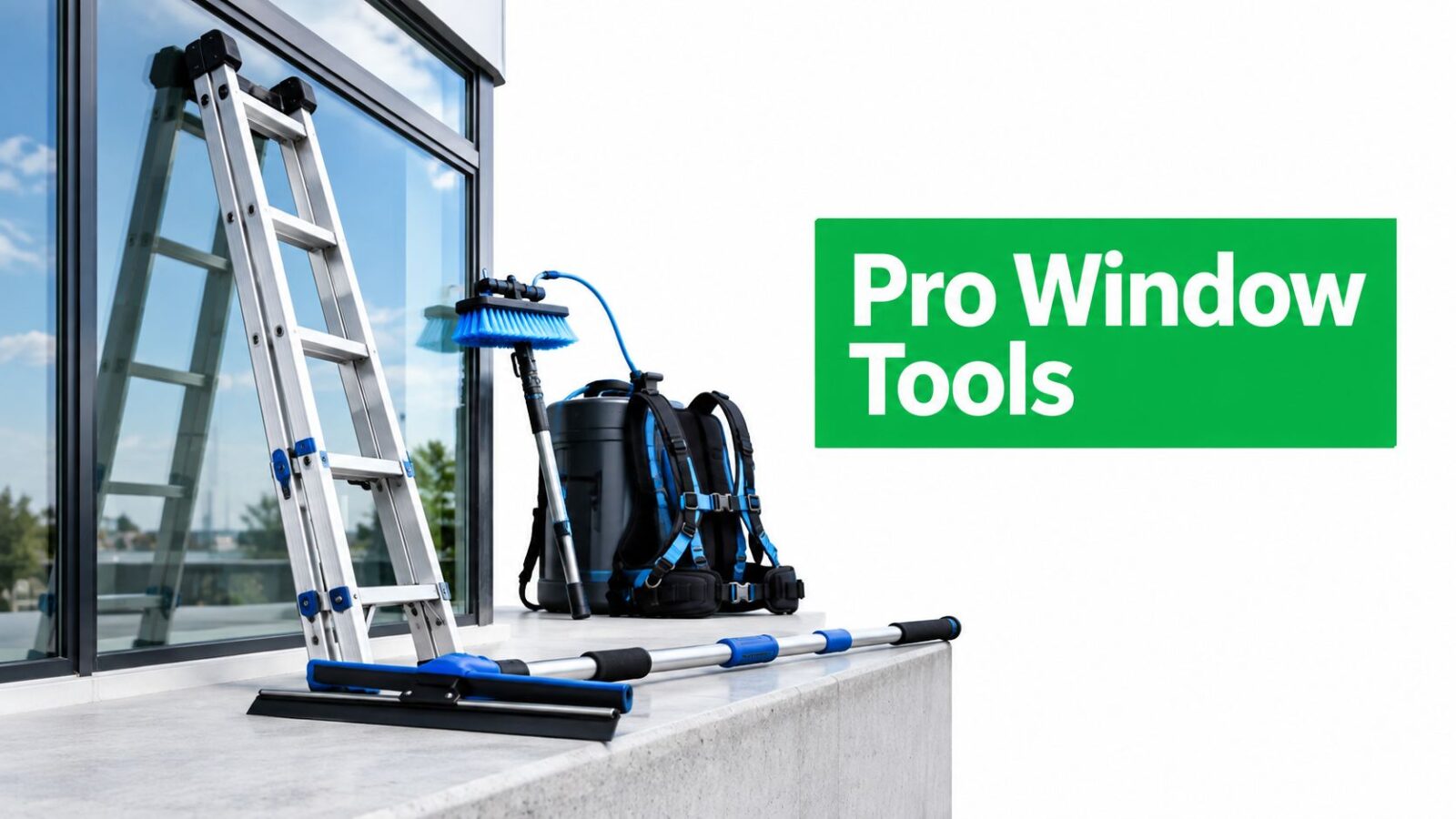
Professional window cleaners commonly use squeegees, extension poles, pure-water brush systems, ladders, commercial lifts, specialized cleaning solutions, screen-care tools, and safety and property-protection equipment. The right combination depends on window height, soil, access, weather, glass type, and the risk to the customer's property.
What do professional window cleaners use beyond a bucket and a cloth? The answer is a coordinated service system, not one magic tool. A trained technician may use a premium squeegee on interior glass, a pure-water pole for exterior panes, a ladder for an awkward architectural feature, or a lift for a commercial elevation. The method changes with the building.
Household shortcuts such as rags, Windex, or newspaper don't provide the control, reach, or protection required on demanding jobs. Professional work also includes removing and cleaning screens, inspecting frames and tracks, protecting landscaping and finishes, managing water, and communicating clearly with the customer.
Pine Country Window Cleaning offers a useful Flagstaff-based example. Founded by Flagstaff native David Kaminski, the company has operated since 1999 and uses squeegees, ladders, extension poles, pure-water brushes, and lifting equipment for homes, cabins, hotels, NAU facilities, dealerships, medical buildings, and other commercial properties. Its service model shows why equipment matters, but also why training, careful handling, and respect for the property matter just as much.
1. Professional Squeegees and Frames
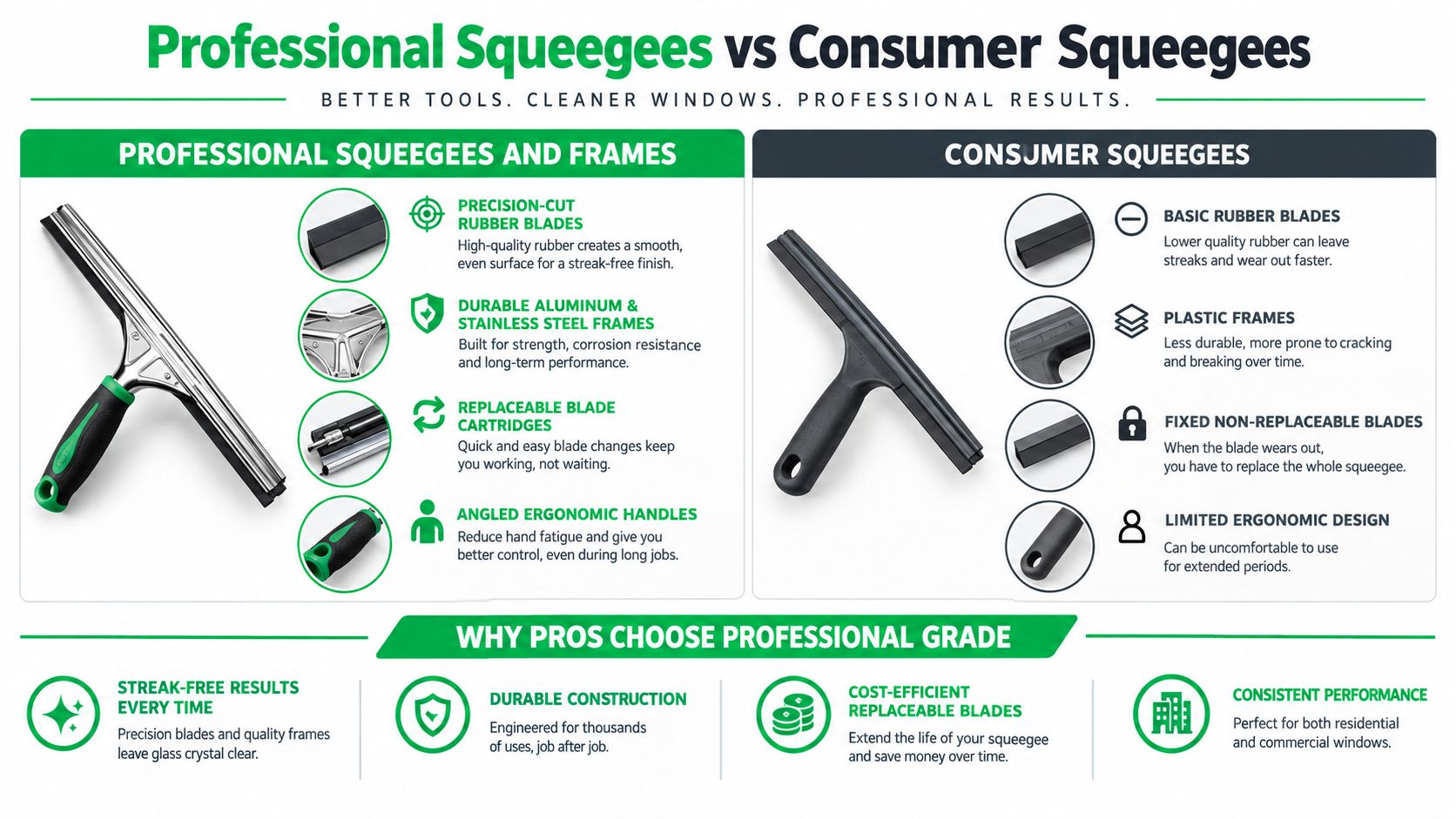
The professional squeegee remains the most dependable tool for controlled glass cleaning. Its job is simple, but the result depends on the details: a consistent rubber blade, a rigid frame, the right channel width, and a technician who can maintain steady pressure across the pane.
Professional window cleaning has a documented history stretching back more than a century. Squeegees were already used for window cleaning by 1918, and the modern professional standard changed in 1936, when Ettore Steccone introduced a lighter brass-handled squeegee with a single flexible blade. The history of the squeegee describes how that design replaced bulkier earlier tools and became popular among professionals.
Why the blade matters
A clean, flexible rubber blade pulls water and solution away in one controlled pass. A nicked, dirty, or hardened blade leaves trails, skips across the glass, or deposits water along the edge. Technicians clean the blade repeatedly during a job because a small piece of grit can affect the finish on the next pane.
Different windows call for different frame widths. A narrow squeegee gives better control around muntins and tight panes, while a wider channel covers broad commercial glass efficiently. Good technique includes keeping the blade at a controlled angle, often close to 45 degrees, and maintaining even contact without forcing the tool.
Pine Country uses professional squeegees on Flagstaff homes, cabins, hotels, and facilities where consistent presentation matters. The tool works especially well on interior glass and reachable exterior panes, but it isn't the right answer for every high window.
2. Extension Poles and Reach Systems
Extension poles solve a common access problem: reaching upper windows without immediately setting a ladder. A pole can carry a squeegee, brush, washer, or other attachment, but the technician still needs precise control. A long pole magnifies every movement, especially in wind or around rooflines.
On Flagstaff homes and cabins, telescoping poles can make second- and third-story work more efficient when the ground position is stable and the glass is accessible. They also reduce the number of ladder placements, which means fewer contact points near siding, landscaping, decks, and delicate exterior features.
Pole selection is a safety decision
Longer isn't automatically better. A heavy pole creates arm and shoulder fatigue, while a flexible pole can sway and make it difficult to control the tool at the window. Recent coverage of water-fed pole safety describes guidance developed through a 2025 UK research initiative, including body-position techniques called “Whole Body” and “Walk in and Away From the Wall.” The guidance on long water-fed poles highlights an important trade-off: a floppy pole can increase repetitive-motion strain even though it appears lightweight.
Technicians should check connections, threads, clamps, and sections before placing a pole over a customer's property. Wind also matters. In exposed Flagstaff conditions, a ladder or lift may provide better control than a long pole, depending on the elevation and window design.
For customers comparing equipment options, water-fed pole system rental information can help explain how this method differs from traditional hand cleaning.
3. Pure-Water Brush Systems
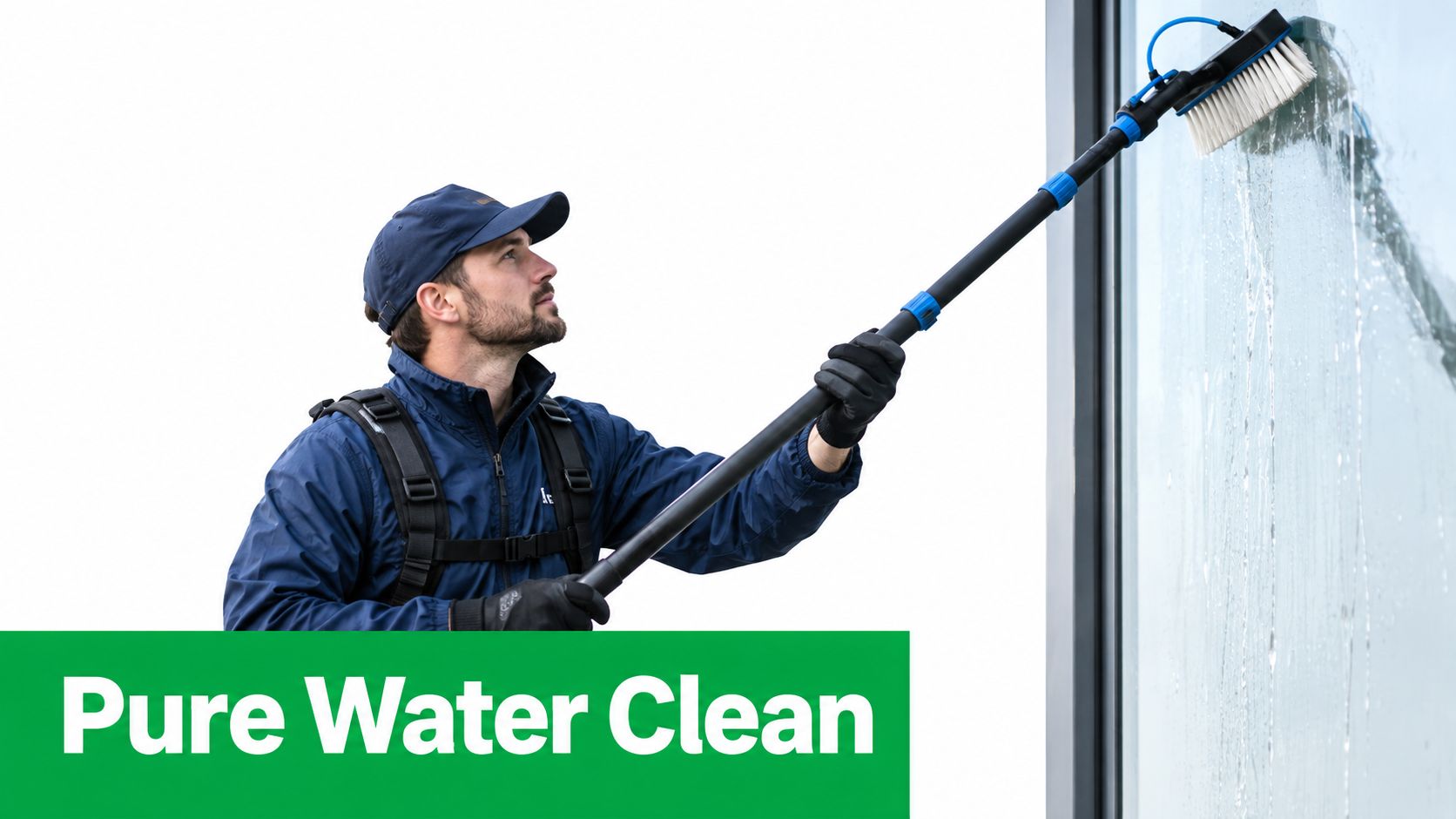
Pure-water systems use water that has been treated to remove dissolved minerals. The water travels through a hose to a soft brush mounted on a pole. The brush agitates dirt, and the purified water carries it away. Once the pane has been rinsed correctly, the remaining water can dry without leaving the mineral spotting associated with ordinary tap water.
This method is particularly useful for exterior glass that sits beyond comfortable ladder reach. It lets technicians work from the ground while cleaning frames, seals, and glass together. The approach also avoids the need to climb up and down repeatedly with a bucket and squeegee.
Where pure water works best
Pure-water brushes are effective for routine exterior maintenance, dusty frames, pollen, and many mineral-prone conditions in Northern Arizona. They're also useful for properties where ladder placement would disturb landscaping or create unnecessary contact with exterior finishes. Pine Country uses these systems for residential properties in Forest Highlands, Pine Canyon, and Munds Park, as well as commercial work.
The system still demands judgment. Brush softness must match the frame and glass, and the technician needs enough water flow to rinse away loosened soil without wasting water or creating runoff problems. Heavy construction debris, adhesive, paint, or etched mineral deposits may require a separate treatment.
Water-fed poles also carry physical trade-offs. A tall carbon-fiber pole reduces climbing, but its weight, stiffness, and leverage affect the technician's body. One industry source describes modern carbon-fiber poles commonly reaching 60 to 70 feet, making them practical for low- to mid-rise commercial work while reducing dependence on lifts and rope descent systems. This industry overview of water-fed poles also characterizes the method as a major productivity, safety, and training enhancer.
4. Commercial Lifting Equipment
Some windows sit beyond the practical range of hand tools and poles. Commercial buildings, hotels, campuses, medical facilities, and atriums may require boom lifts, scissor lifts, suspended systems, or specialized atrium equipment. The lift isn't there to make the job look more industrial. It provides a stable working position where a technician can reach the glass, inspect the surface, and control the cleaning tool.
A boom lift provides horizontal reach around obstacles and over uneven access areas. A scissor lift rises vertically and offers a broad, stable platform when the work is directly above the setup area. Atrium lifts address high interior spaces where ladders and ordinary exterior equipment aren't suitable.
Planning the lift before arrival
Lift work starts with a site plan. The crew must consider ground conditions, overhead obstructions, pedestrian routes, doors, loading areas, weather, and the building's operating schedule. Property managers may need to reserve parking areas or coordinate temporary access restrictions so the equipment can be positioned without disrupting tenants or customers.
Pine Country's commercial equipment includes boom lifts, scissor lifts, and an atrium lift for demanding commercial projects. Its commercial window-cleaning equipment overview explains how access equipment supports work at NAU facilities, hotels, dealerships, and other properties.
Operators also need documented training and daily pre-use inspections. Wind, temperature, and changing site conditions can make a planned lift unsuitable on a particular day. Moving equipment safely matters as much as cleaning the glass, and an appropriate low-deck equipment trailer can support safer transport and staging for equipment-heavy work.
5. Ladders and Ladder Safety Systems
Ladders remain useful because many residential windows are too high for comfortable ground work but don't justify a lift. They also provide access to dormers, porch windows, enclosed architectural features, and areas where a pole cannot be positioned with enough control.
A professional ladder setup includes more than the ladder itself. Stabilizers and stand-offs keep the rails away from gutters, siding, and fragile trim while improving the technician's working position. Level footing, careful angle selection, and a clear base area are essential, particularly on sloped ground, gravel, steps, or uneven terrain.
Protecting both technician and home
Ladder placement is one of the clearest differences between casual work and professional service. The technician needs to maintain a stable position without leaning excessively, while the customer's property needs protection from pressure, scratches, and accidental contact. A ladder can be perfectly sound and still be unsafe if it stands on unstable ground or rests against the wrong surface.
Pine Country's background-checked, OSHA-trained technicians use ladders on Flagstaff homes and cabins when site conditions call for them. Regular inspections should identify cracks, bends, damaged feet, loose hardware, or compromised sections before the ladder reaches a customer's property.
Practical rule: If a ladder position requires repeated stretching, twisting, or reaching sideways, the access plan needs to change. A pole, repositioning, or lift may be safer than forcing the tool to do a job it can't control.
Flagstaff's varied terrain and changing weather make setup especially important. A lighter ladder can reduce handling fatigue, but low weight shouldn't come at the expense of stability or the correct working height.
6. Professional Cleaning Solutions and Water Treatment
Pure water is excellent for many exterior maintenance jobs, but it isn't a universal solvent. Professionals use specialized solutions when glass carries grease, construction residue, adhesive, insect debris, heavy soil, or mineral deposits that need targeted treatment.
A professional solution may contain a controlled surfactant that helps loosen soil and improve glide. Other products are designed for mineral deposits or post-construction residue. The technician's responsibility is to select a product appropriate for the glass, frame, coating, and surrounding materials, then rinse thoroughly so the cleaning agent doesn't leave a film.
Use chemistry strategically
Routine maintenance often doesn't require aggressive chemistry. On a well-maintained exterior, purified water may provide a clean finish while reducing solution handling. A heavily soiled pane, however, may need a traditional scrub and squeegee process before a final rinse.
Northern Arizona properties can also face mineral-related problems from irrigation, runoff, or hard water. Long-standing deposits may bond to the glass or cause etching, so scrubbing harder isn't a safe solution. A technician needs to distinguish ordinary soil from damage that requires restoration or a different recommendation.
Pine Country uses professional solutions for post-construction work on Flagstaff homes and commercial projects. Its soft-water window-cleaning service information describes an approach suited to mineral-sensitive cleaning conditions.
Safe handling matters on every job. Concentrates should be mixed according to the manufacturer's directions, stored securely, and kept away from surfaces that could be damaged. Biodegradable options are preferable when they meet the cleaning requirement, but environmental claims shouldn't replace correct application and runoff control.
7. Screen Removal, Cleaning, and Reinstallation Service
Clean glass can look dirty again when dusty screens, tracks, and frames remain in place. Screens collect pollen, insects, airborne debris, and moisture. When the screen stays dirty, that material can transfer back toward the glass or remain visible from inside the room.
A complete screen service starts with careful removal. The technician should identify the correct tabs, clips, or direction of movement rather than forcing the frame. Once removed, the screen can be inspected for bent corners, loose mesh, damaged spline, and frame distortion before cleaning.
The service step customers can verify
Industry-style screen-care guidance recommends a low-pressure rinse, a soft brush or vacuum brush attachment, mild soap when needed, and complete air-drying before reinstallation. This screen-maintenance guide also emphasizes cleaning the tracks while the screens are out and reinstalling screens only after they're fully dry.
Pine Country Window Cleaning includes screen removal, screen cleaning, and reinstallation with every service. That process is particularly useful for Flagstaff cabins and seasonal properties, where pollen and insects can build up between visits.
A technician should communicate any screen damage rather than hiding it during reinstallation. A screen that no longer fits correctly can rattle, leave gaps, or press against the glass. Soft brushes and controlled water pressure protect the mesh better than aggressive scrubbing.
Customers who want to understand screen-care accessories can also review these screen cleaning wipes, although a professional service still depends on careful removal, inspection, drying, and refitting.
8. Safety Gear and Fall Protection Systems
The answer to “what do professional window cleaners use” must include equipment that never touches the glass. Work at height requires appropriate protective gear, planning, and inspection. Depending on the job, that can include a harness, lanyard, approved anchor points, hard hat, eye protection, gloves, and slip-resistant footwear.
Fall protection isn't a substitute for choosing a better access method. A technician should first determine whether the window can be cleaned from the ground, with a ladder, from a lift, or through another controlled system. Harnesses and lanyards must be compatible with the work setup and inspected for damage before use.

Safety includes the working environment
Technicians also need to manage hoses, poles, buckets, lift controls, electrical hazards, public pathways, and changing weather. Wind can turn a long pole into a difficult lever. Cold can affect grip and dexterity. Sun and heat can change how quickly solution dries on the glass.
Pine Country identifies its technicians as background-checked and OSHA safety-trained, serving both residential properties and commercial facilities such as NAU buildings. For commercial customers, visible safety practices demonstrate that the crew is managing risk rather than improvising around height.
A safety program should include job-specific procedures, regular equipment checks, documented training, and a clear decision to stop work when conditions become unsafe. The safest professional doesn't rush to finish a pane that should have been accessed differently.
9. Customer Property Care and Protection Systems
Professional cleaning should leave the property better, not just leave the glass clear. Technicians work around landscaping, furniture, flooring, siding, stone, paint, screens, gutters, and customer belongings. Property protection therefore belongs in the equipment standard alongside the squeegee and pole.
Protection can include coverings, towels, pads, hose management, careful ladder placement, and controlled water flow. Interior work may require attention to floors, sill areas, curtains, furniture, and paths through the home. Exterior work may require moving or covering furniture, keeping water away from sensitive finishes, and avoiding unnecessary pressure on plants.
Treat the property as part of the job
Before work begins, technicians should identify fragile areas and note existing conditions. Photographs can help document property condition, but the more important habit is active observation. A ladder shouldn't rest against a surface because it's the nearest place to set it, and a hose shouldn't cross a walkway without a plan to keep people safe.
Pine Country technicians work on visually sensitive properties in Forest Highlands and Pine Canyon, where landscaping, privacy, and exterior finishes matter to owners. Commercial customers also need crews that protect entrances, customer routes, displays, and operating areas while maintaining an efficient workflow.
Property care is not a courtesy added after cleaning. It determines how the crew stages equipment, moves through the site, controls water, and checks the property before leaving.
Communication strengthens that protection. Customers should know what the crew plans to move, cover, access, or avoid. For storage and transport materials, crews may use protective items such as removal and storage blankets, provided they're clean, suitable, and used without marking the customer's surfaces.
10. Professional Communication, Scheduling, and Customer Service Systems
A professional window cleaner uses communication tools as deliberately as physical equipment. Clear estimates, appointment confirmation, arrival updates, scope notes, and completion checks prevent misunderstandings before they become service problems.
This matters even more for second homes, cabins, short-term rentals, and commercial properties. An owner in Pine Canyon or Munds Park may not be present during the visit. A property manager may need the work coordinated around guests, tenants, deliveries, or business hours. A facility manager may require access procedures, documentation, and a defined completion window.
Reliable service is part of the result
Good scheduling begins with an accurate scope. The company needs to understand the number and type of windows, access restrictions, screens, high work, post-construction debris, and any special glass concerns. A rushed estimate can lead to rushed work or unexpected changes on site.
Pine Country Window Cleaning has served Northern Arizona since 1999 and was founded by Flagstaff native David Kaminski. Its local context includes residential homes and cabins as well as hotels, NAU facilities, car dealerships, medical buildings, and other commercial properties. That range requires communication that works for both a homeowner and a facilities team.
Customers should expect courteous technicians, professional presentation, responsive scheduling, clear pricing, and a practical way to raise concerns. A satisfaction guarantee only has value when the company communicates clearly and responds when a customer identifies an issue.
The best service systems also record screen condition, access notes, weather concerns, property sensitivities, and recurring preferences. Those records help the next visit run more smoothly and make consistent care possible.
Top 10 Professional Window Cleaning Tools & Systems
| Item | Core features | Performance / Quality | Best for (Target) | Value proposition / USP | Cost & considerations |
|---|---|---|---|---|---|
| Professional Squeegees and Frames | Precision rubber blades, replaceable cartridges, aluminum/stainless frames, multiple widths | Streak-free, consistent finish, long-lasting | Residential & commercial windows, multi-story facades | Reliable, efficient finish that reduces rework | Mid–high upfront cost; annual blade replacement; training required |
| Extension Poles and Reach Systems | Fiberglass/aluminum poles, 12–60+ ft, threaded attachments, adjustable sections | Faster, safer than ladders for many jobs; wind-sensitive at height | Ground-level to 3rd‑story, cabins, commercial windows | Increases speed & safety; reduces ladder use | Training & practice needed; storage and wind limitations |
| Pure‑Water Brush Systems | DI/RO purification, soft-bristled brushes, pole-compatible delivery systems | Spot‑free, chemical‑free results; gentle on glass | Premium residences, hard‑water areas, eco‑minded clients | Eliminates mineral spotting; reduces follow‑ups | Higher equipment & cartridge costs; water logistics for large jobs |
| Commercial Lifting Equipment (Boom/Scissor/Atrium) | Boom/scissor/95-ft atrium lifts, OSHA‑certified, hydraulic systems | Reaches high/easily accesses complex features; stable platforms | Hotels, campuses (NAU), medical buildings, high‑rise | Enables safe, efficient commercial high‑elevation work | Very high capital & maintenance costs; operator certification; weather dependent |
| Ladders and Ladder Safety Systems | Reinforced aluminum/fiberglass, stabilizers, non‑slip feet, stand‑offs | Precise access for detail work; portable but higher risk | Residential, tight/confined areas, detailed cleaning | Cost‑effective and essential where poles/lifts can't reach | Safety risks if misused, potential property damage; OSHA training required |
| Professional Cleaning Solutions & Water Treatment | Concentrates, biodegradable surfactants, mineral‑removal agents, pH‑balanced | Effective on heavy soil and post‑construction debris | Post‑construction projects, heavily soiled commercial windows | Powerful, cost‑efficient cleaning for tough stains | Handles require proper mixing, storage, disposal; potential residue if not rinsed |
| Screen Removal, Cleaning & Reinstallation Service | Safe removal, mesh/frame cleaning, damage inspection, precise reinstallation | Improves indoor air quality and window function | Residential cabins, seasonal maintenance, rental properties | Full‑service convenience; detects & prevents screen issues | Adds time to visits; some screens may need replacement |
| Safety Gear & Fall Protection Systems | OSHA‑compliant harnesses, lanyards, anchors, PPE, inspection protocols | Reduces injury risk, ensures compliance, builds client confidence | All high‑elevation work, commercial contracts | Protects workers, lowers liability, required for many jobs | Significant investment; ongoing inspections, training & replacement |
| Customer Property Care & Protection Systems | Protective tarps, ladder stabilizers, water management, condition documentation | Prevents damage, preserves curb appeal, reduces claims | Properties with landscaping, high‑value residential & commercial | Demonstrates respect; differentiates service; builds trust | Adds service time; requires standardized protocols & training |
| Professional Communication, Scheduling & Customer Service | Free estimates, online/phone scheduling, responsive updates, 100% guarantee | Higher satisfaction, fewer disputes, repeat business | Second‑home owners, rental managers, commercial clients | Differentiator that improves booking, retention and referrals | Investment in systems and staff training; must be consistently executed |
Match the Equipment to the Job
Professional window cleaning is a matching exercise. The technician chooses tools based on the height, access route, soil, glass, surrounding property, weather, and the finish the customer expects. A squeegee may be the best option for controlled interior work, while a pure-water brush and pole may be the better choice for an exterior elevation with clear ground access.
Squeegees handle precision. They give the technician direct control over solution removal and finishing. They're especially effective on interior glass, reachable exterior panes, detailed divided-light windows, and heavily soiled surfaces that need scrubbing before the final pull.
Poles and pure-water brushes handle reach. They can clean many high exterior windows from the ground, reducing ladder dependence and keeping technicians away from unnecessary climbing. The trade-off is that pole weight, stiffness, wind, water flow, and body position all affect control. The lightest pole isn't automatically the safest choice if it flexes excessively or creates repetitive strain.
Ladders solve specific access problems. They remain practical for residential windows, dormers, porch glass, and architectural features that a pole can't reach cleanly. They also create direct property and fall risks when placed carelessly, so stabilizers, stand-offs, level footing, inspections, and trained technicians are essential.
Lifts serve complex commercial heights. Boom lifts, scissor lifts, and atrium lifts provide working positions for buildings, campuses, hotels, medical facilities, and other sites where ground-based tools aren't enough. Their use requires planning around weather, surfaces, overhead hazards, pedestrian traffic, parking, and building operations.
Specialized solutions address difficult soil. Pure water is often suitable for exterior maintenance, but construction residue, grease, adhesive, heavy deposits, and mineral buildup may require professional cleaning solutions or restoration methods. More scrubbing isn't always better, particularly when deposits have etched the glass.
Screens belong in the service plan, not at the bottom of it. A complete visit should include removing screens carefully, cleaning mesh and frames, inspecting for damage, cleaning tracks while the screens are out, allowing them to dry fully, and reinstalling them correctly. Pine Country Window Cleaning includes screen removal, cleaning, and reinstallation with every service.
Safety and property care are also equipment standards. Harnesses, lanyards, hard hats, non-slip footwear, ladder stabilizers, lift inspections, protective coverings, hose management, and careful staging all support the final result. A clean window doesn't justify damaged landscaping, marked siding, wet flooring, or an unsafe work position.
Before choosing between DIY work and a trained professional, assess the actual job. Check the window height, ground access, glass condition, screen condition, weather, mineral deposits, nearby landscaping, interior furnishings, and the consequences of a fall or property mistake. If the work involves multi-story exteriors, awkward access, high lifts, fragile finishes, or persistent deposits, Pine Country Window Cleaning is a local option for residential and commercial service in Flagstaff and Northern Arizona.
Pine Country Window Cleaning uses professional squeegees, ladders, extension poles, pure-water brush systems, commercial lifts, screen care, and property-protection practices for homes, cabins, and commercial buildings. Visit Pine Country Window Cleaning to request a free estimate or schedule service in Flagstaff, Munds Park, and across Northern Arizona.