
You're standing in a Flagstaff driveway, looking at a set of tall windows, a ladder, and a squeegee, wondering whether this work could become a dependable living. Maybe you want an outdoor trade instead of a desk job. Maybe you're comparing a technician position with starting a small service business. The practical questions are straightforward: Is window cleaning a good job, does it pay enough, and can you do it safely for the long term?
The honest answer depends on which kind of window cleaning you mean. Residential work, storefront routes, commercial buildings, and high-rise access jobs can have very different schedules, risks, training requirements, and earning ceilings. A person who dislikes heights may enjoy careful home service, while another worker may prefer commercial routes or specialized access equipment.
Professional window cleaning also involves more than making glass look clear. A good technician protects floors, frames, screens, landscaping, furniture, and the customer's privacy. The work rewards people who are dependable, observant, physically capable, and comfortable speaking with homeowners or facility managers.
Pine Country Window Cleaning offers one local example of how the trade can develop over time. The company was started by Flagstaff native David Kaminski and has been in business since 1999, serving homes, cabins, businesses, hotels, NAU facilities, medical buildings, dealerships, and taller properties. That range matters because a worker's experience can change as the work mix changes.
This guide separates the job into its real parts, then compares pay, work settings, equipment, safety, and Flagstaff conditions. Use it to decide whether you'd rather apply to an established company, learn the trade before operating independently, or choose another hands-on occupation.
Introduction: Is Window Cleaning Worth Your Time
A first day on a window-cleaning crew can show the appeal quickly. You arrive at a Flagstaff home, check access, protect the work area, remove screens, and follow a repeatable process. By the end, the glass is clearer, the screens are back in place, and the customer can see the result without a technical explanation.
That visible change makes the work satisfying. You can compare a pane before and after, then leave the property in better condition. The setting also changes. A residential visit may call for careful screen handling and respect for floors and furnishings. A storefront route rewards pace and consistency. Commercial or high-rise work may offer different pay and advancement, while bringing stricter safety procedures and specialized access equipment.
Professional tools shape the experience. Squeegees, extension poles, pure-water systems, and properly selected ladders reduce wasted effort, but they do not replace judgment. A technician still has to protect frames, screens, landscaping, and the customer's belongings.
The trade has demanding sides. You may carry equipment, kneel beside frames, work outdoors, climb when access requires it, and adjust plans for weather. Customer service matters because homeowners and facility managers are trusting you around glass, walls, floors, and private spaces.
A useful test: If you want outdoor work, visible results, and regular customer interaction, window cleaning may fit. If you need a fixed indoor schedule and dislike physical repetition, another occupation may suit you better.
The U.S. window-cleaning sector includes residential, commercial, and specialty services, with employment spread across those segments. Industry workforce and pay context In Flagstaff, the mix of homes, cabins, businesses, hotels, medical buildings, and taller properties can affect which opportunities are available. Local demand, seasonal conditions, equipment, and risk all influence satisfaction and earning potential.
The useful question is which part of the trade matches your abilities, location, income needs, and comfort with risk.
What Professional Window Cleaning Really Involves
A Flagstaff homeowner may open the door to a technician carrying a squeegee, scrubber, pole, or ladder. Each tool serves a different situation. The technician first considers the glass, height, access, surrounding surfaces, and weather, then chooses a method that controls both the cleaning result and the risk to the property.
A squeegee and scrubber provide close control on accessible windows. An extension pole reaches from a safer position, while a rated ladder suits certain low-risk areas. For exterior glass, a pure-water brush system can wash from the ground. Pure water contains very little mineral content, so it dries with less spotting than ordinary tap water after the brush agitates the glass and frames. How pure-water systems work for professional glass cleaning
A home visit follows a practical sequence:
- Inspect the property: Identify window types, access points, fragile surfaces, screens, landscaping, and areas needing special care.
- Choose the method: Match the tools and access equipment to the height, condition, and location of each window.
- Clean frames and glass: Remove loose debris, wash the surface, and remove water and soil with the appropriate tool.
- Handle screens carefully: Take out each screen, clean it separately, and check for damage before reinstalling it.
- Finish the home safely: Let wet screens dry upright with airflow on both sides before replacing them. Professional screen-cleaning guidance
Screen care often separates careful work from a rushed job. A bent frame, trapped moisture, or poorly seated screen can cause trouble after the glass looks clear. A detailer treats a vehicle as a complete surface, not just a dirty panel. Window cleaners use the same care around frames, floors, walls, furnishings, and landscaping.
Why the system matters
The craft shows in the finish. Clean edges, dry screens, protected surfaces, and consistent results give a homeowner confidence that the technician respected the property. In commercial work, that same care supports a professional appearance for staff, visitors, and customers.
Pure-water brushes can keep exterior work on the ground up to five stories, according to the equipment guidance. Ground-based outdoor glass cleaning with water-fed poles That can make the work feel more controlled, while close squeegee work builds the hand skill needed for detail-focused residential jobs. Together, these methods turn window cleaning into a trade built on observation, precision, and repeatable care.
How Much Window Cleaners Make and What Drives Pay
A residential technician in Flagstaff may spend a morning protecting floors, cleaning screens, and detailing glass in a cabin. A commercial technician may follow a recurring storefront route. A high-rise specialist works with access systems and fall protection. All three are called window cleaners, but their pay, risks, and daily satisfaction can differ sharply.
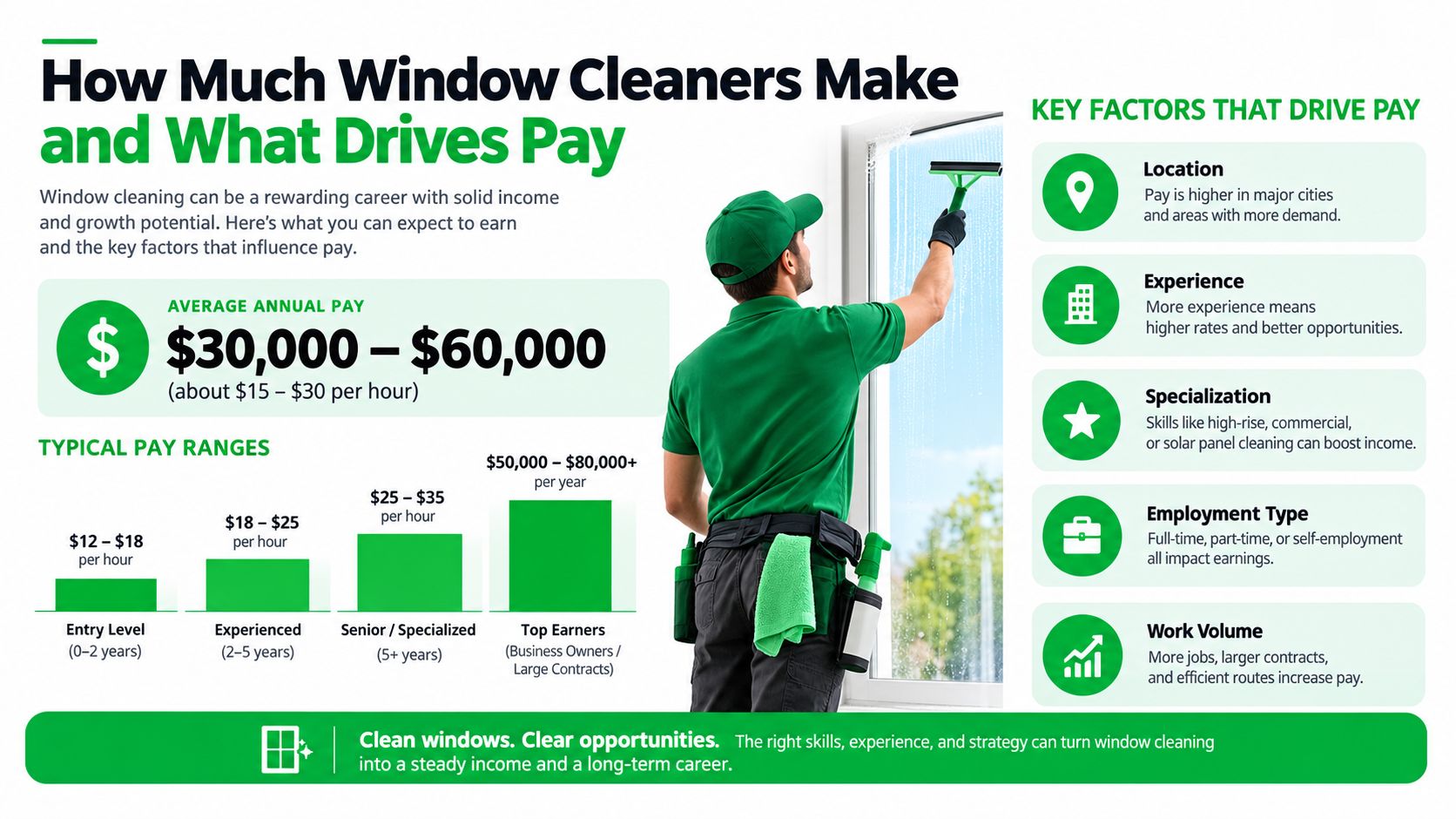
One industry source estimated average U.S. window-cleaning pay at $37,665 per year, or about $18 per hour. It also reported that 89.4% of workers were men, with an average age of 48. U.S. window cleaning industry statistics and workforce profile These figures describe the occupation broadly. They are a starting point, not a promise of what an individual technician will earn.
Reported pay ranges show why the work segment matters. Standard residential and commercial roles often begin around $12 to $25 per hour, while experienced high-rise specialists can reach roughly $30 to $35 per hour in some markets. Reporting on window-washer pay and high-rise work ZipRecruiter reports high-rise specialists earning around $82,000 per year, with top major-market roles reaching $100,000 or more. Window cleaner salary variation by specialization and location
What moves a technician upward
The main pay drivers are access difficulty, property type, technical skill, location, and responsibility. A recurring storefront route rewards dependable timing and efficient work. Larger commercial properties may require lift operation, scheduled maintenance, and coordination with a facility manager. High-rise and rope-access assignments add formal training, fall protection, and strict equipment checks. Those requirements can raise the earning ceiling because fewer workers can accept the responsibility.
Certification alone does not guarantee higher pay. Industry reports have described a 40% to 80% wage premium for some certified high-rise and rope-access technicians. The actual result depends on demand, verified qualifications, employer structure, and the tasks the technician can perform safely.
Geography changes the calculation. Salary analysis identifies California, New York, Oregon, and dense urban centers as higher-paying markets than the national average. Flagstaff has a different mix, with residential, cabin, hospitality, campus, and commercial work but limited high-rise demand. Someone pursuing the highest vertical-access wages may need to travel or relocate. Someone who values outdoor work, local relationships, and varied properties may find the Flagstaff market a better fit.
Industry conditions also shift with construction and maintenance cycles. One analysis reported a 4.9% CAGR decline from 2019 to 2024 for the U.S. window washing industry. The broader janitors and building cleaners category is projected to grow 2% from 2024 to 2034, with roughly 351,300 openings per year, mostly from replacement needs. Occupation outlook and replacement openings
For commercial pricing, this guide to pricing commercial window cleaning shows why contract size, access, service frequency, and labor requirements matter more than counting panes. In practice, those same factors help explain whether a route produces steady income or only looks profitable on paper.
Types of Window Cleaning Work Compared
The “good job” question changes with the building. Residential and cabin work centers on careful service inside occupied homes. Storefront routes reward speed, consistency, and efficient scheduling. High-rise work requires formal access systems, specialized training, and greater tolerance for exposure.
| Work Type | Typical Skills and Equipment | Pay and Risk Profile |
|---|---|---|
| Residential and cabin | Squeegees, scrubbers, ladders, extension poles, pure-water brushes, and careful screen removal and reinstallation | Roughly $12-$25/hr, with physical work, customer-care duties, and moderate access risk |
| Storefront and low-rise commercial | Route planning, fast squeegee work, poles, pure-water systems, and recurring-service discipline | Often steady entry-level to moderate pay, with repetitive work and lower access risk on low buildings |
| High-rise and specialty commercial | Fall protection, lifts, rope-access systems, advanced equipment, and strict procedures | Roughly $30-$35/hr+, with a higher earning ceiling and greater training, liability, and access risk |
Residential and cabin service
A residential technician works around someone's home, so the job includes more than making glass clear. Floors, trim, furniture, landscaping, and screens all need protection. Removing a screen carefully and returning it to the correct window can matter as much as the wash itself.
Cabins and second homes may bring seasonal scheduling, large glass areas, and difficult access. In Flagstaff, those properties can make the work varied, while weather and travel between locations affect the day's pace.
This path fits someone who enjoys a finished project and regular customer contact. Homeowners notice punctuality, clean work areas, and respectful handling of their property.
Storefront and commercial routes
Storefront work follows a steadier rhythm. A technician may service the same businesses on a recurring schedule, work around customers and employees, and clean efficiently without interrupting operations. Managers usually value reliable timing and a consistent appearance more than elaborate conversation.
Travel time directly affects the route's earning power. Scheduling systems and field-service methods can cut travel time for field techs, leaving more of the day for paid stops when several commercial accounts are nearby.
High-rise and rope-access work
High-rise cleaning belongs to a more specialized segment. Workers may use lifts, rope-access systems, or other mechanical equipment, and they must follow detailed site and fall-protection procedures. Historical reporting describes occupational hazards involving wet surfaces and falls from ladders, scaffolding, and ledges, although those accidents are not described as common. Window-cleaner occupational hazards
The best fit depends on the worker's priorities. Residential service offers varied properties and closer customer relationships. Commercial routes provide repetition and recurring schedules. High-rise work can offer higher pay, but it demands more training, judgment, and comfort with height.
Skills, Training, Safety, and Liability Essentials
A new technician arrives at a Flagstaff home with tall windows, uneven ground, and delicate landscaping. The job is not just a test of reach. It requires choosing a method that protects the worker, the glass, the screens, and the property. Ladders can be appropriate when they match the height and surface, are inspected, positioned securely, and used with a clear work plan.
Weather and site conditions can change that decision. Wet surfaces, wind, electrical hazards, sloped ground, and fragile plants each require a different setup. As covered above, water-fed poles can reduce ladder exposure for suitable exterior work. Knowing when to stay on the ground is part of professional judgment.
Training changes the work
A new worker needs more than squeegee technique. Useful training includes:
- Ladder selection and setup: Select equipment for the height and surface, maintain stable contact, and keep the work zone clear.
- Fall protection: Learn equipment requirements, anchor points, inspection procedures, and operating limits before working at height.
- Lift operation: Understand the rules for boom lifts, scissor lifts, and other mechanical access equipment.
- Rope access: Treat this as specialized work requiring formal instruction, equipment knowledge, rescue planning, and disciplined procedures.
- Property protection: Manage hoses, poles, ladders, screens, and cleaning water so the home or business remains protected.
Screen care also belongs in this training. A screen can bend, tear, or fall if it is forced into place or handled without support. Technicians should label or separate screens when needed, keep them away from foot traffic, and check that frames are secure before finishing the job.
OSHA expectations matter because employers and clients need evidence that workers can perform tasks safely. Background checks, clear communication, incident reporting, and insurance become more important as a technician enters occupied homes, commercial facilities, or supervisory roles.
An employee generally works within an employer's safety program and insurance structure. An owner-operator carries more responsibility for vehicle coverage, general liability, workers' compensation decisions, equipment maintenance, contracts, and customer complaints. Ownership may provide a higher income ceiling, while also adding administrative and financial duties.
Safety principle: The professional question is not “Can I reach the window?” It is “Can I reach it with the right method, equipment, training, and property protection?”
For practical guidance, review ladder safety requirements for window cleaning. Good training does not remove every physical challenge. It helps technicians make deliberate choices before a small mistake becomes an injury, damaged screen, or costly claim.
Pros and Cons and Flagstaff Market Realities
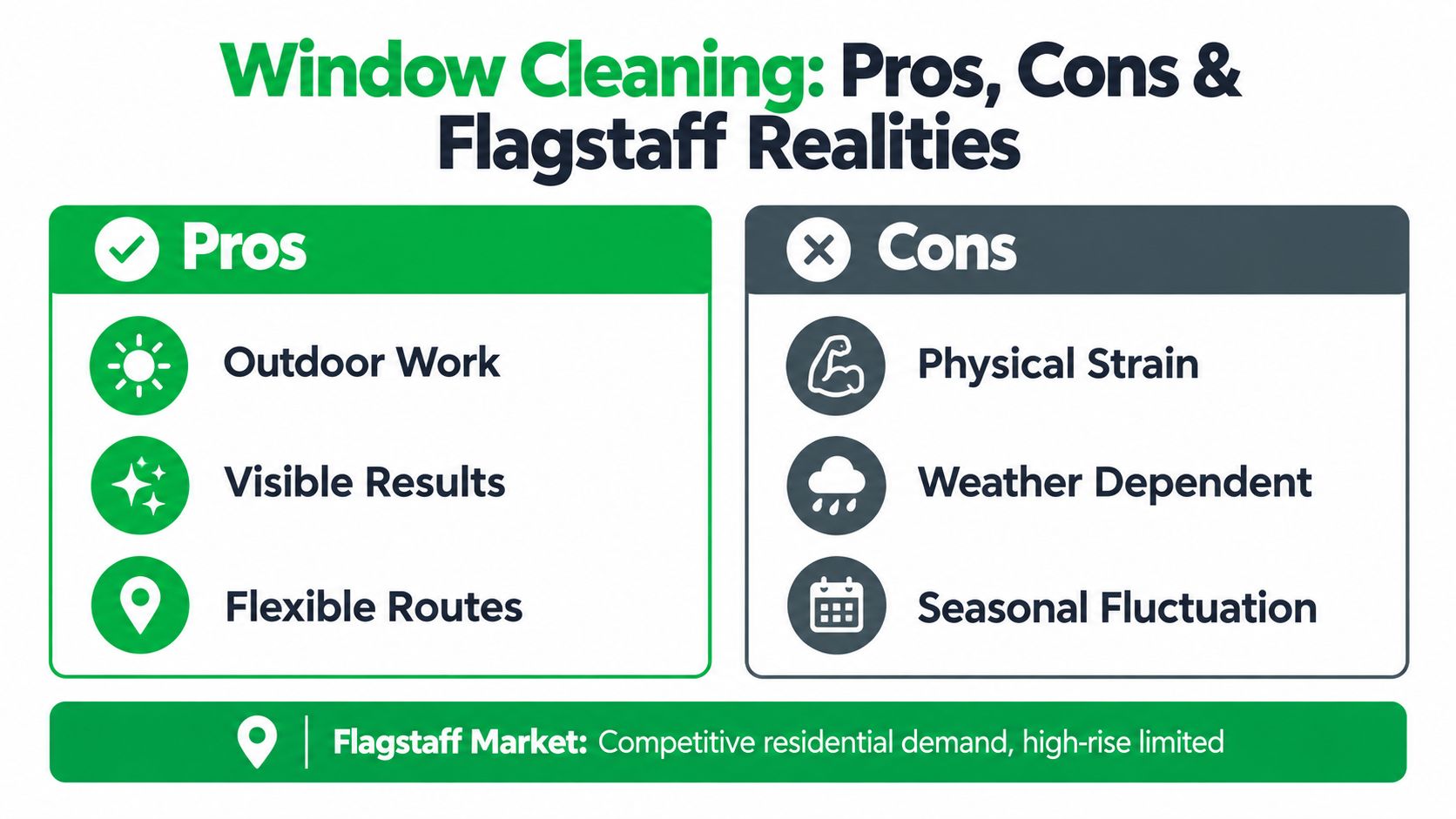
Flagstaff gives window cleaning a particular shape. The work can include ordinary residential homes, mountain cabins, second homes, short-term rentals, retail storefronts, hotels, medical buildings, dealerships, and campus facilities. Properties around Forest Highlands and Munds Park may bring different access and scheduling needs than a regular storefront route or a hotel maintenance contract.
The local climate also affects the worker experience. Outdoor work can be enjoyable during favorable weather, but wind, cold, snow, and seasonal access can change the schedule. A technician needs patience with conditions that a desk worker may never consider.
What makes the work attractive
- Outdoor variety: You move between properties instead of sitting in one room.
- Visible results: Clean glass, frames, and screens give customers an immediate improvement.
- Local relationships: Repeat customers can turn a one-time visit into dependable route work.
- Transferable skills: Squeegee control, equipment use, estimating, scheduling, and customer communication apply across the trade.
- Service expansion: Gutter cleaning, downspout work, pressure washing, post-construction cleaning, and seasonal snow services can help a company serve customers through changing conditions.
What can wear you down
Physical strain is real. Reaching, carrying, climbing, kneeling, and repeating the same motions can challenge your shoulders, hands, back, and legs. Heights add a psychological demand even when equipment and procedures are sound.
Income can also vary by segment and season. Flagstaff workers may find strong demand for homes, cabins, hospitality, and commercial properties, while winter conditions can slow some exterior work. A company that adds gutter or snow services may create a broader year-round workload, but that doesn't remove the need for planning.
A homeowner considering service can learn more about residential window cleaning cost before comparing estimates. For a prospective technician, the same principle applies in another form: understand what customers pay for, then notice how much of that value comes from access, care, speed, equipment, and dependable communication.
Window cleaning is a good job in Flagstaff for someone who values practical work, accepts changing weather, and takes customer care seriously. It may be a poor fit for someone who wants guaranteed indoor conditions, dislikes repetitive movement, or feels unsafe around ladders and height.
Is Window Cleaning Right for You and How to Start
Start by testing the work before making a large commitment. Shadow an experienced crew if possible. Practice controlled squeegee movements on suitable glass, learn how extension poles behave, and study how pure-water brushes clean frames and panes. Notice whether you enjoy the whole process, including setup, protection, cleanup, and customer communication.
A sensible progression might look like this:
- Technician: Learn tools, glass types, screen handling, access decisions, and service standards.
- Crew lead: Coordinate jobs, check quality, communicate with customers, and help newer workers.
- Owner-operator: Estimate work, schedule routes, purchase equipment, manage insurance, and build recurring accounts.
The business side deserves attention early. A dependable company needs clear scheduling, accurate estimates, respectful technicians, quality guarantees, and a process for handling problems. Local visibility also matters, and practical guidance on local SEO for contractors can help explain how service businesses make it easier for nearby customers to find them.
Pine Country Window Cleaning has operated in Flagstaff since 1999 and uses equipment that includes boom lifts, scissor lifts, and a 95-foot atrium lift for challenging access. That example shows how a local company can grow beyond basic residential work while keeping customer care and safe procedures central to the service.
So, is window cleaning a good job? It can be, especially if you want an outdoor trade and are willing to build skill in a specific segment. Begin with one conversation, one shadowing opportunity, or one application. Then judge the work by the full day, not just the shine on the final pane.
Pine Country Window Cleaning serves Flagstaff and Northern Arizona with residential, cabin, commercial, post-construction, gutter, pressure-washing, and seasonal property-care services. Visit Pine Country Window Cleaning to request a free estimate or schedule service with a crew that respects your home and handles screens, glass, and access carefully.