

You finish cleaning a window, step back, and still see pale lines crossing the glass. A rag has left lint near the frame, the spray dried before you could remove it, and the afternoon sun has made every missed spot obvious. In Flagstaff, dust, heat, strong sunlight, and mineral-heavy water can turn a simple chore into a frustrating one.
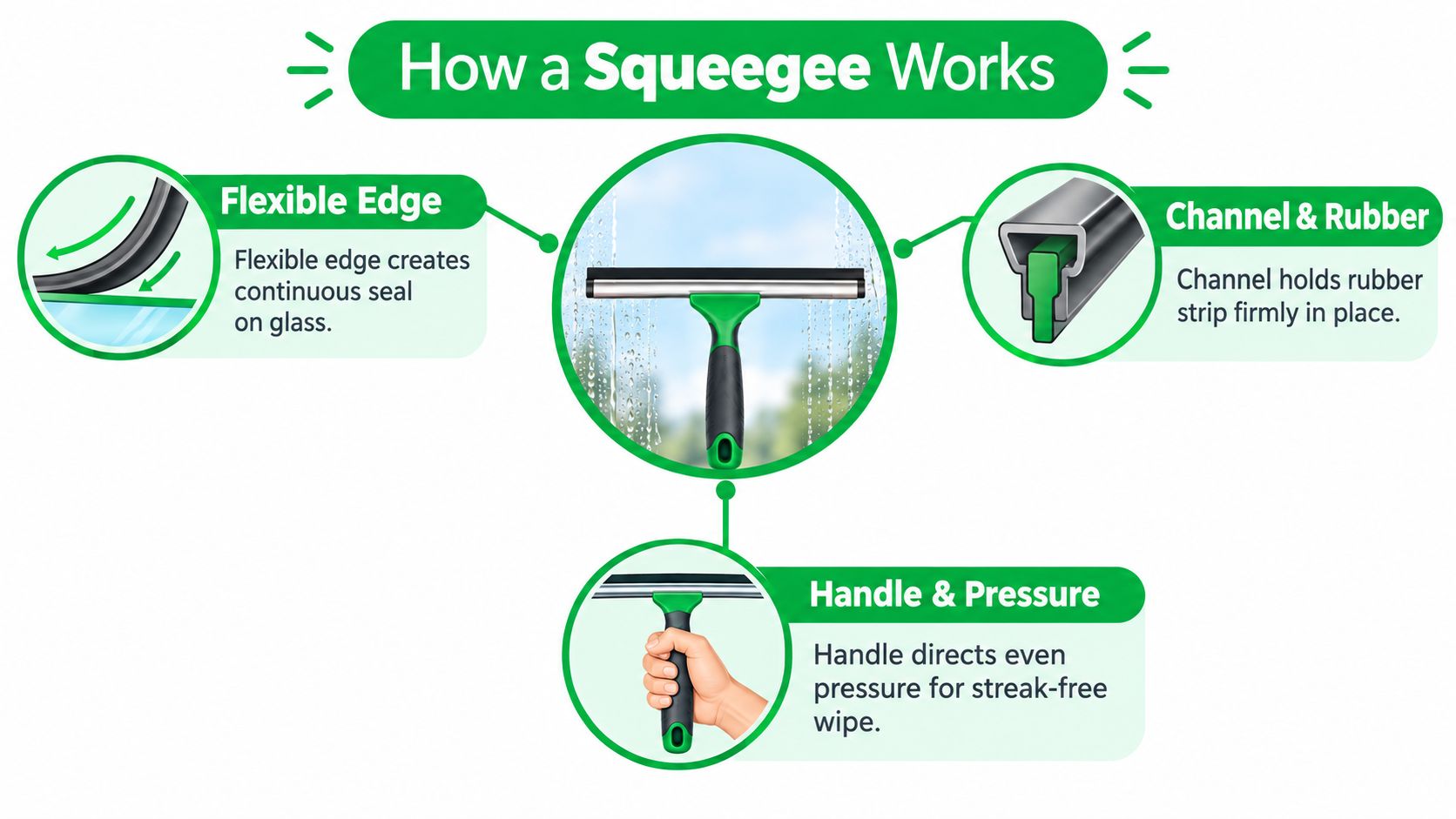
A window cleaning squeegee solves a different problem than a rag. It doesn't smear water around. Its flexible rubber edge creates a continuous seal against the glass and pulls dirty solution away in a controlled path. The result depends on more than buying any blade from a hardware aisle. Channel design, rubber condition, handle control, reach, glass type, and timing all affect the finish.
Pine Country Window Cleaning has served Northern Arizona since 1999, using professional-grade squeegees, extension poles, and pure-water brushes for homes, cabins, businesses, and high windows. The company also treats screen care and protection of the home as part of the work, not as an afterthought. Clean windows can change how a room feels, and this real estate marketing windows guide offers useful context on why clear glass matters when a property needs to look its best.
This guide breaks down how the tool works, how to choose blade size and rubber, when a pole makes more sense than a ladder, and where a squeegee may not be the right first choice. You'll also learn the technique professionals use to control water without forcing the blade across the glass.
Introduction to the Window Cleaning Squeegee That Pros Trust
The squeegee looks simple because its job is simple. A channel holds a strip of rubber, and a handle gives you control. Yet a small change in blade condition or hand position can separate a clean pane from one covered in chatter marks and wet trails.
Think of the tool as a windshield wiper for a house. A good windshield wiper doesn't need heavy pressure to clear rain. It needs a flexible edge that stays in contact with the surface while the arm moves at a steady angle. A window cleaning squeegee works on the same principle, but the operator must guide the water rather than push it away.
The useful mental shift: You aren't polishing glass with the blade. You're directing water off the glass while keeping dirt from returning to the cleaned path.
That distinction explains why rags and sprays often disappoint on larger panes. Fabric absorbs some moisture, releases lint, and can move dirt from one area to another. A squeegee gives the water somewhere to go, provided the rubber is clean and the edge remains flexible.
Why the tool's history still matters
The earliest documented window-cleaning use of a squeegee dates to 1918, when an American Navy jargon book described a deck-cleaning tool as being used in civil life to clean windows. The Oxford English Dictionary cites that entry as the earliest written reference to a window-cleaning squeegee, as documented in this history of the squeegee.
The professional form familiar today came later. In 1936, Ettore Steccone patented a lighter brass design with a single flexible rubber blade, replacing the bulkier Chicago squeegee. Earlier Chicago models used two thick rubber blades held by 12 screws, while Steccone's design created the foundation for the contemporary professional tool, a progression also described by the California library's history of squeegee development.
For a homeowner, that history has a practical lesson. The modern tool wasn't refined to look elegant. It was refined to give the operator better control, a more consistent seal, and less bulk during repeated work.
What a professional system adds
A handheld squeegee works well on accessible panes. It becomes less suitable when glass is high, wide, recessed, or surrounded by delicate landscaping and furnishings. Professionals combine the blade with extension poles, ladders where appropriate, and pure-water brushes so they can reach glass while managing safety and protecting the property.
The tool choice matters, but the system matters more. A fresh rubber blade on a short handle won't solve a reach problem, and a long pole won't compensate for a damaged edge. The following sections show how each part fits together.
How a Window Cleaning Squeegee Actually Works
Start with the edge, because the edge does most of the work. When you wet a pane and pull a flexible rubber strip across it, the rubber bends slightly and maintains contact with the glass. That contact forms a moving seal, carrying water and loosened dirt toward the edge of the pane instead of leaving a thin film behind.
The channel supports the rubber. It holds the strip firmly and keeps it aligned, while the handle transfers your movement into the channel. If the channel twists, the handle flexes unpredictably, or the rubber loses contact, the seal breaks. Water then slips beneath the edge and appears as a line or narrow streak.
The windshield-wiper comparison
A windshield wiper glides because its edge remains flexible and its pressure stays even. Pressing harder doesn't repair a cracked wiper. The same principle applies to a window cleaning squeegee. Excess pressure can bend the rubber away from the glass, while too little control can let water escape under the edge.
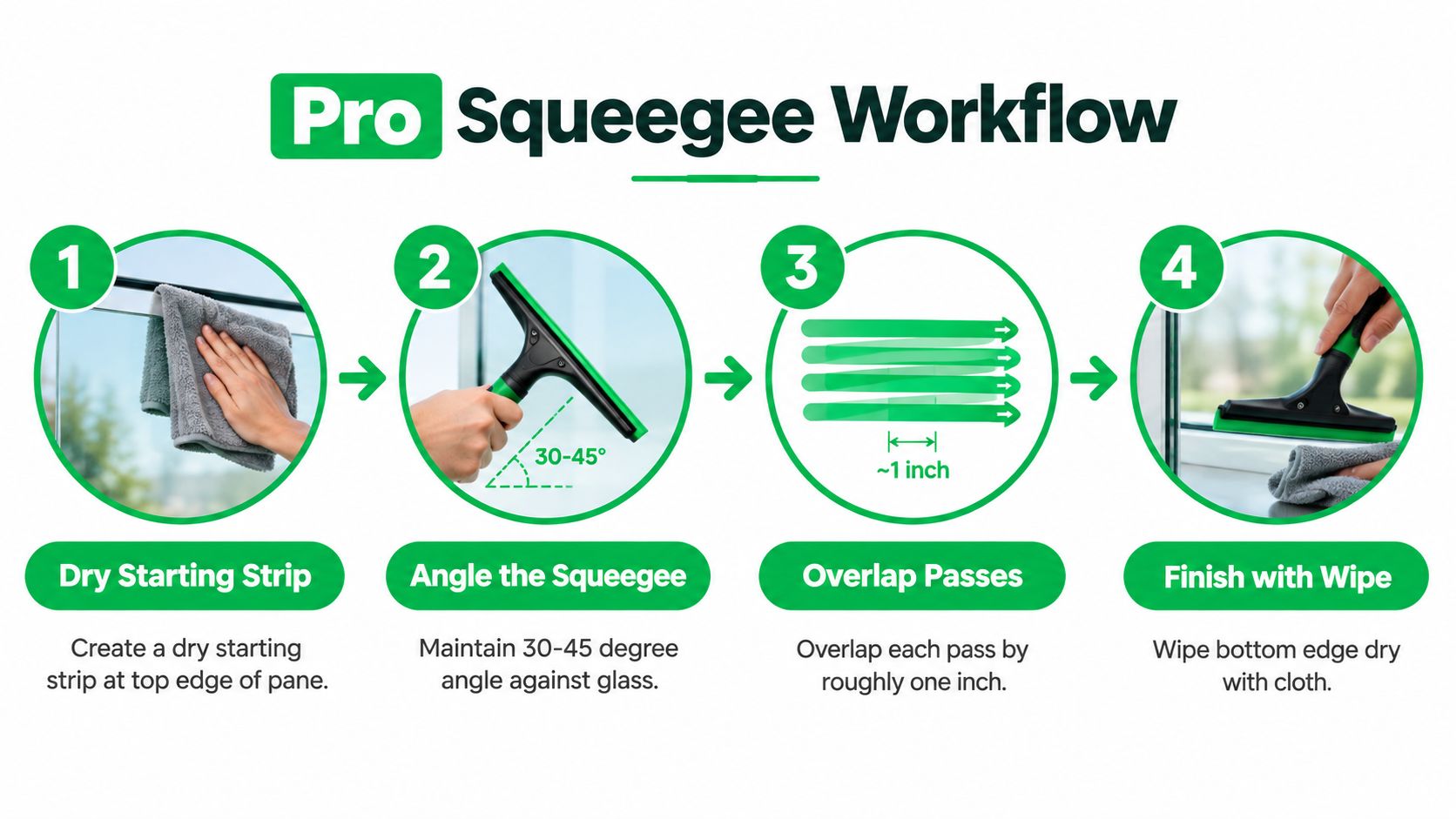
Angle changes the shape of the contact point. Hold the blade too flat and it may skate over the water. Hold it too upright and the edge can chatter or leave a narrow trail. Professional guidance places the blade at about a 30-degree angle to the glass and recommends overlapping each downward pass by roughly one inch, as explained in this professional squeegee technique guide.
Follow the water, not the pressure
A useful sequence is straightforward:
- Wet the glass evenly. Water loosens dust and deposits so the blade can move them away.
- Set the edge into the water. The rubber should contact the pane continuously, not scrape across dry patches.
- Guide a steady pull. Keep your angle consistent and let the blade carry the water.
- Wipe the blade. Dirt left on the rubber can become a new streak on the next pass.
The handle determines how reliably you can repeat that motion. On a standard interior pane, a fixed handle may give excellent control. On high exterior glass, a pole lets you maintain distance from the edge and reduce ladder use. Pure-water brushes serve a different purpose, especially when the goal is to rinse high glass without leaving mineral residue from ordinary water.
That gives you a simple evaluation model. Look at the edge, the channel, and the handle. The edge must seal, the channel must hold it straight, and the handle must let you maintain the right movement and reach.
Squeegee Types Sizes and Rubber Materials Explained
Choosing a blade starts with the glass in front of you, not the largest size on the shelf. A compact channel can maneuver around divided panes, narrow cabin windows, and tight corners. A larger commercial channel can cover broad, open glass efficiently, but it becomes awkward when the pane has muntins, obstructions, or uneven access.
Natural rubber generally provides the crispest wipe and the fewest streaks when the edge is fresh. Silicone has a slightly softer feel, but it offers longer service life and stronger resistance to heat, chemicals, and degradation. Those differences matter in Northern Arizona, where direct sun and warm glass can challenge a blade that isn't suited to the conditions. This comparison of silicone and rubber squeegee blades explains the tradeoff between wiping feel, streaking, and durability.
A blade doesn't need to look dramatically damaged before it affects the finish. Worn, chipped, or hardened rubber can't maintain a continuous seal, so the squeegee leaves water behind. Inspect the edge under good light. If it has a nick, a rough section, or a stiff shape that no longer sits evenly against the glass, replace the rubber rather than compensating with pressure.
Match the tool to the pane
| Job Scenario | Recommended Size | Best Rubber Choice | Why It Works |
|---|---|---|---|
| Narrow cabin panes or divided residential windows | Compact channel, often around 10 to 12 inches | Natural rubber for a crisp wipe | A smaller blade turns easily and fits between obstacles |
| Broad residential picture windows | Medium channel sized to the clear glass area | Natural rubber for frequent touch-ups | It balances coverage with hand control |
| Large storefront or commercial panes | 18-inch or larger channel when access is open | Silicone where heat, chemicals, or repeated use matter | A wide channel clears more glass per pull and silicone tolerates demanding conditions |
| Sunny exterior work in warm conditions | Size based on pane layout, not simply maximum reach | Silicone can suit longer service demands | Its resistance to heat and degradation can reduce premature hardening |
| Detail work on glass needing the cleanest immediate wipe | Compact or medium channel | Fresh natural rubber | The sharper wipe helps limit fine water trails |
The table isn't a rule that one material fits every property. It helps you avoid buying an oversized channel for small panes or choosing a durable blade when the cleanest possible feel is your main priority.
A large squeegee saves time only when the window is large, open, and easy to control.
Blade condition also matters more than branding. Rinse the rubber after use, keep grit away from the edge, and replace it at the first signs of chatter or recurring lines. A well-maintained smaller squeegee can outperform a larger tool with a tired blade.
Handle Systems From Cast to Ergonomic and Telescoping Poles
The handle decides how your hand meets the glass. A fixed cast handle gives direct control and a predictable angle, which makes it a practical choice for standard residential panes. It feels straightforward because there are fewer moving parts between your wrist and the rubber.
An ergonomic swivel handle changes the equation on larger jobs. Its pivot allows the handle to follow the motion of the arm, reducing the need to bend the wrist sharply during repeated pulls. That can make a noticeable difference when cleaning many panes, especially when consistent angle matters as much as speed.
A telescoping pole solves a different problem: reach. It lets an operator work from the ground on high or difficult glass, reducing the need to stretch from a ladder. The pole must still be controlled carefully. Extra reach magnifies small movements, so the operator needs a stable stance, a clean blade, and a deliberate pull.

Choose for reach and fatigue
For a single-family home, cabin, or short maintenance visit, the cast handle often offers enough control. A swivel handle becomes more valuable when the property has many large panes or a facility team needs to repeat the same motion across a long route. Commercial settings such as hotels, NAU facilities, storefronts, and dealerships may require a combination of handles and poles rather than one universal tool.
High glass also changes the safety decision. A pole can handle many elevated panes, while extreme heights may require in-house equipment such as boom lifts, scissor lifts, or an atrium lift. The right choice keeps the operator from forcing a reach that compromises balance or blade contact.
The handle should fit the job, not the other way around. If you want to compare professional equipment by function, this guide to professional window cleaning tools covers the broader system that supports squeegee work.
A useful test is simple:
- Control: Can you keep the blade at a steady angle?
- Reach: Can you access the glass without unsafe stretching?
- Comfort: Can you repeat the movement without excessive wrist or shoulder fatigue?
- Consistency: Does the handle help you produce the same pull from one pane to the next?
The handle isn't a luxury accessory. It determines whether the blade stays where you put it.
How to Choose and Use a Squeegee Like a Professional
Professional technique begins before the first pull. The glass needs an evenly wet working surface, and the top or side needs a dry starting strip. That strip gives the rubber a clean place to begin, so water moves into an uncleaned path rather than back over glass you've already cleared.
Build a repeatable pull
Use this sequence on an accessible pane:
- Create a dry starting strip. Leave a narrow dry area at the top or side. This gives the blade a controlled entry point.
- Set the angle. Keep the blade roughly 30 to 45 degrees to the glass. Guidance varies within that range, but consistency matters more than chasing a perfect number.
- Pull steadily. Use enough pressure to maintain the seal, not enough to bow the rubber away from the pane.
- Overlap the next pass. Overlap each pass by roughly one inch so a narrow wet line doesn't remain between strokes.
- Wipe the blade. Clean the rubber after every pull. Dirt loading turns a clean tool into a moving streak-maker.
- Finish the edges. Detail the bottom and side edges so residual water doesn't run onto the frame or sill.
Independent product testing found that top-performing hand squeegees can remove about 98% of water on the first pass, while lower-performing tools need multiple passes to reach similar dryness. See the tested hand squeegee results for that performance comparison. If you need repeated passes on a small, properly wet pane, check the edge first, then check your angle and overlap. More force usually isn't the answer.
Protect the house while you clean
A professional result includes the area around the glass. Water should be controlled near painted trim, wood sills, flooring, furniture, and electronics. Screens also need deliberate handling. Industry service guidance includes removing every screen, cleaning it thoroughly, and reinstalling it in the correct position after the glass is finished, as described in this professional screen and squeegee workflow.
Pine Country's approach uses squeegees for appropriate glass, extension poles for reach, and pure-water brushes where that system suits the pane and access. Pure-water work can help reduce the need to carry solution to high exterior glass, while the squeegee remains valuable for controlled removal on accessible surfaces. The company also removes, cleans, and reinstalls screens with every service, so the finished job includes the window system rather than only the center of the pane.
For a broader equipment overview, homeowners can review these home window cleaning tools before deciding whether a small touch-up is manageable or whether the property calls for a complete service.
When a Squeegee Is Not the Right Tool and How to Avoid Damage
A squeegee isn't automatically safe for every type of glass. Tinted, coated, hydrophobic, and other specialty surfaces may have manufacturer requirements that limit which cleaning solutions, blades, or agitation methods are appropriate. A rubber edge that performs beautifully on ordinary glass may drag residue across a coating or interact poorly with a finish if the surface has not been identified first.
Start with compatibility, not technique. Check the glass documentation or ask the installer what finish is present. Look for signs of film, surface treatment, delicate coating, or a product label that specifies approved cleaning methods. If you can't identify the surface, avoid aggressive pressure and test a small, inconspicuous area with a clean, compatible tool.

Flagstaff conditions change the workflow
Heat and direct sun can dry solution before the blade completes its pull. Dust can load the rubber quickly, while mineral-heavy water can leave deposits that look like streaks even after the surface appears dry. Troubleshooting guidance recognizes dirty solution, hot sunlight, and mineral haze as common sources of poor results, but wiping harder doesn't correct the underlying condition.
Professionals adapt the system:
- Work with the shade: Schedule or sequence panes so the solution stays workable instead of baking onto hot glass.
- Control contamination: Use clean water and a fresh working solution, and wipe the blade after each pull.
- Change the method: Pure-water brushes and extension poles can be more suitable for some high exterior glass.
- Respect the coating: Use a compatible blade and gentle contact when the surface has a specialty finish.
Recent industry coverage also points toward ergonomic, lightweight, and efficiency-focused designs. One market report projects 4.6% CAGR from 2025 through 2035, with ergonomic handles identified as a growth driver, as described in this window-cleaning industry guidance. That projection doesn't prove that a particular handle will work on your property, but it reflects a practical need: operators want systems that reduce fatigue and maintain consistency in demanding conditions.
For high panes where access is the main risk, this guide to cleaning high windows safely can help you evaluate whether a pole or professional equipment is the better choice.
Keeping Your Squeegee Sharp and Knowing When to Call Flagstaff Pros
Rinse the blade after use and remove grit before storing the tool. Keep the rubber flat or supported without bending it, inspect the edge for nicks, and replace it when chatter or recurring lines appear. A fresh edge protects the finish because it maintains the seal without requiring excess pressure.
Pine Country Window Cleaning states that it uses high-quality squeegees, extension poles, and pure-water brushes rather than consumer-grade products, and that Flagstaff native David Kaminski started the company in 1999, according to this professional squeegee profile. The company handles residential and commercial glass, high-reach work, and screen removal, cleaning, and correct reinstallation with every service.
A small, accessible pane may be a reasonable DIY project when you have the right blade and can work safely. Whole-home glass, cabins with difficult access, coated windows, commercial properties, and high panes require more than a squeegee in a bucket. They require a coordinated system, careful handling, and respect for the home.
Pine Country Window Cleaning provides professional squeegee work, extension-pole access, pure-water brushing, and complete screen care for homes and businesses in Flagstaff and Northern Arizona. Visit Pine Country Window Cleaning to request a free estimate or schedule service with a team that treats your glass, screens, and property with care.