
A property manager calls at 8:15 on a Monday morning. The request sounds simple: “What would you charge to clean the windows on our six-story hotel along Route 66?” The dispatcher can give a rough range, but no responsible commercial cleaner can give a dependable phone number without seeing the elevations, lift access, staging area, water source, interior schedule, and glass condition.
That uncertainty is where commercial window-cleaning margins disappear. A competitor quoting per pane from the truck may be losing money on Flagstaff's lift-heavy accounts, or padding every bid to survive the worst case. Learning how to price commercial window cleaning means replacing guesswork with measured access, labor, equipment, risk, and service frequency.
What You Will Walk Away Knowing After This Guide
A commercial quote should be defensible line by line. If a property manager asks why the price includes a boom-lift mobilization charge, screen handling, or a weather contingency, you should be able to point to the work those items represent rather than retreat to “that's just our rate.”
The phone quote problem
Hotels, dealerships, medical buildings, and campuses rarely have one uniform window type. A Route 66 hotel may combine ground-floor storefront glass, upper elevations, stairwell windows, and an atrium that needs specialized access. A dealership may have broad showroom glass that responds well to pure-water brushes, while a campus account may require several buildings, separate access plans, and carefully coordinated service windows.
Flagstaff adds practical complications that national pricing formulas often miss. A scissor lift or boom lift may need delivery and staging. A 95-ft atrium lift may be required for interior glass. Snow, wind, freezing mornings, and monsoon weather can change the safe working window. Those conditions belong in the bid before the crew arrives.
This guide gives you a working decision tree for selecting a pricing model, a cost-stack method for calculating the job, and a sample bid for a Flagstaff medical office with lift work. It also addresses recurring contracts, proposal language, negotiation mistakes, and the minimum details a site walk should capture.
Practical rule: If you can't explain the access plan, labor assumption, equipment charge, and scheduling condition, you haven't finished pricing the account.
You'll also see where per-pane pricing works, where it fails, and why mixed quotes are often more honest than a single number. A low-rise storefront on Milton Road can be straightforward. A six-story hotel, a dealership canopy, or a campus atrium can't be treated as a pile of identical panes.
The local details drive everything downstream: scissor-lift logistics on Route 66, pure-water brush work on reachable elevations, ladder-clearance decisions, and weather windows during monsoon season. The objective isn't to make every bid expensive. It's to make every bid fit the actual job.
Choosing the Right Pricing Model for Each Account
No single pricing model fits every commercial account. The correct choice depends on whether the crew can work from the ground, how predictable the glass count is, how much soil is present, and whether access equipment controls production.
Five models side by side
| Pricing Model | Best Account Fit | Flagstaff Example | Watch Out For |
|---|---|---|---|
| Per pane | Small, divided-light storefronts | A row of shops on Milton Road with reachable glass | Small panes may require more detailing than the count suggests |
| Per window | Standard low-rise maintenance | A medical office with consistent, accessible windows | Don't use it when lift setup controls the job |
| Per square foot of glass | Glass-heavy facades and curtain walls | A dealership showroom or mid-rise office elevation | Measure actual glass scope, not building floor area |
| Hourly or crew-hour | Unknown soil, build-outs, post-construction, specialty access | A renovation with adhesive, paint, or irregular atrium glass | Poor production assumptions can make the quote vague |
| Recurring contract | Repeat accounts with predictable service | A hotel, campus, or multi-tenant property on a planned route | A discount without route and scope discipline erodes margin |
Published commercial benchmarks commonly place larger-property work around $0.50 to $2.50 per square foot, while standard low-rise work may fall around $0.75 to $1.50 per square foot, depending on access and complexity. The commercial window-cleaning pricing guide also reflects the broader market pattern of roughly $5.50 to $15 per window for standard commercial work. Those figures are anchors, not substitutes for a site inspection.
Per-pane and per-window pricing work when the crew can move efficiently between predictable openings. Per-square-foot pricing makes more sense when pane counts hide the actual scope, particularly across broad curtain walls. Hourly pricing protects the cleaner when soil, access, or post-construction conditions remain uncertain.
Access rule: Any window requiring lift setup should generally move off simple per-pane pricing and onto hourly, crew-hour, square-foot, or project pricing.
Contract pricing dominates repeat work because setup becomes easier to plan, soil load is more predictable, and route density can reduce unnecessary travel. A mixed quote is often strongest: per-window pricing for ground-level glass, square-foot pricing for a large facade, and crew-hour or project pricing for lift-dependent elevations.
If your office already estimates related trades, a resource such as Exayard commercial painting estimating software can provide useful estimating workflow ideas. The principle carries over, even though window cleaning has different production and access variables: measure the work, record assumptions, and make the final number traceable.
Counting the Real Costs Behind Every Bid
A commercial bid starts with cost, not markup. The number has to cover the people, equipment, compliance, travel, administration, and unbilled time required to deliver the promised result.
Build the cost stack
Direct labor includes cleaner wages plus payroll taxes, workers' compensation, supervision, and the time spent loading, unloading, protecting occupied areas, removing screens, cleaning screens, and reinstalling them. A crew that spends an hour setting up a lift is still working, even though no glass is being washed during that interval.
Safety and compliance include fall-protection planning, training, site controls, and equipment appropriate to the elevation. Cornell's window-washing program prohibits ladder-based cleaning when the top of the window is more than 35 feet above the nearest interior floor or equivalent surface (Cornell window-washing program). California's rule allows ladders only when windows can't otherwise be cleaned safely and practicably with approved anchors and belts, and it bars a fully extended extension ladder over 40 feet (California ladder regulation). Local rules and site conditions still need to be reviewed, but those thresholds show why height changes the method, not merely the labor estimate.
Insurance and vehicles belong in the job allocation. General liability, commercial auto, workers' compensation, fuel, maintenance, and travel between Flagstaff accounts all consume revenue. Equipment also depreciates: water-fed poles, pure-water systems, brushes, ladders, squeegees, buckets, and protective materials need replacement or service.
Don't hide mobilization
Lift work has a cost before the first pane. Delivery, pickup, staging, barricades, operator requirements, charging or fueling, and site coordination all affect the quote. Setup and breakdown can each run 45 minutes, creating roughly an additional hour of fully loaded labor before cleaning begins. That claim is a practical planning assumption, so verify it against the specific equipment and site rather than treating it as universal.
Electrical hazards require another access check. Guidance for unqualified window cleaners calls for at least 10 feet of clearance from overhead electrical lines, while some professionals recommend 15 feet to account for pole flex, ladder movement, wind, and conductive water streams (power-line safety guidance for window cleaners).
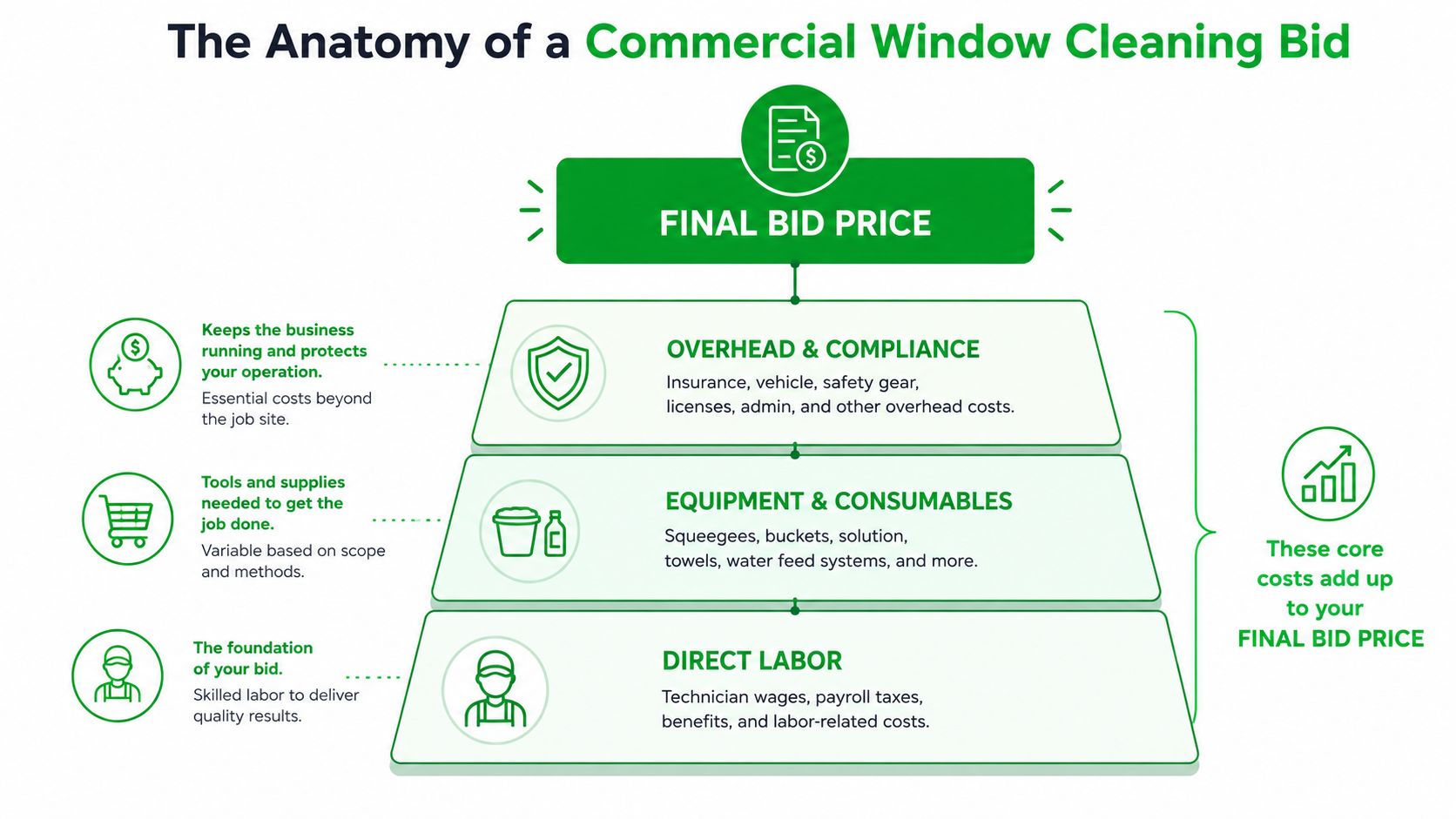
Your overhead allocation should cover office staff, estimating time, scheduling software, bookkeeping, training, unbilled callbacks, and time spent obtaining certificates or coordinating tenants. Disposables such as squeegee rubber, soap concentrate, towels, scrub pads, and water-treatment supplies may be small individually, but they recur on every account.
The final audit is simple: subtract direct labor, equipment, travel, consumables, insurance, compliance, and overhead from the proposed price. If the remainder doesn't compensate the company for risk and profit, the bid isn't ready. Don't set one universal markup target for every job. High-access work, post-construction work, and occupied medical properties carry different uncertainty than a repeat storefront route, so each requires its own margin threshold.
Sample Calculation for a Flagstaff Commercial Site
Consider a two-story medical office with 84 windows, a 28-ft atrium, and a rear stairwell that requires a scissor lift. This is a teaching example, not a market quote. The figures below are illustrative assumptions, and a real proposal should replace them with measured labor, rental, insurance, and overhead costs.
Build the bid from the site walk
Assume the crew uses pure-water brushes for reachable exterior glass and the atrium where that method is safe and productive. The stairwell receives scissor-lift access. Screens are removed, cleaned, and reinstalled as part of the service.
| Line Item | Calculation | Cost | Notes |
|---|---|---|---|
| Direct labor | 16 crew-hours × $50 | $800 | Includes glass, screens, setup, and breakdown |
| Scissor-lift rental | 1 rental period | $450 | Replace with the supplier's written quote |
| Lift delivery and pickup | Site mobilization | $250 | Separate from rental |
| Pure-water system and brush allocation | Equipment use | $100 | Includes system and brush wear |
| Screens and supplies | Handling and consumables | $140 | Removal, cleaning, reinstallation, rubber, soap, and supplies |
| Insurance and safety allocation | Job allocation | $160 | Confirm with the company's cost model |
| Travel and vehicle | Route and site time | $120 | Includes fuel and commercial auto allocation |
| Overhead allocation | Office and unbilled time | $280 | Scheduling, estimating, administration |
| Estimated cost before margin | Total cost stack | $2,300 | Illustrative only |
| Operating margin | Added after cost review | $575 | Illustrative pricing decision |
| One-time proposal | Cost plus margin | $2,875 | Subject to final scope and conditions |
The table deliberately makes access visible. A per-window formula would hide the lift rental, delivery, and stairwell setup inside a count that says little about the work. Commercial guides cite hourly ranges around $50 to $100 for specialized commercial or high-rise jobs, with some high-rise conditions reaching about $170 per hour (commercial window-washing cost guidance). The appropriate figure depends on crew composition, equipment, insurance, and local operating cost.
Pure-water brush work can reduce interior atrium handling when the glass and surrounding surfaces permit it, but it doesn't eliminate inspection, edging, frame attention, or safe access planning. A 95-ft atrium lift is a different category entirely from this sample's 28-ft atrium, and its equipment, staging, and supervision must be priced from a specific site plan.
For a quarterly agreement, you might offer a modest recurring adjustment after confirming that the client accepts the same scope, access window, and scheduling conditions on every visit. Don't promise a discount merely because service repeats. Winter sub-freezing mornings may force rescheduling, and the contract should state how weather delays are handled without turning safe operations into a penalty.
Recurring Contracts Versus One-Time Cleans
Recurring service usually creates a better operating model because the crew maintains the glass instead of restoring it from a neglected condition. The first visit establishes the baseline. Later visits can require less aggressive soil removal, less troubleshooting, and less setup uncertainty, especially when the same crew returns to the same elevations.
Match frequency to the property
A busy restaurant, hotel entrance, or dealership showroom may need a tighter schedule because fingerprints, traffic, and public visibility expose dirty glass quickly. A low-traffic office may fit a quarterly plan. A campus or multi-tenant property may need different frequencies by building rather than one blanket schedule.
The commercial pricing guidance from Jobber's window-cleaning pricing resource notes that recurring discounts and contract pricing are common considerations. The amount should come from actual savings, not from an automatic percentage. Calculate reduced setup, expected soil load, route density, coordination time, and minimum-visit economics before changing the rate.
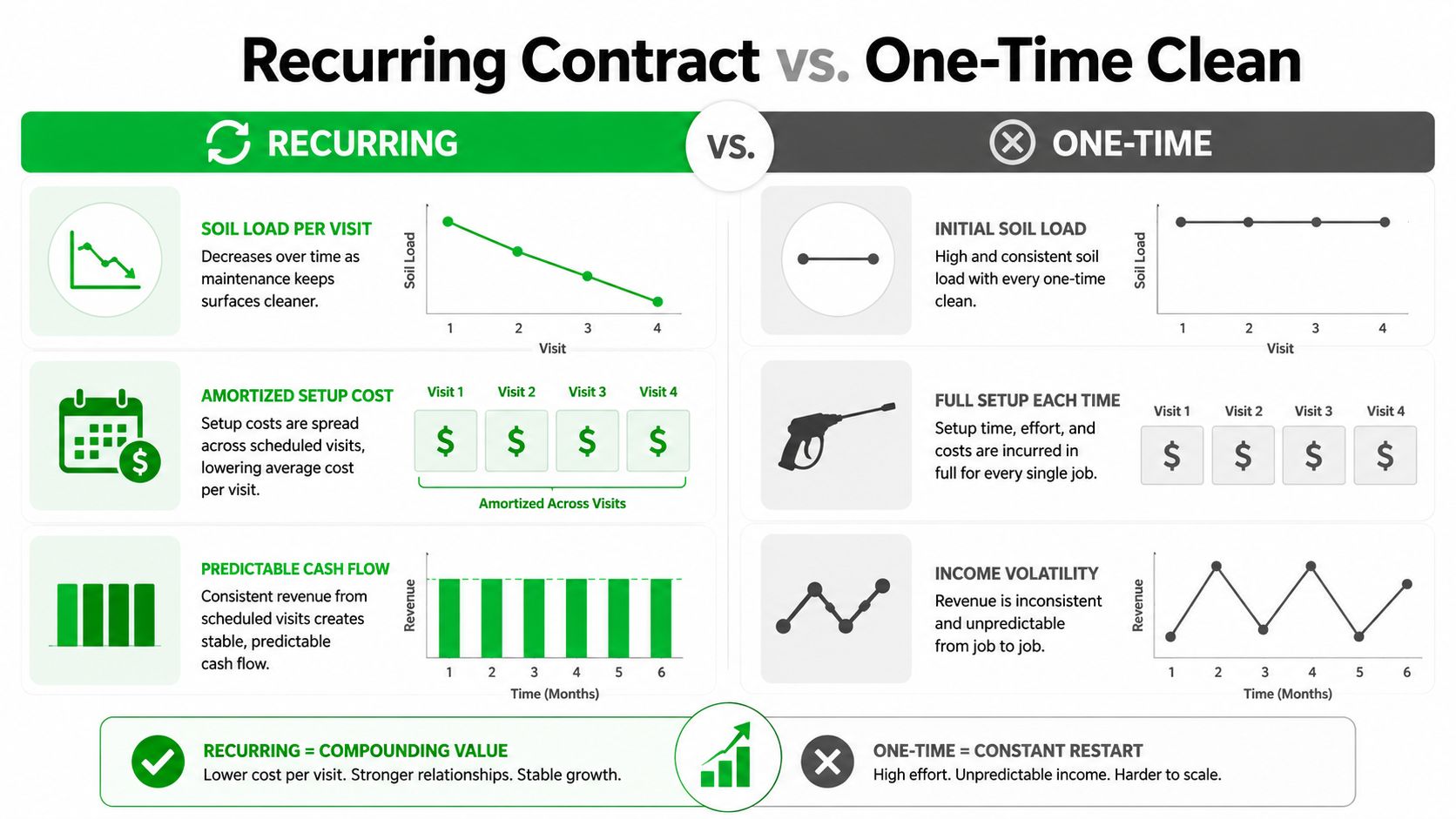
One-time cleaning still has a place. Post-construction punch lists, pre-sale preparation, tenant turnover, inspections, and annual budget releases can justify a standalone project price. Those jobs carry more uncertainty because the crew may face adhesive, mineral deposits, construction dust, access changes, or a property that has not been maintained.
A recurring discount should reward operational efficiency, not subsidize the client's scope.
A useful hybrid arrangement bundles three buildings into one predictable monthly invoice while preserving a separate internal price for each building. The property manager receives one simple bill. The cleaner retains visibility into which site consumes lift time, screen labor, or special scheduling. That structure works particularly well for campuses, hotels with separate wings, and property managers overseeing several nearby facilities.
Building a Proposal That Closes the Job
A good proposal answers questions before the first technician loads the truck. It should tell the client what gets cleaned, how the crew will reach it, what the client must provide, and what happens when conditions differ from the site walk.
Put scope before price
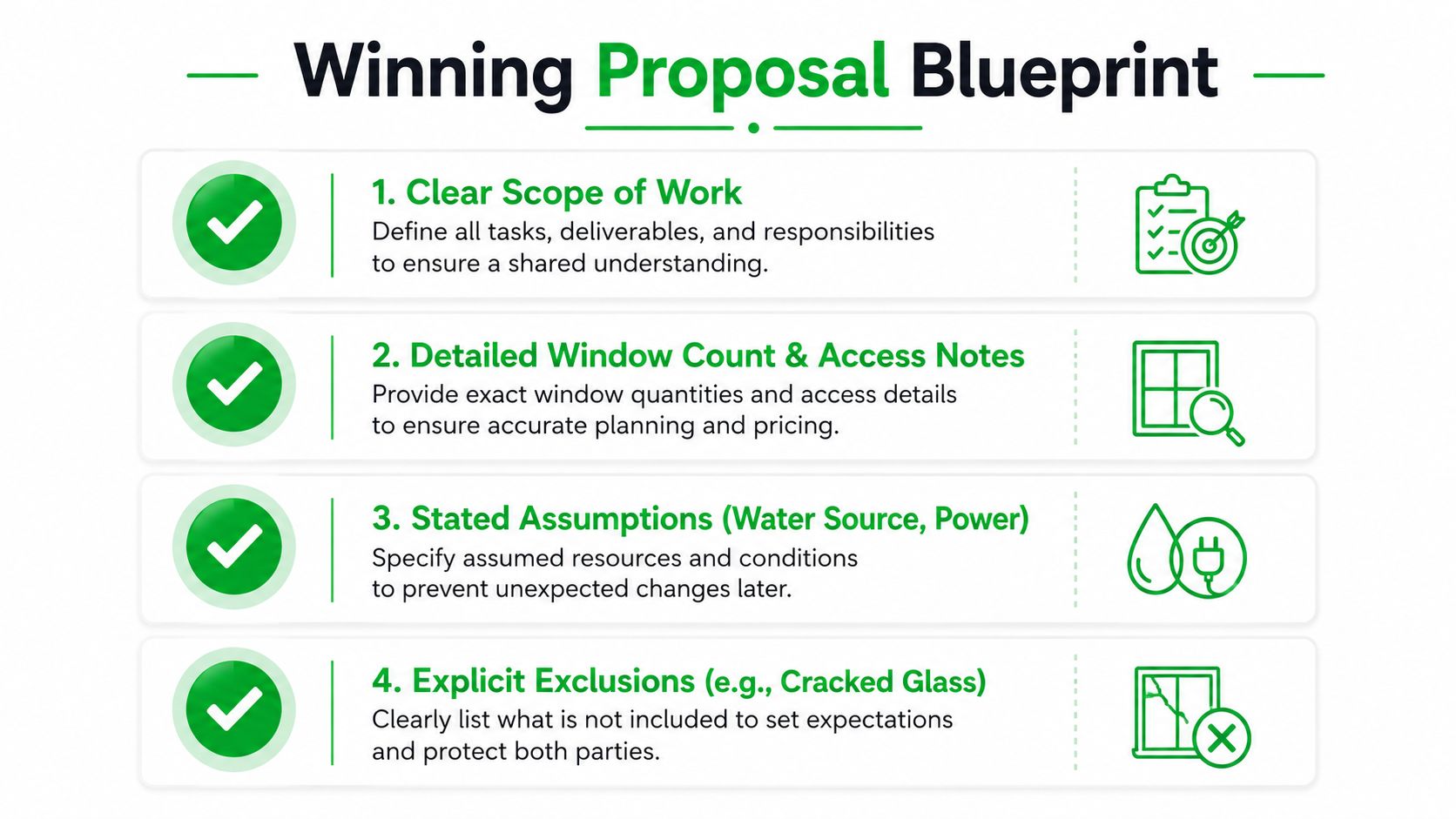
Start with the exact service: exterior glass, interior glass, doors, sidelites, transoms, partitions, frames, sills, screens, and reinstallation. State whether the count covers all elevations or only identified areas. If the proposal excludes cracked glass, failed seals, mineral etching, paint, adhesive, or construction debris, say so plainly.
List access notes beside the scope. Identify ground work, ladder work, pure-water brush work, scissor-lift work, boom-lift work, and any atrium equipment. Record the planned water source and power source, plus the contingency if either isn't available.
A scheduling clause should address business hours, tenant coordination, weather, freezing conditions, wind, monsoon interruptions, and lift delivery. Don't promise a same-week start until equipment and site access are confirmed.
Use a checklist that prevents scope creep
- Scope of work: Identify the glass, screens, frames, sills, doors, and elevations included.
- Count and access: Record the window count, approximate sizes, height bands, lift locations, ladder clearances, and pole limitations.
- Assumptions: State water source, power, parking, staging, tenant access, escorts, and approved work hours.
- Exclusions: Separate cracked glass, scratches, failed seals, etched mineral deposits, paint, silicone, adhesive, and post-construction debris.
- Safety plan: Reference applicable OSHA ladder requirements, lift operator qualifications, fall protection, electrical-line clearance, and pedestrian controls.
- Weather contingency: Explain rescheduling for wind, lightning, freezing conditions, snow, or unsafe surfaces.
- Screen policy: State that screens are removed, cleaned, and reinstalled when included, and identify damaged screens as a separate repair issue.
- Re-clean warranty: Define the window for reporting streaks or missed spots and exclude new damage or later contamination.
- Change orders: Set a separate rate for added panes, changed access, extra soil, or newly discovered construction debris.
- Signature block: Include the approved scope, price, service frequency, payment terms, contact names, and authorization.
A practical commercial cleaning estimate template can help organize those fields, but the proposal still needs site-specific language. A clean signature block is useful only when the scope above it is precise.
Negotiation Pitfalls and Your Next Step
A property manager countering your number isn't automatically asking for an unreasonable price. They may be comparing scopes, budgets, or vendors. The mistake is cutting the bid before finding out which line item they want changed.
Protect the items that make the work possible
Dropping a boom-lift mobilization fee doesn't remove delivery, staging, or pickup. Waiving a minimum for a small storefront doesn't remove drive time, setup, screens, insurance, or administrative work. Absorbing screen removal transfers labor from the invoice into your margin.
Four mistakes show up repeatedly:
- Discounting without shortening scope. If the client needs a lower price, remove an elevation, reduce frequency, or change the service window. Don't give away the same work.
- Accepting a per-pane rate before measuring. Count only after access, condition, and screen handling are understood.
- Promising a same-week start for lift-dependent work. Equipment availability, delivery, weather, and site approval may control the schedule.
- Skipping the recurring conversation. A planned route may create legitimate efficiency, but only after the cadence and scope are clear.
Use a bid sheet that shows the change. “Remove rear stairwell lift work” is a real scope decision. “Take $300 off” is not a production plan.
When calls arrive while your crew is on a ladder, lift, or active commercial site, dependable intake matters. A practical comparison of contractor answering services can help a growing operation evaluate how after-hours and missed-call coverage might fit its workflow. The service doesn't replace a site walk, but it can prevent a serious commercial lead from disappearing while the crew is working.
The next step is a free, on-site walk-through. Measure height, access, water, power, glass condition, screens, soil load, tenant coordination, lift staging, and weather constraints together, then replace the phone number with a written proposal that shows its assumptions.
Pine Country Window Cleaning has served Flagstaff since 1999, using squeegees, ladders, pure-water brushes, boom lifts, scissor lifts, and a 95-ft atrium lift for residential and commercial properties. The team also removes, cleans, and reinstalls screens with every service while treating the home or business with care. Visit Pine Country Window Cleaning to request a free on-site estimate and build a commercial proposal around your actual access conditions.