
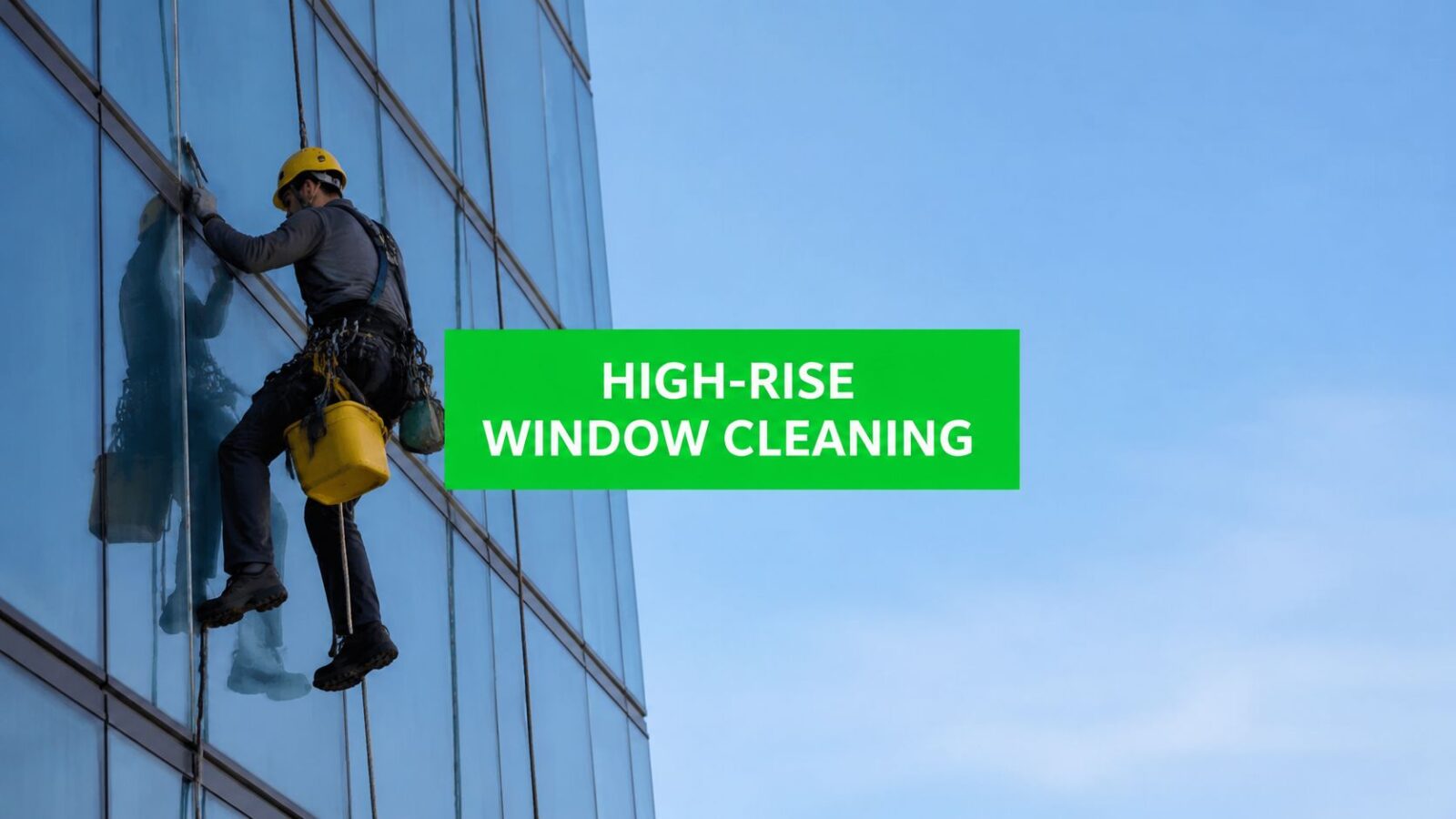
A property manager can usually spot the problem before anyone files a complaint. Stand in the lobby, tilt your head back, and the glass climbing above the entrance is already showing dust, mineral spotting, pine pollen, or streaks from an earlier rinse. The immediate question is rarely whether the windows need cleaning. It's how the crew will reach them without disrupting tenants, damaging the façade, or creating an unacceptable safety risk.
Window cleaning for high rise buildings is a building-maintenance decision, not a larger version of residential glass cleaning. The right plan accounts for façade geometry, roof anchors, ground access, weather, public protection, screen and frame care, documentation, and the conditions specific to Northern Arizona. A crew may use squeegees, ladders, extension poles, pure-water brushes, lifts, or rope systems, but the method must fit the structure.
Why High Rise Window Cleaning Matters More Than People Realize
A dirty façade can change how people judge an otherwise well-managed property. Tenants and visitors notice hazy glass, streaked storefronts, dusty mullions, and runoff marks before they see the maintenance work behind the building. At a hotel, office building, campus facility, or retail center, that first impression reflects on the entire property.
Appearance is only one part of the maintenance problem. Mineral deposits can bond to glass and become difficult to remove, particularly when irrigation spray or hard water dries repeatedly on the façade. Dust and organic material also gather around frames, mullions, ledges, and drainage paths. Cleaning only the center of each pane leaves the surrounding surfaces dirty and gives the façade less preventive attention.
The cost of postponing the work
Heavily soiled glazing can reduce daylight entering occupied spaces, which may increase reliance on interior lighting. The effect depends on glass type, interior layout, and lighting controls, so it does not support a universal savings claim. The practical concern is clear: clean glass supports the building's intended daylighting performance, while accumulated soil works against it.
Tenant experience is affected as well. A resident looking through a streaked window, a hotel guest seeing mineral spotting, or a retail customer approaching a dirty entrance may not identify the maintenance failure in technical terms. They see a property that feels neglected.
Practical rule: Treat recurring glass contamination as façade maintenance. Remove deposits before they harden, inspect adjoining components, and document conditions that require more than routine cleaning.
Runoff creates a separate risk at entrances and pedestrian routes. A professional plan protects floors, controls interior drips, and keeps cleaning water from creating slippery surfaces or carrying debris onto public walkways. Those controls are part of competent work, not an optional courtesy.
Local contamination changes the schedule
Northern Arizona properties face pine pollen, wildfire ash, dust, and winter freeze conditions. Pine pollen can leave a persistent film, while wildfire ash settles on glass and frames after smoke events. Winter freezes also affect when water-based work can be performed safely and how quickly surfaces dry.
A façade that appears acceptable in one season may develop stubborn contamination after the next weather event. High-rise service should follow exposure, tenant use, access limits, and the building's condition rather than a generic annual appointment. That approach helps owners choose an appropriate cleaning frequency and avoid turning routine maintenance into difficult restoration work.
The Main Methods Used to Reach High Rise Glass
Access starts with the façade survey. A contractor should identify roof access, parapet conditions, permanent building maintenance units, rated anchors, setbacks, overhead obstructions, courtyard restrictions, glazing type, and areas where equipment could affect pedestrians or tenants. Only then can the crew select a method.
Ground-based systems
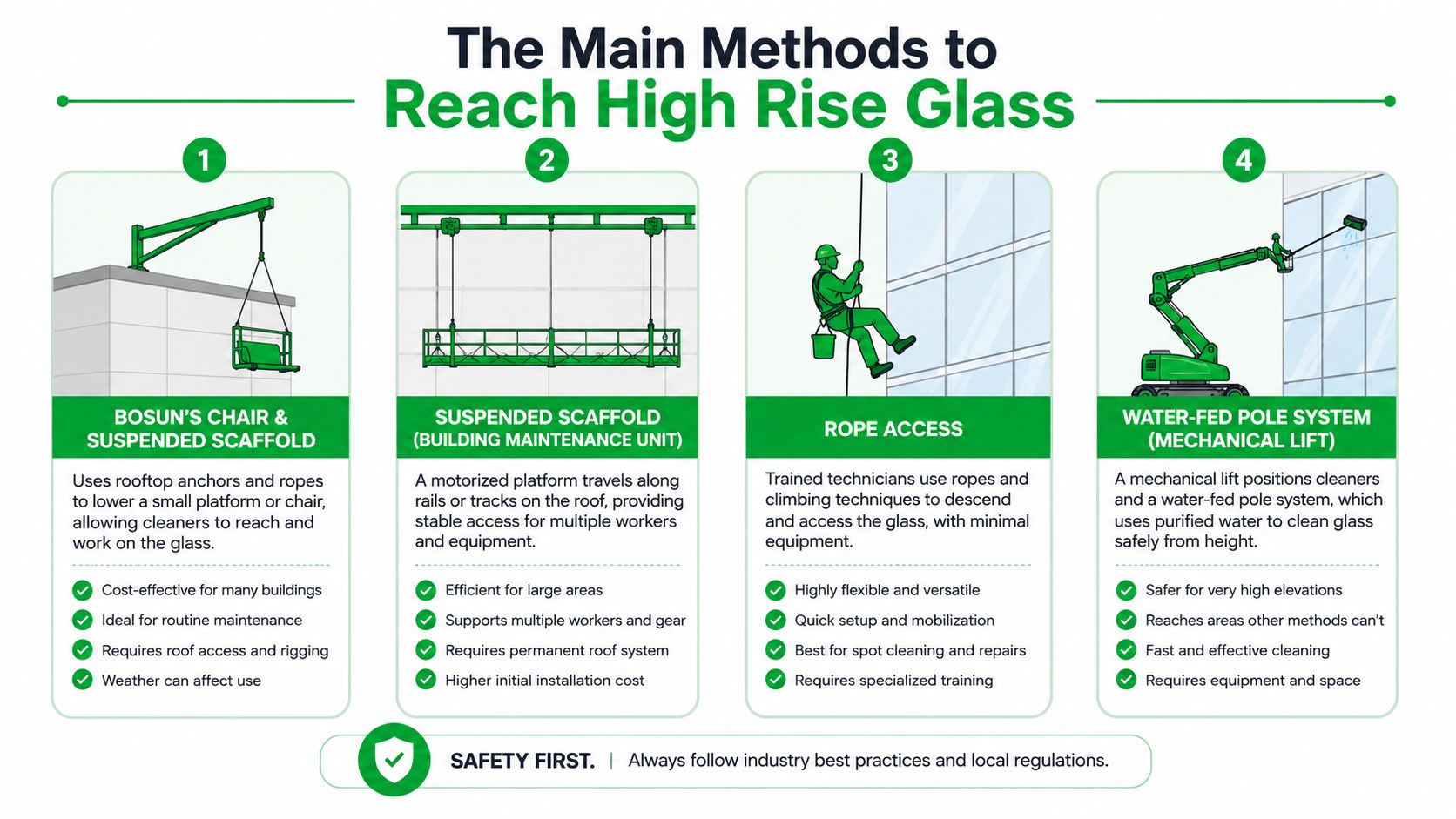
Water-fed poles keep technicians on the ground while purified water is brushed across the glass and rinsed away. The method works well on low- to mid-rise sections, open courtyards, and façades where the pole can reach without striking architectural features. It reduces the need for high access, but it isn't a universal high-rise solution. Wind, recessed windows, overhangs, and extreme height can make pole work impractical.
A boom lift or scissor lift offers a stable work platform when the site has suitable grade, staging space, and permission for vehicle placement. Boom lifts can reach around some obstructions, while scissor lifts are better suited to vertical work over a firm, level surface. Neither method helps if the courtyard is too tight, the ground can't support the machine, or the upper façade sits beyond the equipment's reach.
Suspended and rope-based systems
A bosun's chair lowers one technician from a rooftop anchor, while a suspended scaffold or swing stage carries a broader platform and more equipment. Suspended setups can make sense for long, regular elevations, especially where a building has usable roof anchors or a permanent access system.
Rope access uses a working line and an independent backup line. It suits tall or irregular façades where lifts can't reach and temporary scaffold would create excessive setup or public disruption. Rope work still depends on suitable anchors, trained technicians, rescue planning, exclusion zones, and weather monitoring.
Property managers comparing equipment types can review this practical guide to high-rise window cleaning equipment before requesting bids. Automated robots and track-mounted units are also emerging for some façades, but they need compatible mullions, reliable routing, controlled operating conditions, and a plan for edges, corners, frames, and areas the machine can't contact.
Safety Standards and OSHA Rules That Shape Every Job
A high-rise cleaning plan should first remove the need for outside exposure. Internal cleaning or balcony access can reduce fall and dropped-object risks before a harness, rope, or powered platform is considered. UK guidance on safer window-cleaning access sets out this practical hierarchy: eliminate the hazard where possible, prevent a fall when exposure remains, then use fall arrest as the final defense.
U.S. planning must bring OSHA requirements, site conditions, equipment manuals, and written procedures together. The safety file should identify the cleaning method, rescue plan, equipment inspections, anchor documentation, worker qualifications, public-protection controls, and daily records. Northern Arizona conditions belong in that review. Pine pollen can reduce visibility and leave slick residue, wildfire ash can contaminate glass and work areas, and winter freezes can change footing, access, and equipment decisions.
Anchor capacity is a design requirement
A rope-descent system needs a dedicated anchor capable of supporting at least 5,000 pounds per attached worker, along with independent rigging and documented inspection. Rope-access window-cleaning guidance explains why anchor certification and inspection records matter when suspension loads transfer into the roof structure.
For tall-building rope descent in the United States, the owner must notify the employer in writing that each anchorage has been identified, tested, certified, and maintained to support 5,000 pounds in any direction for each attached worker. OSHA also limits rope-descent systems to 300 feet above grade, unless the employer demonstrates that no other access method is feasible or safer. This OSHA RDS summary outlines these owner and access obligations.
| Standard | Requirement | Threshold |
|---|---|---|
| OSHA rope-descent provisions | Dedicated, independently rigged anchor for each attached worker | At least 5,000 pounds per worker |
| OSHA rope-descent limitation | Use above the stated height only when no other access is feasible or safer | 300 feet above grade |
| Fall-protection planning | Select hazard elimination or prevention before relying on arrest | Site-specific assessment, training, inspection, and rescue planning |
| ANSI/IWCA practice | Use recognized window-cleaning procedures and competent personnel | Building-specific method statement and records |
The trade is safer than it was historically, but high-access work still demands disciplined setup. A historical comparison reports that about 1 in every 200 New York City window cleaners died each year in 1932, while the International Window Cleaning Association reported one fatality per year among U.S. high-rise window cleaners during 2010 to 2014, despite roughly 1.5 million annual exposures. Historical high-rise window-cleaning safety comparison links the improvement to better access systems, fall protection, training, and regulation.
Another OSHA-cited industry analysis recorded 88 window-cleaning accidents over 15 years, including 62 fatalities, while a separate summary reported 28 incidents over five years, including 11 deaths. The industry safety discussion citing those figures shows why a low incident count cannot justify casual procedures. Tie-off checks, anchor inspections, exclusion zones, weather monitoring, and a workable rescue plan receive the same attention as the cleaning itself.
Ground-level and short-access work still requires controls. Review these ladder safety requirements when a property combines routine ladder tasks with high-level window cleaning.
Matching the Right Access Method to Your Building
The contractor shouldn't choose a method just because it owns a particular machine. Start with the building's constraints, then select the access system that controls risk while delivering reasonable production.
| Method | Best Building Type | Height Range | Setup Complexity | Typical Use |
|---|---|---|---|---|
| Water-fed poles | Low- to mid-rise façades with open ground access | Limited by reach and site conditions | Low | Routine exterior maintenance without elevated access |
| Boom lift | Buildings with grade-level staging and clear reach paths | Moderate, equipment-dependent | Moderate | Lower and mid-level sections, setbacks, and selected upper areas |
| Scissor lift | Straight vertical façades over firm, level ground | Moderate, equipment-dependent | Moderate | Broad vertical sections with adequate footprint |
| Rope access | Tall, irregular, or recessed façades with suitable anchors | Tall structures, subject to applicable limits | High planning, limited physical footprint | Upper stories, corners, setbacks, and difficult geometry |
| Suspended scaffold | Long, regular elevations with usable roof access | Tall structures, subject to system design | High | Repeated façade sections and larger crews |
| Robotic or track-mounted unit | Compatible façades designed for machine travel | Building-specific | High planning and specialized equipment | Repetitive cleaning where geometry and controls support automation |
Where each choice breaks down
A boom lift can be efficient until a steep grade, narrow drive, overhead canopy, landscaping, or public route blocks the setup. A scissor lift needs even more predictable ground conditions because it generally works vertically from a fixed footprint. Moving equipment between elevations can also create traffic and tenant-disruption issues.
Rope access has the opposite profile. It needs less ground space and can reach areas a lift can't, but it depends heavily on anchor capacity, roof access, wind conditions, rescue capability, and trained personnel. A suspended scaffold offers a broader platform, though rigging, exclusion zones, and staging can increase the planning burden.
Robots may reduce human exposure on suitable façades, but they don't automatically solve the whole cleaning program. Frames, corners, mullions, ledges, screens, and damaged or irregular panels may still require technicians. The lowest-risk system may therefore be a hybrid plan, such as water-fed poles or lifts for lower areas and rope access for upper stories.
A practical selection flow
- Can the glass be cleaned from inside, a balcony, or the ground? Use that option where it provides adequate results.
- Can equipment be staged safely without blocking occupants or public routes? If yes, assess a lift.
- Does the roof have documented, suitable access infrastructure? If yes, compare rope descent, suspended scaffold, or a permanent unit.
- Does the façade support automation? If yes, evaluate the robot alongside the manual work still required.
- Are conditions mixed? Specify a hybrid scope instead of forcing one method across every elevation.
Caring for Screens, Frames, and Surrounding Surfaces
A clean pane can still leave a poor impression if the screen, frame, sill, or track is dirty. In Northern Arizona, pine pollen can collect in mesh and tracks, wildfire ash can settle on ledges, and winter freezes can expose weak seals or trapped moisture. Screen and frame work should be planned with the glass, not treated as an afterthought.
Before removal, photograph unusual panel positions, label each screen, and record damaged corners or missing hardware. Support every screen with both hands, then place removed components in a padded, stable area.
The remove-clean-dry-reinstall sequence
- Remove and label. Take screens out before cleaning the glass. This gives the brush, squeegee, or pure-water rinse access to the full pane and frame.
- Clean gently. Rinse loose debris first, wash the mesh and frame with mild detergent and a soft brush, and avoid pressure that could deform the screen.
- Dry completely. Wait until each screen is fully dry before reinstalling it. This reduces trapped moisture and streaking, particularly before a freeze.
- Reinstall correctly. Return each labeled panel to its original opening, seat the springs and clips, and confirm that the screen is secure.
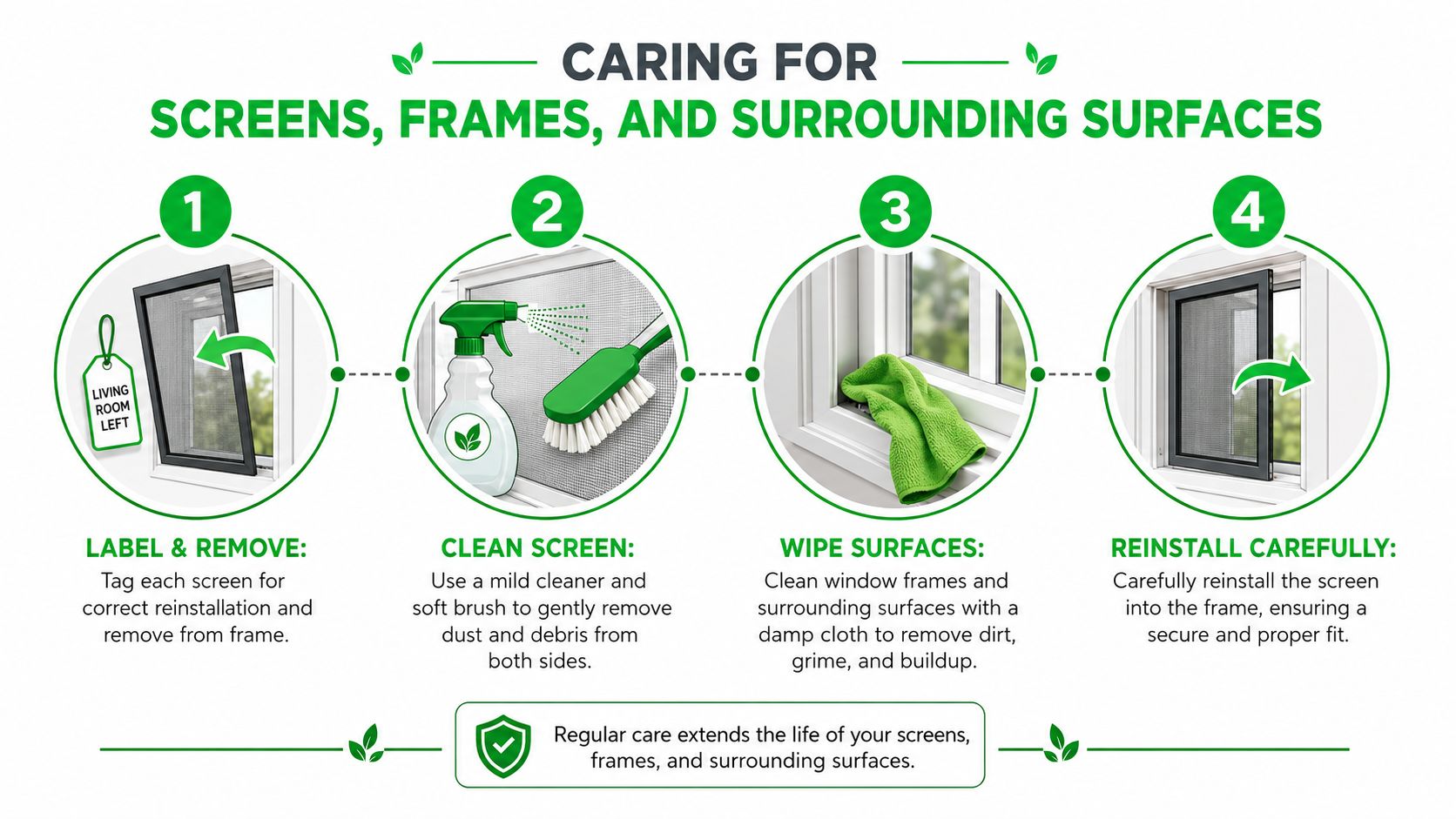
This screen-cleaning guide supports removing screens before cleaning, then rinsing, washing, drying, and reinstalling them only after they are fully dry. This maintenance guide also emphasizes labeling, two-hand support, padded storage, floor protection, and careful treatment of nearby surfaces.
Crews should clear sill tracks, inspect weep holes, wipe aluminum, vinyl, or clad-wood frames according to their condition, and look for failed caulk or damaged seals. Low-E coatings and tinted glass require products and agitation methods compatible with manufacturer specifications. Abrasive pads and harsh chemicals can create permanent damage while trying to remove a stubborn mark.
A useful reference for surrounding glazing conditions is Northpoint Construction's guide on how to tell if windows need replacing. It helps distinguish removable dirt from signs of seal failure, damaged frames, or aging units.
Before leaving, the crew should verify:
- Floors and furnishings: Protect interior work areas and control the dripline.
- Frames and tracks: Remove loosened debris instead of pushing it into weep holes.
- Screens and hardware: Reinstall the correct panel and confirm its fit.
- Ledges and trim: Wipe contacted surfaces and remove runoff marks.
- Documentation: Photograph existing damage and record repairs outside the cleaning scope.
What High Rise Window Cleaning Really Costs
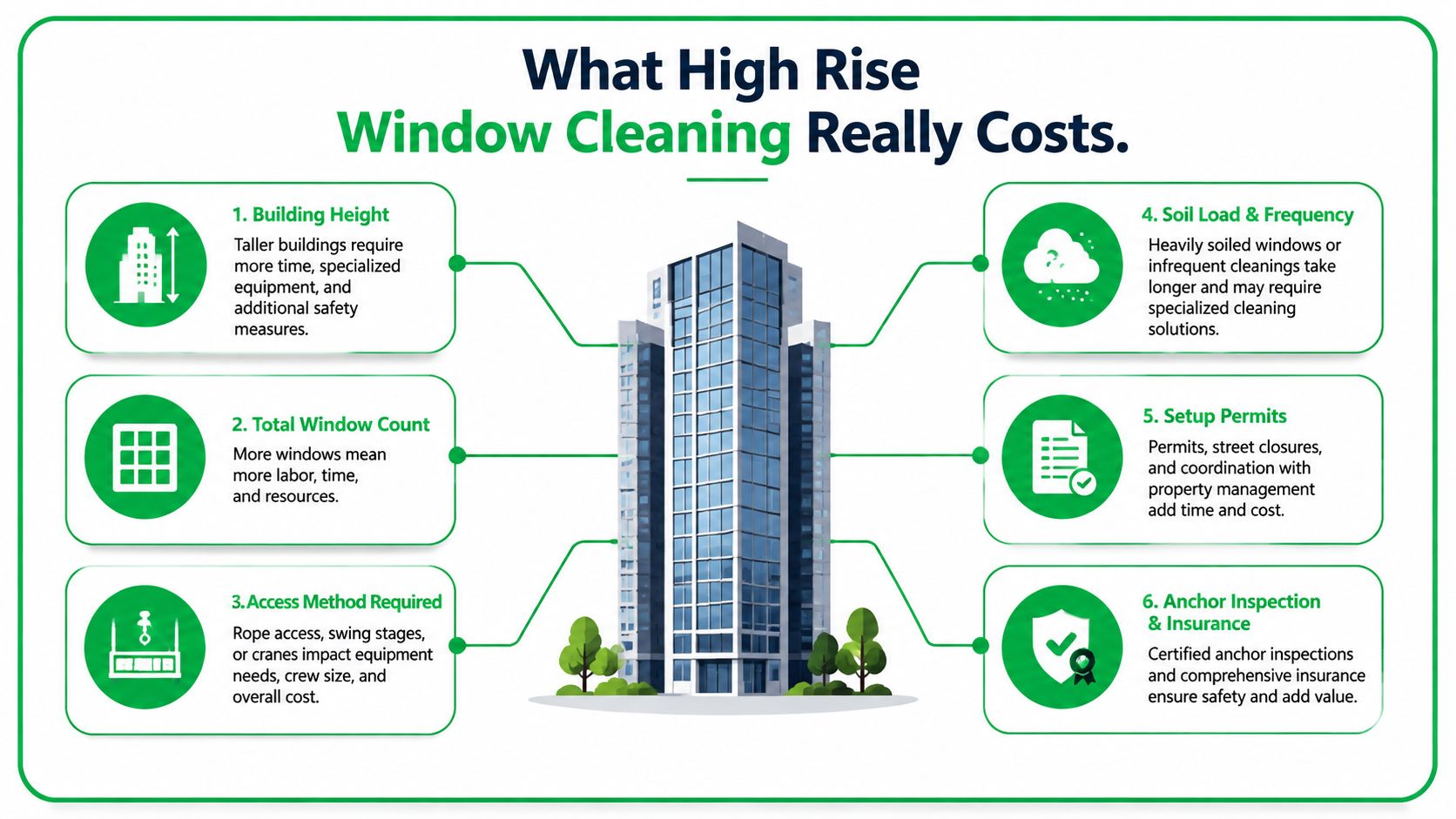
A high-rise quote reflects access complexity more than pane count alone. Height, total glazing, façade geometry, soil load, cleaning frequency, permits, anchor inspection, insurance, labor specialization, tenant coordination, and weather restrictions all affect the final scope.
The cheapest bid often looks attractive because it leaves something out. It may assume ground-based access where the upper façade requires rope or a lift, omit anchor certification, exclude screen handling, ignore public protection, or use labor without the training the site demands. That doesn't make the work cheaper. It transfers cost and risk to the owner.
Price the service as a maintenance program
A lifecycle view includes the cost of access equipment, roof setup, inspections, labor, traffic control, tenant communication, and documentation. It also considers what happens when service is delayed, such as hardened mineral deposits, more difficult restoration, complaints from occupants, and a rushed schedule after a visible event.
Recent market reporting places façade maintenance at USD 1.60 billion in 2025, with reported growth of 9.3%, while window cleaning remained the largest application at USD 2.26 billion and 48.0% of revenue. The building maintenance unit market report describes a broader shift toward integrated cleaning, inspection, coatings, and digital quality verification. Those figures describe market reporting, not a quote for any particular property, but they show why owners increasingly evaluate façade care as an asset-maintenance program.
For regional budgeting, request a site-specific estimate rather than relying on generic Flagstaff pricing bands. A low-rise storefront, a mid-rise hotel, and a tall structure with restricted roof access can have completely different labor and equipment requirements. Bundling interior and exterior glass, screen service, frame detailing, and seasonal rinses may reduce mobilization waste, but the contractor should show exactly what is included.
Use the commercial window cleaning cost guide as a starting point, then compare bids using the same scope:
- Access: Identify the method for each elevation.
- Safety: Confirm anchors, inspections, rescue planning, insurance, and public protection.
- Labor: Ask who performs the work and what training applies.
- Finish: Include screens, frames, sills, ledges, and cleanup.
- Frequency: Price recurring service separately from restoration.
- Records: Require completion notes, photos where useful, and exceptions.
Choosing a Contractor You Can Trust With Your Property
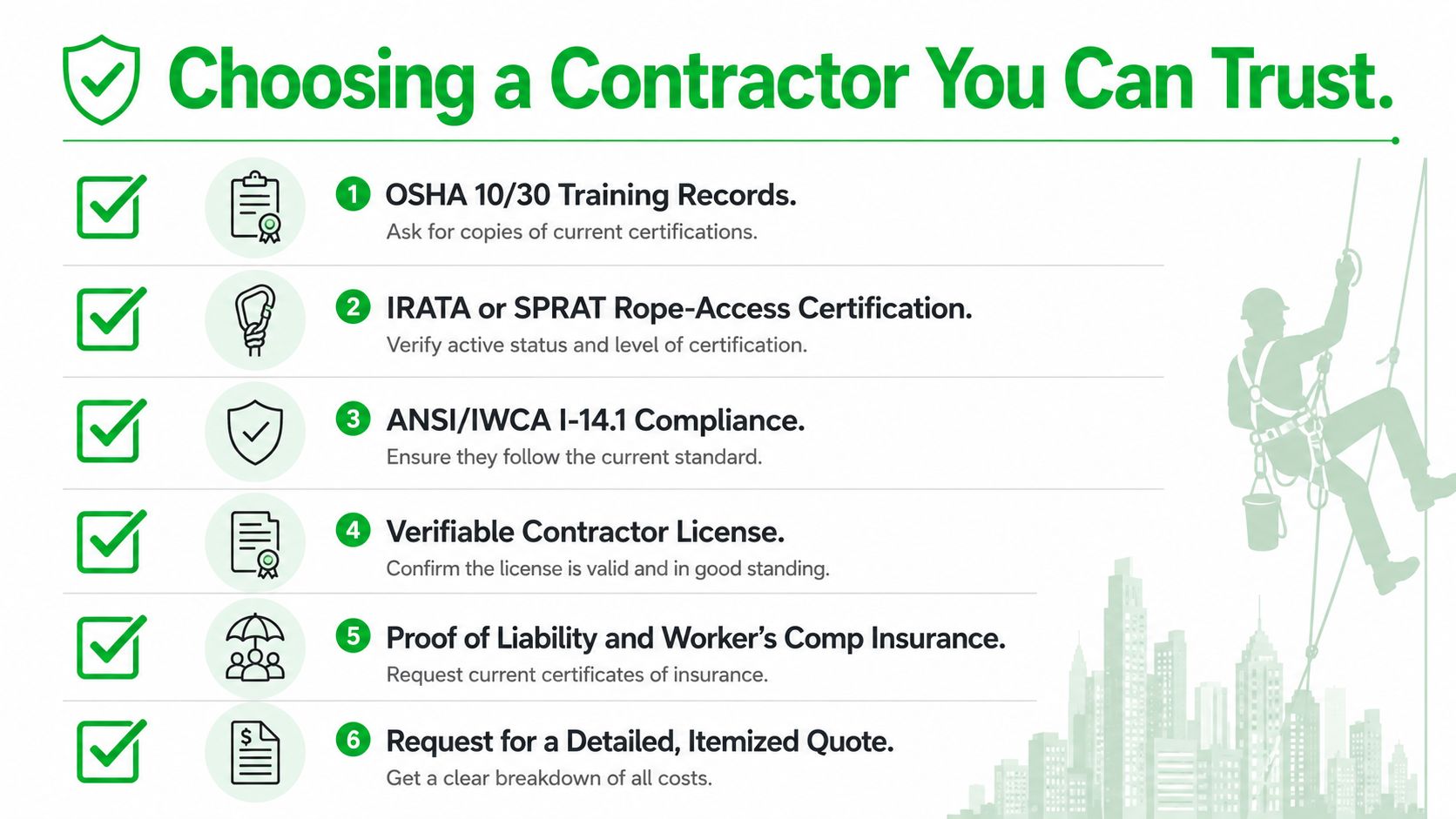
A contractor's sales presentation matters less than its records. Ask for current OSHA 10 or OSHA 30 training documentation where applicable, IRATA or SPRAT rope-access credentials for rope work, evidence of ANSI/IWCA I-14.1 practices, and a license verifiable through the Arizona Registrar of Contractors.
Insurance should be specific to the exposure. Request certificates showing general liability coverage of at least $1 million, workers' compensation, and any umbrella policy required by the owner's risk manager. Confirm whether the building owner must be named as an additional insured before mobilization.
Vet the roof and the method
Walk the roof with the contractor before signing. Anchors should have documented load ratings, visible inspection information, and records dated within the last twelve months. For rope descent, the applicable requirement is 5,000 pounds per attached worker, so a contractor who can't explain how the anchors were identified, tested, certified, and maintained hasn't completed the basic planning conversation.
Request a written, building-specific method statement. It should address:
- Access points: Roof routes, staging areas, lifts, anchors, and façade transitions.
- Worker protection: Tie-off, equipment inspection, exclusion zones, and dropped-object controls.
- Rescue: How the crew will recover a suspended or injured worker.
- Occupant care: Notifications, interior protection, access restrictions, and cleanup.
- References: Comparable high-rise, hotel, campus, or commercial projects.
- Screening: Evidence of pre-employment drug screening if required by the property.
The contractor should also explain how suspended-scaffold users are trained and how daily inspection logs are maintained. Cash-only invoicing, vague safety language, missing site-specific plans, and crews arriving without documented equipment checks are serious warning signs.
Pine Country Window Cleaning is one local option for Northern Arizona properties. Its service capabilities include boom lifts, scissor lifts, and a 95-foot atrium lift, along with commercial and high-access window cleaning for properties such as hotels, facilities, dealerships, and other challenging sites.
Northern Arizona Schedules and Year Round Care
Northern Arizona doesn't reward a generic cleaning calendar. Pine pollen can leave a yellow-green film on exposed glass, while wind carries dust and wildfire ash onto west- and south-facing elevations. Winter freezes add another layer of difficulty because moisture can dry or freeze against glass, frames, ledges, and entry surfaces.
A building manager should schedule around contamination and use, not wait until the façade looks poor from the street. Hotels, retail entrances, medical buildings, and campus facilities may need more frequent attention at ground level than upper elevations because fingerprints, irrigation overspray, traffic dust, and pedestrian activity concentrate near occupants.
| Season | Recommended Service | Frequency | Trigger Conditions |
|---|---|---|---|
| Spring | Deep exterior glass, screens where included, frames, sills, and ledges | Repeat during the strongest pollen period as conditions require | Visible pollen film, reduced clarity, heavy exposure near pine stands |
| Summer monsoon | Exterior rinse and elevation inspection | Schedule around recurring dust and storm activity | Dust loading, wildfire ash, wind-driven debris, west- or south-facing contamination |
| Fall | Pre-winter detail and drainage-path check | Before sustained freezing or snow conditions | Mineral residue, dirty tracks, blocked weep paths, exposed entry glazing |
| Winter and post-storm | Spot cleaning, safety inspection, and targeted rinsing when conditions allow | After significant storms or contamination events | Ash, runoff marks, frozen deposits, damaged screens, unsafe entry surfaces |
| Ground-floor retail | Entry glass and accessible storefront maintenance | Recurring service based on traffic and soil load | Fingerprints, tracked-in grit, irrigation spray, customer-facing buildup |
Fire-related residue deserves quick attention. If wildfire ash settles on glass, frames, or ledges, dry aggressive brushing can spread abrasive particles across the surface. A controlled rinse and appropriate cleaning method are safer than grinding the residue into the glass.
Customer care is part of the schedule, too. A professional crew should communicate arrival times, protect occupied areas, remove and reinstall screens carefully, keep equipment organized, and leave the property as clean as it found it. Pine Country Window Cleaning has served Northern Arizona since 1999, was started by Flagstaff native David Kaminski, and handles screen removal, cleaning, and reinstallation with its window-cleaning service.
The strongest annual plan combines a deep seasonal service with responsive spot work after pollen, ash, dust, or storms. That approach protects the glass, supports a clean tenant experience, and gives the owner a documented basis for adjusting frequency as the property's exposure changes.
For a building-specific plan, Pine Country Window Cleaning can evaluate access, glass, screens, frames, lifts, and Northern Arizona weather exposure, then provide a clear estimate for recurring or project-based service. Visit Pine Country Window Cleaning to request service for a hotel, campus, commercial building, high-rise property, home, or cabin.