
Commercial window cleaning cost usually falls between $5.50 and $15.00 per window, or $0.50 to $2.50 per square foot for larger properties. Your final price depends on the building type, access, glass condition, and how often you have the work done.
If you manage a retail center, medical office, hotel, dealership, or campus building in Flagstaff, you've probably run into the same problem. One company gives you a per-pane quote, another prices by the hour, and a third throws out a flat monthly number with almost no explanation. On paper, those bids can look completely different even when they're talking about the same building.
That's where most budgeting mistakes start. The issue usually isn't the number itself. It's not knowing what's included, what equipment the crew will need, whether screens are handled, or how much of the price is tied to local conditions like pine pollen, mineral deposits, and the extra wear that Northern Arizona weather puts on glass.
Budgeting for a Clear View Your Guide to Window Cleaning Costs
A facility manager in Flagstaff typically isn't asking one simple question. They're asking several at once. What should this service cost, how often should the property be cleaned, and what kind of bid is realistic for a low-rise storefront versus a multistory building with hard-to-reach glass?
That's why commercial window cleaning cost needs to be looked at as a maintenance budget item, not a generic cleaning expense. A ground-level bank branch with straightforward access is one kind of job. A hotel with courtyard glass, upper-story windows, screens, guest traffic, and seasonal buildup is a very different job, even if both properties look “medium-sized” from the street.
In Flagstaff, the local conditions matter more than many national pricing guides admit. Pine pollen sticks to frames and screens. Hard water leaves mineral deposits that don't come off with a quick pass. High-altitude sun bakes residue onto the glass, especially on south- and west-facing elevations. That changes labor time and the tools needed to do the work correctly.
Clean windows aren't just a cosmetic line item. For many properties, they're part of tenant experience, curb appeal, and routine asset care.
A practical budget starts with the right questions:
- What exactly is being cleaned. Exterior only, interior and exterior, entry glass, transoms, atriums, or specialty panes.
- How is the glass accessed. Pole work, ladders, boom lift, scissor lift, or atrium lift.
- What condition is the glass in. Light dust, seasonal pollen, mineral staining, or post-construction debris.
- What else is included. Screen removal, screen cleaning, sill attention, and reinstallation.
- How often the work is scheduled. One-time service is different from a recurring route.
That last point matters. Buildings that stay on a regular schedule are usually simpler to maintain because the crew is removing current soil, not restoring neglected glass.
Flagstaff property managers also need a contractor who understands local building types. Downtown storefronts, NAU-related facilities, car dealerships, hotels, and medical properties all have different access patterns and service expectations. A quote only becomes useful when it reflects those real-world differences.
How Professional Window Cleaners Price Their Services
Professional companies don't price glass the way a homeowner might think about cleaning a mirror. The bid is built around measurable scope, safe access, and the method required to leave the glass clear without damage. That means squeegees, extension poles, ladders, pure-water brushes, and lift access when the building requires it. It does not mean a rag, off-the-shelf spray bottle, or shortcut work that leaves detailing problems around edges and frames.
Per window and per pane pricing
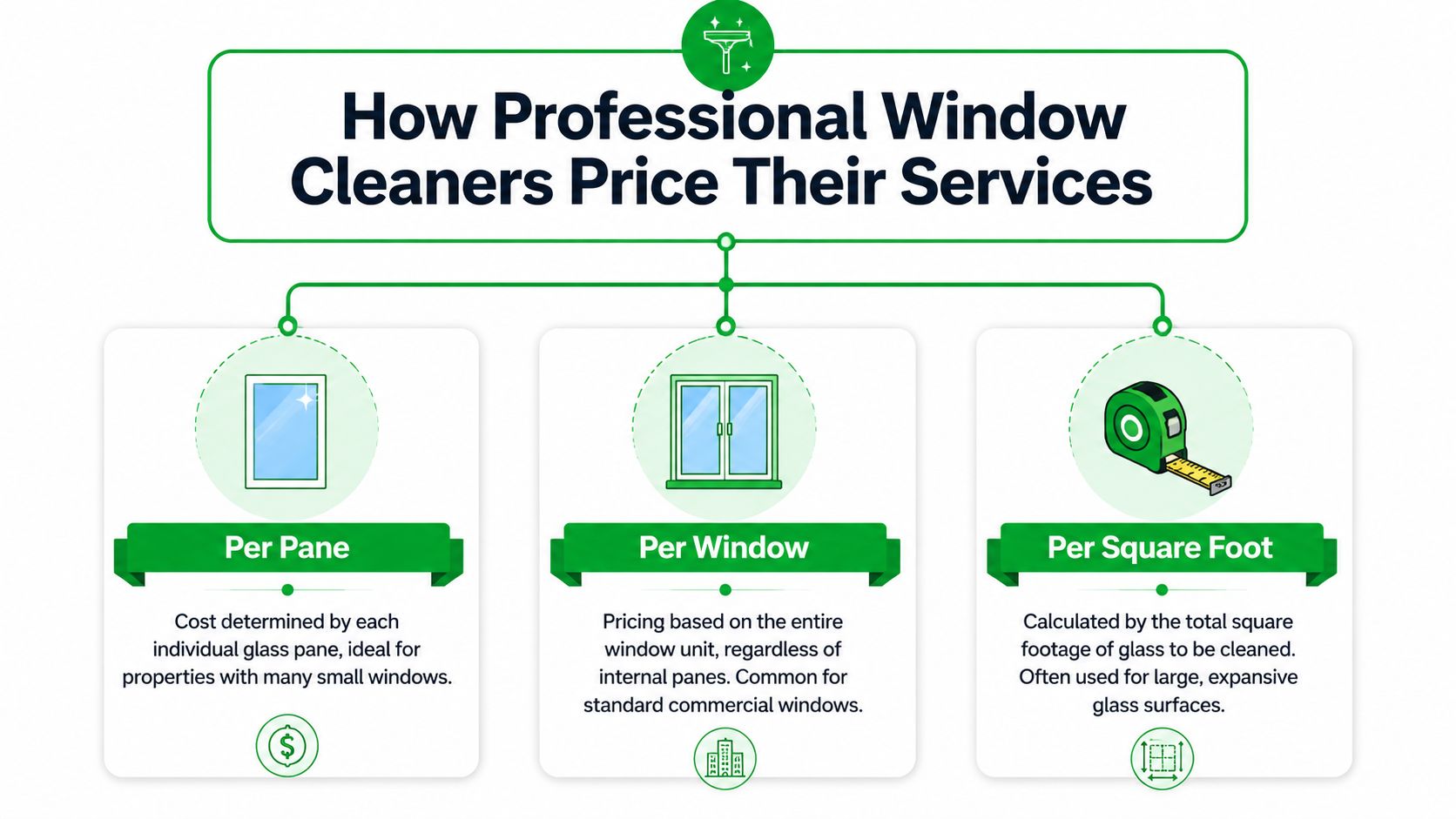
For many standard commercial properties, per-window pricing is still the easiest model to understand. In major U.S. markets, commercial window cleaning ranged from $5.50 to $15.00 per window, with an industry standard of about $10 per window, according to commercial window cleaning price analysis from Window Hero.
Per-pane pricing gets used when the structure of the glass matters more than the outer frame. The same source notes that companies charging by the pane typically bill $2 to $8 per pane. That model often makes sense for older buildings, divided-light storefronts, and properties with many small sections of glass that take more detailing than a single large pane.
Here's the practical difference:
- Per window works best when the windows are standard and repetitive.
- Per pane works better when grids, divided lights, or unusual layouts increase labor.
- Neither model works well alone if the job also requires specialized access equipment.
Square footage and hourly pricing
Large commercial properties often shift to glass area or labor-based pricing because counting panes doesn't capture the whole job. Expansive facades, showrooms, hotels, and campuses can be priced more accurately by square footage or by crew time.
Hourly pricing is usually tied to labor and equipment demands. Window Hero notes that smaller teams commonly charge $35 to $60 per hour in the same market overview. On real jobs, hourly pricing tends to appear when the access is irregular, the glass is heavily soiled, or the work includes extra detailing that can't be captured cleanly in a basic count.
Practical rule: If a quote seems low, ask what pricing model the company used and what they left out to get there.
A well-run company chooses the model that matches the property. That's one reason many operators who want better estimating systems and tighter operations study resources like this profitable growth plan for cleaning businesses. Better systems usually produce clearer quotes for the customer.
What actually justifies the cost
The value isn't in “someone wiping glass.” The value is in sending a trained crew with the right tools to produce consistent results while protecting the property and working safely around staff, tenants, and customers.
That includes things like:
- Professional tools such as channel-and-rubber squeegees, scrubbers, poles, and pure-water systems.
- Safe access planning for upper elevations, courtyards, canopies, and atriums.
- Detail work around edges, frames, and screens.
- Reliable scheduling so the property stays ahead of buildup instead of paying for restoration every time.
Key Factors That Drive Your Final Cost
The biggest mistake in commercial budgeting is treating all glass like it costs the same to clean. It doesn't. A single-story storefront with easy walk-up access will price very differently from a multilevel medical building with landscaping obstacles, interior courtyard glass, and mineral buildup on shaded elevations.
Height and access change everything
For low-rise commercial work, pricing often hinges on straightforward metrics. ProMatcher's commercial pricing overview notes $3 to $8 per window or $0.75 to $1.50 per square foot for low-rises.
That sounds simple until access becomes difficult. A canopy over an entry, shrubs below the glass, sloped terrain, a narrow service lane, or an interior atrium can all slow down production. Once lifts or more complex ladder setups enter the job, labor planning changes and so does the price.
For taller or more complex properties, it helps to review what true high-rise window cleaning services involve before comparing bids. The equipment, safety planning, and crew training are different from standard storefront work.
Northern Arizona residue is not generic dirt
Flagstaff buildings deal with a combination of pine pollen, dust, and mineral deposits that can make routine service look deceptively simple from the ground. ProMatcher also notes that Northern Arizona conditions like pine pollen or mineral deposits can require pre-rinsing with deionized water, potentially increasing costs by 15% to 25% compared with jobs in other climates in that market context.
That matters because residue often collects in layers:
- Pollen coats screens and frames before it even shows heavily on the glass.
- Mineral deposits bond to the surface and may need more than a standard wash.
- UV exposure bakes debris onto south-facing glass, which raises labor time.
A professional crew plans for those conditions with pure-water brushes, proper scrubbers, and detailing techniques that remove soil without scratching or smearing it around.
If your building sits under pines or gets regular sprinkler overspray, the cheapest quote often becomes the most expensive one after the glass still looks spotted.
Here's a short look at the YouTube video that shows the kind of access planning commercial work can require:
Condition and scope affect labor more than owners expect
Two buildings with the same window count can price very differently if one has been maintained and the other has gone too long between cleanings. First-time or delayed service usually means more scrubbing, more detailing, and more time on each pane.
Scope matters too. Some customers ask only for exterior glass. Others need interior and exterior cleaning, entry doors, partitions, and high interior windows. Screen handling also takes real time. On many Northern Arizona properties, removing screens, cleaning them, and reinstalling them is part of doing the job correctly because debris trapped in the mesh keeps dropping dust and pollen back onto the glass.
Insurance and risk management also influence who should be on your bid list. If you're reviewing vendors, it's worth taking a minute to learn about GL from Coverage Axis so you know what general liability coverage is meant to protect against on commercial work.
Frequency usually lowers friction
Routine service is easier to execute than rescue work. Glass that's cleaned on a workable schedule generally needs less aggressive effort, produces more consistent results, and causes fewer surprises during the visit.
That doesn't mean every building needs the same frequency. A downtown storefront, a dealership showroom, and a campus building all collect soil differently. The right schedule is the one that matches traffic, exposure, and the image the property needs to maintain.
Sample Costs for Northern Arizona Properties
General national benchmarks are useful, but facility managers usually need a more local working range for planning. For bigger commercial properties, square footage pricing commonly averages $0.50 to $2.50 per square foot, and Thumbtack reports national commercial jobs averaging $150 to $650 per visit, according to FieldCamp's commercial window cleaning pricing guide. The same source notes that post-construction cleaning adds $4 to $5 per pane for debris removal.
Those numbers help establish a frame, but local bids still turn on property type. In Flagstaff and nearby markets, a dealership with large showroom glass is usually easier to price than an older downtown building with divided panes and tighter ladder access. A campus or hotel may have cleaner access on one elevation and far more complicated work on another.
Estimated Commercial Window Cleaning Costs in Northern Arizona 2026
| Property Type | Typical Pricing Model | Estimated Cost Per Visit |
|---|---|---|
| Small retail storefront | Per window or per pane | Often falls near the lower end of national commercial visit ranges when access is simple |
| Car dealership showroom | Per square foot or custom site bid | Usually higher than a small storefront because large glass walls and presentation standards raise scope |
| Mid-rise office building | Square footage plus access considerations | Typically priced above basic low-rise work due to elevation and equipment needs |
| Medical office | Per window, square footage, or blended quote | Varies based on entry glass, patient traffic, and whether interior glass is included |
| Hotel or hospitality property | Custom recurring service plan | Commonly priced as a route contract because multiple elevations and public-facing glass need regular attention |
| Large campus facility | Square footage or project-based proposal | Usually requires a site audit because building mix, height, and scheduling logistics vary widely |
What these property types have in common
The table above isn't meant to replace a site visit. It's meant to help you understand why quotes vary.
A few examples make that clearer:
- Small retail spaces are often straightforward if the crew can park close, work from the ground, and clean a limited amount of entry glass.
- Dealerships usually have large panes that show every streak and water spot, so the finish standard is high.
- Medical buildings often need careful scheduling around patient flow and entrances.
- Hotels require both appearance and discretion because the work happens around guests.
- Campus buildings can have a mix of simple exterior runs and difficult access points in the same service area.
The right estimate doesn't start with an average. It starts with a site audit that matches the pricing model to the actual property.
When post-construction pricing shows up
New construction, remodels, and tenant improvements create their own category. Debris, stickers, paint, silicone, and fine dust all slow the process and increase risk if the work is rushed. That's why post-construction should be quoted separately from routine maintenance.
For developers, builders, and property managers turning over space, this is one of the most important distinctions in the whole commercial window cleaning cost discussion. Maintenance pricing is for maintained glass. Post-construction pricing is for cleanup and restoration to first-ready condition.
Maximizing Value with Add-On Services
A property rarely needs only one thing. The windows may be overdue, but the gutters are also collecting debris, exterior concrete is dingy, and the building would present better if those items were handled on the same trip. That's where bundled work starts making sense.
Why bundled service often works better
Mobilization is a real part of any commercial job. Crews travel, unload equipment, set safety zones, and coordinate around the site. When you combine related exterior services, you reduce repeat setup and keep maintenance more organized.
That doesn't mean every add-on is a deal. It only makes sense when the services support the same maintenance goal.
Good combinations often include:
- Window cleaning and gutter cleaning when seasonal debris is dropping onto roofs, ledges, and glass.
- Window cleaning and pressure washing when entryways, sidewalks, or building fronts are undermining curb appeal.
- Routine cleaning and post-construction follow-up after tenant improvements or exterior work.
If you're comparing options, a provider that handles broader commercial building window cleaning work can often identify where bundled scheduling is practical and where it isn't.
What adds value and what doesn't
Value comes from reducing repeat labor and preserving the property's appearance over time. It does not come from stacking random upsells onto a basic service call.
The useful add-ons are the ones that solve a related problem:
- Screen cleaning matters in Northern Arizona because pollen and dust collect there first.
- Downspout and gutter attention helps stop runoff patterns that can dirty facades and adjacent glass.
- Pressure washing makes sense when dirty concrete or splashback is making clean windows look unfinished.
One practical option in the local market is Pine Country Window Cleaning, which handles commercial glass along with related exterior maintenance using the same professional approach to access, scheduling, and property care.
Think in route efficiency, not line items
A facility manager gets the best value by looking at the property as a whole. If the crew is already on site with poles, ladders, lift planning, and exterior access mapped out, that visit can often do more than one job efficiently.
That approach usually creates cleaner results overall too. Sparkling glass on a building with clogged gutters and dirty entry concrete doesn't look finished. Coordinated maintenance does.
How to Evaluate Quotes and Choose the Right Partner
The best quote isn't always the lowest one. It's the one that tells you exactly what crew is showing up, what they're cleaning, how they'll access the work, and what protections are in place if something goes wrong.
What a solid quote should include
A professional proposal should answer the questions a facility manager would otherwise have to chase down later.
Look for these items:
- Clear scope of work. Exterior only, interior and exterior, screens, entry glass, partitions, or specialty glass.
- Access method. Ground poles, ladders, lift work, or another approach that fits the site.
- Scheduling details. Daytime, off-hours, phased service, or work around customer traffic.
- Insurance and safety information. You shouldn't have to guess whether the company is prepared for commercial risk.
- Service frequency options. One-time cleanup and recurring maintenance are not the same thing.
Red flags that deserve a second look
Some bids are low because they're efficient. Others are low because they're missing important parts of the job.
Be cautious if the quote:
- Avoids specifics and gives only a lump sum with no breakdown.
- Skips access discussion on buildings that obviously need more than basic ladder work.
- Doesn't mention screens or frame conditions on properties where those affect the final result.
- Feels rushed from the start with weak communication before the work even begins.
A vague quote usually leads to one of two outcomes. Change orders later, or a crew cutting corners on site.
For building managers comparing providers, it helps to review what established commercial window cleaning services typically include so your quote comparison is fair.
The decision that usually pays off
Select the contractor who prices the actual job, not a simplified version of it. On commercial work, reliability matters. Safety matters. Respect for the property matters. So does having technicians who understand how to move through occupied spaces without creating disruption.
That's the difference between buying a low number and buying a dependable maintenance outcome.
The Clear Choice for Flagstaff's Businesses
Commercial window cleaning cost isn't random. It's built from access, labor, safety requirements, glass condition, service frequency, and the property itself. Once you understand those drivers, quotes become much easier to judge.
That matters even more in Northern Arizona. Pine pollen, mineral deposits, altitude, weather swings, and varied building types all affect how long a job takes and what method will produce clean glass. A useful estimate has to reflect those conditions, not ignore them.
For Flagstaff businesses, local experience counts. Pine Country Window Cleaning has served Northern Arizona since 1999 and was started by Flagstaff native David Kaminski. The company handles everything from storefronts and medical offices to hotels, dealerships, campus facilities, and high-access projects with in-house equipment that includes boom lifts, scissor lifts, and a 95-foot atrium lift. Their crews are background-checked, OSHA safety-trained, and focused on careful work that respects the property.
If you're budgeting for routine service, bidding a larger project, or trying to make sense of inconsistent proposals, the next step is simple. Get a site-specific estimate from a company that understands Flagstaff buildings and can explain exactly how the price is built.
Need a clear, no-obligation quote for your property? Pine Country Window Cleaning can assess your building, explain the right pricing model, and put together a practical maintenance plan for your windows, screens, and exterior access needs.