

You wipe the downstairs panes on a bright Flagstaff morning, then look up at the second story and see the same white spotting you were trying to remove last weekend. The hard water from a well or outdoor spigot dried before you could finish, and Northern Arizona's strong sun made every mineral mark easier to see. On a Munds Park cabin, the problem can be worse around sprinkler-facing glass, lodge-pole trim, screens, and windows that sit untouched between visits.
That's where soft water window cleaning earns its place. The method isn't “washing with nicer water.” It combines controlled water treatment, soft-bristled brushes, poles, and careful rinsing to leave exterior glass free of the mineral residue that ordinary water can deposit. The right system can improve the finish, reduce ladder work, and protect the home from the careless handling that causes more trouble than dirty glass.
What Soft Water Window Cleaning Actually Is
A homeowner on Flagstaff's south side may start with a familiar routine. The downstairs windows look manageable, but the upstairs panes streak again because the rinse water dries quickly under high-altitude sun. Wiping harder doesn't solve the cause. It can spread mineral residue, leave lint, and make the glass look acceptable from one angle while white spotting remains visible from another.
Soft water window cleaning uses water with much of its dissolved mineral content removed before that water touches the glass. Calcium and magnesium are the main minerals responsible for deposits when ordinary water evaporates, so reducing those minerals helps the final rinse dry with far less visible residue. Guidance on hard-water deposits explains that these minerals can leave white spotting and that older buildup may eventually require restoration rather than routine cleaning. This overview of hard-water stain treatment also notes that vinegar treatments may need a dwell time of 5 to 30 minutes, depending on the deposit.
Three terms that sound alike
The industry uses several related terms, but they don't mean exactly the same thing:
- Softened water passes through an ion-exchange softener. The process targets calcium and magnesium, but the water still contains dissolved material.
- Deionized water passes through resin that removes charged ions, producing a much lower-residue rinse.
- Reverse-osmosis water passes through a semipermeable membrane that rejects much of the remaining mineral content before a resin stage may polish it further.
In the field, technicians commonly call the overall approach pure-water cleaning. A water-fed pole carries purified water through a brush head, allowing the technician to agitate the glass and rinse from the ground. No soap is applied to the exterior pane during the pure-water pass, so the glass doesn't receive a detergent film that can collect dust on a dry afternoon.
The distinction matters beyond Flagstaff. Homeowners researching water-treatment problems in other hard-water regions may find useful background in this guide to fix water softener San Antonio. For a Northern Arizona property, the practical question is simpler: does the final rinse contain enough mineral residue to spot when it dries?
How Pure Water Technology Works on Glass
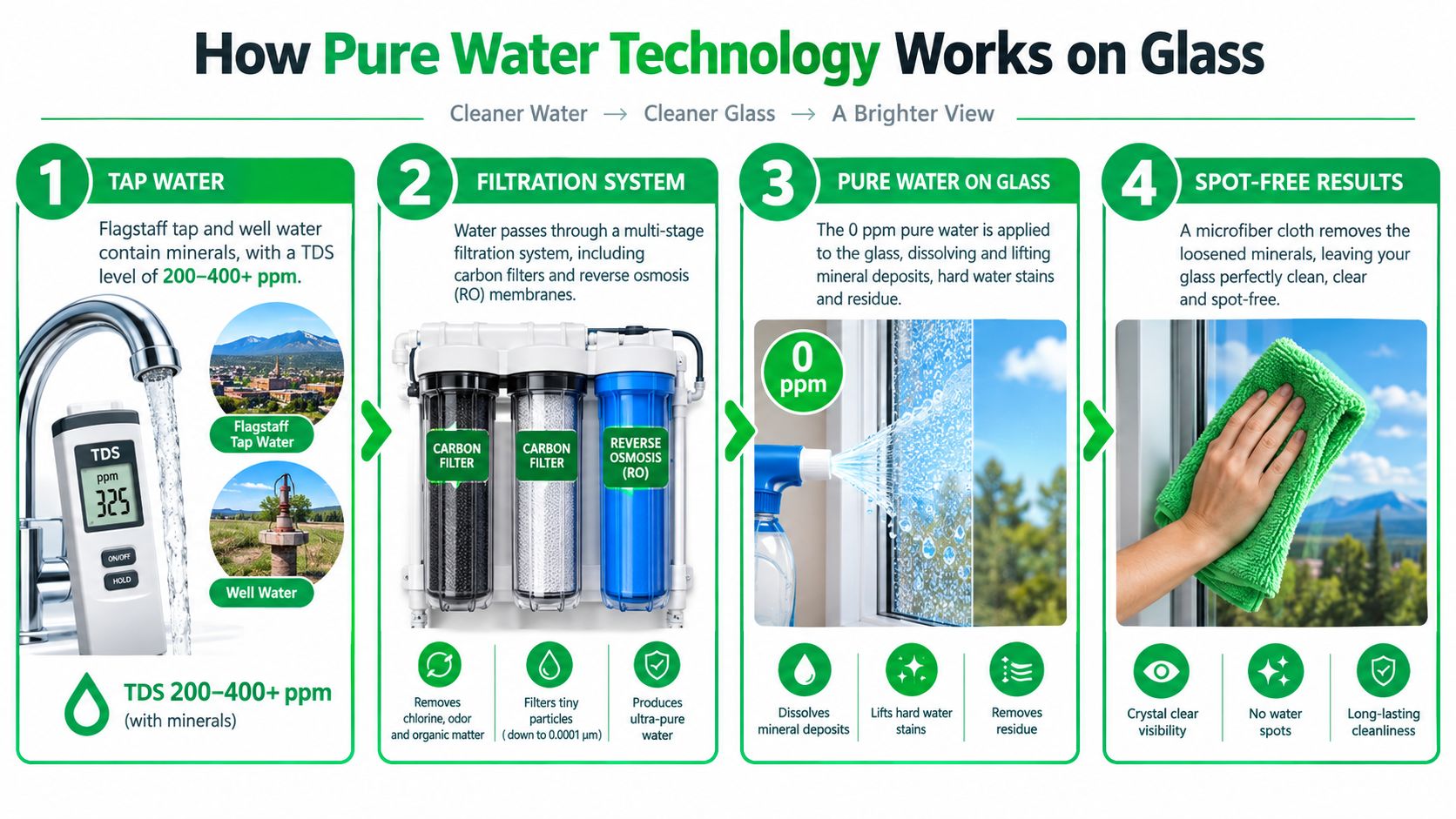
A pure-water system starts with a water-quality reading. Total dissolved solids, or TDS, measures the material dissolved in the supply. Readings from 0 to 10 ppm are rated excellent for streak-free results on all glass, while 10 to 20 ppm is good for most glass. 20 to 50 ppm is marginal, and 50+ ppm is poor and likely to leave visible spots. This TDS guide for deionized cleaning systems explains why the reading matters. As water evaporates, its remaining minerals can dry onto the pane.
Flagstaff and Munds Park properties often expose that problem quickly. Sun, UV, windblown dust, and hard well water make mineral residue easier to see on bright glass, especially around lodge-pole-heavy homes and second properties that sit closed between visits. A digital TDS meter gives the technician a direct reading instead of relying on how the source water looks.
The filtration path
Professional rigs commonly use several stages:
- Ion exchange targets charged minerals, including calcium and magnesium, reducing the load on the later filters.
- Reverse osmosis sends water through a membrane that rejects much of the remaining dissolved material.
- Deionization uses resin beds to polish the water to a very low TDS reading.
- The water-fed pole carries that rinse through a soft brush, allowing the technician to agitate and rinse the glass from the ground.
The field result is easy to verify. On a 60-ppm rinse, a mineral outline can appear as the pane dries. At 0 ppm, the water sheet dries clear, provided the brush has removed the surface dirt and the glass is free of other contaminants.
Testing at the pole keeps the process controlled. One pure-water source identifies 0 ppm as the target, treats readings above 10 ppm as a spotting risk, and recommends resin replacement above 5 ppm. This explanation of RO and DI window-cleaning systems provides that operating benchmark.
Pine Country trucks carry integrated purification equipment for cabins, two-story homes, and commercial storefronts. Homeowners comparing ownership with hired service can review the water-fed pole system rental information to understand the equipment involved.
Soft Water Cleaning vs Soap and Squeegee
Soap and a squeegee still have an important place. On a calm, shaded, single-story home, a skilled technician can produce an excellent finish with traditional tools. The difficulty appears when upper-story panes are awkward to reach, wind speeds up drying, or the technician must work around deep sills, rooflines, and landscaping.
A bottled DI setup gives a homeowner or small contractor another option. It can provide low-mineral rinse water without a truck-mounted system, but carrying and managing bottled water limits production. A truck-mounted RO and DI system paired with a water-fed pole costs more to operate, yet it becomes efficient on larger homes, second properties, commercial glass, and short-term-rental turnovers.
Practical rule: Choose the method that matches the building, not the method that looks cheapest before access and cleanup are considered.
| Method | Finish Quality | Safety | Typical Cost | Best For |
|---|---|---|---|---|
| Soap and squeegee | Excellent when the technician can reach every edge cleanly | More ladder exposure | Often the lowest-cost choice for simple ground-floor work | Single-story homes and accessible interior glass |
| Bottled DI rig | Can produce a spot-free rinse when water quality is verified | Less ladder use, but more handling and setup | Moderate, with production limited by water supply | Small commercial jobs and limited exterior work |
| Truck-mounted pure water and water-fed pole | Strong exterior finish with low residue when TDS is controlled | Keeps technicians on the ground for much of the work | Higher equipment cost, often efficient for larger jobs | Two-story homes, cabins, storefronts, rentals, and commercial properties |
Ladders aren't automatically wrong, but they demand disciplined setup. One institutional window-washing program prohibits ladder-based work when the exterior window top is more than 35 feet above ground and requires someone at the foot of ladders over 18 feet long. The Cornell window-washing program illustrates why access planning matters.
For homeowners comparing maintenance projects, a broader Dublin outdoor renovation guide can also help frame how window work fits alongside exterior upkeep. For mineral deposits that already exist, the hard-water stain removal process is a separate question from routine pure-water maintenance. Prevention and restoration shouldn't be confused.
Inside a Pine Country Window Cleaning Visit
A careful visit begins before the brush touches glass. The technician arrives, walks the property, checks where screens are located, notes stuck or delicate units, identifies pet access points, and finds the usable water spigot. On a cabin or second home, that first pass prevents surprises around gates, decks, wood trim, and locked rooms.
Screens come out before the glass is cleaned. Each screen is handled so it can return to the correct opening, then rinsed with low-pressure water or cleaned with a soft brush or vacuum approach. A screen-care guide recommends removing the screen safely, cleaning it separately, and reinstalling it so it sits correctly in the frame and moves freely. Centra Windows' screen-care guidance supports treating screens as part of the service rather than leaving them as an afterthought.
The exterior cleaning sequence
The technician pre-rinses frames and uses a water-fed pole supplied by on-board RO and DI tanks. The soft brush agitates the glass and frame, while purified water carries away loosened dust, pollen, and mineral residue. Work proceeds from the top down so runoff doesn't soil areas that have already been finished.
Interior sills receive protection when requested. Ladder work is reserved for places where ground-level reach won't work, and ladder feet are padded on the flagstone decks common around Flagstaff and Munds Park homes. That detail matters because the home is part of the job. Clean glass isn't a successful result if a deck, planter, finish, or screen is damaged.

The final inspection takes place against window light, where missed edges and remaining spots show quickly. The technician checks frames, sills, screens, and glass, then asks the homeowner whether anything needs another look. For cabin and short-term-rental clients who aren't present, a written service note records what was completed and flags access or maintenance issues.
This video shows the kind of pole-based process homeowners often see during professional exterior work:
Why Flagstaff Homes Benefit from Pure Water Cleaning
Northern Arizona gives window deposits several opportunities to form and reappear. Strong UV and dry air accelerate evaporation, while wind carries dust onto exposed panes. During monsoon conditions, dust and rain can combine into a film that looks different from mineral spotting but still demands a proper first rinse.
Hard well water creates the clearest local challenge. Irrigation overspray can repeatedly wet sprinkler-facing panes, lower elevations, poolside glass, and areas beneath roof runoff. When the water dries, calcium and magnesium remain on the surface. If deposits persist, they may become difficult to remove, and a wet-versus-dry inspection can help distinguish surface contamination from etching. This hard-water spot guidance emphasizes that water hardness, surface contamination, and drying speed are separate variables.
Cabins, decks, and elevated glass
Munds Park and Flagstaff properties often include lodge-pole-heavy exteriors, deep porches, steep grades, and windows above decks or landscaping. Those features make ladder positioning awkward, especially when a homeowner wants exterior maintenance without putting boots against delicate surfaces.
Pure-water poles address much of that access problem. The technician can work from the ground while using the brush to reach upper panes, then rinse without leaving soap film behind. A pure-water rinse isn't magic, though. Sun, wind, and airborne dust can still affect dry-down, so brush technique, rinse volume, and working order matter.
Short-term rentals add a scheduling problem. A turnover crew may need exterior glass refreshed between guests, while an owner wants the listing to remain photo-ready without creating noise, ladder traffic, or unnecessary disruption around the property. Recurring service can make sense for cabins, second homes, and storefronts where appearance depends on consistent maintenance rather than occasional rescue cleaning.
Winter brings another layer of grime from road treatments, sand, and wet-weather traffic. Pure water helps with the rinse finish, but technicians still need to remove loose grit before agitation and use glass-safe methods on contamination that water alone won't dissolve.
DIY Soft Water Cleaning vs Hiring a Pro
A portable setup can cost several thousand dollars before the first pane is cleaned. That expense may make sense for a single-story home with easy hose access, light dust, and frequent cleaning needs. A homeowner can pair an RO/DI system with a 20 to 35 foot water-fed pole, then test the water at the pole and aim for 10 ppm or below for dependable spot-free results.
The filter housing is only part of the commitment. The operator must learn brush pressure, pole control, rinse technique, resin care, hose routing, and safe placement around landscaping. Resin eventually needs attention or replacement, and the equipment requires storage, hauling, setup, and cleanup after each job. A pole that reaches a second-story window becomes tiring at full extension, especially across an entire elevation.
DIY also has a narrower margin for error around Flagstaff and Munds Park properties. UV, fine dust, hard well water, lodge-pole-heavy exteriors, decks, and second-story glass can turn a simple rinse into a slow, awkward job. Pine Country Window Cleaning brings the purification equipment, poles, transport, and site judgment needed for those conditions.
A practical decision table
| Factor | DIY Soft Water Setup | Hiring Pine Country |
|---|---|---|
| Equipment | Portable RO/DI system, TDS meter, hose, and water-fed pole | Purification systems, poles, transport, and job equipment supplied |
| Skill | Homeowner learns brush movement, rinse control, and access planning | Technician brings established technique and site procedures |
| Access | Best on simple, low-obstruction properties | Better suited to taller homes, cabins, decks, and difficult elevations |
| Ongoing effort | Resin care, storage, setup, hauling, and cleanup remain with the owner | Equipment maintenance and transport stay with the service provider |
| Best value | Frequent use on accessible glass | Occasional or recurring work on larger, taller, or rental properties |
The professional advantage extends beyond a cleaner finish. It includes water hauling, equipment inspection, screen handling, protection of the home, and decisions about when a mineral mark needs more than routine washing. Hard deposits can etch glass, and aggressive scrubbing can make the problem worse.
A sensible boundary: DIY works when the property is easy and the equipment will see regular use. Professional service makes more sense when height, access, rental turnover, or glass condition makes the learning curve and resin maintenance disproportionate.
Cost, Scheduling, and How Often to Book Service
A reliable quote starts with the property, not a vague flat rate. Pane count, story height, access, screen condition, interior inclusion, and the amount of mineral buildup all affect the work. A cabin with many divided panes and awkward deck access can take a different approach from a modern storefront with broad, reachable glass.
That's why a per-window or property-specific quote is more useful than guessing from square footage alone. Homeowners comparing service options can review this residential window cleaning cost guide for the factors that shape pricing without assuming every Flagstaff property has the same access or labor needs.
Seasonal planning in Northern Arizona
Late spring is a sensible time for a deeper exterior clean before monsoon dust becomes a regular nuisance. A fall visit can remove accumulated film before snow, winter grime, and shorter daylight make access less convenient. Commercial properties may need a maintenance plan based on visibility, public access, and the appearance standards of the site.
Bundling window cleaning with gutter or downspout clearing and pressure washing can reduce repeated site visits when those services are needed together. The work still needs to be sequenced properly. Loose roof and gutter debris shouldn't be allowed to contaminate freshly cleaned glass.
| Property Type | Recommended Frequency | Why |
|---|---|---|
| Primary Flagstaff home | Biannual service often provides a practical rhythm | Seasonal dust, weather, and water exposure create recurring buildup |
| Cabin or second home | Quarterly or biannual service, based on exposure and occupancy | Owners may not see new deposits until they have become noticeable |
| Short-term rental | Monthly or turnover-based service | Listing photos and guest impressions depend on consistent exterior presentation |
| Storefront or commercial building | Scheduled maintenance matched to visibility and traffic | Public-facing glass shows dust, spots, and fingerprints quickly |
| Property with sprinkler overspray | More frequent inspection and targeted service | Repeated mineral exposure can turn maintenance into restoration |
Pure-water finishes often hold up well in Flagstaff's dry climate because the technician isn't leaving soap residue behind, but no rinse can prevent new dust or sprinkler overspray from reaching the glass. Adjusting sprinklers, correcting runoff, and booking service before deposits harden can protect both appearance and budget.
Frequently Asked Questions and Next Steps
Is pure water safe for tinted or Low-E glass?
A properly managed pure-water process is generally suitable for exterior glass, including many tinted and Low-E applications, when the technician uses the correct brush and avoids aggressive contact with damaged film, failed seals, or fragile coatings. The technician should identify unusual glazing during the walk-around and test an uncertain surface rather than assume every pane behaves the same way.
How long does a service take?
The time depends on pane count, access, screens, interior work, and condition. A straightforward visit can be completed efficiently with a water-fed pole, while mineral deposits, stuck screens, or difficult cabin elevations add labor. A quote should account for the property instead of promising one universal duration.
Are screens removed and cleaned?
Yes. Pine Country removes screens, cleans them separately, and reinstalls them with each service. That step matters because a clean pane behind a dusty or poorly seated screen still looks dull, and a screen forced into the wrong opening can damage the frame.
What happens in freezing weather?
Water-fed work requires weather judgment. Freezing conditions can create slip hazards, affect hoses and equipment, and leave water where it shouldn't remain. The service team can discuss rescheduling or adjusting the scope when temperatures make exterior rinsing unsafe.
Does the service include interior windows?
Interior glass should be confirmed when the estimate is prepared. Interior work may require different tools, floor protection, furniture coordination, and homeowner access, while pure-water poles are primarily an exterior solution.
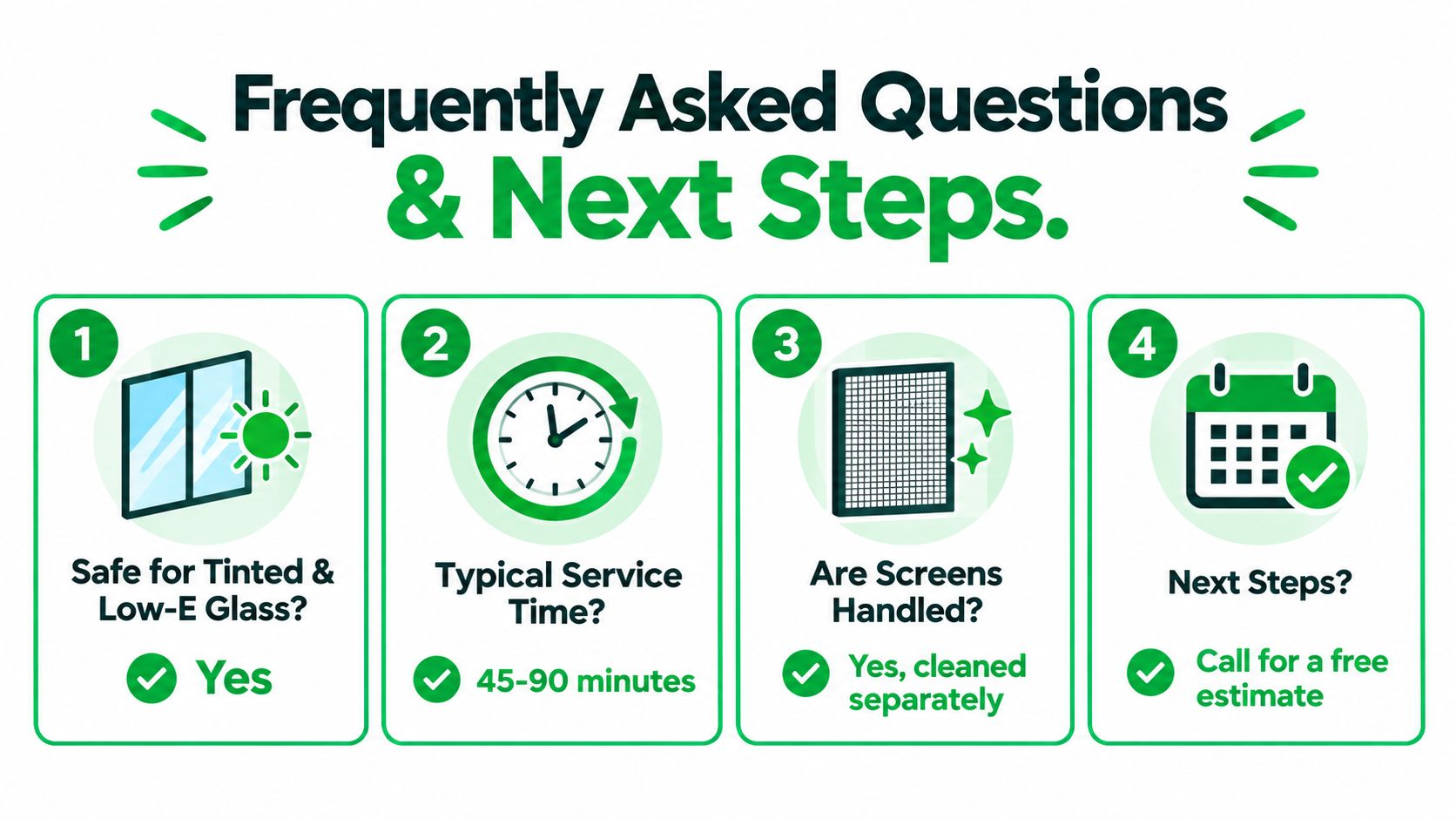
A free estimate should identify the property, access points, screen condition, requested interior or exterior scope, and any sprinkler or hard-water concerns. Pine Country Window Cleaning serves Flagstaff, Munds Park, and surrounding Northern Arizona properties, including homes, cabins, commercial sites, and short-term rentals. Recurring scheduling can be arranged when a property needs maintenance between guests or when a second-home owner wants the work handled without being present.
Pine Country Window Cleaning uses water-fed poles and purified-water systems for exterior glass, removes and cleans screens with every service, and protects the home while technicians work. Visit Pine Country Window Cleaning to request a free estimate for your Flagstaff or Munds Park property, or ask about recurring maintenance for a cabin, second home, or short-term rental.