
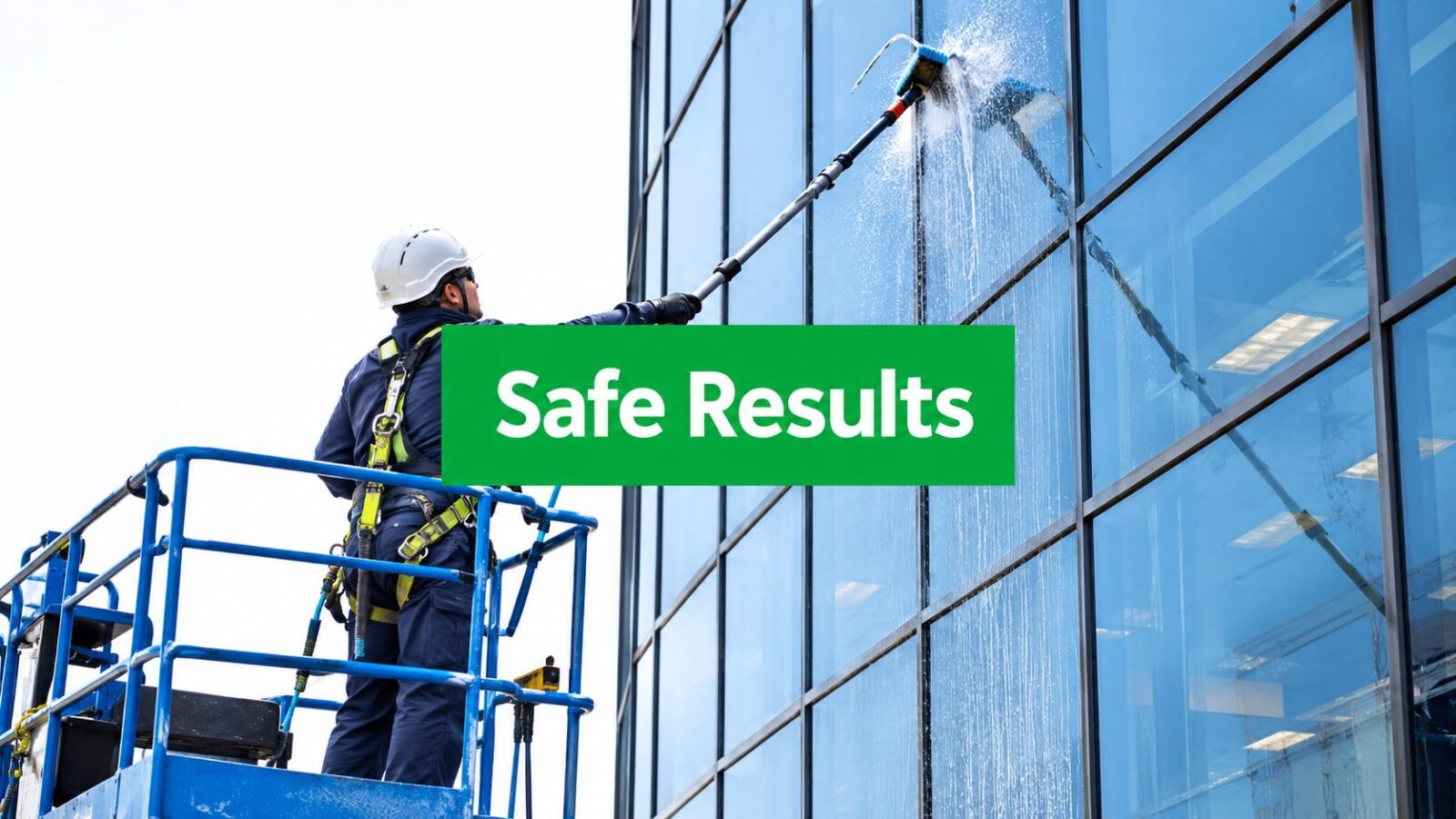
Most advice on what commercial window cleaners use starts with a shopping list. That misses the point. A storefront, office, hotel, campus, or high-rise tower doesn't need the same setup, and the wrong equipment can turn a straightforward service visit into a slow, disruptive, or unsafe job.
The practical answer is a system built around the building's height, glass type, access conditions, soil, and operating schedule. Some properties need a squeegee and ladder. Others are better suited to a pure-water pole from the ground, a boom lift, a suspended platform, or a combination of methods. The crew's job is to match the equipment to the property while protecting the glass, frames, landscaping, tenants, customers, and home interiors.
Why the Windex and Rag Routine Stops at Home
A spray bottle and rag can handle a small pane. They don't scale well to a storefront or office building exposed to traffic film, mineral dust, bird droppings, construction residue, fingerprints, and constant tenant expectations. Commercial glass often faces contamination from several directions at once, and a quick wipe can spread that soil instead of removing it.
Large panes also expose the weaknesses of household methods. A rag or microfiber cloth can leave lint, damp edges, and uneven coverage across a 10-foot pane, especially when the cleaner has to keep changing position. Ammonia-based products may cut some grime, but they can leave residue and aren't a sound default for every tinted film, anodized frame, coating, or seal. Routine commercial maintenance is generally better served by mild, neutral-pH detergents and professional hand tools, as reflected in the IWCA glass cleaning matrix.
Practical rule: If the crew is wiping a large pane repeatedly instead of washing, pulling, and inspecting it systematically, the method probably belongs in a home kitchen, not a commercial service plan.
The minimum credible hand setup is a bucket, applicator, squeegee, scraper appropriate to the soil, detailing cloths, and a way to carry those tools safely. That kit handles interior glass, low storefronts, doors, and sections where purified water isn't the right answer. It also gives the technician control around frames, seals, furniture, flooring, and sensitive finishes.
Commercial work usually falls into four equipment categories:
- Hand tools: Squeegees, applicators, scrapers, brushes, buckets, and cloths for controlled cleaning.
- Purified-water systems: Water-fed poles and soft brushes for suitable exterior glass from the ground.
- High-reach access equipment: Ladders, boom lifts, scissor lifts, suspended systems, and atrium platforms.
- Safety gear: Harnesses, helmets, footwear, eye protection, fall protection, training, and rescue planning.
The takeaway is simple. Commercial window cleaning isn't about finding a stronger spray. It's about choosing the right access and finishing system for the building.
The Core Hand Tools on Every Crew Truck
The modern squeegee earned its place through a practical redesign. In 1936, Ettore Steccone patented a lighter version that replaced the bulky earlier “Chicago squeegee,” which used two thick rubber blades secured with 12 screws. Steccone's design used a lightweight brass handle and one flexible rubber blade, establishing the basic form that still anchors professional glass cleaning today. The history of the squeegee explains why this apparently simple tool remains so important.
A working crew truck should carry tools that solve specific problems, not decorative gear that stays unused. Property managers should expect to see:
- Professional squeegees: Channels commonly range from 6 to 18 inches, with brass or stainless-steel components and replaceable rubber. Short channels control small panes and divided lights. Longer channels cover broad storefront glass faster, but only when the technician can maintain a clean, even pull.
- T-bar applicators: Microfiber or lambskin sleeves hold solution and loosen soil before the squeegee pass. A scrubber isn't a substitute for a squeegee. It prepares the surface.
- Non-marring scrapers: Replaceable carbon-steel blades handle paint, tape, and stubborn construction residue when used at the correct angle and with care. Carbon steel outperforms plastic on heavy soil, but careless pressure can scratch glass.
- Razor scrapers: These are for hard deposits and controlled spot work, not for dragging across an entire pane without inspection.
- Bucket-on-belts and holsters: A belt rig keeps tools accessible on ladder work. A freestanding bucket is awkward when both hands need to manage position and balance.
- Detail brushes: Hogs-hair or boar-bristle brushes reach frames, corners, tracks, and seals without the harshness of an aggressive scrub pad.
- Lint-free detailing cloths: These finish edges, handles, sills, and frame corners.
- Rag towels: A small pouch of absorbent towels protects nearby surfaces and handles drips. They support the process, but they aren't the glass-cleaning method.
Channel length should match pane size, technician reach, and obstructions. A long channel can be fast on open curtain wall glass and clumsy on narrow panes or divided sections. On a ladder, a compact belt setup is safer and more efficient than repeatedly reaching toward a bucket on the ground.
A property manager comparing equipment lists should also look at how crews manage hoses and water movement around the site. Practical industrial hose reel buying tips can help facility teams understand why controlled hose storage matters when a pure-water system is part of the service operation. For a fuller overview of the hand-tool kit, see these professional window cleaning tools.
Cleaning Solutions and Pure Water Chemistry
Streaks usually repeat for a reason. The glass may still carry soil, the solution may be overmixed, the rubber may be worn, or the rinse water may contain minerals that remain after evaporation. On exterior glass, hard-water minerals are a frequent cause of spotting because the water disappears while dissolved material stays behind.
Professional pure-water systems address that problem by removing minerals before the water reaches the glass. Deionization and reverse osmosis are common filtration approaches. The resulting water has a low dissolved-mineral load, often targeted in the 0 to 10 ppm TDS range for a spot-free finish, as described in this professional glass-cleaner formulation guidance.
Why neutral soap matters
Pure water isn't the answer to every contaminant. Routine maintenance generally uses a mild, neutral-pH detergent that helps carry ordinary soil away without unnecessarily attacking coatings, frames, or seals. The goal is controlled soil removal, not chemical force.
A commercial formulation may combine purified water with a fast-evaporating solvent and surfactants. The formulation guidance lists water at about 70% to 90%, alcohol at 5% to 20%, and surfactants at 1% to 5%, with optional pH drivers or chelators in low amounts. Those ranges explain the balancing act. Too little surfactant can leave soil behind. Too much can create foam and a lingering film that takes longer to rinse.
Ammoniated or acidic products shouldn't become the default for coated or finished building components. Tinted film, anodized aluminum mullions, sealants, and specialty glass each deserve product compatibility checks. Paint, tar, concrete, caulk, and established hard-water stains also fall outside ordinary routine cleaning and may need restoration methods rather than a stronger daily detergent.
When the glass and conditions are suitable, pure water plus the right brush agitation can dry without mineral spots or detergent residue. That lets a water-fed pole crew finish a storefront without a squeegee pass, provided the soil, weather, and water quality support it.
Water-Fed Poles and Ground-Level Reach
A water-fed pole system works as a connected chain. A portable deionization or reverse-osmosis tank produces purified water, a hose carries it to the pole, and a lightweight carbon-fiber or fiberglass pole delivers it to a soft brush head. Jets in the brush rinse the glass while the bristles loosen surface soil.
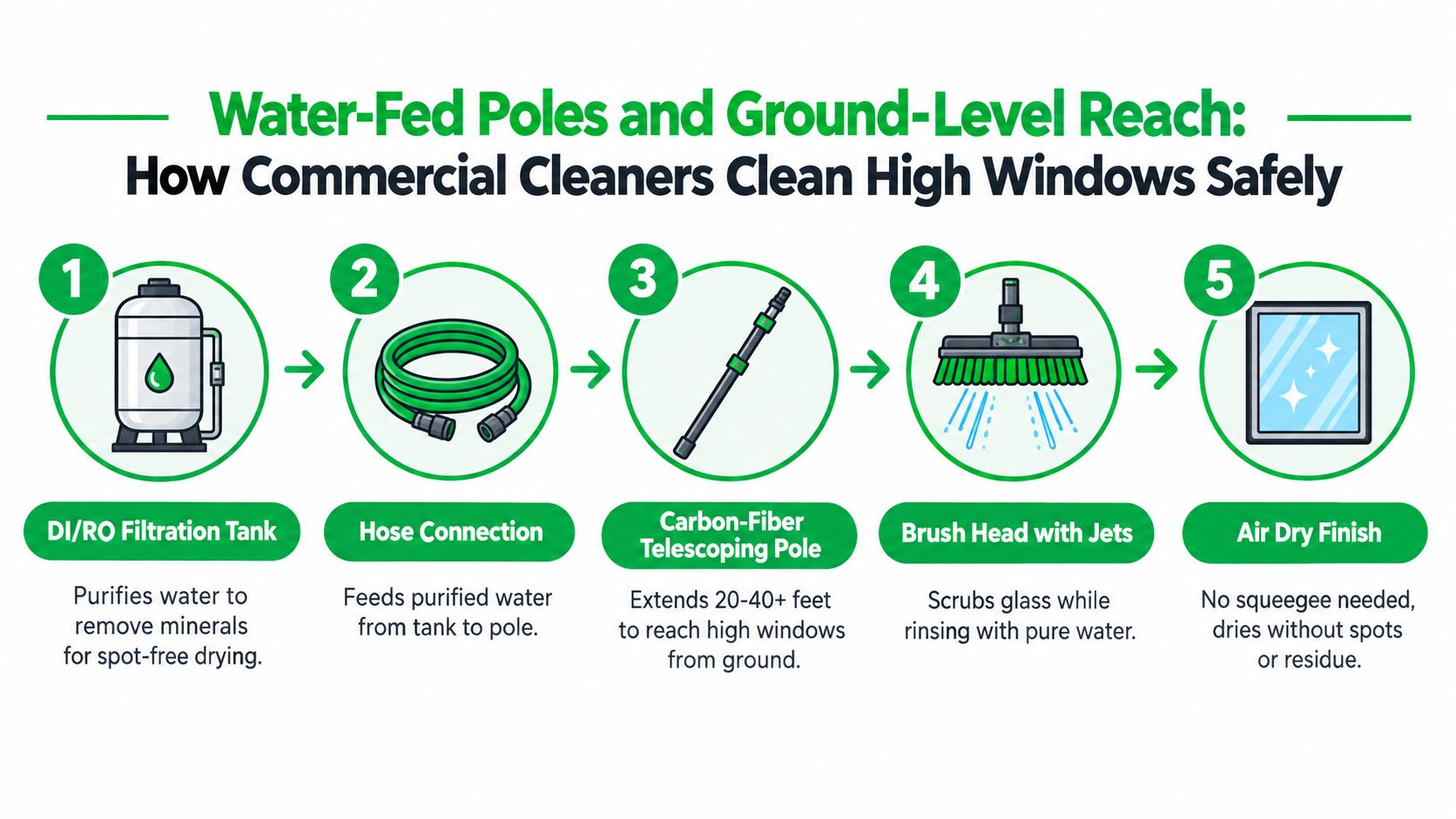
The drying science is straightforward. Ordinary water leaves dissolved minerals when droplets evaporate. Properly purified water leaves far less mineral residue, so the cleaned surface can dry clear without a final squeegee pull or detergent film. Professional systems commonly use carbon-fiber or fiberglass poles, and some configurations reach 70 feet or more, according to this commercial window cleaning industry overview.
Matching the pole to the building
Water-fed poles make sense when a crew can work from stable ground and maintain a clear path around the façade. They're especially useful for low-to-mid-rise exteriors, broad storefronts, atrium skylights, glass near solar panels, and locations where a ladder would put workers into traffic or against delicate landscaping. Safety guidance notes that some water-fed pole systems can clean up to about 24 meters from ground level, while also warning against high winds and overhead power lines, as outlined in this window cleaning supply guide.
The method has limits. Heavy soil, post-construction film, nearby sprinkler deposits, and wind above 15 mph can override its advantages. A brush and pure water may maintain clean glass beautifully, but they won't automatically remove every bonded contaminant. In those cases, technicians may switch to hand tools, restoration products, controlled scraping, or high-reach access.
Pine Country Window Cleaning describes a water-fed pole system rental for situations where purified-water equipment fits the property and work plan.
A short demonstration of the system can help managers understand the workflow:
Lifts, Booms, and Suspended Access Compared
Access equipment should follow the building geometry. A low-rise retail property with open parking and level pavement may be easy for a boom lift, while an interior atrium with sloped glazing may require a suspended or custom platform system. Ladders remain useful, but they aren't a sensible answer for sustained work at height or large recurring elevations.
| Access Method | Best For | Height Range | Key Limitations |
|---|---|---|---|
| Extension ladders | Low-rise retail, isolated windows, residential-style sections | Low-level and localized reach | Limited working position, frequent relocation, unsuitable for sustained elevated work |
| Boom lifts | Parking lots, uneven layouts, façades with offset windows | Varies by machine and job | Requires ground planning, traffic control, permits, and rental coordination |
| Scissor lifts | Broad curtain walls, flat façades, high window counts | Varies by machine and job | Needs a stable, relatively level surface and substantial operating space |
| Suspended access and atrium lifts | High-rise towers, atriums, sloped glazing, inaccessible geometry | Building-specific | Requires suitable anchors, trained personnel, inspection, and rescue planning |
Where each method earns its place
An extension ladder is quick for a small number of accessible windows. It becomes inefficient when the technician must reposition constantly or work around customers, vehicles, planters, and doors.
A boom lift offers reach over landscaping, parked vehicles, and architectural setbacks. Its articulating arm can place a technician where a straight ladder can't, but the site needs a traffic plan and enough clearance for the machine.
A scissor lift provides a broad deck and stable working position for long runs of flat glass. It suits some office façades and large retail buildings, though it doesn't solve every obstruction or elevation change.
Suspended access, rope descent, and atrium platforms solve geometry problems that machines can't. They demand certified anchors, competent setup, inspections, and a trained team. The high-rise window cleaning equipment guide gives property managers a useful starting point for understanding that distinction.
The cheapest access method on paper isn't always the cheapest service method. Mobilization, permits, ground protection, traffic disruption, and setup time belong in the decision.
Safety Gear and OSHA Training in Practice
Safety gear only works when the crew matches it to the exposure and knows how to use it. For general industry, OSHA's standard 29 CFR 1910.28 requires fall protection when workers are four feet or more above a lower level, as summarized in this commercial window cleaning safety guidance. Construction work follows different provisions, and the applicable rule depends on the operation and site.
A professional crew may use full-body harnesses, shock-absorbing lanyards or self-retracting lifelines, hard hats, high-visibility clothing, gloves, non-conductive footwear, and protective eyewear suited to the task. ANSI Z87.1 eye protection is especially relevant around chemical handling, scraping, grinding, or any work that can send particles toward the face.
Training is part of the equipment
A harness sitting in a truck doesn't protect anyone. The technician must inspect it before use, understand anchor compatibility, manage lines, secure ladders, and know what happens after a fall. Rescue planning matters because suspension after a fall creates its own emergency.
Property managers should ask how a contractor handles:
- Anchor inspection: Are anchors identified, inspected, and suitable for the planned system?
- Ladder control: Are ladders secured, positioned correctly, and removed from pedestrian conflict?
- Pre-use checks: Does the crew inspect harnesses, lifelines, poles, lifts, and hoses before work?
- Weather decisions: Who stops the job when wind, lightning, ice, or visibility makes access unsafe?
- Credentials: Does the team maintain relevant training such as IWCA CSC, OSHA 10 or 30, and rope-access credentials where the work requires them?
PPE budgets and training hours tell a manager more than a glossy equipment brochure. A contractor that plans access, communication, inspections, and rescue before starting is treating safety as an operating system rather than paperwork.
Screen Removal, Cleaning, and Reinstallation
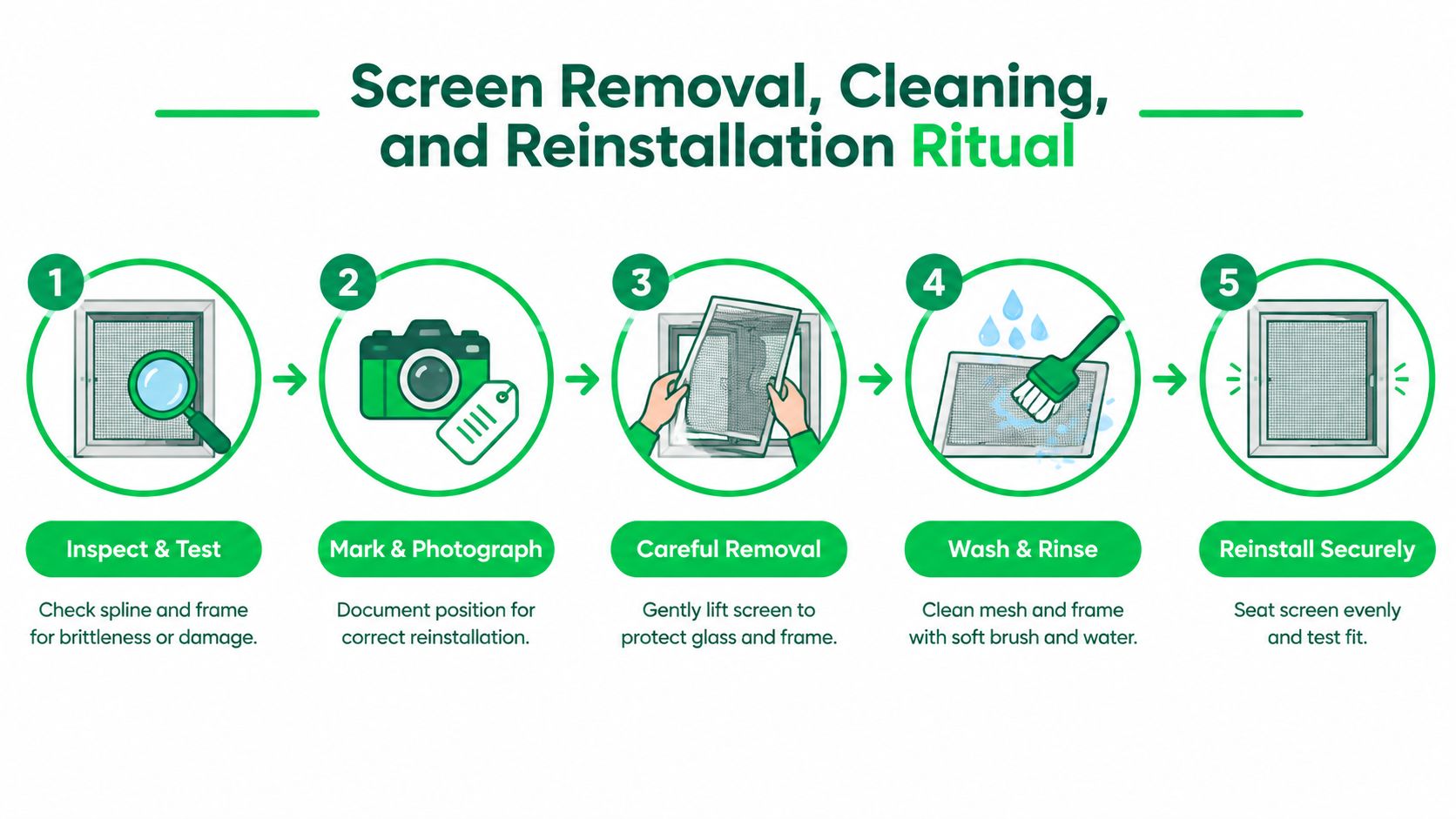
Screens need their own process. Crews should remove each screen carefully, inspect the frame and spline, clean both sides with mild soap and a soft brush, rinse thoroughly, and let the screen dry before reinstalling it. Guidance on window-screen cleaning also recommends organizing screens by room or size so they return to the correct opening.
A careful five-step routine
- Inspect before pulling: Test the spline and frame for brittleness, warping, and damage. Sun-damaged materials can fail when a technician applies normal pressure.
- Mark the orientation: Photograph the screen or label it by window. This prevents a pile of similar screens from becoming a reinstallation puzzle.
- Remove with a plastic tool: A plastic pry tool protects the frame and glass better than a screwdriver. Lift evenly instead of twisting one corner.
- Wash on a padded surface: Use a soft brush and low-pH solution. Don't press hard on aluminum mesh, and don't attack fiberglass with stiff bristles.
- Dry and reinstall evenly: Let the screen air-dry in a clean area, then seat the spline with even pressure. Confirm that the frame sits flush without bowing.
The common mistakes are predictable. Forcing a swollen spline into a sun-damaged channel can distort the frame. Leaning a screen against rough concrete can bend it. Reinstalling while grit and moisture remain on the mesh can redeposit soil onto the glass.
Screen care protects the rest of the service. A torn or poorly seated screen can allow insects and debris to reach a freshly cleaned opening, while rough handling can damage the home or building component the crew was hired to maintain. Good technicians also protect floors, furniture, landscaping, sills, and nearby finishes while they work.
How Equipment Choice Shapes Scheduling and Care
The equipment a crew brings is often a scheduling decision in disguise. A quarterly storefront route rarely justifies mobilizing a boom lift for every visit, so a pure-water pole system may maintain exterior glass efficiently between deeper hand-tool cleanings. The right setup keeps the property presentable without paying for access that the building doesn't need.
A ground-floor retail box with anodized framing can often run on a two-person squeegee crew with a repeatable cadence. A mid-rise office façade with reflective glass, exposed edges, and difficult ground access may require a boom, suspended access, or another planned system. Healthcare and food-service properties may need more frequent interior attention around doors, lobbies, and touch points, while exterior work follows a different appearance schedule.
| Property Type | Primary Access | Cleaning Method | Typical Cadence |
|---|---|---|---|
| Storefront or low-rise retail | Hand tools, ladders, or water-fed poles | Squeegee work for interiors and soil, pure water for suitable exteriors | Quarterly maintenance, adjusted for exposure |
| Office building | Water-fed poles, ladders, lifts, or suspended access | Interior hand cleaning with planned exterior access | Recurring rotation based on visibility and mineral exposure |
| Hotel or campus facility | Pure-water poles, lifts, and hand tools | Mixed interior and exterior service around occupied areas | Scheduled maintenance with seasonal adjustments |
| Healthcare or food-service site | Hand tools indoors, poles or lifts outdoors | Controlled interior cleaning plus exterior maintenance | More frequent interior attention, exterior visits planned separately |
| High-rise or complex façade | Boom lifts, suspended systems, or specialized platforms | Access-specific hand cleaning and restoration | Written schedule based on façade conditions and access logistics |
Seasonal conditions can change the plan. Pollen may increase visible soil. Summer irrigation can create hard-water spotting near façades. Storms can leave windblown grime on glass and frames. A practical manager doesn't demand the same equipment and interval in every season. The schedule should respond to exposure, tenant use, weather, and the building's appearance standard.
Pine Country Window Cleaning has operated in Flagstaff since 1999, was started by Flagstaff native David Kaminski, and handles residential and commercial work with professional squeegees, poles, pure-water brushes, boom lifts, scissor lifts, and a 95-foot atrium lift. Its technicians also remove, clean, and reinstall screens with service, while treating homes, cabins, businesses, and surrounding property with care.
The planning process should begin with the property, not the truck. Height, glass type, exposure, access, screen condition, tenant traffic, and seasonal soil should become a written rotation before the crew arrives. That approach tells you what do commercial window cleaners use in the only way that matters, by showing which system fits your building.
Pine Country Window Cleaning can match professional squeegees, pure-water brushes, poles, ladders, lifts, and screen care to your property's access and maintenance needs. For a practical service plan in Flagstaff or Northern Arizona, visit Pine Country Window Cleaning to request a free estimate or schedule service.