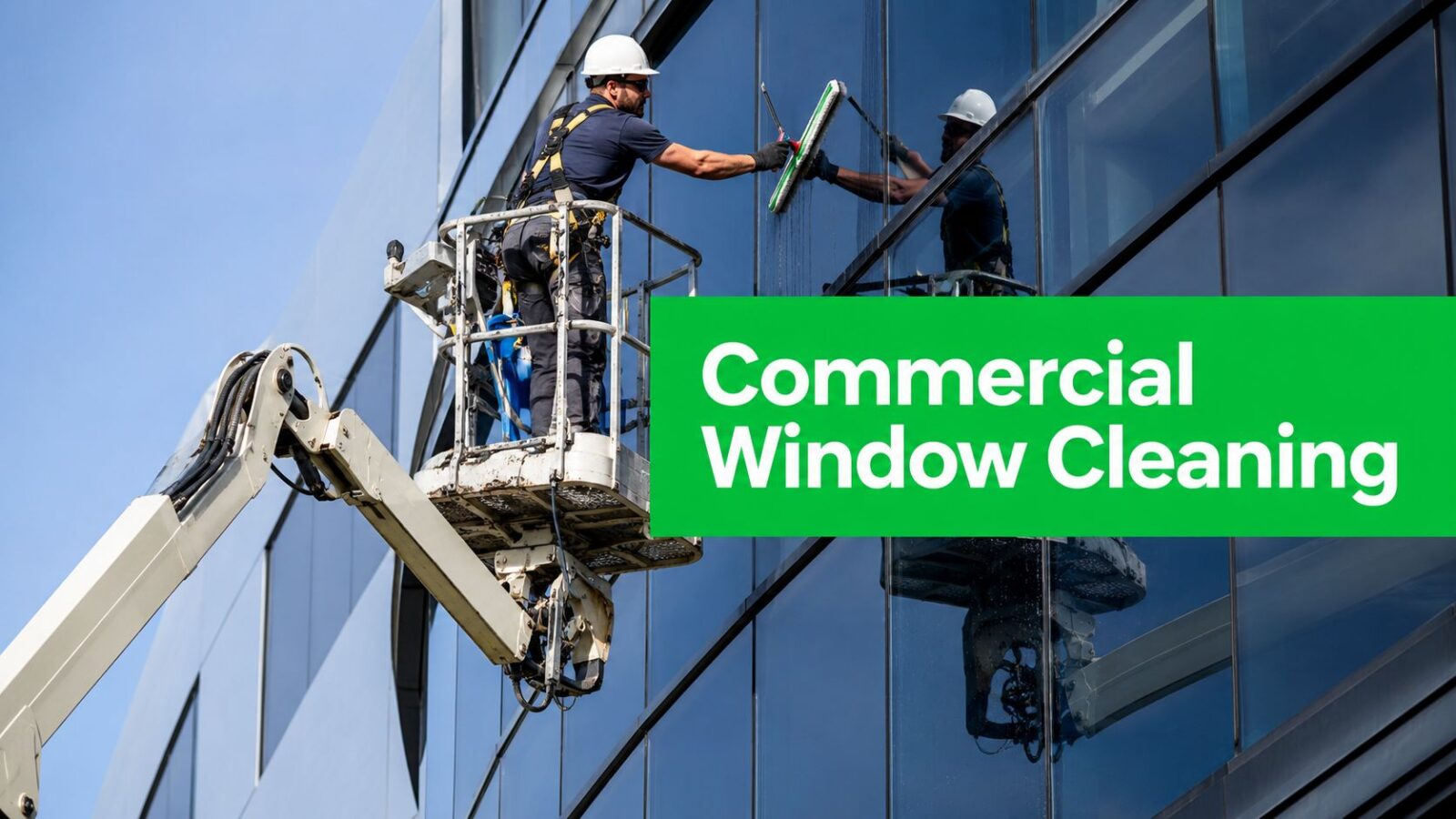
Commercial window cleaning is professional interior and exterior glass care for non-residential buildings, and it becomes a specialized height-access trade when windows sit above ground level. By the 1930s, New York reportedly had about 3,000 window cleaners, a sign that commercial buildings had already created a distinct profession rather than a larger version of household cleaning.
You may be a property manager looking at fingerprints on a lobby entrance, dust on a hotel façade, or pollen clouding a dealership showroom. The question sounds simple, but what is commercial window cleaning really asking is more practical: who can safely reach the glass, which equipment is allowed, how should the work be scheduled, and what documentation protects everyone involved?
A professional crew uses squeegees, ladders when access requires them, telescoping poles, and pure-water brushes. The work also includes careful interior protection, communication with occupants, and respect for the building itself. At Pine Country Window Cleaning, screens are removed, cleaned, and reinstalled with every service, because a complete result involves more than wiping the visible pane.
What Commercial Window Cleaning Really Means
Commercial window cleaning is the professional cleaning of interior and exterior glass on non-residential properties such as storefronts, offices, schools, hospitals, hotels, campuses, and dealerships. A crew may clean the glass, frames, sills, screens, partitions, doors, and related façade components, depending on the scope.
A home cleaning usually involves a limited number of windows, familiar floor plans, and access from the ground or a small ladder. A commercial building changes the equation. A second-story office window, a hotel atrium, or glazing above a downtown storefront may require a water-fed pole, lift, suspended platform, or rope-descent system. The cleaner is choosing the fastest tool. The crew is selecting a safe access method for the building's height, shape, surroundings, and applicable rules.
California's window-cleaning rule defines the work broadly, including washing, wiping, and cleaning windows, frames, curtain-wall components, and building panels, and it applies to window-cleaning operations for all buildings. You can review the California window-cleaning requirements for the regulatory language.
The three markers of commercial work
A job usually crosses into commercial window cleaning when three conditions appear:
- Specialized access equipment: Technicians may need pure-water systems, telescoping poles, boom lifts, scissor lifts, atrium lifts, or rope access.
- Fall-protection planning: The crew must control exposure to unguarded edges, skylights, roofs, balconies, and suspended work areas.
- Trained staffing: A larger or raised project needs people who can inspect equipment, communicate during setup, protect occupants, and respond to changing conditions.
A downtown Flagstaff storefront may look straightforward from the sidewalk, yet its upper transom, canopy glass, or adjacent signage can make a household ladder an unsuitable choice. A building near the Northern Arizona University campus may combine interior atrium glazing with exterior windows that require entirely different methods.
Practical rule: The building determines the method. The method determines the equipment, crew plan, and safety paperwork.
For a closer look at the service itself, see commercial building window cleaning. The important boundary is simple: commercial cleaning isn't defined only by the size of the building. It's defined by the risk, coordination, access, and responsibility involved.
How Commercial Work Differs From Residential Cleaning
A Flagstaff homeowner may schedule cleaning around family routines and give a technician direct access to the property. A commercial client must keep tenants, customers, employees, deliveries, security procedures, and operating hours in mind. The work therefore becomes a coordinated height-access operation, not just a larger version of residential cleaning.
A home with windows on one or two accessible levels may need a bucket, mop, squeegee, extension pole, and small ladder. A retail center or office complex can involve hundreds of panes, several elevations, interior partitions, glass doors, and equipment staging areas that cannot block customers or business activity.
The same glass, a different operation
| Consideration | Residential cleaning | Commercial cleaning |
|---|---|---|
| Scale | One home or cabin | Storefront, campus, hotel, office, or multi-building property |
| Access | Ground work, extension poles, or limited ladder use | Water-fed poles, lifts, suspended platforms, or rope access |
| Scheduling | Arranged with the homeowner | Coordinated around tenants, staff, visitors, and deliveries |
| Hiring decision | Homeowner or resident | Property manager, facility manager, owner, or general contractor |
| Documentation | Often limited | May include insurance, safety plans, equipment records, and access details |
| Liability | Centered on the home and occupants | Extends to workers, tenants, visitors, vehicles, and building operations |
The difference becomes clearest at height. A storefront may appear simple from the sidewalk, yet its upper transom, canopy glass, nearby signage, or sloped entrance can make a household ladder an unsuitable choice. A property near Northern Arizona University may pair interior atrium glazing with exterior windows that require different access methods, equipment, and crew positioning.
Commercial work grew into a distinct service because larger buildings created access and coordination problems that one person with a squeegee could not solve. The quote must account for how the crew reaches the glass, protects people below, and keeps the property operating during the visit. The trade's early development is documented in this account of the window-washing trade.
Why the distinction affects the quote
Pane count is only a starting point. Crew size, lift delivery, water supply, setup and teardown, pedestrian control, access restrictions, insurance requirements, and permitted work hours can all change the plan.
A property manager should confirm whether the proposal covers interior glass, frames, sills, screens, doors, and difficult elevations. Two buildings with a similar number of windows may require very different labor. Flat, ground-level glazing is straightforward; setbacks, canopies, sloped glass, and an atrium can require specialized access and a carefully sequenced crew.
In Northern Arizona, weather and site layout can affect that sequence as well. Wind around exposed façades, uneven ground, and busy entrances may determine when equipment can be positioned and which method is appropriate. The building sets the method, and the method sets the equipment, staffing, and safety plan.
A Brief History of the Trade
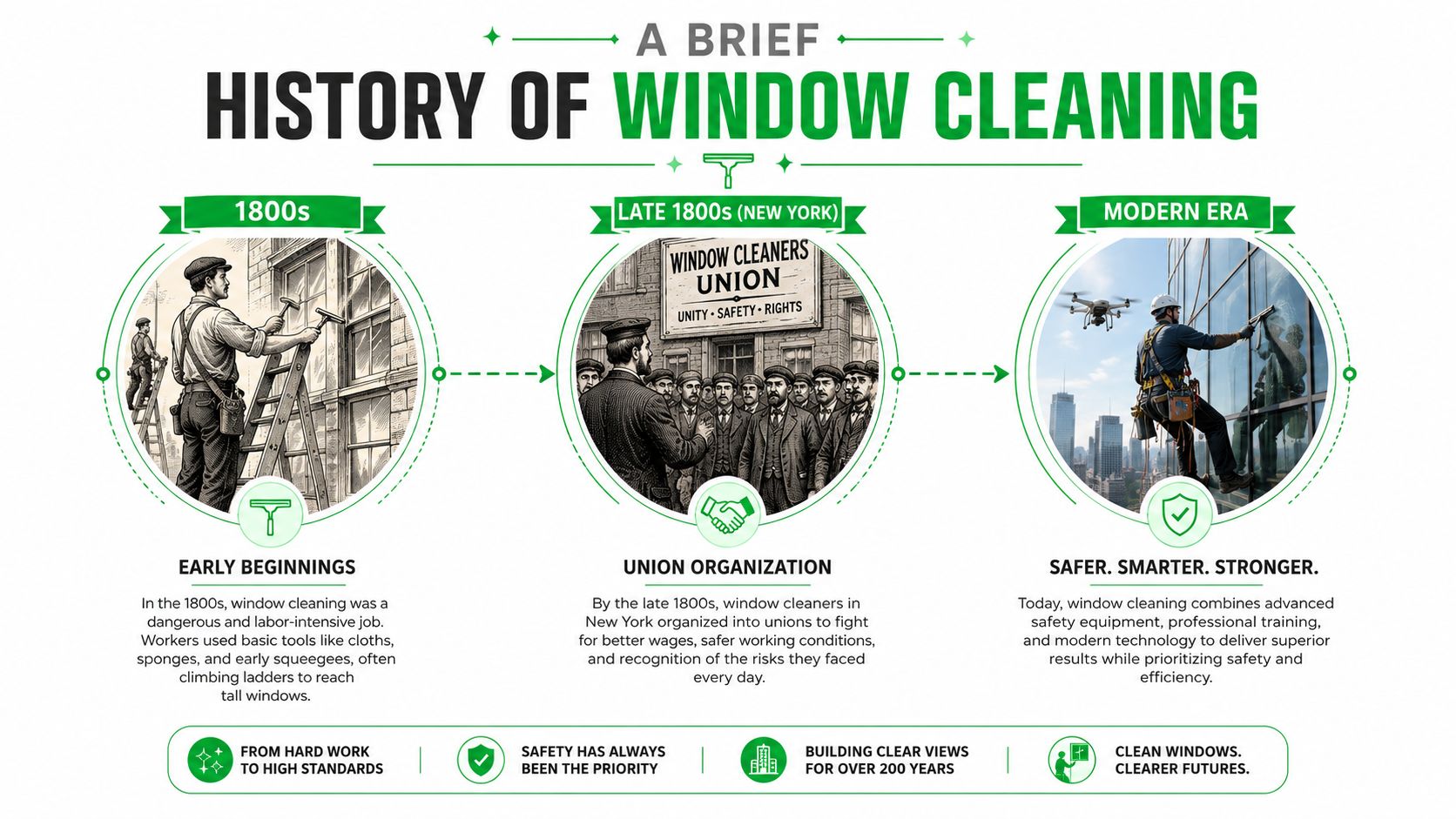
The trade developed as glass manufacturing and urban construction expanded. Larger panes gave buildings more daylight, but they also created surfaces that needed regular care. Professional window washers appeared in organized urban markets by the late 19th century, serving transportation stations, churches, offices, and homes. Tall commercial buildings created the strongest demand because their façades could no longer be reached safely with ordinary ground equipment.
One early milestone was Maruis Moussy founding the French Cleaning Institute in 1878, followed by German cleaning-industry entrepreneurs organizing by 1901. As skyscrapers spread, crews adopted ladders, suspended platforms, and rope-based methods to reach façades above the street. The work became less like ordinary janitorial cleaning and more like a height-access trade, where the building determined how technicians could approach the glass.
From access problem to safety discipline
Height changed the consequences of a mistake. Falls from height have repeatedly been a leading cause of workplace deaths in Great Britain. A UK safety source reports that falls from height killed 35 workers across all industries in Great Britain in 2024/25, and cites U.S. reporting of 88 window-cleaning accidents over a 15-year span, including 62 fatalities. These figures help explain why commercial crews rely on training, inspections, engineered anchors, and controlled access methods. The window-cleaning accident and safety history provides that safety background.
OSHA and formal fall-protection requirements pushed the trade further from informal cleaning work toward documented operating procedures. A crew may still use a hand squeegee, but the job also involves equipment selection, weather assessment, surface protection, communication, and written planning. In Northern Arizona, exposed façades, uneven ground, wind, and active entrances make that planning practical rather than administrative.
Water-fed poles changed lower and medium-height work as well. Pure water travels through telescoping poles to brush heads, letting technicians clean from the ground while reducing ladder use. A commercial window cleaner now combines cleaning skill with access planning and site-safety control.
Typical Services and Equipment Used at Height
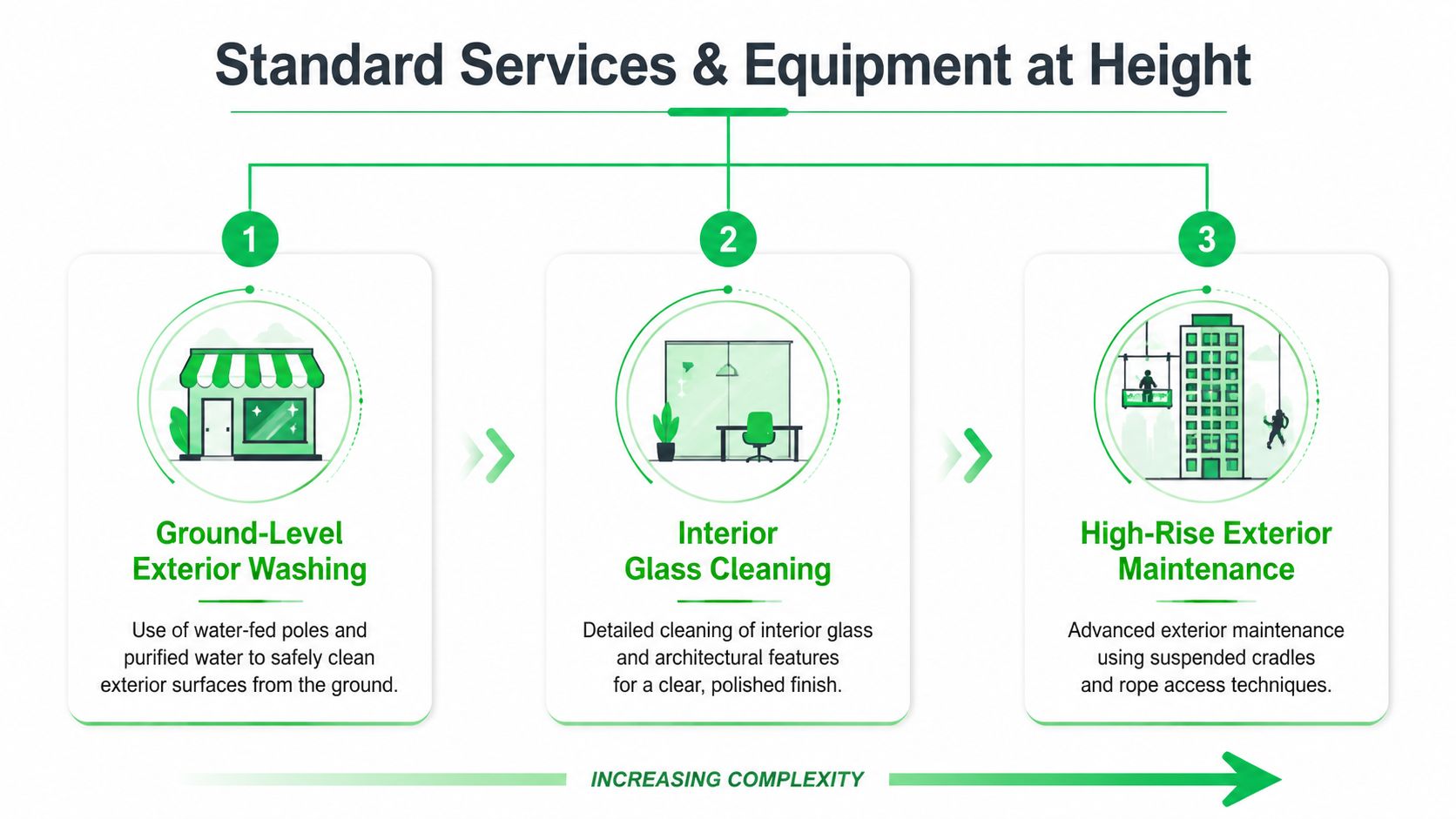
A commercial window-cleaning visit usually begins with the simplest reachable work and becomes more technical as access gets harder. The cleaning solution matters, but the first question is always, how can the technician reach the glass without creating unnecessary exposure?
Ground-level storefronts are often cleaned with a pure-water system. Deionized or purified water travels through a hose to a telescoping pole and brush head. The brush agitates soil on the glass, frame, and sill, while the purified water dries without the same mineral residue associated with ordinary water. Industry equipment guidance describes this as a ground-based approach that can reduce ladder use while cleaning glass, frames, and sills. The commercial window-cleaning equipment guide explains how these systems fit into a professional workflow.
Matching equipment to the access problem
- Water-fed poles: Best suited to many storefronts and lower façades where the technician can remain on the ground. Industry guidance describes telescoping poles reaching up to about five stories from the ground, depending on the building and system. High-access window-cleaning guidance also treats ladders as limited-use equipment rather than the default.
- Extension poles and brushes: Useful for two- and three-story façades, especially where a lift can't be positioned or would interfere with traffic.
- Scissor lifts: A practical choice for broad, vertical glass facing a parking lot or loading dock, where the machine can travel on a relatively flat surface.
- Boom lifts: Helpful for setbacks, canopies, tall signs, and elevations where the machine must reach outward and upward.
- Atrium lifts: Designed for high interior spaces such as hotel lobbies, campus common areas, skylights, and suspended ceiling glass.
- Rope-descent systems or suspended scaffolding: Used on towers and façades where ground equipment can't reach. These systems require careful anchor review, trained technicians, and a documented plan.
Interior glass presents a different challenge. Crews need controlled water use around floors, furniture, electronics, and occupants. They may clean partitions, sidelites, conference-room glass, doors, and lobby glazing with squeegees, detail tools, and appropriate extension equipment.
Equipment affects more than reach. It determines crew size, setup time, water supply, parking requirements, pedestrian control, and the order in which the work can proceed. A hotel or dealership in Northern Arizona may need several methods during one visit because the same property can contain ground-floor storefront glass, a tall lobby, balcony railings, and rooftop signage.
Glass and doors also form part of a building's operating system. If a replacement or renovation is involved, storefront door installation insights can help property teams understand how door hardware, framing, and glass installation affect future cleaning access.
A short visual demonstration can make the equipment differences easier to follow:
The safest efficient method is often the one that keeps workers on the ground. Ladders still have a place, but professional crews use them selectively rather than treating them as the automatic answer.
Safety Standards, OSHA Rules, and Fall Protection
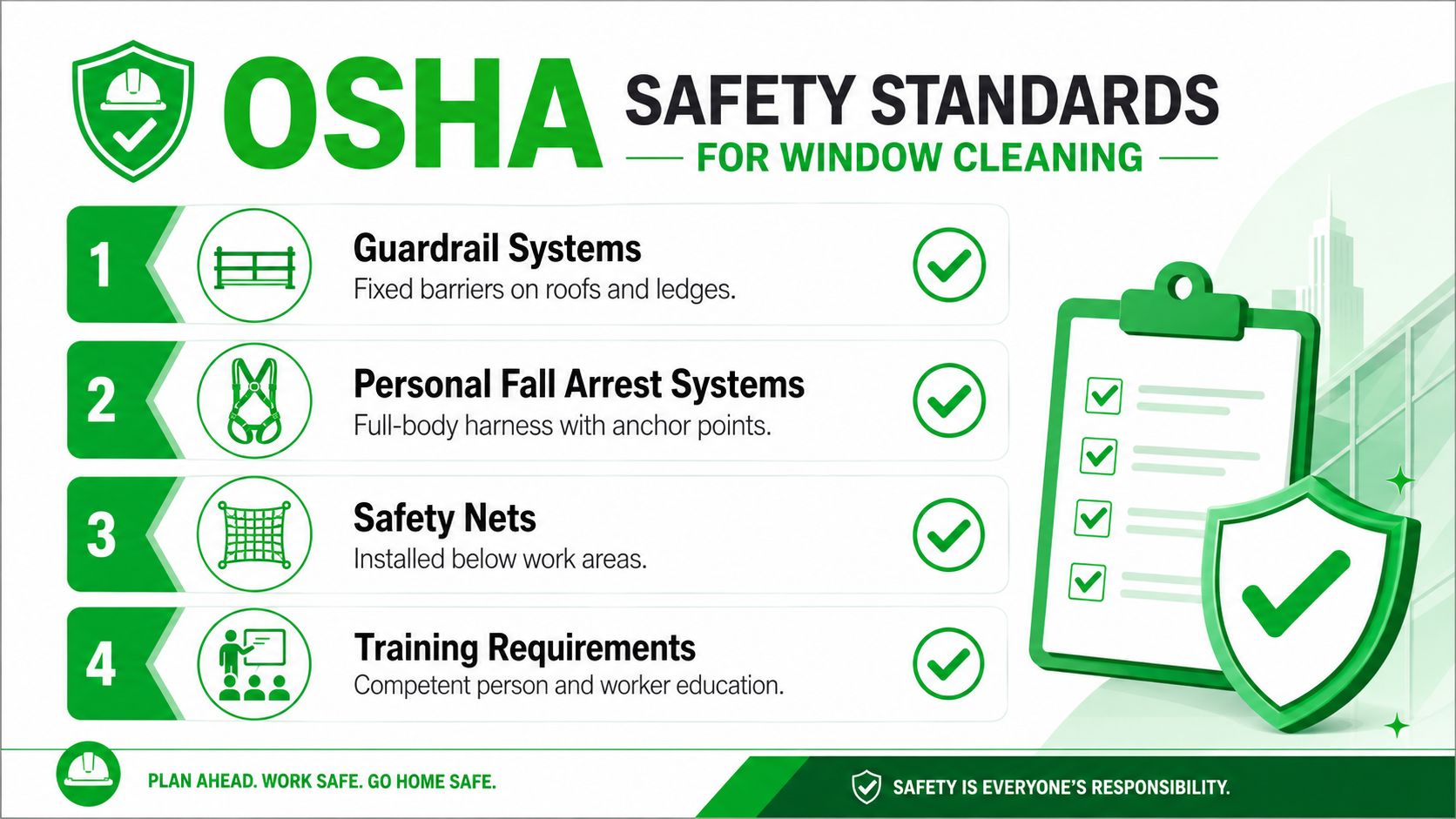
OSHA compliance isn't a paperwork exercise added after the cleaning plan. It shapes the plan from the start. A crew first looks for a way to eliminate the fall exposure, then chooses equipment that limits or controls the remaining risk.
For general industry, the plan notes identify 29 CFR 1910.28 as the rule governing fall protection, with protection required when workers are four feet or more above a lower level. Specific window-washing setups can also involve Subpart M and 29 CFR 1910.66, including rope-descent systems. Requirements vary by location and building, so a provider should verify the rules that apply to the project rather than relying on a generic checklist.
How a crew thinks through the hierarchy
A competent crew generally works through access choices in this order:
- Stay on the ground when possible. A pure-water pole may remove the need to climb for lower façades.
- Use a guarded lift. A boom lift, scissor lift, or atrium lift can provide a protected work platform when the site allows it.
- Use personal fall protection only when necessary. A harness, restraint or arrest system, certified anchor, and rope-access procedure must match the building and task.
- Stop when conditions become unsafe. Excessive wind can increase swing risk, affect lift stability, and make façade contact unpredictable.
The IWCA commercial ground-level guidance says fall protection or perimeter guarding is needed when workers come within 6 feet of an unguarded edge or skylight, and it advises stopping work in excessive winds. Review the IWCA commercial ground-level safety guidance for those practical controls.
What responsible preparation looks like
Before work begins at a hotel, NAU facility, dealership, or multi-story office, the provider should identify access points, inspect equipment, confirm worker training, and document the fall-protection approach. For suspended work, anchor points need appropriate verification and certification. Canadian federal rules, for example, require buildings above ground-floor level to follow CSA window-cleaning safety codes, including qualified inspection of anchor points and permanently installed suspended platforms.
California rules also cover window cleaning broadly, including windows, frames, curtain-wall components, and building panels. The practical effect is clear: height, access geometry, anchor certification, and local rules can determine whether a method is permitted at all.
The safety system should also account for communication when technicians work alone or out of direct view. Property managers evaluating communication and check-in procedures may find best lone worker safety apps 2025 useful when comparing options for remote or isolated work.
A reputable provider should be able to explain the access method before the crew arrives, not improvise it after equipment is unloaded.
Property Types Served Across Northern Arizona
Commercial window cleaning in Flagstaff rarely follows one building template. A crew may move from a ground-level retail entrance to a hotel atrium, then to a dealership façade or a warehouse clerestory. Each property has a different combination of glass, soil, occupants, access, and scheduling restrictions.
Hotels along the I-40 and I-17 corridors often combine tall lobby glass, exterior entrances, and balcony railings. An atrium lift can suit high interior glazing, while water-fed poles may handle accessible exterior panes. NAU academic and residence-hall buildings may include sloped glazing, large atriums, and busy pedestrian routes, making timing and containment just as important as the cleaning itself.
Auto dealerships along Milton Road typically have expansive showroom walls designed to display vehicles. A scissor lift may fit broad, flat exterior elevations, while a boom lift can reach setbacks or upper signage. Big-box stores and grocery locations often rely on water-fed poles for entrances and storefront glass, with additional planning around carts, loading activity, and customer traffic.
| Property Type | Typical Access Method | Flagstaff-Specific Note |
|---|---|---|
| Hotels | Water-fed poles and atrium lifts | Tall lobbies, balcony railings, and guest movement require careful scheduling |
| NAU facilities | Atrium lifts, poles, and selective lift work | Sloped glazing, atriums, and campus pedestrian traffic affect setup |
| Auto dealerships | Scissor lifts and boom lifts | Large showroom walls and rooftop signage may need different reach |
| Retail and grocery | Water-fed poles | Entrances and low glass collect dust, fingerprints, and seasonal debris |
| Medical and dental offices | Poles and lifts | Patient access, privacy, and quiet work windows matter |
| Restaurants | Poles, ladders when suitable, and interior tools | Kitchen air and outdoor exposure can leave film on nearby glass |
| Banks | Water-fed poles and controlled interior work | Drive-through glazing adds traffic and security considerations |
| Municipal buildings | Poles, lifts, or rope access | Downtown placement can restrict staging and pedestrian space |
| Industrial warehouses | Poles, lifts, or specialized high-access equipment | Clerestory windows may sit above active work areas |
| Multi-story offices | Lifts or rope access | Façade geometry and tenant schedules drive the access plan |
Northern Arizona also changes the maintenance conversation. Flagstaff's elevation, strong UV exposure, pine-pollen seasons, dust, and monsoon grime can affect how quickly glass becomes visibly soiled and how carefully older seals, screens, and finishes must be handled. A method that works smoothly in a low-rise Phoenix storefront may not fit a Flagstaff property with snow-season access, uneven ground, or forest exposure.
Property managers also coordinate window work with landscaping, pressure washing, snow removal, and exterior repairs. Guidance on vetting commercial grounds contractors can help when several exterior vendors share the same access routes and scheduling calendar.
Frequency, Pricing Factors, and Screen Handling
A useful commercial cleaning schedule starts with the building's use rather than a universal calendar. A busy storefront, hotel entrance, medical lobby, or bank drive-through may need more frequent attention than a warehouse with limited public contact. Offices, campuses, and multi-story properties often use a recurring monthly, quarterly, semi-annual, or annual cycle, adjusted for tenant expectations and exposure to dust, pollen, construction residue, and monsoon grime.
Northern Arizona conditions make inspection valuable. Pine pollen can collect on frames and sills, wind can move dust onto exterior glass, and seasonal weather can leave spots or muddy residue around lower panes. The right interval is the one that keeps the property presentable without paying for an access-heavy service more often than the building needs.
What changes a commercial quote
| Pricing Factor | Impact on Quote |
|---|---|
| Window count | More panes increase labor, water use, detailing, and inspection time |
| Pane height | Elevated glass may require poles, lifts, or rope access |
| Access method | Lift staging, delivery, rigging, and safety controls add planning |
| Soil level | Construction dust, pollen, grease film, and mineral deposits can require extra passes |
| Interior scope | Doors, partitions, sidelites, frames, and sills expand the work area |
| Screens | Removal, separate cleaning, labeling, inspection, and reinstallation add handling time |
| Site conditions | Parking, landscaping, pedestrians, tenants, and weather can affect production |
Screen handling deserves its own plan
Screens are easy to damage when technicians pull them by the mesh or force brittle frames. UV exposure and age can make Northern Arizona screens especially vulnerable, so a careful crew handles each one by the frame, not the fabric.
The workflow should be clear:
- Identify each screen: Mark or organize screens so they return to their original openings.
- Remove carefully: Release clips and tabs without bending the frame.
- Clean separately: Wash the screen and frame using a method suited to the material.
- Inspect while handling: Note tears, loose spline, bent corners, and damaged tabs.
- Reinstall correctly: Confirm the screen sits squarely and operates as it did before service.
Industry guidance describes screen removal, separate cleaning, and reinstallation as part of a complete window-cleaning workflow. That matters because a clean pane behind a dusty screen still looks dull, and a damaged screen can create an avoidable repair dispute.
When requesting a proposal, give the provider building plans or a window count if available, identify difficult elevations, explain operating-hour limits, and ask whether screens, frames, sills, doors, and interior glass are included. For additional planning context, review commercial window cleaning rates. A responsible proposal should spell out the scope, access assumptions, safety requirements, scheduling conditions, and any work that would require a separate approval.
Pine Country Window Cleaning has served Northern Arizona since 1999, was started by Flagstaff native David Kaminski, and handles commercial properties with equipment that includes boom lifts, scissor lifts, and a 95-foot atrium lift. The company also removes, cleans, and reinstalls screens with each service while caring for the customer's building and surrounding home or business.
For a property-specific plan, visit Pine Country Window Cleaning to request a free estimate for storefronts, offices, hotels, NAU facilities, dealerships, medical buildings, or other challenging properties. Share the building type, access concerns, desired schedule, and screen requirements so the crew can recommend a safe method and clear scope.