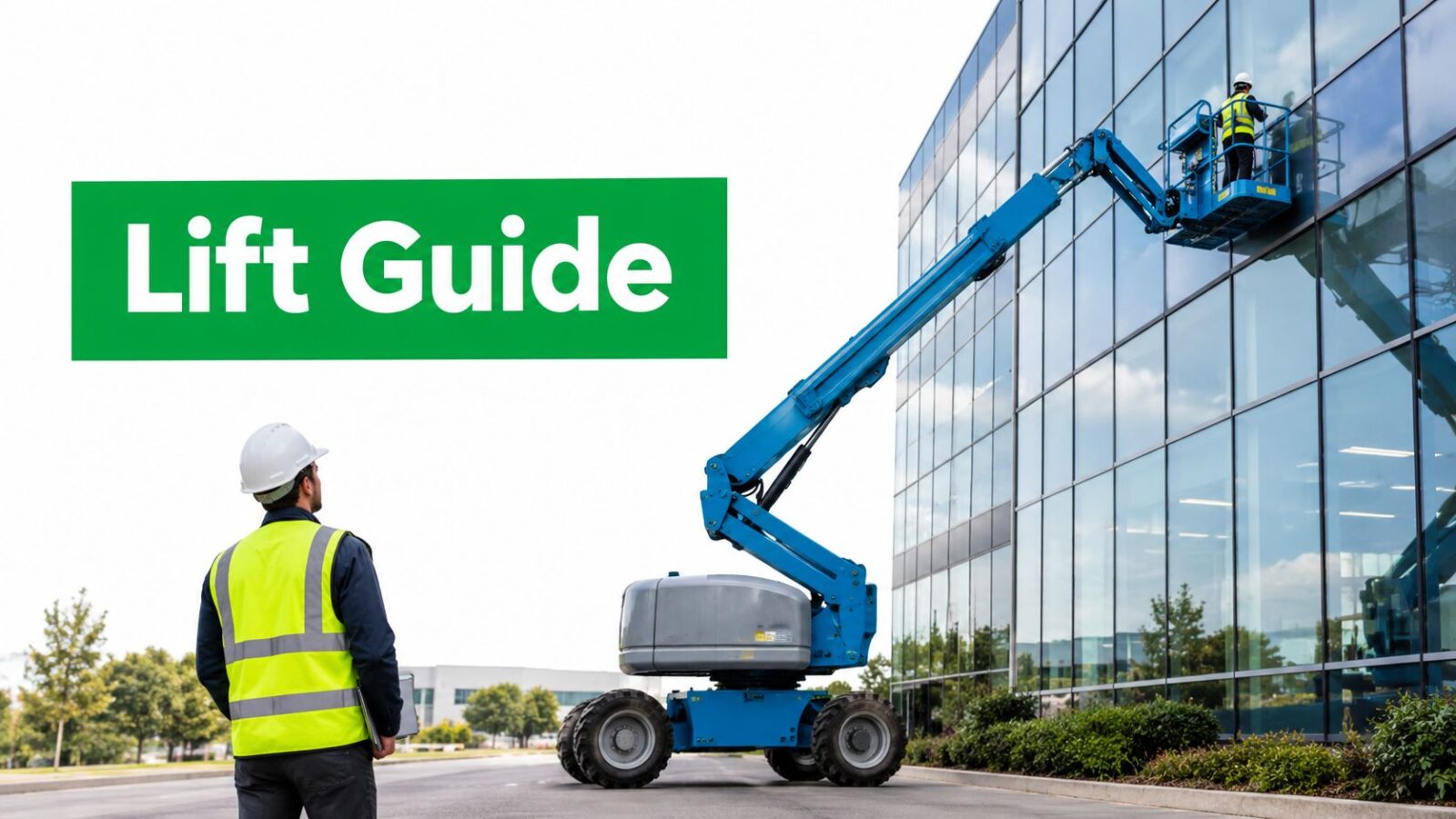
A property manager in Flagstaff can do everything right on paper, then watch a window-cleaning crew arrive with the wrong machine. The boom lift may reach the upper glass, but its outriggers might not fit beside the building. A scissor lift may fit the courtyard, but it can't reach over a planter or awning. An atrium lift may solve an indoor skylight problem that no truck-mounted machine can touch.
That's why a window cleaning lift should be selected after someone studies the building, not before. Height matters, but so do ground slope, wind exposure, overhead lines, tenant traffic, interior doors, fragile landscaping, and the time required to set up safely. Pine Country Window Cleaning has served Northern Arizona since 1999, and local conditions make equipment choice especially important for offices, hotels, cabins, campuses, dealerships, and multi-story residences.
Why the Right Window Cleaning Lift Matters
A four-story office building can look straightforward from the street. On the parking lot, the access problem may be different. A tow-behind boom might reach the upper glass, yet fail to fit through the courtyard without blocking a drive lane. A compact vertical lift may fit the opening, but leave the crew working around tenant entrances, parked vehicles, or a sloped surface.
That mismatch affects the entire service. The wrong lift can add repositioning, setup time, rental expense, and pressure on the work plan. In some cases, the crew discovers only after arrival that the basket cannot approach the glass squarely. Equipment that works on an open commercial lot may be a poor fit beside a narrow alley, covered atrium, or courtyard.
Reach is only one part of the decision
A boom lift reaches outward and upward, which helps crews work over obstacles. It also needs room to travel, set up, and stabilize. A scissor lift rises vertically and gives workers a broad platform, but it cannot bend around a canopy or reach across a setback. An atrium lift can pass through an interior opening and operate beneath a roof, though it may not suit a tall exterior façade.
The building's footprint matters as much as its height. Measure access points, turning room, ground conditions, overhead obstructions, and the distance from the machine to the glass. For a property owner, that assessment protects the building and controls service cost. For a manager serving tenants, it also determines how much parking, walkway, or entrance space must be restricted during the work.
Safety depends on the same match. OSHA accident records include fatal window-washer incidents involving suspended scaffolds and ladders. An OSHA-linked construction safety study also recorded aerial-lift deaths from 1992 through 1999, including incidents involving boom-supported and vertical lifts. OSHA's window-washer accident records show that work-at-height hazards require planning, training, and controlled setup.
Practical rule: Choose the access method during the site assessment. Do not schedule a lift based on building height alone.
Lift access has become common across façade maintenance, industrial upkeep, building access, and window cleaning. That wider selection helps crews match equipment to unusual buildings, but it also creates more ways to choose poorly. A machine is useful only when its reach, footprint, ground requirements, and operating environment fit the property in front of you.
Meet the Lifts Professional Crews Run Every Day
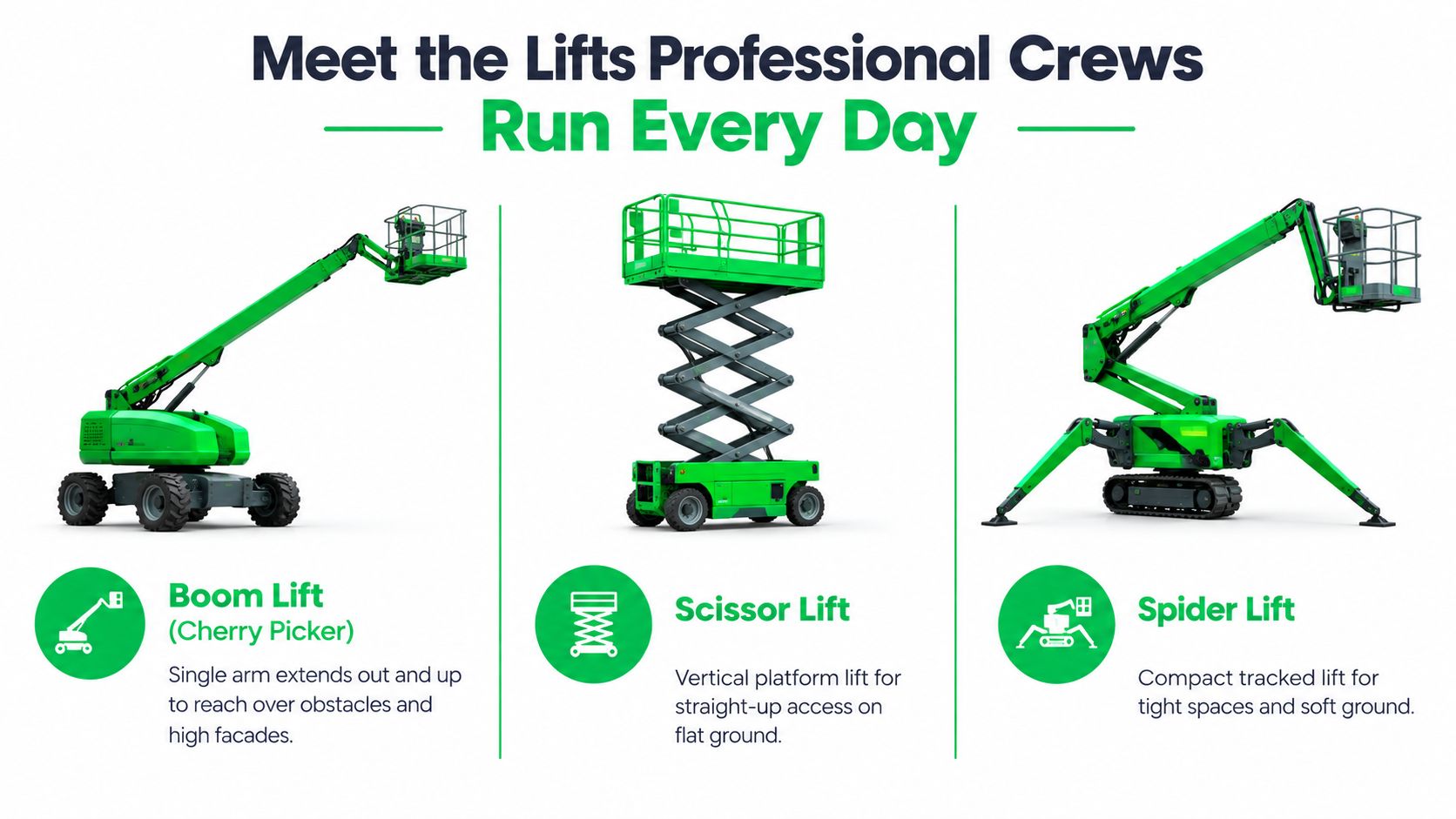
Professional crews generally work with three lift families: boom lifts, scissor lifts, and atrium or spider lifts. Each solves a different access problem. Think of a boom lift as a telescoping fishing pole, a scissor lift as a stable tabletop on stilts, and an atrium lift as a folding step stool on wheels.
Start with the building profile, then choose the machine.
Boom lifts reach around obstacles
A boom lift, sometimes called a cherry picker, uses an articulated or telescoping arm to move the basket out and up. That arm lets a crew approach upper glass over landscaping, a low roofline, signage, parked vehicles, or a sloped edge. It suits multi-story offices, tall storefronts, condominium façades, and dealership showrooms where the basket needs more than straight vertical access.
A telescoping boom provides direct outward reach. An articulating boom, often called a knuckle boom, bends around obstacles and can be easier to position in a constrained parking lot. Both require careful attention to ground conditions, overhead obstructions, and the manufacturer's operating limits.
Scissor lifts favor broad, straight runs
A scissor lift raises its platform vertically on a linked frame. The platform gives cleaners room to carry squeegees, buckets, pure-water tools, screens, and other equipment while working across a wide section of glass. It performs well on flat, paved ground beside curtain walls, hotel corridors, warehouse clerestories, and broad commercial façades.
The trade-off is simple. A scissor lift is stable and efficient when the glass is directly above the footprint, but it won't reach over a deep awning or around a planter. A crew may spend more time repositioning if the façade has setbacks or irregular geometry.
Atrium lifts solve interior access problems
An atrium lift is compact and designed for indoor or covered work. It can move through an appropriate doorway and operate in lobbies, courtyards, atriums, and other spaces where an exterior lift can't be placed. It's the practical answer for skylights and tall interior glass at hotels, campuses, medical buildings, and residential common areas.
Crews still need to protect flooring, confirm clearance, and control pedestrian traffic. A compact footprint doesn't eliminate setup requirements. It makes access possible where a larger machine would be physically or legally impractical.
For a closer look at the equipment used for commercial work, see commercial window cleaning equipment.
Matching the Window Cleaning Lift to Your Building
Lift selection gets easier when the building is reduced to five questions: How high is the glass? Where can the machine sit? Is the ground level? What blocks the approach? Can the work happen indoors?
A manager should also separate ownership from management. An owner may consider purchasing equipment for repeated access needs, while a facility manager usually benefits from hiring a qualified crew that already carries, inspects, and operates the appropriate machine. The best answer depends on frequency, storage, maintenance, insurance, operator training, and the variety of properties involved.
| Constraint | Boom Lift | Scissor Lift | Atrium Lift |
|---|---|---|---|
| Upper glass above 35 feet | Strong choice when the basket needs outward reach. | Useful when glass is directly overhead on suitable ground. | Usually limited to interior or covered applications. |
| Wide curtain wall | Works, but may require repositioning around the façade. | Efficient for long, straight runs on flat paved surfaces. | Practical only when the glass is indoors and access allows. |
| Awnings, landscaping, or parking between machine and glass | Designed to reach over many obstacles. | Straight-up movement limits access past obstructions. | Avoids exterior obstacles when the work is inside. |
| Sloped or uneven site | Can work when setup meets the manufacturer's stability requirements. | Better suited to firm, level ground. | Useful indoors, but flooring and transitions require protection. |
| Lobby, skylight, or covered courtyard | Generally unsuitable unless exterior placement is possible. | Often too large or difficult to bring inside. | Purpose-built for compact interior access. |
The 35-foot threshold appears in Cornell's window-washing program, which prohibits certain exterior and interior window-cleaning situations above that height and sets specific ladder controls. Local rules can differ, so managers should review the requirements that apply to their property rather than treating one table as a universal approval. Cornell's window-washing program provides one example of how institutions define acceptable access.
For properties with complex façades, high-rise window cleaning equipment can help managers identify whether a powered platform, boom, suspended system, rope access, or another method fits the building.
Pricing also needs a consistent scope. If you're comparing vendors, a guide to setting rates per square foot can help clarify how glass area, access difficulty, and equipment requirements affect a quote. The lowest rate per square foot isn't necessarily the lowest project cost if the crew must remobilize or work around blocked access.
Safety and Training Rules You Should Always Verify
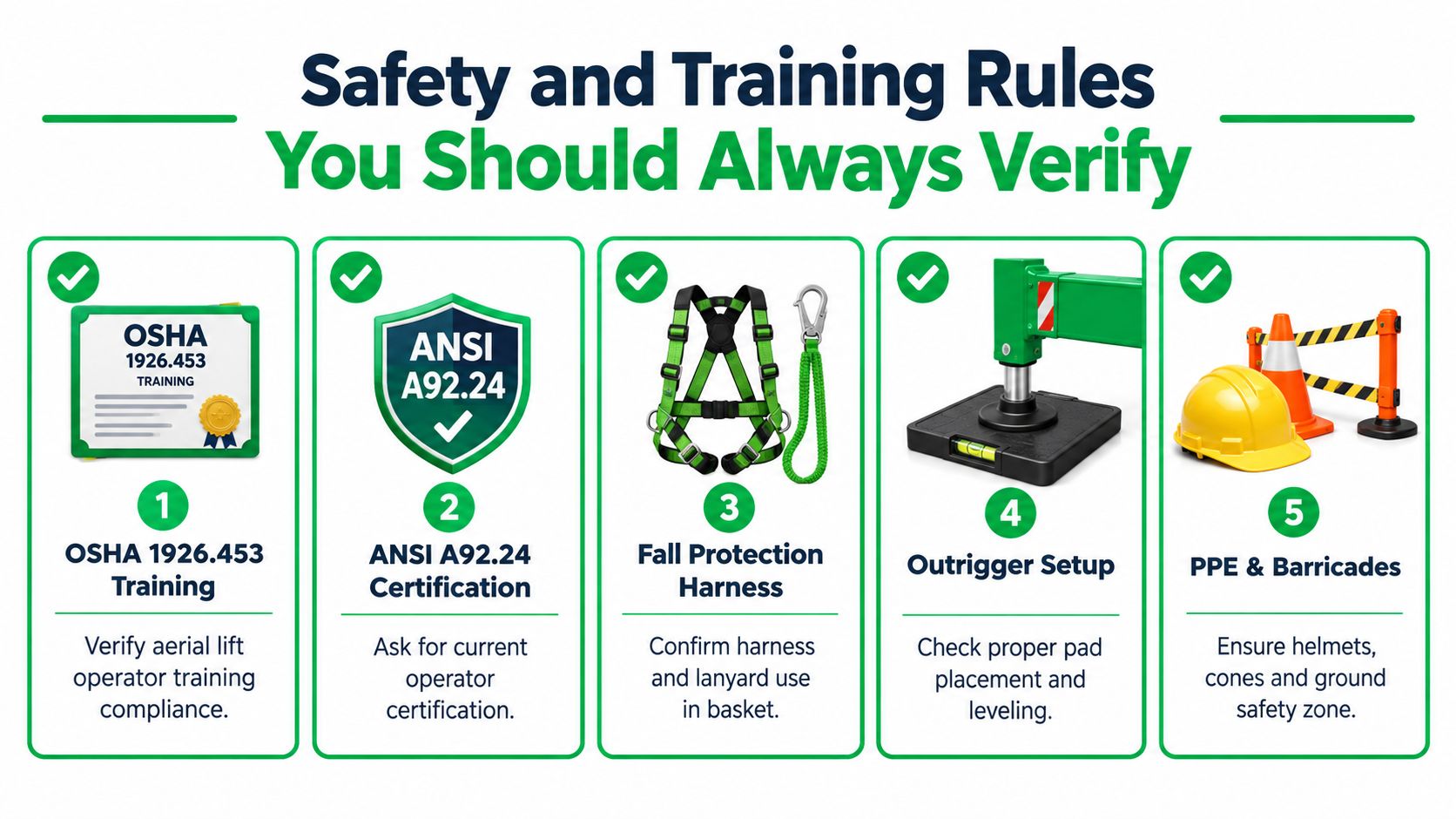
A lift doesn't make high work safe by itself. OSHA's aerial-lift rule, 29 CFR 1926.453, requires safe-use training, and fall protection remains a core control when workers operate from an aerial lift. Property managers should verify the crew's process before the machine arrives, not after someone is already in the basket. OSHA's aerial-lift standard explains the regulatory foundation.
Documents worth checking before booking
Ask for documentation that connects the operator, equipment, and site plan.
- Operator training: Confirm that each person who will operate the lift has documented training for the equipment category and the company's operating procedure. Ask how the crew handles a model they haven't used before.
- Daily inspection: Request confirmation that the specific lift is inspected before use. The inspection should address controls, tires or tracks, brakes, guardrails, alarms, outriggers, and visible damage.
- Fall protection: Verify that the harness, lanyard, and attachment arrangement suit the platform. A tie-off point must be compatible with the equipment and the work method.
- Ground conditions: Have the crew evaluate slope, soft soil, underground voids, drop-offs, paving, and outrigger-pad placement. A stable-looking surface may not support concentrated loads.
- Rescue planning: Ask who retrieves a worker after a control failure, medical event, or obstruction. A rescue plan should name responsibilities and communication methods.
ANSI A92.24 certification is often included in commercial operator-qualification discussions, but managers should ask the contractor to identify the exact training and certification records they maintain. State and local rules can add requirements. Great Britain's Work at Height Regulations 2005 demonstrate how fatal window-cleaning incidents helped shape stricter controls, while American requirements can vary by jurisdiction and work setting.
The same attention to access applies before the lift arrives. If a locked gate or controlled parking area affects delivery, review the property's procedure and, where relevant, consult a cellular gate access system buyer's guide when planning reliable entry for scheduled crews.
Safety standard: A rented machine with no verified operator, inspection record, fall-protection plan, or rescue procedure isn't a complete access system.
How Flagstaff Properties Use Lifts in Real Life
A Mountainaire cabin with an A-frame glass wall may have plenty of height but little room for a large machine. A downtown condominium can offer a tall façade while adding overhead utility lines, narrow parking, and steady pedestrian traffic. A hotel lobby may need an indoor lift even when exterior walls are reachable from the street.
The building's geometry sets the starting point. Ownership and occupancy set the operating limits. A property manager serving tenants may prioritize quiet setup, protected walkways, and predictable access, while an owner may accept a slower setup to avoid rental and surface-protection costs.
| Property Type | Typical Height | Recommended Lift | Key Flagstaff Consideration |
|---|---|---|---|
| Mountainaire cabin | 22-foot A-frame glass | Compact 26-foot scissor lift | Stabilize the gravel pad and protect surrounding grounds. |
| Downtown condominium | 60-foot glass façade | 65-foot articulating boom | Plan around overhead power lines, parking, and street access. |
| NAU-area student housing | Multi-story and interior common areas | Atrium lift or compact scissor lift | Protect lobby floors and keep residents separated from the work zone. |
| Route 66 hotel | Tall exterior glass and lobby skylights | Boom lift outside, atrium lift inside | Coordinate guest circulation, loading areas, and indoor clearances. |
| Auto dealership | Tall showroom glass | Articulating or knuckle boom | Preserve customer parking and avoid blocking vehicle displays. |
These heights are job-profile examples, not universal equipment rules. The crew still needs to measure the glass, check the approach, and confirm the machine's rated operating envelope. A lift that reaches the window may still be the wrong choice if its footprint blocks tenant parking or its platform cannot position the cleaner squarely in front of the glass.
Weather changes the schedule
Northern Arizona weather can turn a workable setup into a cancellation. Monsoon winds may ground a boom lift, winter ice can make a scissor-lift pad unsuitable, and cold conditions can delay work until surfaces and access routes are safe. Lift-based window cleaning should not be scheduled in rain, snow, high winds, or freezing temperatures. Crews also need to check tipping hazards, brakes, outriggers, cones, and harness attachment before work begins.
High elevation adds maintenance pressure. UV exposure, dust, freeze-thaw cycles, and rough access roads can wear equipment faster than conditions at lower elevations. Ask whether the crew owns and maintains its lifts or obtains them through a rental partner. That answer affects scheduling control, inspection responsibility, and how quickly a replacement machine can be arranged after a mechanical issue.
A wide range of aerial work platforms may be available in the market, but availability alone does not select the right machine. For a Flagstaff property manager, the useful question is whether the lift fits the building, the ground, the weather window, and the people using the property. An on-site assessment remains the practical way to make that choice.
Scheduling a Window Cleaning Lift the Right Way
The most expensive lift mistakes happen before delivery. Schedule an on-site walkthrough roughly two weeks before service, as a planning interval rather than a guarantee, so the crew can inspect the route, confirm equipment, and identify conflicts while there's still time to adjust.
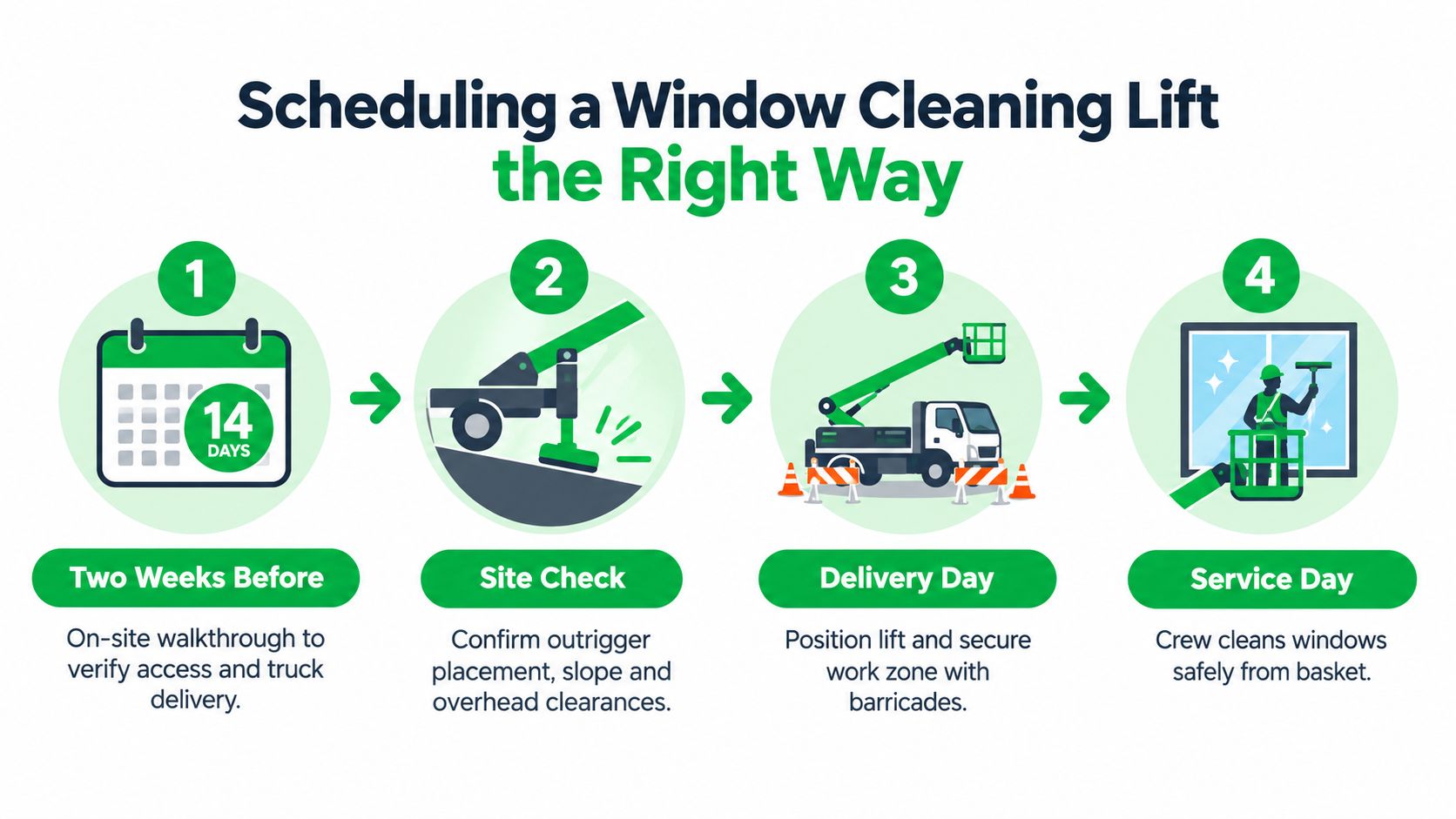
Copy this walkthrough checklist
Map the delivery route. Identify the truck entrance, gate width, turning space, loading zone, and any height restrictions. Confirm whether delivery can occur without blocking fire lanes or tenant parking.
Mark the work footprint. Measure where the lift will sit, where outriggers or stabilizers will land, and where cones or barricades will separate workers from vehicles and pedestrians.
Inspect the surface. Note slope, loose gravel, soft soil, curbs, drains, underground structures, drop-offs, and pavement that may not support concentrated equipment loads. The crew should determine whether pads or another stabilization method are appropriate.
Look overhead. Record utility lines, branches, roof edges, signs, canopies, and suspended fixtures. A boom operator needs a clear travel and work envelope, not just a clear view of the windows.
Protect the building. Point out skylights, fragile screens, landscaping, irrigation heads, finished floors, stone thresholds, and surfaces that could be damaged by tires, tracks, water, or equipment placement.
Coordinate occupants. Notify tenants, residents, guests, and staff about access restrictions and noise. Decide who opens gates, moves vehicles, answers site questions, and receives the crew on arrival.
Put weather terms in writing
At Flagstaff elevation, morning frost and afternoon monsoon activity can disrupt a lift day. A fair agreement should explain the weather decision, the rescheduling process, and whether a canceled visit is credited instead of treated as billable standby. High-wind limits must come from the specific lift's instructions and the operator's site assessment, not from an assumption copied from another machine.
The written scope should name the proposed lift, operators, access contact, work areas, screen handling, expected duration, and exclusions. It should also identify what happens if the crew finds an unsafe slope, blocked access, hidden obstruction, or surface that can't support the machine.
Scheduling rule: A fifteen-minute phone call can't reveal what a site walkthrough can. Put the walkthrough on the calendar before you put the lift on the invoice.
What a Window Cleaning Lift Actually Costs to Run
A day rate is only one part of a lift-based cleaning quote. Commercial high-rise guidance in Australia places boom-lift platform hire at roughly $500 to $1,500 per day, before labor, as described by Home Depot's overview of window-washing lifts. That figure isn't a Flagstaff quote, and it doesn't include the site-specific costs that often decide the final price.
| Cost Layer | What's Included | Typical Impact |
|---|---|---|
| Mobilization | Delivery, retrieval, travel, and staging | Higher when the machine or crew must travel beyond the immediate service area. |
| Equipment time | Rental, ownership cost, fuel, charging, and wear | Increases when access requires repeated repositioning or a second machine. |
| Certified labor | Qualified operator and window-cleaning technicians | Reflects training, responsibility, and the number of workers needed. |
| Site setup | Outrigger pads, cones, barricades, ground protection, and access control | Adds time where tenants, vehicles, landscaping, or narrow drives are involved. |
| Weather risk | Rescheduling, standby terms, and lost work windows | Becomes significant when wind, frost, rain, snow, or ice interrupts the plan. |
| Cleaning method | Squeegees, pure-water brushes, water-fed poles, or interior equipment | Depends on glass height, reach, water access, and the finish required. |
| Extras and exclusions | Screen removal, hard-water spotting, bird deterrents, or post-construction debris | Should be listed clearly so the manager knows what the base scope doesn't cover. |
For local work, ask whether the quote includes mobilization to Flagstaff, Page, Sedona, or Reservation properties, and whether a subcontracted operator adds a separate fee. A single-story cabin may need a straightforward visit, while a multi-story apartment or dealership may require equipment, access control, and pricing tied to glass area and repositioning.
Request a written scope and compare it with the guidance on commercial window cleaning cost. The quote should state the equipment, labor, weather policy, screen work, water-fed or traditional methods, and any conditions that trigger a change order.
Pure-water work, squeegees, ladders, poles, and brushes can be more economical than a lift when the glass is reachable from the ground or an interior position. A lift earns its premium when it reduces exposure to unsafe improvisation, provides efficient access to difficult glass, or avoids repeated repositioning with a less suitable method.
Putting It Together for Your Next Service
The building should decide the access plan. A downtown storefront may be better served by a water-fed pole from the sidewalk than by a boom lift. A hotel atrium near the train depot may need a compact indoor lift, while a hospital or NAU residence hall with glass higher than 40 feet may require a telescopic boom and a properly qualified operator.
Rope access and suspended platforms have their own rules and limitations. OSHA requires permanent roof anchorages for rope-descent systems to be sound, rigid, and capable of supporting maximum intended loading, with separate worker-safety-line anchorages and lifelines capable of sustaining 5,000 pounds. OSHA also limits rope-descent systems to 300 feet above grade unless the employer demonstrates that another method isn't feasible or would create a greater hazard. OSHA's rope-descent guidance and anchorage interpretation are useful references when a contractor proposes suspended access.
Powered platforms and swinging scaffolds may be preferable to boatswain's chairs when other methods can't provide safe, practical access, because they allow upright work, guardrails, and stabilization against the building, as explained in OSHA's powered-platform interpretation. The final decision still belongs to the competent contractor and the applicable authority having jurisdiction.
Three useful next steps
- Review the last invoice. Mark every line item you don't understand, especially mobilization, equipment, standby, screen work, and access charges.
- Book two site assessments. Have qualified lift companies walk the property before monsoon season and compare their equipment plans, not just their totals.
- Request records in writing. Confirm OSHA training, equipment inspection, fall-protection procedures, insurance, and the weather cancellation policy before approving the work.
Pine Country Window Cleaning is a Flagstaff company founded by Flagstaff native David Kaminski, in business since 1999. The team uses squeegees, ladders, poles, pure-water brushes, boom lifts, scissor lifts, and a 95-foot atrium lift, while removing, cleaning, and reinstalling screens with every service. It also serves homes, cabins, hotels, NAU facilities, dealerships, medical buildings, and commercial properties, with attention to protecting the customer's home, furnishings, landscaping, tenants, and finished surfaces.
For a building-specific lift assessment, screen-inclusive window cleaning, and a clear written scope for Flagstaff or Northern Arizona properties, visit Pine Country Window Cleaning to request a free estimate or schedule service. Tell the team about the glass height, site access, interior spaces, slope, and weather concerns so the equipment plan fits the property before service day.