

Most bad window cleaning advice creates the very problem it claims to solve. Spray bottles, paper towels, old T-shirts, and newspaper all leave residue, lint, uneven moisture, or all three. Then the sun hits the glass and every shortcut shows up.
Professional window cleaning works because it follows a controlled process. The glass stays wet long enough to clean properly, the water gets removed cleanly with the right rubber blade, and the edges get dried before they can leave lines. That's how to clean windows streak free. It isn't a household hack. It's a trade.
Forget Everything You Know About Window Cleaning
Forget the spray bottle and the roll of paper towels. That routine was built for quick touch-ups, not clear glass. In Flagstaff, it falls apart fast because strong sun dries solution before it can be removed cleanly, wind drops grit onto the pane, and hard water leaves minerals behind after the surface looks clean.
After more than 25 years cleaning glass in Northern Arizona, I can say the usual DIY habits cause a lot of the streaking people blame on the windows. Rags often carry detergent residue or fabric softener. Blue consumer sprays leave surfactants behind. Paper towels shed lint, then drag that lint through dirty water.
The bigger mistake is treating every window the same. A shaded ground-floor pane on a calm morning gives you room for error. West-facing glass at 7,000 feet does not. Timing matters here, which is why homeowners get better results when they follow guidance on the best time to clean windows instead of cleaning whenever the glass looks dirty.
Streaks usually come from residue, rushed drying, or minerals in the water. They are a process problem.
Hard water makes that process less forgiving. If your property deals with mineral spotting on glass, shower doors, and exterior fixtures, whole-house water filtration options can reduce how often those deposits come back.
Our company was started in 1999 by Flagstaff native David Kaminski, and the lesson has stayed the same through every season. Good window cleaning is controlled work. The right amount of solution, the right timing, and the right removal method matter more than any household shortcut.
What fails in real conditions
- Paper towels: They leave lint and smear cleaner residue.
- Old towels and T-shirts: They hold grit, fabric softener, and oils that transfer to glass.
- Store-bought spray cleaners: They dry fast in direct sun and often leave a film.
- Cleaning hot glass: Water flashes off, edges set up quickly, and lines stay behind.
What professionals do differently
Professionals control the conditions as much as possible, then control the water on the glass. That means using the proper solution, working out of direct sun when possible, and removing water completely instead of pushing it around. In Flagstaff's climate, that difference shows up immediately and lasts longer.
The Professional's Toolkit For Flawless Glass
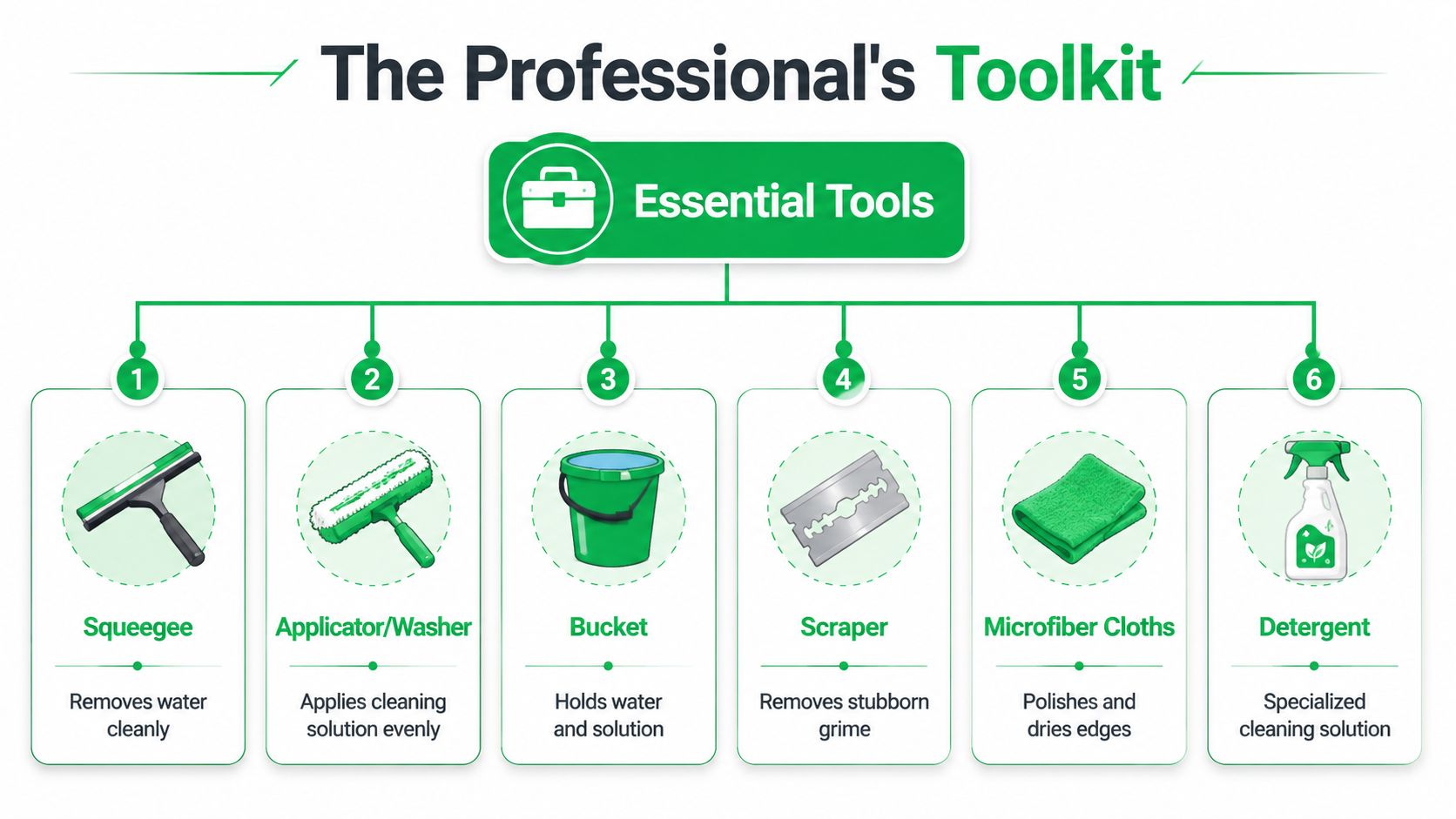
Professional results start with professional tools. After 25 years cleaning windows in Flagstaff, I can tell you the usual DIY kit fails for one simple reason. It was built for wiping. Window cleaning is a water-control job.
The core kit
A quality squeegee clears the pane cleanly and predictably. Cheap rubber skips, hardened rubber leaves lines, and the wrong channel width slows the work. In Flagstaff's dry air and bright sun, those small tool flaws show up fast.
An applicator or washer carries enough solution to loosen soil and keep the glass evenly wet while you work. That matters on exterior glass with pollen, dust, and mineral residue. Scrubbing with a rag spreads contamination and gives grit more chance to mark the surface.
A bucket sounds basic, but it gives you control over dilution and keeps enough solution available for consistent passes across the pane.
A lint-free microfiber cloth belongs at the edges and corners, where small amounts of leftover moisture collect. Use it for detailing, not for the whole pane. If the cloth is doing the main drying, the system has already broken down.
The solution matters less than control
Homeowners often spend too much time chasing the perfect spray. The better question is whether the solution stays workable on the glass long enough to scrub and remove it cleanly. A light soap mix or a simple vinegar-and-water blend can work, as long as it does not leave heavy residue and matches the conditions.
That trade-off is especially important in Northern Arizona. High altitude and direct sun shorten your working time. Hard water raises the stakes because any water left behind can dry into visible spotting.
| Tool | What it does | What goes wrong without it |
|---|---|---|
| Squeegee | Removes water cleanly | Streaks, lines, and drag marks |
| Washer | Applies solution evenly and loosens soil | Dry patches and uneven cleaning |
| Microfiber cloth | Details edges and corners | Perimeter drips, lint, and touch-up smears |
| Scraper | Removes bonded debris with care | Extra pressure, missed debris, scratching risk |
| Ladder or pole | Gives safe, accurate access | Overreaching, poor angles, and unsafe footing |
For exterior work on taller homes, access equipment matters as much as the cleaning mix. If you're comparing homeowner options, this 20 ft aluminum extension ladder buying guide gives a useful overview of the trade-offs before you get off the ground.
What professionals add for higher and harder glass
Upper-story windows, divided panes, and sun-baked exterior glass usually need more than hand tools from a hardware store. Crews use extension poles, ladders, replacement rubber, scraper blades matched to the glass condition, and in some cases pure-water systems for rinsing exterior panes without towel detailing.
At Pine Country Window Cleaning, that equipment is part of the standard workflow on homes and commercial buildings where reach, angle, and water quality all affect the finish. If you want a practical breakdown of products and methods for exterior glass, our guide to the best outside window cleaner explains what works and what wastes time.
Mastering the Professional Squeegee Technique
The squeegee is where streak-free cleaning is won or lost. A lot of people own one and still get poor results because the technique is off. The blade angle, the sequence, the overlap, and the wipe-down between passes all matter.
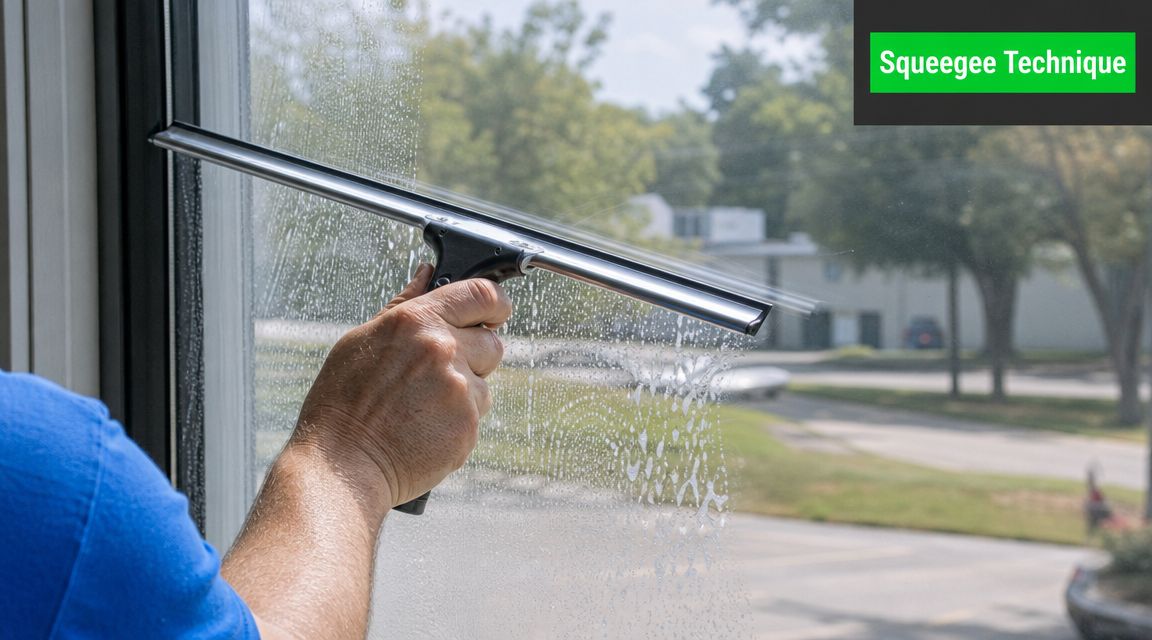
Ned Stevens puts it plainly: the squeegee is the most important tool for streak-free windows. Their guidance also matches professional practice on two points that matter every single time. Work from the top down, and wipe the blade after each pass so thin lines of dirty water don't stay on the glass.
Start with a clean edge
Before the blade touches the pane, remove loose grit and obvious debris from the glass area you're about to clean. Then wet the pane thoroughly with your applicator. The glass needs enough moisture for the rubber to glide. If the surface starts drying while you work, you'll feel the blade drag, and drag turns into chatter marks and streaks.
For a standard residential pane, the simplest method is a straight pull:
- Wet the glass evenly: Don't leave dry corners.
- Set the blade near the top: Keep it level and firm.
- Pull downward smoothly: Maintain steady contact.
- Wipe the blade clean: Do it after every pass.
- Overlap the next pass slightly: That prevents narrow lines between pulls.
That overlap is one of the quiet trade secrets. Miss it, and you'll get skinny stripes that only show up when the light changes.
Large panes need controlled movement
On big windows, storefront glass, or wide fixed panes, many professionals use a fan pattern or figure-of-eight style because it keeps the water moving and avoids heavy buildup at the bottom edge. The goal isn't to look fancy. The goal is to keep one clean leading edge and avoid trapping dirty solution under the blade.
Keep the blade moving on wet glass. Stop mid-pass and the blade can leave a mark right where you hesitated.
Pressure matters too. Too light and the blade skips. Too hard and it flexes, especially on large panes. The sweet spot feels smooth, not forced.
A short visual helps if you've never watched the motion closely:
The mistakes that cause most streaks
At this stage, homeowners usually lose the finish, even after doing most of the job correctly.
- Dirty rubber: A tiny piece of grit can leave a line across the whole pane.
- Dry glass: The blade chatters instead of gliding.
- Too much delay: Solution dries before removal.
- Ignoring the edges: The center looks good, but perimeter drips leave visible borders.
After the final pull, detail the edges and corners with a dry microfiber cloth. Don't scrub the whole pane again. Just catch the leftover water before it settles into lines.
Interior glass and exterior glass aren't the same job
Interior panes need tighter control because runoff lands on flooring, trim, and sills. Exterior work gives you more freedom, but the wind, dust, and sun create other problems. Professionals adjust pace and tool choice depending on which side of the glass they're cleaning. That's why the same homeowner can get decent results inside and a mess outside using the exact same bottle and towel.
Total Care for Your Windows Screens and Sills
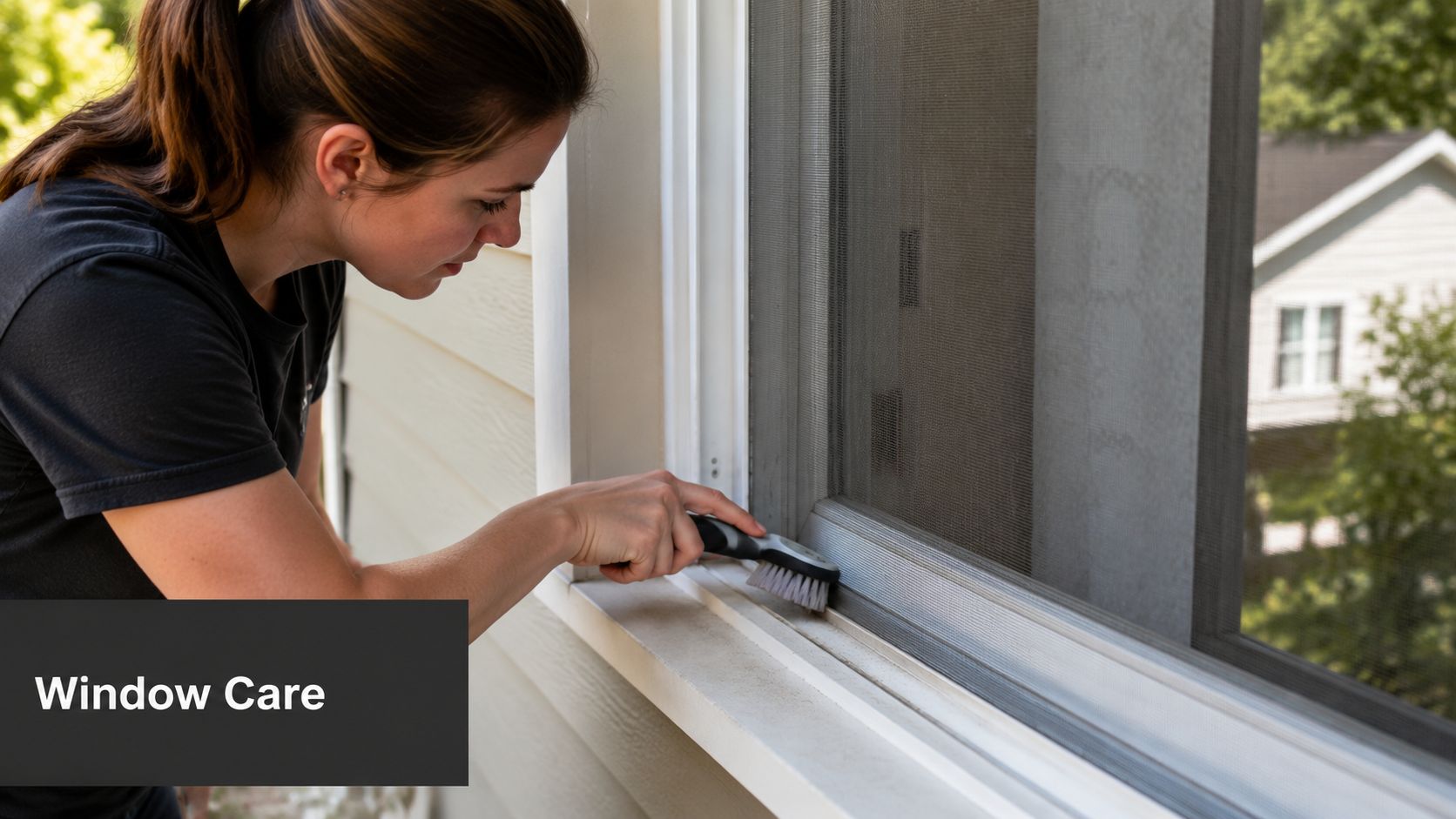
Clean glass in a dirty frame still looks unfinished. Worse, dust in the tracks and grit on the sill will wash back onto the pane the next time moisture hits the window. A proper job starts before the glass.
Marvin's professional workflow is clear on this point: remove dust and grit from frames, tracks, and sills before washing the glass, then use a squeegee in smooth, overlapping passes so dirty water doesn't get redistributed onto areas you already cleaned. That sequence is one of the biggest differences between quick DIY cleaning and trade-quality work.
Why screens matter
Most homeowners focus on the pane and ignore the screen. Then sunlight comes through a dusty mesh and the whole window still looks dull. Screens also hold pollen, spider webs, and fine dirt that can end up back on the glass during handling.
At our company, we remove screens, clean them, and reinstall them with every service because leaving them in place means leaving part of the window dirty. That's also part of caring for the home, not just the appearance of the glass.
The full-window approach
A complete workflow looks like this:
- Remove the screen carefully: Don't bow the frame or force old corners.
- Clear tracks and sills first: Dust and grit belong out of the window system before any water is applied.
- Clean the screen separately: Let it dry before reinstalling.
- Wash the glass after prep: That way runoff doesn't pull dirt from the frame onto clean panes.
Homeowners notice clean glass. They feel cared for when the frames, tracks, and screens are clean too.
This matters even more with skylights and specialty glazing, where neglected debris can shorten service life and make maintenance harder. If you have overhead glass, this guide on how to extend your skylight's lifespan gives useful maintenance context.
Where rushed jobs usually fail
A rushed cleaner often skips three things: screen removal, track cleaning, and reinstalling everything properly. That leaves dust in the system, loose debris in the sill, and screens that don't sit right. On homes in Flagstaff and Munds Park, where wind and pine debris are common, those skipped steps show up fast.
Tackling Northern Arizona's Unique Challenges
Generic window cleaning advice usually assumes mild conditions. Northern Arizona is not mild. Flagstaff windows deal with altitude, strong sun, dust, wind, and mineral-heavy water. If you don't adjust for those conditions, even a decent technique can leave a poor finish.
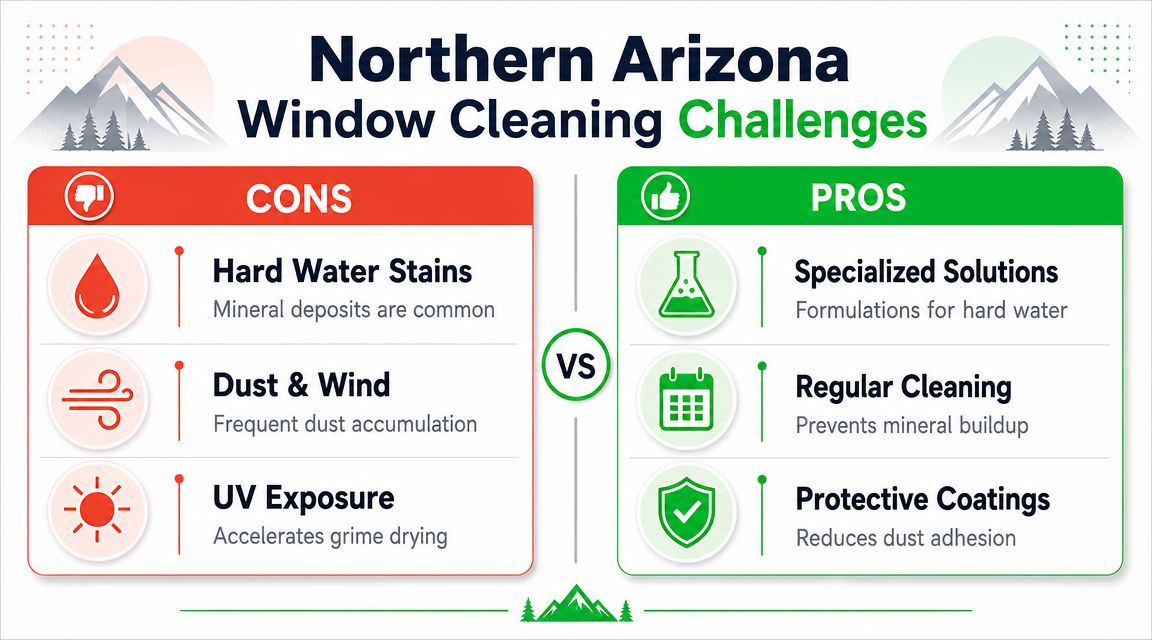
Kärcher's guidance highlights a point that matters a lot here: in dry, high-UV, and hard-water regions, using distilled or demineralized water is critical to prevent mineral spots from re-depositing on the glass as it dries. That's not theory in this market. It's daily reality.
Hard water changes the job
Hard water doesn't just make windows dirty. It can leave minerals behind after you've already removed the visible grime. That means you can clean the pane and still have spotting once it dries. If the deposits have built up over time, you may need restoration rather than maintenance cleaning. For that specific issue, this guide on how to remove hard water stains from windows explains the difference.
Sun and wind force better timing
In Flagstaff, direct sun speeds up evaporation so fast that the solution can start drying while you're still working the pane. Wind adds dust and increases drag on the blade. The answer isn't more spray. It's better timing and tighter workflow.
A practical local approach:
| Challenge | What it causes | Better response |
|---|---|---|
| Hard water | Mineral spotting | Use distilled or demineralized water |
| Intense sun | Fast drying and streaks | Work the shaded side first |
| Wind and dust | Contamination during cleaning | Keep tools clean and work in smaller sections |
What works better at altitude
Choose the shaded side of the house when possible. Keep your solution under control and your passes deliberate. On exterior work, pure-water systems help because they reduce the chance of mineral residue being left behind on the rinse.
In Northern Arizona, a good method isn't enough. You need a good method matched to the climate.
This is the part most online advice misses. The same house can clean beautifully on one side and streak badly on the other just because the sun moved. Local experience matters because conditions here change the speed, moisture, and finish of every pane.
When to Trust Your Windows to Flagstaff's Experts
Some windows are worth doing yourself. Some aren't. The dividing line is usually safety, access, time, and how perfect the result needs to be.
If you're working on a single-story home with reachable panes and mild conditions, a homeowner can get respectable results with the right process. But multi-story glass, steep terrain, oversized fixed panels, skylights, atriums, and commercial storefront runs are different. That work calls for ladders, poles, lift access, and a crew that knows how to move efficiently without risking the glass, the landscaping, or the people below.
Good reasons to bring in a professional crew
- Safety concerns: High windows and awkward rooflines aren't the place to learn ladder technique.
- Time pressure: Property managers, second-home owners, and busy families often need the job done without losing a full day.
- Special surfaces: Construction debris, hard water buildup, and large commercial panes need a more advanced approach.
- Presentation matters: Pre-listing homes, retail storefronts, hotels, and event-ready properties need a consistent finish.
Flagstaff native David Kaminski started this company in 1999, and that local history matters because Northern Arizona is not a generic window cleaning market. Homes in the pines, cabins in Munds Park, dealership glass, campus buildings, and high-reach commercial work all come with different access and climate demands. A trained crew should protect flooring, remove and reinstall screens correctly, communicate clearly, and leave the property looking cared for, not just cleaned.
What homeowners should expect
A professional service should respect the home at every step. That means clean workmanship, careful handling of screens and sills, and technicians who understand that they're working on someone's property, not just on glass.
When the windows are difficult, the schedule is tight, or the finish needs to be right the first time, hiring a pro is the practical move.
If you'd rather have your windows cleaned with professional tools, screen removal and reinstallation, and methods built for Northern Arizona conditions, contact Pine Country Window Cleaning for a quote.