
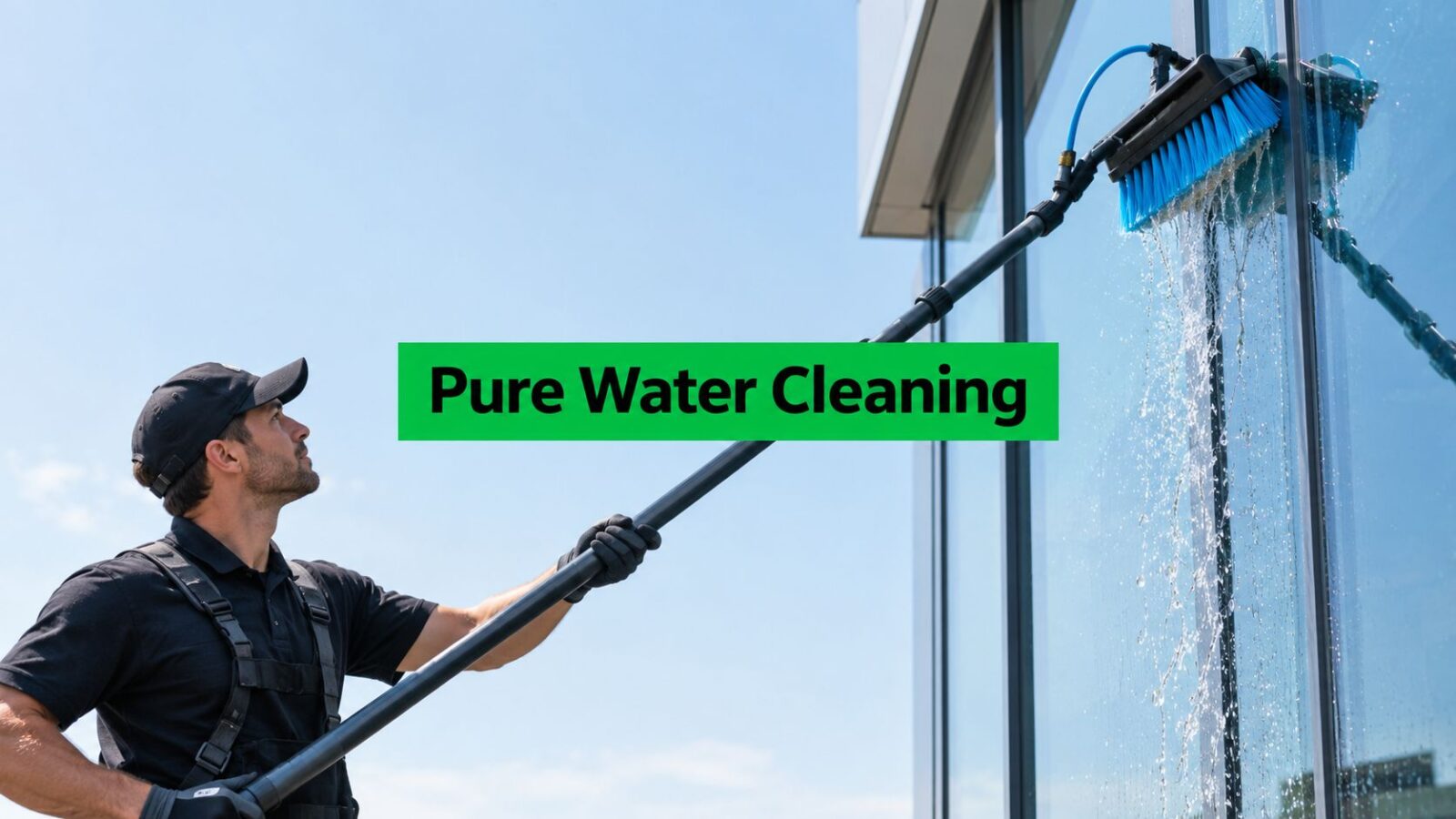
Pure water window cleaning is often described as a chemical-free way to make glass shine. That description is incomplete. The core advantage is not just the absence of soap. It is the removal of dissolved minerals before water reaches the pane, combined with the right brush technique, safe access, and an honest assessment of what the glass needs.
That distinction matters in Flagstaff. Strong sunlight, low humidity, dust, seasonal snowmelt, and rapid evaporation can expose poor water quality quickly. Pure water is excellent for routine soil and maintenance, but it won't erase cured silicone, paint, mortar, or established mineral damage. A professional result depends on knowing both what the method can do and where another treatment is necessary.
The Chemistry Behind Streak Free Glass
Water from a garden hose looks clear, but clear doesn't mean mineral-free. As groundwater moves through rocks and soil, it can pick up dissolved calcium and magnesium. Those minerals remain invisible while the water is moving. When a droplet dries on glass, the water disappears and the minerals stay behind as a white spot, haze, or crust.
That's why rinsing a window with untreated tap water can put contamination back onto the surface. A wet rag or hose may move dust around, but it can't prevent dissolved solids from drying on the pane. The issue isn't whether the water looks clean in a bucket. The issue is what remains after evaporation.
For a broader look at how professional glass maintenance differs from household cleaning, see this guide to a commercial glass cleaner formula. The important principle is simple: cleaning and rinsing are separate jobs. Agitation loosens soil, while clean rinse water carries it away without adding another mineral load.
What low-TDS water changes
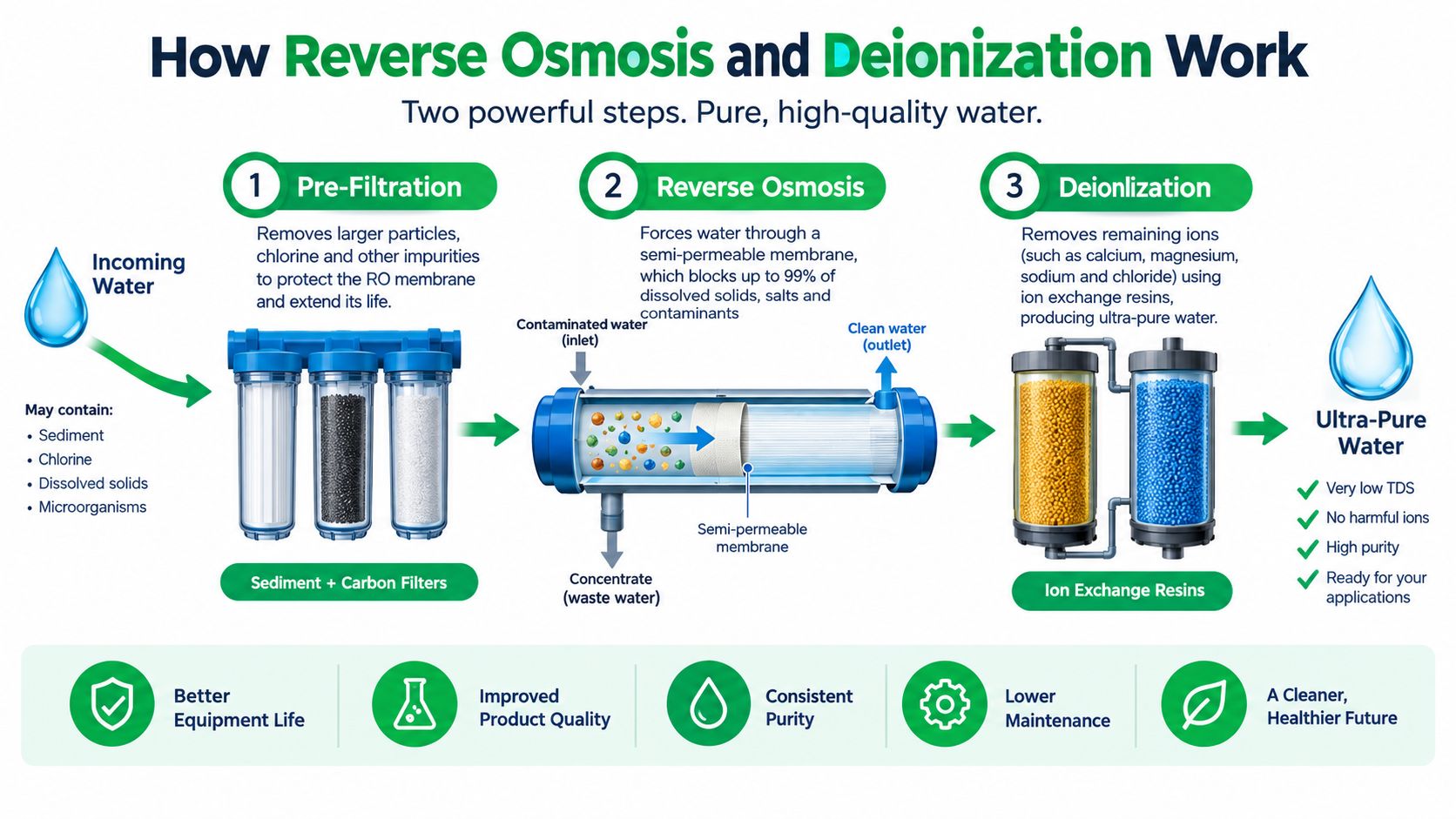
Pure-water window cleaning removes dissolved ions before the water reaches the glass. Reverse osmosis rejects much of the dissolved material, and deionization captures remaining charged particles. The resulting water can air-dry without leaving the same ionic residue as ordinary tap water.
A total-dissolved-solids, or TDS, reading near zero indicates that the treatment system is removing most dissolved material. Technical guidance identifies 0 to 5 parts per million TDS as a practical target for reliable air-drying, with a zero reading indicating especially strong demineralization performance (technical guidance on spotless-water systems).
A technician shouldn't assume a filter is working because the water looks clear. The water should be tested at the pole outlet, where contaminated hoses, connectors, storage tanks, or brush heads can affect the final rinse. Rising readings can indicate exhausted DI resin, membrane breakthrough, or contamination farther along the delivery system.
Practical rule: Test the water that touches the glass, not only the water that leaves the purification unit.
Low-TDS water is especially useful on large panes, skylights, atriums, and raised windows where squeegee access is slower or requires lifting equipment. It prevents new mineral spots, but it doesn't chemically remove glass etched by old deposits. Prevention and maintenance are where the method earns its place.
How Reverse Osmosis and Deionization Work
Pure water isn't boiled water, distilled water by appearance, or water that merely passed through a basic household filter. It's treated water whose dissolved mineral content has been reduced enough for controlled air-drying on glass.
The first major stage is reverse osmosis, or RO. The system applies pressure to force water through a semipermeable membrane. Water molecules pass through more readily than many dissolved substances, creating a purified permeate and a concentrated reject stream. The RO stage removes a large share of dissolved minerals, but it doesn't usually finish the job by itself.
Deionization, or DI, acts as the polishing stage. DI resin exchanges dissolved cations and anions for hydrogen and hydroxide ions. Those ions combine to form water, while the resin captures the charged mineral particles that remain after RO. In practical terms, RO does the heavy separation and DI removes the remaining ionic material.
Why the TDS meter matters
A TDS meter gives the technician a field check on whether the water is ready for spot-free work. Technical guidance cited for pure-water cleaning places the practical spot-free range at approximately 0 to 10 parts per million, while water around 20 to 50 parts per million may begin leaving marks on some surfaces (pure-water window-cleaning guidance).
The exact result also depends on the glass, weather, contamination, brush condition, and rinsing technique. A low reading is necessary for reliable air-drying, but it isn't a substitute for proper agitation and a thorough final rinse.
The EPA provides a useful operating benchmark for commercial and institutional purification systems. Typical RO recovery is 50% to 75%, meaning approximately 25% to 50% of incoming water may leave as concentrate (EPA water purification guidance). System design changes the balance. One-stage systems can recover about 50%, two-stage systems about 75%, and three-stage systems about 90%. Optimized installations can exceed 90%, and the EPA cites an example achieving 95% recovery, rejecting only 5% of feed water, using the same source.
That trade-off matters for a company cleaning homes, hotels, campuses, dealerships, and large commercial buildings. Purity is only one operating objective. A responsible setup also considers feed-water quality, reject-water management, resin life, flow control, and the amount of water used per job.
For a practical look at the consumable that finishes the purification process, review this resource on pure-water window-cleaning resin. Technicians should replace or regenerate treatment media when readings trend upward rather than waiting for visible spotting to become widespread.
A peer-reviewed study of an automated façade-cleaning system reported approximately 20% lower water use than comparable conventional operation while also reducing scattering and dripping (peer-reviewed façade-cleaning research). That system wasn't a standard water-fed-pole service, so the figure shouldn't be presented as a promise for every window-cleaning job. It does show why modern façade maintenance should measure controlled delivery, overspray, recovery, and water demand, not just the final appearance.
Water Fed Poles and Property Safety
A purified-water system still needs a controlled delivery method. A water-fed pole sends treated water through a hose inside a telescoping pole and out through jets in a soft brush head. The brush agitates dirt on the glass, frames, seals, and edges, while the flowing water flushes loosened material downward.
The final rinse is where technique matters. The technician must move methodically across the pane, keep the brush and jets clean, and use enough water to carry contamination away rather than just wetting the surface. The glass may look uneven while it's wet. That temporary appearance isn't the quality test. The relevant question is whether the pane dries without mineral residue.

Why ground-based access helps
Water-fed poles can reach many high windows from a driveway, walkway, or garden path. That reduces repeated ladder placement against siding, gutters, landscaping, and delicate finishes. It also reduces foot traffic around planting beds and helps technicians clean upper glass without asking homeowners to move through the work area.
The method isn't automatically appropriate for every opening. Awkward rooflines, deep setbacks, fragile surfaces, interior access problems, or windows beyond pole reach may require ladders, lifts, or a combination of methods. Professional judgment matters more than forcing one tool onto every property.
When a portable ladder is necessary, OSHA guidance requires workers to face the ladder while climbing and maintain three-point contact, meaning two hands and one foot, or two feet and one hand (OSHA portable-ladder guidance). A technician shouldn't climb turned away from the ladder, carry something that prevents secure contact, or treat a ladder as a substitute for proper access planning.
A safer access plan protects the glass, the landscaping, the technician, and the person who owns the property.
The best service combines tools instead of treating pure-water poles as a universal replacement. Poles handle suitable exterior glass efficiently from the ground. Ladders and lifts remain valuable where geometry, height, or condition requires them.
For a detailed explanation of the equipment and cleaning sequence, see how water-fed pole window cleaning works. The practical standard is not “never use a ladder.” It's using the least disruptive, safest access method that still produces a complete clean.
Where Pure Water Excels and Where It Falls Short
Pure water is a maintenance method, not a magic eraser. It works well on ordinary dust, pollen, salt, and some organic residue because brush agitation loosens the material and low-TDS water carries it away. It also helps maintain glass after restoration work has removed older deposits.
It struggles when the contamination has bonded to the glass or changed the surface itself. Cured silicone, paint, mortar, adhesive, oxidation, and established calcium-carbonate scale usually need assessment and a separate treatment. Hard-water etching is especially important. Repeated mineral-rich drying can leave deposits that become increasingly difficult to remove, and pure water alone won't reverse that damage.
A practical comparison
| Contaminant Type | Pure Water Effectiveness | Required Professional Action |
|---|---|---|
| Dust and pollen | Effective for routine maintenance when the brush and rinse are clean | Agitate, rinse thoroughly, and allow suitable glass to air-dry |
| Salt and light organic residue | Often effective, especially with repeated maintenance cleaning | Use controlled brushing and a complete final rinse |
| Cured silicone and adhesive | Poor, because the material is bonded to the surface | Assess the glass and use an appropriate specialist removal method |
| Paint overspray | Limited, particularly when paint has cured | Use careful spot treatment and glass-safe removal techniques |
| Mortar and construction debris | Poor as a stand-alone rinse | Arrange post-construction cleaning with suitable mechanical or chemical treatment |
| Calcium-carbonate scale | Prevents new mineral residue but doesn't remove established etching by itself | Evaluate for restoration, descaling, or polishing |
| Coated or tinted glass | Depends on the coating and contamination | Inspect first and avoid aggressive scraping or chemicals without approval |
The inspection comes first
A builder preparing a new development shouldn't assume a maintenance wash will remove every construction mark. Mortar splatter, paint, silicone, and adhesive may require specialized treatment, and aggressive scraping can damage coated, tinted, or delicate glass.
The same caution applies to an older home or cabin. If white deposits have been drying on the pane for years, the technician needs to distinguish loose residue from etching. Cleaning the surface and restoring damaged glass are different services with different risks.
The honest answer: “Spot-free” describes the rinse, not a guarantee that every substance on the glass will disappear.
This is also why “chemical-free” can be a misleading selling point. Pure water may reduce the need for detergents in routine exterior work, but successful service still requires inspection, agitation, contamination control, and sometimes a different cleaning method. The professional protects the property by stopping before an unsuitable treatment creates scratches, coating damage, or seal problems.
Comprehensive Care Beyond the Glass
A window is more than a transparent pane. Frames, sills, seals, tracks, and screens all affect how clean the property looks and how debris moves back onto the glass. A dirty frame can release contamination during rain or rinsing, while a neglected screen can continue blocking visibility and holding airborne material beside the opening.
Screen care deserves its own process. The technician should remove each screen carefully, identify its opening and orientation, clean the mesh and frame without damaging them, inspect the component, and reinstall it correctly. Screens may have different dimensions, tabs, springs, or orientations, so treating them as interchangeable creates avoidable damage and mismatches.
Pine Country Window Cleaning removes, cleans, and reinstalls screens with every service. The company brief states that the business has operated since 1999, was started by Flagstaff native David Kaminski, and is Flagstaff's largest window-cleaning company. Those business-specific claims should be confirmed through the company's own records or independent local documentation before being treated as externally verified history.
Respect is part of the work
Customer care shows up in small decisions. Technicians protect interior finishes, communicate about access, watch for fragile landscaping, identify pre-existing glass damage, and avoid making promises that the chosen method can't keep. A homeowner should know whether the job involves poles, ladders, lifts, interior access, screen handling, or restoration treatment.
Property owners with distinctive architectural details may also benefit from specialist design references. For example, this steel window guide from Black Badge Doors can help explain how steel-framed windows differ visually and structurally from common residential units. That context is useful when deciding how much pressure, which brush, and what restoration approach a surface can tolerate.
A cabin, second home, hotel, or medical building each has different scheduling and access concerns. The underlying standard stays the same: clean the entire window system carefully, document limitations, return screens to the correct openings, and leave the property in better order than it was found.
Planning Your Flagstaff Property Maintenance
Flagstaff properties don't all collect the same soil at the same pace. A cabin near Munds Park may see seasonal dust and snowmelt residue. A home in Pine Canyon or Forest Highlands may have extensive glass, screens, and landscaping that make ladder placement inconvenient. A hotel, dealership, NAU facility, or retail storefront may need coordinated access around guests, staff, vehicles, and deliveries.
Start with the property rather than a generic schedule. Walk the building and identify the window types, upper-level access, screens, skylights, atriums, rooflines, and areas where runoff could affect stone, paint, plants, or walkways. Then separate ordinary maintenance glass from panes showing construction debris, hard-water scale, or possible etching.
A workable planning sequence
Inspect the condition. Look for mineral deposits, paint, silicone, mortar, damaged seals, fragile coatings, and screens that don't sit correctly.
Match the equipment. Use water-fed poles where ground-based work is suitable. Plan ladders, boom lifts, scissor lifts, or atrium lifts where the building's height and geometry demand them.
Confirm water quality. Require a TDS check at the point of use, especially before large commercial work or whenever spotting has appeared.
Protect the property. Discuss gates, landscaping, indoor access, furniture, alarms, vehicles, tenants, guests, and screen locations before work begins.
Choose maintenance or restoration. Routine pure-water cleaning prevents new mineral residue. Existing scale, etching, or construction contamination may require a separate evaluation.

Match service to the season
Strong sunlight and low humidity can dry droplets quickly, leaving less time to notice contamination or correct a poor rinse. Dust, pollen, and snowmelt minerals can arrive at different times, so property owners should plan service around visible buildup, access demands, occupancy, and the risk of allowing mineral deposits to remain on the glass.
Window maintenance also fits into a broader property-care calendar. Owners who are organizing seasonal work may find this resource on air conditioner maintenance useful when coordinating exterior contractors and household systems.
A clear estimate should identify the number and type of windows in qualitative terms, interior versus exterior work, screen handling, access equipment, restoration needs, and any areas the chosen method can't safely reach. That conversation prevents the most common disappointment, which is expecting a maintenance rinse to perform a restoration job.
Pine Country Window Cleaning provides pure-water window cleaning with deionized water, water-fed poles, and specialized brushes for suitable exterior glass, along with screen removal, cleaning, and reinstallation. Visit Pine Country Window Cleaning to request a free estimate and discuss the right combination of poles, ladders, lifts, or restoration work for your Flagstaff, Munds Park, or Northern Arizona property.