
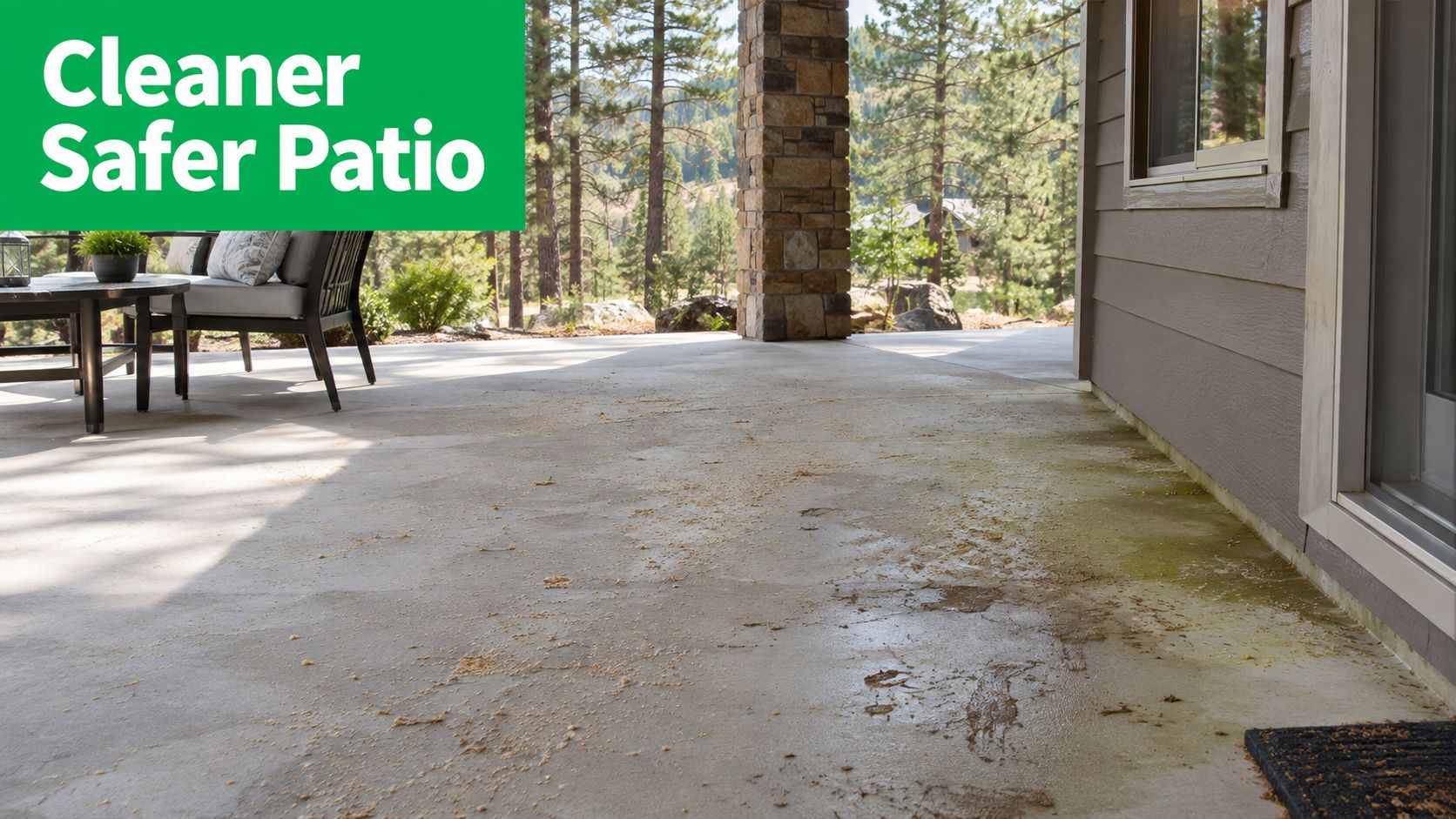
A Flagstaff patio can look fine from the kitchen window until you step outside. Then the details stand out: pine pollen in the corners, monsoon mud along the slab, algae in the shaded areas, and winter grit worked into the concrete. The furniture gets moved, the patio gets swept, and the surface still looks tired.
That buildup isn't only a cosmetic problem. Organic growth can make walking surfaces slick, while embedded soil can hold moisture against concrete, brick, or pavers. A careful patio pressure washing service removes that layer and reveals the surface you thought had faded.
Introduction to a Cleaner Safer Patio
A homeowner in Munds Park might notice the same pattern after a long season. Needles collect beneath the table, dark streaks form where snowmelt lingered, and a shaded edge develops a green film. A patio wash can brighten the concrete, improve the feel of the walking surface, and make the outdoor area ready for guests again.
For businesses, the setting changes but the concern is similar. A hotel courtyard, campus walkway, cabin rental, or restaurant patio needs to look cared for without creating damage, messy runoff, or an unexpected closure. Cleaning works best when the operator treats the patio as part of the property, not as an isolated slab.
What a good cleaning changes
A professional job removes loose debris first, treats suitable stains, and uses controlled water pressure to lift soil from the surface. The result isn't just “more white” concrete. It can be a cleaner, more even-looking area with fewer slippery patches and less grime tracked indoors.
Northern Arizona patios also benefit from a maintenance mindset. Pine debris, seasonal moisture, freeze-thaw exposure, and shaded conditions can all affect how quickly buildup returns. A seasonal inspection helps you decide whether the patio needs a full wash, a gentle treatment, or only sweeping and spot cleaning.
This guide focuses on that judgment. You'll learn how pressure and water flow work together, how materials respond differently, what a careful cleaning process looks like, and when a lower-pressure or no-pressure approach makes more sense.
What Patio Pressure Washing Is and How It Works
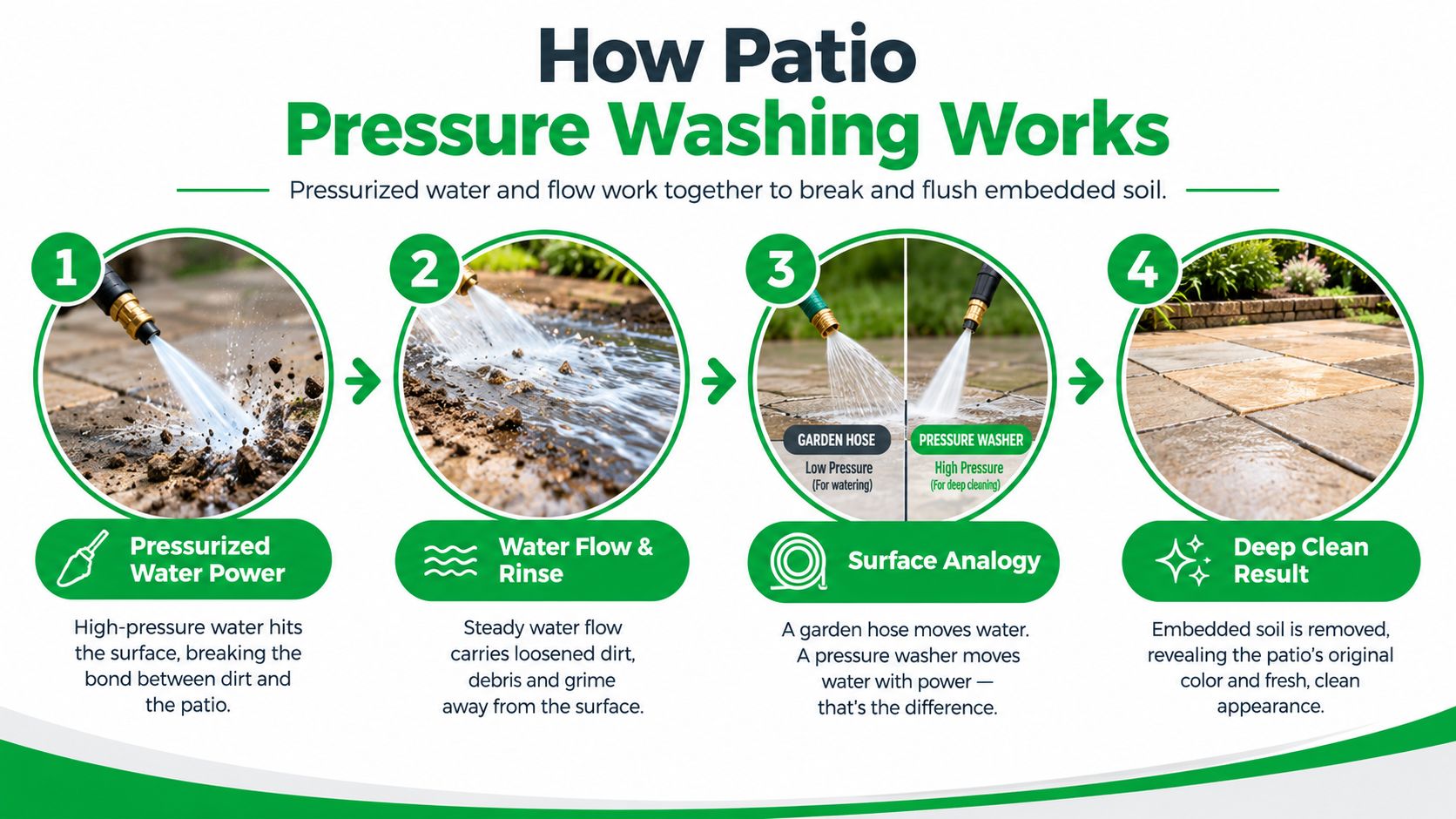
A pressure washer uses a pump to move water through a small opening in a nozzle. The nozzle concentrates the stream, creating the force needed to break the bond between soil and the patio surface. Once that bond is broken, the water must carry the loosened material away.
Think of the difference between a garden hose and a focused jet. A hose can wet a dirty patio, but it may not have enough impact to release compacted grime. A focused stream can break that bond, but if the machine delivers too little water, the loosened dirt may smear, streak, or settle somewhere else.
Pressure and flow do different jobs
Pressure provides impact. Flow provides the rinse. For concrete patios, independent guidance commonly places working equipment around 2,500 to 3,500 PSI with roughly 3 to 5 GPM. Many contractors use about 3,000 PSI as a practical residential baseline, but the correct setting still depends on the concrete's finish, age, condition, and stain type. Concrete Network's equipment guidance explains why both pressure and flow matter.
A surface cleaner uses rotating spray bars beneath a protective housing. It helps distribute cleaning across the slab more evenly than a single wand pass, reducing the chance of visible stripes when the operator moves at a steady pace.
Material changes the answer
Concrete, pavers, brick, and natural stone don't respond to water force in the same way. A hard concrete slab may tolerate more pressure than an older brick patio with fragile mortar. Pavers can lose joint sand, while a concentrated jet can gouge edges or expose aggregate.
Stamped concrete deserves extra care because the decorative finish can etch if the nozzle stays too close or moves too slowly. For more detail on working around decorative concrete, the Concrete Resurfacing Products pressure washing tips offer useful context.
Benefits of a Freshly Washed Patio for Homes and Businesses
A clean patio changes how people use a property. At home, the improvement might be simple. You can walk from the back door to the grill without stepping across dark organic buildup, set out chairs without surrounding them with debris, and feel more comfortable inviting people outside.
Practical benefits at home
Removing algae and accumulated soil can improve the walking experience, especially in shaded areas that stay damp. It can also reduce the amount of dirt brought into the house or cabin. For a short-term rental, a cleaner patio gives arriving guests a better first impression and makes outdoor amenities feel ready rather than neglected.
The visual result matters, too. Dirt can make concrete, brick, and pavers appear faded or uneven. Washing removes that surface film and helps the original color and pattern show through. It won't repair cracks, coating failure, or permanently etched areas, but it can make existing condition easier to evaluate.
Practical rule: A clean patio should support the surface, not hide a maintenance problem.
Commercial and managed properties
Property managers face a different set of priorities. A courtyard at a hotel, an outdoor seating area at a restaurant, or a common space at a managed community has to remain presentable while limiting disruption. Scheduling can be coordinated with occupancy, events, tenant access, and final inspections.
A cleaning plan also helps identify problems early. Loose pavers, failing grout, exposed aggregate, lifted edges, and damaged sealers become easier to see after grime is removed. That gives an owner an opportunity to arrange repairs before a small defect becomes a larger complaint or trip hazard.
The broader value is prevention. Routine exterior care can preserve appearance and reduce the heavy buildup that demands aggressive treatment later. The right service isn't always a high-pressure wash. Sometimes it's a detergent treatment, controlled rinse, or light scrub that protects the patio while still producing the improvement the property needs.
How Professionals Clean Patios Step by Step
A careful patio cleaning starts before the machine turns on. The technician first identifies the material, checks the age and finish, and looks for cracks, loose joints, chipped coatings, weak mortar, drainage concerns, and areas that may react differently from the rest of the surface.
The preparation phase
Furniture, planters, toys, and decorations are moved away from the work area. Nearby plants and landscaping are protected, and doors or vulnerable exterior features are checked before water and cleaning solution are introduced. Dry sweeping removes needles, gravel, leaves, and loose grit that would otherwise become wet sludge.
The operator may pre-wet the patio and adjacent surfaces before applying a suitable detergent. Pre-wetting helps control how quickly a surface absorbs moisture, while detergent gives organic growth and oily residue time to loosen. A stain treatment is selected for the problem rather than applying the strongest available chemical to everything.
Controlled washing
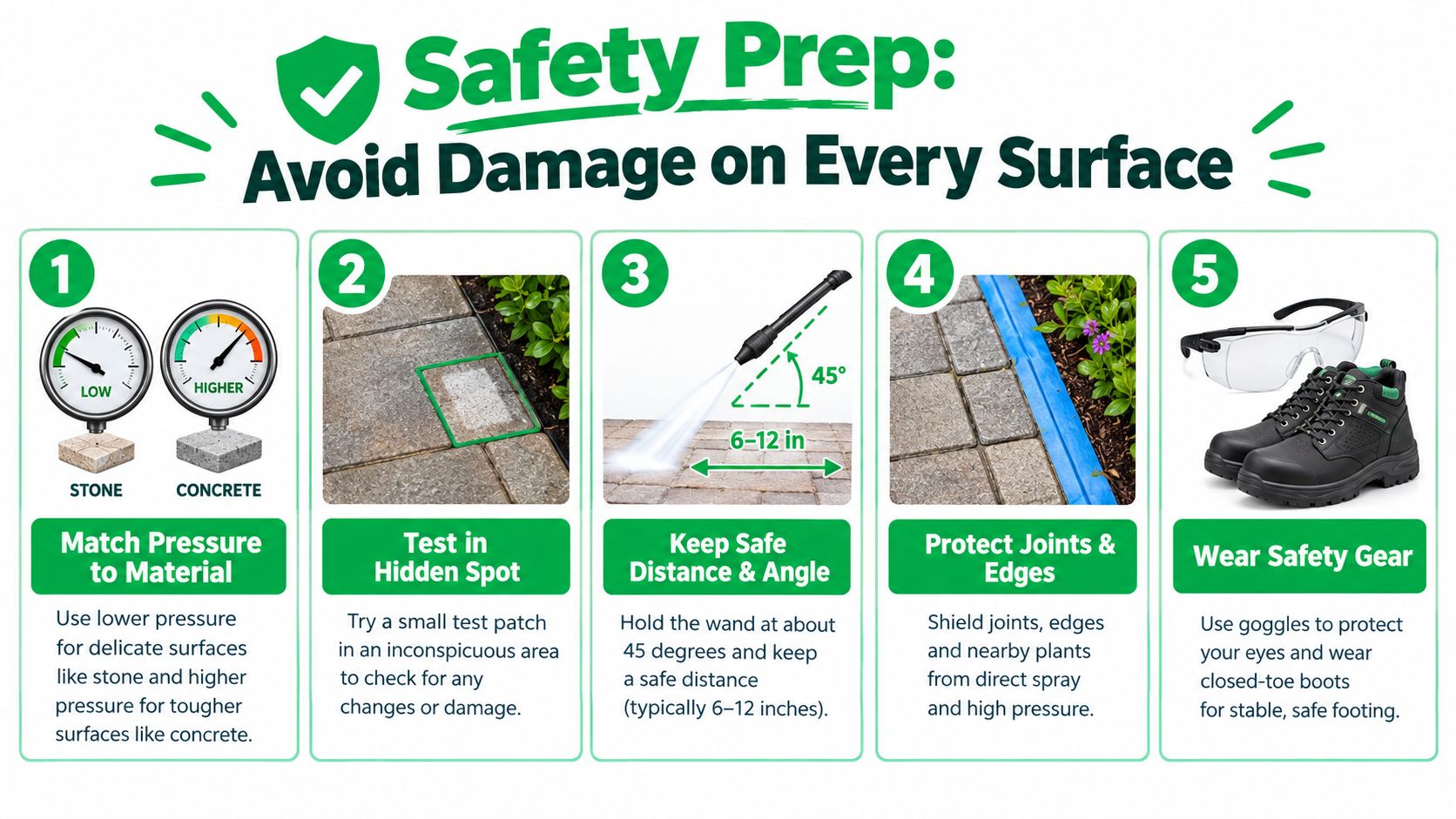
The technician tests a small, less visible area first. That test shows how the surface responds and helps determine the nozzle, distance, angle, pressure, and movement speed needed for the rest of the patio.
Concrete may be cleaned with a surface cleaner and then detailed around edges with a wand. A 25° fan tip and a 6 to 12 inch standoff distance are commonly recommended for solid concrete to help reduce etching, pitting, and wand marks, as described in safe patio pressure washing guidance.
Even passes matter. The operator works systematically instead of tracing random circles, keeps the nozzle moving, and watches where dirty water travels. Higher flow can improve rinsing efficiency, but the goal is controlled removal, not maximum force.
Rinsing and final inspection
A thorough rinse carries away suspended soil and detergent. Plants and nearby surfaces are rinsed as needed, and the patio is checked for missed bands, remaining oil, lifted joints, exposed aggregate, or finish changes.
For a broader exterior service that may include related surfaces around the home, see the house pressure washing service.
Here's a short visual look at the equipment and movement involved:
The final step is allowing the area to dry before furniture returns. Drying makes it easier to see the true result and gives the owner a chance to address any surface condition revealed by cleaning.
Safety Prep and Avoiding Damage on Every Surface
The safest patio wash begins with restraint. A stronger setting isn't automatically a better setting, and the wrong nozzle can damage a surface before the operator realizes what happened.
For concrete, working guidance commonly falls around 2,500 to 3,500 PSI and 3 to 5 GPM, while brick and pavers are often kept near 1,500 to 2,500 PSI to reduce joint-sand loss and edge damage. Other guidance places pavers around 1,200 to 1,800 PSI, concrete as high as 3,000 PSI, and natural stone often below 1,500 PSI. These ranges are starting points, not permission to use the highest setting.
Compare the surface before choosing the method
| Surface | Main concern | Safer starting approach |
|---|---|---|
| Concrete | Etching, pitting, wand marks | Fan tip, test patch, steady movement |
| Brick and pavers | Joint-sand loss, fragile edges, weak mortar | Lower pressure, wider spray, careful rinse |
| Natural stone | Surface wear and finish changes | Gentle treatment and low-pressure rinse |
| Older or stamped surfaces | Decorative finish failure | Test first and increase force only when necessary |
Softwood is especially vulnerable. Independent guidance places an upper boundary around 500 to 800 PSI for softwood decking, while dense concrete can tolerate substantially more, as summarized by the National Power Washing Authority's surface guidance.
DIY and professional risk are different
A homeowner can save service cost by washing a small, sound concrete area, but the homeowner also carries the risk of leaving stripes, blowing dirt toward a wall, damaging a coating, or washing joint sand into a drain. A professional brings experience with test patches, nozzle selection, runoff control, and surface-specific movement.
Protection extends beyond the patio. Cover or shield plants, keep dirty water away from doors and windows, and plan where the rinse will go. Never direct high-pressure water at screens. Guidance on patio repair decisions can also help you distinguish a cleanable surface from one that needs repair first.
For nearby siding, the same principle applies. Use a method suited to the cladding rather than aiming a patio setup at it. Related exterior work is described through vinyl siding pressure washing.
Surface judgment matters more than machine strength. If the grime is light, a lower-pressure wash or a scrub-and-rinse process may be the smarter choice.
Wear eye protection, closed-toe shoes, and clothing that can handle splashback. Keep people and pets away from the spray area, and never point the wand toward a person, animal, electrical component, or fragile glass.
DIY Versus Hiring a Professional in Flagstaff
A small, sound concrete patio can be a reasonable DIY project when access is open and you can test the equipment first. The decision changes with pavers, old mortar, decorative finishes, complicated drainage, delicate landscaping, or a rental turnover deadline. In those settings, a rushed pass can leave stripes, loosen joints, or push dirty water where it should not go.
Flagstaff patios also face local wear. Pine debris settles into joints, monsoon moisture supports organic growth in shade, and winter grit works into textured surfaces. Freeze-thaw exposure can reveal cracks or loose edges. Hard water may leave mineral residue that ordinary rinsing does not remove.
A simple decision matrix
| Question | DIY may fit | Hire a professional when |
|---|---|---|
| Surface | Sound concrete with light soil | Pavers, brick, stone, stamped or weathered finishes |
| Property | Unoccupied home with easy drainage | Rental, hotel, campus, or managed property |
| Equipment | You have suitable low and adjustable control | You'd need to rent unfamiliar equipment |
| Condition | No loose joints or visible coating failure | Repairs, runoff, or fragile areas need assessment |
| Time | You can work slowly and inspect the result | You need dependable scheduling and a consistent finish |
Pressure should match the surface, much like choosing the right brush for a delicate finish. Start low, use a wider spray pattern, and test an inconspicuous patch. For light soil, scrubbing with a suitable cleaner followed by a controlled rinse may protect the patio better than high pressure. Pavers, coatings, fragile mortar, and weathered stone often need slower movement and closer inspection.
Plan the runoff before starting. Shield plants, keep rinse water away from doors and windows, and never aim high-pressure water at screens, electrical components, people, pets, or fragile glass. Eye protection, closed-toe shoes, and clothing that handles splashback reduce common injuries.
Pine Country Window Cleaning has served Northern Arizona since 1999, and Flagstaff native David Kaminski started the company. Its technicians use squeegees, ladders, poles, and pure-water brushes for window work, and the company also provides exterior services. Screens are removed, cleaned, and reinstalled with window service, with attention to protecting the home instead of spraying indiscriminately.
The company describes its technicians as background-checked and OSHA safety-trained, and it offers a 100% satisfaction guarantee. That may suit a patio connected to a cabin, short-term rental, commercial property, or home where the owner wants one coordinated maintenance visit.
Pricing Maintenance and Your Next Step With Pine Country
A patio quote should account for more than its visible size. Square footage, surface material, stain severity, access, drainage, landscaping, furniture, and related exterior work influence both the labor and the cleaning method. A small paver patio with fragile joints may need more care than a larger, open concrete slab.
Published consumer pricing offers a broad reference point. Patio pressure washing is commonly estimated at $0.10 to $0.50 per square foot, with total prices from $80 to $500 and many customers spending around $250, according to patio pressure washing cost information. Examples include up to $120 for a 10 by 10 foot patio, $160 for a 12 by 12 foot patio, and $250 for a 20 by 20 foot patio. Treat these figures as starting points, since material, condition, drainage, and access can change the final quote.
Build a repeatable local plan
For a Flagstaff home or cabin, inspect the patio after the season that leaves the most debris and moisture. Sweep routinely, keep plants from pressing against the edge, and address oil or organic stains before they settle into the surface. A simple inspection can show whether the next visit needs pressure washing, gentle scrubbing, or only a controlled rinse.
For a rental, schedule service around guest turnover and check afterward for loose joints, exposed aggregate, and residue along runoff paths. Commercial managers can coordinate cleaning with occupancy, events, tenant access, and safety inspections. The goal is early buildup control, so technicians can use gentler methods instead of applying unnecessary pressure to an already weathered surface.
If you are planning a larger outdoor upgrade, a patio design ai can help organize layout and furnishing ideas before cleaning or renovation begins. For service-cost planning, review pressure washing service cost information.
Pine Country Window Cleaning provides patio pressure washing and related exterior care for homes, cabins, rentals, and commercial properties across Northern Arizona. For a free estimate, visit Pine Country Window Cleaning and schedule a maintenance visit that matches the patio material, surrounding landscaping, and runoff conditions.