
The most popular advice about a non toxic window cleaner is also the least reliable: if it's natural, it must be safer and better. That shortcut ignores fragrance chemistry, indoor air quality, mineral deposits, and the simple fact that a solution can be gentle yet leave glass streaked.
In Flagstaff, window cleaning has its own challenges. Dry conditions, dust, pollen, hard-water residue, cabins, high exterior glass, and screens all affect the result. Vinegar can handle light soil, but it won't replace the right squeegee, purified water, brush, or safe access equipment when glass needs a proper professional clean.
What Non Toxic Really Means for Window Cleaners
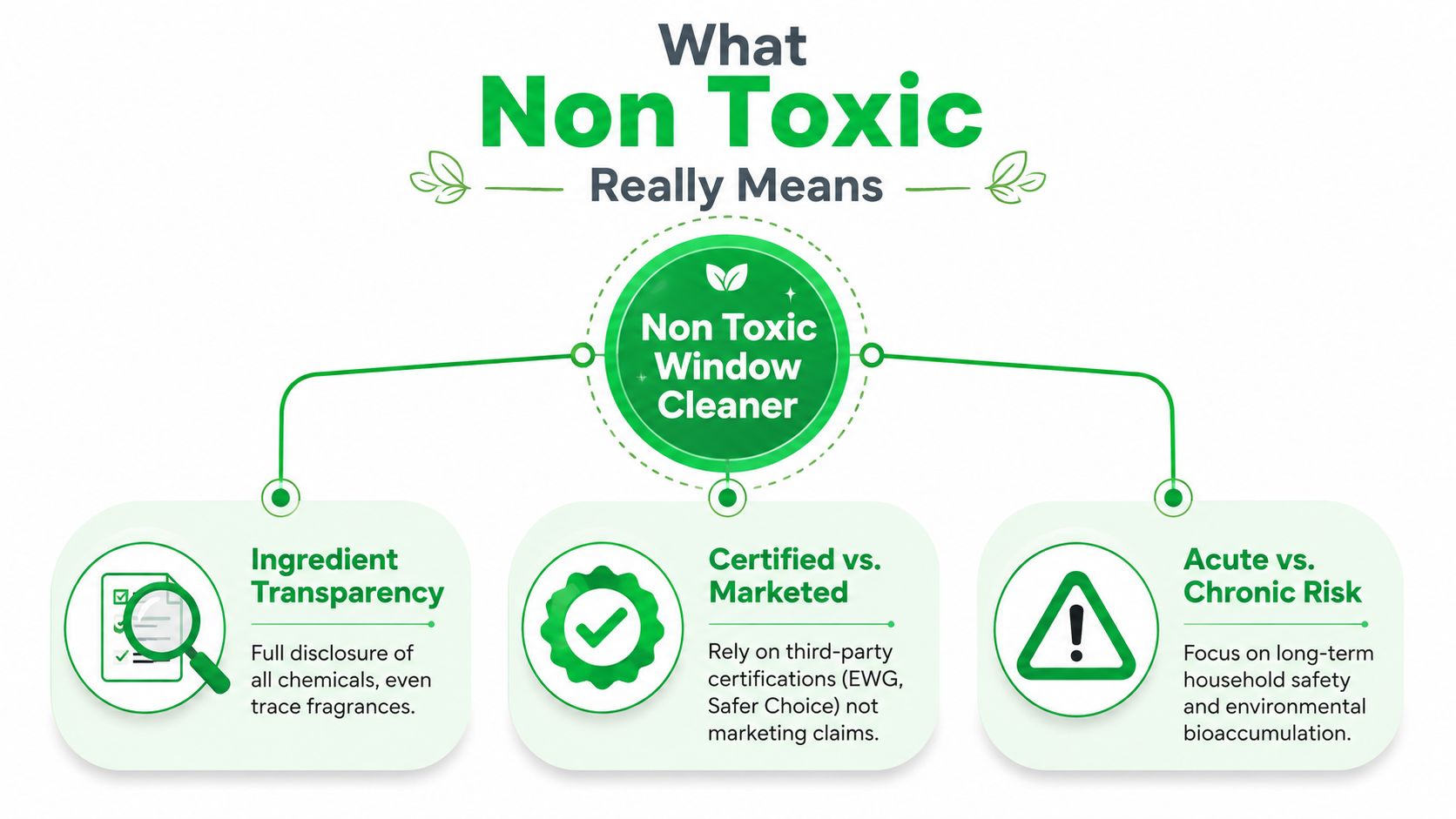
A green label doesn't automatically mean a product is harmless in every setting. Some green cleaners can emit hundreds of VOCs, and green products aren't consistently better for indoor air than conventional products, according to research summarized by the Environmental Working Group. Fragrance-free formulas generally emit fewer VOCs overall, but some plant-based formulas still release monoterpenes that can contribute to secondary pollutants such as formaldehyde and PAN species.
That matters in homes, offices, schools, rentals, and cabins where windows may be cleaned often with limited ventilation. Pine or citrus oils deserve particular caution because reactive VOCs such as terpenes can contribute to ground-level ozone formation, as explained in this California Air Resources Board guidance on cleaning products and indoor air quality. “Natural” describes an ingredient's origin. It doesn't, by itself, describe exposure, reactivity, or performance.
Certification matters more than green language
EPA's Safer Choice program is a more useful benchmark than vague claims such as “eco-friendly” or “chemical-free.” The program replaced the Design for the Environment label in March 2015. By that point, more than 2,000 products had qualified to carry the Safer Choice label, after EPA's earlier cleaner and detergent partnership work had developed into a formal product-labeling system (EPA program history).
The important detail is ingredient review. EPA says every ingredient in a Safer Choice-certified product is evaluated, regardless of its percentage in the formula. That includes the solvents, surfactants, pH adjusters, preservatives, and fragrance components that consumers may overlook when they focus only on the main cleaning agent.
EPA's Safer Chemical Ingredients List contains over 950 chemicals that meet Safer Choice criteria, giving formulators a screened pool for safer product development. By 2024, the wider Safer Choice ecosystem had grown to more than 2,000 products across six major product categories, which shows that safer chemistry has moved beyond a niche market (green cleaning background).
For homeowners, the practical test is straightforward:
- Look for ingredient accountability: A credible certification is more meaningful than a front-label promise.
- Reduce fragrance exposure: Fragrance-free is often the sensible choice for enclosed rooms and frequent cleaning.
- Separate safety from shine: A product can have a cautious ingredient profile and still perform poorly on filmed glass.
For a local approach using environmentally conscious methods, see eco-friendly window cleaning in Flagstaff. The safer choice isn't always the product with the most natural-sounding label. It's the choice that balances reviewed ingredients, ventilation, surface conditions, and cleaning performance.
Proven DIY Window Cleaner Recipes That Actually Work
A homemade solution can be useful for light interior dust, fingerprints, and routine maintenance. It works best when you control the water quality, use a clean tool, and dry the glass before evaporation leaves a film.
The most dependable starting point is diluted distilled white vinegar. Established window-care guidance recommends diluting vinegar from 1:10, one cup vinegar to ten cups warm water, up to 1:1 for heavier grime (window-cleaner recipe guidance). Start weaker on ordinary dust. A stronger mix may help with mineral film, but it still has limits.
Three useful formulas
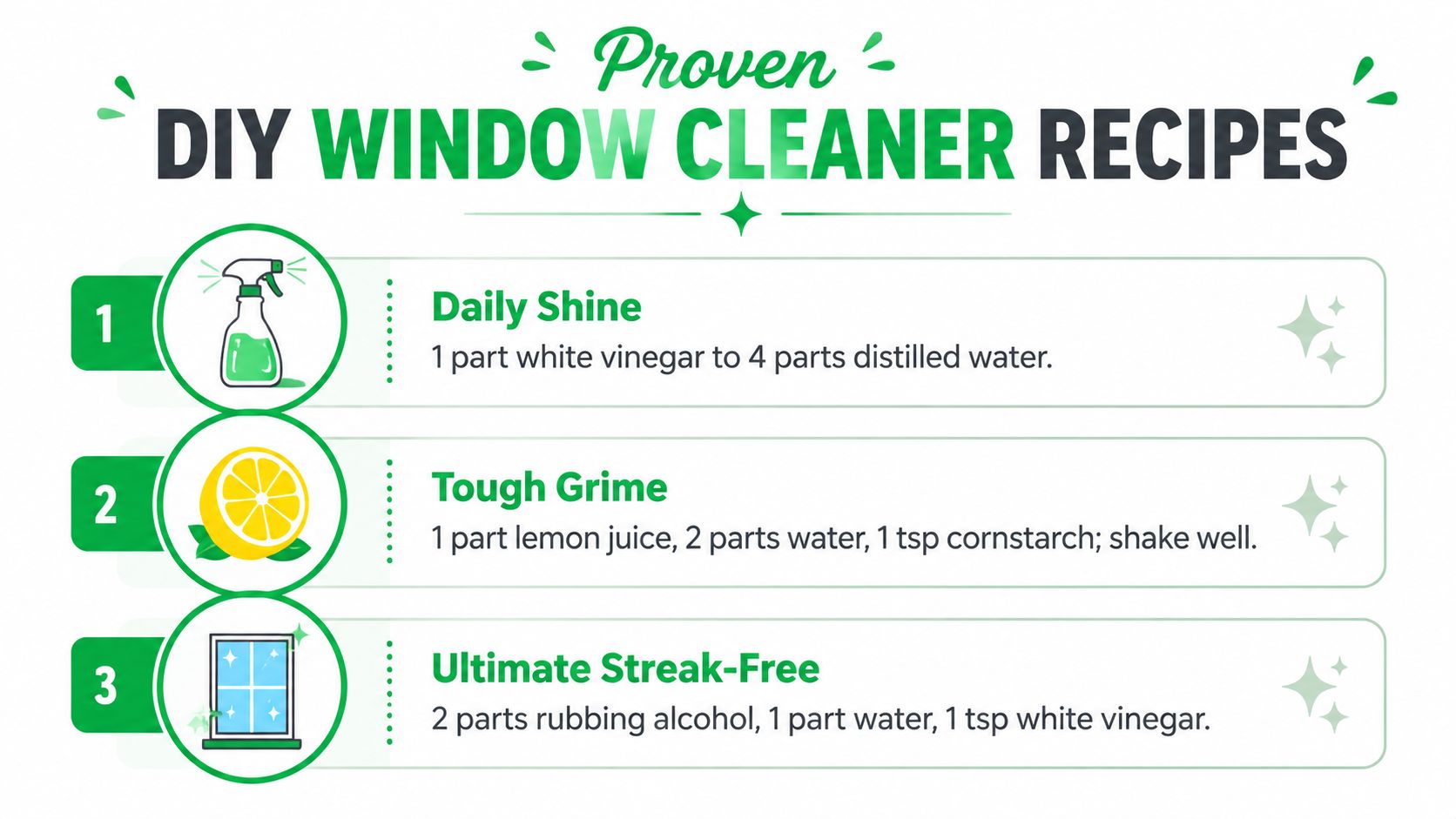
The following recipes offer different levels of cleaning action. Test any mixture on a small area first, and keep liquids away from wood trim, unsealed stone, and sensitive finishes.
Daily Shine: Mix one part white vinegar with four parts distilled water. Use a light spray, then clean with a professional squeegee or a clean, lint-free microfiber cloth. This is appropriate for light soil, not baked-on exterior buildup.
Tough Grime: Combine one part lemon juice, two parts water, and one teaspoon of cornstarch, then shake well. The blend may help with greasy fingerprints and light kitchen soil, but citrus ingredients aren't automatically better for indoor air. Avoid using fragrant citrus formulas in poorly ventilated spaces, particularly when windows are cleaned repeatedly.
Ultimate Streak-Free: Combine two parts rubbing alcohol, one part water, and one teaspoon of white vinegar. This can dry quickly on light interior soil, but fast evaporation creates a timing challenge. Don't spray more glass than you can clean immediately.
Technique decides the outcome
Apply the solution with a spray bottle, work in an S-pattern, and dry promptly. A lint-free microfiber cloth can handle detail work, but a squeegee gives better control over the liquid and removes the dirty solution rather than spreading it around.
Practical rule: Work quickly. Evaporation before drying is one of the most common reasons a homemade cleaner leaves visible streaks.
Distilled water helps limit residue from minerals found in tap water. Pre-dust the sill and frame, use a clean tool, and change cloths when they become damp or dirty. If the glass has heavy mineral buildup, soot, or an exterior film, vinegar may soften the soil without fully removing it.
For a visual walkthrough of the cleaning process, watch this video:
DIY is practical for maintenance. It isn't a universal substitute for a professional system designed to rinse away soil and dry without residue.
Commercial Non Toxic Options Worth Buying
Ready-to-use products make sense when you don't want to mix formulas or when a building needs consistent cleaning between professional visits. The key is to evaluate the product by certification, fragrance load, ingredient disclosure, and soil type, not by the word “natural” alone.
EPA Safer Choice is the strongest recognizable benchmark in this category because every intentionally added ingredient is reviewed under the program's criteria. That standard is more useful than a product that highlights vinegar, plant extracts, or essential oils on the front label.
A commercial formula may also outperform a basic vinegar mix on greasy fingerprints or light film because surfactants help loosen soil and improve wetting. That doesn't mean every commercial cleaner is safer, or that stronger cleaning power requires harsh chemistry. It means formulation matters.
Commercial Non Toxic Window Cleaner Comparison
| Product Type | Certification | Best For | Fragrance |
|---|---|---|---|
| Certified safer-choice glass cleaner | EPA Safer Choice, when the individual product carries the label | Routine interior glass and repeat-use environments | Choose fragrance-free where available |
| Fragrance-free commercial glass cleaner | Certification varies, verify the label | Homes, offices, schools, and enclosed rooms | None or minimal |
| Vinegar-based ready-to-use cleaner | Certification varies | Light soil and routine touch-ups | Vinegar odor |
| Citrus or botanical cleaner | Certification varies | Users who prefer a scented product | May contain reactive botanical VOCs |
| DIY vinegar solution | No third-party certification unless the finished product is certified | Light maintenance with controlled ingredients | Vinegar odor |
The table isn't a promise that one category will clean every window. Glass condition, water quality, dwell time, and tool choice still determine the finish.
Read the back label
Look for the full ingredient list, safety directions, fragrance information, and certification details. Be wary of “chemical-free” wording. Water is a chemical, and a product can contain undisclosed fragrance components while presenting itself as green.
For frequent cleaning, fragrance-free is usually the more sensible default. Ventilation matters too. Open doors or windows when practical, avoid overspraying, and never combine vinegar with bleach or other incompatible products.
Commercial products are worth buying when they save time, provide consistent dilution, or handle soil that a pantry formula can't. They're not worth buying merely because a green leaf appears on the packaging.
Tools and Techniques for Streak-Free Results
A non toxic window cleaner won't produce a clean window if the operator drags dirty liquid across dusty glass. Professional results come from controlling four things: loose soil, solution volume, blade condition, and drying speed.
Start by pre-dusting the frame, sill, and nearby edges. Exterior dust can turn into muddy runoff as soon as liquid hits it. On interior glass, remove loose particles before wet cleaning so grit doesn't travel under a blade or cloth.
Use the right tool for the surface
A professional squeegee removes solution in a controlled pass. The rubber blade should be clean, flexible, and free from nicks. A damaged blade leaves repeating lines that look like a glass problem but are a tool problem.
A lint-free microfiber cloth is useful for edges, corners, frames, and final detailing. It shouldn't become a substitute for proper liquid removal. Spraying heavily and wiping with a household rag often spreads soil, leaves lint, and creates damp edges that dry into streaks.
You can review the equipment categories used in residential work through this guide to home window cleaning tools.
A practical squeegee sequence
- Wet selectively: Apply enough solution to loosen soil, but don't flood the frame.
- Move with control: Use an S-pattern or deliberate overlapping strokes, keeping consistent contact with the glass.
- Wipe the blade: Clear the rubber edge between passes when soil or excess water builds up.
- Detail last: Use a dry microfiber cloth only around edges and corners.
For exterior upper-story glass, water-fed poles change the process. The system sends purified water through a telescoping pole and brush, allowing the operator to stay on the ground. Industry guidance generally uses water treated below 10 parts per million total dissolved solids so the glass can dry without mineral residue (water-fed pole guidance).
This approach avoids adding detergent residue to the glass. It also gives professionals a safer way to reach upper windows with the right brush movement and rinse technique. A spray bottle is convenient for a small interior pane. It isn't the right access system for every exterior window.
Solving Hard Water Spots and Stubborn Film
Hard-water spots aren't ordinary dirt. They're mineral deposits left behind when water dries on the glass, and a light vinegar spray may only soften the outer layer. Repeated deposits can bond tightly enough that ordinary wet cleaning leaves the window looking cloudy even after loose soil is gone.
Start by identifying the problem. A removable dusty film usually responds to pre-dusting, wet scrubbing, and a controlled squeegee pass. A white, crusty pattern around sprinklers or runoff points suggests mineral buildup. Grease, soot, and construction residue require a different approach again.
Match the method to the deposit
For light mineral film, a diluted vinegar solution can be a reasonable first attempt. Apply it to a small test area, allow limited dwell time, then agitate with a safe, non-abrasive tool and rinse or squeegee promptly. Don't let acidic solution sit on frames, stone, metal finishes, or painted surfaces.
For heavier deposits, a dedicated mineral remover may be necessary. Read the product label, protect surrounding materials, and follow the manufacturer's dwell and rinsing directions. A scraper can remove bonded debris from glass when used correctly, with a suitable lubricating solution, a clean blade, and controlled pressure. Never scrape dry glass, and stop if the surface may have a specialty coating or existing damage.
Readers dealing with vehicle glass may also find this DIY windshield spot remover guide useful for understanding why mineral spots need targeted treatment rather than ordinary glass spray.
Exterior film needs more than spray
Dust and pollen often form a thin film that looks streaky because the cleaner has moved soil instead of removing it. A two-stage process works better: loosen and lift the film first, then rinse or squeegee the glass clean. Clean water, a properly maintained brush, and immediate drying matter as much as the chemical choice.
For detailed local guidance, see how to remove hard-water stains from windows.
High glass adds an access problem. Pure-water pole systems can clean windows up to roughly 90 feet high while the operator keeps both feet on the ground, and industry guidance reports that ladder use may drop by about 80% on residential jobs, with job time reduced by up to 40% compared with traditional squeegee methods (water-fed pole safety and efficiency guidance). Those figures apply to the cited industry guidance, not every property. The practical point remains: the right pole system can reduce ladder exposure while reaching glass that a homeowner shouldn't approach from an unstable step stool.
When to Call a Professional Window Cleaning Service
DIY cleaning has a sensible place on reachable interior glass. It becomes a poor trade when the job involves multi-story windows, atriums, skylights, post-construction debris, commercial storefronts, or screens that need more than a quick vacuum.
Safety is the first reason to call. A ladder on uneven ground, a wet sill, a high atrium, or a window above a stairwell can turn a simple cleaning task into an access problem. Professionals can choose between squeegees, water-fed poles, ladders, boom lifts, scissor lifts, and specialized atrium equipment instead of forcing one tool to do every job.
Screens are part of the clean
Screens trap dust, pollen, and fine debris directly in front of the glass. Removing the screen first lets the technician clean the pane properly and inspect the frame and mesh. Standard screen care includes removing the screen, cleaning both sides with gentle tools or low-pressure rinsing, drying it thoroughly, and reinstalling it only once it's completely dry (professional screen-care guidance).
That's why our service includes removing, cleaning, and reinstalling screens with every visit. Caring for the home means protecting frames, sills, landscaping, furnishings, and finished surfaces while leaving the window assembly properly put back together.
Pine Country Window Cleaning is based in Flagstaff, locally owned and operated, and has been in business since 1999, with Flagstaff native David Kaminski associated with the local window-cleaning business (business profile). The company serves residential and commercial properties with professional tools and access equipment, including boom lifts and a 95-foot atrium lift.
For a homeowner, cabin owner, property manager, hotel, campus, dealership, or storefront, the value isn't just a shinier pane. It's having the right method for the glass, a safer plan for the height, and a crew that treats the surrounding property with care.
Pine Country Window Cleaning handles residential and commercial glass cleaning with squeegees, ladders, water-fed poles, pure-water brushes, and screen removal, cleaning, and reinstallation included with every service. If your Flagstaff or Munds Park windows have streaks, hard-water film, dusty screens, or difficult upper glass, visit Pine Country Window Cleaning to request service or a free estimate.