
You usually notice a commercial gutter problem after it has already become a building problem.
A property manager walks the site after a storm and sees water staining on masonry, splashback at the base of the wall, ice near an entry, or runoff cutting channels through landscaping. Sometimes the first sign is inside: a wet ceiling edge, a damp wall cavity, or a tenant complaint. By then, the gutter system has already stopped doing its job.
On commercial buildings, gutters aren't trim. They're part of the drainage system that protects the roof edge, façade, entrances, walkways, and foundation perimeter. That matters even more in Northern Arizona, where Flagstaff properties deal with snowpack, freeze-thaw cycles, and summer storms. A system that looks acceptable in dry weather can fail fast when meltwater refreezes at the edge or when debris blocks a long run during a hard storm.
Why Your Building's Gutter System Matters More Than You Think
Commercial gutters sit in that category of building components people only think about when something goes wrong. That's a mistake. When the system fails, water doesn't just fall to the ground. It runs behind the gutter, overshoots walkways, saturates soil near the perimeter, stains walls, and creates slip hazards where tenants and staff walk every day.
The scale of the industry tells you this isn't a minor maintenance niche. The global rain gutter market was estimated at $8.38 billion in 2024 and is projected to reach $11.39 billion by 2030, according to industry reporting citing market data. Commercial properties are a distinct part of that demand because large roof areas produce a lot more runoff and require larger-capacity systems.
In practice, the problem isn't only volume. It's concentration. A long roof edge can dump water in the same few places if the drainage path isn't working exactly as intended. On a retail center or hotel, that can mean water at entries. On a medical or campus building, it can mean recurring ice at sidewalks and curb lines in winter.
Practical rule: If water is reaching places it shouldn't, the gutter system isn't a cosmetic issue. It's an asset protection issue.
A lot of property managers already have a general maintenance plan, but gutters often get buried under roofing, façade, and grounds tasks. They shouldn't. If you're reviewing seasonal priorities, a commercial building maintenance checklist should treat roof-edge drainage as a scheduled inspection item, not a reactive repair.
When failure does lead to interior moisture or exterior water intrusion, it's helpful to understand what the recovery side looks like too. For a practical example of post-loss support, this guide on assistance for water damage in Bellingham shows the kind of claims and restoration coordination owners often need after water gets past the building envelope.
What commercial properties risk when gutters underperform
- Foundation perimeter saturation: Water that should have been controlled ends up soaking soil near the building.
- Roof-edge deterioration: Overflow and backing water can affect fascia, soffits, and adjacent roof components.
- Tenant-facing problems: Staining, drips at entrances, and unsafe walkways create complaints fast.
- Winter hazards: In Flagstaff, bad discharge patterns often turn into ice where people enter and exit the building.
Choosing the Right Gutter Materials and Profiles
The wrong commercial gutter system usually starts with a mismatch between the building and the specification. A contractor proposes a profile they're comfortable installing, or an owner chooses the cheapest material that looks acceptable on bid day. Years later, the building pays for that decision through distortion, corrosion, loose supports, or repeated service calls.
Profile comes first. Material comes second. Both have to fit the roof design, the expected water load, and the maintenance reality of the property.

Box gutters and K-style gutters
On many commercial buildings, box gutters make more sense because they offer a clean rectangular profile and are commonly used where capacity matters more than decorative appearance. They're a common fit for larger roof sections and more utilitarian building designs.
K-style gutters show up more often on smaller commercial properties or buildings where the roofline borrows from residential styling. They can work well, but they aren't automatically the right choice for every storefront, office, or mixed-use building.
The key question is simple: does the profile match the building's drainage demand and roof geometry? A profile that looks fine from the parking lot can still be a poor performer during snowmelt or a summer downpour.
Material choices in the field
Material selection is where trade-offs get real.
| Material | Typical Lifespan | Pros | Cons |
|---|---|---|---|
| Aluminum | Varies by application and maintenance | Lightweight, corrosion-resistant, easier to form | Can dent or deform more easily on demanding commercial runs |
| Galvanized steel | Varies by coating condition and maintenance | Strong, rigid, widely used | Protective coating can wear over time, leading to corrosion concerns |
| Galvalume or coated steel | Varies by exposure and maintenance | Good strength with improved corrosion resistance over basic galvanized options | Heavier than aluminum, finish damage matters |
| Stainless steel | Varies by environment and maintenance | Excellent durability and corrosion resistance | Higher material and fabrication cost |
| Copper | Varies by design and maintenance expectations | Long service life potential, premium appearance | High upfront cost and often unnecessary for many commercial properties |
Because the verified data doesn't provide lifespan figures by material, it's better to discuss them qualitatively. In real maintenance work, the best material isn't the fanciest one. It's the one that fits the building, the local climate, and the owner's willingness to maintain it.
Materials don't fail in isolation. Fasteners, seams, hangers, and discharge points usually tell the real story first.
What works in Northern Arizona
In Flagstaff and surrounding areas, snow and ice push the decision toward stronger assemblies and better support details. Light material on a long run can still perform, but only if the design, hanger spacing, slope, and attachment are done correctly. A stronger metal won't save a poor installation.
Ask these questions when reviewing a proposal:
- What profile was chosen and why: The answer should reference roof shape and drainage demand, not just preference.
- How will the material handle snow and ice exposure: In Northern Arizona, winter loading matters.
- What parts of the system are most vulnerable: Seams, outlets, end caps, and long unsupported runs deserve a direct answer.
- How easy is future service: If cleaning and repairs will be awkward, maintenance usually gets delayed.
Sizing Gutters for Maximum Water Management
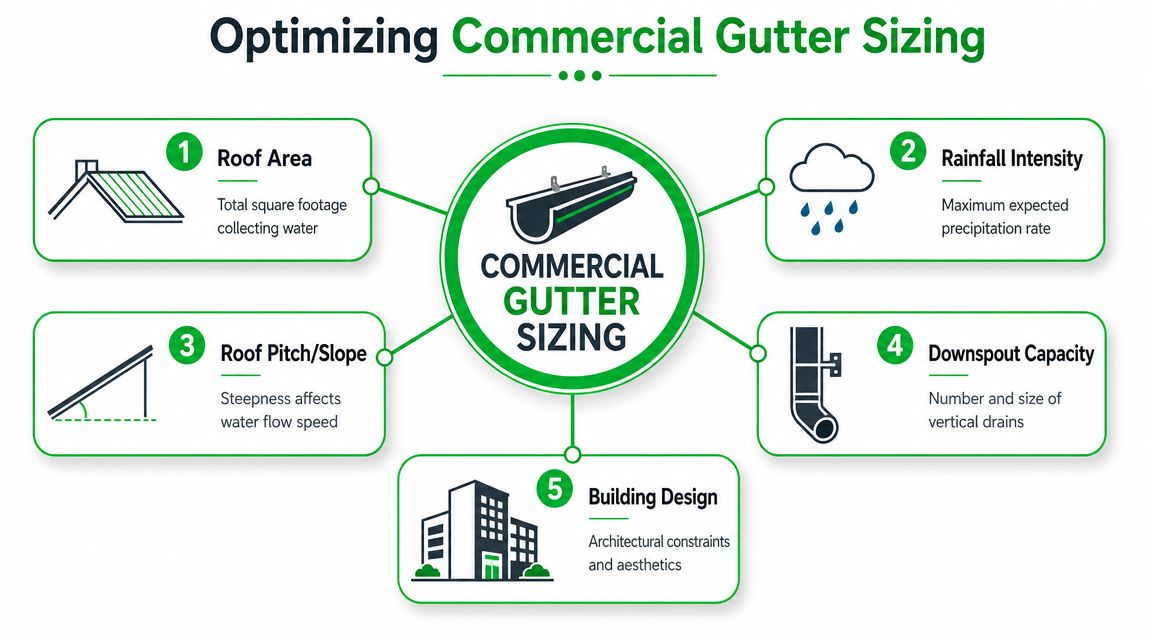
Commercial gutter sizing isn't guesswork. It should be based on the roof area feeding the gutter, the roof design, how quickly water reaches the edge, and whether the downspouts can carry that water away. On larger buildings, mistakes show up quickly because the roof contributes runoff at a scale that residential rules don't cover well.
Industry guidance lays out a useful benchmark. A 6-inch gutter can typically handle runoff from 3,840 square feet of roof area, while an 8-inch gutter can manage up to 7,200 square feet. The same guidance says proper design also needs a minimum slope of 1/16 inch per foot and downspouts spaced no more than 40 feet apart, according to this commercial gutter sizing guidance.
What the numbers actually mean
Those capacity figures are helpful, but they shouldn't be treated like a shortcut. They tell you that size matters. They don't mean every building with a given roof area should automatically get the same gutter.
A property manager should expect the installer or designer to consider:
Roof collection area
The larger the roof section feeding one run, the more water the gutter must carry.Roof pitch and drainage behavior
Water reaches the edge differently on steep roofs, low-slope roofs, and roof areas with concentrated flow.Downspout layout
A large gutter with too few outlets still backs up.Run length and slope consistency
If the gutter doesn't maintain fall toward the outlet, water ponds instead of draining.
Bigger isn't always better
One of the most common mistakes in commercial work is assuming a larger gutter solves every overflow complaint. Sometimes it does. Sometimes the issue is that the existing system has poor slope, too much distance between outlets, or a downspout layout that can't move water away fast enough.
That's especially true in Flagstaff. Snowmelt can produce long periods of steady runoff rather than one short event. Ice can also partially block the path, which means the system needs clean outlets and reliable drainage geometry, not just more metal at the edge.
If one corner overflows while the rest of the run looks normal, don't jump straight to upsizing. Check slope, outlet placement, and blockage first.
A field checklist for property managers
Before approving a replacement or retrofit, ask for a clear explanation of these points:
- Drainage path: Where does water go after it leaves the downspout?
- Outlet spacing: Are downspouts located to match the roof's actual runoff pattern?
- Support details: Will long runs stay in slope under snow and ice exposure?
- Service access: Can crews reach outlets and downspouts for cleaning without turning routine maintenance into a special project?
Navigating Complex Commercial Gutter Installations
Commercial installations get complicated long before the first section of gutter goes up. Access, building height, pedestrian traffic, roof design, and weather exposure all affect the job. A contractor who mostly works on houses can miss problems that show up immediately on a hotel, dealership, apartment complex, or campus building.
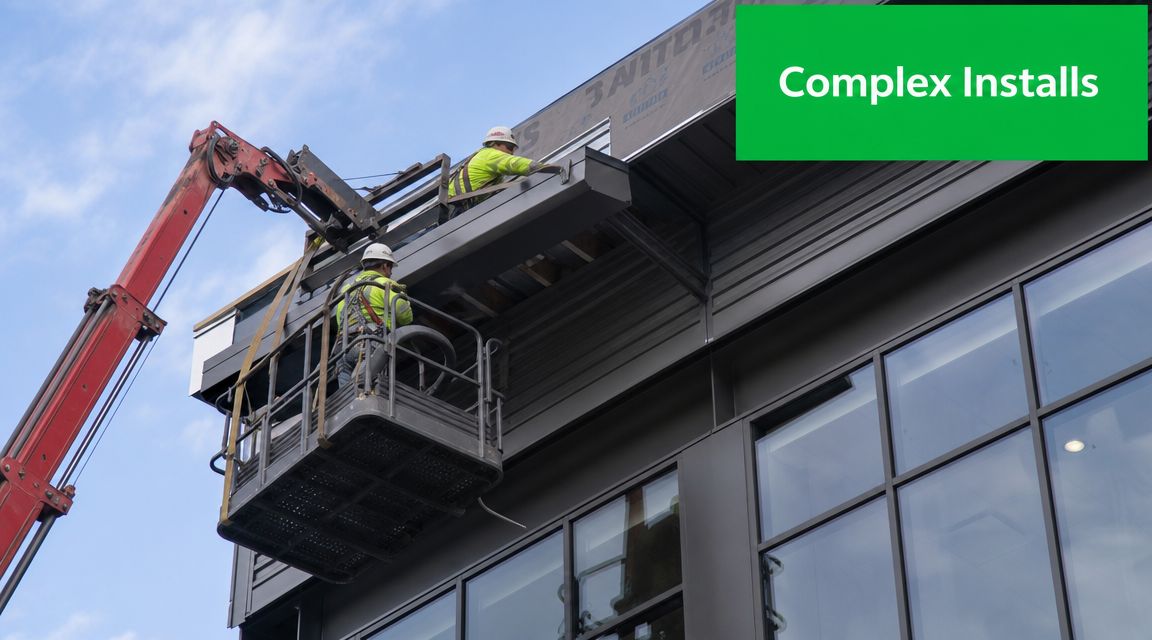
A simple example is access equipment. Multi-story work often needs boom lifts, scissor lifts, or other specialized access tools. The installation crew has to manage height safely, protect the area below, and keep work moving around parked vehicles, storefront entries, or active tenants. That changes labor planning and often determines whether the job goes smoothly or becomes disruptive.
Where high-altitude weather changes the job
Flagstaff isn't a generic Sun Belt market. Snow loads, freeze-thaw cycles, and ice buildup put different stress on commercial gutter systems. On long eaves, accumulated snow can drag on the outer edge. During thaw periods, water can refreeze at shaded sections and create concentrated weight where the system is already under strain.
That means installation details matter more than many owners realize. Support placement, attachment quality, outlet reinforcement, and consistent slope all have to be right. A gutter that's merely attached isn't the same as a gutter that's engineered to stay attached through winter.
For local service needs, property managers often look for teams that already handle gutter services in Flagstaff and understand how snow, ice, and steep access conditions affect maintenance and installation planning.
Problem areas that deserve extra attention
Some commercial roofs are straightforward. Many aren't.
- Parapet conditions: Water may need to move through scuppers or transition around wall details.
- Low-slope roofs: These systems depend on disciplined drainage layout. Small slope errors create big problems.
- Long runs with thermal movement: Expansion and contraction can stress joints and attachments.
- Entries and pedestrian zones: Discharge can't end where people walk, queue, or unload.
A good commercial installer treats the whole drainage path as one system. Gutters, downspouts, elbows, splash control, and discharge location all have to work together.
Proactive Gutter Maintenance and Lifecycle Costs
A new commercial gutter system can still fail early if no one maintains it. That's the part many budgets get wrong. Owners approve the installation, then treat cleaning and inspection as optional until overflow shows up. By then, the work is no longer preventive.
Expert guidance from the Insurance Institute for Business & Home Safety notes that upsizing gutters alone often isn't the answer. Poor slope, debris clogs, and improper downspout discharge are common failure points, which is why regular professional cleaning and inspection matter as much as initial design, as outlined in this IBHS roof drainage guidance.
What a useful maintenance program looks like
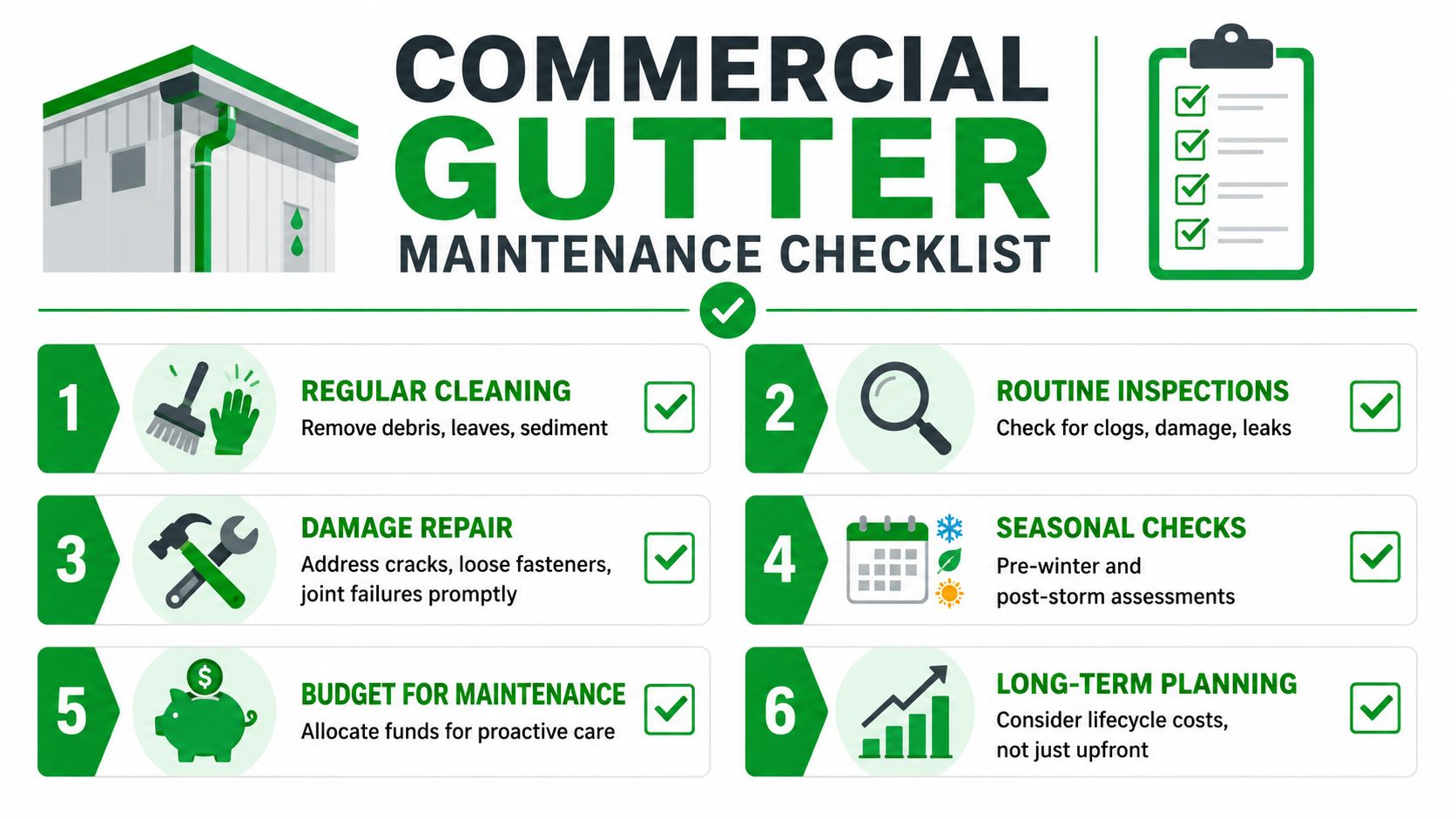
In Northern Arizona, the schedule should match the climate. Properties need attention before winter, after major storms, and during periods when needles, leaves, roof granules, or windblown debris build up in the system.
A professional service visit should usually include:
- Debris removal: Leaves, pine needles, sediment, and roof grit need to come out of the troughs and outlets.
- Downspout flushing: Water should move freely from top to bottom, not just disappear into the elbow and clog lower down.
- Attachment checks: Loose spikes, hangers, brackets, and strain at seams should be caught early.
- Discharge review: Water needs to leave the building perimeter correctly, not dump at the base of the wall.
Here's a useful video overview to pair with a maintenance discussion:
What doesn't work
Reactive cleaning doesn't work well on commercial properties. Sending someone up only after tenants report overflow means the building already absorbed the risk. The same goes for partial service, where crews scoop visible debris but don't verify downspout flow or look for slope loss.
The right maintenance partner is key. For example, commercial gutter cleaning should cover the full drainage path, not just the gutter channel. On taller or more complex buildings, Pine Country Window Cleaning is one local option with in-house lift equipment for access, which matters when routine service involves height, atriums, or difficult roof edges.
Clean gutters that discharge badly still fail. A maintenance visit should confirm where the water ends up, not just whether the trough looks empty.
Lifecycle thinking beats emergency spending
Owners often focus on replacement cost and overlook serviceability. A system that's hard to clean usually gets neglected. A system with poor access near roof transitions or entry canopies tends to hide problems until they become expensive.
The better approach is simple: budget for recurring inspection, seasonal cleanout, and small repairs before joints open up or supports loosen. That keeps minor drainage problems from turning into façade repairs, ice complaints, or emergency calls during winter weather.
Calculating the ROI of a Professional Gutter System
The return on investment for commercial gutter systems isn't measured only by what you spend on installation. It's measured by what the system prevents. Most owners never get a line-item report saying, "your gutters prevented damage this quarter." They see the benefit in the problems that never show up.
A functioning system protects several costly areas at once. It helps keep runoff away from the foundation perimeter. It reduces staining and premature wear on exterior walls. It limits the chance of water collecting at entries, loading docks, and sidewalks where people can slip, especially during freeze-thaw periods in Flagstaff.
Where the payback shows up
The financial logic is straightforward:
- Fewer emergency calls: Planned service costs less than surprise response during a storm or snowmelt event.
- Less collateral damage: Water controlled at the roof edge is less likely to damage adjacent building components.
- Lower liability exposure: Better discharge means fewer icy trouble spots near doors and walkways.
- Longer service life for related components: Fascia, soffits, coatings, and surrounding ground elements all benefit when runoff behaves.
A professional system also improves predictability. Facility managers can plan maintenance around seasons instead of reacting to tenant complaints and weather-driven failures. That's a real operational advantage, especially on multi-building sites where one unresolved drainage issue can consume an outsized amount of staff time.
A practical way to evaluate value
Don't ask only, "What does the gutter project cost?" Ask:
- What water-related repairs has this building already had near the roof edge or perimeter?
- Where do people walk during snow and ice conditions?
- Which elevations are hardest to inspect and maintain?
- Will the proposed system be easy to service every year?
The cheapest gutter bid can become the most expensive option if it creates repeat access costs, recurring leaks, or winter safety issues.
On commercial properties, good drainage is risk control. The ROI comes from fewer disruptions, fewer repairs, and fewer chances for water to turn into a larger building claim.
How to Select a Qualified Gutter Service Partner
Choosing a commercial gutter contractor or maintenance provider shouldn't come down to who can quote fastest. Commercial work has different failure points than residential work. Height, access, tenant coordination, safety planning, and weather exposure all raise the stakes.
Start with commercial experience. Ask what types of buildings the company works on regularly. A crew that understands hotels, campuses, retail centers, medical offices, and multi-story buildings will usually ask better questions about access, pedestrian protection, and drainage routing.
What to verify before hiring
Use a shortlist, not a gut feeling.
- Insurance and safety practices: Commercial work should involve documented safety procedures and crews trained for high-level access.
- Equipment fit: If the building needs lifts, long poles, roof access planning, or controlled work around entries, the company should already have that capability.
- Local climate knowledge: In Flagstaff, a contractor should understand snow loading, ice formation, and monsoon-driven debris.
- Scope clarity: The proposal should say whether they are cleaning only, inspecting attachments, flushing downspouts, and checking discharge locations.
Communication matters too. A reliable partner explains what they found, what needs immediate repair, and what can wait. That makes budgeting easier and keeps small issues from getting lost between seasons.
Why local knowledge matters in Northern Arizona
A gutter system that performs in a mild climate may struggle in Flagstaff. Snow sliding from one roof plane, ice lingering on shaded elevations, and windblown pine debris all change maintenance needs. The right service partner won't treat those conditions as exceptions. They'll build the schedule around them.
Property managers should also pay attention to how the company treats the site. On occupied properties, professionalism means protecting landscaping, controlling debris, managing access around tenants, and leaving the building cleaner than they found it. That same care shows up in related exterior services too. The companies that respect screens, trim, entries, and surrounding surfaces during one service call usually bring the same discipline to gutter work.
If you manage a commercial property in Flagstaff or elsewhere in Northern Arizona, Pine Country Window Cleaning can help with gutter and downspout maintenance, difficult-access cleaning, and seasonal exterior service planning. Contact them for an estimate and a practical maintenance schedule that fits your building, access conditions, and winter weather exposure.