

If you're searching for gutters flagstaff az, there's a good chance something already got your attention. Water spilling over the edge in a monsoon storm. A sagging section above the garage. Pine needles packed so tightly in the trough that the downspout might as well be capped off. In Flagstaff, gutter problems usually show up fast and at the worst time.
Northern Arizona homes don't deal with one kind of weather. They deal with snow load, spring melt, summer downpours, wind, pine debris, and freeze-thaw cycles that punish any weak point at the roof edge. Since 1999, property maintenance here has taught one lesson over and over. A gutter system isn't trim. It's protection.
Why Gutters Are a Flagstaff Home's First Defense
A failed gutter in Flagstaff rarely stays a gutter problem.
When runoff overshoots the system during snowmelt or a monsoon burst, water doesn't just disappear into the yard. It hits siding, fascia, walkways, and the soil next to the house. On sloped lots, it cuts channels fast. Around entries and patios, it leaves slick surfaces and splashback. At the foundation line, it starts a much more expensive conversation.

Flagstaff weather makes gutters work harder
Think of gutters as the home's exterior circulatory system. They collect runoff at the roof edge, move it in a controlled path, and send it away from areas that shouldn't stay wet. Once that flow gets interrupted by debris, ice, bad pitch, or loose fastening, the whole exterior starts taking water where it wasn't meant to.
Flagstaff adds stress from several directions at once:
- Winter snow load puts weight on gutter runs and exposes weak fastening.
- Freeze-thaw cycles turn standing water into ice, then back into runoff.
- Spring melt sends concentrated flow through every outlet and downspout.
- Monsoon storms test whether the system can move water quickly instead of letting it pour over the face.
A lot of Arizona homeowners ask if gutters matter in a drier climate. In Flagstaff, that question usually goes away after one hard season. The issue isn't constant rain. It's how much water arrives at once, and where that water goes when drainage fails.
The overlooked risk at the foundation
One of the biggest local problems sits below grade, not at the roofline. A primary risk for Flagstaff foundations comes from the region's expansive clay soils, which can swell by 20-30% when saturated by runoff. That geological factor is responsible for 15% of all foundation cracks in Northern Arizona, and properly installed gutters can reduce that risk by 50-60%, according to Foundation Repairs Arizona's overview of rain gutters and soil movement.
That matters on custom homes, cabins, rentals, and commercial buildings alike. Water concentrated at one corner of the structure doesn't need years to start causing visible trouble. It can wash out soil, keep one area wet longer than the rest of the perimeter, and begin stressing surfaces that were never meant to stay saturated.
Practical rule: If water isn't being controlled at the roof edge, you're asking the siding, trim, soil, and foundation to absorb the problem instead.
What good gutters actually do
A properly working system does more than catch rain.
It helps protect:
- Fascia and trim from chronic wetting
- Siding and stone veneer from staining and splashback
- Walkways and entries from runoff dumping in the wrong place
- Landscaping and grade from erosion
- Foundation areas from concentrated saturation
Quick fixes don't hold up well here. A handyperson can reattach a loose section, but if the pitch is wrong or the outlet stays clogged, the same problem returns with the next weather event. What works in Flagstaff is straightforward. Good installation, proper slope, solid support, clean downspouts, and seasonal attention before weather finds the weak spot.
Recognizing the Warning Signs of Gutter Failure
Most gutter failures advertise themselves before they become emergencies. The trick is knowing what you're seeing.
A quick walk around the house after a storm, or after snow starts melting off the roof, can tell you a lot. Look up, but also look down. Overflow leaves clues at the siding, the soil line, and the hardscape below.
Signs on the outside of the house
Start with what the gutter system is doing during or right after water movement.
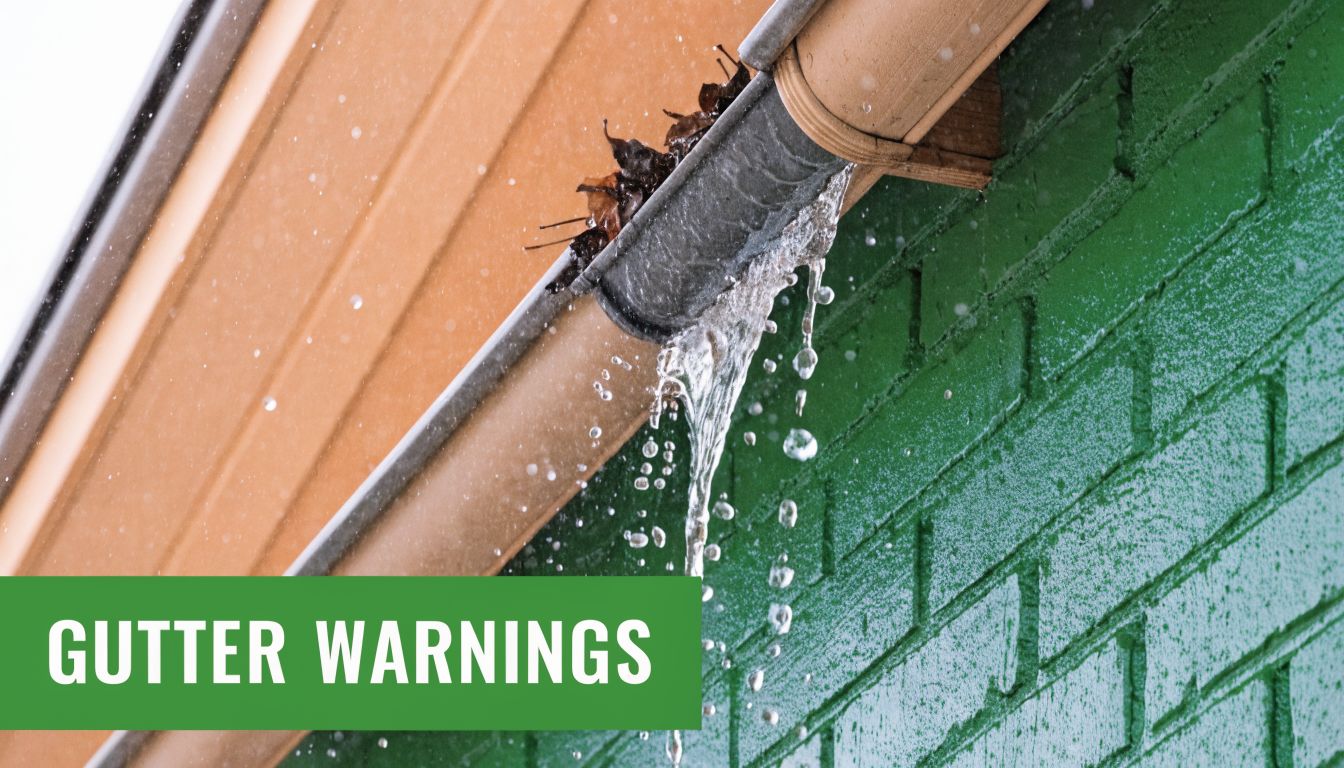
- Water pouring over the front edge usually points to a blocked outlet, packed debris, or a section holding the wrong pitch.
- Staining on fascia or siding often means water has been wicking behind the gutter or spilling in the same place repeatedly.
- Mud channels or washed-out gravel below corners show where runoff has been concentrated instead of directed away.
- Sagging runs or visible separation suggest the system has carried too much wet debris, ice, or standing water.
- Plants growing in the gutter mean the buildup has gone well beyond a light cleaning issue.
Those last two deserve prompt attention. Once a gutter starts pulling away from the fascia, it stops being just a drainage problem and starts becoming a carpentry and water-intrusion problem.
What to watch for after winter
Icicles alone don't always mean failure. In Flagstaff, some winter icicles are normal.
What raises concern is uniform, repeated icicle formation along a run, especially where the gutter should be draining. That pattern can signal water backing up, freezing at the edge, and staying trapped long enough to build ice where it shouldn't. If one section keeps doing it while others don't, that section needs inspection.
A gutter packed with wet needles can look harmless from the driveway and still be one thaw cycle away from twisting out of shape.
Clues inside the home
Gutter trouble often shows up indoors after the exterior has been struggling for a while. If water is getting where it shouldn't, you may notice ceiling staining near exterior walls, damp trim, or discoloration that appears after storms or snowmelt. If you're trying to sort out whether those marks may be part of a broader moisture issue, this guide to signs of water damage ceiling is a useful visual reference.
This short walkthrough shows the kinds of blockages and overflow patterns homeowners should pay attention to:
A simple inspection routine
Use this checklist during a ground-level inspection:
- Check corners first because corners often reveal overflow, staining, and fastening stress before straight runs do.
- Look below every downspout for splash marks, erosion, or water collecting too close to the house.
- Scan roof edges under pine cover because those sections usually pack with needles first.
- Watch for peeling paint or swollen trim near the eaves and window tops.
- Notice anything crooked. Gutters should look straight and intentional, not bowed or twisted.
If you see one issue, don't assume it's isolated. Overflow at one outlet can mean the entire run hasn't been draining correctly for a while. Catching it early is the difference between a service call and a repair project.
Your Seasonal Gutter Maintenance Schedule for Flagstaff
Flagstaff doesn't reward a once-a-year approach.
Nationally, 65% of gutter service calls occur in the fall and spring, but in high-elevation areas like Flagstaff, up to 80% of gutter damage stems from winter freeze-thaw cycles. Unmaintained systems also have a 300% higher failure rate, which is why seasonal prep matters so much here, according to national gutter service statistics covering seasonal damage patterns.
A good schedule follows the weather, not the calendar alone.
Fall work before the first real cold
Fall is when many systems show early signs of failure.
Pine needles, cones, seed litter, and roof grit settle into the troughs before winter ever arrives. Then the first rounds of moisture turn that loose debris into a dense, wet mat. If it stays there, the gutter starts winter already carrying extra weight and holding water in places that should drain clean.
Fall service should focus on:
- Removing compacted debris before snow adds weight to it
- Flushing downspouts so spring melt has a clear path
- Checking fastening and alignment on runs that carried summer buildup
- Watching steep roof sections closely because snow slide areas tend to punish the gutter edge
For homeowners who keep a broader upkeep calendar, a good annual home maintenance checklist can help place gutter service in the right sequence with roof, tree, and exterior work.
Winter monitoring and snow management
Winter in Flagstaff creates a different kind of gutter problem. The issue isn't just debris. It's debris plus frozen water, plus snow load, plus repeated thawing and refreezing at the roof edge.
That's where advanced solutions can make sense on the right home.
When heat tape helps
Heat tape isn't for every property, but it can be useful on homes with recurring ice buildup, shaded roof edges, or sections where meltwater refreezes at the eaves. It works best as part of a system. Clean gutters, open outlets, and a roofline that has been evaluated for winter drainage.
If the trough is full of debris, heat tape won't rescue it. It may reduce one symptom while the clog remains.
Where snow retention systems fit
On steep roofs, especially on cabins and second homes, unmanaged snow movement can slam the gutter line. Snow retention systems help control how snow releases instead of letting heavy sheets slide all at once toward the edge.
That matters on hillside homes, entries, decks, and pedestrian areas where snow movement can damage the gutter or create a hazard below.
Field note: The homes that struggle most in late winter are often the ones that looked fine in October but went into snow season with packed outlets and no margin for meltwater.
Spring cleanup after snowmelt
Spring is not just another cleaning. It's an inspection.
By the time the snow backs off, winter has already tested the fasteners, seams, pitch, and outlet performance. This is when sagging, twisting, and slow drainage show up clearly. Spring service should remove what winter left behind and look for physical changes caused by ice and weight.
Key spring tasks include:
- Clear debris that settled or shifted over winter
- Run water through the system to confirm proper flow
- Inspect joints and attachment points for movement
- Check runoff areas at grade for erosion or splash issues
Pre-monsoon preparation
Monsoon storms expose weak drainage in a hurry. A gutter doesn't need to be fully packed to fail in a hard rain. Sometimes one outlet is enough.
Before summer weather settles in, it helps to schedule a final check of the sections that collect the most debris or see the heaviest runoff. Property owners who want service details can review Flagstaff gutter cleaning options and compare what a full cleaning and downspout flush should include.
The right maintenance rhythm in Flagstaff usually isn't reactive. It's preventive. Clean before winter, inspect after winter, and make sure monsoon flow has a clear path before the sky does the testing for you.
Choosing the Right Gutter System for Northern Arizona
Not every gutter system holds up equally well in Northern Arizona. Some styles shed debris better. Some materials handle exposure better. Some installations look acceptable from the ground but fail because the basics were wrong from day one.
In Flagstaff, good selection starts with local conditions. Pine needles. Snow load. fast runoff. Freeze-thaw stress. Those factors narrow the field quickly.

Material choice that makes practical sense
For Flagstaff's climate, professional installations require a minimum slope of 1/8 inch per foot and support straps placed at 30-inch centers to handle snow loads, and aluminum is often the most economical choice because it's durable and paintable in a market with heavy pine debris, according to architectural gutter specifications and material guidance from Copper Development Association resources.
That practical case for aluminum is strong here.
Why aluminum works well:
- It resists rust, which matters when debris holds moisture.
- It stays lighter than heavier alternatives, reducing stress on the structure.
- It can be painted, which helps match trim packages on custom homes.
- It performs well across varied property types, from cabins to larger residential builds.
Copper has its place, mostly as a premium architectural option. But for many homes in Flagstaff, aluminum is the sensible balance of durability, serviceability, and cost control.
Style matters too
The most common conversation is usually K-style versus half-round.
K-style tends to be the practical choice for many local homes because it offers a shape that works well with typical residential rooflines and can handle everyday runoff demands effectively. Half-round can look excellent on certain architectural styles, but it isn't automatically the better answer just because it looks more traditional.
What matters more than style alone is whether the system is sized, supported, and installed for the property's actual exposure.
What separates a professional installation from a shortcut
Homeowners don't need to become installers, but they should know what to ask.
Use this as a screening list when evaluating a new system or repair proposal:
| Installation detail | What to verify |
|---|---|
| Slope | The run should maintain at least 1/8 inch per foot so water doesn't sit in the trough |
| Support spacing | Straps or supports should be set at 30-inch centers maximum |
| Watertight connections | Downspout connections should be flashed and sealed properly |
| Expansion planning | Long runs need proper allowance for movement |
A gutter can look straight and still hold water. That's why pitch matters so much.
If a contractor talks only about color and style but not about slope, support, sealing, and drainage path, the conversation is incomplete.
Matching the system to the property
A steep-roofed cabin under heavy pines needs a different strategy than a lower-profile home with modest debris exposure. The same goes for homes in neighborhoods with mountain architecture and complex rooflines. For owners comparing exterior service needs in that type of setting, this page on Forest Highlands property care gives a sense of how access and environment change maintenance requirements.
What works best in gutters flagstaff az is rarely flashy. It's a well-pitched, well-supported system in the right material, installed by someone who understands what winter and pine debris do to a roof edge.
DIY Gutter Cleaning vs Hiring a Professional
A lot of homeowners consider cleaning their own gutters for one simple reason. It seems like a straightforward way to save money.
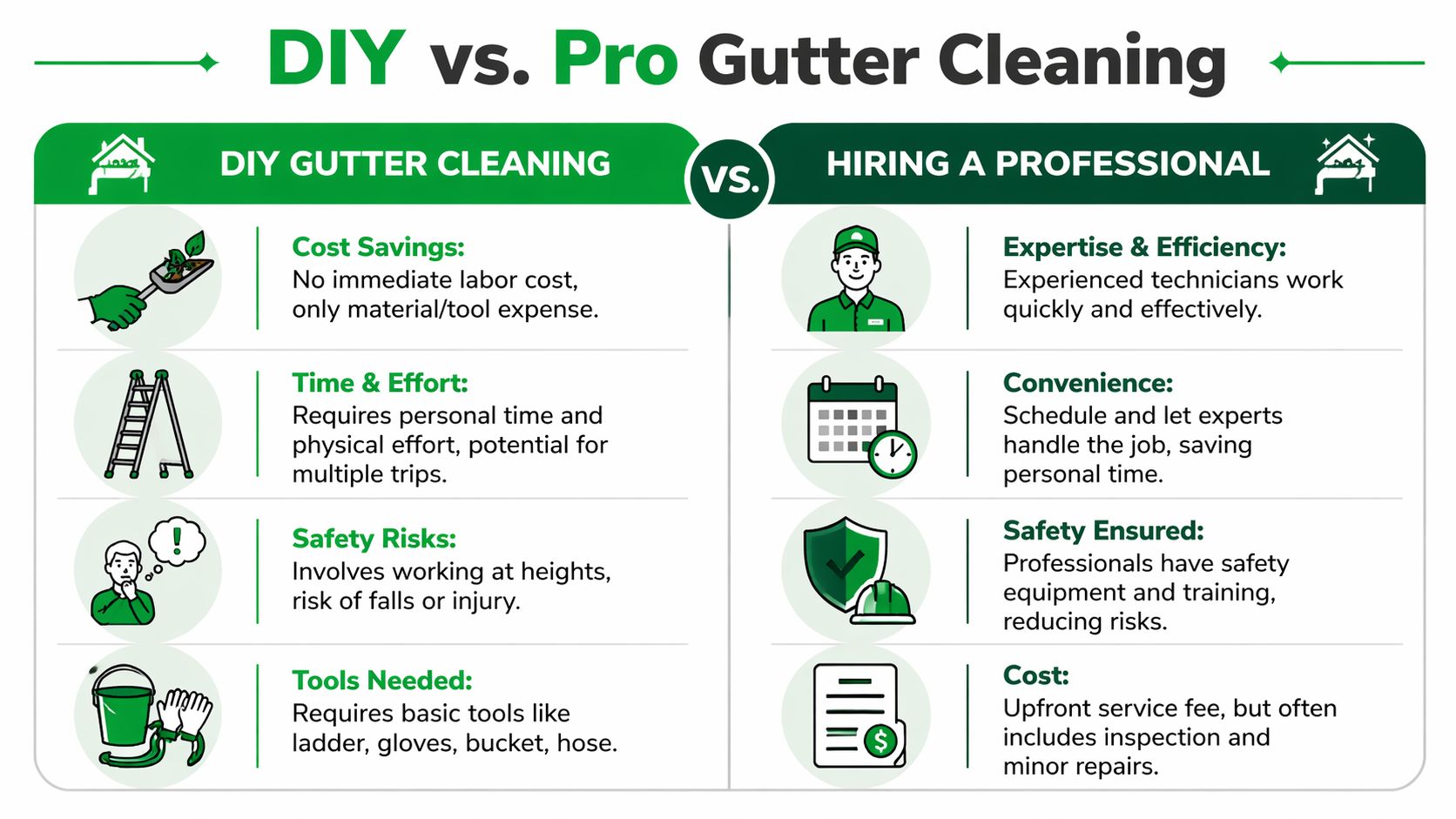
Sometimes it is. On a low, simple roof with easy access and light debris, a careful homeowner may be able to handle routine cleaning. But Flagstaff properties often stop being simple once the ladder is up. Pine needles compact. Downspouts clog below the visible layer. Rooflines get steeper than they looked from the driveway. Ground conditions aren't always friendly to ladder placement.
Where DIY makes sense and where it breaks down
DIY usually appeals for one-story homes and light maintenance. The challenge is that a gutter can appear lightly dirty while still hiding a packed outlet or downspout blockage. Cleaning what you can reach isn't the same as confirming the whole system drains correctly.
The bigger issue is safety. Ladder placement on gravel, uneven hardscape, soft soil, or sloped driveways creates risk fast. Add wet debris, winter residue, or overhead lines, and the job changes from inconvenient to hazardous. This overview of the dangers of DIY gutter cleaning is a good reminder of how quickly a routine task turns serious when height and footing are involved.
What professional service changes
Professional crews bring more than labor. They bring process.
That usually means:
- Safer access methods for tall or awkward rooflines
- Full debris removal and downspout flushing instead of partial clearing
- A trained eye for loose sections, bad pitch, or seam issues
- Cleanup that doesn't leave sludge and needles all over the property
For high-access work, the difference gets wider. Homes with steep sections, fragile landscaping, multiple levels, or commercial facades often require more than a ladder and a bucket. One available local option for that kind of work is professional rain gutter cleaning in Flagstaff, where service details typically include downspout cleaning and property-specific access planning.
DIY vs Professional Gutter Cleaning A Head-to-Head Comparison
| Factor | DIY Approach | Professional Service (Pine Country) | Winner |
|---|---|---|---|
| Immediate cost | Lower out-of-pocket if you already have tools | Service fee applies | DIY |
| Safety at height | Homeowner assumes ladder and roof-edge risk | Trained technicians handle access and safety procedures | Professional |
| Time required | Can take most of a day with setup, cleanup, and repeat ladder moves | Usually faster because crews use a system | Professional |
| Downspout verification | Often limited to what can be seen or flushed casually | Full drainage check is part of a proper service | Professional |
| Ability to spot hidden issues | Easy to miss pitch problems, loose hardware, or separation | Inspection experience improves issue detection | Professional |
| Access to tall or complex structures | Limited by ladder reach and comfort level | Better suited for multi-story and steep-roof work | Professional |
| Control over scheduling | You choose the day | Depends on appointment availability | DIY |
| Overall thoroughness | Varies with tools, time, and experience | More consistent on debris removal and flow testing | Professional |
Bottom line: DIY can work on the right house, in the right conditions, with the right skill. Once the roofline gets higher, steeper, or more debris-heavy, professional service usually becomes the safer and more complete choice.
The Pine Country Promise Your Gutter Care Partner Since 1999
Pine Country Window Cleaning has been serving Flagstaff since 1999. That history matters because local exterior maintenance isn't generic work here. A crew can do everything right in a lower-elevation market and still be unprepared for packed pine needles, steep cabin rooflines, snow stress, and multi-story access in Northern Arizona.
The company was started by Flagstaff native David Kaminski, and that local background shows up in how the work gets approached. The focus isn't just getting through a route. It's protecting homes, cabins, storefronts, hotels, and facility buildings from the weather patterns that keep repeating year after year.
What professionalism looks like on a real property
Good gutter service starts before anyone touches a ladder.
The property should be evaluated for access, roof height, ground conditions, landscaping, and the type of debris present. Crews should know whether they're dealing with loose needles, wet sludge, compacted outlet blockages, or sections that may already be stressed from past snow load.
That same care should show up in how the crew treats the home:
- Screens are removed, cleaned, and reinstalled when window work is part of the visit
- Technicians work carefully around trim, walkways, and landscaping
- Cleanup matters, because no homeowner wants a clean gutter and a mess below it
- Communication matters, especially for second-home owners and property managers who need clear updates
Safety isn't optional in this trade
Gutter work in Flagstaff often means height, awkward access, and weather-related hazards. That's why trained crews and proper equipment matter.
The company description provided here notes background-checked, OSHA safety-trained technicians and in-house equipment including boom lifts, scissor lifts, and a 95-ft atrium lift for challenging access. That kind of setup is relevant for steep-roofed homes, hotels, medical buildings, NAU-related facilities, and large commercial structures where standard ladder-only service isn't enough.
The right crew doesn't improvise around access problems. They plan for them, bring the right equipment, and do the work without turning your property into the risk zone.
Why full exterior care helps gutter work
Gutters don't fail in isolation. The same homes that collect roof runoff problems often have residue on windows, clogged screens, splashback on siding, and debris collecting around entries.
That's one reason integrated property care has real value in Flagstaff. When the same company handles gutter cleaning, window cleaning, pressure washing, post-construction cleanup, and seasonal snow-related exterior work, the crew sees the full condition of the property instead of just one symptom. That helps catch developing issues sooner.
For homeowners, second-home owners, and facility managers, the long-term value is simple. You want people on the property who respect the home, work safely, and understand what Northern Arizona weather does to exterior systems. That's what steady service since 1999 is supposed to mean.
Frequently Asked Questions About Flagstaff Gutters
How often should gutters be cleaned in Flagstaff
It depends on tree cover, roof design, and how exposed the home is to pine debris and snow. Homes under heavy pines usually need more attention than open properties. Seasonal homes and cabins also need closer monitoring because debris can sit unnoticed until runoff exposes the clog.
Are gutters really necessary in Flagstaff
Yes, especially where runoff can concentrate near the foundation, entries, or sloped grade. In this climate, gutters help manage snowmelt, monsoon water, and roof-edge drainage in a controlled path. Without them, water often ends up where homeowners don't want it.
Can gutters be cleaned in winter
Sometimes, yes. It depends on access, temperature, ice conditions, and whether the system can be serviced safely. Winter work is often less about routine cleaning and more about addressing drainage issues, packed debris, or problem areas connected to ice buildup.
Are gutter guards worth it
They can be. Gutter guards don't eliminate maintenance, but they can reduce how much debris collects in the trough and at the outlets. In pine-heavy areas, guard performance depends on design, roofline, and installation quality.
What do gutter guards cost in Flagstaff
In Flagstaff, the average cost to install professional-grade gutter guards is around $8.09 per linear foot, according to local gutter guard cost data for Flagstaff. That's separate from cleaning service, but it can help reduce long-term maintenance by blocking a large share of debris accumulation.
What should a proper gutter service include
A proper service should include debris removal from the troughs, downspout flushing, drainage testing, and cleanup on the ground below. On Flagstaff homes, it should also include an eye for snow-related stress, fastening issues, and areas where pine debris tends to mat at the outlets.
Do all gutter problems require replacement
No. Many problems come from clogs, loose attachment, minor pitch issues, or neglected maintenance. Replacement makes sense when the system is badly deteriorated, repeatedly failing, or was installed poorly enough that repair won't hold.
If your home, cabin, rental, or commercial property needs practical help with gutters flagstaff az, Pine Country Window Cleaning offers free estimates and experienced exterior care built for Northern Arizona conditions. Since 1999, the focus has stayed the same. Safe work, respectful service, and protecting the property before the next storm tests every weak point.