

If you manage a commercial property in Flagstaff, you already know the pattern. A stretch of dry weather makes the gutters seem fine. Then monsoon rain hits, or a heavy snow starts to melt, and water suddenly pours over edges, stains walls, pools near entries, or backs up where it shouldn’t. By the time that overflow is visible from the ground, the gutter problem has usually been building for a while.
In Northern Arizona, commercial gutter cleaning isn’t a cosmetic add-on. It’s part of protecting roofs, siding, walkways, foundations, entries, and tenant experience. Pine needles, pollen, roof grit, and storm debris don’t behave like the light seasonal leaf buildup you see in generic maintenance articles. They pack down, hold moisture, and create blockages that show up at the worst time.
Why Your Commercial Gutters Need a Strategy Not Just a Cleaning
A lot of property managers still treat gutters like a one-off service call. The building gets cleaned when someone notices overflow, when a tenant complains, or when a storm exposes a problem. That approach usually means you’re reacting to symptoms instead of controlling risk.

In this region, that reactive pattern is expensive. A hotel, campus building, dealership, retail center, or mixed-use property doesn’t just need debris removed. It needs a maintenance plan that matches exposure, roof design, drainage layout, and local weather. That’s why gutter service belongs in the same conversation as commercial building exterior cleaning, not in a last-minute fix list.
Why this has become a bigger business issue
The service category itself reflects how important this work has become. The global gutter cleaning services market reached US$1.2 billion in 2023 and is projected to reach US$1.9 billion by 2033, within the broader US$21 billion global building exterior cleaning industry, according to Fact.MR’s gutter cleaning services market report. That matters because mature service categories usually grow when property owners see a repeatable maintenance need, not a niche task.
What a strategy changes on the ground
A practical gutter strategy does three things:
- Sets timing before weather does so you’re cleaning ahead of monsoon flow, snow load, and freeze-thaw conditions.
- Matches frequency to exposure because a pine-heavy property doesn’t behave like an open retail pad with fewer surrounding trees.
- Builds inspection into the visit so you catch loose hangers, failing seams, poor drainage, and problem downspouts before water starts moving into the building envelope.
Practical rule: If a property only talks about gutters after overflow appears, it doesn’t have a gutter plan. It has a gutter emergency pattern.
Local experience matters here. A company that’s worked in Flagstaff for years sees the same failure points over and over. Pine needles at downspout entries. Snowmelt exposing packed debris. Monsoon runoff finding the one low spot that maintenance missed. Strategy is what keeps those predictable issues from becoming repair tickets.
Beyond the Basics What Makes Commercial Gutters Different
Commercial gutters look simple from the ground. They’re not. The scale of the roof, the volume of water, and the consequences of overflow all change the equation.
Roof area changes everything
Commercial gutters are typically sized at 6 inches because large roofs move far more water than a house does. A 10,000 square foot roof can generate over 1,200 gallons per hour in a moderate storm, which is why standard residential sizing isn’t enough for many commercial applications, as explained in this commercial gutter sizing guide.
That’s the first mistake people make when they compare commercial gutter cleaning to residential work. They assume it’s the same task, just on a bigger building. It isn’t. On a commercial property, even a partial blockage can push a large volume of water to the wrong place very quickly.
What failure looks like on a commercial site
When a house overflows, you may get staining, wet landscaping, or fascia damage. On a commercial site, the stakes are broader:
- Pedestrian areas get slick near entries and sidewalks
- Exterior walls take repeated runoff
- Flat or low-slope roof edges stay wet longer
- Drainage backs up around parapets and downspouts
- Ice forms in winter where water should have drained away
That’s why commercial gutter cleaning has to include inspection thinking, not just debris removal.
Debris behaves differently on business properties
A second difference is the type of material inside the gutter. On many Northern Arizona sites, you’re not only dealing with leaves. You’re dealing with pine needles, roof granules, seed pods, dirt, windblown trash, and compacted sludge. Needles are especially troublesome because they knit together. They bridge over outlets and trap finer sediment underneath.
If the downspout opening is buried under a mat of needles, the rest of the gutter can look passable from the ground and still fail in the next storm.
Why access also changes the job
Commercial buildings often have long runs, changes in roof height, service alleys, signage, pedestrian traffic, rooftop equipment, and sections that are awkward to reach without the right gear. That creates trade-offs.
A basic ladder approach might work on a small storefront with open access. It’s a poor fit for a hotel frontage, a dealership canopy, or a campus building with height changes and public exposure below. In those settings, the method matters almost as much as the cleaning itself.
Here’s the practical takeaway. Commercial gutters are not just larger versions of home gutters. They carry more water, fail more expensively, and require a more controlled service process.
Your Northern Arizona Gutter Cleaning Calendar When to Service
Most gutter advice online is too broad to be useful in Flagstaff. It assumes a typical leaf season and a mild weather pattern. That doesn’t match a region where commercial properties can see 2 to 3 times higher debris accumulation from pine needles and pollen, along with monsoon and snow-related stress, as noted in this review of commercial gutter cleaning content gaps.
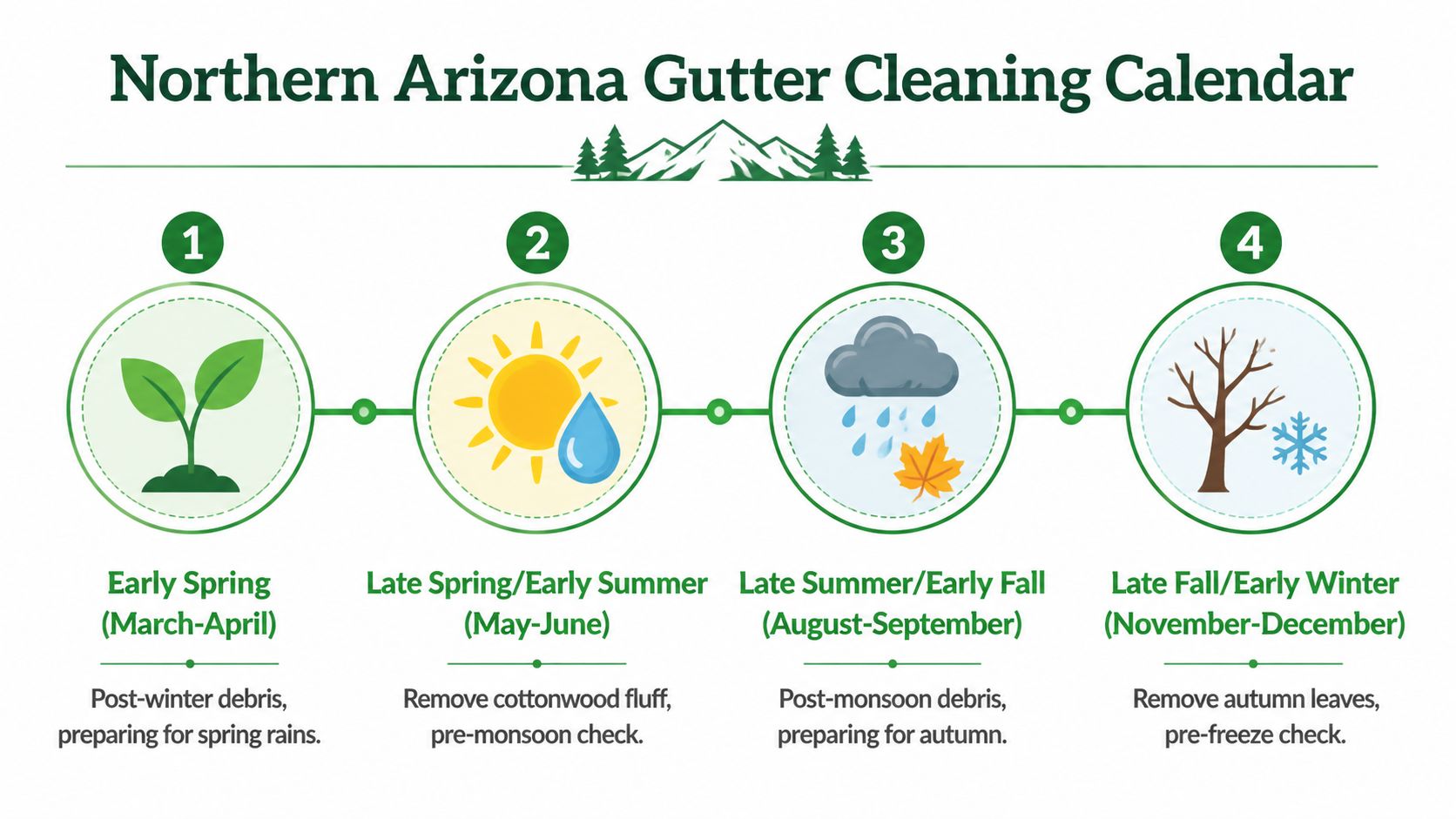
The right schedule depends on tree density, roof pitch, occupancy, and tolerance for disruption. But in Northern Arizona, a calendar-based plan works better than waiting for visible overflow.
Early spring and late spring
Spring is when winter tells the truth about your drainage system. Melting snow exposes where water stood too long, where debris compacted, and where low spots or seams need attention.
By late spring and early summer, the focus shifts. This is the time to clear out material that built up after winter and prepare for hard summer rain. It’s also when many managers realize a roofline that looked fine in dry weather has poor actual flow.
A useful support tool is a broader commercial building maintenance checklist so gutters aren’t handled in isolation from roof edges, drains, walkways, and façade conditions.
Late summer and late fall
Monsoon season tends to move more than water. Wind-driven debris, roof grit, and branch litter often settle into valleys, outlets, and corners. A post-monsoon cleaning helps reset the system before cooler weather arrives.
Late fall into early winter is the most important cleaning window for many pine-surrounded properties. If needles and leaves sit in gutters before freezing weather, they hold moisture in place and create the kind of drainage restriction that turns snowmelt into overflow and ice.
The best time to clean a commercial gutter is usually before the system proves it needed cleaning.
A practical planning table
| Property Type / Environment | Recommended Frequency | Key Seasons |
|---|---|---|
| Retail or office with low tree exposure | At least seasonally, with extra checks before monsoon and before winter | Spring, early summer, late fall |
| Hotel, campus, or medical building with mixed rooflines | Multiple scheduled services through the year | Early spring, pre-monsoon, post-monsoon, pre-freeze |
| Pine-heavy property in Flagstaff, Munds Park, or forested edges | More frequent service due to persistent needle buildup | Spring, early summer, late summer, late fall |
| Short-term rental or second-home cluster with limited on-site oversight | Scheduled preventive service tied to turnover and weather risk | Pre-monsoon, post-storm, pre-winter |
What doesn’t work here
A once-a-year schedule often sounds efficient on paper. In Northern Arizona, it usually means one of two bad outcomes. Either the service comes too early and the gutters refill before the critical season, or it comes too late and the property already absorbed the risk.
For commercial gutter cleaning in this area, timing is part of the job, not just the appointment date.
The Professional Process Equipment and Safety Protocols
The quality gap in commercial gutter cleaning usually comes down to process. Not effort. A technician can work hard and still leave a poor result if the method doesn’t fit the building.
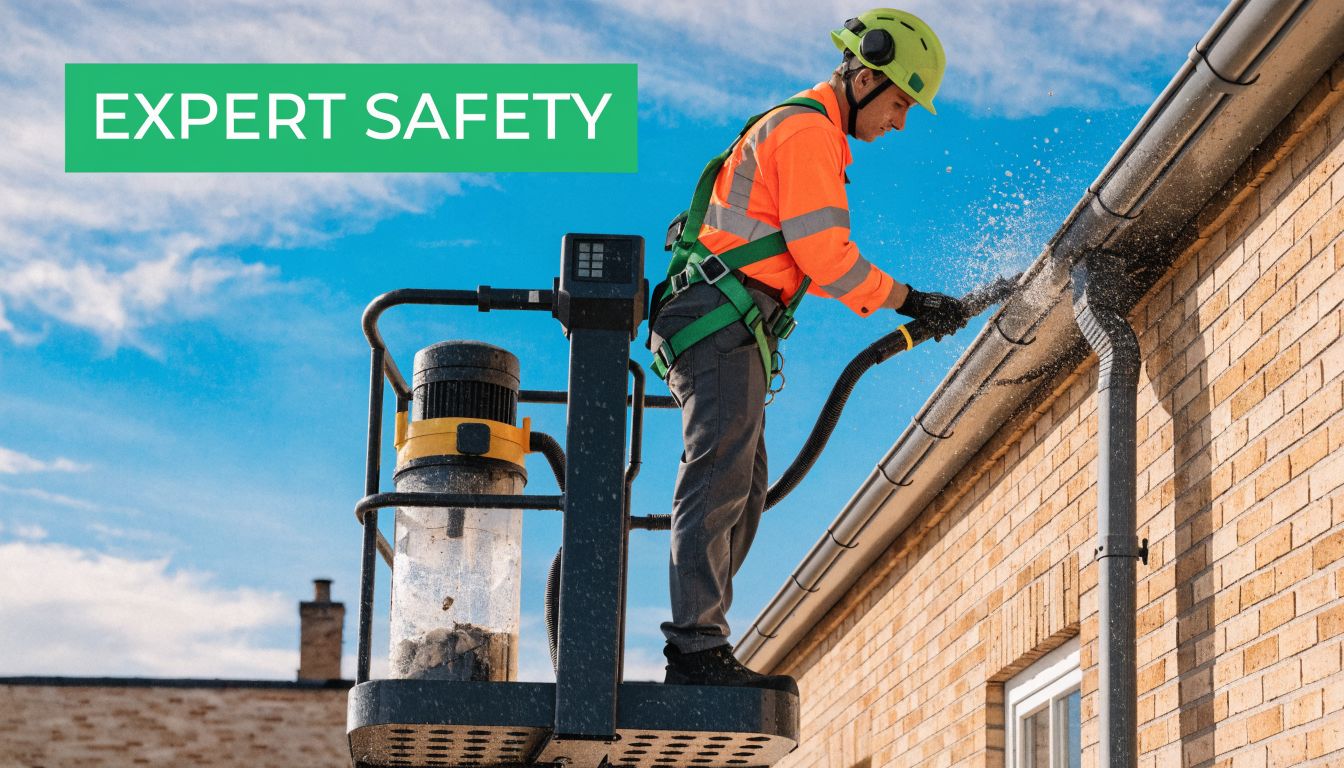
What professional equipment changes
High-reach gutter vacuum systems allow crews to clean gutters up to 60 feet from the ground, clear 10 times more debris per hour than manual methods, and eliminate nearly all ladder-related fall risk, according to SpaceVac’s overview of professional gutter vacuum methods. That’s a major difference on multi-tenant sites, hotels, campuses, and buildings where pedestrian traffic can’t be disregarded for half a day.
Ground-based vacuum work is especially useful when the goal is controlled debris removal with less disruption around the building. For taller or more complex sections, access equipment may still be the right call.
What a thorough service should include
A proper commercial gutter cleaning visit usually includes more than pulling out what’s visible.
- Initial assessment: Crews identify roof access constraints, public safety concerns, and likely blockage points before starting.
- Bulk debris removal: Needles, leaves, and packed sediment are removed from runs, corners, and outlet zones.
- Downspout verification: The team confirms water flows freely through the full system, not just the top channel.
- Visual inspection: Hangers, seams, slope issues, and obvious drainage faults get flagged.
- Site cleanup: Debris should be removed from the ground and entry areas, not left for property staff to handle.
One provider that handles this type of work in Northern Arizona is Pine Country’s gutter cleaning service in Flagstaff, which includes gutter and downspout cleaning for commercial and residential properties.
What doesn’t work well on commercial properties
Some methods create more problems than they solve.
Manual ladder cleaning can be appropriate on small, simple sections, but it slows down quickly on long commercial runs. It also introduces more fall exposure and more repositioning around parked vehicles, landscaping, signs, and entrances.
Pressure-only approaches are another weak option when gutters contain compacted needle mats or sludge. Water can move loose debris, but it can also hide the fact that an outlet is still partially blocked or push mess onto walls and walking surfaces.
This short clip shows the kind of equipment-based approach many professionals use on larger buildings:
Safety isn’t a side note
Commercial gutter work happens around guests, employees, students, tenants, and the public. That means safety has to cover more than the technician on the ladder. It includes work zones, equipment placement, ground control, and protecting the property itself.
Field note: The safest method is usually the one that minimizes time at height, limits ladder movement, and keeps debris control predictable.
In practice, that’s why experienced crews rely on high-reach vacuums, boom lifts, scissor lifts, or other access tools depending on the building. The goal isn’t to make the job look advanced. The goal is to clean the system thoroughly without creating a new risk while doing it.
The Business Case Calculating Your Gutter Cleaning ROI
Property managers don’t need a sales pitch on maintenance. They need a defensible reason to budget for it. Gutter service is one of the easier line items to justify because the downside of neglect is so lopsided.
Professional maintenance typically costs $100 to $300 annually, while water damage claims from neglected gutters average $11,605 to $14,000, according to this gutter statistics summary. Even if your property’s service cost lands above a basic residential range because of building size, access, or complexity, the logic still holds. Preventive cleaning is small compared with repair, insurance friction, tenant disruption, and emergency response.
What managers are really buying
You’re not only paying for debris removal. You’re buying:
- Reduced chance of overflow during monsoon rain or snowmelt
- Fewer surprise maintenance calls tied to drainage failures
- Better protection for entries and facades
- Cleaner documentation around preventive care
- Less reactive scheduling during busy weather windows
A simple way to frame the decision
Think about the decision in two columns.
| Cost of regular service | Cost of delay |
|---|---|
| Planned maintenance on your schedule | Emergency dispatch on the weather’s schedule |
| Routine property access | Tenant, guest, or staff disruption |
| Basic cleanup and inspection | Water intrusion, staining, ice, and follow-on repairs |
| Predictable budgeting | Unplanned budget pressure |
For commercial properties, the strongest ROI often comes from avoiding secondary costs that don’t show up on the initial invoice. A blocked gutter can lead to wet entry areas, service complaints, damaged landscaping, façade cleanup, and after-hours calls. Those costs stack fast, even before a major claim enters the picture.
The practical budgeting answer
If you’re responsible for a hotel, campus building, retail center, or multi-building property, gutter cleaning belongs in your annual preventive maintenance budget. It’s easier to approve a planned service than explain why visible drainage failures were allowed to develop.
That’s the key ROI of commercial gutter cleaning. It turns a preventable building issue into a scheduled task instead of an avoidable incident.
Vetting Your Vendor Questions to Ask a Gutter Cleaning Pro
Hiring a gutter company gets easier when you stop asking “Who can do it?” and start asking “Who can do it safely, consistently, and with the right equipment for this property?”
The first questions to ask
Start with the basics, but don’t keep the conversation basic.
- What type of commercial properties do you regularly service? A crew that mainly works on small homes may not be ready for hotels, campuses, dealerships, or multi-story buildings.
- What access equipment do you use? You want a clear answer, not a vague promise to “figure it out on site.”
- How do you handle safety around occupied properties? The vendor should talk about technician training, pedestrian control, and site awareness.
- Do you clean downspouts or only the gutter channel? A gutter that looks clean but drains poorly isn’t finished.
Questions that reveal experience
The next set of questions tells you whether the company understands Northern Arizona conditions or just offers a generic service menu.
Ask about local debris and weather
A useful question is simple: how do you adjust service frequency for pine needles, heavy snow, and freeze-thaw conditions? If the answer sounds like a canned national script, keep looking.
You can also ask how the vendor handles properties with different exposure levels across the same site. A building edge under tall pines often needs more attention than the windward side facing open pavement.
Ask about documentation and communication
Good vendors explain what they found, what they removed, and whether they saw issues that need repair attention. That matters when you’re tracking recurring problems or reporting back to ownership.
A professional should be able to explain not just that the gutters were cleaned, but what condition the system was in when they arrived.
Questions for specialized use cases
Some property types need more than routine service. That’s where many vendors get thin.
Ask direct questions like these:
- Can you handle post-construction cleanup without damaging new finishes?
- Do you support short-term rental turnovers or pre-arrival scheduling?
- Can you service difficult access points without bringing in outside equipment at the last minute?
- How do you coordinate around guest traffic, class schedules, or dealership operations?
If you’re comparing providers outside your immediate market, it can help to review how service directories categorize specialists. For example, VerticalRent for Dupont maintenance pros shows how property managers often sort vendors by trade focus and maintenance role. It’s a useful reminder that not every exterior cleaner is equipped for commercial gutter work.
One local question that matters
Ask how long they’ve worked in this market. Local operating history matters because recurring weather patterns matter. A Flagstaff-native company that has worked through monsoon seasons, snow events, pine-heavy neighborhoods, campus schedules, and commercial access challenges since 1999 will usually give you a more realistic service recommendation than a generic provider quoting from a standard checklist.
Get Your Property Ready A Final Checklist and Your Next Step
Commercial gutters fail in predictable ways. They clog where pine needles settle. They overflow when monsoon water hits faster than debris-choked outlets can drain. They create winter problems when standing water gets trapped before freezing weather. None of that is surprising in Northern Arizona. What matters is whether the property has a plan before the next storm.
Use this quick checklist before you schedule service:
- Walk the perimeter: Look for staining, overflow marks, sagging runs, or water patterns near entries and foundations.
- Note high-risk zones: Mark any rooflines under pines, corners that collect debris, and downspouts that have backed up before.
- Review your timing: If monsoon season or winter weather is approaching, don’t wait for visible failure.
- Check access conditions: Identify gates, parking constraints, guest areas, or operational windows that could affect scheduling.
- Bundle related exterior work: If the property also needs window cleaning, pressure washing, or seasonal maintenance, it’s often easier to coordinate one site plan.
The right commercial gutter cleaning schedule protects more than the gutter itself. It protects the building envelope, daily operations, and your maintenance budget.
If your property in Flagstaff, Munds Park, or the surrounding Northern Arizona area needs a practical gutter maintenance plan, contact Pine Country Window Cleaning for a free estimate. Their team handles commercial properties with the equipment, scheduling discipline, and site care needed for local conditions, including pine debris, monsoon runoff, snow, and difficult access.