
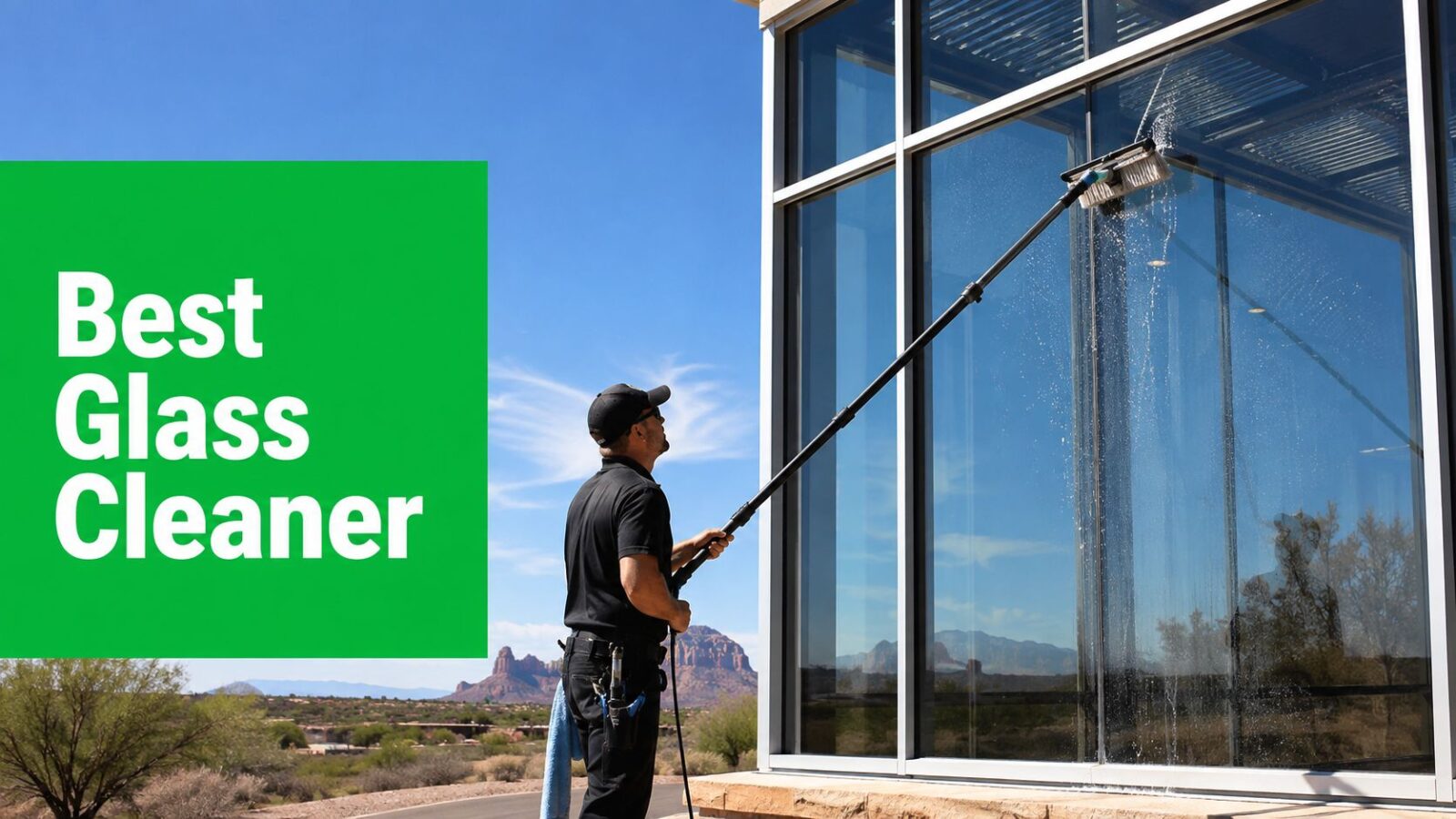
If you're staring through a dusty storefront in Flagstaff and wondering why the glass looks hazy again by lunch, you're not alone. Northern Arizona puts commercial glass through a different kind of punishment, dry wind, abrasive dust, hard water, UV exposure, and big temperature swings that can turn a decent wipe-down into a streaky mess fast. The best commercial glass cleaner in this region isn't just the product that smells strongest or sprays the farthest, it's the one that matches the job site, the tool system, and the crew's skill.
| Cleaning Approach | Best For | Strengths | Trade-Offs |
|---|---|---|---|
| Ammonia-based cleaner | Fast interior touch-ups and greasy spots | Fast dry time, strong cut on fingerprints | Smell, handling caution, not ideal for every surface |
| Alcohol-based cleaner | Quick evaporation and lower smear risk | Flash-off helps reduce re-wiping | Can underperform on heavy soil if rushed |
| Biodegradable formula | Facilities prioritizing gentler chemistry | Better fit for some environmental policies | May need tighter technique to avoid residue |
| Pure water system | Exterior glass, height, large commercial runs | No chemical residue, strong for repeatable exterior work | Needs trained equipment and purified water management |
Northern Arizona property owners, hotel managers, and facility teams don't buy glass cleaner in a vacuum. They're buying labor savings, finish quality, and fewer callbacks. The commercial glass cleaner market reflects that scale, with one estimate putting global revenue at USD 4.6152 billion in 2024 and North America at more than 40% of that total, or about USD 1.84608 billion in the same year, while another forecast places the market at USD 3.59 billion in 2025 and projects USD 6.78 billion by 2034 (Cognitive Market Research). That's not a niche consumable market. It's a serious purchasing category where performance and consistency matter.
Why Commercial Glass Cleaning Demands More Than Consumer Products
A property manager calls after a windy week in Flagstaff and says the front entry glass looks clean until the sun hits it. That's the normal failure mode here. Dry dust clings to the surface, mineral haze catches the light, and a consumer spray that looks fine in a kitchen can leave film across a bank of storefront panes by noon.
Commercial glass work is a different job because the surface area is larger, the visibility is public, and the labor cost shows up fast. Reviewers who test glass cleaners in a controlled way don't judge them by label claims. They look at the number of passes needed to remove grease, lipstick, dust, and fingerprints, and they check how much residue is left after a fixed wipe process, which is why wipe passes and residue are the right benchmarks for professional buying decisions (Consumer Reports).
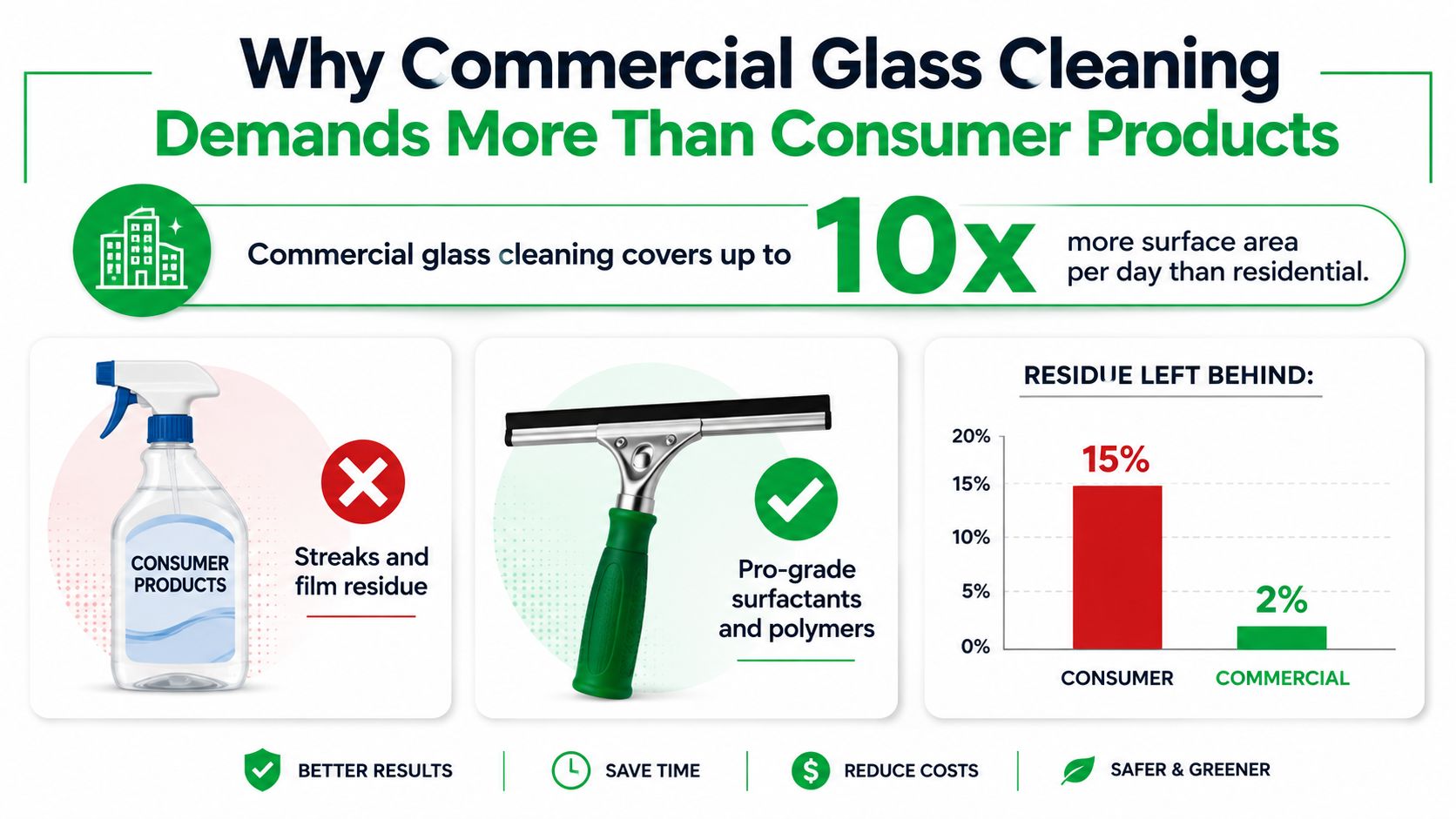
Practical rule: if a cleaner forces extra passes on a big pane, it's costing more in labor than it saved at purchase.
The commercial side also demands better finish control. Professional reviewers consistently favor cleaners that flash off quickly, cover well, and leave low smear risk, because those traits reduce re-wiping on storefronts and large panes. Bob Vila's assessment of top performers lines up with what crews see in the field, minimal scrubbing and streak-free wipeout matter more than scent or bargain pricing (Bob Vila). For readers comparing options, the practical takeaway is simple, consumer products are often built for occasional use, while commercial systems are built to perform under repeatable, high-volume conditions.
If you want a local point of reference for the kind of professional-grade glass-cleaning approach that fits Northern Arizona properties, this best professional window cleaning solution overview is worth a look.
Comparing Commercial Glass Cleaner Chemistries
The label matters less than the chemistry underneath it. On commercial glass, the key question is whether the formula cuts soil fast, flashes cleanly, and leaves the fewest visible traces when the light changes. That's why it helps to compare the major chemistries by how they behave on the glass, not by marketing language.
What each chemistry tends to do well
Ammonia-based cleaners are often chosen for fast cutting power on fingerprints and greasy buildup. Alcohol-based formulas usually win on quick evaporation, which can help lower smear risk when the crew is moving through a lot of panes. Biodegradable blends appeal when a facility wants a gentler profile, but they still need disciplined technique if the crew wants crisp results. Pure water systems are different entirely, because they rely on purified rinse water rather than a traditional chemical cleaner.
For crews choosing among types of commercial cleaning chemicals, glass cleaner should sit in the context of the full chemical toolkit, not as a standalone bottle. The right chemistry depends on the soil load, the surface type, and whether the job is interior touch-ups or exterior maintenance.
| Chemistry Type | Evaporation Speed | Streak Risk | Safety Profile | Best Use Case |
|---|---|---|---|---|
| Ammonia-based | Fast | Low when used correctly, higher if overapplied | Needs careful handling and ventilation | Greasy fingerprints, quick commercial touch-ups |
| Alcohol-based | Very fast | Low if cloths and squeegees are clean | Generally straightforward with normal handling | High-visibility glass where flash-off matters |
| Biodegradable formulations | Moderate | Moderate if residue is left behind | Often preferred where gentler chemistry is valued | Facilities with environmental preferences |
| Pure water systems | No chemical flash, rinse dries clean | Very low when rinse water is properly purified | No chemical residue, but equipment discipline matters | Exterior windows, high glass, repeat routes |
The best choice depends on the surface and the crew. A retail lobby with fingerprints needs something different than a sun-baked façade that gets blasted by dust. Formula and method have to match. If the chemistry flashes too slowly, crews keep chasing haze. If it flashes too fast without enough glide or cleaning strength, soil gets pushed around instead of removed.
For a local formula perspective, the commercial glass cleaner formula topic shows why formulation details matter more than bottle size. In the field, the right cleaner is the one that lets the squeegee do its job without leaving a trail behind it.
Concentrate Versus Ready-to-Use and Water-Fed Systems
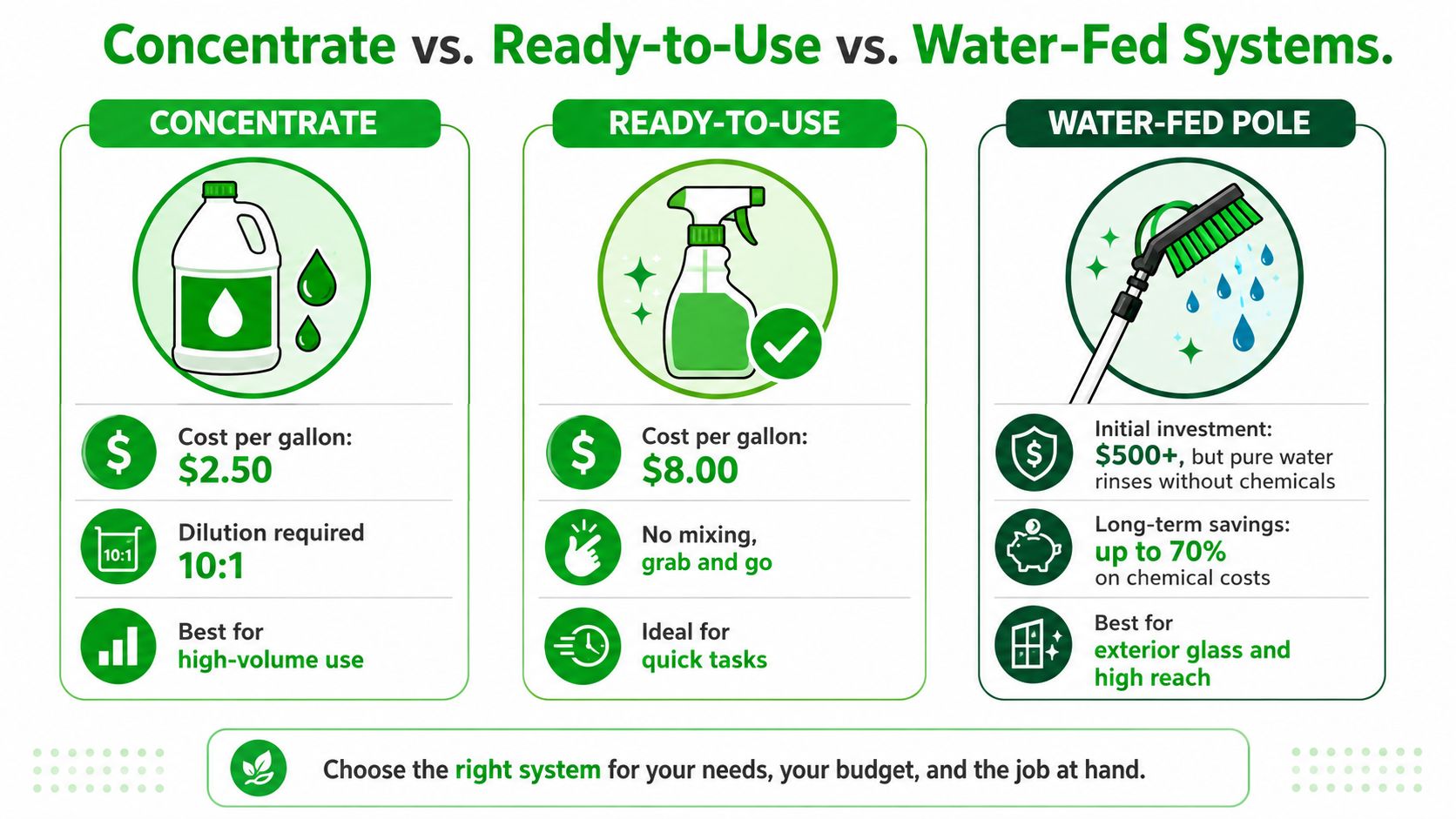
A hotel manager doesn't care whether a cleaner comes in concentrate or ready-to-use form until the staff starts spending extra time mixing, carrying, and redoing panes. Delivery method changes labor, storage, and consistency, which is why the choice matters as much as the chemistry itself. In commercial work, the container format can shape the whole workflow.
Where each system fits
Concentrates make sense when a crew has volume and discipline. They reduce storage bulk and can be efficient in high-use settings, but only if dilution stays consistent. Ready-to-use bottles are faster for quick jobs, training is simpler, and the risk of bad mixing disappears, though they usually cost more per unit of finished solution. Water-fed pole systems are different again, because they use purified water and a brush to clean exterior glass and leave the rinse water to dry spot-free, which is why they're a standard professional method for many exterior runs and many high-reach jobs (Oreate AI).
Field note: on tall exterior glass, a pure-water setup often saves more labor than any “stronger” spray bottle ever will.
The equipment side matters too. If your crew is still building its toolkit, this commercial window cleaning equipment resource helps frame the decision around what gets used on site.
The big trade-off is control versus speed. Concentrate rewards a trained team. Ready-to-use rewards convenience. Water-fed systems reward scale, especially on exteriors, because they remove the chemical residue variable altogether and keep ladders out of many jobs where reach would otherwise slow the crew down.
Performance Considerations for Northern Arizona Conditions
Northern Arizona changes the rules. The combination of high-altitude sun, dry air, abrasive dust, and mineral-heavy water means a cleaner that behaves well in a mild climate can fail here in a hurry. On a bright day in Flagstaff, a small streak that might go unnoticed elsewhere can jump out on glass and make the whole building look neglected.
What the climate does to glass cleaning results
Dust is the first problem. It's not just loose dirt, it acts like fine grit, so if a crew drags it across the pane before pre-cleaning, the glass can pick up haze and micro-scratches. UV exposure and temperature swings make timing matter too, because the same solution that wipes clean in cool shade can dry unevenly on a warm pane. Hard water is the third issue, especially on glass hit by irrigation or rinse runoff, because mineral spots don't behave like ordinary dust.
The practical answer is to match method to conditions. Exterior glass in this region often benefits from pure-water methods because the rinse dries without leaving chemical film behind. Interior glass near entries and service counters usually does better with a fast-flashing formula and careful squeegee work. Cooler parts of the day tend to give crews more control, because the solution stays workable long enough to be removed cleanly.
What actually works on site
A good Northern Arizona routine usually looks like this.
- Pre-remove loose dust: don't wet-scrub grit into the glass.
- Use controlled dilution: too much product leaves film, too little leaves soil behind.
- Work in shade when possible: slower drying gives the squeegee more room to finish cleanly.
- Address mineral spotting early: the longer hard-water deposits sit, the more they bind to the surface.
- Inspect with changing light: glare reveals streaks that flat light hides.
Here's the honest part. A powerful cleaner won't fix poor timing, dirty tools, or bad water. In this climate, the best commercial glass cleaner is the one that lets the crew move quickly enough to beat flash-drying, but not so aggressively that it leaves a film. That balance is why local experience matters so much more than generic product recommendations.
Safety Requirements and OSHA Compliance for Commercial Cleaning
Commercial glass cleaning is a safety job before it's a shine job. That's true on one-story retail, and it becomes essential on atriums, campuses, and multi-level buildings. Crews need the right chemical documentation, the right training, and the right access equipment for the height and layout in front of them.
The compliance side facility managers should expect
Professional crews should have current SDS or MSDS documentation for the products they use, along with training on handling, storage, and spill response. They also need a working understanding of OSHA expectations for working at height, because ladders, lifts, and roof edges all bring different risks. If a team is using boom lifts, scissor lifts, or atrium lifts, the operator training and site planning have to match the job.
That's why background-checked, safety-trained technicians matter. A building owner may see only the finished glass, but the risk is managed long before the first pane gets cleaned. For broader workplace training examples, WHMIS training for dental clinics is a useful reminder that chemical handling standards are part of any serious service operation, even outside window cleaning.
What separates a prepared crew from a risky one
- Documented chemical handling: crews know what's in the bottle.
- Equipment matched to the height: no improvising on access.
- Protected public areas: cones, signage, and clear work zones matter.
- Trained lead techs: one person should own the plan and the safety call.
A facility manager can ask one simple question. If the team can't explain how they'll manage the access, the product, and the cleanup without disrupting the property, they're not ready for the building. Safety and compliance aren't extras in commercial glass care, they're part of the service itself.
Cost Analysis and Return on Investment
The cheapest product on the shelf is rarely the cheapest way to keep commercial glass clean. Labor, setup, training, equipment wear, and callbacks change the math fast. That's why buyers should compare in-house cleaning to professional service using the actual work required, not just the price of a bottle.
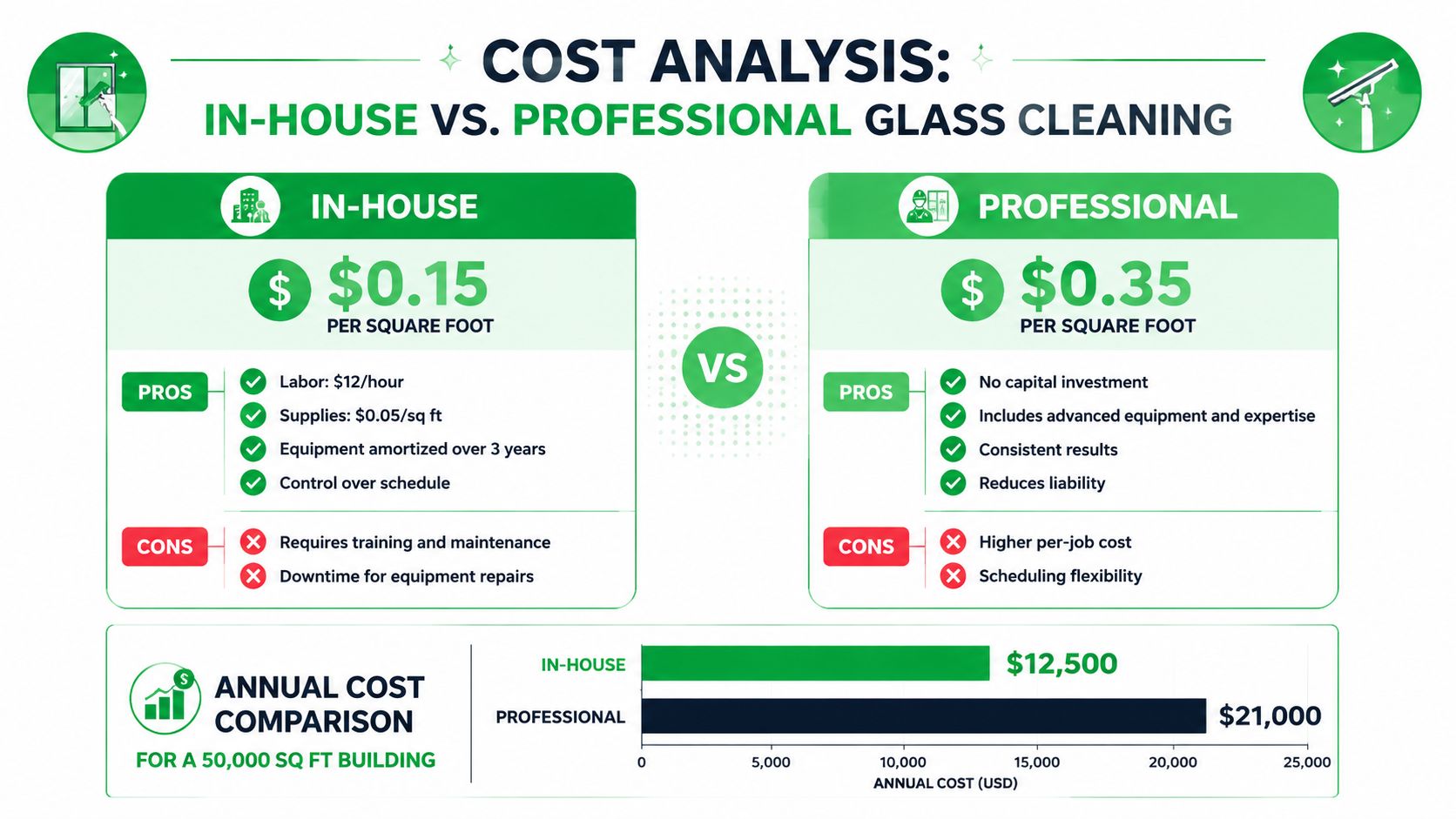
What the numbers in the infographic mean in practice
The comparison chart shows $0.15 per square foot for in-house work and $0.35 per square foot for professional service, with an annual example of 50,000 square feet at $12,500 in-house versus $21,000 professional. Those figures frame a real decision, but the line item doesn't tell the full story. In-house work carries training, maintenance, and downtime risk. Professional service brings advanced equipment, consistency, and reduced liability, which matters on larger or harder-to-reach glass runs.
The value argument comes back to finish quality. The cleaner that flashes quickly, covers well, and leaves little smear cuts re-wiping, and re-wiping is where labor disappears. On a commercial property, one extra pass across a whole façade can erase the savings from a cheaper solution. That's why first-pass performance often decides the return.
When DIY makes sense and when it doesn't
DIY can work for small, low-risk glass areas where a trained staff member can clean safely and consistently. It becomes a weaker choice when the building has height, heavy dust exposure, frequent visitors, or hard-water problems that need specialized treatment. Once the job starts demanding lifts, water-fed tools, or repeated quality corrections, professional crews usually make more financial sense.
The right question isn't “What costs less today?” It's “What leaves the building looking right with the fewest interruptions over time?” For most commercial owners, that answer comes down to labor efficiency, not product price.
Dilution Ratios and Professional Application Techniques
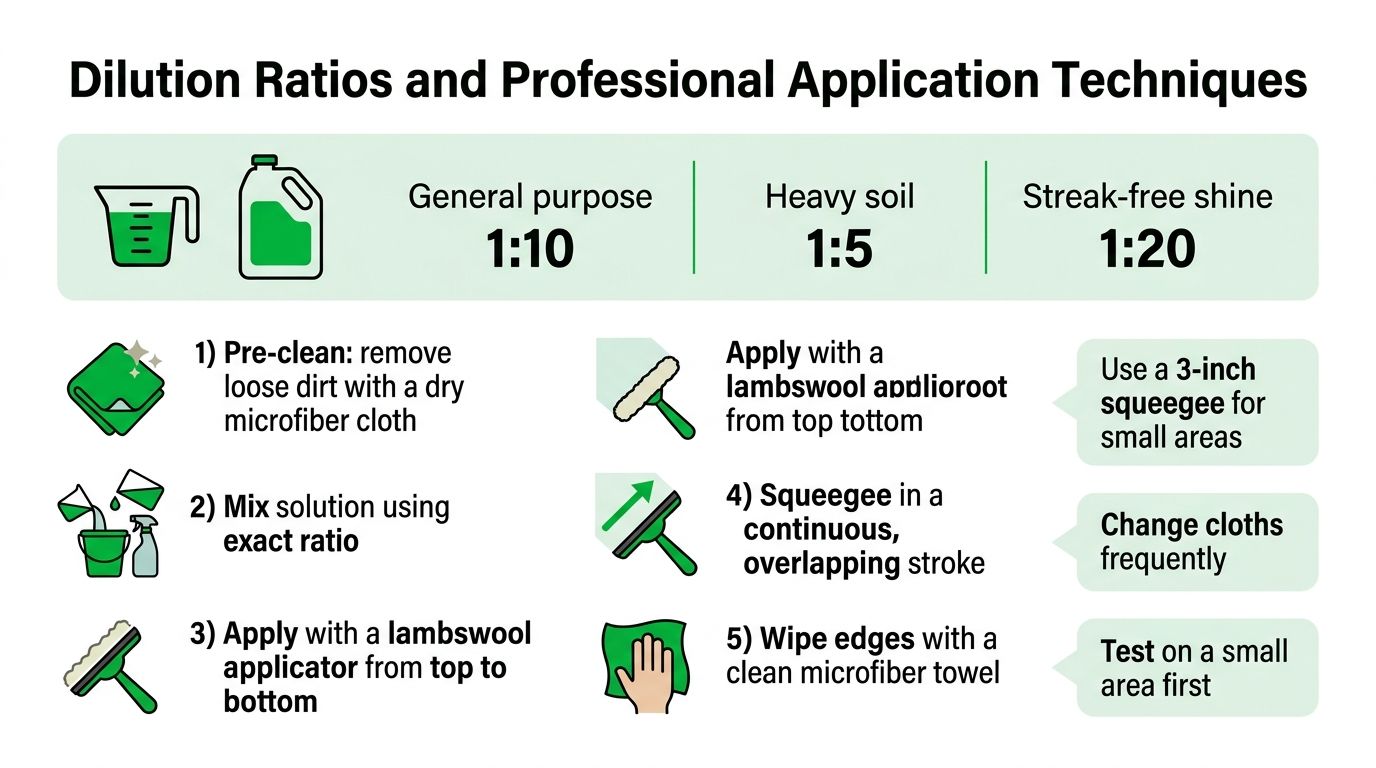
Bad dilution ruins good chemistry. Too strong, and the glass can haze or leave film. Too weak, and the soil stays put. Professional crews don't guess at that balance, they measure it, then apply the solution with tools that remove residue instead of spreading it around.
The ratios and the workflow
A practical starting point is general purpose 1:10, heavy soil 1:5, and streak-free shine 1:20 when the surface is already in decent shape and the goal is a lighter finish. The exact ratio depends on the product label and the soil load, but the discipline stays the same, measure it, don't wing it. On commercial glass, consistency matters more than improvisation.
- Pre-clean loose dirt with a dry microfiber cloth so grit doesn't smear across the pane.
- Mix the solution at the exact ratio the job requires.
- Apply from top to bottom with a lambswool applicator or equivalent wetting tool.
- Squeegee in one continuous, overlapping stroke so the waterline stays controlled.
- Wipe the edges with a clean microfiber towel to catch runoff and corner moisture.
Professional habit: change cloths early. A dirty towel turns edge work into streak work.
A 3-inch squeegee helps on small panes, mirrors, and tight commercial fixtures, while larger glass needs a blade and handle combination that fits the pane size. Pure-water brushes handle the exterior side of many jobs better than rags or consumer spray bottles because they lift dirt and rinse it away instead of redistributing it. If a crew is using the right dilution but the wrong tool, the result still fails at the edge.
One option in the field is Pine Country Window Cleaning's commercial glass service, which pairs squeegees, poles, ladders, and pure-water brushes with screen removal, screen cleaning, and reinstallation during service. That combination fits the kind of work commercial properties in Northern Arizona usually need.
When to Hire Professional Window Cleaners in Flagstaff
A storefront manager can keep a small lobby pane looking fine with a steady routine. A hotel, campus building, car dealership, or multi-level property is a different story. The moment the glass requires height access, mineral removal, or a clean finish across many panes at once, professional help starts to make more sense than an in-house scramble.
Flagstaff's conditions reward local knowledge. Pine Country Window Cleaning has served Northern Arizona since 1999, and the company was started by Flagstaff native David Kaminski. That local history matters because crews who work here every week know how dust, sun angle, and water spotting behave on real properties, not just in product demos. The team also handles screen removal, screen cleaning, and reinstallation with every service, which keeps the whole window assembly in shape, not just the glass.
For building owners who compare service vendors, the compare janitorial and maintenance services discussion is a good reminder that window cleaning, janitorial work, and building maintenance don't always fit the same contract model. Glass care often needs a specialist who brings the right access equipment, not a generalist who treats every surface the same way.
Pine Country's technicians are background-checked and OSHA safety-trained, and the company works on everything from single-family homes to hotels, NAU facilities, car dealerships, and high-rise properties. That range matters because the right crew can move from a cabin window to a large commercial façade without changing the standard of care. In practice, that means better communication, fewer surprises, and a cleaner finish that respects both the property and the people in it.
If your windows in Northern Arizona are fighting dust, glare, or mineral buildup, Pine Country Window Cleaning can handle the glass, screens, and access work with a professional approach that fits the region. Visit Pine Country Window Cleaning to request a free estimate or schedule service that's built around your building and your timeline.