
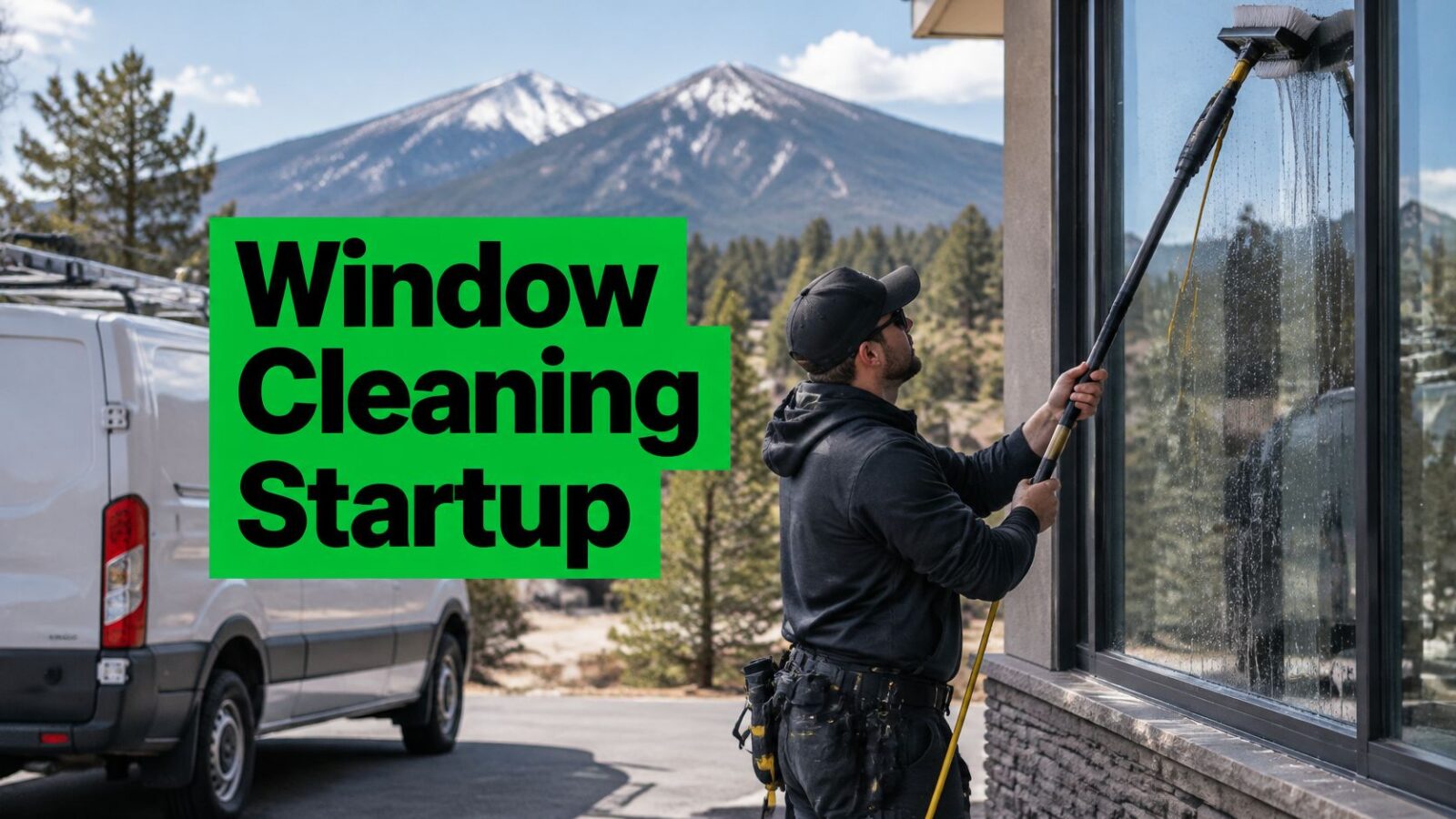
A streaked storefront, a second home empty all winter, or a neighbor's ladder against a two-story wall looks like money if you do the work right. Property managers still will not book you on shine alone. They ask for your license, your certificate of insurance, your access plan, and proof your crew will not damage screens, landscaping, or interiors.
That order is how Flagstaff commercial buyers decide. Pine Country Window Cleaning is a locally owned Flagstaff company in business since 1999. Years like that come from documented paperwork, professional squeegees, ladders, poles, and pure-water brushes, careful screen handling on every visit, and crews who treat a customer's home as carefully as the glass.
Startup Checklist and Licensing Order
Start with what blocks revenue, not what feels exciting. A new van wrap won't help if a hotel facilities director can't admit your crew because you can't produce insurance paperwork. Build your window cleaning business in the sequence a commercial buyer checks it.
| Requirement | What It Covers | When You Need It |
|---|---|---|
| Business registration | Legal name and entity filing with the state | Before your first invoice |
| State tax registration | Confirms which of your services are taxable | Before your first invoice |
| City of Flagstaff business license | Local permission to operate, if it applies to your entity | Before you work in the city |
| General liability insurance | Property damage and injury claims from third parties | Before your first job |
| Commercial auto insurance | Accidents involving the work van and ladder rack | Before you drive to a job |
| Workers' compensation | Injuries to employees | Before your first hire |
| Equipment kit | Squeegees, extension poles, ladders, water-fed pole system | Before your first job |
| Safety training | Fall protection, ladder use and pole work | Before you climb or hire |
| Estimate and contract template | Scope, screen handling, add-ons and payment terms | Before your first quote |
File in This Order
- Choose your entity type: Sit down with an accountant or attorney, pick the structure that fits your tax and liability situation, and file the business name with the Arizona Corporation Commission. Don't guess at this because changing entities later creates new accounts, new paperwork, and confused customers.
- Get a federal employer identification number: You'll need it for banking and, later, payroll. Open a dedicated business bank account the same week so personal fuel and supply purchases don't blur your job costs.
- Register with the Arizona Department of Revenue: Confirm which services are taxable and how you report them. Guessing here is expensive because a price that looked profitable can shrink fast once tax is handled correctly.
- Ask the City of Flagstaff about a local license: Confirm whether your entity needs a local business license before you work in town. Rules change, so verify current requirements directly with city and state agencies instead of copying another operator's old checklist.
- Buy general liability insurance first: Many operators start around one million dollars per occurrence, but you should check the limits your largest prospects require before you bind a policy. A homeowner may never ask. A campus, hotel, or medical building probably will, and retrofitting higher limits mid-bid slows you down.
If you're still mapping the wider launch sequence, including budgeting and early decisions beyond licensing, planning your small business launch is a useful companion while you work through these filings. Use it for structure, then confirm every Arizona and Flagstaff requirement with the agency that enforces it.
Insurance Certificates Win Access
- Get a certificate of insurance you can attach to proposals: Keep a clean PDF ready to send the same day someone asks. Where property managers, hotels, and campuses request it, ask your insurer about naming them as additional insured. That single step removes a common reason bids stall in a facilities office.
- Add commercial auto, then workers' compensation: Put commercial auto insurance on the work van before you drive to a job with a ladder rack loaded. Set up workers' compensation and payroll registration before the first hire, not after your schedule forces a rushed decision.
Practical rule: Anything marked "before the first job" is non-negotiable. Hiring paperwork can wait until demand is real, but insurance and registration can't wait until after an accident or a lost bid.
Build the Bid Folder
Finish this stage with one document folder, digital and printed, holding every certificate, license, tax registration, and contract template. Your estimate template should state the scope in plain language, list screen removal, cleaning, and reinstallation, separate paid add-ons, and set payment terms. When a manager asks for paperwork at 4 p.m., you send the folder in minutes instead of hunting through email.
That readiness is your first sales asset. It tells a buyer you understand risk, documentation, and follow-through before they've seen a single cleaned pane.
Equipment and Vehicle Setup for Safe, Fast Work
Buy for the jobs you can win this month, then organize the van so tools come out in job order. Wasted trips back to the vehicle are unpaid labor, and they add up on every route.
Hand Tools and Pure Water
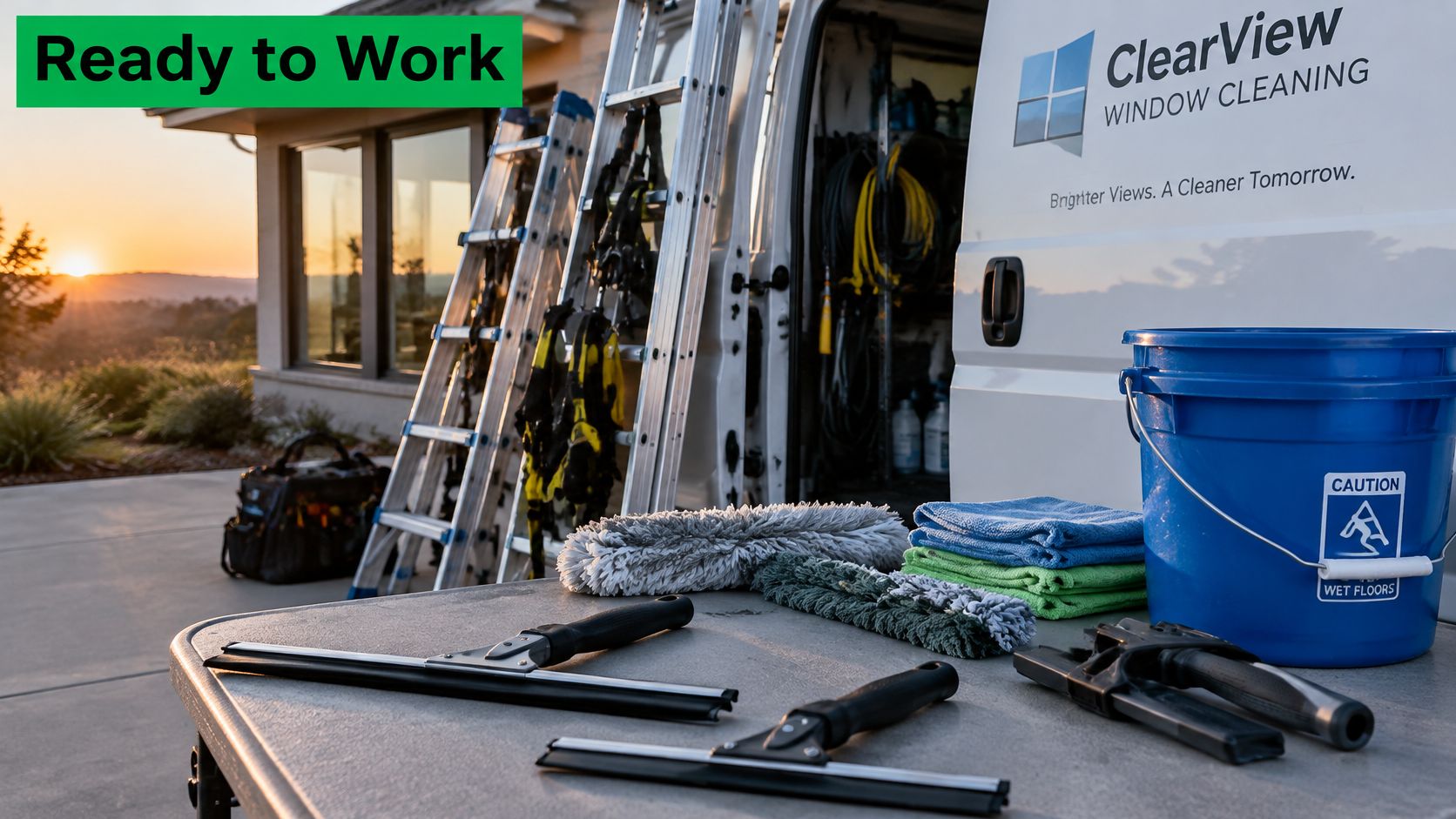
For ground-level and reachable glass, carry squeegees in two blade widths for large panes and narrower frames, scrub pads, edgers for corners, and a clean bucket and microfiber set for detail work. Replace worn rubber early. A tired blade leaves lines that cost more in callbacks than the rubber ever would.
A water-fed pole system pushes filtered pure water to the top of an extension pole fitted with a soft brush. Because the water is filtered to remove contaminants and minerals, the glass can dry without spotting. Carbon fiber poles cost more than heavier alternatives, but they reduce shoulder and back strain on long reaches, which matters when you're working a full route. Our guide to professional window cleaning tools shows how these pieces fit together in a working kit.
For ladders, choose an extension ladder with stabilizers sized to the heights you work. Don't buy the tallest ladder you can find and build your business around climbing it. Minimize ladder time by using poles from the ground whenever the site allows it.
Screen Care and Van Layout
Screen handling separates careful operators from fast ones who create damage claims. The Milgard care and maintenance guide recommends removing screens carefully and placing them on a clean, flat surface, cleaning them with mild soap, water, and a soft brush, rinsing with clear water, and reinstalling them only after they're completely dry. It also warns against objects that may puncture or tear screen material. Follow that sequence on every visit: remove, lay flat, wash gently, rinse, dry fully, inspect, and reinstall.
Never pressure wash screens. The Ply Gem window care guidance warns against pressure washing screens because high pressure can damage them, and it cautions that aluminum mesh can be dented or creased by excessive force. Rinse with lukewarm water instead and let each screen dry completely before replacement.
- Ladder rack: Secures ladders outside the cargo area for fast, safe unloading.
- Pole rack: Keeps carbon fiber sections straight, separated, and protected from impacts.
- Water tank and filtration: Sized to your route so you don't refill mid-job.
- Locked tool drawer: Holds squeegees, blades, edgers, and scrub pads in job order.
- Screen-cleaning station: A labeled flat area with mild soap, soft brushes, and drying space.
Pricing Models for Residential and Commercial Work
Pricing fails when it's copied from another market or built on hope. Compare the models side by side, pick the one that matches each buyer, and protect margin per labor hour.
| Pricing Model | Best For | Main Risk | How to Protect Margin |
|---|---|---|---|
| Per pane | Single-family homes with standard windows | Small or high panes take longer than expected | Add a per-pane minimum and a height surcharge |
| Flat per-visit rate | Homes with uniform windows | Odd layouts and screens add unplanned time | Quote by counted windows and list screen work separately |
| Per hour | Commercial jobs with an unclear scope | Slow crews erase profit | Set a crew-hour estimate and a cap before work starts |
| Recurring maintenance plan | Property managers, rentals and second homes | Missed visits and client churn | Lock the route, schedule and price for a set term |
| Per square foot | Large commercial glass | Measurement disputes | Measure on site and confirm the count in writing |
Match the Model to the Buyer
Per-pane pricing is easy for homeowners to understand, but a small high pane above a stairwell doesn't behave like a sliding door at ground level. Count accurately and price access, not just glass. A flat per-visit rate gives clients a fixed number they can approve quickly, yet it punishes you on homes with odd layouts, heavy screens, or interior obstacles you didn't inspect.
For commercial work with an unclear scope, per-hour billing can be fair if you set expectations before anyone unloads a pole. State the crew size, estimated hours, and a not-to-exceed cap. Without a cap, the client fears an open-ended invoice. Without an estimate, your slow day becomes your loss. For larger facades, per-square-foot pricing works only when both sides agree on the measurement in writing, ideally after an on-site count.
A recurring maintenance plan, quarterly or monthly, is the model I'd build around property managers, rentals, and second homes. It steadies route income, makes scheduling predictable, and gives the client one less vendor problem to solve. Our breakdown of how to price commercial window cleaning goes deeper on structuring those commercial numbers.
Keep the Base Price Honest
List add-ons separately instead of absorbing them. Window tracks, hard water removal, paint or stain removal from glass, sunscreen removal and reinstallation, ceiling fans, and mirrors are usually priced apart from standard cleaning. Screen removal, cleaning, and reinstallation should appear on every quote so the customer knows it's included and your crew knows it's expected.
Publish two pricing models at most. Too many options confuse buyers and make your own margin review messy.
Set a minimum charge that protects drive time, add a travel fee for distant mountain properties, and put the full scope in writing before the crew arrives. Then review margin per labor hour every quarter by model. If one model keeps producing busy days and thin profit, change it or drop it.
Finding Residential, Commercial and Property Manager Clients
Different buyers trust different proof. A homeowner wants reviews and a careful crew inside the house. A facilities manager wants documents, an access plan, and one invoice that doesn't create extra work.
This work sits inside a large, established labor market. The U.S. Bureau of Labor Statistics outlook for janitors and building cleaners counted about 2,432,600 jobs in 2025 and projected employment growth of 53,600 positions, or 2%, from 2025 through 2035. The same source identifies window and glass washing among typical job duties, which supports selling window maintenance as regular property care rather than an occasional specialty purchase.
Residential and Short-Term Rentals
Start with a complete Google Business Profile using photos of real jobs, accurate service areas, and your phone number. Ask for a review after every visit while the result is fresh. Door hangers work best on streets you already serve because neighbors can see your van and the finished home on the same day.
Short-term rental hosts on Airbnb and VRBO need turnover-ready windows and reliable scheduling between guests. Offer condition notes and photos when you find damaged screens or hard water buildup. Absentee owners value that reporting almost as much as clean glass. If you want local search to compound instead of starting from zero each month, Silva Marketing's cleaning SEO guide is a practical resource for structuring service pages and local visibility.
Commercial and Property Managers
For hotels, medical buildings, car dealerships, retail storefronts, and university facilities, walk the property first. Bring photos, show your insurance certificate, and send a written scope that names the access method and who approves it. Facility managers also ask who verifies roof anchors and what documentation is kept, so prepare a one-page access plan for any building above ground level.
Property managers respond to multi-property bids. Offer one bid covering several buildings, one contact, and one invoice. Builders and real estate agents need pre-listing and post-construction cleaning, which often requires several passes to remove construction residue without scratching glass or frames. Reviewing window cleaning advertising examples can help you shape outreach that speaks to each buyer instead of using one generic message.
- Ten door hangers: Place them only on streets already on your route.
- Five property manager calls: Lead with documentation and multi-property invoicing.
- Three walkthroughs: Photograph access points, screens, and problem glass.
- One written bid: Send it with your certificate and access plan attached.
Track which channel produced each signed client. If a channel creates estimates but no signed work after a fair test, cut it and move that time to the channel that's filling the route.
Safety, Hiring and Training Your First Crew
Owning the right equipment is not a safety plan. A taller ladder doesn't make a risky method acceptable, and a new lift doesn't replace inspection, authorization, and rescue planning.
Use the Hierarchy of Controls
Work in this order. First, eliminate exposure by cleaning from ground level or from a protected interior position. Second, use engineered access such as properly rated lifts. Only then use ladders or rope-descent systems when a site assessment justifies the method.
The OSHA fall protection publication sets the benchmark that fall protection is required at unprotected edges 4 feet or more above a lower level. It also states that for rope-descent systems, the building owner must provide written confirmation that permanent anchorages were tested, certified, and maintained to support 5,000 pounds per attached worker, and OSHA limits rope-descent use to 300 feet. OSHA estimates that falls from ladders represent 20% of fatal and lost-workday injuries in general industry, so ladder work should be minimized rather than repeated with taller equipment.
Use the same job sequence every time. Document the elevation and access route, inspect roof edges, anchors, ladders, lift controls, and weather, and establish exclusion zones below the work. Verify each worker is authorized for the method and that rescue is possible before cleaning starts. During the work, maintain three-point contact on ladders or continuous attachment where the system requires it.
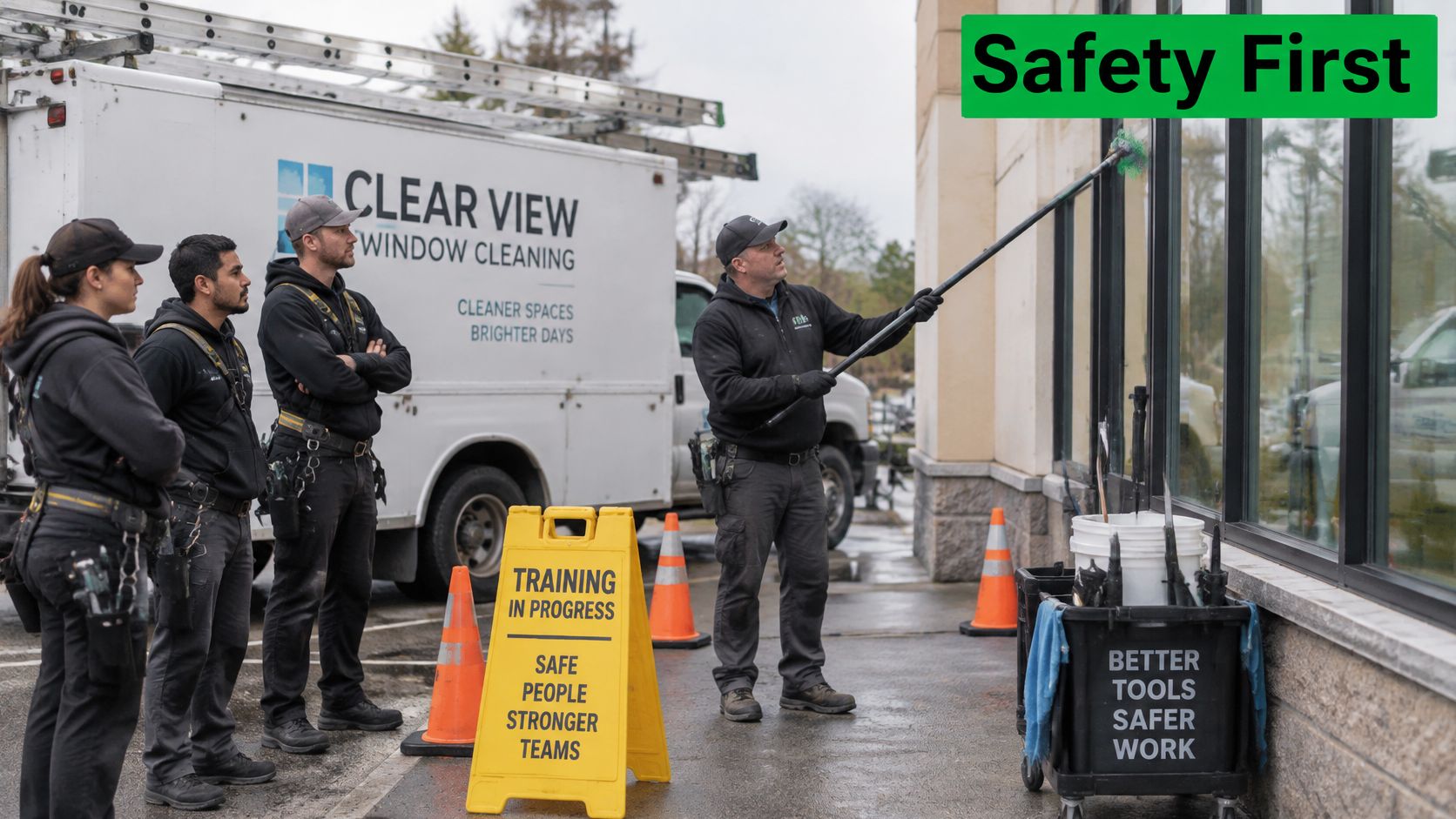
The video below is useful for seeing how training and technique come together on site before a new technician works without direct supervision.
Hire for Trust, Then Train
Run background checks for every technician, keep OSHA safety training on file, and document ladder and pole training during a supervised first week. Pair new hires with an experienced lead for high-level work, and don't let schedule pressure shorten that pairing rule. Customers are inviting your crew into homes, hotels, and medical buildings, so conduct and property care belong in training alongside squeegee technique.
Teach the small behaviors that protect a home. Move carefully around landscaping, protect floors and furnishings during interior work, handle screens on a flat surface, and report cracked glass or torn mesh instead of forcing a screen back into place. Those habits prevent claims and earn repeat bookings.
Log Every Incident and Near Miss
Keep a simple injury log from day one. Record every injury and near miss, classify each by hazard type such as ladder, lift, rope, chemical, ergonomic, or vehicle, and review the pattern quarterly by crew and job type. Log each injury rate as cases per 100 full-time-equivalent workers, using employer-reported hours as the denominator, so crews of different sizes compare fairly.
A quiet month isn't proof that a method is safe. The log tells you where exposure is building before someone gets hurt.
Your First 90 Days and Northern Arizona Scaling
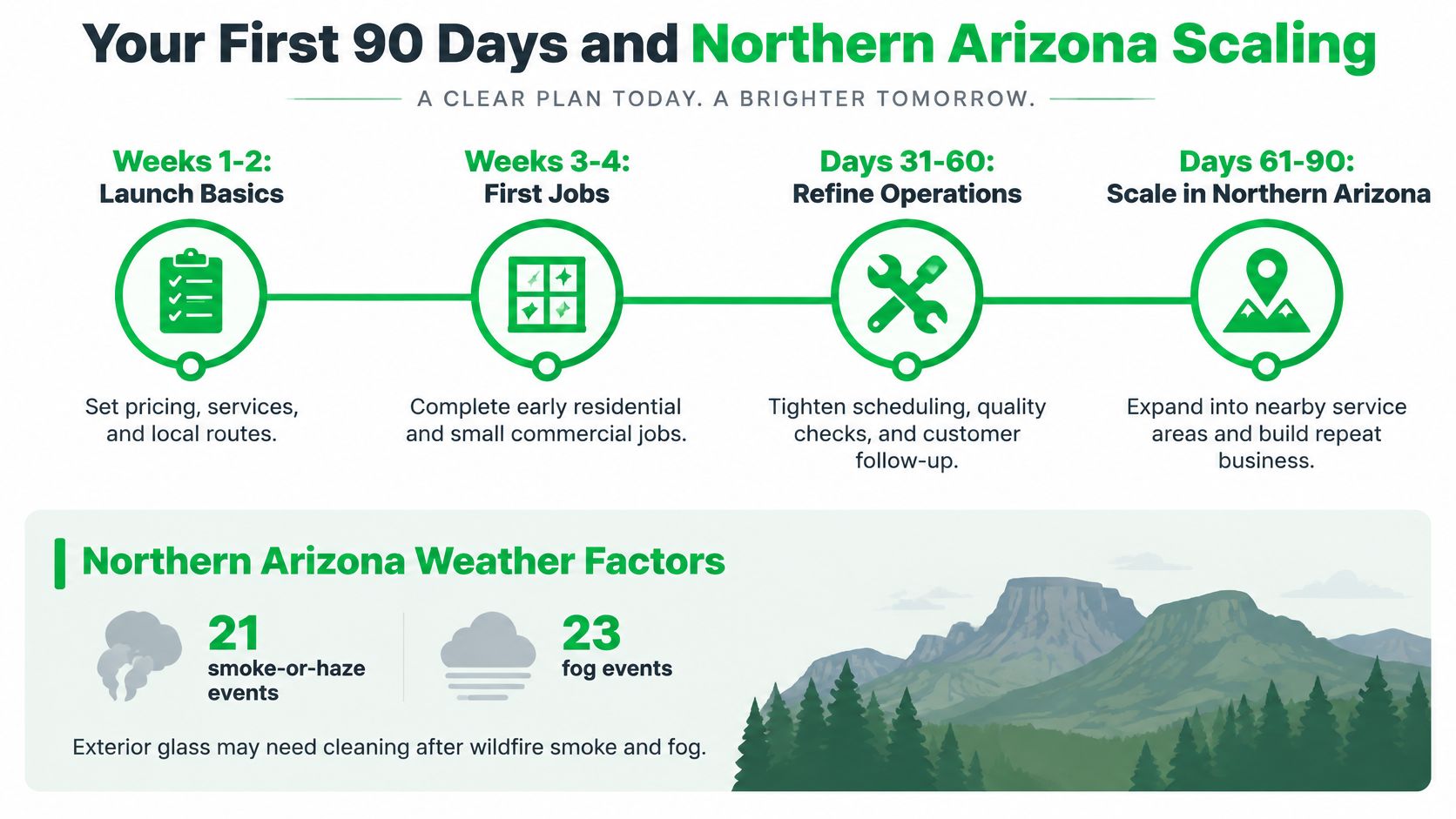
Northern Arizona doesn't reward a fixed calendar as much as it rewards inspection triggers. Exterior glass may need attention after wildfire smoke, monsoon storms, construction dust, heavy pollen, or a long winter vacancy. Second homes and rentals in Munds Park and Forest Highlands need condition checks before guests return and after the property sits empty, with photos that show screen condition, hard water spots, and any glass damage you found.
The 90-Day Sequence
Use weeks one and two for registration, tax setup, local license confirmation, and insurance. Don't quote serious commercial work until your certificate is ready to send. A fast "yes" followed by a week of paperwork delays makes you look unprepared.
Use weeks three and four for equipment, van layout, your pricing sheet, and your contract template. Decide your minimum charge, travel fee, add-on list, and screen-care language before the first estimate. If those decisions happen in a customer's driveway, you'll discount under pressure.
Spend months two and three on outreach, walkthroughs, first jobs, reviews, and a weekly margin check. Record drive time, on-site time, callbacks, and revenue per labor hour for every job. That record tells you which neighborhoods and buyer types deserve more attention.
Scale on Triggers, Not Optimism
- Add a route day: Do it when weekly bookings consistently fill the current route, not after one busy weekend.
- Hire the first technician: Wait until workers' compensation, payroll, background checks, and training materials are finished.
- Take larger commercial contracts: Move forward once you hold current insurance certificates, a references list, and a written access process you can explain clearly.
At day 90, review margin per labor hour and decide which of your two pricing models earns its place. Cut the work that's far away, underpriced, or dependent on access you can't document safely. Before you send your first serious bid, check the scope, pricing, insurance folder, screen-care promise, and access plan one more time. That final check is cheaper than learning the same lesson on a customer's property.
If you'd rather hire a crew that already brings this level of documentation, training, and careful screen handling to your home or building, Pine Country Window Cleaning offers a free estimate when you call to schedule, and you can book online or by phone at (928) 527-0671. Our window cleaners have all been background checked and industry safety trained, and we remove, clean, and reinstall screens with every service so your property is cared for, not just your glass.