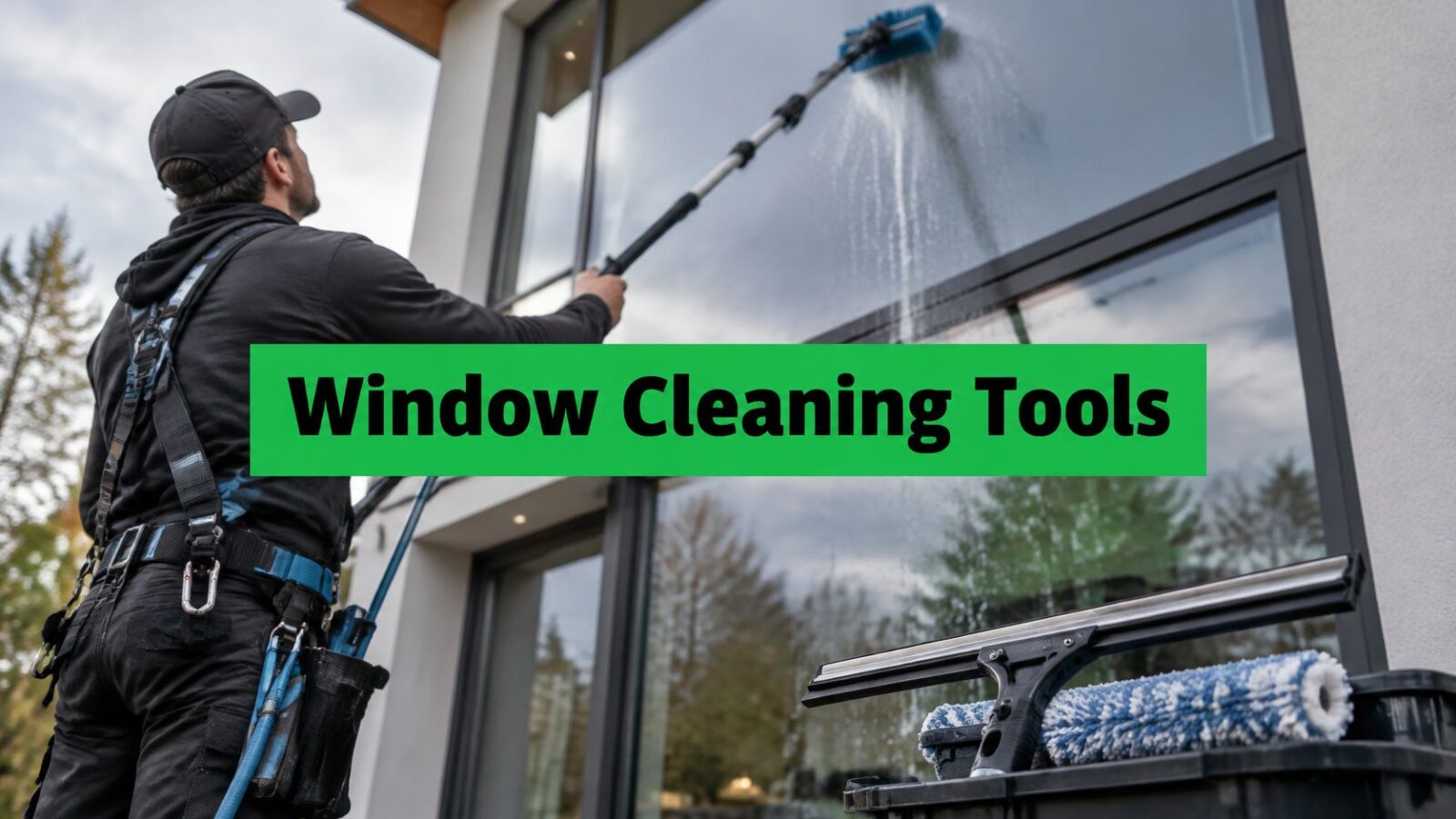
A safety summary cited on Unger Global's indoor window and glass page reports more than 164,000 emergency-room-treated ladder injuries and about 300 deaths annually in the United States, with many incidents involving falls of 10 feet or less. That's why I don't treat window cleaning tools as a shopping list. I treat them as fall-safety decisions. The right squeegee matters, but the reach method you pair with it matters more. Choose the tool that cleans the pane while keeping feet on the ground, on a rated platform, or on a properly set ladder for the shortest time possible.
Window Cleaning Tools at a Glance
| Tool | Main job | Best for | Watch for |
|---|---|---|---|
| Squeegee with rubber blade | Pulls water and dirty film off glass in one pass | Ground-level and reachable panes | Worn or nicked blades leave streaks |
| Scrubber sleeve | Loosens dust, pollen and grime before squeegeeing | Heavily soiled glass and frames | Grit left in the sleeve scratches glass |
| Water-fed pole with brush | Delivers purified water to a soft brush from the ground | Upper stories without ladders | Pole rating, wind and overhead power lines |
| Extension pole | Adds reach to a squeegee or brush | Second-story windows from stable ground | Rated length and wind exposure |
| Ladder | Gives direct physical access to a window | Short, reachable windows on level ground | Unstable ground and overreaching |
| Boom or scissor lift | Raises an operator and platform to height | Tall walls, commercial facades and atriums | Rated capacity, site access and anchorage |
| Harness and lanyard | Arrests a fall when work is above ground level | Any work at height where a fall is possible | Anchor point must be rated and independent |
| Robotic cleaner | Cleans flat panes automatically | Simple, flat residential glass | Corners, edges, weather and power loss |
Every tool in the table trades reach, control and fall exposure against each other. A squeegee in your hand gives you the best control over edges and corners, but it only works where your hand can safely go. A pole keeps you on the ground, yet you give up some feel for stubborn spots and you gain a long lever that wind can push around. A lift restores close control at height, but it adds weight, ground pressure, travel path and anchorage questions.
Advanced doesn't mean appropriate. A robot on a flat, low pane is a convenience. The same robot on a divided light, a skylight or a pane above a walkway is a different risk entirely.
Before you pick a tool, answer three questions. How high is the glass, what's the surface and frame like, and who has to leave the ground to reach it?
Answer those for each elevation, not for the building as a whole. A two-story home may need hand tools at the entry, a water-fed pole on the back wall and a ladder for one sheltered side window. A storefront may be all hand work. An atrium may need a lift even though the exterior is pole work. The kit follows the glass.
Squeegees, Scrubbers and Hand Tools
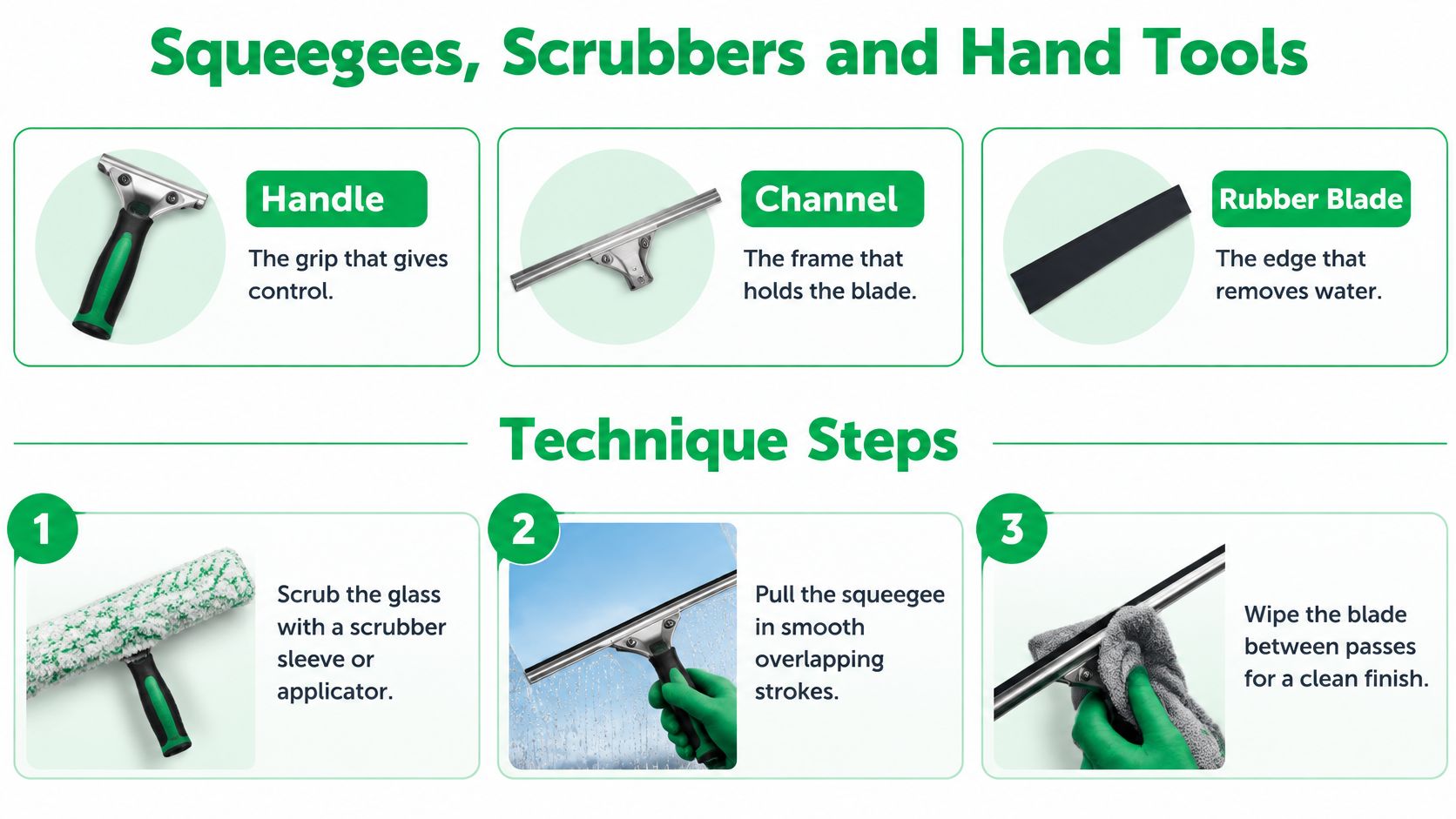
A squeegee has three parts, and only one touches the water. The handle gives you grip and angle control. The channel is the metal or plastic bar that holds the blade straight. The rubber blade does the work, so its edge condition decides whether you get clear glass or a line of streaks on every pass.
The design wasn't always this simple. The history of the squeegee notes that in 1936, Ettore Steccone designed a lightweight brass squeegee with a single rubber blade and two retaining clips, replacing the Chicago squeegee that used two heavy rubber blades and required loosening 12 screws to change them. Easy blade changes still matter. If swapping rubber is fiddly, crews stretch worn blades too long.
The Wash and Squeegee Sequence
- Scrub first: Wet the pane and work a scrubber sleeve on a T-bar across the glass to loosen dust, pollen and film.
- Pull top to bottom: Draw the squeegee down in straight, slightly overlapping strokes, keeping steady pressure and a consistent angle.
- Wipe the blade: Clear dirty water off the rubber after each pass so you don't drag it back onto clean glass.
- Detail the bottom edge: Check the sill line for drips and the corners for missed water.
The scrubber sleeve holds the wash water and does the loosening, so rinse it often. A sleeve loaded with grit becomes sandpaper. Buckets, a belt holster for the squeegee and scrubber, and spare sleeves keep the sequence moving without trips back to the truck.
Sizes and Specs Worth Comparing
I keep small channels around 8 inches for divided lights and narrow frames, mid sizes for standard panes, and 18 to 22 inch blades for large storefront glass. A wider blade covers more area per pass, but it's harder to control on narrow frames and it telegraphs every nick across a bigger swath.
Compare rubber quality and replaceability first, then channel material. Aluminum channels stay straight and light. Plastic suits light duty but flexes. Check handle grip comfort for wet hands and look for a locking pivot if you'll work at angles on a pole. While you're detailing frames, tips for removing window sill mold are worth reading, since sills trap the moisture and dirt your scrubber pushes down.
Water-Fed Poles and Extension Reach
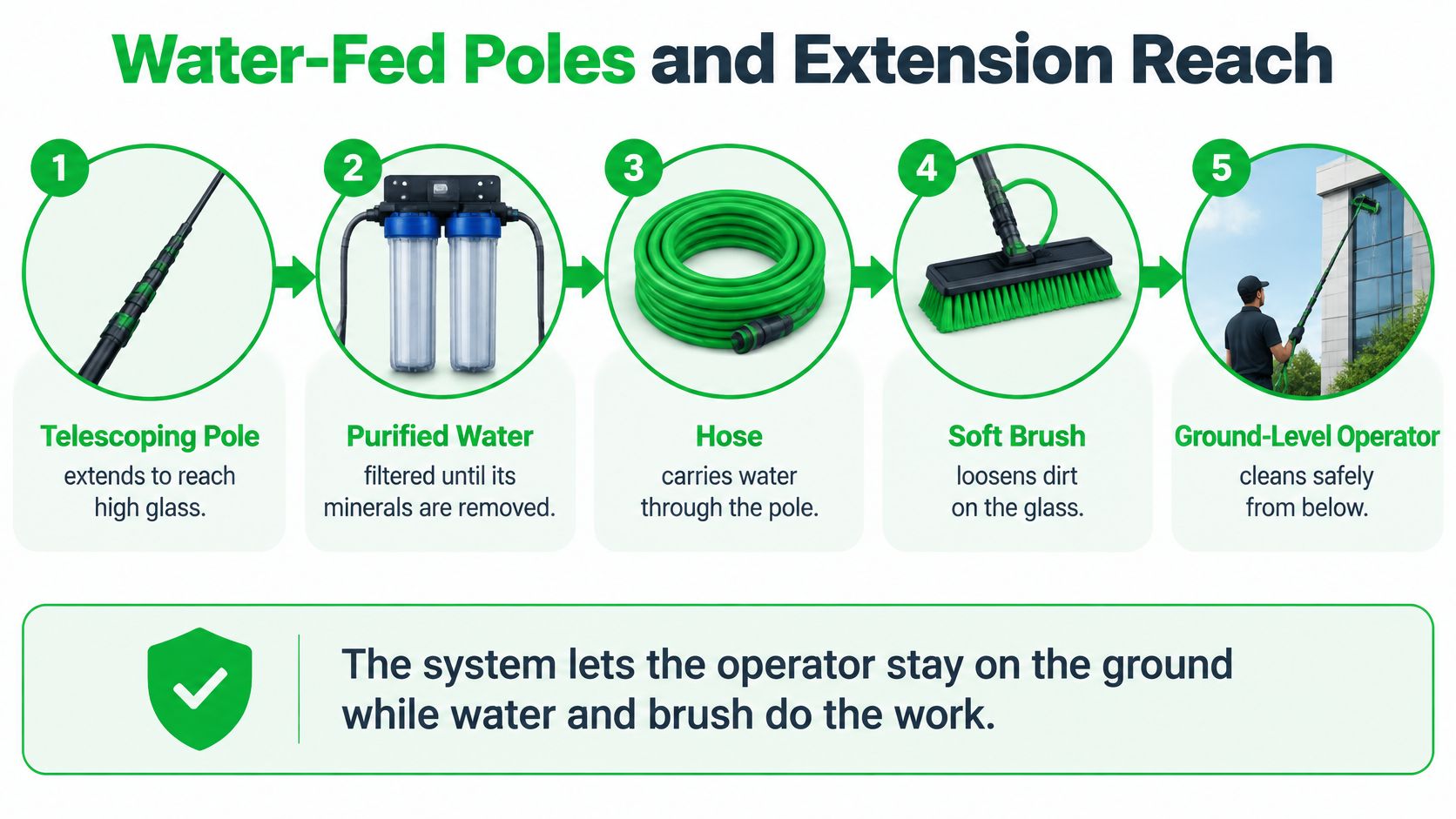
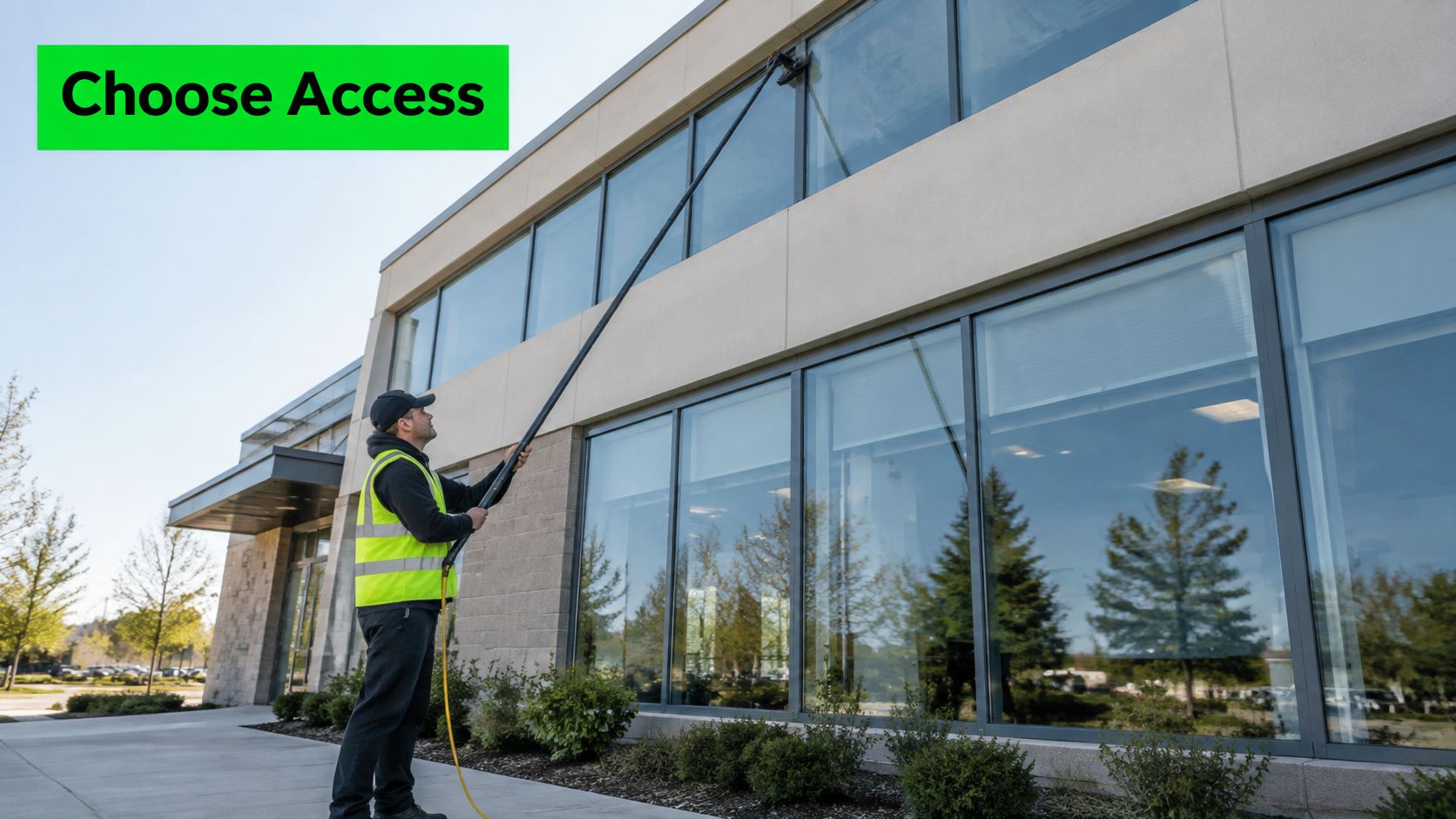
A water-fed pole is a telescoping pole with a hose running through it to a soft brush at the top. You extend the sections, place the brush on the glass, scrub while water flows through the brush jets, then rinse by lifting the brush slightly off the pane. You stay on the ground the whole time.
The water is the point. It's filtered until its total dissolved solids reading sits near zero, so it lifts dirt and then dries without leaving the mineral spots tap water leaves behind. That's why the method works without hand drying. We use pure water filtered to remove contaminants and minerals, delivered to the top of a pole fitted with a soft brush, and our water-fed pole window cleaning service page explains how we apply that setup on homes and commercial glass.
Specs That Change the Job
- Maximum rated pole length: Match it to your tallest regular glass, with margin. A pole at absolute full stretch is hard to control.
- Weight at full extension: You're holding that weight at an angle for hours. Lighter carbon sections reduce shoulder and back strain.
- Brush head size: Wider heads cover big panes faster. Narrow heads fit divided glass and tight frames.
- Filter stages: Carbon filtration and deionizing resin are common stages. More stages generally protect water quality longer between media changes.
- Supply and hose length: Tank systems give you independence from a tap. Mains-fed setups remove refilling but tie you to the building. Hose length decides where the unit can sit.
An extension pole is different equipment. It's a plain telescoping extender that carries a squeegee or brush head without delivering water. Fit matters here. Taper adaptors decide whether a given squeegee handle locks onto a given pole, so confirm the taper or thread before you're standing under a second-story window with a head that won't attach.
Ground Rules for Pole Work
The UK Health and Safety Executive window cleaners best practice guide advises that work at height should be avoided when a safer alternative such as a water-fed pole is suitable, and it sets out pre-use inspections, stopping in high winds or thunderstorms, and maintaining clearance from overhead power lines. Those aren't paperwork items. They're the difference between a controlled tool and a long lever near live wires.
- Inspect before use: Check sections, clamps and fittings for cracks and wear before raising the pole.
- Stop for weather: High wind makes an extended pole wander across the facade. Thunderstorms end the discussion.
- Watch overhead lines: Confirm clearance before extending, not after.
- Never leave it raised: An unattended extended pole can fall across people, vehicles or glass.
- Control the hose: Route it away from foot traffic and doors. A wet or icy hose line is a trip hazard.
Say you're cleaning a two-story residential back wall. From one stable standing position per section, you scrub and rinse each upper pane in a single pass pattern, then move along the wall. No ladder leans against the siding, nobody climbs with wet tools, and the frames get flushed as part of the rinse.
On commercial, hotel, campus or roadside sites, run a quick site check first. Confirm reach, wind exposure across open facades, hose routing across entries and public access points. Pole length alone never settles it.
Lifts and Access Equipment for Tall Glass
Start from the situation in front of you, not from the machine you'd like to use.
| Situation | Access method | Key check |
|---|---|---|
| Reachable from the ground with a pole | Water-fed pole or squeegee on an extension | Pole rating and wind conditions |
| Two stories on stable, level ground | Ladder with stabilizer or spotter | Three-point contact and ground condition |
| Three or more stories on a flat facade | Boom or scissor lift | Rated capacity and clearance from overhead power lines |
| Tall atrium or large open interior | Atrium lift or engineered access system | Anchorage approved for the load |
| Roof edge or unusual building offsets | Suspended platform with independent lifeline | Structural approval and worker restraint |
A boom lift articulates, so it reaches up and over canopies, landscaping and building offsets to position the platform beside the glass. A scissor lift rises straight up on a stable, level surface, which suits open interiors, warehouse walls and flat exterior pads where you can drive the base directly below the work. If you can't get the base under the glass, a scissor lift is the wrong machine no matter how tall it goes.
The video below shows powered access work in context, with the platform doing the positioning so the cleaner can use both hands on the glass.
Check these specs before booking anything. Confirm rated platform capacity for the crew plus buckets and poles, not just body weight. Verify maximum working height against the actual pane, remembering you work beside glass, not above it. Confirm outrigger spread and ground bearing, the power source for indoor versus outdoor use, and platform size for safe movement. Crews new to powered access can use work platform guidance for NSW construction workers as a general primer on platform selection and operator responsibilities before they ever take controls.
We own boom lifts, scissor lifts, and a 95 ft. atrium lift to reach any height, and our window cleaning lift equipment page shows where that atrium lift fits tall interior glass. I still wouldn't choose it on the height figure alone. Floor loading, door and corridor access, ceiling obstructions and where occupants walk below all decide whether it's the right call.
The Structural Check You Cannot Skip
For suspended and high-rise work, load support and fall protection stay separate. OSHA's personal fall protection standard specifies a minimum breaking strength of 5,000 pounds (22.2 kN) for lanyards and vertical lifelines, while suspension-system roof anchorages for portable equipment must support at least four times the maximum intended load without failure or deformation. Roof anchorages must be permanent, structurally sound and rigid, and worker lifelines need independent anchorages so a support failure doesn't disable fall protection at the same moment.
Ask one question before any lift or suspended system is booked. Is the rated capacity, anchorage and building structure approved for this exact load, at this exact offset?
If nobody can answer that with documentation, the job isn't ready to schedule.
Why Robotic Window Cleaners Fall Short
Smart doesn't mean safer. A robot that removes routine labor can still create a new fall or property-damage risk if suction fails above a sidewalk, a car or a lower roof.
Current robots commonly struggle with corners, frameless edges, curved or textured glass, weathered or coated surfaces, and power interruptions, according to market coverage summarized by Research and Markets on the window cleaning robots market. Users often still need manual follow-up on edges, which cuts into the promised labor savings. Condensation, oil, rain, irregular panes and temperatures below 0°C can impair adhesion, sensors, batteries or motors. In Flagstaff, that rules out a good part of the year for cabins, skylights and divided lights.
Demand is still climbing. IDC's global home cleaning robot market coverage reports global shipments of window-cleaning robots increased 70.4% in 2025, driven by high-rise housing, larger glass areas, and rising labor and safety costs. Growth doesn't remove the barriers. Suction reliability during power loss, product liability and difficult architecture still limit where these devices belong.
Five Questions Before You Trust One
- Pane shape: Is it a single flat rectangle with a frame the robot can sense, or does it have curves, muntins or frameless edges?
- Surface condition: Is the glass clean enough for suction, or is it weathered, coated, oily or wet?
- Access height: If it detaches, what does it land on?
- Weather: Is it dry, mild and calm, and forecast to stay that way?
- Backup measures: Does it have reserve power, a fitted safety tether, and a plan for edge and corner detailing afterward?
Commercial owners should add documented fall protection, an emergency stop, operator supervision, set maintenance intervals, incident procedures and an insurance review before approving autonomous equipment on a hotel, campus, dealership or medical building. A falling device over a public entry is a liability question, not a gadget question.
My rule of thumb is simple. Use a robot, if you use one at all, on simple flat residential panes in mild, dry conditions where a drop harms nothing. For corners, tall facades, irregular architecture and anything above people or property, use a water-fed pole, a lift or a trained crew with hand tools.
Safety Gear and Ladder Rules That Prevent Falls
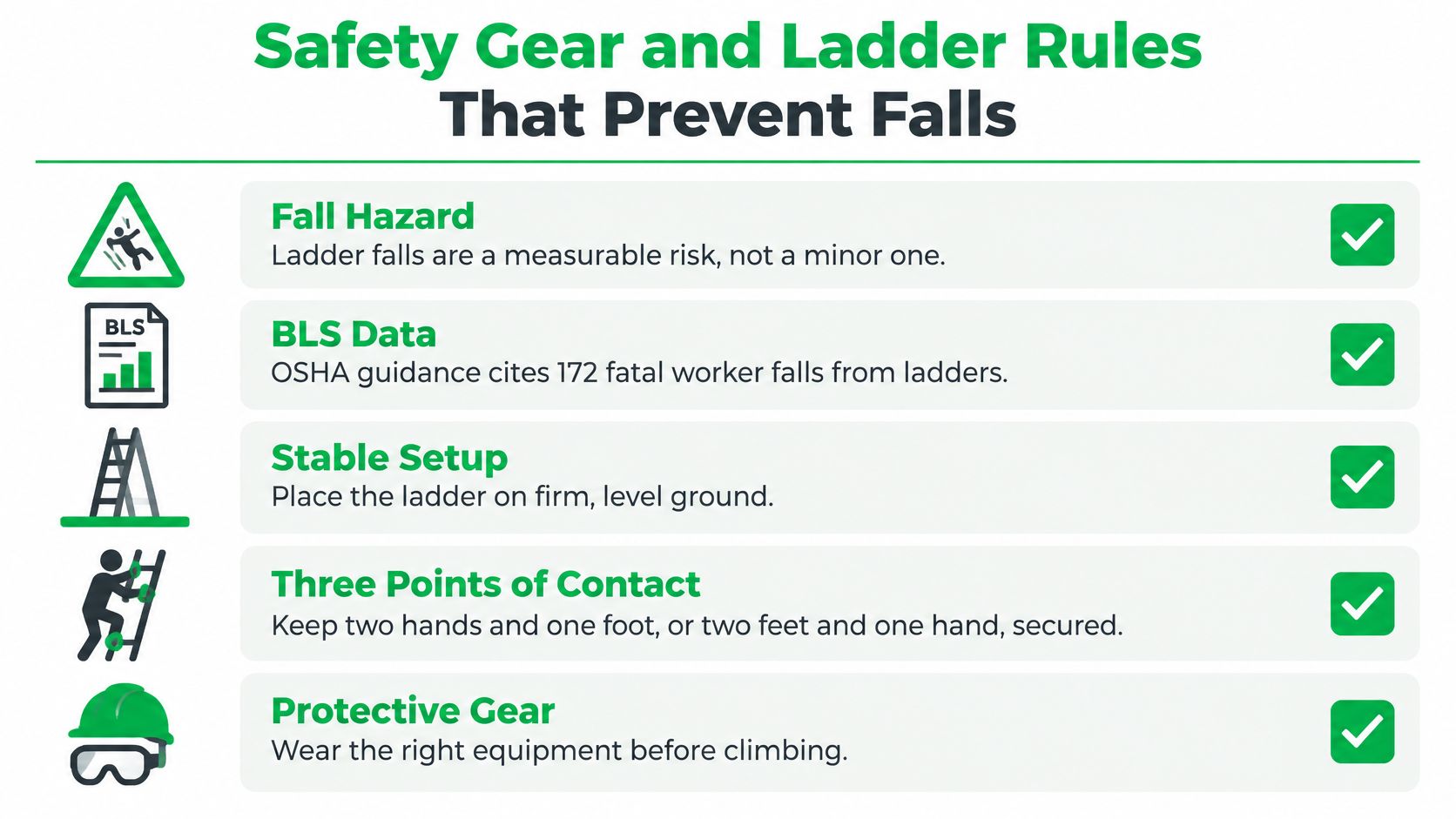
Ladder risk isn't theoretical. A Bureau of Labor Statistics summary cited in an OSHA ladder-hazard document recorded 172 fatal worker falls from ladders in the United States in 2016. Serious injuries happen at residential heights too, on cabin windows and two-story walls, not just on commercial towers.
Three-Point Contact and Working Position
Maintain three-point contact whenever you climb or descend. That means two hands and one foot, or two feet and one hand, on the ladder at all times. It also means you don't carry a bucket up in one hand. Use a belt holster, haul tools on a line, or have a ground person hand equipment up once you're set.
- Face the ladder: Climb and work facing the rungs, never turned outward.
- Stay centered: Keep your body between the side rails. If your belt buckle passes a rail, you're overreaching.
- Never stand on the top step: It removes your bracing and raises your center of gravity past the rails' support.
- Set up on firm, level ground: Soft soil, loose gravel and sloped pads let feet shift mid-job.
- Use a spotter or stabilizer: A second person footing the ladder or a stabilizer bar reduces sideways movement.
The recurring hazards are mundane, which is why they get missed. Unstable or uneven ground. Cracked rungs, worn feet and bent rails. The wrong ladder size, usually one that's too short, which tempts you onto the top step or into a long sideways reach. A quick refresher on how to check ladder safety is worth bookmarking if your crew inspects its own gear, because most defects are visible before anyone climbs.
Our window cleaning ladder practices reflect the same discipline we expect on site, and our window cleaners have all been background checked and industry safety trained, so the person on the ladder has been taught these rules before they arrive at your door.
Harnesses, Lanyards and the Decision Rule
When work is above ground level and a fall is possible, a harness and lanyard arrest that fall, but only if the anchor holds. The anchor point must be rated for the load and independent of the equipment supporting the cleaning work. Clip into structure approved for fall arrest, check webbing and stitching, and confirm connectors lock. A harness clipped to an unrated point is costume, not protection.
If a window can be reached with a pole, a lift or a platform, choose that over a ladder.
Run a pre-job inspection every time. Check ladder feet for wear, rungs for cracks, locks and spreaders for positive engagement. Run your hands along lanyard webbing for cuts and fraying, inspect stitching, and cycle every connector and buckle. Anything damaged comes out of service that day.
Keeping Your Tools in Working Order
| Tool | After each job | Weekly | Every few months |
|---|---|---|---|
| Squeegee blade | Rinse, wipe dry and check the edge | Replace if nicked or streaking | Replace the rubber with heavy use |
| Scrubber sleeve | Rinse out grit thoroughly | Wash or swap the sleeve | Replace when worn or stiff |
| Water-fed pole and brush | Flush the line and rinse the brush | Check filter cartridges and brush wear | Test water quality and inspect fittings and hose |
| Extension pole | Wipe down and check locks | Check sections for bends or damage | Inspect for wear at joints |
| Ladder | Inspect feet, rungs and locks before climbing | Check spreaders and hinges | Full inspection and retire any damaged ladder |
| Harness and lanyard | Inspect webbing, stitching and hardware | Check connectors and anchor | Replace per manufacturer schedule or after any fall |
Rubber blades wear faster than people expect. A single nick leaves a line on every stroke, and dragging a blade across dry, gritty glass accelerates it. Rinse blades after each job, store them so the edge isn't pressed against hard surfaces, and swap rubber at the first repeating streak rather than pressing harder to compensate.
Water-fed systems live or die on water quality. Check filter cartridges on schedule and test output with a total dissolved solids meter. Once the reading climbs off near zero, spots appear on glass that looked fine while wet. Flush lines after work, inspect hoses for cracks and abrasion, and store poles clean and dry with clamps checked. Grit inside telescoping sections grinds the walls thin over time.
Brushes and sleeves need the same grit discipline. Rinse them thoroughly after every job, because trapped sand and pine debris scratch glass and chew up frame finishes on the next house.
Caring for the Home While You Clean
Tool care is only half of it. Screens collect dust, pollen and pet fur all season, so when we come to a customer's home, our service includes outside windows, inside windows, removing, cleaning and reinstalling bug screens, wiping inside and outside window frames, and wiping inside window sills. Reinstalling each screen correctly, in its own opening, is part of the job, not an extra. Crews also choose stable access points, control poles and hoses around landscaping and furnishings, and protect nearby surfaces during ladder moves.
Know the boundaries before you book. Our standard window cleaning doesn't include cleaning window tracks, removing paint or stain from glass, hard water removal, sunscreen removal, ceiling fans, or mirrors. Customers pay extra for these. That's why we walk the site first, so extras are named and priced before work starts instead of argued about after.
Choose Your Tool Setup and Book a Safe Clean
Start with a site list. Write down every window, its height, its surface and frame type, and flag any atrium glass, roof edges, overhead power lines or public access points below the work. That list tells you whether you're looking at hand tools, poles, a lift, or a professional crew with all three.
We're Flagstaff's largest window cleaning company, started by Flagstaff native David Kaminski and in business since 1999. Our crews work with squeegees, ladders, water-fed poles, lifts and pure-water brushes. A standard service covers outside and inside windows, screens removed, cleaned and reinstalled, and frames and sills wiped.
When you call or schedule online, a friendly staff member visits your home, building or project to look at the glass, the access and the tool plan. You get a free estimate on the call, and our work is guaranteed. The walk-through covers reach, height, anchorage, and any power-line or public access concerns, so the access method is settled before the crew arrives.
Call (928) 527-0671 or schedule online, and ask for the access and tool plan for your specific glass before the job is booked. If the plan doesn't match the height and surface on your list, you have your answer about that provider.
If your glass needs more than a ground-level squeegee pass, Pine Country Window Cleaning will walk your property, match each window to the safest reach method, and clean it with professional squeegees, pure-water poles and lift equipment sized for the job. Call or schedule online for a free estimate, and we'll bring the right kit, remove and clean your screens, and leave every pane guaranteed.