
Getting several quotes and choosing the cheapest is popular advice for hiring cleaners. It's also how property managers end up paying separately for lift rental, missed screens, or a return visit they assumed was included. Compare the written scope and proof documents before you compare the total.
A search for “commercial cleaning services near me” should identify crews that can maintain your particular building, not merely businesses with nearby addresses. The useful question isn't who charges the lowest hourly rate. It's who has priced the complete job and can show how they'll deliver it.
Match the Service to Your Building Before You Search
Which services does your building need? Most commercial properties buy a combination of routine housekeeping, glass maintenance, exterior work, and occasional specialty cleaning. Those services shouldn't share a single vague description such as general cleaning.
Use this schedule as a starting point for a site assessment, not an automatic maintenance prescription.
Common commercial cleaning services by scope, frequency and access
| Service | What it covers | Typical frequency | Usual access equipment |
|---|---|---|---|
| Exterior window cleaning | Glass, frames and sills outside the building | Monthly to quarterly | Squeegee, pole system, ladder or lift |
| Interior window cleaning | Glass, sills and tracks in occupied spaces | Monthly to quarterly | Ladder, pole, pure-water brush where drainage permits |
| Screen removal and reinstallation | Each screen removed, cleaned, inspected and reinstalled | With every window service | Hand handling with frame care |
| Gutter and downspout cleaning | Debris removal, gutter flush, downspout clearing | Twice a year, spring and fall | Ladder or lift, debris containers |
| Pressure washing | Walkways, entries, dumpster pads, building walls | Annually or as needed | Pressure unit with surface-safe nozzles |
| Post-construction cleaning | Dust, residue and glass cleanup before occupancy | One-time | Lifts, suitable scrapers, approved cleaning solutions |
| Recurring janitorial | Floors, restrooms, trash, common surfaces | Nightly to weekly | Carts, vacuums, microfiber systems |
| Disinfection of high-touch areas | Door handles, rails, restroom fixtures | Daily to weekly, based on site risk | EPA-registered products used per label contact time |
Build the bundle around occupancy
Exterior glass and gutters generally follow exposure and seasonal conditions. Janitorial work follows foot traffic, operating hours, and how occupants use the building.
A dealership might book frequent showroom-glass service but clean its full front elevation less often. A medical office needs clean entry glass alongside a separate high-touch disinfection scope. A Munds Park cabin rental needs screens and gutters ready before peak occupancy, with work scheduled between guests.
Don't confuse related services with interchangeable ones. Cleaning food residue and maintaining waste areas support sanitation, but pest monitoring and treatment require their own plan. The Green Advantage's guide to pest control for local businesses is a useful resource when defining that separate responsibility.
Match equipment to the surface
Professional glass work uses squeegees, poles, pure-water brushes, ladders, and lifts. Pure-water brushes suit compatible exterior glass and frames where rinse water can drain safely; they aren't a blanket solution for occupied interiors. Scrapers require glass-specific assessment, particularly on coated or construction-damaged surfaces.
Ladders suit appropriate lower work. Taller or obstructed elevations may need a boom or scissor lift, subject to ground conditions and safe positioning. Northern Arizona properties may also need seasonal snow removal under a separate scope.
Take this service list into your search:
- Surfaces: Identify glass, frames, tracks, screens, gutters, pavement, and interior areas.
- Working height: Describe each elevation, setback, obstruction, and access route.
- Visit frequency: Specify recurring visits, seasonal work, and occupancy restrictions.
Find Local Providers Worth Calling Back
Commercial cleaning is a fragmented marketplace, not a choice between a few nationwide operators. Census-based janitorial-services figures reported by Building Services Management show 62,970 firms, with 89.0% employing fewer than 20 workers.
That structure changes how you search. A smaller local company may fit your property well, but proximity alone doesn't establish commercial capability. A prominent search placement doesn't establish it either.
Search for the actual assignment
Start with the service and city, such as commercial window cleaning Flagstaff. Add the property type when it affects access or operations: hotel, medical office, dealership, or campus.
Then check evidence in a practical order:
- Service pages: Confirm the provider explicitly offers your work, rather than residential glass cleaning alone.
- Commercial reviews: Read comments from property managers and business operators, paying attention to recent scheduling, communication, and follow-through.
- Project photos: Look for comparable building heights, visible access equipment, occupied storefronts, or campus work.
- Local referrals: Ask facility peers, property managers, and chamber directories who they would hire again.
A glowing homeowner review may establish courtesy. It won't tell you whether a crew can coordinate loading-zone access at a hotel or work around a dealership's vehicle inventory.
Keep the shortlist useful
Limit the shortlist to providers you can explain in a sentence: relevant commercial references, suitable access equipment, or documented experience with your building type. Don't keep adding names merely to collect more prices.
Shortlist test: If you can't explain why a provider fits your property, you're not ready to ask that provider for a bid.
Check the service area before arranging a walkthrough. Ask whether travel, emergency returns, and recurring visits are handled by the same operating team. Geographic responsiveness matters most when something interrupts the planned work, not when the sales appointment goes smoothly.
Vetting Questions That Separate Capable Crews From Sales Pitches
Who will be on your site in practice? Send that question by email before discussing discounts. Employees and subcontractors can both deliver capable work, but you need to know who supervises them, who verifies coverage, and who answers when something is missed.
A confident sales conversation isn't a substitute for written operating details. Use the answers below as a live checklist.
Vetting questions with strong answers and red flags
| Question | Strong answer | Red flag |
|---|---|---|
| Who will be on my site, and are they employees or subcontractors? | Identified crew, background-check process, named site supervisor | Vague references to the team with no supervision plan |
| What equipment will you bring for my tallest windows? | Lift or pole system matched to the height and named in writing | Ladder-only proposal for a façade needing another access method |
| How do you handle screens and fixtures during service? | Each screen removed, cleaned, inspected and reinstalled | No clear screen process |
| How do you protect floors, walls and landscaping? | Drop cloths, shoe covers, ladder pads, planned placement | A promise to be careful without procedures |
| What happens if weather or access stops the job? | Written reschedule window and advance notice | Verbal promise only |
| How is rework handled? | Re-clean within a stated window, with no added charge for missed contracted work | An invitation to call without a defined remedy |
| Can you provide references from buildings my size? | Current commercial references with comparable access needs | Only residential references |
| What proof of work do you provide? | Before-and-after photos and an inspection log | No documentation |
Ask what property care looks like
Protecting the surroundings is a separate responsibility from cleaning the glass. The company's window-cleaning service description identifies drop cloths, shoe covers, careful ladder placement, professional access tools, and screen removal, cleaning, and reinstallation as service practices.
Translate those practices into your building's requirements. Identify delicate flooring, newly planted beds, guest entrances, and furniture that must be moved by authorized staff. Ask who records an existing cracked pane or bent screen before work begins.
Request a sample photo set from a comparable commercial assignment and ask who inspects the first service visit. For screens, the inspection should include frame condition, clips, and secure seating after replacement.
Weather answers deserve equal attention. A credible plan distinguishes unsafe working conditions from a cosmetic concern after rain, and states who contacts your building representative.
Finally, ask commercial references about corrections, not just appearance. A provider's response to a missed area tells you more about contract management than praise for a spotless first visit.
Scope-of-Work Examples for Windows, Gutters and Pressure Washing
A useful scope lets a supervisor identify the work without calling the salesperson. These hypothetical Flagstaff-area examples show how to turn a general request into an inspectable assignment.
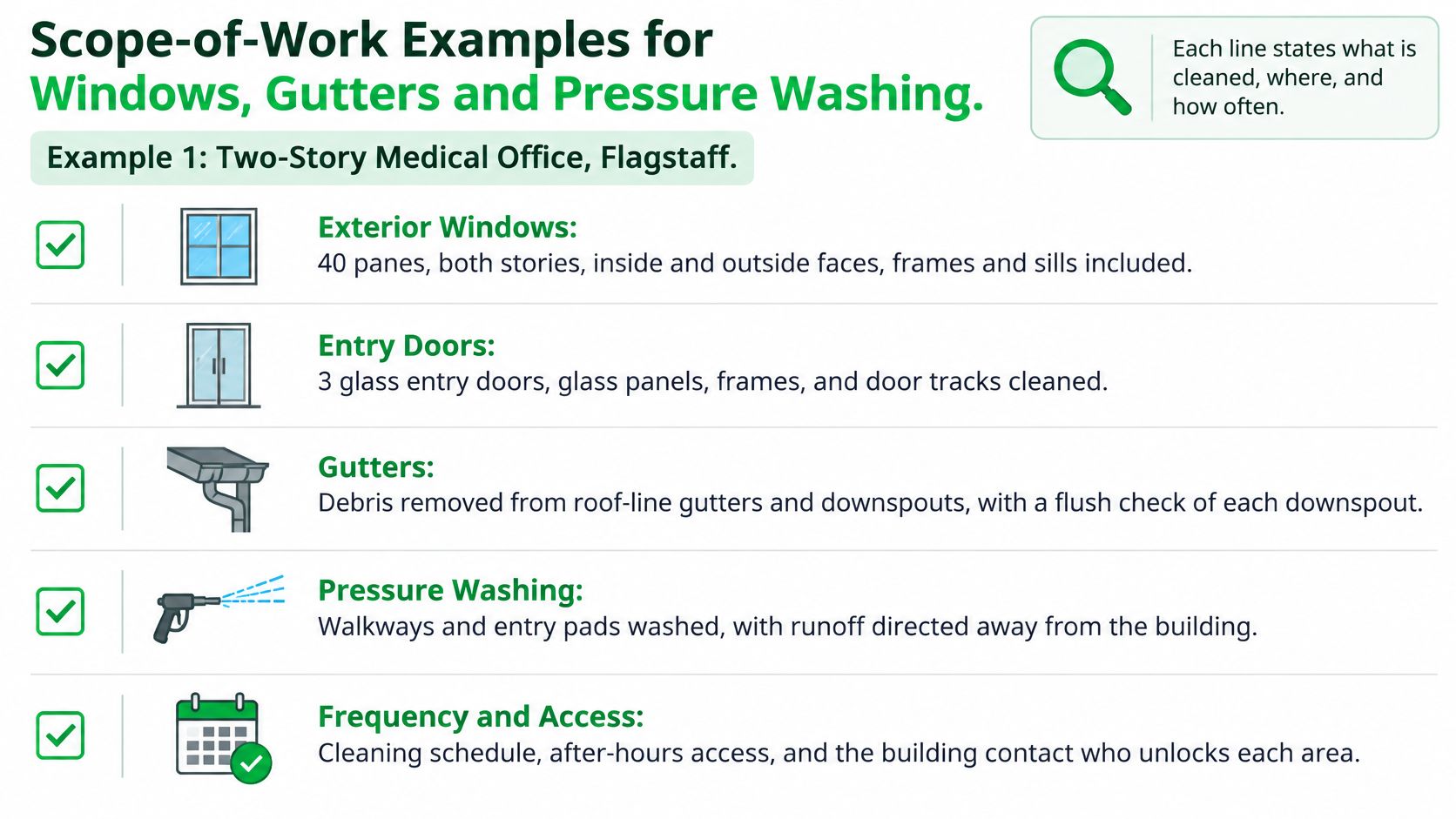
The checklist illustrates the level of detail to capture, although interior faces must be expressly included or excluded in the signed proposal.
Medical office in Flagstaff
Say a two-story office requests 40 exterior panes, three glass entry doors, front and back gutters, and an entry-walk wash. The scope includes exterior frames and sills, identifies pole or lift access after inspection, and records the screen count during the walkthrough.
Schedule work outside patient arrivals. Protect interior thresholds with absorbent coverings, keep a pedestrian route open, and position ladders away from planting beds. Exclude disinfection, interior window faces, hard-water restoration, and failed-seal correction unless separately authorized.
The building contact signs off against labeled elevation photos, gutter-flow observations, and the entry-walk inspection. Without the interior-face exclusion, the illustrated checklist could create a different expectation from the quoted exterior-only job.
Dealership showroom
For a hypothetical dealership, inventory every pane on the front elevation and attach a marked photo identifying interior and exterior faces. Confirm whether screens exist rather than assuming there are none.
Specify lift access, approved parking positions, vehicle relocation, and a Sunday start. Use shoe covers and drop cloths indoors, and keep equipment outside customer circulation routes.
Exclude signage removal, adhesive restoration, and mineral-stain treatment unless itemized. The manager accepts the work after inspecting showroom glass from normal viewing positions, not merely from the lift departure point.
Munds Park rental cabin
For a cabin, count gutter runs, downspout outlets, windows, and screens before pricing. Include gutter debris removal, downspout clearing, and every screen removed, cleaned, inspected, and reinstalled.
Book between guests, protect the entry path, and identify ladder positions that avoid decks and landscaping. Keep roof repairs, gutter repairs, and underground drainage work outside the cleaning scope.
A commercial gutter-cleaning scope should distinguish accessible downspout clearing from a concealed drainage obstruction. Require completion photos and owner approval before guest access resumes.
A scope is complete when it names the surfaces, access method, protection measures, exclusions, and person authorized to accept the work.
Disinfection Steps and Air Handling in the Scope
Disinfection belongs on identified risk surfaces, not automatically on every cleanable surface. Door hardware, rails, restroom fixtures, and authorized clinical counters need a different specification from showroom glass.
Write the workflow into the contract
The CDC's facility-cleaning guidance supports this four-stage process:
- Identify the surface and risk. Record the material, contamination concern, and rooms excluded from contractor access.
- Clean first. Remove soil with soap and water before applying disinfectant.
- Apply a compatible EPA-registered product. Document its name, label dilution, application method, and required personal protective equipment.
- Maintain full wet contact. Keep the surface visibly wet throughout the label contact time. Record timing where the facility's risk-control procedures require it.
Don't let a crew substitute a quick wipe for the product's required exposure. Never mix cleaning chemicals unless the label expressly permits it.
Choose frequency through the facility's risk assessment. A clinic may need daily high-touch treatment, while a lower-risk office lobby may use a different schedule. For food-service properties, Vanish Pest Control Inc.’s resource on disinfection for restaurant spaces can help frame questions about separating cleaning, disinfection, and operational access.
Include indoor-air controls
The EPA's indoor-air-quality guide identifies source control, ventilation, and filtration as complementary measures.
- Inventory chemical sources. Review Safety Data Sheets and keep containers closed when not in use.
- Coordinate ventilation. Verify outdoor exhaust discharge, agree on HVAC settings, and open doors or windows where safe. Never obstruct supply or return grilles.
How Commercial Cleaning Quotes Are Priced and Compared
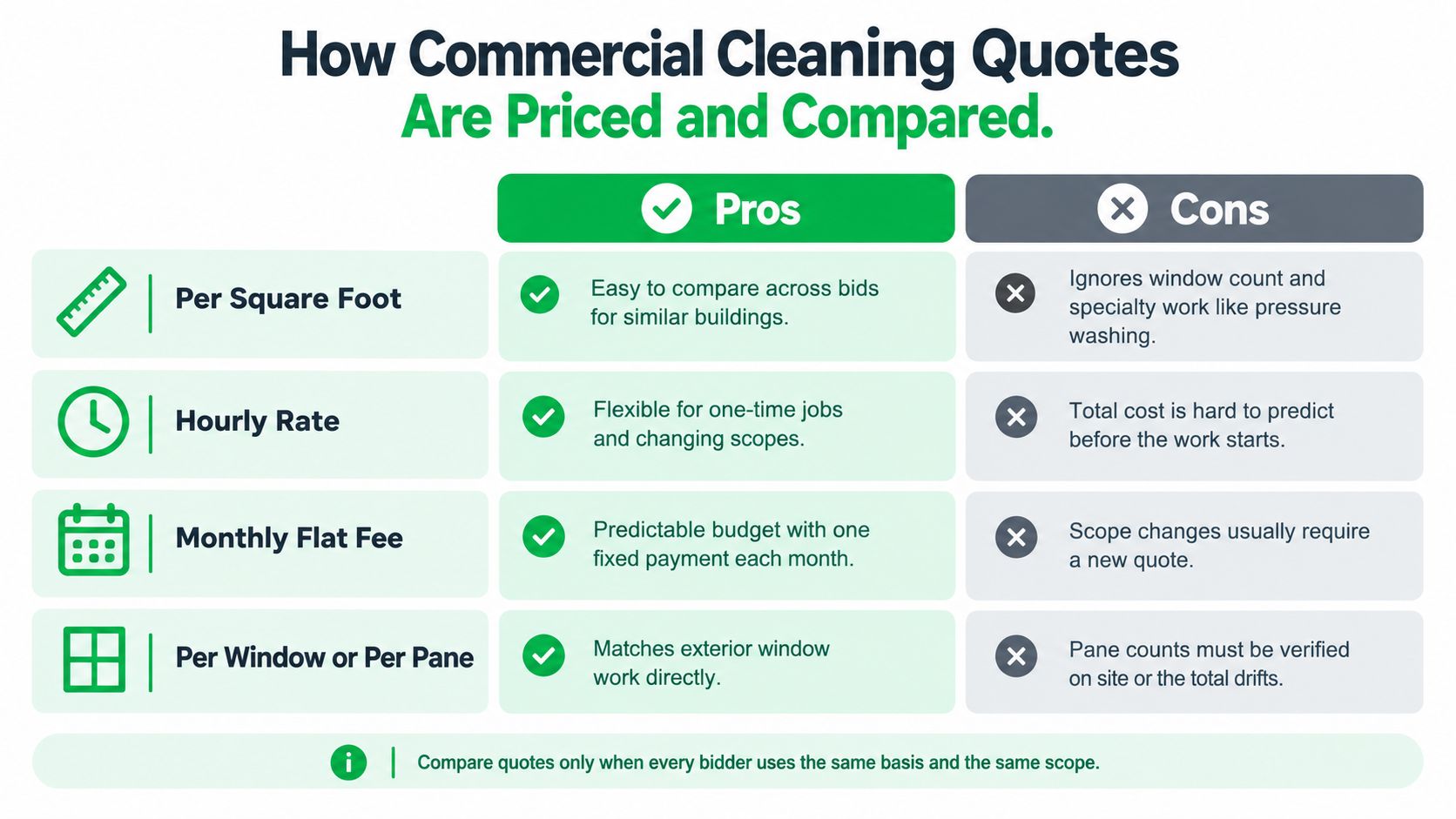
Learn the pricing basis before judging the total. A per-pane quote and a monthly contract can describe the same property while including very different work.
This comparison highlights the trade-offs, but the signed scope must resolve them.
Commercial cleaning pricing bases and what moves the price
| Pricing basis | Typical use | What raises the price | Watch for |
|---|---|---|---|
| Per window or per pane | Storefronts and small offices | Pane count, stories, tinted or hard-to-reach glass | Quotes that skip upper-floor panes |
| Per square foot of façade | Large glass and pressure washing | Height, access, surface condition | Bids that ignore working height |
| Flat monthly rate | Recurring exterior maintenance | Visit frequency, travel, access setup | Minimum visits and rain-day policy |
| Hourly labor | Irregular or unusual jobs | Crew size, equipment hours, setup time | Open-ended hours with no cap |
| Per linear foot or per job | Gutter and downspout cleaning | Stories, roof pitch, debris load | Downspout flushing left out |
| Monthly contract | Recurring janitorial or window programs | Scope breadth, response-time promises | Auto-renewal and rework terms |
Compare deliverables, not just rates
Per-pane pricing works when everyone agrees on the pane inventory. Square-foot pricing needs an equally clear definition of measured area and separate treatment of specialty work.
Hourly labor offers flexibility for uncertain conditions, but request an authorization ceiling and approval before overruns. A fixed monthly payment makes budgeting easier only when visit counts and included tasks are explicit.
The 2025 CMM in-house facility-management benchmarking survey identifies labor shortages and budget constraints as leading concerns. Those pressures make staffing continuity and contingency coverage worth examining, not reasons to accept an incomplete proposal.
Use a line-item worksheet to compare supplier costs with Procright, then apply it to labor, consumables, access equipment, travel, inspections, and corrections. The commercial window-cleaning cost guide provides another service-specific starting point for quote questions.
For additional context during your proposal review, use this video alongside the written bids.
Investigate the lowest total
Treat a substantially cheaper bid as the proposal most likely to need an omission check, not automatic proof of poor work. Ask the bidder to identify who supplies lifts, water, safety equipment, and backup staffing.
Require a written correction window and a clear definition of any satisfaction guarantee. A promise without an inspection process or remedy won't help you close a disputed job.
Insurance and Credentials to Verify in Writing
A low hourly rate can hide missing insurance, access equipment, or clear correction terms. Judge the bid by its written scope and proof documents, then verify that the business signing the contract and any subcontractors are covered for the proposed work.
Build a usable vendor file
- General liability evidence: Request a certificate from the broker or agent. Check the named insured, policy dates, covered operations, and limits with your risk adviser.
- Workers' compensation evidence: Confirm coverage fits the crew arrangement and applicable requirements. General liability does not establish coverage for worker injuries.
- Certificate-holder details: Ask for your property or management company to be listed correctly. Certificate-holder status alone does not make you an additional insured.
- Required endorsements: If the contract requires additional-insured status or other terms, request the actual endorsements, not just a certificate summary.
- Bond documentation: For recurring janitorial or sensitive-access contracts, decide whether a bond addresses a specific theft or performance concern.
- Screening confirmation: For schools, medical buildings, and occupied hotels, require a documented screening process that matches your access policy.
A certificate summarizes coverage; policy terms, exclusions, and conditions govern it. Ask the broker about work at height, subcontracting, and the specific operations in the proposal.
Check access training against the job
OSHA's standards list ladder requirements under 29 CFR 1910.23 and stairway requirements under 29 CFR 1910.25. The ANSI/IWCA 1-14.1-2001 Window Cleaning Safety standard is a separate industry reference.
Request training records for the ladders, lifts, or suspended equipment the crew will use. A general safety statement does not show that the assigned operator is prepared for the planned access method. For commercial window-cleaning services, ask for equipment-specific operating procedures and the person responsible for site safety.
Vendor-file rule: Record document expiration dates and assign someone to request renewals before the next service visit.
If disinfection is part of the contract, keep product-use procedures with the vendor file. The documentation should match the purchased work.
Request Your First Estimate Without Losing a Week
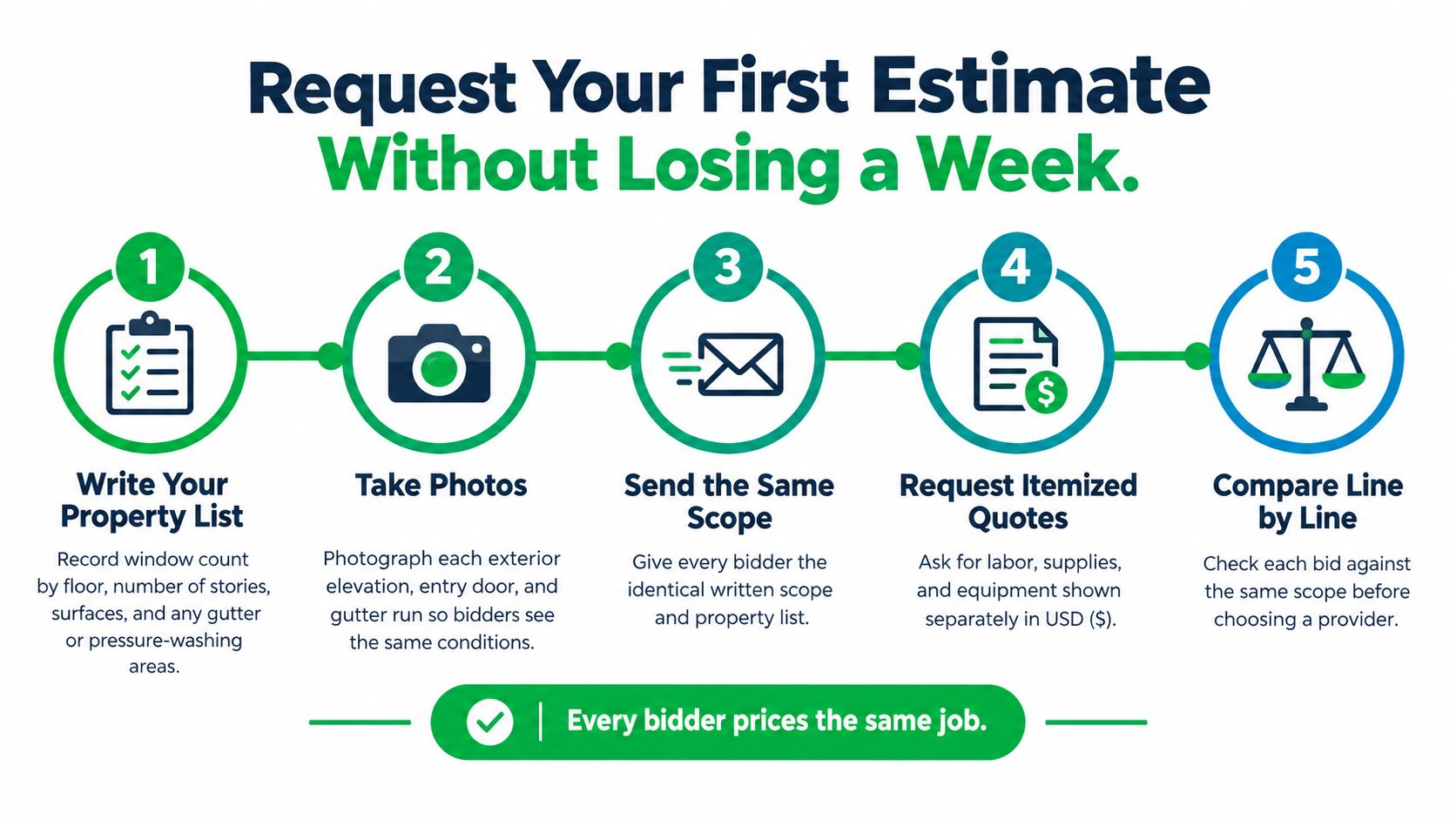
The cheapest quote can cost more once access equipment, insurance, or correction work appears as an extra. Compare bids by the written scope and supporting documents, not the hourly rate alone. Give every provider the same property information so you can see what each price includes.
Send a complete packet
- Inventory the property. Record window locations by floor, building height, gutter runs, and areas for pressure washing.
- Photograph access conditions. Include façades, rooflines, screens, entries, overhead obstructions, and equipment routes.
- Set the service calendar. Give your preferred season and frequency, plus occupancy or access restrictions.
- Send the same packet to each provider. Keep the shortlist manageable and use identical documents for a fair comparison.
- Request an itemized proposal. Require a written scope, exclusions, and separate equipment charges. Check that the proposal accounts for lifts or other access needs shown in your photos.
- Review insurance documents. Confirm coverage details and policy expiration dates with the broker-issued evidence.
- Set the operating terms. Put scheduling, weather interruptions, inspection, and correction work in writing.
- Arrange the opening walkthrough. Name the building contact who can approve changes and accept completed work.
Assess the local option with the same discipline
Pine Country Window Cleaning offers free estimates by phone or online scheduling for commercial properties and homes across Northern Arizona. Its listed work includes hotels, medical buildings, NAU facilities, dealerships, homes, and cabins. The company says its technicians are background-checked and OSHA safety-trained, and that it owns boom lifts, scissor lifts, and a 95-foot atrium lift. Ask the proposal to identify the equipment and crew planned for your building.
The company has served Northern Arizona since 1999 and is a member of the Flagstaff Chamber of Commerce and an International Window Cleaning Association-recognized team. Its stated credentials and equipment help you assess fit, but the proposal still needs to define surfaces, access, exclusions, and correction terms.
For homes and cabins, spell out how the crew will protect finished surfaces, coordinate arrival, and handle screens during window service.
Choose the provider whose written scope names every included surface and exclusion, with supporting documents and a named supervisor.
Pine Country Window Cleaning offers commercial window cleaning, gutter and downspout cleaning, pressure washing, and seasonal snow removal for Northern Arizona properties. Visit Pine Country Window Cleaning to request a free estimate, share property photos, and arrange a walkthrough so the quote reflects the surfaces, access needs, and schedule.