
You wake up to the kind of Flagstaff morning that settles arguments fast. The storm's gone, the Peaks are sharp against a blue sky, and the driveway is buried, the sidewalk is already your problem, and the plow windrow is sitting right where you need to leave for work. If the crew you called yesterday isn't coming back, you're not shopping for convenience anymore, you're trying to protect access, safety, and compliance before the next freeze locks everything down.
A good snow removal service near me should solve the whole property headache, not just knock snow off the driveway and disappear. In Flagstaff, that means planning for repeated storms, sidewalk deadlines, windrows from public plows, and private roads that aren't anyone else's job to maintain. It also means choosing a crew that shows up with the right equipment, the right paperwork, and a service scope that matches how you live or work on the property.
The Morning After a Flagstaff Storm
The first hour after a storm tells you almost everything about the service you hired. If the driveway is passable but the sidewalk still looks untouched, you don't have a complete snow plan, you have a partial one. If the crew says they'll “get to it later,” that usually means you're the one watching the clock and checking the curb while everyone else assumes the job is done.
The right call in that moment depends on the property. A primary home in town needs clear access for the family leaving at 7 a.m., a cabin in Munds Park needs someone who can reach it, and a short-term rental needs the entry looking workable before the next guest arrives. A commercial site has a different pressure, because the lot, walkways, and service doors all have to open in the same cycle.
Practical rule: if you have to guess whether the crew will cover sidewalks, stairs, and curb cuts, you're already under-informed.
That's why I like to start with a simple test. Ask what gets cleared, when it gets cleared, and what happens if a public plow leaves a pile across the access point after your crew finishes. If the answer is vague, keep looking.
For a tighter local option, this snow shoveling near me page is worth a look because it forces the conversation toward actual service scope instead of marketing fluff. The best vendors make the morning after boring, and boring is exactly what you want in a Flagstaff winter.
What Flagstaff Winters Demand
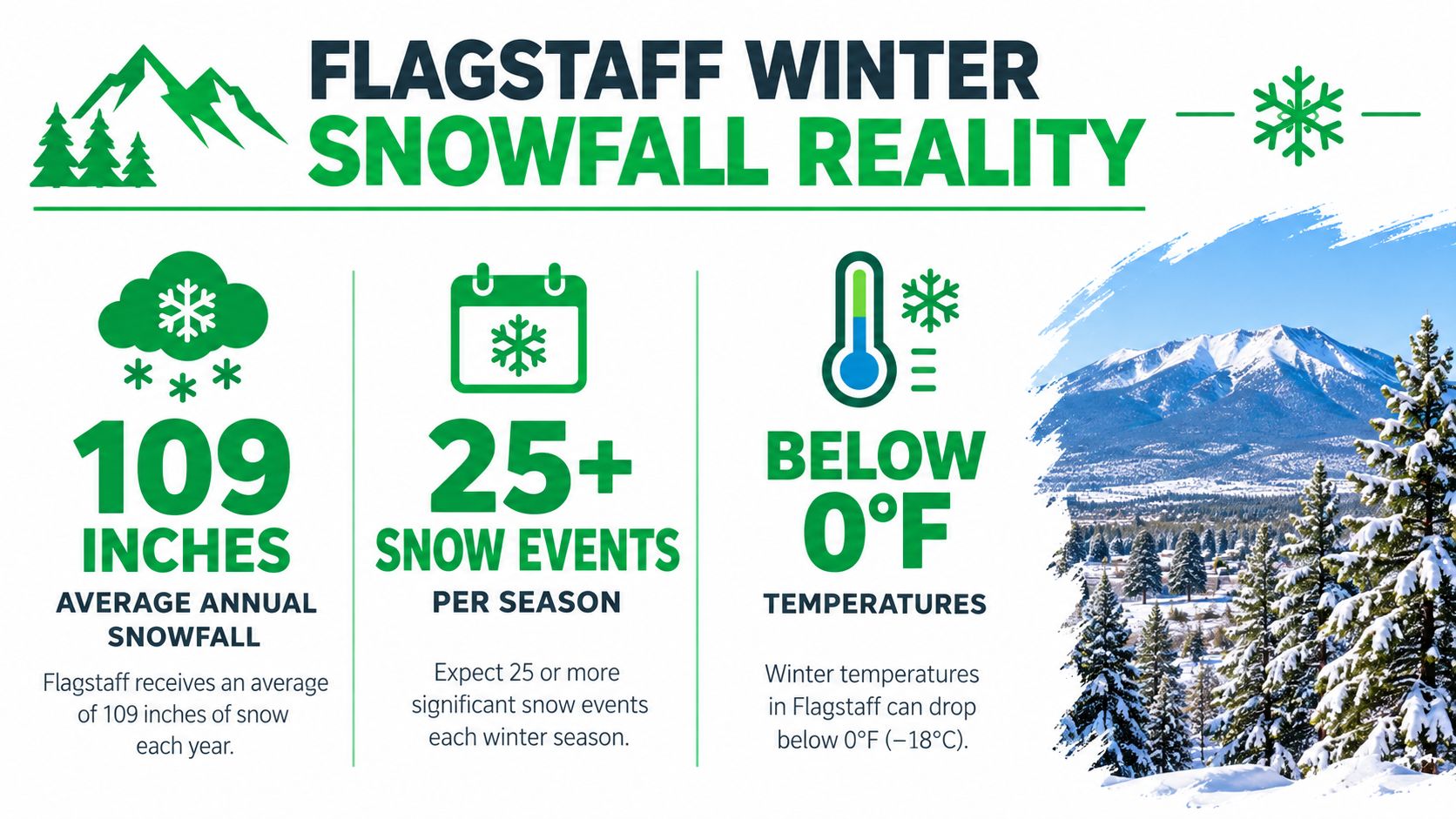
Flagstaff does not run on a mild-climate snow schedule. NOAA climate records show an average seasonal snowfall of approximately 109.4 inches, with a historical swing from 11.2 inches in 1933-34 to 210.0 inches in 1972-73. The season generally runs from October through May, so snow removal here is a repeated operational job, not an occasional chore. NOAA also notes that winter snowfall can exceed 100 inches in a single month and more than 200 inches during an entire winter, with daily totals above 20 inches recorded eight times. NOAA climate records
That range matters more than the average. In a light year, a property owner might get by with patience. In a heavy year, the same site gets hit again and again, and each storm adds another round of driveway, walkway, roof-edge, and entry work. A provider that only plans for the first clearing is built for easier weather.
A recurring service model fits the way winter behaves here. Snow comes back over several months, drifts close access points, and forces crews to reassess conditions after the city plow moves through. That is why I care more about scheduling discipline than promises to show up whenever the phone rings.
If you manage a cabin, rental, or commercial property, plan around access windows, not just snow depth. A place that needs to stay open for arrivals, deliveries, or staff turnover needs a crew that understands repeated service and follow-up, not one that treats every storm like a one-off.
For a practical local reference, the winter snow removal services page is useful because it frames snow as part of a whole-season maintenance routine. That is the right mindset in Flagstaff.
What a Qualified Snow Crew Should Prove
A crew worth hiring proves its value before the first flake falls. Start with insurance, then ask who steps onto the property. For occupied homes, rentals, and commercial buildings, background-checked technicians matter because snow work happens early, near entries, and around the places people trust most.

The written scope should come first, not last. It needs to name the driveway, sidewalks, stairs, entry pads, curb cuts, mailbox approach, and whether windrow removal is included after the city plow passes. If a provider will not put that in writing, expect confusion when the weather is ugly and everyone is rushing.
The safety side is not optional
Roof work, high edges, and awkward access points change the job fast. FEMA's snow-load guidance says a competent person should decide whether a snow-loaded surface is safe to access, ground-based methods like nonmetallic snow rakes should be used when possible, and work should stop if a roof sags, creaks, or shows distress. FEMA snow-load guide
If you want a practical benchmark while you compare crews, compare two-stage snow blowers and look at whether the equipment matches the kind of accumulation your property gets. The point is not to buy the machine for them. The point is to judge whether their setup is fit for the lot.
If the operator cannot explain how they will protect the property, the sidewalk, and the people on site, the equipment does not matter.
I also want a clear answer on missed visits. Good vendors explain how they communicate delays, whether they document service, and how they handle follow-up after a bigger storm. For rentals and commercial properties, that paper trail matters because liability does not disappear just because the weather was bad.
For a local safety-focused overview, use the snow removal safety tips page as a reference when you compare how seriously a company handles winter work.
Pine Country Window Cleaning also offers snow shoveling and removal, which is useful if you want one local provider handling winter access and other exterior maintenance.
A quick way to screen a provider
- Insurance and training: Ask for proof, not reassurance.
- Exact service scope: Make sure sidewalks, steps, and windrows are named, not implied.
- Documentation: Ask for photos or completion notes if you will not be on site.
- Escalation plan: Find out who answers when weather gets bad and the route is delayed.
Pricing Models That Actually Fit the Property
The wrong price model can make a snow contract look cheap right up until the first heavy cycle. Per-storm pricing fits smaller properties, light winters, or owners who want flexibility. Seasonal pricing makes more sense when you care about being on the route, locking in coverage, and avoiding the scramble every time the forecast turns ugly.
| Contract type | Best for | Typical trigger | Pros | Watchouts |
|---|---|---|---|---|
| Per-storm | Smaller homes, low-frequency users, flexible owners | Varies by event | Simple to understand, pay only when it snows | Can be inconsistent during busy periods |
| Seasonal | Cabins, rentals, recurring customers, commercial sites | Often based on a set depth | Better route priority, steadier planning | Needs clear scope so nothing is assumed |
| On-call | Backup coverage, occasional properties, emergency access | Usually event-based | Useful when you don't need constant service | Response timing can be uncertain |
A trigger depth should never be hidden inside a quote. If the contract starts at a 2-inch trigger or a 4-inch trigger, say so and compare apples to apples. The same goes for ice treatment, windrow hauling, and whether sidewalk work is included or priced separately.
What I look for in a written quote
I want the quote to spell out response window, service area, trigger depth, frequency cap, ice treatment, sidewalk inclusion, and roof-edge work. If a provider won't tell you where removed snow goes, you haven't really bought snow removal, you've bought temporary movement.
A seasonal contract usually makes the most sense for property owners who need predictability. You're not just paying for labor, you're paying for route placement, equipment readiness, and someone else carrying the scheduling headache when the storm cycle gets busy. That's especially true on steep driveways, private roads, and properties that can't wait for an open-ended callback.
My rule on price: the cheapest quote is often the one that leaves out the work you'll care about most after the first real storm.
Why the City Plowing the Street Is Not Enough
A lot of owners make the same mistake. They see the street plowed and assume the property is handled. In Flagstaff, that's not how it works. The City requires property owners and occupants to clear adjacent sidewalks within 24 hours of snowfall, and they may not push snow into streets or alleys. Public snow removal also runs on a priority-route system that can take 12 to 36 hours in January and February depending on storm depth. City of Flagstaff sidewalk and snow guidance
That matters because the city is clearing public routes, not managing your full access plan. The plow can make the street passable and still leave a ridge across your driveway or a dangerous edge near the walk. Coconino County also makes clear that private roads aren't County-maintained, which leaves those properties on their own for access decisions.
The hidden problem is the windrow
The windrow is the pile that the public plow leaves behind, and it's the part people forget to budget for. If your driveway opens onto a plowed street, you can be “on a plowed road” and still stuck behind a compacted berm. That's why a real snow service should say whether it handles the extra pass after the municipal plow.
For elderly residents or people with qualifying disabilities, Flagstaff's Snow Hero program extends the sidewalk deadline to 48 hours. That's helpful, but it still leaves the owner or manager with a responsibility to track timing and keep access safe. A good contractor should be willing to manage that part on your behalf instead of forcing you to interpret the ordinance after every storm.
If you like using local search data to sharpen your vendor list, the RecensioAI local pack insights article is a useful reminder that visibility isn't the same thing as operational fit. A provider can show up in search and still be a poor match for a steep driveway, private road, or sidewalk-heavy property.
The right takeaway is simple. If your service only covers the driveway, you're still vulnerable to compliance problems and access delays. If it covers sidewalks, curb cuts, stairs, mail access, and post-plow windrows, you've got something closer to a real winter plan.
Getting the Property Ready Before the Crew Shows Up
Crews work faster and cause less damage when the property is set up before the first storm. Do the prep early, while the ground is still visible. Mark sprinkler heads, invisible-fence lines, low obstacles, and any edge markers the plow can catch before freeze-up hides them.
Where the snow should go
Pick a storage area that is flat, safe, and outside drainage flow. Tell the crew where that pile belongs. If you leave it vague, they make a judgment call under pressure, and that is how sightlines get blocked or snow gets shoved where it should not go. Trash cans, recycling bins, and movable planters should already be out of the route.
Clear access beats clever improvisation. The fewer surprises in the yard, the less damage you will see in spring.
Absentee owners need a tighter checklist. Keep access codes, gate codes, pet notes, snow-storage instructions, and a current photo contact on hand before the first storm. If you manage a rental or second home, do not expect the crew to hunt for details while the weather is still coming down.
Shared drives need one more step. Coordinate where each property stores snow so one neighbor's pile does not trap the other's entrance, mailbox, or turn-around space.
For roof-edge work, apply the same competent-person rule covered earlier and keep it separate from ground clearing. Ground access should stay the priority. If you want a broader checklist for keeping entry points and work areas clear, the practical workplace safety guidance resource is a good reminder that clear access is a management decision, not just a weather reaction. That mindset helps on commercial lots, short-term rentals, and any property where people arrive when you are not there.
Lock In Coverage Before the Next Storm
Do not wait for the next forecast to start calling. Get one estimate now, then get the scope in writing before you need it. If you call Pine Country, have the property address, driveway size, sidewalk count, stairs, gate codes, HOA or insurance requirements, and property type ready, whether it is a home, cabin, rental, or commercial site.
The quote should spell out exactly what gets cleared, what does not, how ice treatment is handled, how windrows are handled, and when the crew plans to arrive. Ask for proof of insurance, ask for photo documentation if you are off-site, and ask what happens if a bigger storm delays the route. If the answers stay vague, keep looking.
Pine Country Window Cleaning has served Flagstaff since 1999, and it publishes OSHA safety-trained and background-checked technicians as part of its service model. It already works around occupied homes, cabins, campuses, and business sites. Pine Country Window Cleaning
That matters because winter service should not be a one-off fix. You want a company that can handle snow removal, then stay with the property for screen removal and reinstallation, gutter and downspout cleaning, pressure washing, and post-construction window work when the season changes.
If you want a winter plan that covers sidewalks, driveways, and the Flagstaff rules, visit Pine Country Window Cleaning and get a free estimate before the next storm hits. They handle snow removal, exterior maintenance, and the kind of local service that keeps a property usable when the weather turns fast.