

Professional window cleaning isn't household glass wiping with a better attitude. It relies on controlled water removal, purpose-built squeegees, ladders, telescoping poles, pure-water brushes, and access equipment selected for the building. The difference shows in the details too: screens come out, screens get cleaned, floors and landscaping are protected, and every pane is checked before the crew leaves.
Safety matters because window cleaning remains a hazardous trade. One published safety summary reports that an OSHA analysis recorded 88 window-cleaning accidents over 15 years, including 62 fatalities in its historical safety discussion. Modern professional work therefore combines fall protection, equipment inspection, weather awareness, and disciplined communication with the customer.
Pine Country Window Cleaning has served Flagstaff since 1999, when Flagstaff native David Kaminski started the locally owned company. That experience provides useful context for homeowners, cabin owners, property managers, and commercial teams who need more than a quick rinse. The following professional window cleaning tips explain how dependable crews combine technique, access planning, screen care, property respect, seasonal knowledge, and final quality control. For related exterior maintenance, see this pro guide to cleaning pool decks.
1. Professional Squeegee Technique for Streak-Free Results
A professional squeegee removes the cleaning solution instead of spreading it around. The technician applies enough solution to loosen soil, then pulls the blade across the glass in a controlled movement that leaves a clean, nearly dry surface.
Blade condition comes first. A nicked or worn rubber edge skips over the pane, leaves trails, and forces the operator to compensate with extra pressure. Keep blades clean, replace damaged rubber promptly, and wipe the edge between passes so grit doesn't create a new line across the glass.
Control the angle, overlap, and pressure
A consistent 45-degree angle gives the blade a stable contact point. Overlap each stroke slightly, especially on broad panes, because a narrow untreated strip can remain between passes. Use firm, even pressure, but don't lean hard enough to stress seals, flex the tool, or push water into the frame.
The starting position also matters. On a large pane, a technician may use a top-to-bottom pull, a side pull, or a professional “fanning” pattern depending on obstructions and pane shape. Divided lights often need shorter controlled strokes rather than an oversized movement that leaves water in the muntins.
Practical rule: If the blade chatters, inspect the rubber, the glass, and the pressure before adding more solution.
Edge detailing should be deliberate. A clean detailing cloth removes small remaining beads at the frame, while the squeegee itself should be wiped dry before the next pass. Pine Country's professional squeegee guidance provides a useful reference for overlapping strokes and edge cleanup.
A squeegee still isn't the right first tool for every pane. Heavy dust, pollen, or mineral soil needs pre-treatment, and hot sun can dry solution before the blade reaches it. The best result comes from matching the squeegee pattern to the glass, soil, temperature, and access conditions.
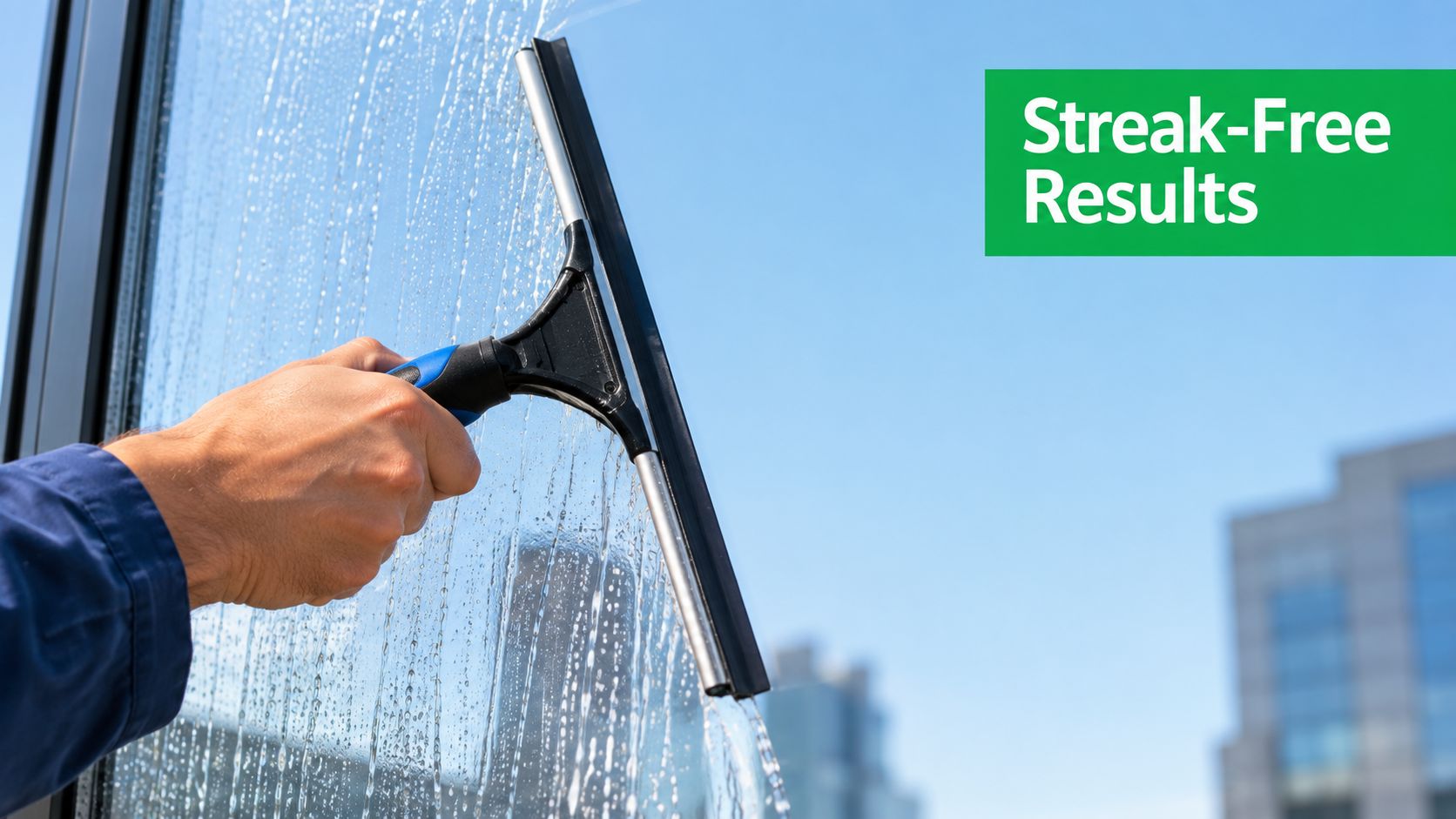
A short demonstration can make the difference between a controlled pull and repeated rework:
2. Professional-Grade Ladder and Lift Safety Protocols
Access equipment should be chosen before the first pane is washed. A ladder may suit a low residential window, while a boom lift, scissor lift, or atrium lift may be the safer and more productive choice for a tall façade, awkward setback, or multi-story interior space.
Pine Country Window Cleaning maintains OSHA safety training for technicians and operates specialized equipment including boom lifts, scissor lifts, and a 95-foot atrium lift. That range matters for work at NAU campus buildings, high-rise hotel properties, commercial offices with four or more stories of access needs, medical buildings, and car dealerships with extensive display glass.
Match the equipment to the building
A lift doesn't automatically make a job safe. The crew must confirm ground conditions, overhead obstructions, travel paths, loading limits, work-zone controls, and permission to position equipment. Property managers should also explain gates, delivery restrictions, parking rules, roof access, alarm procedures, and any areas that can't support heavy equipment.
Ladders require the same discipline. Guidance for window cleaning places the ladder at roughly a 75-degree angle, with its base about one-quarter of the ladder's working length from the wall. It also says ladders should remain at least 10 feet from electrical lines or devices and shouldn't be used in hazardous wind or weather according to this ladder safety guidance.
Before scheduling high-access work, ask for:
- Documented training: Confirm that technicians receive appropriate OSHA safety training for the work.
- Insurance information: Verify coverage before equipment arrives on the property.
- Equipment readiness: Request inspection documentation or confirmation of current inspections.
- Weather planning: Choose a work window with stable conditions and a clear postponement process.
- Access clearance: Confirm that gates, driveways, landscaping, and interior routes can accommodate the planned equipment.
A capable crew will explain limitations instead of improvising. If wind, ice, unstable ground, or blocked access changes the risk profile, postponing or changing the method is a professional decision, not a service failure.

3. Pure Water Brush Cleaning Systems for Optimal Pre-Treatment
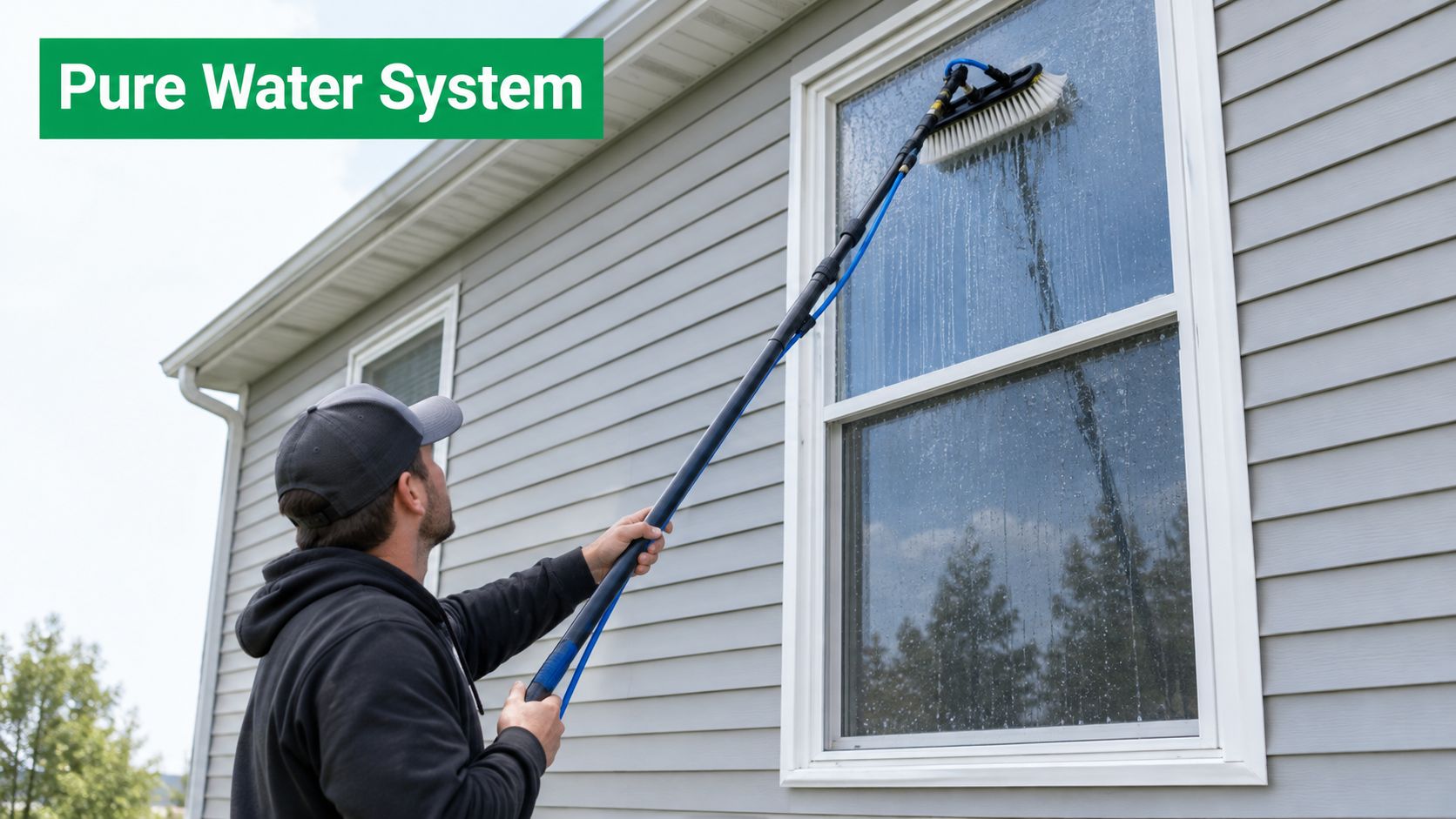
Pure-water systems solve a specific problem: tap water can leave minerals behind as it dries. A water-fed pole sends purified or deionized water through a hose to a brush head, allowing technicians to scrub exterior glass and frames from the ground without detergent residue as explained in this overview of commercial water-fed pole cleaning.
The brush isn't just a substitute for a squeegee. It's a pre-treatment tool that loosens dust, pollen, cobwebs, and frame soil before the final water removal step. On a mountain cabin surrounded by pine trees, for example, the brush can lift pollen and dust that would otherwise drag across the glass under a squeegee.
Use the system with intent
Arizona's hard-water conditions make purification especially important. Filtration cartridges need timely replacement, because exhausted resin or filters can allow dissolved minerals through. A technician should test water quality, maintain the system, and avoid assuming that a pole is producing spot-free water just because the hose is connected.
Heavy soil needs dwell time. Agitate the glass and frame, allow purified water to loosen the contamination, then rinse thoroughly. Rushing this stage can leave the squeegee fighting embedded grit and create avoidable detailing work.
Pure-water poles are well suited to second-story windows, sensitive landscaping, commercial properties seeking lower chemical use, and homes in Forest Highlands or Pine Canyon where clean frames and glass support a carefully maintained appearance. They're also useful around native plantings because the process can reduce the need for detergent runoff.
“Pure water is a method, not magic. The brush still has to contact the soil, and the technician still has to inspect the result.”
For stubborn interior soil, detailed divided panes, or certain restoration tasks, traditional squeegee work remains more precise. The strongest crews combine both approaches rather than treating one tool as a universal answer. The water-fed pole cleaning explanation shows how purified water, pole reach, and brush agitation work together.
4. Comprehensive Screen Removal, Cleaning, and Reinstallation
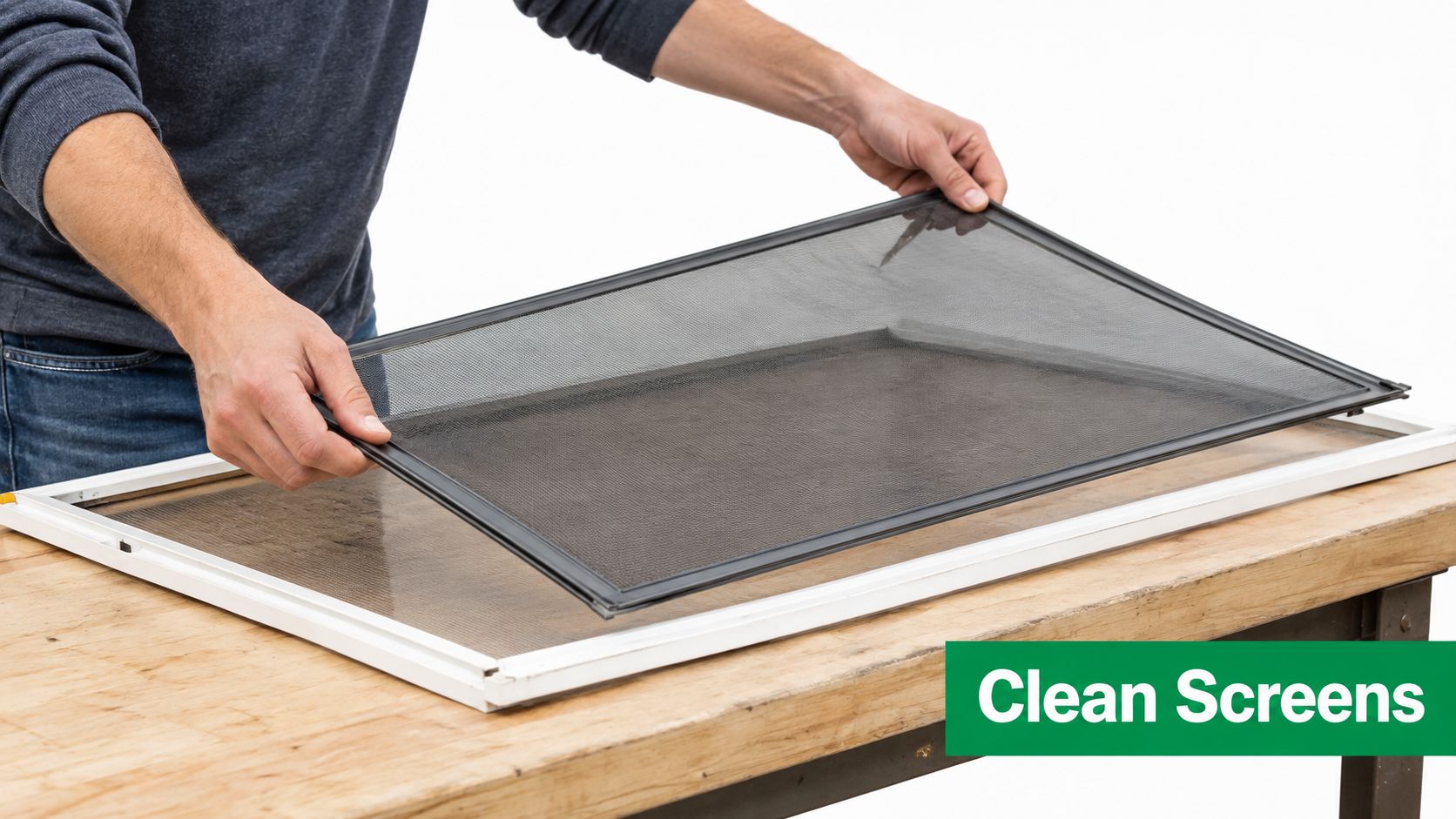
A window service isn't complete when the glass looks clean behind a dusty screen. Screens collect pollen, insects, cobwebs, and fine debris, then release that material into the room when a window opens. Professional crews should remove screens, clean the mesh and frames, and reinstall each screen securely.
Pine Country Window Cleaning includes screen removal, cleaning, and reinstallation with every service. That process requires more care than a quick rinse. The technician should identify each screen's location, remove it without bending the frame, clean both sides without damaging the mesh, and check that the frame and spline remain intact.
Treat screens as functional components
Screen service is especially useful for mountain cabins, second homes, short-term rentals, screened porches, and commercial properties with many operable windows. A Forest Highlands or Munds Park home preparing for an occupied season may need the screens cleaned before windows are opened regularly. An Airbnb or VRBO property needs the same attention because guests notice trapped debris and poorly seated screens.
During removal, look for:
- Tears and loose mesh: Note damage before reinstalling the screen.
- Bent frames: A warped frame may not seat correctly or provide reliable insect protection.
- Blocked tracks: Debris can prevent smooth operation and create pressure on the frame.
- Incorrect placement: Labeling or organizing screens prevents a careless swap between openings.
- Security and fit: Confirm that clips, springs, and latches engage after cleaning.
Screen cleaning also provides a useful inspection opportunity. A technician may notice a screen that no longer fits, a damaged latch, or a window that doesn't open normally. Those observations should be communicated clearly, without turning a maintenance visit into a pressured sales pitch.
The customer should know what the service includes before work begins. “Exterior glass” and “complete window service” aren't always the same scope. Removing and reinstalling screens makes the result more useful because the entire window opening, not just the exposed pane, receives attention.
5. Customer Care and Home Respect as Professional Standard
Clean glass is only part of professional window service. A dependable crew arrives as scheduled, confirms the agreed scope, and treats the property with care from entry to departure. Customers should receive clear updates when weather, access, or site conditions change.
Protection begins before cleaning starts. Use drop cloths on interior floors, shoe covers where appropriate, and ladder positions that avoid walls, furniture, landscaping, and finished surfaces as described in this service overview. Move only necessary items, ask before handling fragile belongings, and return each area to its original condition. Wet sills, muddy footprints, displaced furniture, and open gates require attention before the crew leaves.
Trust also depends on the service relationship. Pine Country Window Cleaning is locally owned and operated by Flagstaff native David Kaminski and has served the area since 1999. The company describes itself as Flagstaff's largest window cleaning company. Its service context includes homes and cabins in Forest Highlands, Pine Canyon, and Munds Park, as well as commercial and short-term rental properties.
A practical customer review should cover:
- Property access: Confirm who will enter, how technicians are identified, and whether background checks are part of the hiring process.
- Issue resolution: Ask for the satisfaction guarantee and the process for reporting incomplete or damaged work.
- Scheduling: Clarify arrival notices, rescheduling, gate codes, pets, and other access instructions.
- Professional affiliations: Check stated memberships, including the International Window Cleaning Association.
- Service reviews: Look for feedback on communication, punctuality, respect, and cleanup alongside comments about the glass.
Pricing should match the work performed. The quote needs to identify interior and exterior glass, screens, tracks, hard-water treatment, lifts, or post-construction debris when those services apply. Clear scope prevents surprises, gives technicians enough time to meet the agreed standard, and lets customers choose the service they need.
A professional visit should leave clean glass, an orderly property, and confidence that the crew respected the home.
6. Post-Construction Window Cleaning and Debris Removal
Post-construction glass requires a different service standard from routine household cleaning. Fine dust can settle in tracks, adhesive may remain on panes, paint overspray can catch the light, and debris may bond to the surface. Removing those materials without scratching glass or damaging finishes requires the right inspection, tools, and sequence.
Schedule the work after dust-producing trades have finished, while leaving time for corrections before the final walkthrough or move-in. Before cleaning, technicians should identify glass types, coatings, protective films, labels, frames, and adjacent finishes. Scrapers, pads, and solvents must match those materials. A tool that works safely on one pane can damage another.
For a new Flagstaff home, the crew should coordinate with the builder's walkthrough and the owner's occupancy date. Offices, hotels, medical buildings, and NAU renovations may need work divided across floors or wings. Real estate teams may require a final clean before photography, staging, or listing inspections.
The handoff should include:
- Final-phase timing: Confirm that construction dust and debris-producing work are complete.
- Material review: Record coatings, films, labels, and sensitive finishes before selecting tools.
- Debris documentation: Provide notes or photographs of material removed and areas requiring follow-up.
- Acceptance inspection: Walk the property with the responsible contact and identify missed panes.
- Occupancy planning: Reserve time for corrections before residents, guests, staff, or tenants arrive.
A careful cleaning also exposes conditions outside the cleaning scope, including scratched glass, damaged screens, failed seals, or paint on nearby finishes. Document each finding and distinguish existing damage from removable contamination. This protects the owner, builder, and cleaning crew from unclear responsibility.
Exterior conditions deserve the same reporting discipline. Roof access, drainage problems, or construction runoff can affect windows and surrounding surfaces. The owner may need a business roof repair resource alongside window maintenance. The window crew should report that need accurately without bundling unrelated work or implying that cleaning will correct it.
7. Seasonal Maintenance and Northern Arizona Climate Adaptation
Northern Arizona windows need a service plan that follows changing exposure. Snow residue, spring pollen, summer dust, fall debris, hard water, and high-elevation weather each affect when technicians work and which methods they use.
A property's schedule should reflect how it is used and exposed. Spring service clears winter film and pollen before windows are opened more often. Fall service removes debris before winter weather limits exterior access. A mountain cabin preparing for seasonal closure needs a different visit pattern from a full-time home. Hotels and short-term rentals require appearance control during continuous occupancy.
Sun and dryness also change the work itself. On broad, sun-exposed panes, solution may dry before the squeegee reaches it. Smaller working sections, frequent blade wiping, controlled application, and adjusted technique reduce this risk. Shade helps, but crews still need a workable method when the property cannot support full-shade scheduling.
Seasonal planning can follow this operating rhythm:
- Spring preparation: Remove winter residue and pollen before peak window use.
- Summer control: Monitor dust and fast-drying solution on exposed glass.
- Fall preparation: Finish accessible exterior work before winter conditions restrict access.
- Winter inspection: Check seals, frames, and operating hardware for weather-related trouble.
- Water management: Use purified or deionized water where mineral deposits are a concern.
The same schedule will not suit every property. Homes near dusty roads, active construction, trees, or unpaved areas may require more frequent cleaning than sheltered homes. Storefronts and guest-facing commercial glass should follow appearance standards and traffic patterns rather than household convenience.
Mineral spotting requires a separate decision from routine soil removal. A technician should identify whether purified water, additional agitation, or a more specialized restoration method fits the glass and the deposit. Choosing the wrong process can waste labor or leave marks behind.
Quarterly service may suit high-dust properties, while other customers need fewer planned visits with inspections between them. Base the recommendation on observed buildup and the customer's priorities. The practical goal is to remove soil, pollen, and mineral residue before they become harder and more expensive to correct.
8. Commercial and High-Rise Property Specialization
Commercial window cleaning succeeds when the service plan fits the building. Hotels, medical facilities, office complexes, campuses, dealerships, and storefronts each impose different access limits, traffic patterns, appearance standards, and scheduling requirements.
Start with the property's operating constraints. A dealership may require clear display glass during business hours while keeping ladders and lifts away from vehicles. A medical building needs controlled communication around entrances and patient areas. Hotels require work that avoids disrupting arrivals, rooms, and outdoor operations. NAU academic buildings, dormitories, and administrative facilities can involve several departments, keys, escorts, and access zones.
The proposal should make the scope easy to verify. Separate labor, materials, access equipment, difficult areas, and specialized restoration. State whether the price includes interior and exterior panes, screens, frames, tracks, lift setup, water-fed pole work, and post-job documentation.
Before scheduling, the crew and facility manager should confirm:
- Maintenance rhythm: Set quarterly or semi-annual visits when the building's exposure and appearance standards support them.
- Insurance suitability: Confirm coverage for the property and planned access method.
- Technician credentials: Verify background checks and OSHA safety training.
- Traffic controls: Choose low-traffic work periods and mark pedestrian routes.
- Site coordination: Arrange keys, escorts, loading areas, alarms, tenant notices, and equipment staging.
High-rise work does not automatically call for the newest technology. Drones and robotic systems can suit predictable façades under appropriate conditions. Irregular architecture, heavy contamination, construction debris, or restricted access may favor trained technicians using lifts, water-fed poles, squeegees, and hand tools. The correct method matches the building and the risk, not the equipment list.
A dependable closeout includes a written service record. Document completed areas, inaccessible sections, damage observations, water or debris concerns, and recommended follow-up. Managers can then compare results across visits, brief replacement staff, and arrange related services such as screen cleaning, frame and track work, restoration, or scheduled maintenance. Post-job review turns a one-time commercial visit into an accountable service program.
8-Point Professional Window Cleaning Comparison
| Service | Implementation complexity | Resource requirements | Expected outcomes | Ideal use cases | Key advantages |
|---|---|---|---|---|---|
| Professional Squeegee Technique for Streak-Free Results | Moderate, requires training to master angle/pressure | Squeegees, replaceable blades, professional handles, trained operator | Genuine streak-free glass, faster than hand-wiping | Routine residential and commercial window cleaning, large panes | Fast, streak-free finish; gentle on glass |
| Professional-Grade Ladder and Lift Safety Protocols | High, rigorous safety procedures and training | Boom/scissor/atrium lifts, PPE, maintenance, insurance, OSHA-trained staff | Safe high-access work, reduced fall risk, efficient multi-story access | High-rise, steep roofs, commercial façades, tall atriums | Safe access to extreme heights; regulatory compliance |
| Pure Water Brush Cleaning Systems for Optimal Pre-Treatment | Moderate, equipment setup and maintenance required | Deionized water system, extension poles, brush heads, filtration cartridges | No mineral spots, effective pre-clean of dirt/pollen, chemical-free finish | Hard-water regions, high-pollen/dust areas, delicate glazing | Prevents spotting, eco-friendly, gentle on seals |
| Comprehensive Screen Removal, Cleaning, and Reinstallation | Low–Moderate, careful handling adds time | Labor time, cleaning station/tools, secure reinstallation process | Fully cleaned screens and tracks, improved airflow and visibility | Seasonal maintenance, rentals, homes with many screened windows | Thoroughness, extends screen life, included with service |
| Customer Care and Home Respect as Professional Standard | Organizational, vetting and service standards | Background checks, training, communication systems, satisfaction guarantee | Higher homeowner trust, fewer disputes, reliable scheduling | Occupied homes, second homes, short-term rentals | Builds trust, clear communication, satisfaction guarantee |
| Post-Construction Window Cleaning and Debris Removal | High, specialized techniques and timing | Specialized cleaners, protective methods, experienced technicians, extra labor | Removal of paint/adhesive/debris; windows ready for occupancy/listing | New construction, renovations, pre-sale staging, commercial turnovers | Restores new windows safely; improves presentation |
| Seasonal Maintenance and Northern Arizona Climate Adaptation | Moderate, seasonal scheduling and protocols | Flexible scheduling, deionized systems, winter/ice procedures | Year-round appearance, reduced weather-related damage, fewer spots | Mountain cabins, second homes, properties in variable climates | Preventive care, tailored timing, climate-specific methods |
| Commercial and High-Rise Property Specialization | High, project management and coordination | Large crews, access equipment, insurance/bonding, scheduled programs | Consistent façade appearance, minimal operational disruption | Hotels, campuses, office complexes, retail storefronts, high-rises | Scalable crews, insured operations, specialized access equipment |
Turn Clean Windows Into a Complete Service Standard
The strongest professional window cleaning tips all point to the same conclusion: results come from a repeatable service system. A technician chooses the safest practical access method, prepares the correct tools, uses pure-water equipment where it improves the work, and selects a squeegee pattern that suits the pane. The crew doesn't force one technique onto every window.
Start with access. Inspect the property, identify ladders, poles, lifts, roof routes, interior obstacles, electrical hazards, weather concerns, and ground conditions. If a lift is required, confirm clearance and inspection readiness before arrival. If a ladder is appropriate, place it correctly and keep the work area controlled. If conditions become unsafe, communicate the limitation and reschedule or change the method.
Then inspect the equipment. Squeegee rubber should be clean and undamaged. Pure-water systems should produce suitably purified water, with filters and cartridges maintained. Brushes, hoses, poles, buckets, scrapers, and protective materials should be ready before the job begins. Rework often starts with a tool that was worn, dirty, mismatched, or rushed into service.
Screens deserve equal attention. Remove them carefully, clean the mesh and frames, inspect for damage, and reinstall each screen so it seats and functions correctly. A complete service also protects the customer's home with drop cloths, shoe covers, sensible ladder placement, and careful handling around furniture, walls, floors, landscaping, and finished surfaces.
Verify the result before leaving
Final inspection should happen from useful viewing angles and in the light available at the property. Check edges, corners, divided panes, frames, tracks, screens, and areas hidden from the first working position. If sunlight, interior lighting, or changing conditions reveal a limitation, document it rather than pretending the job is complete.
Communication belongs in the final step. Explain what was cleaned, what couldn't be reached, what damage was observed, and what maintenance may deserve attention. A customer may benefit from gutter and downspout cleaning, pressure washing, or seasonal snow removal, but those opportunities should be presented as relevant observations, not pushy add-ons. A clogged gutter near a clean window, for example, is worth mentioning because runoff can affect the surrounding property.
Clean windows also contribute to broader presentation goals. Homeowners preparing a property for guests or a sale may pair window service with other budget-friendly curb appeal upgrades for Boston homes, while local Flagstaff owners may focus on screens, dust, seasonal access, and exterior upkeep. The principle is the same: prioritize improvements that customers can see, use, and maintain.
Pine Country Window Cleaning offers residential and commercial window cleaning, screen care, gutter and downspout cleaning, pressure washing, post-construction service, and seasonal snow removal in Northern Arizona. Its background-checked, OSHA safety-trained technicians work on homes, cabins, hotels, NAU facilities, medical buildings, car dealerships, and high-rise properties, using equipment that includes boom lifts, scissor lifts, and a 95-foot atrium lift.
Reliable communication, careful property treatment, and verified results build repeat service and referrals. For Flagstaff and surrounding communities, Pine Country Window Cleaning provides free estimates and scheduling options through its website.
Pine Country Window Cleaning provides residential, commercial, screen, post-construction, gutter, downspout, and pressure washing services for Flagstaff and Northern Arizona properties. Visit Pine Country Window Cleaning to request a free estimate or schedule service with a team focused on safe access, careful home protection, and complete window care.