

You're standing below a two-story Flagstaff home, watching water run down the glass after the cleaner has finished. No bucket is visible. No squeegee touches the pane. There isn't even a ladder leaning against the wall. The windows look unfinished for a moment, but that wet surface is part of the process.
How does water fed pole window cleaning work? A technician pumps purified water through a telescoping pole to a soft brush. The brush loosens dirt from the glass and frames, while the same water rinses the loosened soil away. Because the water contains almost no dissolved minerals, it can dry without leaving the spots ordinary tap water would leave behind.
For Northern Arizona homes, cabins, and commercial buildings, the method combines two ideas that work together: pure-water chemistry and ground-level technique. Understanding both helps you know when a water-fed pole is the right tool, when traditional detailing is still needed, and what a careful professional service should include.
What a Water Fed Pole Service Looks Like From the Ground
A Flagstaff homeowner might first notice the equipment arriving at a pine-shaded A-frame. A two-person crew parks the van, uncoils a hose, and prepares a tank containing purified water. One technician lifts a carbon fiber telescoping pole while the other manages the hose on the ground. The pole rises toward the upper panes, but no ladder leaves the truck.
The visible sequence is simple. The technician pre-rinses the frames and glass, guides the brush across the pane, and works methodically from one section to the next. You may hear the quiet hiss of water, see sunlight catch in the spray, and notice the soft movement of the brush against sun-warmed glass.

The ground-up sequence
The technician usually follows a controlled pattern:
- Frame rinse: Loose dust and grit are flushed from the frame, sill, and surrounding edges before the brush does detailed agitation.
- Brush agitation: Soft bristles move across the glass and frame, breaking the bond between the surface and ordinary exterior dirt.
- Final rinse: Purified water flows over the pane and carries the loosened contamination downward.
- Ground inspection: The technician steps back, checks the glass from below, and looks for missed soil, drips, or access problems.
The windows may remain visibly wet after the final rinse. That isn't a mistake. The water is intended to sheet or bead across the surface and then evaporate cleanly. What most homeowners notice first is that the entire operation stays grounded, which reduces the repeated ladder movement associated with reaching upper exterior panes.
A water-fed pole doesn't eliminate the need for judgment. Wind, overhead power lines, delicate surfaces, roof edges, and awkward access still require a site assessment. The Water Fed Pole Systems safety guidance specifically warns operators against high winds and work near overhead power lines.
How Pure Water Is Made and Why It Matters
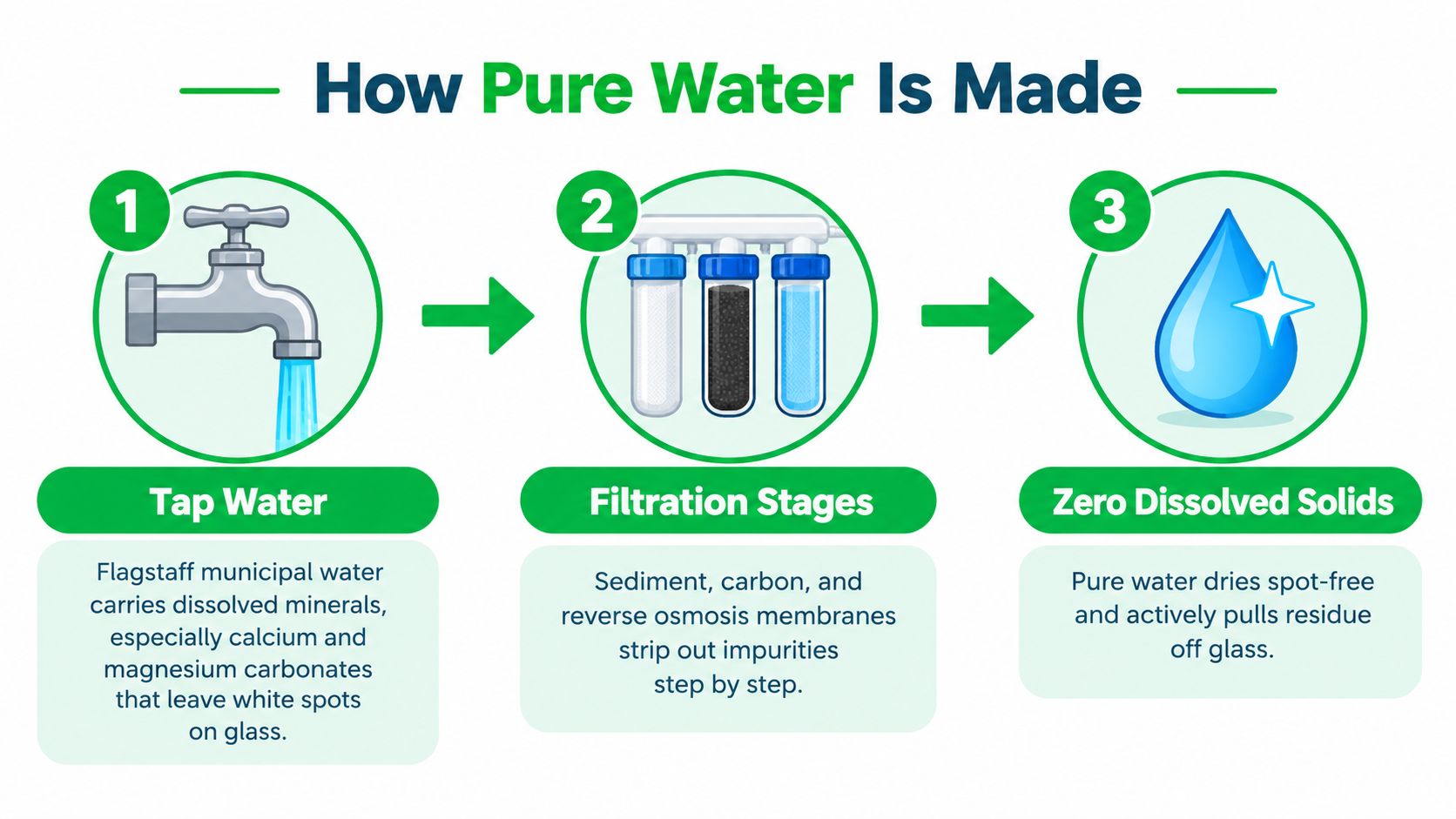
Flagstaff tap water carries dissolved material that isn't always visible in the stream coming from the faucet. Calcium, magnesium, salts, and other minerals remain suspended at a microscopic level. Once ordinary water dries on glass, those minerals can remain behind as the familiar white spots or hazy marks.
Professionals describe that mineral load with total dissolved solids, or TDS. TDS is a measurement of how much dissolved material remains in the water. A professional pure-water system aims for water around 0 ppm TDS, while practical industry guidance commonly keeps rinse water below about 10 ppm, with some recommendations calling for below 5 ppm for the clearest finish. (Aloha Window Bros explains TDS targets and spotting risk)
The treatment path
A multi-stage setup removes those dissolved solids in sequence:
- Pre-filtration protects the system. Sediment and carbon filters remove particles, chlorine, and some organic matter before the water reaches the main purification equipment.
- Reverse osmosis reduces the mineral load. The membrane separates much of the dissolved material from the water, creating a cleaner feed for the final stage.
- Deionization polishes the result. DI resin captures remaining charged particles, helping the operator reach the very low TDS needed for spot-free rinsing.
The exact arrangement varies by equipment and source water. The technical principle doesn't change. The system removes the minerals before the water travels through the pole, rather than asking a squeegee to remove mineral-bearing water after it reaches the glass.
For readers who want broader background on household treatment technology, Ring Hot Water filtration systems offers useful context on water purification equipment. Window-cleaning systems apply the same basic concern, controlling what remains dissolved before water is used on a visible surface.
The chemistry explains the finish. When low-TDS water evaporates, it doesn't deposit the same mineral residue as untreated tap water. The brush removes the dirt, and the purified rinse carries it away. For a practical overview of the service itself, see Pine Country Window Cleaning's professional window cleaning solution.
The Pole, the Brush, and the Glass
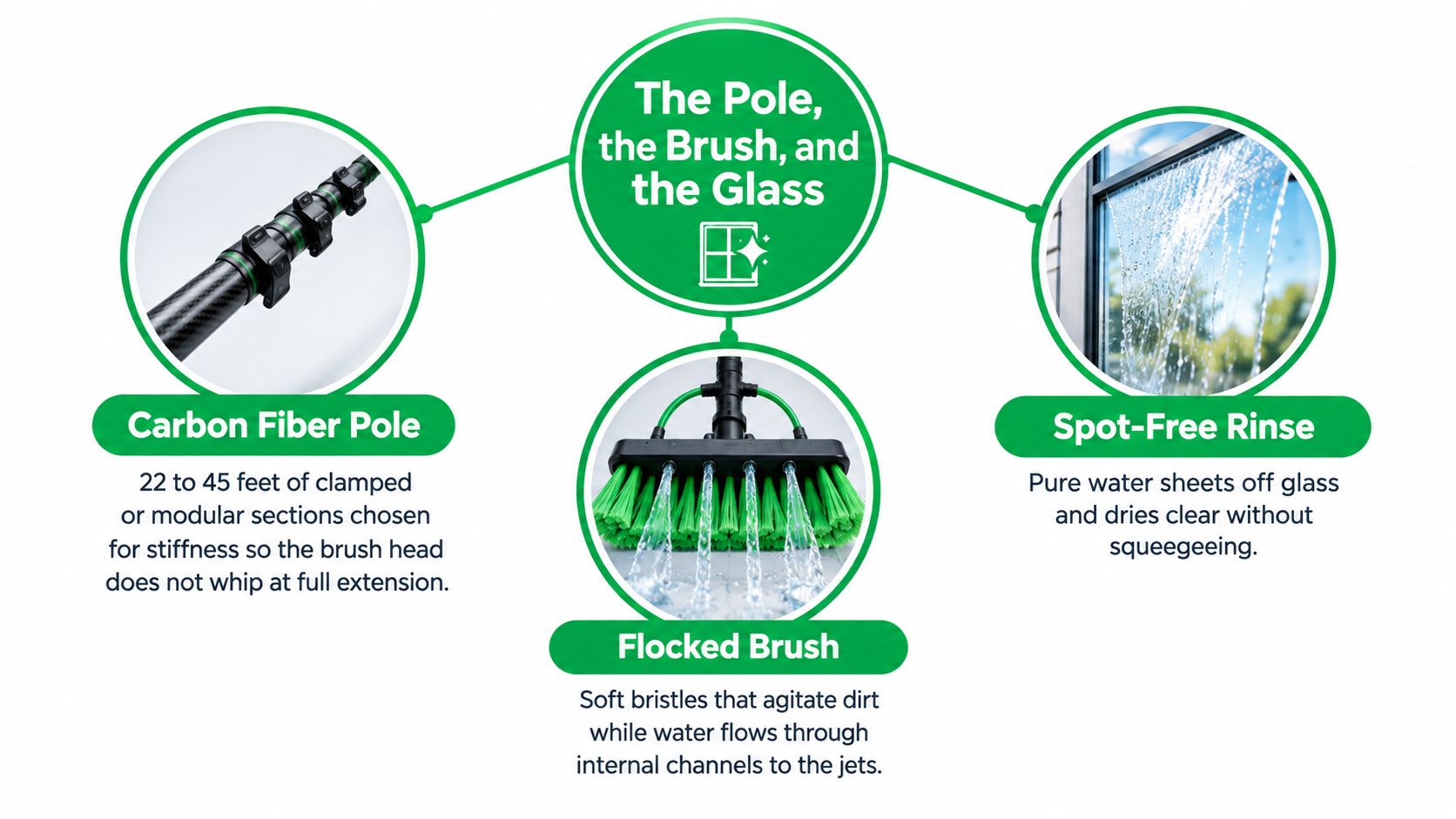
A water-fed pole system has three working parts, and each solves a different problem. The telescoping pole supplies reach from the ground. The brush head supplies controlled agitation. The purified water loosens and carries away what the brush lifts.
Many professional setups use clamped or modular carbon fiber sections in the general range of 22 to 45 feet, depending on the property and equipment configuration. Carbon fiber keeps the pole relatively light and rigid compared with less stable materials. Rigidity matters because a flexible pole can whip or chatter at full extension, making it harder to keep the brush flat against the pane.
The brush isn't a household scrub brush. It typically uses soft nylon or flagged bristles designed to agitate exterior soil without scratching normal glass when the technician uses the correct technique. Small jets or internal channels deliver water through the brush head, so the operator can scrub and rinse during the same pass.
What happens on one pane
A technician may work from the top of a pane downward:
- Water softens the surface soil. Dust, pollen, and loose exterior residue become easier to move once thoroughly wet.
- The bristles lift contamination. Controlled strokes break up grit around edges, frames, and corners. In Flagstaff, that can include pine debris, fine dust, and particles carried by storms.
- The rinse moves soil away. Continuous purified water carries loosened material toward the bottom of the glass instead of leaving it suspended in a soap film.
- Evaporation completes the process. Low-mineral water dries without depositing the dissolved solids that create spotting.
That last step causes much of the confusion. Traditional squeegee cleaning removes water mechanically. A water-fed pole method intentionally leaves purified water on the glass because the water itself has been treated to dry clear. The water-fed pole system explanation from J. Racenstein describes the same sequence, purification first, delivery through the pole, agitation at the brush, and rinsing at the pane.
The operator still needs good technique. A brush must make consistent contact, the frame must be rinsed rather than ignored, and the technician must account for wind, shade, temperature, and the condition of the glass. Equipment provides the reach, but the person holding it controls the quality.
If you're considering equipment for a specific property, water-fed pole system rental information can help you understand what this type of setup involves. Rental equipment doesn't replace training, water testing, or safe access planning.
Water Fed Poles Versus Traditional Squeegee Cleaning
A two-story Flagstaff home with tall exterior windows shows the practical difference between these methods. A water-fed pole lets the technician stay on the ground while purified water and a brush reach the upper glass. Traditional squeegee work gives direct hand control, but the technician may need ladder or lift access when the pane cannot be reached safely from below.
Neither method fits every window. The choice depends on the surface, access, surrounding property, and cleaning goal.
A fair comparison
| Consideration | Water-fed pole | Traditional squeegee |
|---|---|---|
| Primary access | Ground-based pole and hose | Hand tools used from the ground or ladder or lift access |
| Exterior upper panes | Well suited to many homes and commercial properties | Effective where the technician can safely reach the glass |
| Finish | Purified rinse dries without mineral residue | Precise hand-finished result, especially indoors |
| Frames and sills | Brush and rinse can cover surrounding exterior areas | Often require separate hand work |
| Special conditions | Needs safe clearance from lines, roofs, and wind | Can suit restricted areas or detailed interior work |
| Property contact | No ladder contact with gutters or landscaping | Ladder placement requires careful protection |
The reach can be substantial. Industry descriptions commonly place water-fed poles around 55 to 65 feet, while some systems extend to 9 metres or even 60 to 80 feet, depending on the setup. (National Window Cleaning Authority describes common pole reach and operation) Other industry material describes the method as suitable for cleaning up to roughly five stories from the ground. (WAXIE explains water-fed pole applications)
Where the squeegee remains valuable
A squeegee gives the technician immediate tactile feedback. That control suits interior glass, mirrors, narrow panes, delicate detailing, and areas where runoff could mark a wall. A professional crew may also choose a squeegee for first-time restoration, construction cleanup, or glass requiring a hand-applied treatment.
The surrounding property affects the decision as much as the glass. A poorly placed ladder can press against gutters, disturb irrigation lines, or crush xeric landscaping. A pole and brush avoid those contact points, although the hose still needs thoughtful routing around doors, walkways, and plantings.
Pure water works well on loose exterior soil, while hand tools provide greater control over interior work and bonded marks. Northern Arizona properties may present both conditions on the same visit, with dust or irrigation minerals outside and detailed tracks, screens, or stubborn residue requiring separate tools.
Practical rule: Choose the method that reaches the glass safely, matches the soil, and protects the surfaces around it.
A capable company keeps both approaches available. Water-fed poles handle much of the exterior work from the ground, while squeegees, scrapers, towels, and specialty products remain useful for interiors, screens, tracks, and marks that rinsing alone cannot remove.
Where the Method Fits in Northern Arizona
A Flagstaff homeowner may look through clear glass in spring and still see a veil of pine pollen along the frames. Fine dust settles in shaded corners, while an irrigation sprinkler can leave mineral marks on a sunny picture window. A cabin near the Coconino National Forest may sit closed through winter, allowing residue to build on exterior panes before the owner returns.
Those conditions show why water-fed pole cleaning depends on both pure-water chemistry and ground-level technique. Pure water leaves little mineral residue as it dries, while the brush loosens material from the glass and frames. The method works best when the contamination is loose and the upper exterior panes can be reached safely from below.
For many homes in Flagstaff, Sedona, and Payson, that means a two-story stucco facade with tall picture windows. A technician can work across the upper glass, frames, and edges without setting a ladder on uneven flagstone, planted ground, or a sloped lot.
Homes, cabins, and second properties
A vacant cabin may need a more deliberate first visit than a maintained primary residence. Pine pollen, dust, bird residue, and winter road grime can collect around sills and frames. The technician pre-rinses those areas, agitates the loose contamination with the brush, and checks the glass after the final rinse. Any remaining mark then has to be assessed rather than assumed to be removable with pure water.
That approach suits second homes in Pine Canyon, Forest Highlands, Flagstaff Ranch, and Munds Park. Ground-based access reduces the need to move ladders across porches, stone paths, landscaping, and other surfaces owners want protected. It also gives a crew a practical way to reach upper exterior panes while keeping equipment and runoff under control.
Seasonal conditions change the work:
- Spring pollen: Brush agitation and careful frame rinsing help remove soft airborne buildup.
- Summer dust and monsoon weather: Crews may adjust timing for wind and storms, then rinse fine soil from glass and frames.
- Winter road grime: Homes near plowed streets can develop residue on lower panes and nearby trim, where extra rinsing may be needed.
Commercial properties
Hotels, apartment complexes, offices, medical and dental buildings, and retail storefronts can use the same method for recurring exterior maintenance. Auto dealerships with floor-to-ceiling showroom glass need clear windows without disrupting displays. Hotels in Old Town Flagstaff benefit from a repeatable process around guest areas, while apartment communities can often reach upper windows without moving ladders through every courtyard.
A water-fed pole remains one part of the access plan at larger facilities. Obstructed atriums, interior glass, skylights, roof-level panes, and restoration work may require lifts, rope access, or hand tools.
The practical question is local: can the exterior glass be reached safely from the ground, and will brushing and rinsing address the soil on the property? In Northern Arizona, dust, irrigation minerals, cabin residue, and winter grime make that assessment more useful than a broad market forecast.
What the Method Cannot Do and Why
Pure water isn't a magic solvent. Its lack of dissolved minerals is the reason it dries without mineral spots, but that same chemistry doesn't automatically dissolve deposits that have bonded to or etched the glass.
Hard-water spots from irrigation overspray in Prescott can become chemically attached to the surface. Limescale, oxidation, paint flecks, stucco smear, concrete dust, and silicone residue may require a different response. A water-fed brush can remove loose material around a mark, but it may leave the bonded portion untouched.
Common exceptions
- Mineral deposits: Mild acid cleaners or glass-safe restoration products may be needed, selected for the glass and coating.
- Etched staining: Polishing compounds applied by hand can be appropriate when minerals have damaged the surface rather than merely sitting on it.
- Construction residue: Scrapers, solvents, or specialized post-construction procedures may be necessary for paint and sealant.
- Traffic film: Street-level storefront glass can collect oily residue that responds better to a detergent pre-wash than to pure water alone.
Low-E coatings and specialty glass also deserve caution. The technician must identify the surface before choosing a chemical, scraper, pad, or polishing method. Aggressive treatment can create more damage than the original spot.
A separate misunderstanding involves what “window cleaning” includes. Water-fed pole service generally focuses on accessible exterior glass and surrounding exterior frames. Screens, tracks, interior panes, and heavily soiled sills may need removal, hand cleaning, or separate detailing. Professional companies often quote those tasks separately because they require different labor, tools, and drying procedures.
For a homeowner dealing with white mineral marks, this guide to removing hard-water stains from windows offers a useful explanation of why ordinary rinsing may not be enough.
Pure water is excellent at removing loose contamination. It isn't a substitute for glass restoration.
The good news is that a mark left behind usually has a practical next step. Experienced crews keep traditional tools on the truck because bonded cleaning, interior work, screens, tracks, and construction residue still demand hands-on judgment.
Choosing a Window Cleaning Company You Can Trust
The equipment should tell you something about the company, but it shouldn't be the only thing you evaluate. A tall pole doesn't guarantee a clean window. The result depends on water quality, brush condition, operator technique, safety planning, and the scope written into the quote.
Start with purification. Ask whether the contractor uses a multi-stage setup that can include reverse osmosis and deionization, rather than relying on a single cartridge. Then ask how the crew checks TDS at the point of use and what reading it considers acceptable for the final rinse.
Questions worth asking
- How do you verify the water? A TDS meter gives the operator a practical check before water reaches the brush. If the reading is too high, the company should know how it will correct the problem.
- What brush will you use? Flagged or appropriately soft bristles should be maintained rather than worn down or contaminated with grit. The brush should suit the glass and frame material.
- How rigid is the pole? Carbon fiber or another rigid composite can provide more stable reach than a flexible or poorly maintained pole, especially on upper-story panes.
- What does the service include? Confirm whether exterior frames, sills, screens, tracks, and interior glass are included, excluded, or priced separately.
- How are screens handled? A careful workflow removes each screen, cleans both sides with a soft brush or gentle wash, rinses it thoroughly, allows it to dry fully, and then reinstalls it. (Goleta Pressure Washing describes this screen-cleaning procedure)
- What safety coverage is in place? Ask for written proof of insurance, workers' compensation coverage, and a clear plan for ladder work, ground operations, overhead lines, wind, and difficult access.
Local fit matters
Northern Arizona properties don't all present the same water or weather conditions. Ask for references from homes, cabins, or commercial buildings with similar elevation, exterior materials, and exposure to irrigation overspray. A company that understands Flagstaff dust, Sedona mineral residue, winter conditions, and monsoon scheduling can set more realistic expectations than a contractor using one process for every property.
Clarify what happens when weather interrupts the appointment. High winds can make pole handling unsafe, and freezing conditions can affect water use, walkways, and finished surfaces. A dependable company should explain its rescheduling and freeze-thaw policies before the crew arrives.
Finally, request an itemized quote. The estimate should distinguish pure-water exterior cleaning from interior squeegee work, screen cleaning, post-construction cleanup, and mineral restoration. That separation prevents a common disappointment, the assumption that one exterior rinse will remove every mark from every pane.
Pine Country Window Cleaning provides pure-water exterior cleaning for hard-to-reach windows, along with traditional tools and broader property-care services for Northern Arizona homes and businesses. The locally owned company was started by Flagstaff native David Kaminski, has operated since 1999, removes, cleans, and reinstalls screens with every service, and serves residential and commercial properties while treating the home and surrounding landscaping with care.
If your Flagstaff, Munds Park, or Northern Arizona property needs exterior glass cleaned from the ground, visit Pine Country Window Cleaning to request a free estimate. The team can assess your window access, explain where pure-water cleaning fits, and identify any screens, interiors, mineral deposits, or restoration work that needs a different tool.