

A Northern Arizona deck can look harmless after a long season of sun. The boards turn silver-gray, mildew darkens the shaded edges, and a pressure washer waits in the garage, ready to make the surface look new again. That machine can also leave permanent stripes, raised fibers, or gouges if the spray is stronger than the wood can handle.
Pressure washing a deck safely depends on more than the number printed on the machine. Wood species, board condition, finish, nozzle angle, pressure, distance, water flow, and drying conditions all affect the result. The safest approach uses cleaner and patience to loosen the grime, then controlled water flow to rinse it away.
Why Pressure Washing a Deck Is Riskier Than It Looks
Sun-bleached cedar, pressure-treated pine, redwood, and dense hardwood don't respond to water pressure in the same way. Older boards may already have brittle springwood, open grain, failed stain, or small checks that weren't obvious before cleaning. A deck that's dry from intense Flagstaff sun can scar more readily than a board that has retained moderate moisture.
The common mistake is treating wood like concrete. A narrow spray can etch the softer grain, raise fibers into a fuzzy texture, and create clean bands beside dirty ones. Water driven into joints can also remain where boards meet framing, increasing the risk of moisture-related deterioration. Guidance for wood decks emphasizes a wide fan tip of at least 30 degrees, no more than 800 PSI, and a nozzle held at least 8 inches from the surface. When changing direction, moving farther away, beyond 12 inches, helps prevent visible hard-stop lines in the wood. (Treated Wood)
The surface isn't as bonded as it appears
Grime often looks welded to weathered boards, but cleaner, dwell time, and brushing can loosen much of it before the rinse. That combination gives the water a simpler job, removing suspended dirt instead of forcing a concentrated jet into the grain.
Practical rule: If the spray is doing all the cleaning, the setup is probably too aggressive.
Standard pressure washers may operate in the 2,500 to 4,000 PSI range, well above the level many wood decks need. Guidance warns that pressures above about 2,500 PSI can strip stain or paint, while pressures above 3,000 PSI can permanently damage wood fibers. (Belovora Exterior Cleaning) Pressure washing a deck is therefore a low-pressure, high-control restoration task, not a blast-cleaning exercise.
Tools, Cleaners, and Prep Before You Start
Set up the work area before connecting the wand. A machine with adjustable output is preferable, whether it's electric or gas, and a usable range of 1,500 to 2,500 PSI provides room to work cautiously. That machine rating isn't a target for every board. Softwood often needs far less.
Bring a 40-degree nozzle, a 25-degree nozzle, a 15-degree nozzle, and a soap tip. Add a downstream injector or dedicated detergent tank, a pump sprayer, stiff and soft brushes, and a garden hose with adequate flow. Use GFCI protection with electric equipment, and wear safety glasses, hearing protection, gloves, and closed-toe, non-slip shoes.
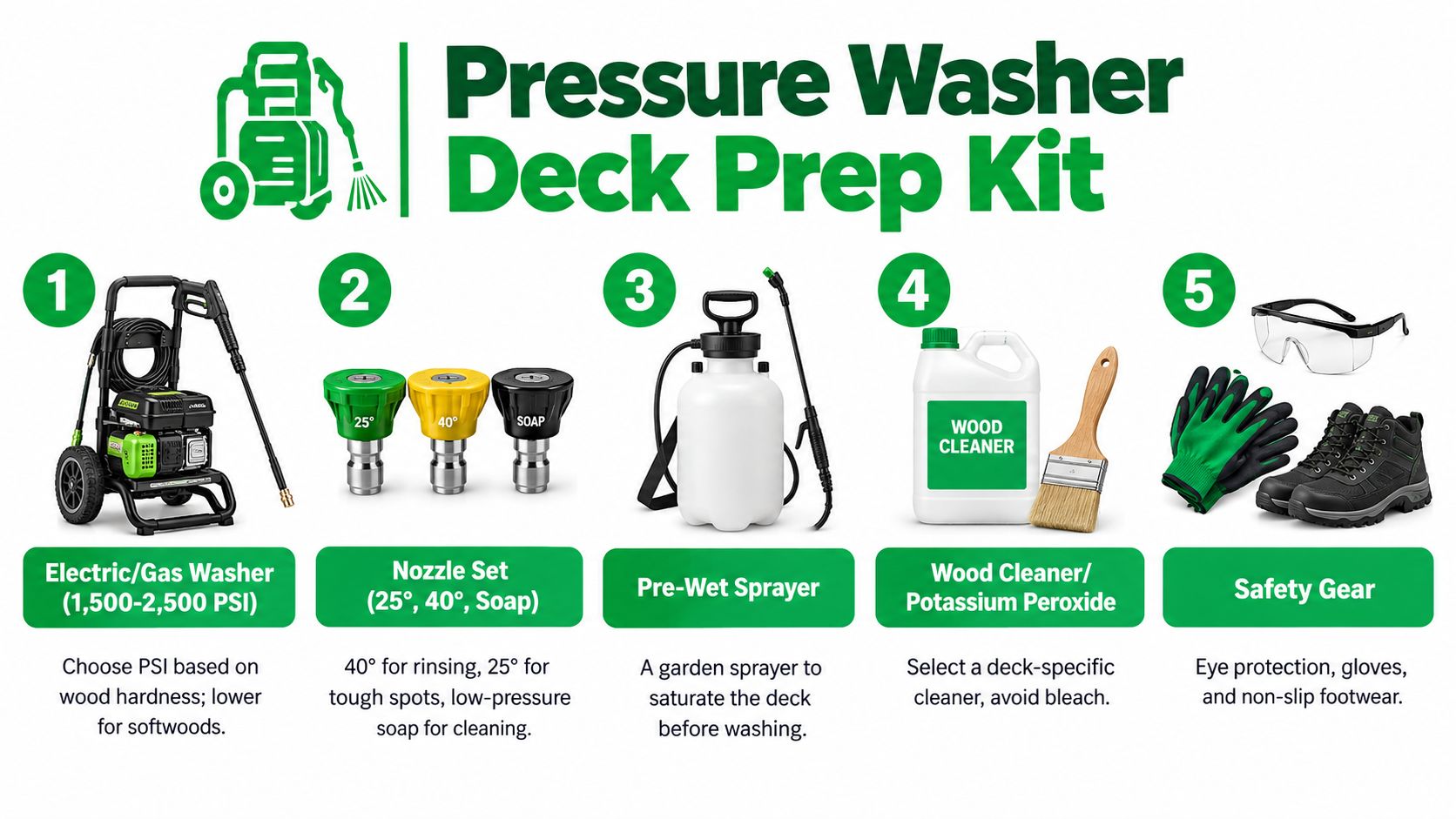
Choose chemistry before adding force
For mildew and weathered gray wood, an oxygenated cleaner can loosen organic buildup without relying on a hard blast. Sodium percarbonate brighteners are commonly used on cedar and redwood, while a neutral-pH wood cleaner suits a lighter seasonal rinse. Always follow the product label, protect nearby plants, and don't allow the solution to dry on the boards.
Before spraying, clear furniture, sweep leaves and grit from gaps, cover plants, and tape or shield nearby metal fixtures. Check the deck for loose fasteners, soft framing, cracked boards, and failing coatings. Test the complete process on a hidden board, including cleaner, dwell, brushing, and rinsing.
For a broader approach to low-impact exterior cleaning, see Pine Country Window Cleaning's eco-friendly pressure washing service. If staining is next, this guide to how to prep deck for stain helps connect the cleaning stage with the finish stage.
Choosing the Right PSI, Nozzle, and Distance by Wood Type
The correct setting is a relationship, not a single dial. PSI controls force, the fan angle spreads that force, and distance changes how concentrated the spray feels at the board. Flow matters during rinsing too. One industry comparison notes that a machine delivering 2.5 GPM at 1,500 PSI can rinse more effectively than a 4,000 PSI machine delivering only 1.8 GPM, because gallons per minute helps carry loosened dirt away. (Expert Power Washing)
The table below is a practical starting framework. Hidden-board testing still decides the final setting.
| Wood Type | Target PSI | Nozzle (color/degrees) | Standoff Distance | Pass Speed |
|---|---|---|---|---|
| Pressure-treated pine | 500–800 PSI | White, 40° | 12–18 inches | Slow, steady |
| Cedar and redwood | 500–800 PSI | White, 40° | 12–18 inches | Slow and even |
| Standard southern yellow pine | 500–800 PSI | White, 40° | 12–18 inches | Controlled, overlapping |
| Dense hardwoods such as ipe | 1,000–1,500 PSI | Green, 25° or 40° | 8–12 inches | Smooth, never stationary |
Independent guidance places softwoods around 500 to 1,200 PSI, with denser hardwoods reaching about 1,500 PSI, using a wide fan and at least 12 inches of working distance in many situations. The recommended process is to pre-wet, apply cleaner at low pressure, allow it to dwell, and rinse with the grain in overlapping passes. (HMNDP)
What works, and what doesn't
A 40-degree tip is the safer default for most wood rinsing. A 25-degree tip can address a stubborn area on a harder board, but it demands more care. Keep the 0-degree nozzle off the deck entirely. A 15-degree tip is also a poor choice for routine wood cleaning because its narrower pattern concentrates energy.
Some deck guidance recommends beginning near 500 to 600 PSI for cedar and pine, while other recommendations begin around 1,800 PSI and increase cautiously. The useful common ground is simple: start low, test a hidden area, and increase only when chemistry and controlled passes aren't enough. (Decks.com) For related exterior work, pressure washing a house requires the same surface-specific thinking, but siding and masonry shouldn't be treated like deck boards.
The Wash Sequence From Pre-Wet to Final Rinse
Start with the widest fan and the lowest practical pressure. Mist the entire deck until the boards are evenly wet, working from the house outward. This pre-wet step reduces sudden absorption and loosens surface grime before the cleaning solution has to work.
Mix the deck cleaner according to its label and apply it with a pump sprayer or low-pressure detergent system. Work in manageable sections, not across the whole deck at once. Cedar, pine, pressure-treated lumber, and hardwood can have different absorption and drying behavior, so consistent section size makes the dwell stage easier to control.
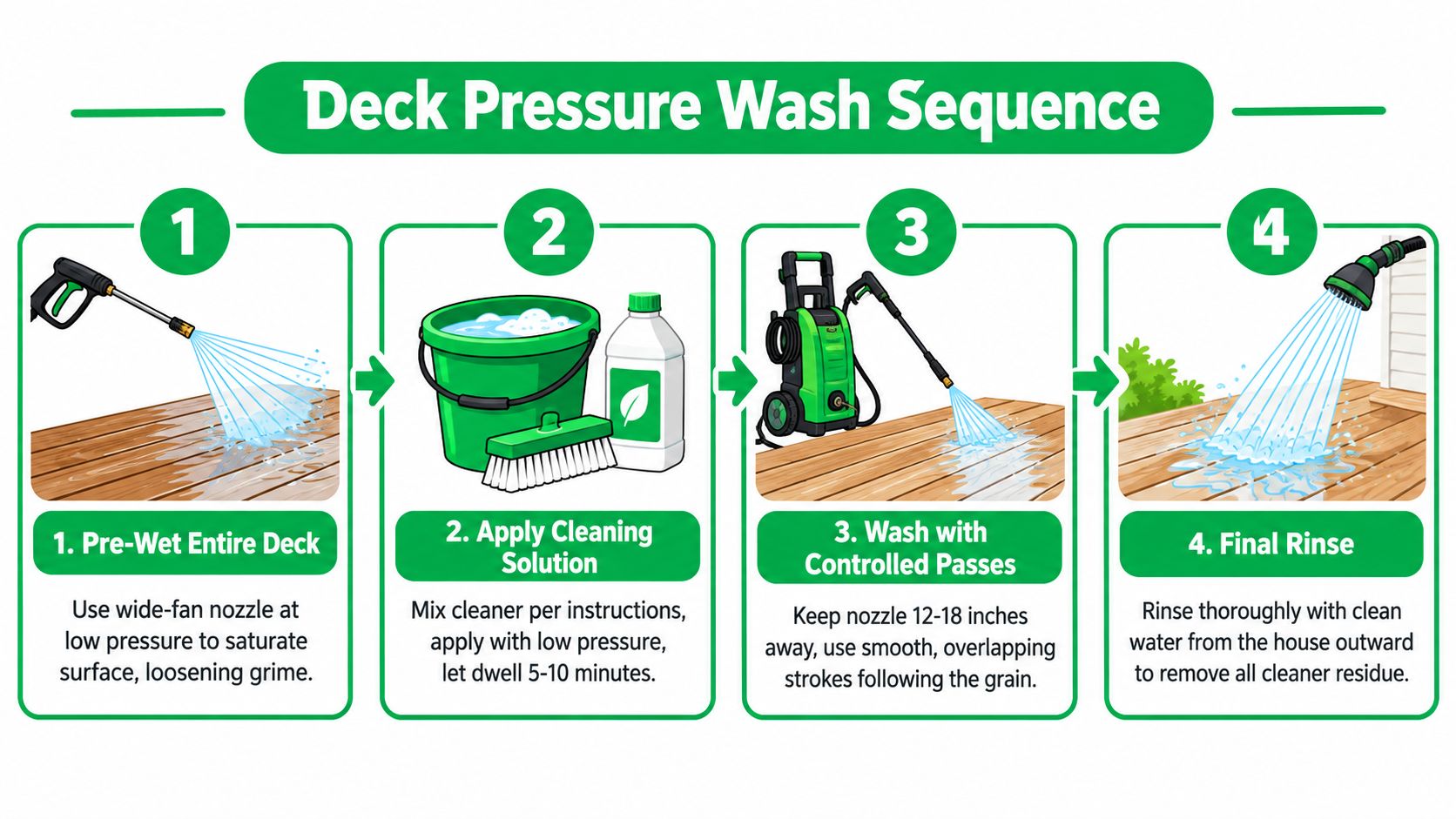
Let the cleaner do the heavy work
Give the solution enough contact time to break down mildew and oxidation, but never let it dry. The supplied process visual specifies a 5 to 10 minute dwell period. (MTM Hydro Parts) If a shaded patch begins drying while the rest remains wet, lightly mist that area rather than adding a stronger chemical mix.
Use a stiff-bristle, non-metal brush on stubborn spots, following the wood grain. Avoid grinding across the boards, especially where the grain is already loose or raised.
For the rinse, use the wide fan and keep the wand moving parallel to the boards. Hold it around 12 to 18 inches away, overlap each pass, and maintain a consistent walking speed. Stopping over one spot creates lap marks, while changing distance mid-pass can produce striping.
Watch corners, stairs, and the gaps beside rail posts. Finish by rinsing surrounding foliage and checking that no suds or cleaner remain. A deck should look evenly rinsed, not merely bright in the center and foamy along the edges.
Drying Time, Sealing, and Staining After the Wash
The wash isn't finished when the boards look clean. Northern Arizona's intense sun and low humidity can dry exposed surfaces quickly, while shaded areas and monsoon humidity can keep moisture in joints and board undersides. Washing immediately before a rain cell, sealing damp boards, or staining over heavy morning dew can trap moisture beneath the finish.
A practical drying window is 24 to 48 hours for most softwoods and up to 72 hours for dense hardwoods or shaded decks. Verify the surface with a moisture meter and wait for a reading under 15 percent, rather than relying only on a calendar. These timing and moisture benchmarks are commonly included in deck-finishing guidance for post-wash work. (L&D Decks)
| Wood Type | Minimum Dry Time | Target Moisture Reading | Recommended Finish |
|---|---|---|---|
| Cedar | 24–48 hours | Under 15% | Penetrating sealer or compatible stain |
| Redwood | 24–48 hours | Under 15% | Penetrating wood finish |
| Pressure-treated pine | 24–48 hours | Under 15% | Product-compatible sealer or stain |
| Dense hardwood | Up to 72 hours | Under 15% | Hardwood-appropriate penetrating finish |
Match the finish to the wood
A penetrating sealer soaks into the board and preserves a more natural appearance. A film-forming stain leaves a coating on the surface and can provide a different visual result, but it needs a clean, dry, properly prepared substrate to bond well. Existing failed coatings may require more than a routine wash before a new finish can succeed.
Cedar deserves particular care because aggressive washing can roughen its softer grain. This resource on protecting your cedar deck offers useful finish-focused context from Guelph Deck Builders. For a related preparation decision, pressure washing a house before painting follows the same principle: the surface must be clean and adequately dry before applying a coating.
Inspect again after drying. Washing can reveal loose boards, exposed fasteners, soft areas around joists, and uneven old stain. Those conditions matter more than a bright, freshly rinsed appearance.
Key Takeaways for a Deck That Lasts
A durable deck-cleaning result comes from restraint. Low pressure, a wide fan, steady movement, effective chemistry, and enough drying time protect more wood than a high-powered machine used at close range.
Match the setup to the board beneath the wand. Softwoods need a gentler approach than dense hardwoods, and a wider nozzle generally gives you more control. Keep your distance consistent, follow the grain, and never use a zero-degree nozzle on the deck.
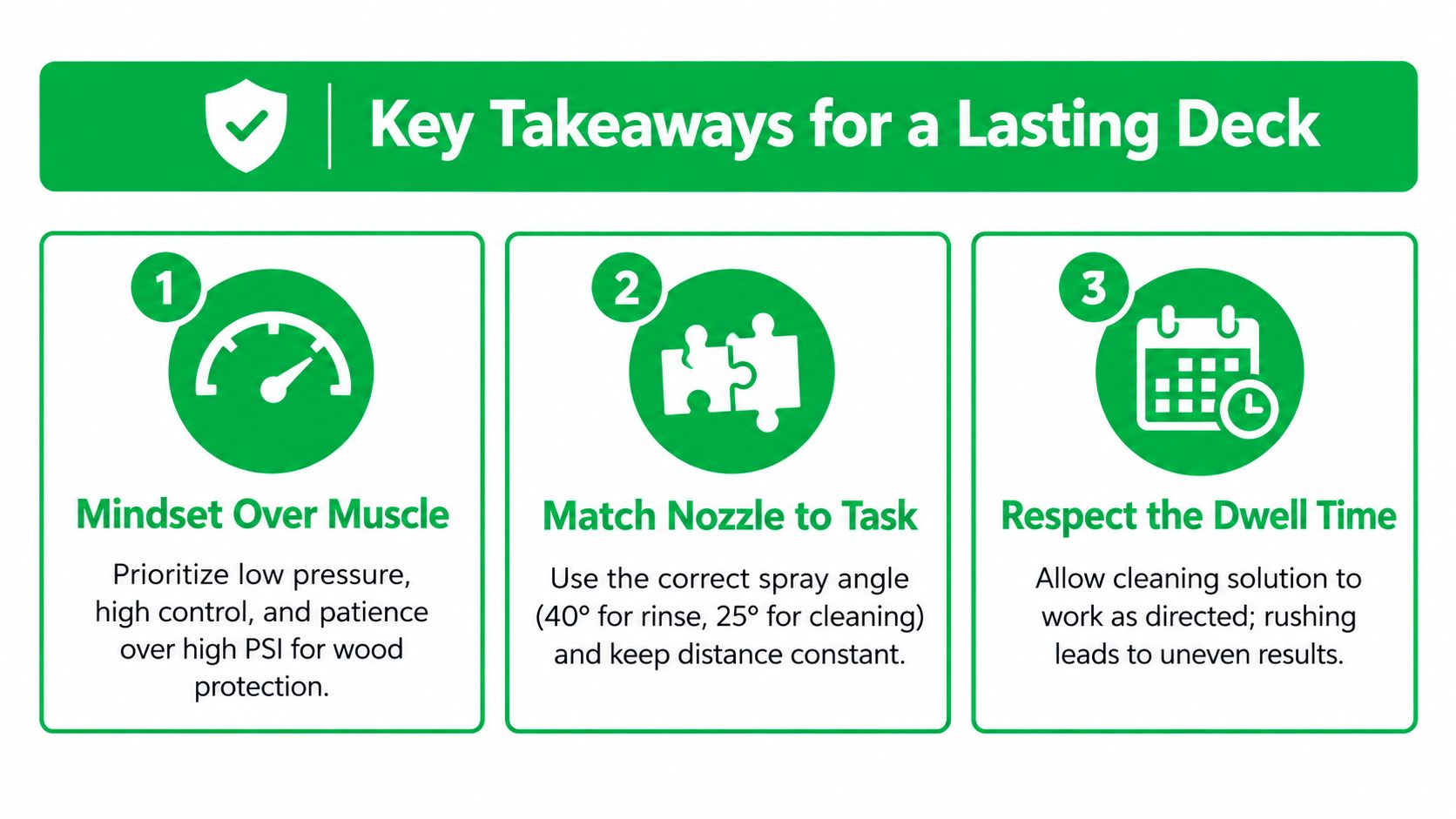
Three decisions protect the finished surface
- Mindset over muscle: Let the cleaner and dwell time loosen buildup before the rinse.
- Match nozzle to task: Use a broad fan for routine rinsing, keep the nozzle moving, and adjust only after testing a hidden area.
- Respect moisture: Don't seal or stain because the calendar says it's time. Use a moisture meter and wait for the boards to dry.
DIY stops making sense when the deck has widespread raised grain, deep gray oxidation that returns within days, structural softness around joists, or old coatings that have failed across large areas. Those signs point to repair, stripping, or finish-removal work that a normal wash won't solve.
Flagstaff and Munds Park decks also face intense ultraviolet exposure, temperature swings, and periods of monsoon humidity. An annual inspection paired with gentle cleaning helps reveal problems while boards and framing are still accessible. The best maintenance routine doesn't hide deterioration under a new-looking surface. It exposes the condition of the wood and gives you a chance to address it correctly.
Pine Country Window Cleaning provides calibrated pressure washing for decks and other exterior surfaces, along with professional window, screen, gutter, and downspout cleaning for Northern Arizona homes and businesses. Their technicians remove, clean, and reinstall screens with every window service, and you can visit Pine Country Window Cleaning to request a free estimate or schedule service.