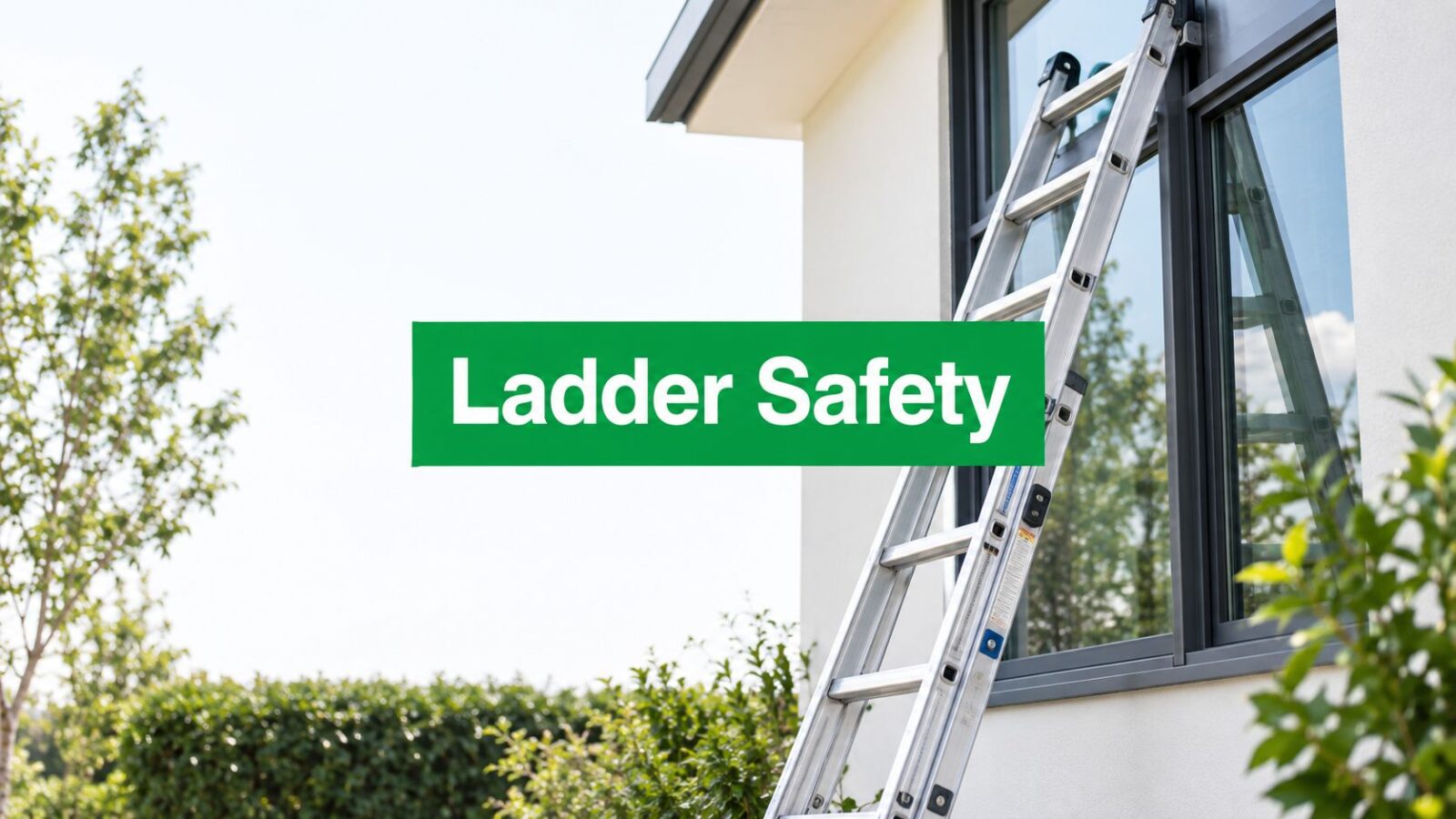
You're standing in the driveway with a squeegee in one hand, an extension ladder in the other, and a second-story window that looks close enough to reach. Then you notice the ladder feet are sitting on wet gravel, one side is slightly lower than the other, and yesterday's snowmelt has left the patio slick. The glass may be dirty, but the actual problem is the access method.
A window cleaning ladder is only one part of a professional service. Safe work also depends on the ground, weather, electrical surroundings, window height, equipment choice, and the way the crew protects the home while cleaning. Professional window cleaners use squeegees, ladders, poles, and pure-water brushes because each tool fits a different access and surface condition. They also remove, clean, and reinstall screens as part of a complete visit, rather than treating the glass as an isolated task.
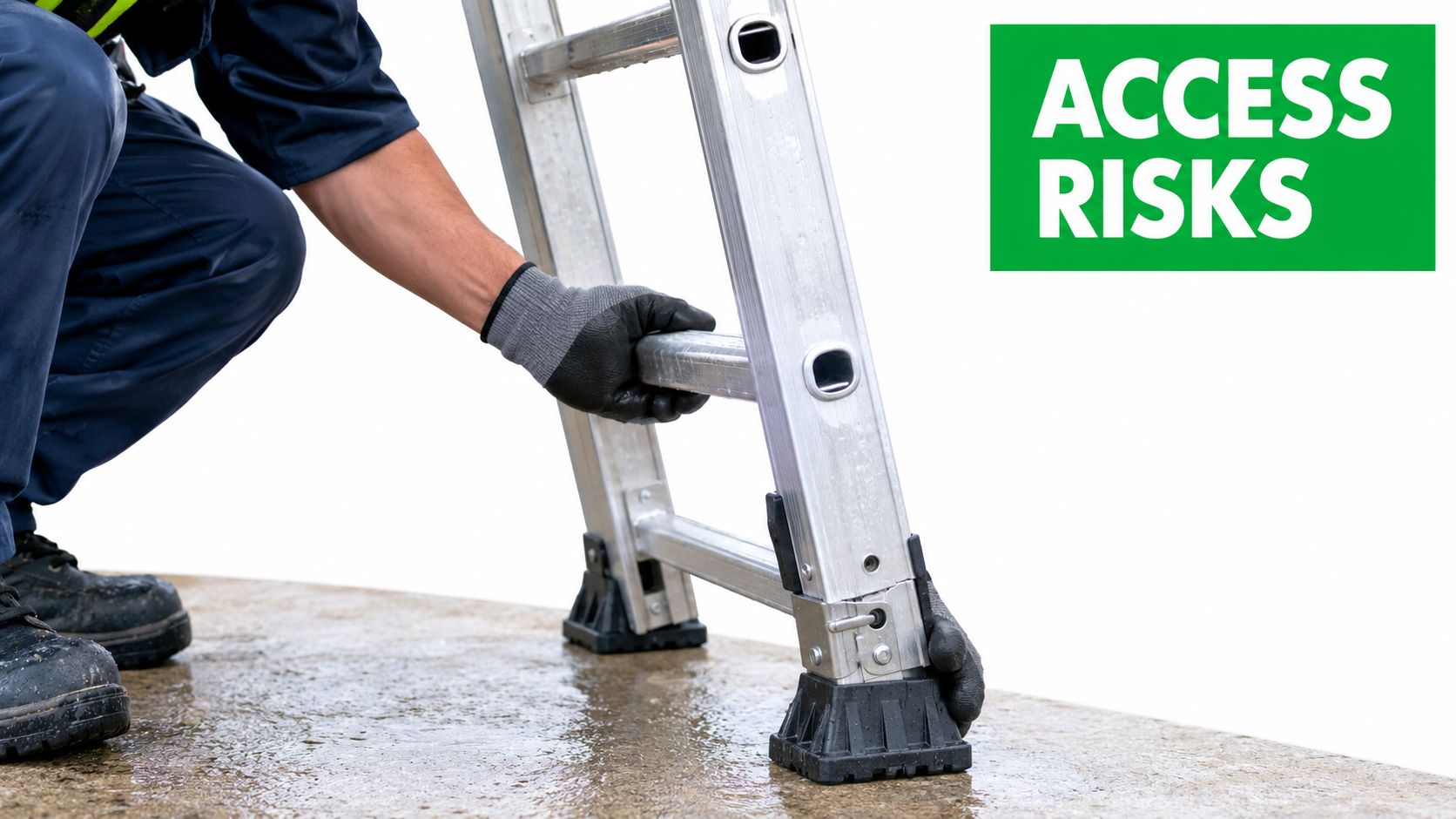
Assessing Access Risks Before You Climb
A homeowner may see a ladder, a wall, and a reachable window. A trained cleaner sees a load-bearing surface, a ladder angle, a fall path, nearby landscaping, water runoff, and the need to work without overreaching. That difference in perspective often determines whether the job stays routine or becomes dangerous.
Consider a common Flagstaff or Munds Park setup. The window is above a sloped planting bed, the soil is soft from snowmelt, and the ladder must rest near a stone walkway. Even if the ladder looks upright, one foot can settle while the cleaner climbs. Add a bucket, a squeegee, wet footwear, and the instinct to lean sideways instead of climbing down to reposition. The unstable moment usually begins before the first stroke across the glass.
Treat the ladder as access equipment
Window cleaning ladders are governed by some of the strictest height-access rules in the industry because regulators treat them as a high-risk access method rather than a routine tool. California's window-cleaning ladder regulation allows ladder use only when windows can't otherwise be cleaned safely and practically with approved anchors and window-cleaning belts. It also prohibits using a fully extended extension ladder in excess of 40 feet for this purpose.
That regulatory approach reflects the actual work. Window cleaning often occupies both hands, requires repeated lateral movement, and puts water on the glass, rungs, footwear, and ground. A ladder that might be acceptable for a brief inspection can become a poor choice when the cleaner must scrub, squeegee, detail edges, handle screens, and manage hoses.
What a site assessment looks for
Before setting up, a professional should evaluate:
- Footing: Wet soil, gravel, mulch, ice, polished stone, and sloped paving can let ladder feet shift or sink.
- Reach: If the top of the window requires stretching from the side, the ladder is positioned poorly or the method is unsuitable.
- Obstructions: Shrubs, retaining walls, roof edges, awnings, and furniture can prevent proper placement.
- Traffic and exposure: Public walkways and driveways require base control and protection against people contacting the ladder.
- Property condition: Fragile trim, screens, stucco, gutters, and landscaping need a planned approach rather than improvised contact.
A ladder isn't automatically unsafe, but it isn't automatically appropriate either. The correct decision may be a shorter ladder, a water-fed pole, an anchor system, or a lift.
Mastering the Setup Ratio and Placement Geometry
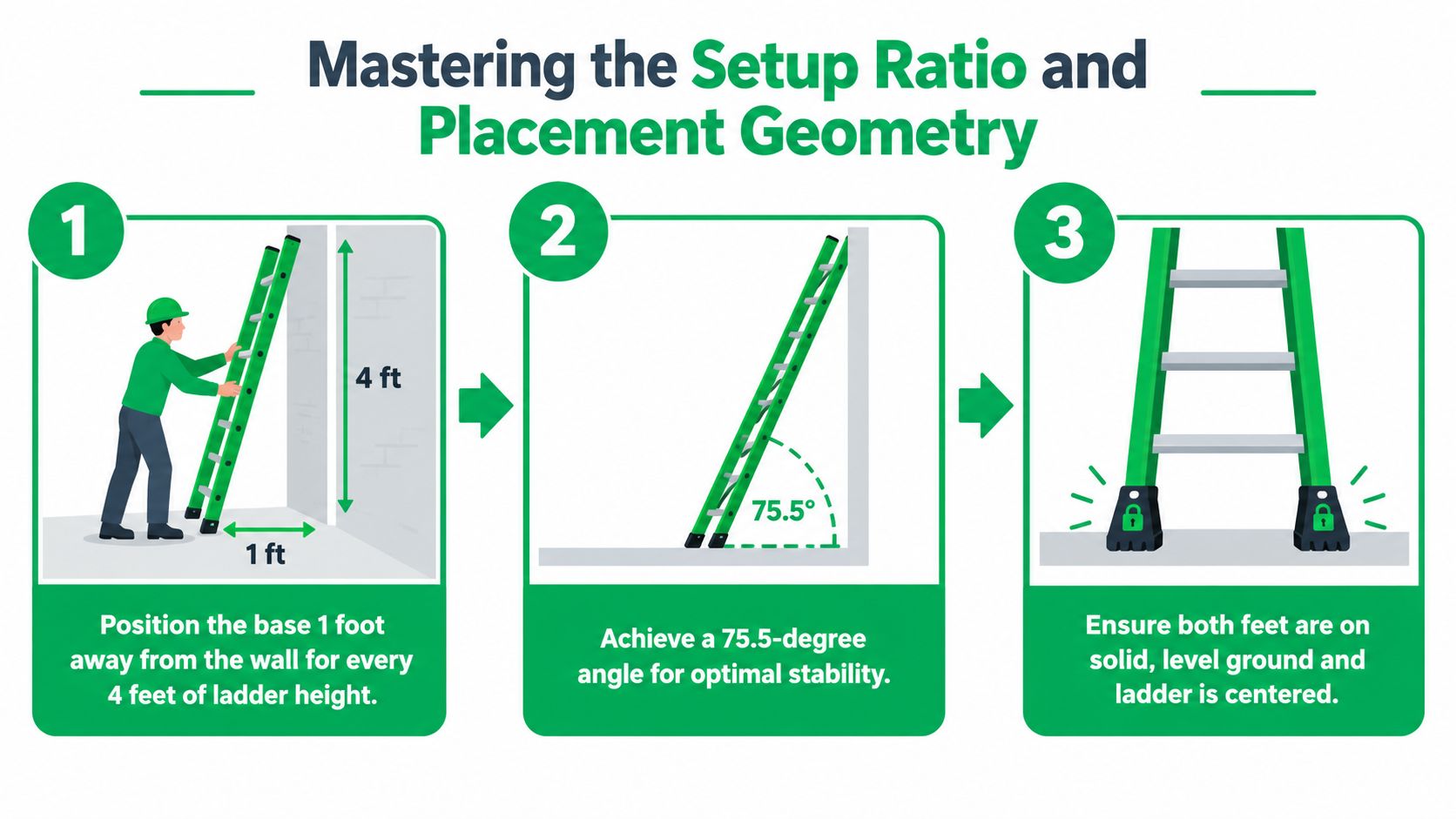
The most important placement calculation for a leaning or extension ladder is the 4-to-1 ratio. The base should sit one-quarter of the ladder's working length away from the wall, creating an angle of about 75 degrees, as described in ladder-angle safety guidance.
The measurement uses the working length along the ladder, not just the height of the window. If the ladder's working length is 16 feet, the base should be approximately 4 feet from the wall. That example follows the same 1:4 relationship described in industry guidance for commercial ground work.
Why the angle matters
A ladder set too shallow pushes more force outward at the base. On wet concrete, smooth stone, or loose ground, that force can overcome traction and send the feet away from the wall. A ladder set too steep reduces the base footprint and increases the chance of tipping backward, especially when the cleaner reaches upward or carries equipment.
The ratio doesn't compensate for poor ground. Both feet still need solid, level support, and the ladder must remain centered against a suitable upper contact point. Never use loose boards, stacked objects, or improvised blocks to correct a slope. Those additions can move independently and create a second failure point.
A practical placement sequence
- Inspect the surface first. Clear debris and identify whether the ground is firm, level, and free of slick contamination.
- Measure the setback. Use the ladder's working length and place the base at one-quarter of that distance from the wall.
- Check the upper contact. Make sure the rails rest against a stable surface rather than fragile trim, gutters, or a questionable edge.
- Center the ladder. Align it with the window so the cleaner won't twist or reach sideways.
- Secure the base and ladder. Use appropriate nonslip devices and a second person when the setup requires it.
California rules require another person to stand at the foot, face the ladder, and hold it with both hands when a cleaner is working on a ladder over 18 feet working length. The same regulation also requires nonslip devices on portable ladders used for window washing, prohibits unstable or slippery footing, and prohibits overloading. Review Pine Country's ladder safety requirements before treating a tall residential setup as a simple chore.
The following visual breaks the setup into the three checks that matter most: setback, angle, and footing.
Navigating Weather and Environmental Hazards
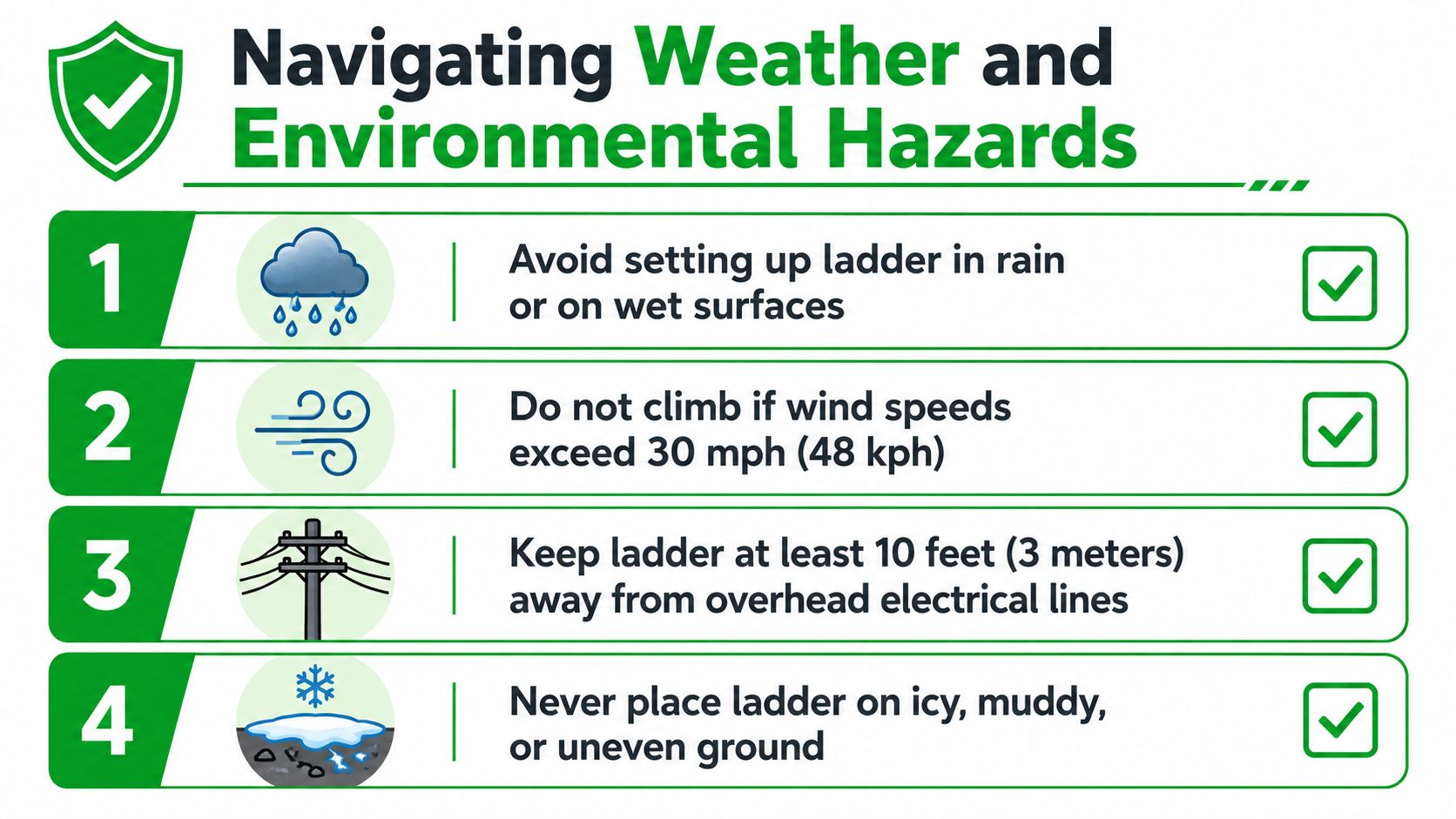
A ladder can be correctly positioned and still be unsafe because the environment changes after setup. Wind can move a tall ladder or catch a tool. Ice can reduce traction under a foot that appeared stable moments earlier. Wet gravel can shift beneath the load, while uneven ground can twist the ladder and make the climber compensate with body movement.
That's why a clear sky isn't the only weather question. The practical question is whether wind, moisture, temperature, and surface conditions create a hazard during the entire task. Recent window-cleaning safety guidance says ladder use should stop when wind or other weather creates a hazard, and ladders should remain at least 10 feet from electrical lines or devices.
Snow and meltwater deserve extra attention
Mountain properties create conditions that are easy to underestimate. A patio may look dry while ice remains in the shaded edge. A gravel drive may be firm at the surface but soft underneath. Snow piled beside a wall can force the ladder base onto a slope, and meltwater can run across the exact spot where the feet need dependable traction.
Wet surfaces also affect the cleaning process itself. Water from the brush or washer can run onto rungs and shoes, so a surface that starts marginal can become less reliable during the visit. If the base can't be placed on firm, level ground without disturbing the property, a ladder may not be the right access method.
Electrical proximity is a separate hazard
Electrical lines and devices require deliberate clearance, not visual guesswork. Aluminum ladders conduct electricity, and even a nonmetallic ladder can become dangerous when a person, tool, or wet pole approaches energized equipment. Maintain the required 10-foot clearance identified in the guidance above, and stop if the position of the ladder or equipment could change that distance.
Use this field check before climbing:
- Wind: Stop when gusts or other weather make the ladder difficult to control.
- Ice: Don't place feet on icy patches, packed snow, or frozen runoff.
- Water: Treat wet concrete, patios, and rungs as reduced-traction surfaces.
- Ground: Reject soft, muddy, loose, or uneven footing.
- Power: Keep the ladder and working equipment at least 10 feet from electrical lines or devices.
A professional crew also considers the customer's property. That means protecting walkways, avoiding damage to planted areas, controlling hoses, and keeping equipment away from doors and vehicles. A ladder decision should account for the home and the people around it, not just the cleaner's ability to reach the glass.
Recognizing the Limits of Extension Ladders
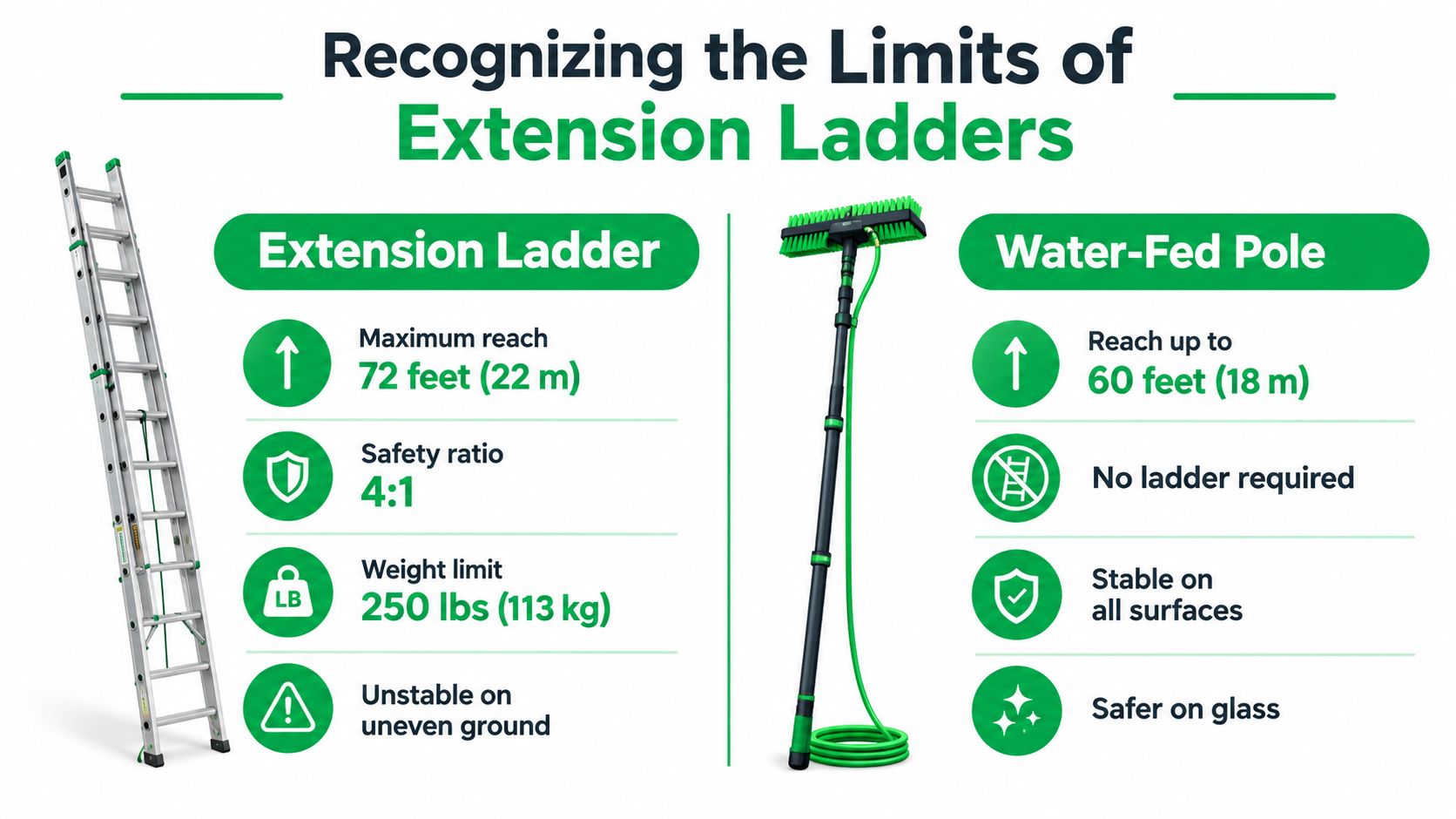
Extension ladders are useful for selected low-risk tasks, but height changes the trade-off quickly. The taller the ladder, the more difficult it becomes to control deflection, maintain a stable base, reposition without disturbing the property, and work without reaching away from the rails. A ladder can provide access, but it doesn't provide a fall-protection system.
Independent window-cleaning access guidance recommends avoiding ladder-based window cleaning when the top of the window is beyond about 45 feet above the supporting surface or when the required extension ladder would exceed roughly 40 feet fully extended. California's rule also explicitly prohibits a fully extended extension ladder over 40 feet for window cleaning, reinforcing the point that tall ladder work has a defined outer boundary.
Choosing the method by access condition
A traditional ladder and squeegee can make sense when the surface is stable, the height is moderate, the ladder can be secured, and the cleaner can work without overreaching. This method offers close control around glass edges, seals, muntins, and detailed trim.
A water-fed pole keeps the operator on the ground and uses a pure-water brush to wash glass and frames from below. It can be a better option for upper windows, landscaping that blocks ladder feet, and surfaces where placing a ladder would create unnecessary risk. The operator still needs to manage wind, overhead hazards, hose routing, and the possibility of water entering vulnerable openings.
A boom lift, scissor lift, or atrium lift becomes more appropriate when the building design, height, or window arrangement requires a stable high platform. Lifts need their own trained operation, surface assessment, clearance planning, and property protection. They aren't a shortcut, but they can provide a more controlled work position than a tall portable ladder.
For roof-adjacent windows or work near an unprotected edge, window cleaning may also overlap with roof-access hazards. Property owners who need to understand that separate exposure can consult this practical resource on how to hire a roof edge expert.
The right equipment depends on the building, not on which tool happens to be stored in the garage. For additional guidance on selecting a method for glass at height, review how to clean high windows.
Executing a Professional Cleaning Workflow
Reaching the glass safely is only half the service. The crew also needs to clean without scratching frames, bending screens, flooding sills, disturbing landscaping, or leaving residue on finished surfaces. That's why professional window cleaning uses a combination of squeegees, scrubbers, ladders, poles, and pure-water brushes rather than forcing one method onto every window.
A typical visit starts with an inspection from the ground and inside the property when access is included. The technician identifies fragile trim, loose screens, damaged seals, exterior obstacles, and areas where water needs to be controlled. Drop cloths, towels, hose management, and careful movement matter because the customer is trusting the crew with the entire home, not just the panes.
Screens are part of the window unit
Pine Country Window Cleaning removes screens, cleans them, and reinstalls them with every service. The workflow is deliberate:
- Remove the screen carefully. Avoid prying against delicate frames or forcing a screen that's stuck.
- Note its orientation. Marking or remembering the position makes reinstallation easier, especially when screens look similar.
- Clean without attacking the mesh. A practical screen-cleaning guide advises avoiding sharp tools and high pressure that could damage the material.
- Inspect the frame and track. Dirt in the track can interfere with smooth operation and may need separate attention.
- Reinstall the screen in its original position. Confirm that it sits correctly and doesn't bow, bind, or leave gaps.
A rag and spray bottle may remove visible dirt from a reachable pane, but that approach doesn't solve high access, screen handling, frame cleaning, or runoff control. It also encourages people to lean farther than they should while holding multiple items.
Squeegee work and pure-water work serve different needs
Squeegees provide precise control for detailed glass cleaning, interior panes, divided lights, and areas where the technician needs to manage the final edge closely. Pure-water brushes are valuable for exterior glass and frames where ground-level reach reduces ladder exposure and allows the water to dry without conventional detergent residue.
The best workflow is selective. A professional may use a pole for upper exterior glass, a ladder for a carefully assessed lower section, and a squeegee for interior or detail work. Throughout the visit, the crew protects flooring, walls, screens, landscaping, siding, and customer belongings.
Deciding When to Hire Trained Professionals
The decision to hire a professional isn't only about avoiding a fall. It also covers property damage, responsibility for an injured worker, equipment limitations, and the quality of the finished result. A second-story window may look like a small maintenance task, but the access method can involve uneven ground, weather exposure, electrical clearance, and fragile building components.
OSHA recognizes the ANSI/IWCA I-14.1-2001 window-cleaning standard within its fall-protection framework and notes a 300-foot height limit adopted from that standard for certain fixed-ladder and window-cleaning-related applications. OSHA's fall-protection standards page shows why window cleaning has developed into a specialized safety category rather than relying only on general household ladder habits.
What to ask before booking
Look for a company that can explain the access plan in plain language and answer practical questions about the property.
- Training: Ask whether technicians receive documented safety training and understand ladder, pole, and lift procedures.
- Insurance: Confirm that the company carries appropriate coverage for its work and employees. This guide to contractor insurance risks provides useful background on why insurance questions matter.
- Equipment: Find out whether the crew can use pure-water poles, professional ladders, boom lifts, scissor lifts, or atrium lifts when the building requires them.
- Communication: A dependable provider should explain scheduling, access needs, screens, water use, and property protection before arrival.
- Quality commitment: Ask how the company handles missed spots, damaged screens, or concerns after service.
For Flagstaff property owners, cabins, vacation rentals, commercial buildings, hotels, campuses, and storefronts, Pine Country Window Cleaning has operated since 1999 and was started by Flagstaff native David Kaminski. The company uses professional ladders alongside poles and pure-water brushes, removes and reinstalls screens with every service, and maintains in-house access equipment for challenging properties. Its window cleaning services are designed around both safe access and respectful care of the customer's home or business.
A professional visit should leave more than clean glass. It should leave screens correctly installed, surfaces protected, equipment removed without damage, and the owner confident that the access decision matched the property.
For safe ladder assessment, pure-water pole cleaning, squeegee detailing, screen cleaning, and screen reinstallation in Flagstaff, Munds Park, and Northern Arizona, contact Pine Country Window Cleaning for a free estimate. Visit Pine Country Window Cleaning to schedule service with a team that treats your windows, home, and surrounding property with care.