
You walk into a building you care about and see the signs all at once, peeling paint, a soft spot near the sill, mortar joints that look newer than the wall, maybe a little staining below the roofline. At that point, cosmetic fixes stop making sense. Historic building restoration starts when the building tells you it needs more than a surface refresh, and the hard part is figuring out what to keep, what to repair, and what can't be touched without creating a bigger problem later.
A lot of owners in Northern Arizona find themselves in that exact spot with a cabin, storefront, church, or older home. The building still has character, but the details are failing in ways that don't show up in a quick walk-through. Restoration is the disciplined work of preserving the period character while dealing with the reality of weather, age, and prior repairs that didn't belong there in the first place.
What Historic Building Restoration Actually Involves
A property owner usually sees the problem in stages. First it is a drafty room, then a loose stone, then a window that will not close right, and finally a contractor opens a wall and finds older damage hidden behind the finish work. At that point, the project stops looking like a remodel and starts looking like historic building restoration, because the work has to respect the original form while undoing later changes that do not fit the building's significant period.
The National Park Service defines restoration as accurately depicting a property's form, features, and character from a specific period, which includes removing later features and reconstructing missing ones from that period. It also allows limited, sensitive upgrades to mechanical, electrical, plumbing, and other code-required systems when the building needs them to stay functional. That is a much narrower goal than a general renovation, and it changes every decision on site. NPS treatment guidelines for restoration
Why the project scope feels bigger than expected
The scope usually grows once crews start opening things up. A wall that looked like a simple patch job may reveal rot at the framing, failed flashing, or mismatched repairs that need to be removed before any finish work can go back on. In Northern Arizona, dry air, hard swings in temperature, and past repairs with the wrong mortar, sealant, or paint can make that work more involved than owners first expect.
Private owners also have to keep the budget grounded in reality. Restoration often means paying for careful demolition, documentation, repair of original materials, and selective replacement when a piece cannot be saved, and those line items add up quickly. If a project is tied to tax incentives or grant work, the paperwork and review process can shape the schedule as much as the carpentry does, which is why planning has to start before anyone orders materials.
For owners trying to keep the exterior work aligned with the building, exterior cleaning is one of the places where the wrong method can do real harm. For exterior cleaning best practices, see our guide at Pine Country Window Cleaning's exterior building cleaning page.
Practical rule: if the work only improves appearance, it probably is not restoration yet. If it has to preserve period character, remove incompatible later changes, and still keep the building usable, you are in restoration territory.
That difference matters in the field. A building can look tired without being structurally compromised, or it can look fine while hidden moisture, movement, or incompatible patching is eating it from the inside out. The owner's first job is to define the target period and accept that the building's next life depends on careful choices, not quick substitutions.
Understanding Preservation Standards and Treatment Types
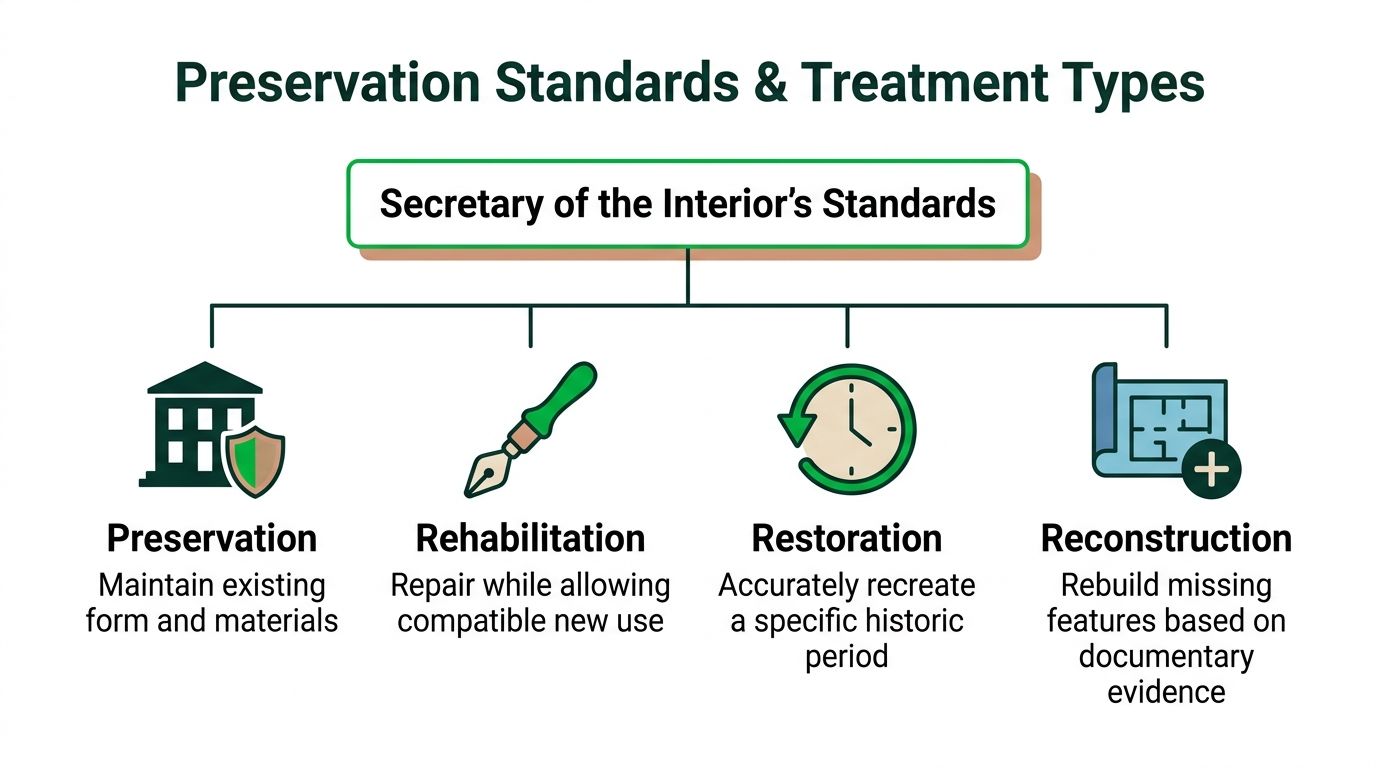
The four treatment approaches, preservation, rehabilitation, restoration, and reconstruction, are easy to mix up until you're standing in front of a real building with real code issues. Preservation keeps the existing form and materials. Rehabilitation keeps the historic character while allowing compatible new use. Restoration returns the building to a specific period. Reconstruction rebuilds missing features based on evidence. Each one serves a different project goal, so the treatment has to match the building's significance, condition, and intended use.
The Secretary of the Interior's guidance is blunt about the core rule, the historic character of a property must be retained and preserved, removal or alteration of historic materials and character-defining features should be avoided, and any replacement of missing features must be substantiated by documentary, physical, or pictorial evidence. That means you don't guess at a cornice profile or invent a sash detail because it “looks close enough.” You verify it first. Secretary of the Interior's Rehabilitation Guidelines
Choosing the right treatment for the building
Restoration usually fits when the owner wants the building to read as a particular period again, even if that means removing later alterations. Rehabilitation fits when the building needs a new or continued use and the historic fabric has to stay part of the plan. Preservation fits when the job is mostly stabilization and maintenance. Reconstruction fits where a feature is gone and there's enough evidence to recreate it accurately.
That choice also affects approvals. Preservation boards and review committees don't just look at aesthetics, they look at whether the proposed treatment makes sense for the building's significance and current condition. In practice, that means the contractor, architect, and owner need the same vocabulary before they ever submit drawings.
The best early question is not, “How do we make it look old?” It's, “Which treatment protects the building's character while still solving the real problem?”
The answer often changes once code, access, and maintenance are on the table. A building in active use may need rehabilitation-level flexibility in some systems while retaining restoration-level discipline on visible features. That's normal. What's not normal is treating all old work as interchangeable.
Assessment and Planning Before Any Work Begins
On a historic property, the costly mistakes usually happen before the first repair begins. An owner spots a cracked wall or a leaking window, hires someone to patch it, and skips the mapping, documentation, and root-cause work that shows why the building failed in the first place. That shortcut treats symptoms, not the source, and it usually means paying for the same problem twice.
UNESCO's guidance for major monuments says they should not be restored without an exhaustive study of the exterior, interior sections, roof, foundations, and remote or inaccessible areas where deterioration may exist. It also says a survey alone is not enough, and restoration plans should be made for four, five, or ten years at the most so they stay current. That advice fits everyday project planning better than most owners realize. UNESCO conservation guidance

What a serious assessment actually includes
A proper survey is more than a walk-around with a clipboard. It usually includes measured drawings, photo documentation, material identification, and targeted inspection of the places owners do not naturally see, like attic framing, crawl spaces, parapets, and hidden wall cavities. In the field, laser-based documentation and detailed mapping make it much easier to track where damage starts and where it has spread.
The hidden condition is the problem. Water infiltration, structural movement, and earlier incompatible repairs can build on each other over decades, and the outside of the building may hide how serious the issue has become. That is why a cosmetic patch so often fails. It covers the visible symptom while the wall keeps moving or moisture keeps traveling through the assembly. Northumbria research on recurring issues in historic building conservation
Practical rule: if you have not documented the existing condition, you cannot honestly measure whether the repair worked.
I have seen owners save a little time by skipping assessment, then lose months reopening the same area because the underlying cause was never addressed. A sharp condition assessment also helps when funding enters the picture, because it turns vague concern into a prioritized scope. If you are trying to understand the financial side as well, how to lower taxes with condition assessment is a useful starting point for seeing how documentation can support better decisions.
Planning for the work in phases
A good plan separates urgent stabilization from visible restoration and from later finish work. That matters because weather windows, permit timing, and contractor availability do not always line up. Around here, that kind of phasing keeps projects from stalling halfway through a season change and exposing new work to avoidable moisture or freeze damage.
The other trade-off is money. Private owners in Flagstaff and across Northern Arizona often want a finished result, but the building usually needs to be opened up, tested, and repaired in stages before anyone should commit to final finishes. That is where early estimates become more honest, and where a qualified team can tell you what must be addressed now, what can wait, and what should not be touched until the cause is clear. For owners building a contractor list, the approved 203(k) contractor directory is a practical place to start.
If the assessment is rushed, the budget will be too. If the budget is vague, the scope will drift. And if the scope drifts, the owner usually pays twice, once for the wrong fix and again for the correct one.
Materials and Techniques That Protect Historic Fabric
Material compatibility is the technical issue that decides whether a repair helps or harms the building. Historic masonry, wood, coatings, and stone all move, breathe, expand, and weather in their own way. If the replacement material behaves differently, the building can fail faster instead of slower.
The classic mistake is repointing masonry with modern Portland-cement mortar where the original wall was built with lime mortar. Expert guidance emphasizes using lime mortars matched for composition, strength, and porosity so moisture can move out of the wall assembly instead of being trapped inside. The practical step is simple, even if the spec sheet isn't, test the substrate composition and vapor permeability before choosing a repair system, then select materials that are mechanically compatible and less rigid than the historic substrate. Material compatibility guidance for historic masonry repair
What to match and what to avoid
The same logic applies to stone patching, wood repair, and coatings. A patch that is harder than the original stone can force stress into the surrounding fabric. A coating that seals too tightly can trap moisture. A replacement timber that doesn't behave like the original can move differently and open new gaps.
For windows, repair usually makes more sense than replacement when the original frames, sash, and glazing can be stabilized. Original wood windows often survive because their parts are repairable, not because they're perfect. If the glass, cords, putty, and stops are still workable, keep them in service and replace only the pieces that failed.
Practical rule: the repair should be softer, more breathable, or more forgiving than the historic material it's joining.
That's where modern substitutes often go wrong. Vinyl units and hard mortars can look convenient on paper, but they change the way the wall or opening handles moisture and movement. On older buildings, that mismatch is what creates edge failure, spalling, and delamination.
A maintenance-oriented service can still fit into that picture when it's done carefully. For example, scheduled exterior cleaning from a local provider like Pine Country Window Cleaning can help maintain historic glass and frames without forcing harsh methods onto fragile surfaces. The important part is the method, not the marketing, use tools and products that respect the building's finishes and never treat old materials like they're modern aluminum storefronts.
Repair before replacement
Historic fabric has value because it's original fabric. A restoration-focused study on historic buildings says unnecessary replacement should be avoided because it can diminish historical or architectural value and authenticity, and all repair work should be recorded, photographed, and documented for archival purposes. That's the standard worth following on every job, even the small ones. Study on restoration and historic fabric documentation
The best results come from patient repair, not wholesale substitution. If a window rail can be consolidated, if a mortar joint can be repointed correctly, if a wood sill can be dutch-mended instead of ripped out, the building keeps more of its history and usually performs better over time.
Budgeting and Funding Your Restoration Project
A restoration budget starts before the first trade arrives on site. On historic work, costs include research, condition documentation, specialty labor, custom fabrication, permit reviews, and the time lost when a repair has to wait for the right sequence. That is why market data matters here. It reflects a specialty field with significant overhead, not a casual remodel category. Industry estimates valued the global restoration of historic buildings market at USD 316 billion in 2025 and projected growth to USD 451.1 billion by 2035, with a 3.64% CAGR over 2025-2035. The same source estimates North America accounts for about 40% of global market share. Global historic buildings restoration market estimate
Where private owners run into trouble
The hardest part for many owners is that funding rarely works the way they expect. A lot of grants and incentive programs are tied to listings such as the National Register of Historic Places, and many are aimed at municipalities, nonprofits, or properties with broader public significance. That leaves a practical gap for a cabin, a storefront, or a small privately owned building that clearly matters but does not fit the easiest program box.
The paperwork can be part of the budget itself. Historic photos, condition reports, material descriptions, drawings, contractor scopes, and approval records may all be needed before money is available. That looks like overhead, and it is, but it also keeps an owner from paying for work that cannot be justified later if a reviewer, lender, or tax professional asks for support.
A restoration budget that ignores documentation is incomplete. The paperwork is part of the project, not a separate chore.
Historic tax incentives can help when a property qualifies, but they do not solve every funding problem. The National Park Service has reported substantial activity through the federal Historic Tax Credit program, which shows how important incentives can be on the right project. Owners still need to confirm whether the property, use, and scope fit the rules before they assume any tax benefit will apply. NPS Historic Tax Credit statistical report
Comparing funding paths
Private owners usually have to compare three things at once, direct out-of-pocket cost, eligibility for credits or grants, and the amount of paperwork required to secure them. Nonprofits and municipalities often have access to a different pool of support, especially for community or civic properties. State incentives can help too, but they still depend on the building's status and on whether the project follows the program rules.
In practical terms, budget first for the work that stops further loss. Then treat incentive programs as a way to offset qualified expenses, not as a reason to expand the scope. The same disciplined planning that helps lower long-term maintenance costs can also keep a project from turning into a financing problem. A useful companion resource is planning repairs to lower maintenance costs over time, because the cheapest project is usually the one you do not have to redo.
Choosing Qualified Restoration Contractors
A general contractor can be excellent at new construction and still be the wrong fit for a historic building. Restoration work punishes guesswork. If someone changes the wrong material, deletes a character-defining detail, or patches over evidence instead of recording it, the damage can be permanent.
The contractor you hire should understand the Secretary of the Interior's Standards, know how local preservation review works, and have a real portfolio of comparable projects. Experience matters most when the building has unusual materials, custom trim, old plaster, masonry issues, or windows that need repair rather than replacement. Historic work is a craft discipline, not just a schedule and a bid form.

What to ask before you sign anything
Start with references from projects that look like yours. Not just old buildings in general, but similar construction, similar materials, and similar constraints. Then ask how they handle documentation, whether they photograph each phase, and how they decide between repair and replacement.
A good bid should tell you how the crew will protect the existing fabric, how they'll handle hidden conditions, and what happens if they uncover something unexpected. If the proposal is vague, the project will be vague too.
Practical rule: the best historic contractor can explain the work without overselling it.
That's where local experience becomes valuable in Northern Arizona. Crews who work here understand the building traditions, the altitude, and the weather patterns that shape the job. Flagstaff businesses that have stayed in operation for decades usually do that by learning how this region behaves, not by assuming every wall assembly performs the same way.
You also want insurance and licensing that match the work, plus clear communication about safety and site protection. Historic buildings often have fragile finishes, older glass, tight access, or occupied spaces. A contractor who respects that will plan around the building instead of forcing the building to adapt to the crew.
Climate Considerations for Northern Arizona Properties
Flagstaff and Northern Arizona put historic buildings through a rough mix of conditions. Freeze-thaw cycles stress masonry and coatings. High-altitude UV breaks down exposed materials faster than people expect. Monsoon-season moisture finds weak points. Winter snow loads test roofs, gutters, and anything already marginal.
That climate changes the repair logic. A mortar mix that might pass somewhere milder can fail here if it doesn't move and dry the right way. A wood treatment that looks fine on paper can still underperform if the sun and moisture cycle keep beating on it year after year. The building has to be restored for the climate it lives in, not the climate on the spec sheet.
What holds up better in this region
The best-performing restoration choices usually favor breathability, compatibility, and routine inspection. Walls need to dry. Roof edges need to shed water cleanly. Flashings need to direct moisture away before it enters the assembly. Anything that traps water in an old wall is asking for trouble.
That's also why maintenance matters as much as the initial repair. Gutter cleaning, downspout checks, and careful exterior washing help prevent the deferred maintenance that creates hidden deterioration. On many older properties, the primary enemy isn't one dramatic failure, it's years of small water problems nobody prioritized.
In this climate, small leaks become wall problems and wall problems become budget problems.
Restoration also has to balance authenticity with resilience. Owners sometimes need better insulation, discreet system upgrades, or structural strengthening, but those changes still have to respect the building's historic character. The sensible move is to make the least visible intervention that solves the underlying performance issue.
If you own a historic property here, treat seasonal upkeep as part of the preservation plan, not an optional extra. Regular inspection after storms, careful window and facade maintenance, and prompt attention to roof drainage protect the craftsmanship already in the building. When the exterior is kept clean and working, the rest of the restoration lasts longer.
If your historic property in Flagstaff or Northern Arizona needs careful exterior maintenance, Pine Country Window Cleaning handles window cleaning, screen removal and reinstallation, gutter care, and other exterior services with the kind of site respect older buildings need. Visit Pine Country Window Cleaning to schedule service and keep your property's historic fabric protected before small problems turn into restoration work.