
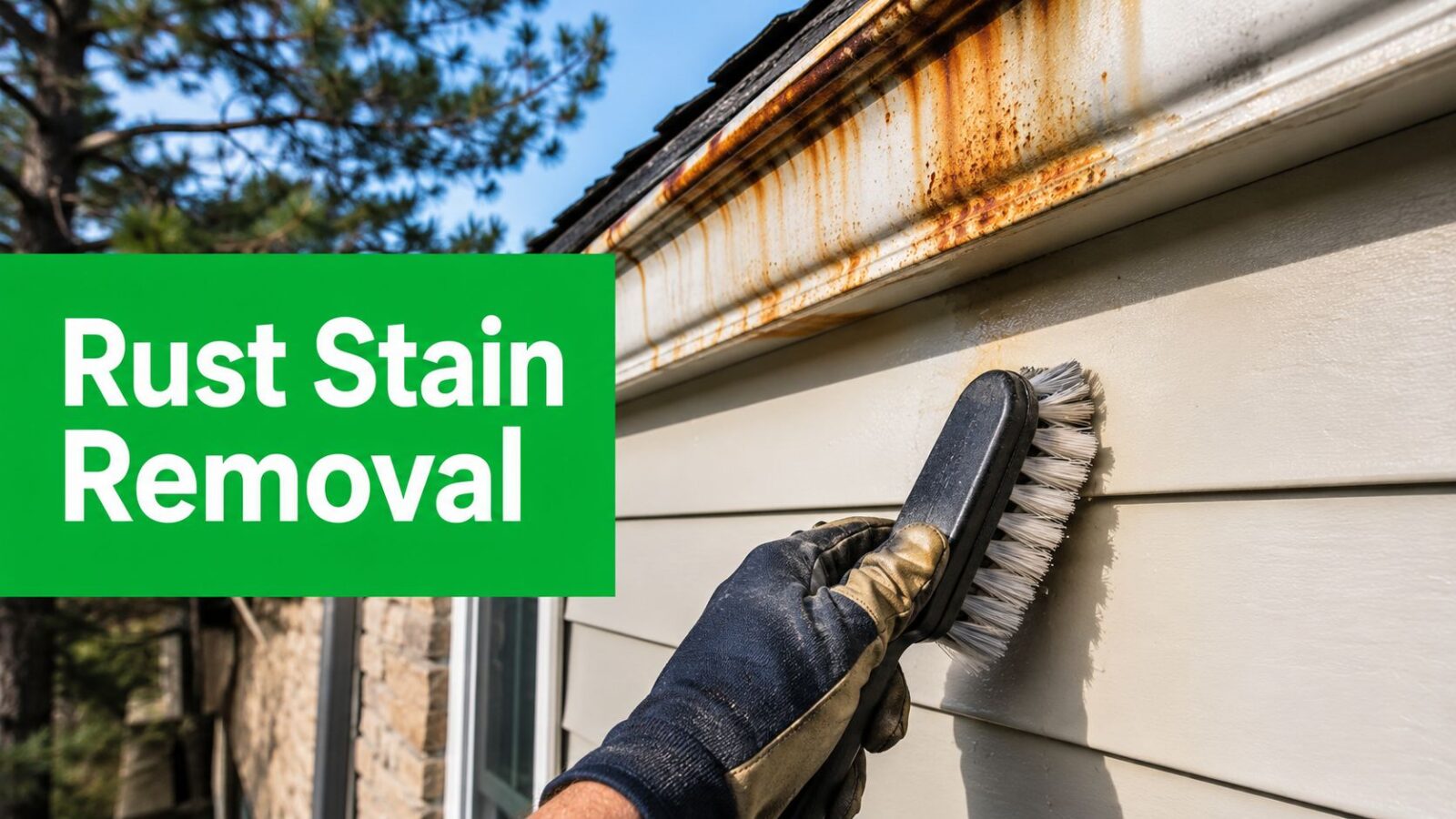
You've got the orange-brown surprise on the patio, a window frame, or a shirt you like, and the first instinct is usually to grab vinegar and start scrubbing. That move can work on some stains, but it can also etch delicate finishes, set fabric stains deeper, or waste time on a stain that's really coming from a corroding fastener or hidden moisture. In Northern Arizona, where dry air, mineral-heavy water, and high-value stone and glass surfaces all show rust differently, rust stain removal works best when the chemistry matches the material.
The smartest approach is simple: identify the surface first, then choose the least aggressive method that still gives the stain a way out. That's how you protect glass, concrete, fabric, and specialty stone while avoiding the kind of damage that turns a cleaning job into a repair bill.
Why Rust Stains Need Surface-Specific Solutions
A Flagstaff homeowner can see rust in three places on the same afternoon, and each one asks for a different answer. A window frame may leave orange streaks on glass, a patio may hold a deep brown mark in the pores of concrete, and a favorite shirt may show a faint stain that looks harmless until heat or the wrong cleaner fixes it permanently. The stain may look the same, but the material underneath changes everything.
Rust removal is really a chemistry decision, not a scrub-it-harder contest. The global rust remover market was valued at USD 493.58 million in 2022 and is projected to reach USD 713.72 million by 2030, with Data Bridge Market Research reporting a 5.41% CAGR from 2023 to 2030, which shows how broad the need is across consumer, commercial, and industrial settings, not just in garages and workshops (Data Bridge Market Research).
Surface first, chemistry second
Glass is nonporous, so rust often sits on top of it, or it's etched by minerals and metal contact. Concrete behaves differently, because it absorbs contamination into its pores. Fabric is different again, because fibers can hold the stain and react badly to the wrong pH or to bleach.
Practical rule: if the stain is on a polished, porous, or dyed surface, start with the mildest targeted cleaner you can justify.
Flagstaff's climate makes this worse in a few ways. Dry air can hide buildup until it becomes stubborn, and hard water leaves mineral residue that complicates stain removal. On porous stone or concrete, hidden moisture and iron sources can keep feeding the stain even after surface cleaning looks successful.
The trade-off is always the same. Stronger chemistry may remove rust faster, but it also raises the risk of etching, dulling, or color shift. On specialty surfaces, the best-performing method is often the one that removes the least material.
Removing Rust Stains from Glass and Windows
Glass rust stains usually start with metal hardware, failing frames, or mineral-rich water running down the pane. The first step is to decide whether you're looking at a stain sitting on the surface or damage already etched into the glass. If the mark changes shape when the window gets wet, it's often contamination. If it stays ghosted in place, the glass may already be marked.
For professional window work, the goal is clean glass without scratch risk. That's why trained crews rely on squeegees, water-fed poles, and pure-water systems, not abrasive towels or newspaper. Paper can leave debris behind, and rough wiping can drag grit across the pane. A proper wash, rinse, and squeegee pull keeps the finish cleaner and safer.
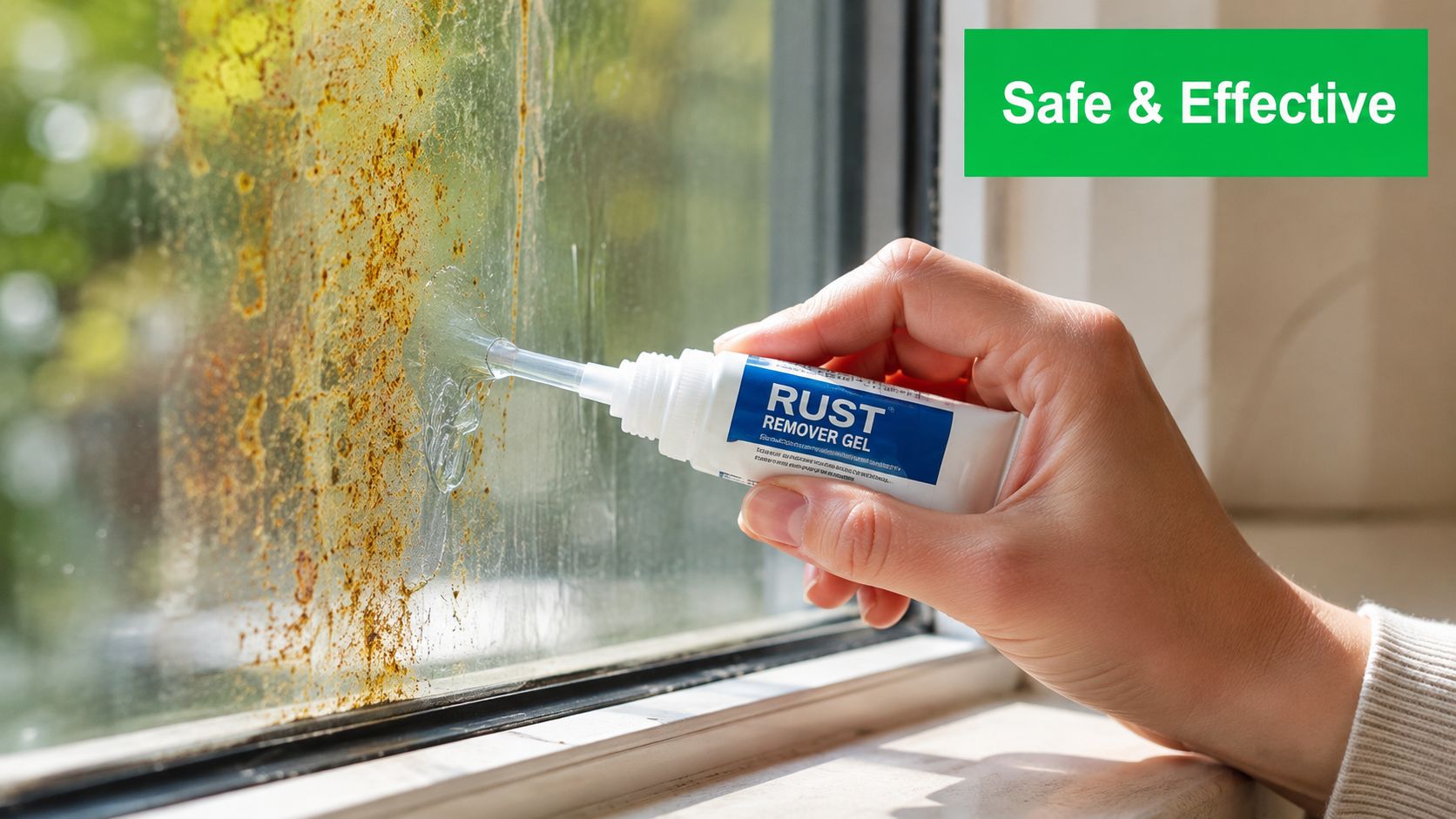
The image below shows the kind of controlled application that matters on glass.
Work slowly and keep the surface protected
For light residue on glass trim or around frames, use a non-scratch, glass-safe rust remover and test a small hidden area first. Keep the product off painted frames unless the label specifically allows it, because the cleaner that's safe for glass may be too aggressive for coatings.
If the window is high, the risk changes fast. Ladder work, lift access, and edge conditions matter more than the stain itself. That's where a specialty cleaner such as Arelli's specialty cleaning page can be useful to compare how pros handle delicate surfaces and access.
For homeowners who also fight mineral haze, the approach has to stay consistent with the rest of the glass care routine. The step-by-step guidance on hard water stains from windows is worth pairing with rust removal, because mineral deposits and rust often show up together.
Never attack rust on glass with a green scrub pad, razor blade, or a mystery acid from the garage shelf. The stain costs less than scratched glass does.
A clean result also depends on the full service around the glass. Screens trap dust and metal particles, so removing, cleaning, and reinstalling them as part of the job keeps the next rain from sending grime right back onto the pane. That's one reason professional window cleaning is more than just wiping a pane and moving on.
Treating Rust on Concrete and Masonry Surfaces
Concrete, grout, and masonry are porous, so rust doesn't just sit on top. It works its way down, which is why a quick rinse can make the stain look lighter without fully removing it. In Flagstaff, that matters on driveways, front walks, retaining walls, and patio pads where moisture, sprinkler overspray, and old metal fixtures can leave repeat stains.
Light staining starts with the right acid
For light rust on concrete, the U.S. National Research Council says a mopping solution of about 1 lb of oxalic acid per gallon of water is effective, and it notes that small additions of ammonium bifluoride can speed removal. It also says 10% muriatic acid or phosphoric acid can work, though the concrete may end up slightly rougher (NRCan digest).
That roughness is the trade-off people forget. A faster result can leave the surface more open, which makes later staining easier. On decorative or exposed surfaces, that matters.
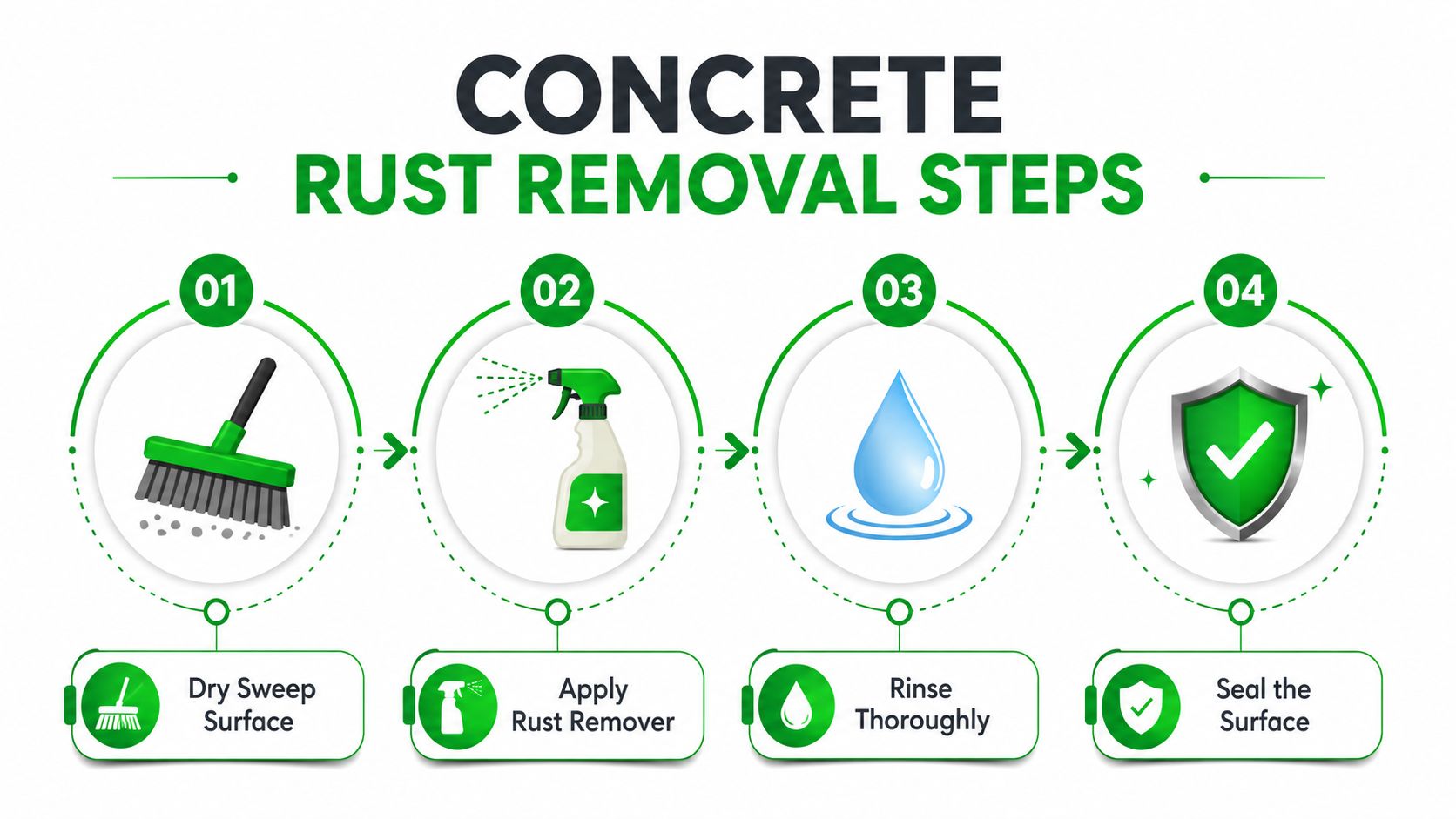
Before any chemical goes down, pre-wet the porous material with warm water, identify the exact surface, and test a small inconspicuous area. A professional-cleaning guide recommends a 5 cm inconspicuous area test first, then saturating the stain with an oxalic-acid-based remover and giving it at least 10 minutes of dwell time before scrubbing with a stiff nylon brush and rinsing thoroughly (The Clean Home). A second pass may be used for significant staining, with dwell time extended to 15 minutes.
Deep staining needs a poultice, not more scrubbing
Deep rust in concrete often needs a pull-out method. The U.S. General Services Administration recommends a poultice made from 11 ounces by weight of sodium citrate in 2 quarts of lukewarm water plus 2 quarts and 12 ounces of glycerol, thickened with diatomaceous earth or talc to an oatmeal-like paste, then applied after wetting the concrete and left to dry before removal and rinsing (GSA poultice method).
That sounds fussy, but the method matters because the paste draws the stain out instead of grinding on the surface. I've seen people chase an old rust mark with stronger acid, only to leave a lighter stain surrounded by a rougher patch.
The short video below shows the broader workflow on hard surfaces.
If the rust keeps returning, stop treating it like a stain-only problem. A fastener, sprinkler head, railing base, or trapped moisture source may be feeding new iron into the concrete. That's when cleaning has to be paired with repair, drainage correction, or hardware replacement.
For property owners who want a broader maintenance view, the guidance from a home concrete and masonry contractor is useful because rust often shows up alongside structural wear, not in isolation. The same logic applies to routine washing and preservation practices used in pressure washing, where surface choice and rinse control matter as much as the chemical itself.
The infographic below lays out the basic sequence for concrete rust care.
Safe Rust Removal from Fabric and Textiles
Rust on fabric can look minor until the wrong chemical sets it deeper into the fibers. Bleach is a poor first move. It can leave rust stains more visible or lock them into cotton, upholstery, and outdoor textiles.
A better approach starts with the stain source and the fabric itself. If the mark came from a metal zipper, patio chair joint, furniture frame, or another rusting part, treat the source and the textile together. On Flagstaff properties, dry air and strong sun can make some fabrics seem stable on the surface while the fibers underneath have already been weakened by age, sun exposure, or repeated cleaning.
Use mild acid, controlled time, and cold water
For textiles, a cited expert protocol recommends a 5 to 8% w/v citric acid solution at pH 2.8 to 3.2, applied directly to the stain for 15 to 30 minutes at 20 to 25°C. After that, the fabric should get a thorough cold-water rinse and be laundered with a neutral-pH detergent, pH 6.8 to 7.2 (Alibaba Life Tips). The same source warns that tap water can reduce efficacy because dissolved calcium and magnesium compete with iron for binding sites, and it advises only a single repeat if faint staining remains.
That makes fabric treatment a timing job, not a brute-force job. If the stain lightens but does not disappear, a controlled second pass is reasonable. If it still will not move, the garment may have deeper fiber damage or an ongoing rust source.
Practical rule: if the stain sits near a metal zipper, button, furniture frame, or patio chair joint, check the source before treating the fabric again.
A peer-reviewed 2023 study on cotton textiles found that cleaned samples had a color difference of just 3.81 from unstained fabric after treatment, which is a useful sign that most rust compounds were removed without wrecking the textile surface (WO2023175537A1). That is not a promise for every fabric, but it does show that careful chemistry can get close to original appearance.
For rugs and upholstery, the safest route is usually surface-specific stain work rather than general cleaning. A Birmingham area rug restoration resource can be a helpful comparison point if you are dealing with pile, fringe, or backed materials that react very differently from washable clothing.
Delicate upholstery, dyed outdoor cushions, and blended fabrics may need spot testing and slower drying, especially if the rust came from a hidden metal frame. For pieces that should not be soaked at home, professional textile cleaning through 4-Seasons Dry Cleaners is the safer path, especially on high-value fabrics that have to keep their finish and shape.
Specialty Surfaces and When DIY Becomes Dangerous
A lot of rust removal advice sounds confident because it's simple, but simple can be expensive on limestone, marble, and other natural stone. Vinegar and lemon juice are common suggestions online, yet those acids can permanently etch or dull polished stone. On high-value finishes, the cleaner that seems strongest usually creates the biggest problem.
Stone needs restraint, not force
The U.S. General Services Administration specifically recommends poulticing for rust stains on limestone and marble rather than aggressive scrubbing, which is a strong signal that surface-specific care matters more than one-size-fits-all advice (GSA poulticing guidance). The reason is simple. Stone can absorb chemicals and react unevenly, so rubbing harder often makes the finish look worse even if the stain lightens.
The UGA Extension treats rust as a distinct stain category and recommends a mild start on treated surfaces, then a stronger formula of 1 part sodium citrate to 6 parts water and 6 parts glycerin, mixed with powdered whiting and applied as a thick layer (UGA Extension). That approach is slower, but it respects the surface.
Recurring rust means there's an underlying source
If the stain keeps coming back, the problem may be hidden corrosion or moisture migration. That shows up around stone thresholds, shower surrounds, exterior masonry, and window-adjacent finishes, where metal hardware or trapped water keeps feeding the stain.
Plain truth: repeated cleaning without finding the source usually turns into repeated damage.
The best decision is often to stop. If the finish is polished, historic, or expensive to replace, a test patch and a conservative method are the only sensible starting points. For a homeowner, that can mean preserving a surface that would cost far more to replace than to clean carefully.
The same caution applies to commercial properties and cabins where finishes have to last through seasons of use and temperature swings. A strong cleaner may win the battle against the stain and lose the war against the substrate.
When to Call Professional Rust Removal Services
Some rust jobs are too risky, too high, or too widespread for DIY to be the best move. High-rise windows, large concrete fields, recurring stains from hidden corrosion, and specialty stone all justify professional assessment because the right answer depends on access, material, and source control. That's especially true when the stain sits on a finish you can't replace easily.
Professional crews bring tools that change the outcome. Boom lifts, scissor lifts, water-fed pole systems, and industrial-grade cleaning solutions let technicians work safely at height and cover large areas without dragging ladders across delicate surfaces. For window work, that usually also means screen removal, screen cleaning, and reinstallation as part of the service, so the glass and the frame are handled as one system.
The best reason to hire out isn't convenience, it's damage prevention. Background-checked, OSHA-trained technicians with proper insurance can assess whether the stain is on the surface, embedded in the substrate, or being fed by a corrosion source. That distinction saves time and helps avoid the expensive mistake of treating a structural issue like a cosmetic one.
For Flagstaff properties, that matters on cabins, second homes, storefronts, and higher-end finishes where a misstep can leave permanent marks. If you're looking at rust on glass, masonry, or stone and you're not sure how deep it goes, professional service is usually the cheaper path in the long run.
If rust stains are showing up on your windows, concrete, or specialty finishes, Pine Country Window Cleaning can help you protect the surface while removing the stain the right way. Visit Pine Country Window Cleaning to schedule service, and let a local Flagstaff team handle the cleaning with the care your home deserves.