
The view is still there. The San Francisco Peaks, the pines, the open sky over Flagstaff. You just can't enjoy it through dusty, spotted second-story glass.
That's the point where a lot of homeowners start thinking about a ladder, a bucket, and a free Saturday. Sometimes that works. Often, it doesn't. Second story window cleaning is different from cleaning a ground-floor slider or a bathroom window you can reach from inside. Height changes the tools, the technique, the risk, and the margin for error.
In Northern Arizona, it also changes what the glass is dealing with. Pine pollen sticks. Hard water spots bake on fast. Snow, wind, dust, and strong sun expose every missed edge and every weak seal. A pro approach isn't about making the job look fancy. It's about getting clean glass without damaging the window or putting someone in danger.
Why Clean Second Story Windows Like a Pro
A second-story window can look clean from the driveway and still be covered with edge lines, screen dust, and hard water film once the afternoon sun hits it. That gap between "good enough" and actually clean is what changes the job.
Professional second story window cleaning starts with matching the method to the glass, the frame, and the access. On upper windows, small mistakes show up more clearly and carry bigger consequences. Too much water can run into frames or onto siding. The wrong brush can drag grit across the pane. A rushed pass leaves detailing marks you will notice from inside and out.
Why upper windows are a different job
Height changes how the work is done long before anyone touches the glass. Tool control gets harder as reach increases. Angles get worse. Screens are more awkward to remove and reset without bending frames or dropping debris below. On many Flagstaff homes, the problem is not just elevation. It is elevation combined with sloped lots, decks, rock landscaping, snowmelt-softened soil, or wind that picks up fast in the afternoon.
Upper glass also tends to collect the kind of buildup that punishes shortcuts in Northern Arizona. Pine pollen sticks to damp edges and screen mesh. Hard water spots set up fast in sun and dry air. Winter residue can leave dirt packed into corners and tracks. If that buildup is scrubbed with the wrong pad or attacked with too much pressure, the window may end up looking worse, not better.
A good technician plans for those conditions before starting. The work is slower, more deliberate, and more protective of the home.
Practical rule: If the setup only works when everything goes perfectly, it is not a safe DIY setup.
What professional care looks like
Professional care means controlling the whole process, not just wiping the visible glass. Screens are removed carefully, cleaned separately, and reinstalled square. Sills, edges, and frames get attention because dirt left there will wash back onto the pane the next time it rains or snows. Water use stays controlled so runoff does not streak stucco, spot trim, or drip onto lower windows that were already finished.
That standard matters on Northern Arizona properties, especially cabins, rentals, and second homes that may sit for weeks between visits. If debris is left behind or a screen is not seated properly, the problem usually shows up later, after wind, pollen, or weather has had time to work on it.
Pine Country Window Cleaning has been serving Northern Arizona since 1999. The company was started by Flagstaff native David Kaminski, and that local experience has shaped how second-story work is handled here, with attention to safety, cleanliness, and protection of the home.
Your Safety Checklist for Working at Height
Treat height work as a separate category of home maintenance. Don't lump it in with washing patio furniture or hosing off a deck. The consequences are different.
Start with the ground, not the glass
Most homeowners look up first. Professionals look down first. The ladder or pole setup only works if the base is stable.
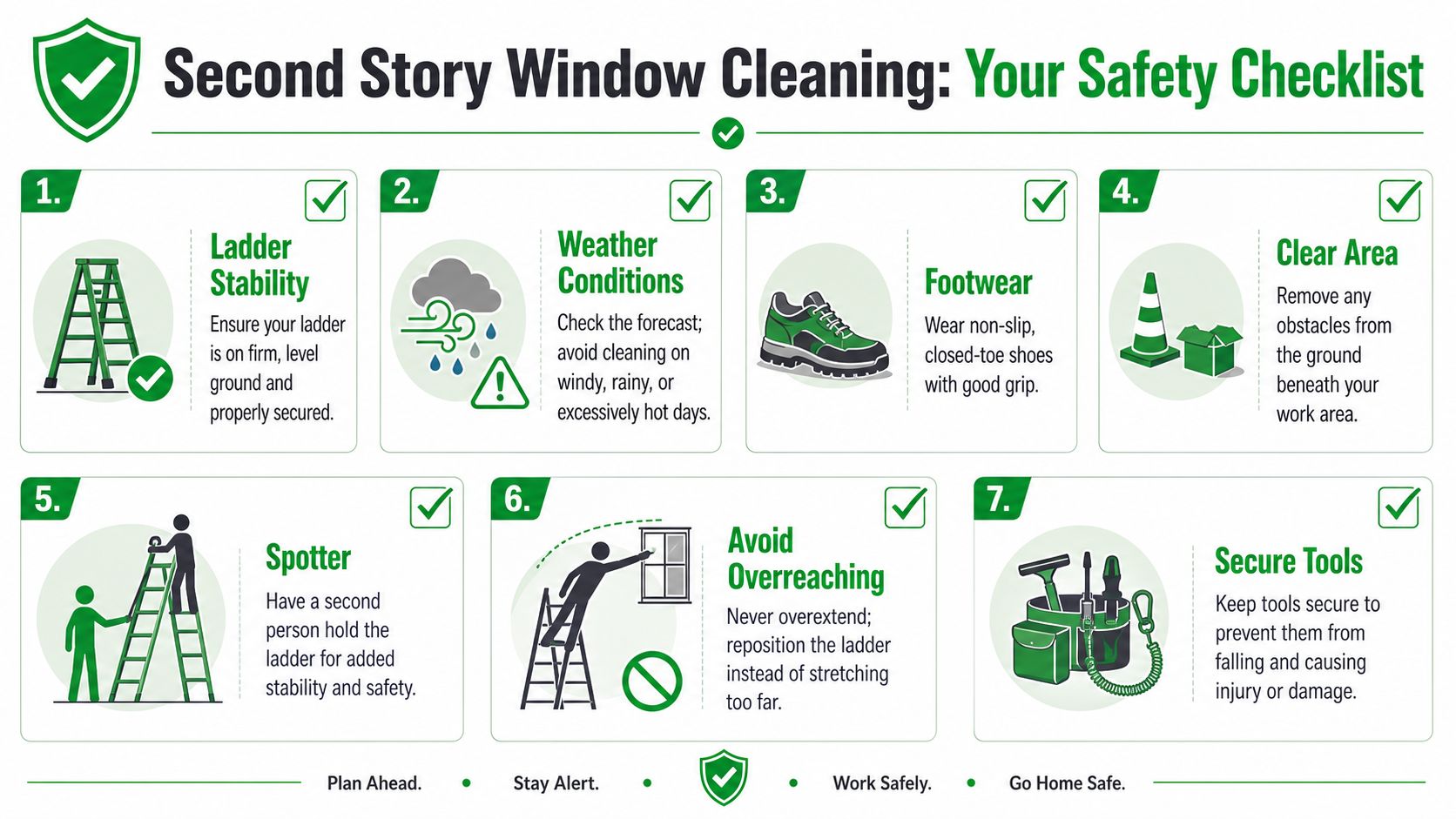
Run through this checklist before you bring out a ladder or extension pole:
- Check the surface: Gravel, thawed soil, mulch, decorative rock, and sloped ground are all problem surfaces.
- Clear the landing zone: Move furniture, hoses, toys, and planters away from the base area.
- Watch overhead hazards: Branches and power lines change the risk immediately.
- Use proper footwear: Closed-toe, non-slip shoes are the minimum.
- Have a second person nearby: Not for casual company. For stability, tool handoff, and emergency backup.
- Reposition instead of leaning: Overreaching is how control gets lost.
- Stop when weather changes: Wind and wet surfaces turn a manageable setup into a bad one fast.
Know what the data says
A lot of online advice treats second-story cleaning like a simple extension of first-floor work. It isn't. Twenty-five percent of all residential ladder injuries occur when cleaning windows on the second floor or higher, and recent 2024 to 2025 OSHA updates emphasize that untrained workers using extension poles over 15 ft without anti-slip bases account for 60% of high-window incidents, according to Consumer Reports coverage on the safest way to clean high windows.
That doesn't mean every homeowner will get hurt. It means the risk is concentrated enough that casual methods deserve a hard second look.
The moment your body starts compensating for unstable footing, the cleaning part of the job is over. You're just managing risk badly.
The non-negotiables
A few safety rules aren't preferences. They're limits.
| Situation | What it means |
|---|---|
| Uneven or soft ground | Don't set a ladder there |
| You need to lean sideways to reach | Reposition or stop |
| Pole flex makes the tool wobble | The setup is wrong |
| Wind affects the ladder or brush head | Wait for better conditions |
| You can't work without rushing | Don't start |
Professionals also build their methods around access and fall protection. Standard ladders become unstable beyond 18 feet, and professional high-window work has to address access, water quality, and fall protection rather than pretending the job is just a taller version of basic window cleaning, as outlined by Pine Country's guide to cleaning high windows safely.
A sober DIY test
Ask yourself three blunt questions:
- Can I reach every target window without stretching or improvising?
- Can I keep both the tool and my footing under control the whole time?
- If a screen sticks, a sash resists, or a brush snags, can I handle it without losing balance?
If any answer is no, call a pro. That isn't overcautious. That's sound judgment.
Gathering Your Professional-Grade Equipment
If you want professional-looking results, use professional-style tools. Don't try to clean second-story windows with a rag and household spray. Those methods leave residue, smear dirt around, and force too much repeated wiping. On upper glass, that usually means more streaks and more time spent in a risky position.
The basic pro kit
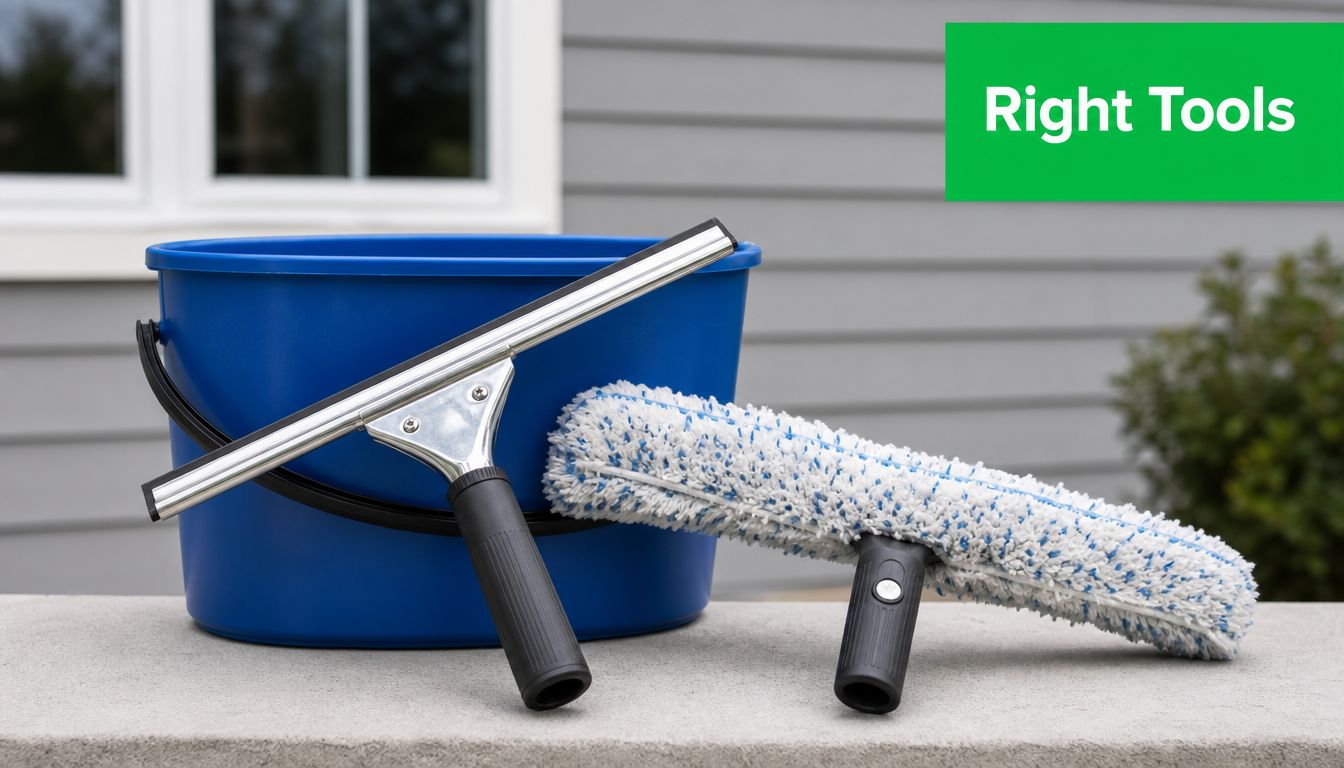
A proper second story window cleaning setup usually includes these pieces:
- A quality squeegee: This is what removes the water cleanly from the glass.
- A T-bar washer or scrubber: Used to apply solution and loosen bonded dirt.
- An extension pole: Needed for controlled reach from the ground or a stable ladder position.
- A bucket: Wide enough to load the washer and keep tools organized.
- Lint-free detailing cloths: For edges, corners, and sill touch-up.
- A screen-removal tool or safe removal method: Because cleaning around dirty screens wastes the effort.
A lot of homeowners buy a pole first and think that solves the problem. It doesn't. The pole only works when the head, the blade, the scrubber sleeve, and the operator are all working together.
Why each tool matters
The squeegee is the difference between clear glass and a pane full of drying marks. The scrubber lifts debris so the blade can glide instead of dragging grit. The extension pole lets you clean from a safer position, but only if it stays rigid enough to control the angle of the tool head.
The cloth matters too. Edge detailing is where many DIY jobs fall apart. The center looks decent, but the perimeter dries with lines and drips because the cloth is too fuzzy, too wet, or already dirty.
For homeowners who want a better look at the tools professionals use, this guide to home window cleaning tools is a useful reference.
Pure water versus traditional tools
There are two broad approaches on upper glass. One is traditional, with scrubber and squeegee. The other uses a pure-water brush system that rinses clean and dries spot-free when the water quality is right. Both can work. The right choice depends on the window design, how much detailing is needed, and whether the frames and surrounding surfaces need hand attention.
Some contractors use a mix of both. Pine Country Window Cleaning handles second-story work with the access and cleaning method that fits the property, rather than forcing one setup onto every home.
Cheap tools don't fail all at once. They fail inch by inch, with chatter, missed edges, and blades that won't stay consistent across the glass.
The Pro Technique for Flawless High Windows
Clean second-story windows in the wrong order and the whole job gets harder. Clean them in the right order and the glass responds better, the screens go back clean, and the finish lasts longer.
The workflow matters as much as the tool choice.
Start with screens and dry debris
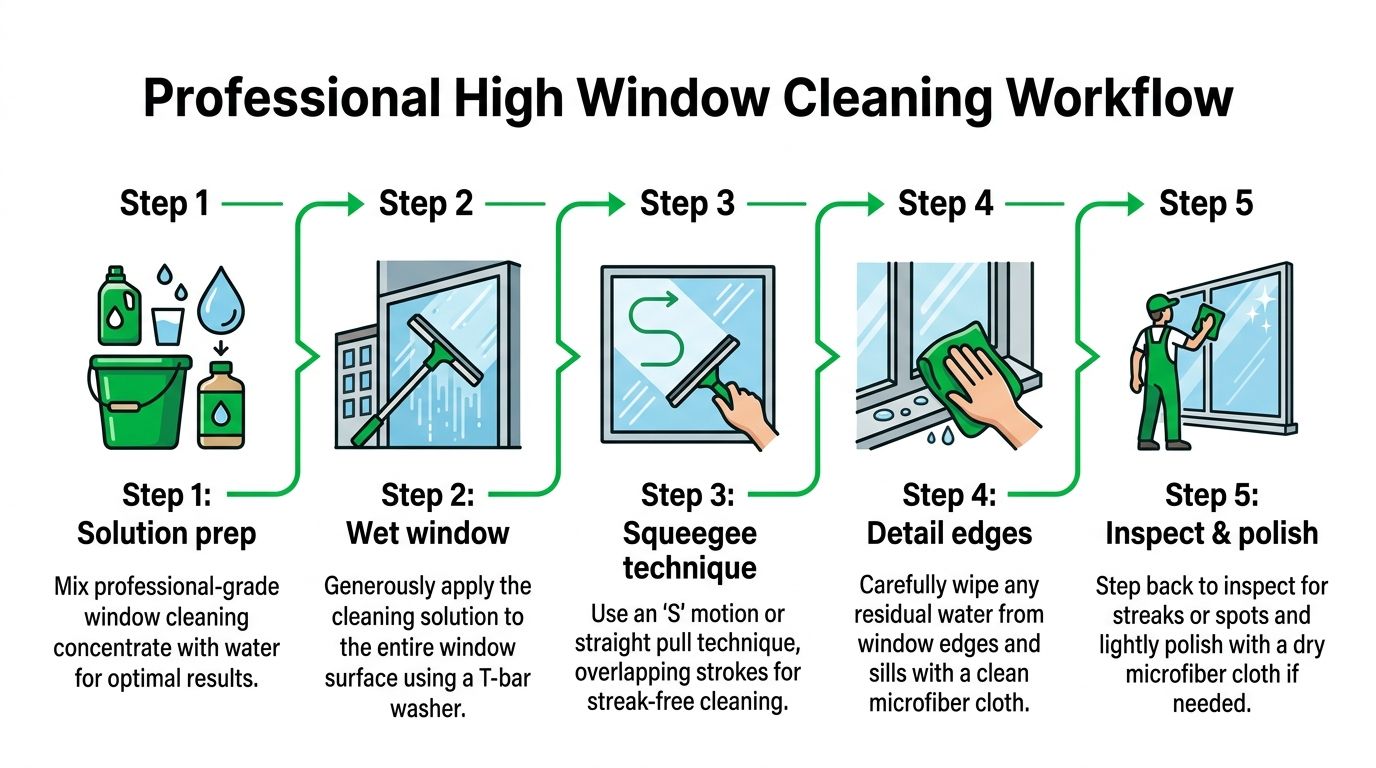
Professionals usually remove screens first. That gives direct access to the glass and prevents dirty screen dust from dropping back onto freshly cleaned panes. It also lets you inspect the sill, the frame edges, and any buildup packed into corners.
At every service, screens should be removed, cleaned, and reinstalled correctly. That's part of doing the job all the way, not halfway.
Before scrubbing the glass, remove loose dust and grit. This step gets skipped all the time by DIY cleaners, and it shows. If loose debris stays on the pane, the washer can grind it across the surface.
A technical mistake professionals avoid is scrubbing before a proper pre-rinse or dust removal. South Mountain Window Cleaning's discussion of second-story cleaning errors notes that failing to pre-rinse or dust the glass can grind grit into the surface, creating micro-abrasions and haze. The same guidance also warns that a dirty squeegee blade or dirty cloth creates immediate streaks.
Wet the glass fully and scrub with control
Partial wetting causes uneven drag. Wet the full pane, then scrub the full pane. On second-story work, especially in Flagstaff's dry air, solution can flash off fast. If the glass starts drying before you squeegee it, the blade won't move cleanly.
Focus on corners, top edges, and bug residue. Those are the spots that hold onto grime. Use the washer to loosen contamination instead of trying to muscle it off with blade pressure later.
A short demo can help if you want to watch the movement of the tools in real time.
Use the S-curve correctly
The industry-standard method for a professional finish is the S-curve, also called fanning. It isn't random motion. It's a controlled pattern that keeps water moving off the glass without leaving tracks behind.
According to this guide to cleaning second-storey windows safely and effectively, the method starts by creating a dry “starting line” with a horizontal pull across the top inch of the glass. After that, each stroke should overlap the previous one by about one inch while maintaining a continuous smooth S motion. The perimeter then gets detailed with a lint-free cloth.
That top dry line matters more than one might expect. It gives the blade a clean lane to start from and keeps dirty water from feeding back into the finished section.
Finish the edges and inspect from a distance
Detailing is not random touch-up. It's targeted moisture removal from the perimeter, corners, and sill where the squeegee can't fully finish the pane. Wrap the cloth around the end of the pole if needed, but keep it dry and clean.
Then step back and inspect from an angle. Looking straight at the window isn't enough. Light reveals missed water, blade lines, and haze.
Use this quick field check:
- If you see arcs or crescents: The blade angle or pressure was off.
- If you see straight wet lines: The blade edge was dirty.
- If the top edge looks dull: The starting line wasn't established cleanly.
- If drips appear later from above: Water stayed in the frame or upper seal area.
A flawless pane isn't just washed. It's controlled from first contact to final inspection.
Adapting to Window Care in Northern Arizona
Flagstaff and the surrounding mountain communities aren't gentle on windows. Homes in Munds Park, Forest Highlands, Pine Canyon, and similar areas deal with a mix of fine dust, pine pollen, snow residue, hard water spotting, and intense seasonal swings. Those conditions change both how windows get dirty and how they should be cleaned.
What the climate puts on your glass
Spring pollen doesn't sit on the window like loose powder for long. It mixes with moisture and sticks to frames, corners, and screens. Summer storms can splash grit upward. In dry stretches, minerals left by sprinkler overspray or hose water harden quickly. Winter brings melt, splashback, and grime along lower sash lines and frames.
That mix is one reason generic window advice from mild climates often falls short here. Northern Arizona glass needs methods that remove contamination without stressing the seals and insulated units.
Why seal-safe methods matter here
In cold-climate markets like Northern Arizona, improper cleaning techniques such as high-pressure water and vinegar-acid solutions can degrade window seals and increase heat loss by 15% to 20% in double-pane units. A 2024 study found that 30% of second-story window failures in mountainous regions stem from seal degradation caused by improper cleaning, not age or manufacturing defects, according to Purilly's analysis of washing second-story windows.
That has practical consequences for homeowners. If the glass is clean but the seal is compromised, the window still loses performance. On upper windows, where people clean less often and inspect less closely, those problems can sit unnoticed.
Timing and frequency in this region
Northern Arizona homeowners usually do better with maintenance based on conditions, not habit. A home under heavy tree cover may need different timing than an exposed property with hard water spray near the landscaping. Vacation homes and short-term rentals also need a different schedule than full-time residences because buildup often sits longer before someone notices it.
For a local framework on timing, this guide on how often windows should be cleaned is a practical place to start.
Clean glass is only part of the job in mountain climates. The method has to protect the insulated window too.
Knowing Your Limits and When to Call a Professional
A homeowner starts on a calm morning with an extension pole and a ladder. By the second upper window, the ladder is sitting on uneven ground, the sun has dried the glass too fast, and the last pass leaves hard-water streaks across the pane. That is the point where second story window cleaning stops being a simple weekend task and turns into a judgment call about risk, access, and the cost of getting it wrong.

Some second-story windows are still reasonable for DIY. A window over a solid deck, a small set of panes that tilt in, or glass you can reach from inside with stable footing can be manageable if you already own the right tools and know how to use them. In those cases, the job stays controlled.
The line gets crossed fast in Northern Arizona. Sloped lots in Flagstaff, rock landscaping, snow-softened ground, pine pollen buildup, and mineral-heavy water all make upper-window work less forgiving. A house that looks like a basic two-story from the street can have first-story access on one side and a much longer fall on the other. Add roof edges, brittle screens, aging seals, or stucco that stains easily, and the margin for error gets small.
Here is the practical test I use. If you cannot keep both feet planted, set the ladder on firm level ground, and clean the glass without overreaching, the job should not be done DIY. If the window needs specialty access, screen removal at height, or repeated repositioning around landscaping, it is time to hand it off.
What are you paying for with a professional? Part of it is labor, because higher-access work takes more setup, more time, and tighter safety controls. Part of it is judgment. Good technicians know when a pole is enough, when a ladder is the wrong choice, and when the glass, frame, or seal condition means the cleaning method needs to change.
Established operators also have equipment that homeowners usually should not try to substitute. IBISWorld's overview of the industry notes that larger window washing companies invest in access equipment such as scissor lifts and atrium lifts that can reach up to 95 feet, which reflects a simple truth. Work at height is its own skill set, and proper access equipment exists because ladders are not the answer for every building shape or terrain condition. You can review that context in IBISWorld's overview of the window washing industry.
For homeowners comparing companies, ask direct questions. How will they access the glass? Who removes and reinstalls screens? How do they protect landscaping, painted trim, and stucco? What do they do differently on hard-water staining or pollen-heavy homes in Flagstaff? If a company cannot answer clearly, keep looking.
If you are weighing options, start with what to look for in a window cleaning service. A qualified company should be able to explain its process in plain language, including safety procedures, access method, and what happens if conditions on site make the original plan unsafe.
For service companies, clear communication matters for a different reason. Homeowners need enough information to judge who is prepared and who is guessing. Silva Marketing has a guide for service business owners that shows how companies present that information online.
Hiring a pro is not admitting defeat. It is making a sound call before a difficult window turns into a fall, a broken screen, or a damaged seal.