

You're probably here because you've felt the sting of a review that should have been better. The guest liked the location, liked the cabin, liked the check-in, then left four stars because of dust on the blinds, crumbs in the toaster, or cobwebs by the entry light. That's how short-term rentals work. Guests forgive small décor quirks. They don't forgive dirt.
In Flagstaff, that standard gets even harder to maintain. Pine pollen, dust, snow, mud, and screened windows that collect grime all work against you. A property can look fine in photos and still feel neglected in person if the details slip. Owners who treat cleaning as a quick reset between bookings usually learn that lesson the expensive way.
Good vacation rental cleaning services do more than make a place look presentable. They protect your reviews, reduce wear, catch maintenance issues early, and help your property stay guest-ready through every season.
Why Five-Star Reviews Start with Spotless Cleaning
A bad cleanliness review rarely comes from one huge failure. It usually comes from small misses that pile up in the guest's mind. Dust on a lamp. A hair in the bathroom. Fingerprints on the glass door. Smudged mirrors. A clean-enough turnover can still feel careless if those details are left behind.
That's why experienced hosts stop thinking about cleaning as a chore and start treating it as part of operations. The cleaning team isn't just resetting the property. They're protecting the guest experience before the guest even unpacks.
Cleaning now sits in a professional service category
The broader market shows how much this has changed. The global vacation rental cleaning services market was valued at $3.2 billion in 2024 and is projected to reach $8.5 billion by 2033, with an 11.2% CAGR, according to Market Intelo's vacation rental cleaning services market report. That matters because it reflects a real shift. Owners aren't handling this as spare-time housework anymore. They're building systems around it.
When reviews depend on cleanliness, cleaning becomes tied directly to occupancy, repeat stays, and how confidently you can charge for your property.
Practical rule: Guests notice cleaning first, long before they notice your upgraded coffee maker or new throw pillows.
What guests actually judge
Guests rarely score cleanliness based on effort. They score what they can see, smell, and touch the moment they arrive. That usually includes:
- Beds and bath presentation because crisp sheets and fresh towels signal that the whole home is cared for
- Visible surfaces like counters, mirrors, windows, and floors
- Corners and edges where dust, hair, and debris collect fast
- Bathrooms because even a minor miss there feels major
- Entry experience including porch condition, front glass, and first-step floors
Linen quality plays a role too. If you're trying to keep white bedding looking sharp between frequent turnovers, this expert white sheet care guide is worth bookmarking. White sheets only look luxurious when they're bright, stain-free, and consistently handled well.
Cost center or revenue protector
New owners often ask how to reduce cleaning costs. The better question is how to avoid cheap cleaning that creates expensive problems. Dirty properties lose trust fast. Worn properties age faster. Missed details become public reviews.
That's the mindset shift. Strong vacation rental cleaning services aren't overhead you tolerate. They're part of how you protect ratings, revenue, and the long-term condition of the home.
The Anatomy of Vacation Rental Cleaning
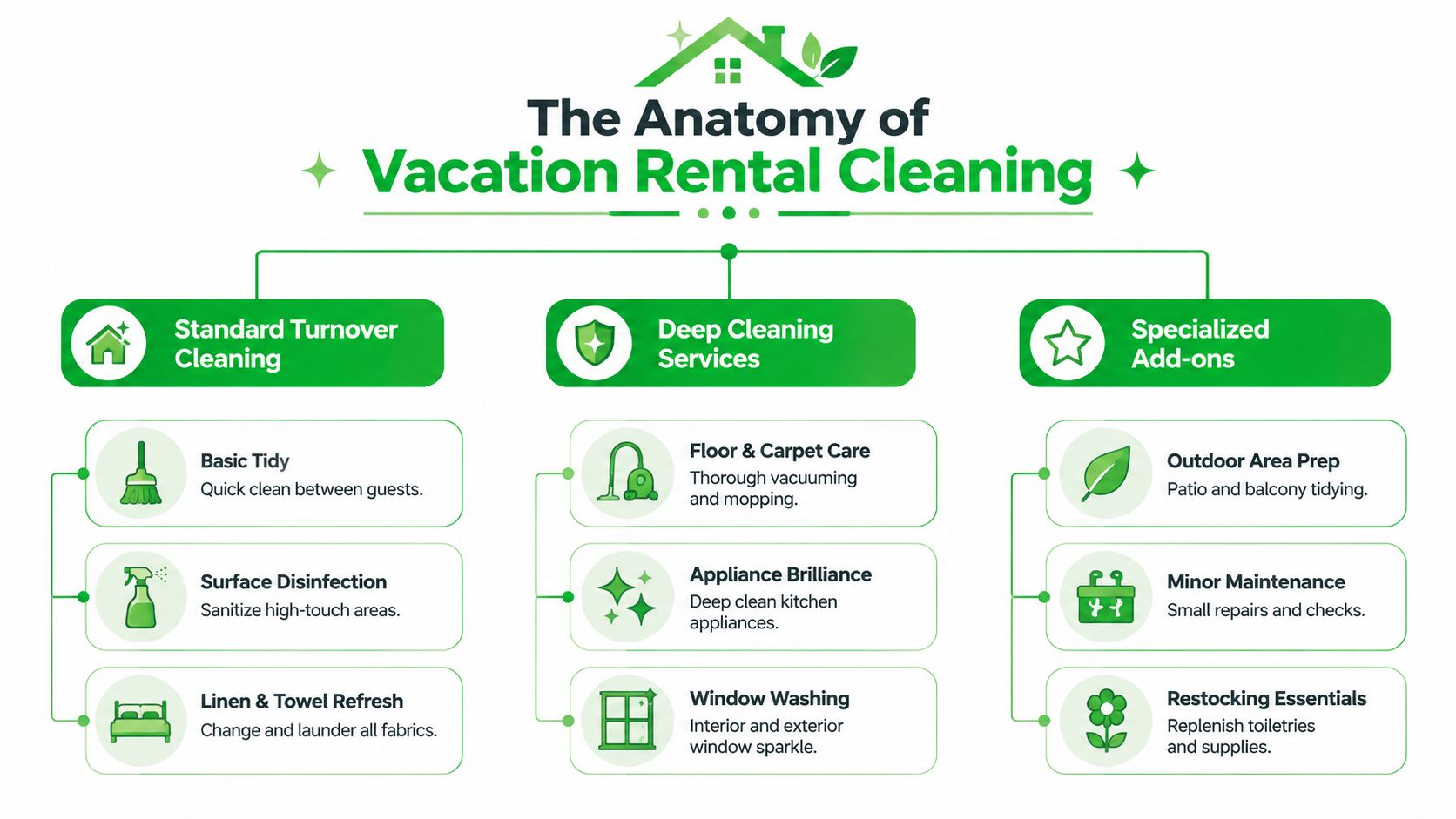
Most new owners lump everything under one phrase: cleaning between guests. That's too simplistic. A vacation rental needs different layers of service, and each one serves a different purpose. If you don't separate them, you end up paying for the wrong scope or expecting a turnover crew to solve problems that belong in a deeper maintenance cycle.
Turnover cleaning is the fast reset
Think of a turnover clean like a quick tune-up. The goal is to restore the property to guest-ready condition in a short window.
That usually includes beds, bathrooms, kitchen surfaces, trash removal, floor care, visible dusting, towel replacement, and restocking basics. It also includes a visual check for damage, missing items, and obvious maintenance issues. This is the work that happens over and over, often under time pressure.
Turnover cleaning should be standardized. If your cleaner is improvising every visit, the quality will drift.
Deep cleaning resets the baseline
Deep cleaning is different. It's less about speed and more about restoring the property before grime becomes normal. Crews handle buildup in places that don't always get addressed during a same-day flip.
Typical deep-clean focus areas include:
- Appliances and kitchen interiors such as refrigerator shelves, oven buildup, and microwave splatter
- Edges and overlooked surfaces including baseboards, trim, vents, and behind furniture
- Soft surfaces like upholstered chairs, rugs, and fabric headboards
- Interior and exterior glass especially where views are part of the rental's appeal
- Seasonal dirt zones such as mud-prone entryways and patio transitions
If your rental has upholstered seating that sees heavy guest use, a practical reference like this guide on how to clean your fabric sofa can help you understand what should be addressed between spot cleaning and full replacement.
A turnover clean keeps you in business this week. A deep clean keeps the property from slowly looking tired all season.
Laundry, restocking, and inspection are part of the job
A lot of owners underquote or underspec the work because they forget the non-wiping tasks. Laundry alone can change the entire labor picture. On-site machines save trips but slow same-day turns. Off-site linen service can improve consistency but adds coordination and inventory pressure.
A complete service menu usually includes more than cleaning itself:
| Service area | What it covers | Why it matters |
|---|---|---|
| Linen handling | Strip beds, launder, remake, inspect for stains | Bedding presentation shapes first impressions |
| Consumable restocking | Toilet paper, soap, paper towels, trash liners, coffee basics | Missing essentials trigger avoidable complaints |
| Pre-arrival inspection | Final walk-through, lights, remotes, odors, entry | Catches last-minute issues before guests do |
Owners who understand these layers ask better questions, get more accurate quotes, and build better systems. That's the difference between hiring a cleaner and building a reliable vacation rental operation.
Building Your Bulletproof Cleaning Checklist
Consistency doesn't come from telling people to “be thorough.” It comes from giving them a system they can repeat under pressure. In short-term rentals, the strongest checklists borrow from hotel inspection culture. Published examples of expert turnover lists can exceed 100 inspection points and cover tasks from bathroom disinfection to restocking toiletries, as noted in AvantStay's vacation rental cleaning checklist guide.
That level of detail isn't overkill. It's what prevents the same annoying misses from showing up in guest reviews.
Here's the visual version most owners need before they build their own property-specific list:
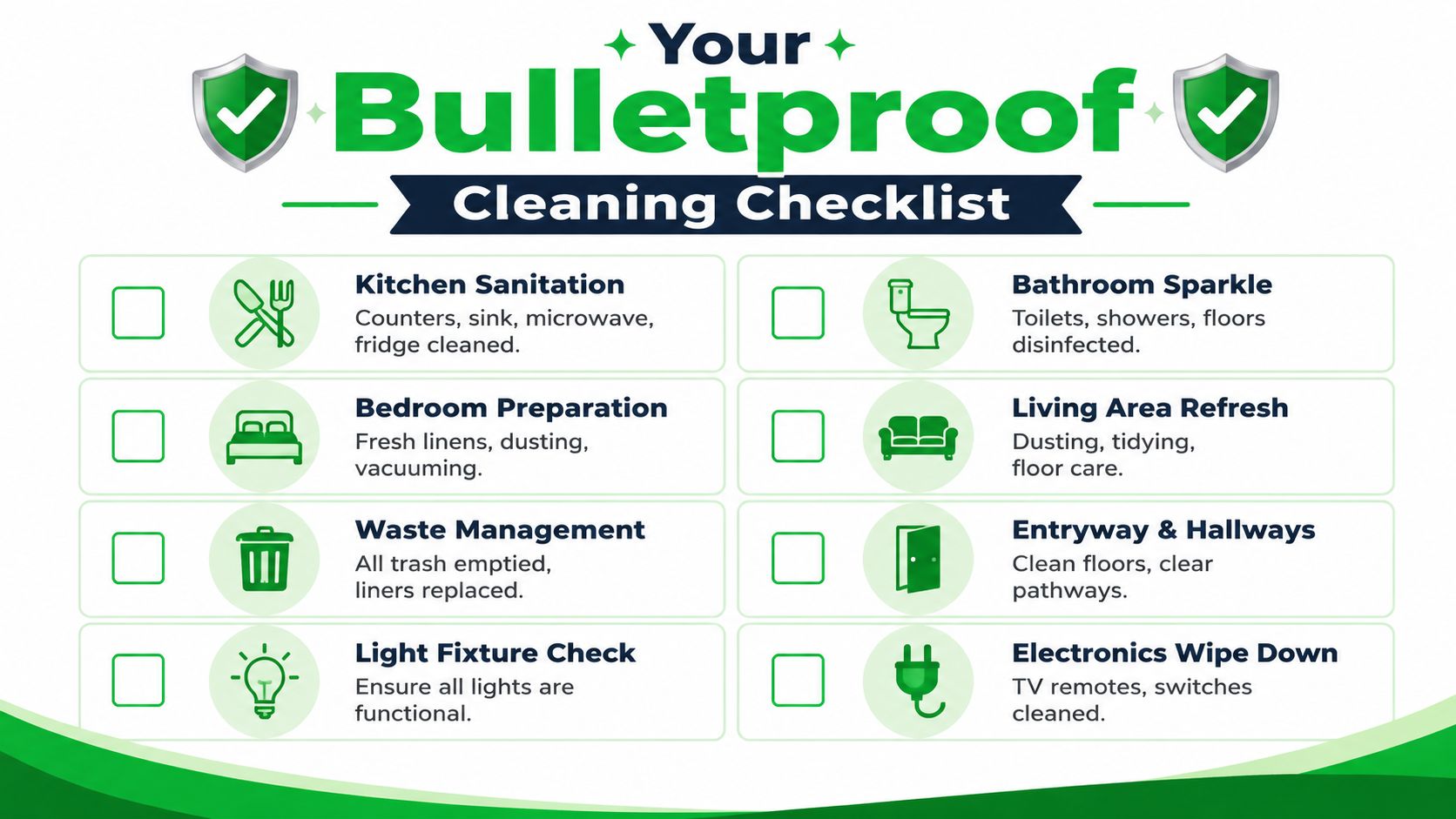
A checklist works best when it's room-based, not one long random list. Cleaners move more efficiently, and inspections become easier.
The non-negotiables by room
Kitchen
The kitchen needs more than wiped counters. Check sink condition, cabinet fronts, appliance exteriors, inside the microwave, refrigerator shelves if needed, trash can cleanliness, and floor edges near kick plates. Guests use the kitchen hard, and crumbs in corners instantly signal a rushed turnover.
Bathrooms
Bathrooms need a disinfect-and-present standard. Toilets, showers, mirrors, faucets, counters, floors, and drains all matter. Towels should be folded consistently, bath mats replaced, and toiletries restocked. If one room in the house has to feel unmistakably clean, it's this one.
Bedrooms
Bedrooms sell comfort. Strip and inspect bedding, remake beds tightly, dust lamps and headboards, check under-bed visibility, and vacuum or mop thoroughly. Don't ignore nightstand tops, closet floors, or window ledges.
Living areas
These spaces collect hidden grime. Clean remotes, switches, side tables, lamp bases, furniture surfaces, and rugs. Fluff cushions, look under seating, and remove signs of the previous stay. If the room has mountain views, dirty glass can make the entire space feel dull.
A quick video walkthrough can help reinforce how room-by-room standards should look in practice:
Build a checklist that catches detail failures
The biggest guest-facing misses are usually not the obvious ones. They're the detail zones that get skipped because nobody assigned them to a schedule.
Use a second layer in your checklist for recurring detail work:
- Baseboards and trim on a rotating cadence, not just when they look bad
- Corners and ceiling lines where cobwebs gather
- Light fixtures and fan housings because dust there is visible from below
- Behind and beneath furniture especially in longer-stay properties
- Windowsills and entry tracks where dirt accumulates fast in Flagstaff
Owner habit that helps: Separate your checklist into every turnover, every month, and seasonally. That's how you stop slow decline.
Inspection matters as much as cleaning
A checklist only works if someone verifies it. That can be the cleaner, a lead, a property manager, or the owner during random spot checks. What matters is that the property gets looked at through guest eyes before arrival.
A practical checklist should also include:
- Function checks for lights, remotes, locks, and thermostat
- Supply checks for paper goods, soap, and kitchen basics
- Damage notes so small issues don't carry into the next booking
- Exterior glance at the front door, mat, porch, and visible windows
The strongest vacation rental cleaning services don't just clean. They leave a repeatable inspection trail that makes quality measurable.
Pricing Models and Service Contracts Explained
Cleaning prices confuse new owners because two quotes can look wildly different while describing what sounds like the same job. Usually, they aren't the same job. One includes laundry and restocking. Another doesn't. One assumes a routine turnover. Another is pricing in recovery from heavy guest use.
The first step is knowing how cleaners commonly structure pricing.

Common pricing models
| Model | How it works | Best fit | Risk |
|---|---|---|---|
| Flat rate by property | One set price for a standard turnover | Stable layouts and repeatable scopes | Can create friction if extra mess is common |
| Hourly | Cleaner bills for time spent | Variable-condition properties | Harder to predict final cost |
| Booking-based arrangement | Cleaning cost tied to stay or management structure | Integrated operations | Scope can get blurry fast |
Flat rates are easiest to budget. Hourly pricing can be fairer when a property swings between light use and difficult departures. Neither is always better. The mistake is choosing a model before defining the work.
Use market context, then local reality
Turno's pricing data shows that in Q3 2021, average cleaning costs were $55.93 for 1-bedroom properties, $74.18 for 2-bedroom properties, and $104.76 for 3-bedroom properties, with major regional variation. The same source reports that a 3-bedroom rental averaged $180.46 in Hawaii versus $68.65 in Alabama, a spread of more than 2.5x. That's all laid out in Turno's vacation rental cleaning cost overview.
That gap is the point. Local labor conditions, turnover expectations, and property type drive pricing more than generic online averages ever will.
The contract is where most problems are prevented
A handshake arrangement can work for a while. It usually breaks when there's a deep clean, a holiday turnover, a supply shortage, or a disagreement about what “included” meant. That's why a defined service contract matters.
A useful contract should spell out:
- Scope of work so everybody knows what happens on a normal turnover versus extra-clean situations
- Supplies and equipment responsibility including who provides consumables, laundry products, and specialty tools
- Scheduling and access covering booking notifications, keys or codes, and what happens during back-to-back stays
- Payment terms so invoicing and add-ons don't become a recurring argument
- Termination rules because every owner needs a clear off-ramp if service quality slips
Cheap cleaning without a written scope often turns into expensive confusion.
When you compare quotes, don't just compare price. Compare assumptions. The cleaner with the higher rate may be the one who priced the full job correctly.
How to Vet and Schedule Your Cleaning Partner
Hiring the right cleaner is less about finding someone who says yes and more about finding someone who can deliver the same standard every time. Vacation rentals punish inconsistency. One strong clean followed by one rushed clean is enough to damage trust with guests.
The detail failures guests notice most often are recurring items like baseboards, corners, and light fixtures, and consistency tends to improve when the same cleaners return to the same property because they learn its problem spots. That point has been emphasized in expert discussion around checklist-driven maintenance systems. It's why the vetting process matters so much.
Questions that reveal how they really work
Don't ask only whether they clean short-term rentals. Ask how they handle them.
Use questions like these:
- Who usually cleans the same property? You want to know whether you'll get a rotating cast or a stable crew
- What happens if a cleaner calls out? Backups matter when a guest is checking in that afternoon
- How do you report damage or missing items? A good partner flags issues quickly, with photos if needed
- Do you follow a checklist or your own system? If they can't describe it clearly, quality is probably inconsistent
- How do you handle laundry, restocking, and last-minute turnovers? Those details often separate residential cleaners from rental specialists
A paid trial clean tells you more than a polished sales pitch. Walk the property after the clean. Open the microwave. Check under the beds. Look at corners, switches, fan housings, and window tracks.
Scheduling has to match booking reality
The best cleaning partner still fails if your scheduling system is sloppy. Calendar updates need to reach the cleaner early, accurately, and in a format they can use. Last-minute texts and vague dates are where missed turnovers start.
A good local benchmark for the kind of broader property care support many owners need around rentals is this page for Flagstaff cleaning services. Even if you already have an interior cleaner, it helps to think in terms of coordinated property services rather than isolated tasks.
A cleaner shouldn't have to guess when a guest leaves, how long they have, or what condition the house should be left in.
The best long-term relationships are boring in a good way. The same team knows the property, the checklist stays tight, and turnovers stop feeling like emergencies.
Special Cleaning Needs for Flagstaff Cabins
A Flagstaff cabin doesn't stay guest-ready on turnover cleaning alone. The climate keeps adding work. Every season pushes dirt, debris, moisture, or safety issues into the property in a different way, and owners who plan for those patterns avoid the constant feeling that the cabin is falling behind.
Spring and summer bring fine debris everywhere
Spring usually means pollen on decks, screens, sills, and exterior glass. It gets tracked indoors, settles on dark furniture, and shows up fast around entry points. A cabin can be cleaned well inside and still feel dusty because the transition areas were ignored.
Summer often adds dry dust. You'll see it on porch furniture, hard floors near the door, and windows that should be selling the view. It also creeps into tracks, blinds, and corners where quick turnovers don't always spend enough time.
Fall and winter shift the problem
Fall tends to load outdoor spaces with pine needles and organic debris. Decks, stairs, and entry mats need more attention because guests judge the property before they even open the door. Needles at the threshold don't just look messy. They get walked throughout the house.
Winter is where cleaning and maintenance stop being separate categories. Snow, slush, mud, and de-icing residue can all end up on floors and rugs. Moisture control matters more. Entry systems matter more. Dryers work harder because linens, towels, and cleaning cloths are handling heavier loads and slower drying conditions.
That's one reason many cabin owners pair turnover planning with broader upkeep like dryer vent cleaning in Flagstaff. It's not a glamorous line item, but in a four-season rental it belongs on the property care calendar.
Cabins need seasonal cleaning logic
A practical Flagstaff routine usually includes:
- Spring resets for pollen, screens, windowsills, and outdoor sitting areas
- Summer dust control at doors, floors, tracks, and high-touch surfaces
- Fall debris removal around decks, entries, and walkways
- Winter floor protection with tighter entry cleaning and faster wet-item handling
Flagstaff cabins don't decline because owners ignore them. They decline because the environment keeps adding small messes that standard turnovers weren't designed to handle. Seasonal thinking fixes that.
Boost Curb Appeal with Exterior Maintenance
Guests start judging cleanliness before they step inside. They notice the front windows, the porch, the walkway, the screens, the deck rails, and whether the property looks maintained or merely occupied. If the outside feels neglected, the inside has to work twice as hard to overcome that first impression.
That's why exterior maintenance belongs in the same conversation as vacation rental cleaning services. A spotless bathroom doesn't erase dirty glass facing a mountain view.
Windows, screens, and outdoor surfaces matter more than owners expect
In a market like Flagstaff, windows aren't a small detail. They frame pines, snowfall, sunsets, and outdoor light. If they're dusty or streaked, the whole interior feels dimmer. Professional window cleaning should be done with the right tools, including squeegees, ladders, poles, and pure-water brushes where appropriate. Not spray bottles and makeshift glass cleaning shortcuts.
A proper service also handles screens the right way. Remove them, clean them, and reinstall them carefully. That matters in cabins and second homes where screens collect pollen, dust, and debris long before the owner notices.
For owners who also manage dusty siding, decks, walkways, and exterior buildup, house pressure washing services can be part of the same guest-readiness plan.
Exterior care should be written into the service relationship
Interior cleaners and exterior vendors often assume the other party is handling edge tasks. That's where properties start to slip. A formal contract should define who handles supplies and equipment, scheduling processes, payment terms, and termination rules, especially when seasonal setup, deep cleans, or extra exterior work come into play, as explained in Operto's guide to vacation rental cleaning contracts.
Here's what works better in practice:
- Assign responsibilities clearly for windows, screens, patios, decks, and entry cleanup
- Set seasonal service triggers before pollen, monsoon dust, or snow season creates a visible problem
- Protect the home during service with crews who respect access points, finishes, landscaping, and furnishings
- Bundle maintenance thinking so curb appeal, safety, and cleanliness support each other
Some owners also borrow ideas from outdoor maintenance niches that deal with appearance and sanitation together. For example, Modern Yard Landscapes' artificial turf services are a useful reminder that outdoor guest areas need routine care too, especially where pets, dust, and foot traffic affect presentation.
For local owners who want a practical exterior partner, Pine Country Window Cleaning has served Flagstaff since 1999. The company was started by Flagstaff native David Kaminski and handles window cleaning with professional tools, removes and reinstalls screens with each service, and works with the kind of care you want around a guest-ready home. That local, four-season focus matters when you're maintaining a cabin or short-term rental instead of a generic suburban house.
A clean vacation rental should look cared for from the road, at the porch, through the glass, and all the way to the back deck. Anything less feels unfinished.
If you want help keeping your vacation rental guest-ready inside and out, Pine Country Window Cleaning can help with the exterior care that owners in Flagstaff often overlook. From professional window cleaning and screen handling to pressure washing, gutter-related upkeep, and seasonal property support, they provide practical services that fit the realities of short-term rentals in Northern Arizona.