

Post construction cleaning rates per hour usually fall between $25 to $75 per cleaner per hour. That's the clearest starting point, but in Flagstaff the price depends on what was built, how much fine dust is left behind, how accessible the site is, and how much finish-detail work the cleaner has to do.
If you're standing in a newly finished home, cabin remodel, tenant improvement, or commercial build-out, you already know the problem. The contractor is basically done. The paint is dry. The flooring is in. The punch list is shrinking. But the space still has drywall dust in corners, labels on glass, smudges on trim, debris in tracks, and that gritty film that shows up only when sunlight hits the room.
That's why post-construction cleaning isn't priced like routine housekeeping or standard janitorial work. It's a closeout trade. It requires labor, sequence, tools, and judgment. In Northern Arizona, that matters even more because mountain homes, custom builds, high glass, decks, screens, and hard-to-reach elevations add time fast.
Understanding Post Construction Cleaning Rates
A Flagstaff job can look ready for turnover and still need another full day of cleaning. Cabinets are in, floors are finished, and the GC wants a final walkthrough. Then the afternoon sun hits the glass and shows drywall haze, sticker ghosting, and packed window tracks. That is why the hourly rate only tells part of the story.
For post-construction work, the common starting point is $25 to $75 per cleaner per hour. That baseline is useful on punch-list cleanups, partial re-cleans, and jobs where the scope is still shifting. It also helps when different trades are still touching the space and no one can guarantee how much detail work will be left at the end.
Why the same hourly rate can lead to very different invoices
Hourly pricing measures labor time, but post-construction labor is uneven by nature. Two homes with similar square footage can price out very differently because one has light dust and open access, while the other has adhesive on glass, paint specks on hardware, debris in tracks, and fresh finishes that have to be cleaned carefully.
In Flagstaff, I pay close attention to the surfaces that slow crews down. New custom homes around Pine Canyon, rural builds outside town, and remodels in older neighborhoods often have more glass, more elevation changes, and more debris carried in from exterior work. Window cleaning is a good example. Basic wipe-down work is one thing. Removing construction dust, labels, and residue from finished glass without scratching it takes a different process, which is why specialized post-construction window and dust cleaning often needs to be scoped separately from general interior cleaning.
That same budgeting problem shows up on the construction side too. Builders who need to manage Australian project budgets still run into the same issue local contractors face here. Labor looks simple on paper until site conditions add hours.
Practical rule: If the build is still active or the final condition is uncertain, hourly pricing is usually the more honest option.
What to ask before you compare rates
The better question is not “What do you charge per hour?” Ask, “What parts of my job are likely to take longer than expected?”
A solid answer should mention the actual work, not vague sales talk. On Flagstaff post-construction jobs, the usual time drivers are:
- Fine dust in finished areas: Drywall and sawdust settle into vents, trim lines, sills, tracks, and closet shelves.
- Glass and screen detail: Stickers, silicone smear, paint specks, and dirty screens add time fast, especially on homes with a lot of windows.
- Access and logistics: Snow, steep driveways, upper-story glass, locked rooms, and remote locations all affect crew pace.
- Surface sensitivity: Fresh paint, stained wood, new fixtures, and specialty finishes require slower hands and better judgment.
Good post-construction pricing comes from matching labor to the actual condition of the site. In Flagstaff, that usually matters more than the posted hourly number.
What Drives Your Final Cleaning Cost
Post-construction cleaning costs more because the work is harder, slower, and less forgiving than routine cleaning. Commercial post-construction cleaning commonly runs $0.15 to $0.75 per square foot, compared with routine janitorial cleaning at $0.10 to $0.30 per square foot, according to ServiceMaster's breakdown of post-construction cleaning cost factors.
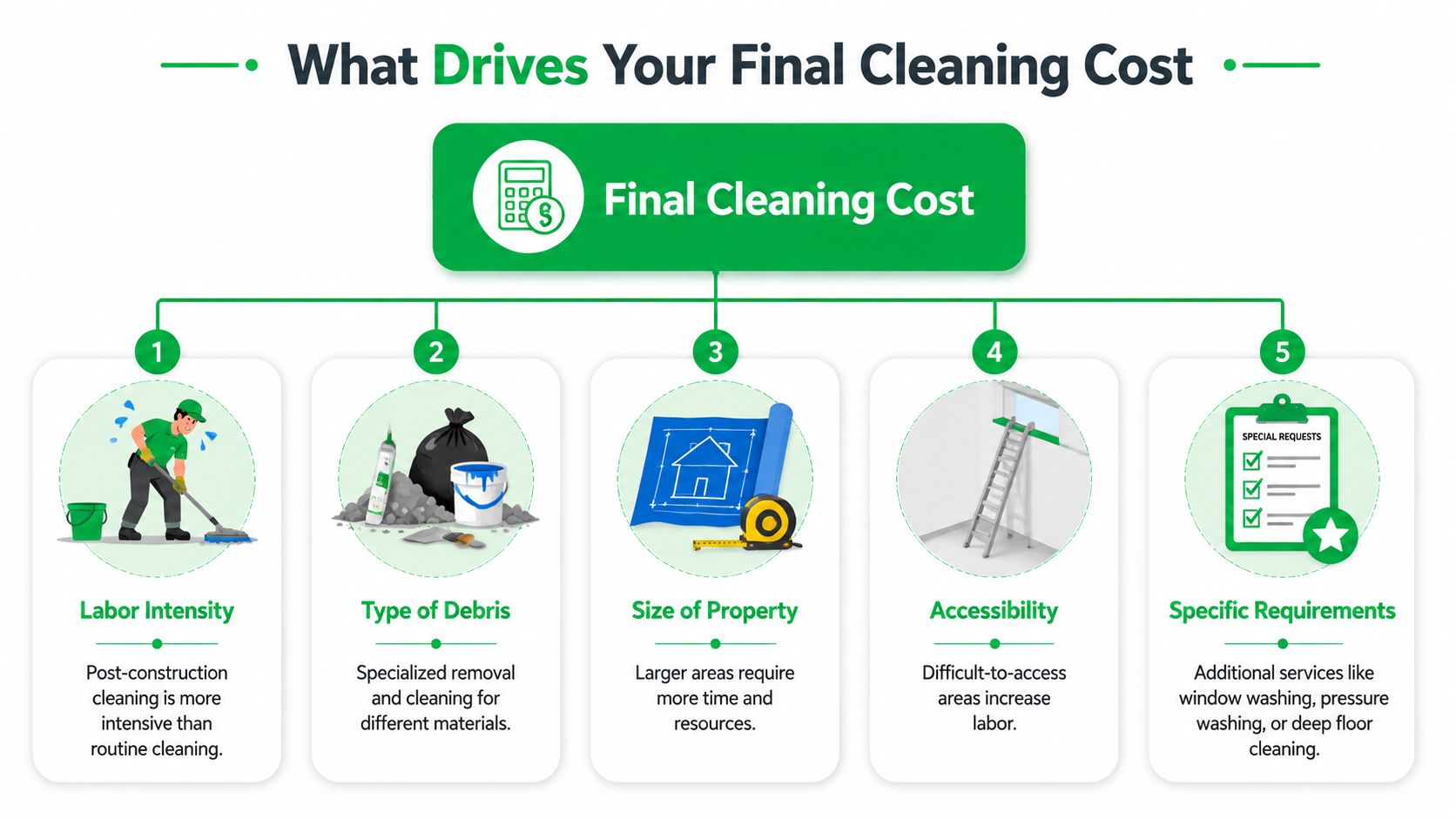
Routine dirt sits on surfaces. Construction residue gets into everything. It sticks to glass, settles on horizontal ledges, hides inside drawer boxes, clings to vents, and reappears after the first pass if the cleaning sequence is wrong.
Labor intensity is the real driver
The biggest factor is labor intensity. That means how many detailed touches the room needs before it looks finished instead of just less messy.
A cleaner can move quickly through an occupied home that gets regular service. A post-construction cleaner usually can't. They have to inspect, wipe, vacuum, detail, and often repeat those steps because debris shifts as they work.
That's also why builders who need to manage Australian project budgets or local owners trying to close out a project run into the same issue. Labor swings when the final finish level changes. The closer the site is to “move-in ready,” the more detail the cleaning team has to deliver.
Site conditions matter more than people expect
A professional estimator is usually looking at a handful of conditions right away:
- Debris level: Light dust from a bathroom remodel is different from full-job residue in a new build.
- Property size: More rooms, more fixtures, more glass, more floor transitions.
- Ceiling height and access: Tall entry glass, stairwells, beams, and transom windows take more time.
- Window complexity: Tracks, screens, hard water, paint specks, and adhesive all add labor.
- Special equipment needs: Extension poles, ladders, pure-water systems, vacuums with fine dust control, and on some projects lift access.
For homes and commercial sites where glass is a major part of the cleanup, detailed construction dust cleaning support often ends up being one of the biggest quality gaps between a basic clean and a properly finished one.
When a bid looks cheap, ask what gets skipped. On post-construction work, the answer is often tracks, vents, high glass, screens, or detailed wipe-downs on trim and fixtures.
Why Flagstaff jobs can be different
Flagstaff projects often combine custom architecture with practical access problems. Mountain homes may have more elevation changes, more exterior glass, more screen handling, and more dust tracked in during the final phase. Seasonal weather can also affect how clean the site stays between trade completion and owner turnover.
That doesn't automatically mean every local job costs more. It does mean simple national averages don't tell the full story.
A Checklist of Standard Post Construction Services
A proper final clean is detailed, not cosmetic. If you're comparing bids, the first thing to check is what the company includes. A vague promise to “clean the whole house” isn't enough.
Often, the cost driver isn't square footage alone. It's the density of finish-detail work needed to remove dust from fixtures, glass, trim, and vents. For commercial spaces and larger residential projects, that level of detail can bring costs to about $0.15 to $0.75 per square foot, according to this post-construction cleaning cost guide.
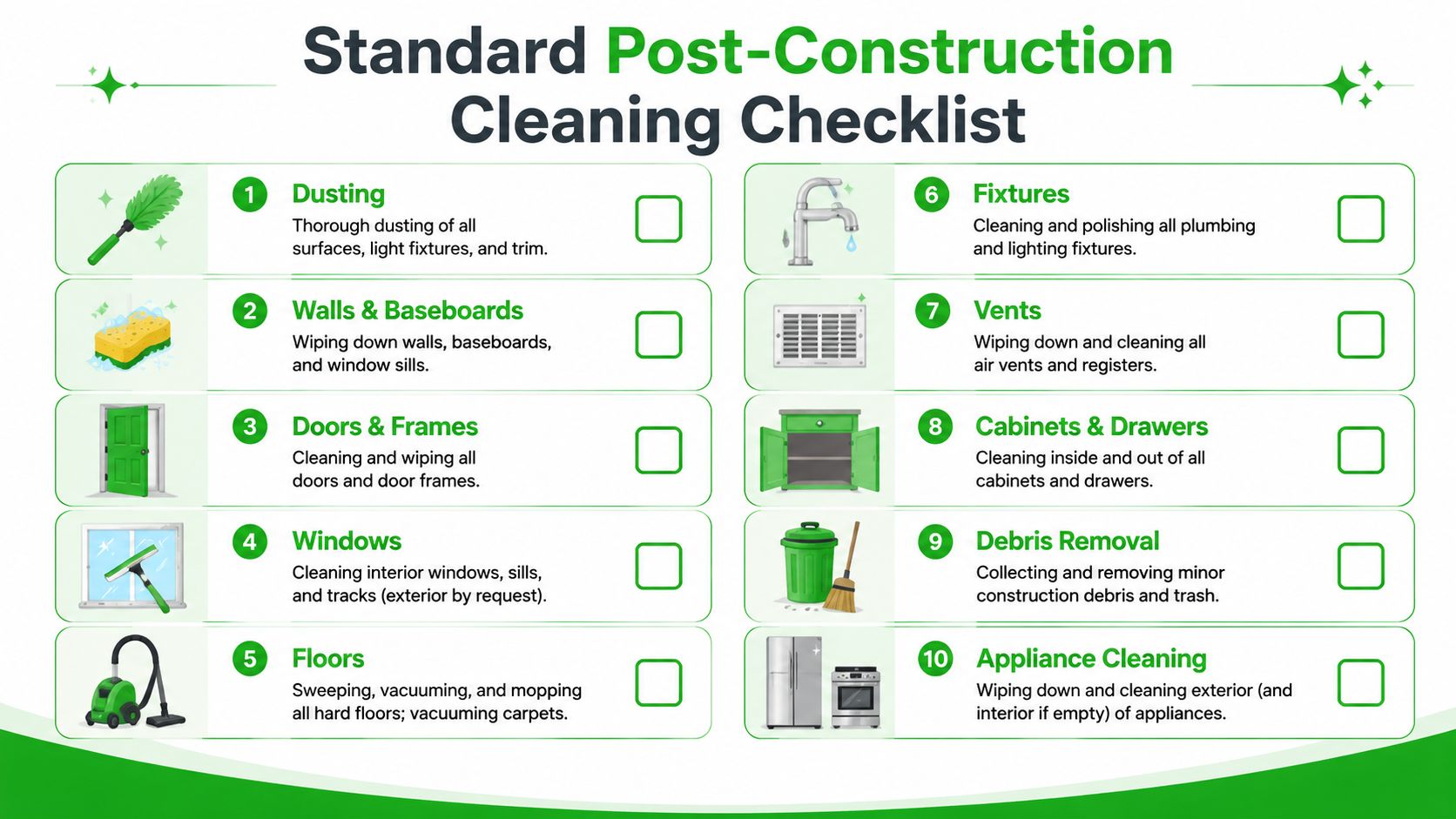
What a standard final clean should cover
A thorough scope usually includes most of the following:
- Dust removal on all surfaces: Tops of doors, trim, ledges, shelves, baseboards, and light fixtures.
- Detailed wipe-downs: Cabinets, drawers, fronts, pulls, switches, outlets, and interior sills.
- Floor care: Sweep, vacuum, and mop hard floors. Vacuum carpeted areas if installed.
- Vent and register cleaning: Remove visible dust so it doesn't blow back into the room.
- Bath and kitchen fixture cleaning: Polish faucets, sinks, counters, mirrors, and appliance exteriors.
- Interior glass detailing: Clean glass, tracks, frames, and adjacent surfaces.
- Minor debris pickup: Collect leftover packaging, tape scraps, and small closeout debris where included.
A more complete post-construction cleaning service checklist should make those tasks plain before work starts.
Why window cleaning is its own specialty
Post-construction window cleaning is where many otherwise decent cleanups fall apart. Glass doesn't just need to look clear. It often needs adhesive removal, paint speck removal, track cleaning, frame detailing, and screen handling.
Professional crews use squeegees, extension poles, ladders, and pure-water brushes where appropriate. That matters because construction glass often has debris that has to be removed carefully and in the right order. A casual wipe with household spray and a rag doesn't solve post-construction residue. It often smears it, misses the edges, and leaves debris in the tracks and screens.
A professional window scope should include:
- Screen removal and cleaning
- Track and sill cleaning
- Careful residue removal from glass
- Frame wipe-downs
- Screen reinstallation
Clean glass after construction should reveal the finish, not hide leftover trade residue in direct sun.
What often gets missed
If you want the space to feel finished, pay attention to the little areas that buyers and owners notice first:
| Area | Common problem |
|---|---|
| Window tracks | Dust, caulk bits, dead insects, sticker fragments |
| Trim and baseboards | Fine dust settled after painting |
| Vents and returns | Visible drywall dust |
| Cabinet interiors | Sawdust and install debris |
| Screens | Dust buildup that gets ignored when glass is cleaned poorly |
These aren't small details. They're the difference between “good enough for turnover” and “ready to live in.”
Hourly Rates vs Flat Pricing Which Is Better
Hourly and flat pricing solve different job-site problems. In Flagstaff, the right choice usually comes down to one question. Is the site ready for a final clean, or are trades still drifting back in to finish punch work?
If the answer is uncertain, hourly pricing usually protects the client better. If the scope is locked, flat pricing usually protects the budget better.
When hourly pricing makes sense
Hourly billing fits jobs with moving targets. I see that most often on remodels, phased custom homes, and builder cleanups where one area is ready and another still has fresh dust or touch-up work pending.
Use hourly pricing when:
- Trades are still active on site
- Only part of the property is ready
- Residue levels are unknown until cleanup starts
- The builder wants the crew to shift priorities during the job
- You may need a return visit after inspections or punch-list work
The benefit is flexibility. The crew can spend time where the site needs it instead of forcing the work into a fixed number that was guessed too early.
The trade-off is simple. The final invoice can move up if the house is dustier, sticker-heavy, or more detailed than expected.
When flat pricing makes sense
Flat pricing works best on true final cleans. The property should be accessible, debris should be removed, and the scope should be written clearly before the crew arrives.
That model is usually a better fit when:
- The home is complete and no trades are expected back
- You want a fixed budget before scheduling
- The scope is detailed room by room or task by task
- Access issues, tall glass, and specialty surfaces have already been discussed
Flat pricing helps owners and builders plan better. It also forces a good estimator to look closely at the work before quoting. That matters in Flagstaff, where a single-level spec home near town and a custom home with steep access, decks, and a lot of glass can require very different labor plans.
Window cleaning is a good example. If post-construction glass, screens, tracks, and frames are part of the finish standard, they should be listed clearly in the quote. A vague flat price often leaves those details out. A defined scope for post-construction window cleaning in Flagstaff makes pricing more accurate and helps prevent change orders later.
Hourly vs. Flat-Rate Pricing Comparison
| Factor | Hourly Rate | Flat-Rate Pricing |
|---|---|---|
| Best fit | Punch-list work, phased projects, uncertain site conditions | Final cleans with a stable scope |
| Budget certainty | Lower | Higher |
| Flexibility | High | Moderate |
| Changes during job | Easy to handle | Usually billed as an add-on |
| Client visibility | Clear time tracking | Clear total if the scope is written well |
| Main client risk | More labor hours than expected | Missing tasks hidden in the exclusions |
| Main cleaner risk | Lower risk of underpricing | Higher risk if the site was described inaccurately |
One caution. Cheap flat quotes often look good until the crew skips the slow parts, especially detailed glass, track cleaning, high dusting, and adhesive removal.
Buying advice: Ask each bidder two direct questions. What is included, and what will trigger added charges?
For many Flagstaff projects, a hybrid approach works best. Set a flat price for the main final clean. Add hourly pricing for punch-list returns, touch-up visits, or any areas trades re-contaminate after the first pass.
Post Construction Cleaning Costs in Flagstaff A Worked Example
National rate ranges help, but local decisions get made job by job. In Flagstaff, property style changes the labor picture fast. A simple single-level remodel near town is one thing. A steep driveway home with tall glass and multiple decks is another.
Specialized markets and demanding jobs can move above the baseline. One NYC-based calculator quotes $70 per cleaner per hour, while a broader guide still places typical labor at $25 to $75 per cleaner per hour for smaller punch-list tasks, according to this post-renovation hourly calculator and pricing guide. That doesn't mean Flagstaff should be priced like New York. It does show how detail-heavy work pushes hourly labor upward.
Example one, a cabin renovation in Munds Park
Start with a common Northern Arizona scenario. A cabin remodel is finished, but the job site still has fine sawdust, trim dust, fingerprints on glass, dirty screens, and debris in tracks. Access is decent, but the home has lots of divided-light windows and wood trim that needs careful wiping.
This kind of project often leans toward hourly billing because remodels hide residue in occupied-style layouts. Some spaces may be finished well. Others may still need extra passes where contractors came back late.
The cleaning plan typically prioritizes:
- Top-down dust removal
- Window and screen detailing
- Kitchen and bath finish cleanup
- Floor vacuuming and hard-surface mopping
- Final pass on sills, trim, and fixtures
If the glass is a major concern, a dedicated post-construction window cleaning service usually makes the difference between a passable result and a polished handoff.
Example two, a custom home in Forest Highlands or Pine Canyon
Now take a larger custom build with tall entry glass, staircase windows, upgraded fixtures, multiple bathrooms, and more finish-sensitive materials. The challenge here isn't only square footage. It's repetition of detail.
Every added surface creates another wipe, vacuum, polish, inspect, and touch-up cycle. High windows and large panes may also need ladders, poles, pure-water tools, or lift access depending on the architecture.
For this kind of property, owners and builders should expect the estimate to hinge on questions like these:
| Local factor | Why it changes labor |
|---|---|
| Tall foyer glass | Slower setup and more careful detailing |
| More screens | Extra removal, cleaning, and reinstallation time |
| Luxury finishes | Gentler methods and slower production |
| Multiple levels | More movement, more equipment handling |
| Late trade activity | Recleaning after dust settles again |
What works in real life
The most efficient post-construction projects in Flagstaff usually have three things in place. The builder removes large debris first. The cleaners get uninterrupted access. Window cleaning is treated as a specialty task, not an afterthought folded into a generic wipe-down.
What doesn't work is trying to close out a high-detail project with a vague “maid service plus a little extra.” That's usually how owners end up with dusty vents, dirty screens, smeared glass, and a house that still looks unfinished in the afternoon sun.
How to Get an Accurate Quote and Save on Costs
A good quote starts with a good walk-through. If the cleaner doesn't ask about glass condition, dust load, access, active trades, screens, and whether you want a rough clean, final clean, or touch-up pass, the number probably won't hold.
A practical benchmark is $25 to $50 per worker-hour, while commercial buyers often compare bids at about $150 to $200 per labor hour when crews of 2 to 3 people, equipment, and supervision are included, according to this construction cleaning pricing reference.
How to lower the bill without lowering the standard
You can reduce wasted labor before the crew arrives:
- Remove major debris first: Don't pay detail cleaners to haul basic trash if that wasn't part of the intended scope.
- Finish the trades: Every late return by a painter, electrician, or flooring installer can create re-cleaning.
- Open access paths: Provide access to rooms, clear counters, and make sure water and power are available.
- Decide what matters most: If budget is tight, identify priorities like glass, kitchens, baths, or owner-facing rooms.
- Separate specialty work: Window cleaning, pressure washing, and high-access work should be scoped clearly.
Owners comparing broader remodeling costs in other regions sometimes find it helpful to review examples like planning a kitchen remodel in Southwest Michigan, not because the pricing transfers to Flagstaff, but because the budgeting logic does. Scope clarity saves money.
Questions worth asking before you hire
Ask these before approving any bid:
- What phase am I paying for? Rough clean, final clean, touch-up, or a mix?
- What's included on the windows? Glass only, or tracks, screens, frames, and residue removal too?
- How do you protect new finishes? Fresh paint, stained wood, and specialty materials matter.
- What happens if trades come back after cleaning? Is the return visit hourly?
- Do you carry the right safety and access equipment? Especially for tall glass and difficult elevations.
This short video gives a feel for the kind of equipment and field work serious window and exterior specialists bring to demanding properties:
The cheapest quote often assumes the easiest version of your project. The most accurate quote usually comes from the company that asks the most specific questions.
If your project is in Flagstaff, Munds Park, Pine Canyon, Forest Highlands, Flagstaff Ranch, or a commercial site anywhere in Northern Arizona, getting the windows right is a major part of getting the whole project right.
If you want help from a local team that understands Northern Arizona properties, Pine Country Window Cleaning is a strong place to start. They're Flagstaff's largest window cleaning company, founded by Flagstaff native David Kaminski, and they've been serving the area since 1999. Their crews use professional tools such as squeegees, ladders, poles, pure-water brushes, and in-house lift equipment for hard-to-reach glass. They also remove screens, clean screens, and reinstall them with every service, while treating each home with care and a strong focus on communication. If you need post-construction window cleaning or want a clear estimate for the final cleanup phase, contact them for a free, no-obligation quote.