

You've got a signed service agreement, a leaking pump on a Friday afternoon, and a vendor on the phone saying that repair isn't in the monthly fee. You're certain it is. The contract, as written, backs neither of you, because it lists "general maintenance" instead of naming who owns that pump, who approves the parts, and how fast someone has to show up.
That dispute is normal, and it's avoidable. A facility maintenance contract fails less often on price than on unassigned work, vague response clocks, and subcontractors nobody approved. Fix those three terms and the monthly rate becomes much easier to judge.
Splitting Preventive, Reactive and Capital Work in Scope
A contract can list the right trades and still leave a costly gap: nobody has defined what triggers the work or who approves it. Separate preventive, reactive, emergency, specialty and capital work before comparing prices. Each category needs its own trigger and approval path.
Preventive work follows a calendar. Reactive work starts with a failure and a work order. Capital work replaces an asset as it reaches the end of its useful life. A rooftop unit might need a scheduled filter change, a repair after a breakdown, or eventual replacement. Those are separate scopes, with different cost and approval terms.
Work Types, Triggers and Approval Paths
| Work type | Typical examples | Trigger or frequency | Approval |
|---|---|---|---|
| Preventive | HVAC filter changes, boiler inspections, roof checks, fire system tests | Calendar, monthly to annual | Covered by fixed fee |
| Routine custodial and grounds | Restroom service, floor care, litter, snow and ice | Daily to weekly, seasonal | Covered by fixed fee |
| Reactive repair | Failed pump, leaking fixture, broken lock, stuck door | Work order from manager | Labor and parts at agreed rate |
| Emergency callout | Burst pipe, power loss, flooding, gas odor | Incident within response tier | Pre-approved premium or retainer |
| Specialty service | Window cleaning, gutter cleaning, post-construction cleanup, bulk snow removal | Scheduled or seasonal | Quoted per job |
| Capital renewal | Roof replacement, chiller replacement, elevator modernization | Lifecycle plan | Separate capital approval |
Use the trigger to classify the task. Calendar-based work belongs in the preventive scope, with a completion record. A failure belongs in reactive or emergency work, with a labor rate, parts approval limit and response tier. Age or condition may prompt a capital request, which needs separate approval.
Boundary cases need clear language. Understanding deferred maintenance versus active failure helps distinguish planned care from a response to a breakdown. When postponed inspections or minor repairs become capital needs, the budget impact can grow. The Government Accountability Office report on deferred maintenance found reported deferred maintenance and repair costs among U.S. civilian federal agencies rose from $51 billion in fiscal year 2017 to $76 billion in fiscal year 2021.
A Worked Example for a Medical Office
For a 60,000 square foot medical office, the fixed fee could cover quarterly HVAC filter changes, semiannual boiler inspections, annual fire-system testing, daily restroom service and seasonal roof checks. Put the schedule and completion standard beside each task.
A failed circulating pump, leaking exam-room fixture or broken entry lock belongs under reactive work. Require a work order and set a parts approval threshold in advance. Chiller and roof replacements belong in a separate capital approval process, supported by lifecycle documentation.
If you're assembling a broader service package, start from a defined building maintenance services scope and sort every line into one row of the table.
Practical rule: If a task cannot be assigned to a row, define its trigger, approval path and cost treatment before signing.
How to Write the Scope of Work Step by Step
A scope you can audit starts with an asset list, not a vendor brochure. Work through these steps in order, and attach the output to the contract as exhibits.
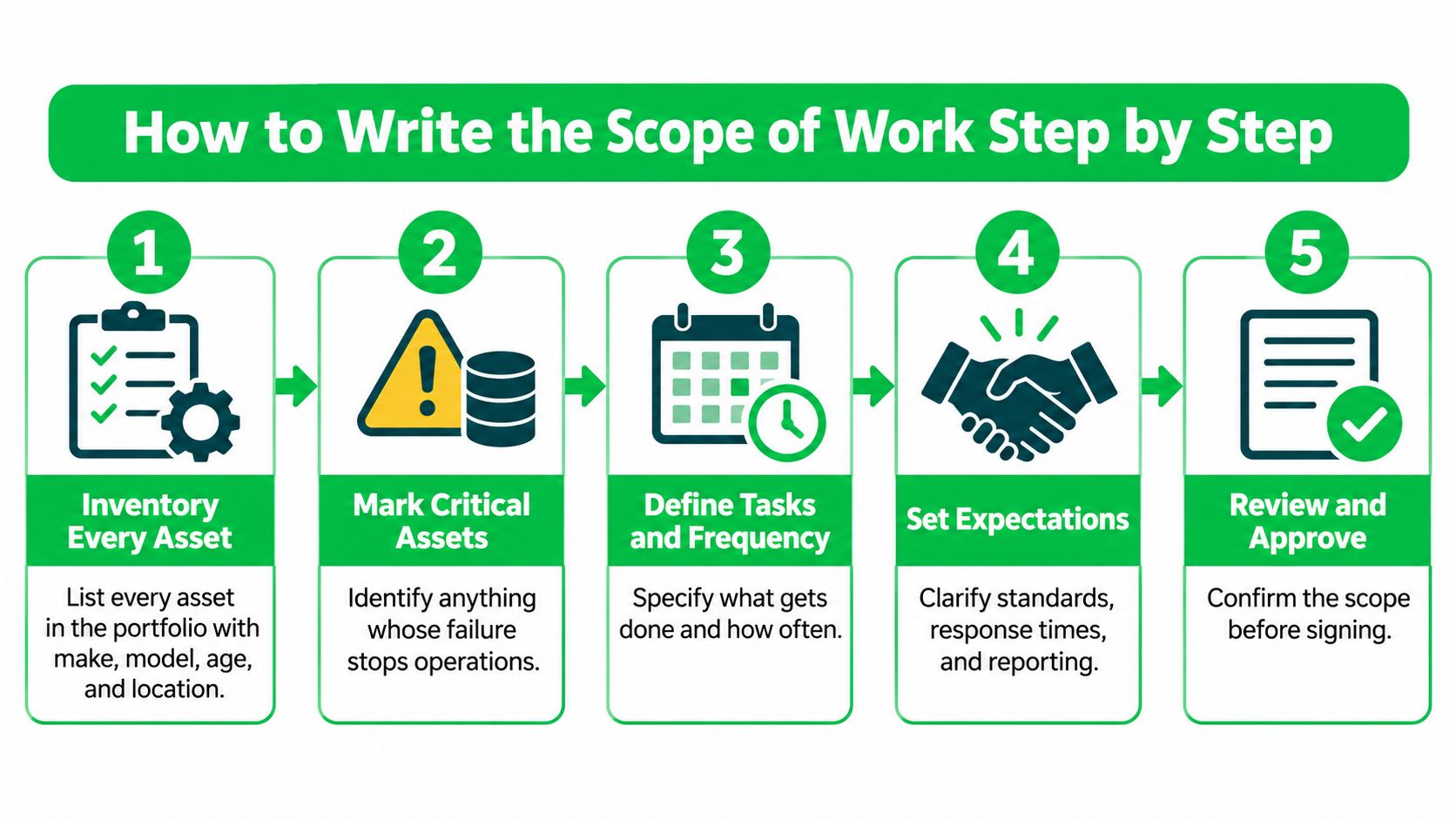
Inventory every asset. List make, model, age, and location for each air handler, boiler, pump, elevator, and backflow device. You can't scope what you haven't listed, and vendors can't price what they haven't seen.
Mark critical assets first. Flag anything whose failure stops occupancy, revenue, safety, or a legal requirement. Buildings reporting on JLL's 2025 facilities management report noted 60% of surveyed facilities leaders identified continuity planning for critical operations as their foremost risk-management priority, so rank by continuity impact before you rank by cost.
Convert manufacturer intervals into a calendar. Pull each asset's recommended service interval and build a visit schedule from it. For elevators, understanding elevator service agreement pricing shows how a specialist trade structures its own intervals and exclusions, which helps you avoid double-paying for service already covered elsewhere.
Write each task as one sentence. Use a verb, a location, and a finish standard. "Replace air filters in all air handlers and log the filter size" is enforceable. "Maintain HVAC" isn't.
Assign a response tier to each reactive category. Define a clock that starts at the call and stops at on-site arrival. Acknowledge time and arrival time are two different promises, so write both.
List exclusions in writing. Name parts over a dollar threshold you set, asbestos or hazardous materials, and work requiring a licensed trade the vendor doesn't employ. An exclusion you both see now is cheaper than an assumption you discover during an outage.
Attach the asset list and calendar as exhibits. Exhibits turn the scope into something a new manager or a replacement vendor can audit without relying on memory.
The Site Walk That Catches Gaps
Finish by walking the site with the vendor, asset list in hand. Check that every critical asset appears in at least one task line. If a boiler, a fire panel, or an atrium glazing system isn't named anywhere, it isn't covered, no matter what the sales conversation promised.
- Roof access points: Confirm who grants access, who escorts, and who logs the visit.
- Mechanical rooms: Verify clearances, shutoff locations, and after-hours entry.
- Occupied areas: Agree on quiet hours and notice periods before disruptive work.
KPI and SLA Targets to Write Into the Contract
Unscheduled failure is the costliest outcome of a weak facility maintenance contract, so your metrics should expose it early. Measure completion, speed, repetition, and backlog, and require a record for each.
Core KPIs and Starting SLA Targets
| KPI | What it measures | Typical starting target | Proof source |
|---|---|---|---|
| Preventive completion rate | Scheduled preventive tasks finished on time | 95% or higher each quarter | Work order log |
| Emergency acknowledgment time | Minutes from call to vendor confirmation | 15 minutes | Dispatch timestamps |
| Emergency arrival time | Hours from call to technician on site | 1 to 2 hours for critical sites | Technician check-in record |
| Routine response time | Business days from work order to completion | 2 to 5 business days | Work order closure date |
| Repeat failure rate | Share of critical-asset failures that recur on the same asset within a set period | Below 5% of critical assets | Asset history report |
| Open work order age | Days a work order stays open | No routine order open beyond 10 business days | Backlog report |
| Occupant satisfaction | Rating from building users or guests | 4 out of 5 or higher | Quarterly survey |
These are starting targets for negotiation, not guarantees you pull from a template. Set them against a baseline. Pull your last twelve months of work orders before you negotiate, count how often preventive visits happened, and ask for improvement only where the history supports it. A vendor who accepts a target with no baseline data is guessing, and so are you.
Two Clocks, Not One
The emergency clock needs the most precision. Time to acknowledge a call and time to arrive on site are different commitments, and vendors often quote the first while you think you bought the second. Write both, name the timestamp source for each, and state what happens when a clock is missed.
For a hotel or medical building, I'd also require the vendor to report arrival performance by tier, not as a blended average. A blended average hides the exact critical-site failures you care about.
Three clauses make these targets enforceable rather than decorative.
- Payment holdback: Tie a holdback to missed preventive visits, released when the visit is completed and logged.
- Repeat failure report: Require a monthly report showing repeat failures on the same asset, with a root-cause note.
- Audit right: Reserve the right to audit the work-order log and dispatch timestamps on reasonable notice.
The same discipline applies when you're comparing a bundled agreement, such as our commercial cleaning contract structure, against separate trade agreements. Compare the reporting, not just the task list.
A target without a data source is only a promise. If nobody can produce the record, the SLA doesn't exist.
Emergency Response and Subcontracting Terms
A pipe bursts at 2 a.m. The primary vendor's on-call technician is out of the area. A subcontractor you've never met arrives without access codes, without the asset history, and without authority to approve parts. Your emergency tier worked on paper and failed in the hallway.
Subcontracting isn't the problem. Unchecked subcontracting is. According to the American Society for Health Care Engineering's 2024 Hospital Operations Survey, hospital and health-system facilities managers reported that, on average, 33% of facilities-maintenance activities were contracted out in 2024. In that environment, a ban on subcontractors is unrealistic. Controls are not.
Define Tiers, Clocks and Fallbacks
Name each emergency tier in the contract. For each one, state the incident types it covers, the acknowledgment and arrival clocks, the contact method, and the fallback if the primary vendor misses the clock. The fallback matters most. It should let you call an approved alternate and bill the difference under terms you agreed before the emergency.
Also state who can declare an emergency. If any tenant can trigger a premium callout, your costs drift. If only one manager can, a real incident waits. I'd name a primary and a backup authorizer.
Make the Prime Contractor Own Every Subcontractor
Require disclosure of every subcontractor before work starts, with trade, licenses, and safety credentials. Keep the prime contractor fully responsible for their work quality, their insurance, and their conduct on site. Add a manager approval step before a new subcontractor is substituted.
Labor depth deserves the same scrutiny. The JLL Global State of Facilities Management Report found nearly 70% of organizations reported operational disruption from skilled-trades shortages and AI or technical-skills gaps in 2025, yet fewer than 45% said they were prepared to manage those risks over the next three to five years. Ask directly how the vendor keeps the same trained people on your site and how it covers absences.
- Named escalation contacts: Primary, backup, and after-hours decision maker, with phone numbers tested before signing.
- Substitute technician rules: Written notice when a named technician leaves, and your right to refuse a replacement who lacks required credentials.
- Site access procedures: Codes, keys, escort rules, and background-check requirements for every person who enters.
- Shared asset history file: A file you own, so a substitute technician inherits the history instead of rediscovering it.
Ask this before signing: What happens if the assigned technician leaves, the vendor is understaffed, or a predictive system misses a failure? Get the answer in the contract, not in a sales call.
Specialty Services and Their Safety Requirements
A window-cleaning contract can leave gaps even when the task is listed. If it does not say which surfaces are included, how high glass will be accessed, and how the work will be protected, disputes over finish and safety can delay the job.

Window Cleaning Scope That Protects the Property
Write down the surfaces and components included in each visit. Pine Country Window Cleaning's residential service includes inside and outside windows, bug screens removed, cleaned and reinstalled, inside and outside window frames, and inside window sills. For commercial or specialty work, identify the areas and finish required rather than assuming the residential scope applies.
State exclusions and extras in the contract, too. Standard window cleaning does not include tracks, paint or stain removal, hard water or sunscreen removal, ceiling fans, or mirrors. Cleaning and reinstalling are also outside the standard scope. Specify which, if any, of these tasks are authorized and how they will be handled.
- Ground-level and storefront glass: List the windows and frames to be cleaned, plus any included sills or screens.
- High or awkward glass: Identify the access method and the elevations covered. Pine Country owns boom lifts, scissor lifts, and an atrium lift reaching 95 feet.
- Post-construction windows: Include both glass and frames, with a clear requirement to clean them without scratching or damaging them.
Safety Terms to Require
The contract should require documented safety training, equipment inspection records, and a written access plan that matches the building and work height. Pine Country's window cleaners are background checked and industry safety trained. Ask bidders to document the training and equipment checks relevant to the work they will perform.
For tall glass, confirm that the proposed access equipment can reach the work area and that the access plan accounts for the site. An available 95-foot atrium lift may suit some high or awkward windows, but the contract should still specify which elevations and areas are included.
Post-construction cleanup needs a defined finish standard. Name the windows and frames, state who handles protective film and construction residue, and require care that avoids scratching or damaging the surfaces. A broad instruction to “clean after construction” leaves too much room for disagreement over what is complete.
Pricing Models Compared and What Downtime Costs
The cheapest monthly fee often buys the most expensive outcome. Compare total exposure, not the quoted rate, and judge each model on how it bills, where it fits, and where it breaks.
Contract Billing Models Compared
| Model | How it bills | Best fit | Main risk |
|---|---|---|---|
| Fixed monthly fee | Set amount covering the agreed scope | Stable portfolios with complete asset lists | Scope gaps billed as extras later |
| Per-visit | Charge for each scheduled or called visit | Small, low-risk sites with few assets | Costs climb with frequent reactive calls |
| Time and materials | Labor hours plus parts at set rates | One-off projects and new sites | Little cost certainty without a cap |
| Hybrid fixed plus reactive | Fixed fee for preventive work, rates for reactive repairs | Most mixed portfolios | Reactive rates drift unless capped |
| Fixed fee with response premium | Fixed fee with faster emergency tiers included | Hotels, campuses, medical buildings | Higher monthly cost than basic plans |
Downtime is the number that should discipline this choice. According to MaintainX's State of Maintenance Report 2024, an average hour of unplanned facility downtime cost approximately USD 25,000 in 2024, while larger organizations could face costs exceeding USD 500,000 per hour. Against that exposure, a fixed fee that includes faster response can beat a low fee with per-call billing for a hotel or campus, even though the monthly line looks worse.
How to Read the Models
A fixed fee suits a stable portfolio with a full asset list, because the vendor can price known work. Per-visit suits small sites with low risk. Time and materials suits one-off projects, provided you cap it. A hybrid of fixed preventive fee plus a reactive rate suits most mixed portfolios, and it's the structure I'd start with.
Watch task-level traps inside each model. A preventive line for a water heater should state the actual service steps, and a plain-language walkthrough of how to drain a water heater shows the level of specificity a task description needs before anyone can price it fairly.
Request itemized quotes for the same scope from every bidder. Bids built on different exclusions aren't comparable, whatever the totals say.
Vet Providers and Book the Site Walk-Through
A proposal based on a template can leave important work unassigned. Before comparing prices, ask each bidder to walk the property and quote against your itemized scope. Confirm that the proposal names what is included, excluded, and handled on request.
Check the guarantee and the remedy. Pine Country Window Cleaning guarantees customer satisfaction and its work. If a customer is not satisfied, the company will visit the property to remedy the situation. Ask other bidders how they address unsatisfactory work, and put the response terms in writing.
Ask for current insurance documentation and confirm what it covers. Pine Country Window Cleaning fully insures its employees, vehicles, and customers' property while its crew is on site, up to $5M. Also check the provider's safety practices and the inspection records for any access equipment its work requires.
Pine Country Window Cleaning has proudly served Northern Arizona since 1999 as a locally owned and operated company. During the walk, ask how technicians handle screen removal, cleaning, and reinstallation, and confirm those tasks are included in the quote. Review its commercial property maintenance services alongside your scope. A staff member will come out to look at your home, building, or project after you call or schedule online.
Bring an itemized scope if your facility maintenance contract includes window cleaning, gutter cleaning, or post-construction cleanup. Pine Country Window Cleaning offers these services and can walk the property and price the work against the scope. Schedule a site walk-through to request a written quote.