
The global contract cleaning services market was valued at USD 406.6 billion in 2025, according to Grand View Research. That's a substantial service category to purchase with a vague promise to keep the building clean.
A commercial cleaning contract turns that promise into a working agreement. It identifies the spaces, tasks, schedule, price, safety responsibilities, and correction process. For a Northern Arizona property, it should also distinguish routine janitorial work from exterior glass, screens, gutters, pine debris, and difficult access. Otherwise, competing bids may describe entirely different jobs.
Building the Scope Every Bid Must Share
Clauses that make bids comparable
| Element | Weak wording | Stronger clause |
|---|---|---|
| Parties and sites | Company name only | Legal names, site list, and escalation contacts |
| Cleanable area | The whole building | Zones or square footage plus named exclusions |
| Tasks and frequency | Regular cleaning | Room-level tasks and a set cadence |
| Outcomes | Maintain a high standard | Inspection score, response time, and cure window |
| Price and changes | Monthly fee to be determined | Pricing model, rate basis, and written change orders |
| Insurance and staff | Fully insured crew | Liability limits, workers compensation, certificate, background checks |
| Windows and exterior | Windows as needed | Glass, screens, frames, gutters, and pressure washing as priced lines |
| Term and remedies | Ongoing service | Start date, renewal review, cure period, and termination |
Mark every unresolved cell before requesting prices. A blank about access, supplies, or exclusions isn't a minor administrative detail. It's a decision the bidder will make for you, often differently from the next bidder.
The U.S. commercial cleaning and sanitation services industry was projected to generate approximately $75.3 billion in revenue in 2024, according to IBISWorld. Buyers have a substantial supplier market to consider, but meaningful competition starts with a shared specification.
Build the specification in order
Define the cleanable area and exclusions.
Identify lobbies, restrooms, break rooms, offices, glass, and exterior zones on a site plan. Separate tenant spaces from common areas and public entrances from service entrances. Name exclusions, including window tracks, paint or stain on glass, hard-water removal, and ceiling fans, unless they receive separate prices.Assign tasks and frequencies to each zone.
A task schedule might call for nightly restroom service, weekly high dusting, and a set window-cleaning cycle. Those are proposed scheduling choices, not universal standards. In a dealership, distinguish showroom glass from service-bay glazing; on a campus, distinguish occupied classrooms from locked buildings.Describe the finished condition.
Labor hours tell you how long someone attended, not whether the work passed inspection. Specify observable results, such as restocked dispensers, waste removed, floors free of loose debris, and glass without visible cleaning residue under agreed inspection conditions. Record existing scratches, damaged seals, and mineral deposits so the contractor isn't judged against an impossible starting condition.Attach service levels and measurement.
Identify who inspects, how defects are photographed, when reports arrive, and how quickly someone must respond. The RICS facilities-management procurement guidance recommends separating the service level from the KPI and defining a consequence for missed performance. A response deadline is the promise; the share of incidents meeting that deadline is the score.Set the commercial terms last.
Once bidders understand the same job, settle pricing, payment, written changes, renewal reviews, and remedies. Include a cure period, meaning the time allowed to correct a breach. Specify which changes need approval before work begins and who has authority to approve them.
Add the details crews need on site
Hotels need guest-sensitive access windows. Campuses need building lists and entry arrangements. Dealerships need vehicle-clearance instructions, while medical buildings need room restrictions and coordination with the facility's hygiene procedures. Each site also needs a consumables list, supply responsibilities, emergency-call contacts, and an escalation contact who can make decisions.
For exterior planning, use our commercial building cleaning services overview to identify work packages for the walkthrough. Contractors assessing formal tender requirements can also review Bidwell cleaning contract opportunities from Bidwell to understand how advertised work separates sites and service packages.
Practical rule: If a bidder can't point to the task, location, frequency, and exclusion, you don't yet have a comparable price.
Northern Arizona sites also need explicit treatment of pine debris, winter access, and construction dust. The glass count may stay unchanged while preparation and access become harder. Price seasonal and post-construction work separately or exclude it clearly, then finish with a one-page scope summary each bidder initials, supported by the detailed schedules.
Pricing Models That Change the Bid
Long-term agreements represented 62.76% of contract cleaning services revenue in 2025, according to Mordor Intelligence. That makes the pricing structure worth negotiating carefully, not just the opening fee.
Compare the models against the same building and scope. A low monthly number means little if one contractor includes interior glass and another has priced only routine floor care.
Pricing models for a commercial cleaning contract
| Model | Best fit | Main risk |
|---|---|---|
| Flat monthly, fixed fee for the agreed scope | Stable offices with steady occupancy | Over-serves empty zones and misses peaks |
| Hourly, approved hours multiplied by the labor rate | Short projects and variable after-hours work | Rewards slow labor without an outcome score |
| Per square foot, cleanable area multiplied by the rate | Comparable daily janitorial bids | Ignores restrooms, height, and glass access |
| Per visit or unit price, agreed quantity multiplied by the rate | Windows, gutters, pressure washing, post-construction | Misses daily janitorial unless paired with a baseline |
| Hybrid baseline plus add-ons, fixed minimum plus authorized extras | Hotels, campuses, dealerships, medical buildings | Needs caps, data rules, and a change-order trigger |
What each price can hide
A flat monthly fee makes budgeting straightforward and doesn't penalize a contractor for finishing efficiently. But a fixed scope can leave a lightly occupied wing receiving unnecessary attention while a busy hotel entrance needs more.
Hourly pricing is easy to check against timecards. It still needs authorized-hour limits and an outcome assessment, or the buyer ends up paying for attendance rather than satisfactory work. Require an explanation when actual hours exceed the approved allowance.
Per-square-foot pricing works best when the spaces are comparable. An open office and a restroom-heavy medical building don't require the same effort because their floor areas match. For specialty flooring, J.G. Carpet Cleaning LLC's discussion of commercial carpet cleaning prices per square foot is useful context for separating carpet work from the general janitorial allowance.
A per-visit or unit price suits episodic work. Define the unit carefully: a window opening, an individual pane, a gutter section, and an elevation aren't interchangeable. State whether mobilization, access equipment, disposal, and cleanup are included.
Keep the invoice tied to the agreement
A hybrid model combines a guaranteed baseline with priced, documented add-ons. It works only when the agreement names the authorization process and spending cap. Unlimited extra cleaning shouldn't be implied by a fixed base fee.
Compare the payable scope, not the headline total.
Before accepting a bid, require these commercial details:
- Matching exclusions: Restate tracks, hard water, paint on glass, and after-hours premiums in the same units across bids.
- Change triggers: Use a written change order when area, tenant count, or glass count crosses an agreed threshold.
- Payment mechanics: Name the invoice day, supporting records, payment deadline, and dispute window.
- Performance remedies: State whether a missed requirement earns a re-clean, a credit, or another agreed remedy.
Return any bid that won't map its price onto the shared scope rows. You can't negotiate a fair adjustment if nobody can identify what the original fee purchased.
Service Levels Insurance and Work at Height
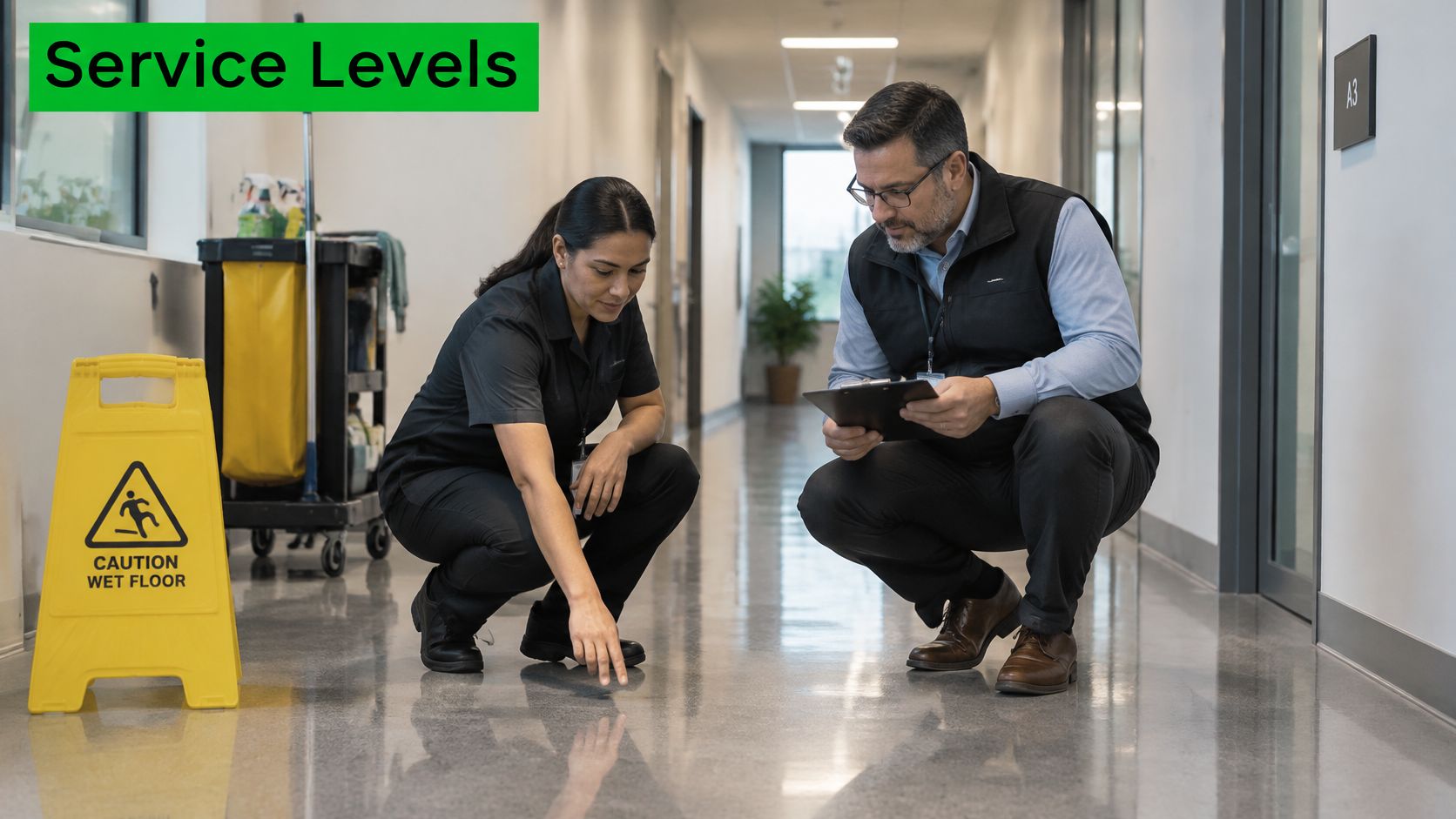
Start quality control with a documented inspection cycle, not a complaint inbox. Record the starting condition, inspect representative zones on an agreed schedule, score the requirements, and log defects with photographs and timestamps. Assign a correction deadline and review recurring failures during monthly or quarterly contract meetings.
The National Environment Agency's outcome-based cleaning contract guide supports measurable outcomes, inspection scores, response-time measures, and a cleaning-management system. Name the person who verifies a correction, too. A closed ticket isn't proof that the restroom or entrance now passes.
A joint inspection helps the manager and contractor agree on what a passing result looks like.
Service levels and KPIs to write into the contract
The response times and percentage below are illustrative negotiated targets, not legal standards or universal industry benchmarks.
| Item | Example target | Consequence |
|---|---|---|
| Response time | Four hours on a reported failed restroom | Re-clean or service credit |
| KPI achievement | Response deadline met on 95 percent of calls | Credit or re-clean when the percentage is missed |
| Inspection score | Pass or fail on sampled zones, or weighted criteria | Correction deadline assigned and trended monthly or quarterly |
| Photo reporting | Timestamped photos of each logged defect | Reviewed at the contract review |
| ATP check | Named device, local baseline, and retest window | Retest and re-clean on failure |
| Certificate of insurance | Current certificate before the first shift | Start date held until received |
Measure hygiene without inventing a universal pass mark
For hygiene-sensitive toilets, ATP testing can supplement visual checks by measuring changes in biological residue. It doesn't replace the cleaning procedure or establish that a surface is free of pathogens. Put the instrument, sampling locations, local baseline, acceptance criteria, and retest window in the contract rather than borrowing a pass number from another device or building.
Insurance requirements belong in the mobilization packet. Specify general liability limits, workers compensation, required additional-insured endorsements, and a current certificate before work starts. Have the insurance adviser verify the required endorsements rather than treating the certificate alone as the entire coverage agreement.
Require background checks and relevant industry safety training for personnel entering homes, hotels, campuses, and medical buildings. Keep verification requirements clear without circulating employees' private screening records.
Put access rules beside the exterior scope
Under OSHA's ladder requirements, portable ladders belong on stable, level surfaces unless secured or stabilized, workers must face the ladder while climbing, and boxes or barrels aren't acceptable bases. Ladders must also be inspected before initial use each shift, with defective equipment tagged and removed from service.
For active entrances, OSHA's ladder training manual addresses securing ladders against displacement, keeping access areas clear, and not moving a ladder while it's in use. Translate those requirements into a site-specific work-zone plan. Our ladder safety requirements guide provides additional planning context.
For high glazing, OSHA's fall-protection guidance supports planning suitable anchorages and inspecting personal fall-arrest equipment before use each shift. Don't leave the access method for the crew to improvise on arrival.
Collect the insurance certificate, required endorsements, training record, access plan, and inspection form before the first shift.
Sample Clauses and a Negotiation Checklist
Use these clauses as drafting language, not a substitute for legal advice. Counsel should review the final agreement, particularly remedies, insurance, liability, termination, and any site-specific compliance obligations.
Paste-ready language tied to the working schedules
Scope rule, make the attachments control the work.
Contractor will perform the tasks and frequencies in Schedule A for the cleanable areas identified in Schedule B. Excluded work may proceed only under a signed change order stating the scope, price, and schedule.
Attach the actual room list and marked elevations. If a proposal conflicts with a schedule, the agreement should specify which document controls.
Service-level rule, separate the response promise from its score.
As an illustrative negotiated standard, Contractor will respond to a reported restroom deficiency within four hours and meet that deadline on at least 95 percent of calls each month. Missed performance will receive the re-clean or service credit specified in Schedule C.
Define when the clock starts, what counts as a response, and when physical correction must finish. An acknowledgment message shouldn't count as a completed re-clean.
Occupancy rule, authorize variable work and restrict data use.
Usage-triggered visits will be billed under the approved rate card after the monthly baseline allowance is used, subject to the authorization rules and spending cap. Client owns occupancy data, and Contractor may use it only to schedule service.
Chemical rule, make product approval enforceable.
Contractor will use products listed in the approved site product register and keep their safety data sheets on file at each site. No substitution may occur without written approval, and an unapproved substitution will constitute a breach subject to the stated cure period.
Insurance rule, verify coverage before entry.
Contractor will deliver a current certificate of insurance and the required additional-insured endorsement wording before the first shift. Service will not begin until the required insurance documents have been accepted.
Negotiate the unresolved decisions
A drafting tool can help compare versions or identify undefined terms. The AI contract tool recommendations from LegesGPT provide a starting point for evaluating such tools, but keep sensitive site-access and personnel information out of unapproved systems. Software doesn't replace counsel's review or the physical walkthrough.
Before signing:
- Complete every blank: Resolve site names, approval authority, access restrictions, supply ownership, and payment details.
- Normalize exclusions: Have every bidder restate excluded work in matching units.
- Set the cure period: Distinguish a routine missed task from a safety breach requiring work to stop.
- Check the attachments: Confirm that schedules, rate cards, drawings, and insurance requirements share the correct version.
- Reject undefined window work: Return wording that says windows as needed without identifying the glass and service cycle.
A useful clause tells the site manager what to do next when something goes wrong.
Occupancy Swings, Green Products, and the Glass Walkthrough
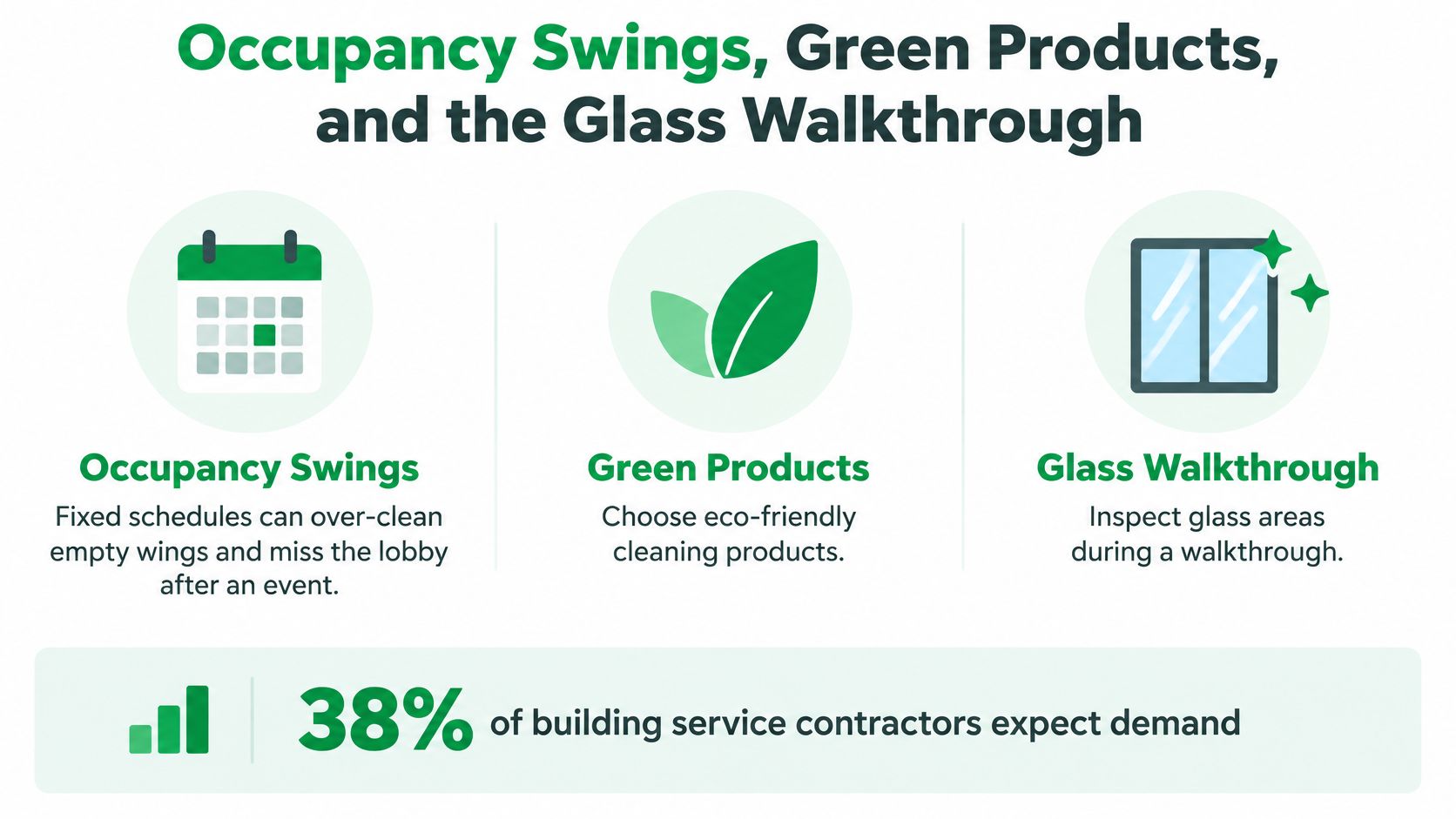
A fixed schedule can send cleaners through an empty wing while an event leaves the lobby needing attention. Set a guaranteed minimum, identify what changes with occupancy, and require approval before usage-triggered work exceeds the agreed spending cap. The baseline works like a standing appointment; added visits are documented separately when building use changes.
A 2026 market study cited by ISSA found that 38% of building service contractors expect demand for automation and technology in contracts to increase, up from 25% in 2025. Occupancy and restroom-traffic sensors can help identify demand, but the contract should name who reviews the information and authorizes work.
Match service to use without collecting unnecessary data
A hotel might use an event notice or occupancy report to request extra lobby service. A campus can consult its term calendar and room-booking schedule. A dealership may need an authorized entrance-glass visit after a promotional event, rather than more cleaning across the building.
Use only the information needed to schedule the work. Specify permitted data, ownership, retention, access, and privacy limits in the agreement. A restroom-entry count may be enough; identifying individual occupants usually adds no value to that scheduling decision.
Keep baseline hygiene and safety work in place even when occupancy falls. A lightly used building still needs its agreed inspections and essential service. Do not let a quiet wing become an excuse to suspend all cleaning.
Turn green preferences into purchasing rules
The Queensland government's sustainable cleaning procurement guide outlines environmental labels, a worksite product register, and safety data sheets. Treat it as a procurement model, not a statement of Arizona law. Separate requirements your organization must meet from optional preferences.
A workable green-cleaning schedule should identify:
- Accepted certifications: Name the labels or standards the buyer accepts.
- Site records: Keep approved products and their safety data sheets at the property.
- Cost responsibility: State who pays for certified chemicals and documentation.
- Substitution approval: Allow an approved equivalent when the named product is unavailable.
- Training and waste procedures: Specify handling, dilution, storage, water-use expectations, and disposal.
- Remedies: Define correction and reporting if an unauthorized product is used.
Green requirements do not automatically lower the total price. Product restrictions and recordkeeping take time, so include those tasks in the budget. Use this guide to sustainable cleaning practices to help frame site-specific product choices.
Walk the exterior as separate work packages
Price gutter and downspout cleaning, pine-needle cleanup, pressure washing of walks and siding, post-construction glass and frames, and seasonal snow clearing as separate lines. For each, state who handles disposal and what completed work should look like. Before post-construction glass is cleaned, record residue and surface conditions so the scope accounts for the actual job.
Describe window work by zone: inside and outside glass, frames, sills, and screens. Pine Country Window Cleaning's home service includes inside and outside windows, removing, cleaning, and reinstalling bug screens, wiping inside and outside frames, and wiping inside sills. Tracks, paint or stain removal, hard-water removal, and sunscreen removal are extra services. On a commercial bid, list each included zone and cycle rather than relying on a broad exterior-glass allowance.
Work at height needs its own scope and access plan. Pine Country Window Cleaning has in-house boom lifts, scissor lifts, and a 95-ft atrium lift for reaching high glazing. Its window cleaners are background checked and industry safety trained. For any contractor, identify the glass to be serviced, the proposed access equipment, and any restrictions on reaching the work area. Record protection for landscaping, furniture, pedestrian routes, and restricted rooms.
Finish the walkthrough with a marked plan:
- Elevations: Show which glass belongs in recurring service and which receives a separate cycle.
- Equipment: Identify the access equipment proposed for each area and who supplies it.
- High access: Confirm the lift can reach the atrium and enter the work area.
- Protection: Mark landscaping, furniture, pedestrian routes, and restricted rooms.
- Documentation: Identify the current insurance certificate and approved access plan on file.
Pine Country Window Cleaning has served Northern Arizona since 1999 and offers commercial window cleaning. A local provider can help assess the property's glass and access needs, but the written scope should still define the work, cycle, and approved extras.
Pine Country Window Cleaning also offers gutter and downspout cleaning and pressure washing, which can appear as separate lines in a commercial cleaning contract. Customers can schedule online or call (928) 527-0671 for a free estimate and a walkthrough of glass, exterior work, and access requirements.