
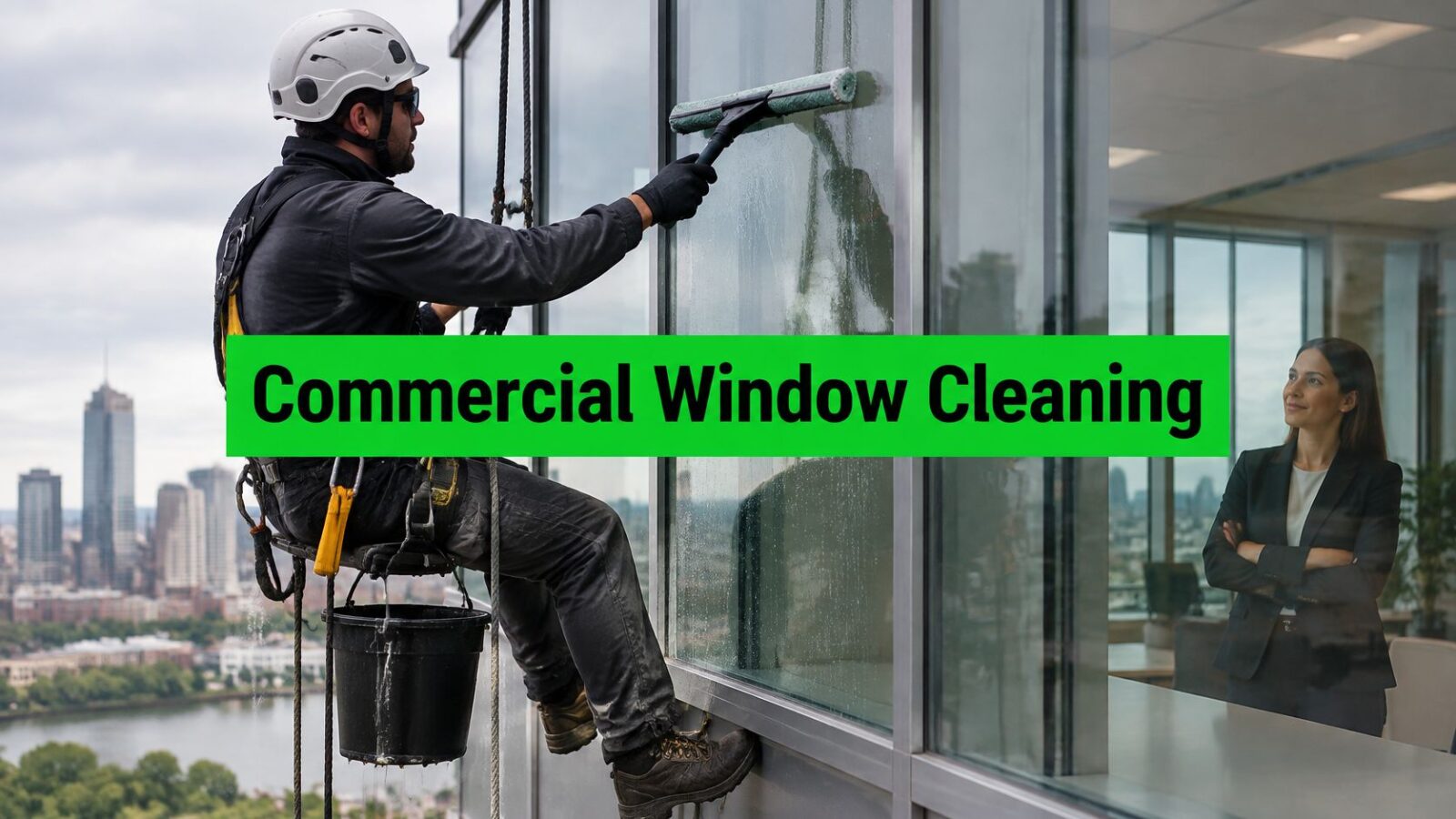
You're standing in a hotel lobby at check-in, a dealership showroom before opening, or a medical building entry as patients arrive, and the glass tells the story first. Last night's wind left dust, fingerprints crowd the doors, and streaks cut across panes your guests can't avoid seeing. You don't need someone to wipe glass, you need a crew that can work around occupancy, reach the building safely, and leave records your office can file.
That's where good commercial window cleaning separates itself. It's scheduled access, trained technicians, the right chemistry for occupied space, and care for screens, frames, and finished surfaces.
What Commercial Window Cleaning Actually Involves
The hotel general manager notices it before the front desk does. Morning sun hits the lobby glazing, every overnight smudge shows, and a conference group is due in an hour. A competent crew doesn't start by wetting glass. They start with a pre-job walkthrough.
That walk confirms which panes are interior, which are exterior, where pedestrians move, and what access each elevation needs. Crews note coated glass, damaged seals, stuck operable windows, and screens that need handling. They agree on quiet zones, entry sequencing, and where equipment can stage without blocking doors.
What happens during a visit
Interior work comes with obligations you don't face outside. Technicians protect floors and furniture, control ladders and poles around finished surfaces, and keep solution off sensitive materials. Exterior work adds weather, wind, pedestrian exclusion, and access planning.
- Exterior glass: Technicians clear dust, pollen, hard-water spotting, and road film with squeegees, poles, and pure-water brushes suited to the height and façade.
- Interior glass: Crews work around occupants, coordinate low-traffic windows, and detail edges, partitions, and entry doors where fingerprints build fastest.
- Screens and frames: Screens come out, get cleaned separately, get inspected, and go back correctly seated after the glass is done.
- Closeout: The crew checks its own work in changing light, reports damaged seals or glass, and leaves the space ready for use, not ready for your housekeeping team to finish.
Residential work taught many of us the customer-care side first. In a home, you protect flooring, move carefully around furnishings, and reinstall every screen so the homeowner doesn't inherit cleanup. Commercial properties deserve that same respect, multiplied across lobbies, patient areas, classrooms, and guest floors.
You judge a crew as much by what they don't touch, drip on, or leave behind as by how clear the glass looks.
Scale changes everything else. One building can require several technicians, different access methods on different elevations, and a schedule built around deliveries, clinic hours, or classes. Documentation matters too, including scope completed, access used, problems found, and sign-off. If a vendor describes the job as just showing up and squeegeeing, they've either never run a large property or they're planning to improvise on yours.
The Tools and Equipment Professionals Bring to the Job
Professional gear isn't a longer shopping list. It's a set of choices matched to height, façade design, ground conditions, and what's happening inside the building. The infographic below maps the core toolkit most property managers should recognize when a truck arrives.
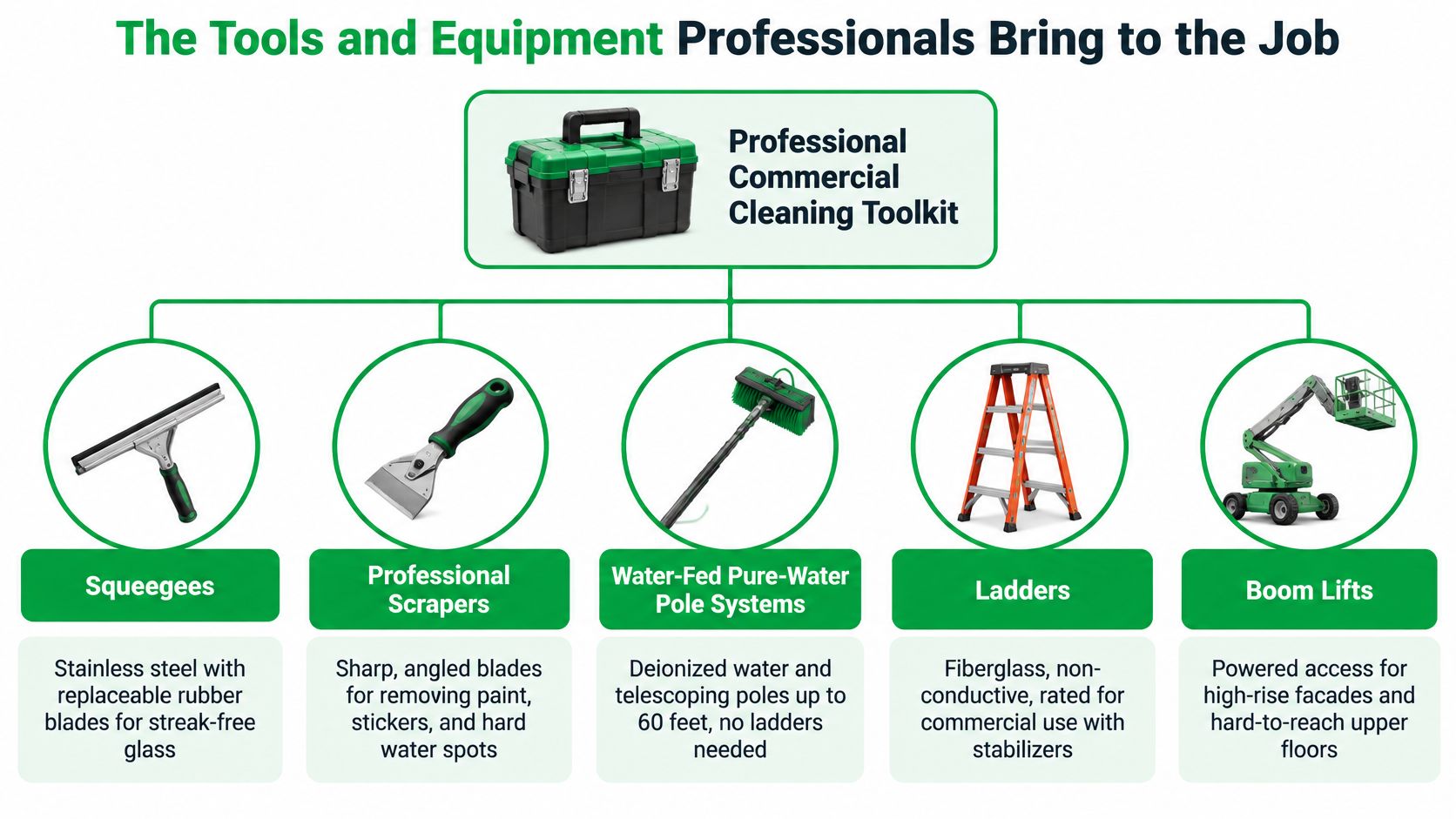
Squeegees remain the finishing tool for accessible glass because a trained hand controls edges and detail in a way spraying and wiping can't. Channels and rubbers get swapped for pane size and wear. Professional scrapers handle paint, stickers, and construction residue, but only in trained hands and only where the glass and coatings allow it.
Matching access to the building
Water-fed pure-water pole systems use telescoping poles and brush heads fed with purified water. They're efficient on multi-story exterior glass where ground access is clear and repeated ladder moves would slow the job. They aren't a universal answer. Heavy deposits, recessed glazing, screens, and architectural obstructions can still require closer access.
Ladders earn their place on low elevations and interior work, provided technicians inspect them, set them on stable footing, and protect contact points. Boom lifts and scissor lifts handle façades where poles can't reach safely or where technicians need controlled positioning. Compact atrium lifts solve tall interior glazing in hotels, campuses, and medical atriums without building scaffold inside an occupied lobby.
The short video below shows the kind of equipment handling you should expect to see planned, not improvised on arrival.
Locally, Pine Country Window Cleaning describes using boom lifts, scissor lifts, and a 95-foot atrium lift for tall interiors, alongside traditional squeegee, pole, and pure-water brush work. That range matters because Northern Arizona properties mix storefront glass, tall lodge-style atriums, campus buildings, and upper floors on the same contract.
Ask how a bidder mapped each elevation before you accept a price, then compare that plan against this overview of commercial window cleaning equipment and access choices. If every building gets the same pole answer, the bidder probably priced convenience, not your façade.
Safety Standards That Govern Commercial Cleaning at Height
Height turns a cleaning task into regulated work. A technician on a ladder, lift, suspended platform, or rope system faces hazards your janitorial staff don't, and the controls have to exist before anyone leaves the ground.
The history explains why the rules are strict. An OSHA analysis of 88 window-cleaning accidents over 15 years, including 62 fatalities shows how often incidents in that compilation ended in death. That same source recounts a 2016 case in which a 20-year-old washer fell more than 58 feet after safety lines weren't properly tied off, leading to one willful and eight serious citations involving fall protection and training.
Thresholds you should know
OSHA construction rules generally require effective fall protection at six feet or more above a lower level. Suspended work has its own trigger. For two-point adjustable suspension scaffolds used more than 10 feet above a lower level, OSHA requires both a guardrail system and a personal fall-arrest system. One control isn't enough.
- Guardrails: They reduce the chance a worker steps or falls from the platform.
- Personal fall arrest: A fitted harness and compatible lifeline limit the consequence if a fall or platform failure occurs.
- Inspection: Crews verify anchors, suspension components, and equipment condition before use, and remove damaged gear from service.
University programs show what documented control looks like day to day. Cornell University's window-washing program requiring pre-use ladder inspection and independent lifelines at height requires a person to hold ladders longer than 18 feet at the base and requires approval for suspended scaffolds at 75 feet or more, with each worker on a harness connected to an independent lifeline.
Practical rule: If the crew can't explain its access method, anchor plan, and rescue thinking in plain language, don't let the low price explain it for them.
Watch for warning signs on site. Harnesses worn loose, lifelines clipped to the platform instead of an independent anchor, ladders with visible damage, and no pedestrian controls below overhead work all point to a culture problem. A competent provider names a competent person, documents training, sets weather limits, and stops work when wind or lightning makes the plan invalid. That discipline protects your occupants and your organization, not just the technicians.
Maintenance Schedules for Different Commercial Properties
No single cadence fits every building. Glass at a busy entrance soils on a different clock than upper-floor office glazing, and Northern Arizona adds pollen, monsoon dust, snowmelt splash, and wildfire smoke. Build the schedule by exposure and customer visibility, then adjust seasonally.
The chart below gives a practical starting rhythm by property type, which you can tighten for entrances and loosen for less visible elevations.
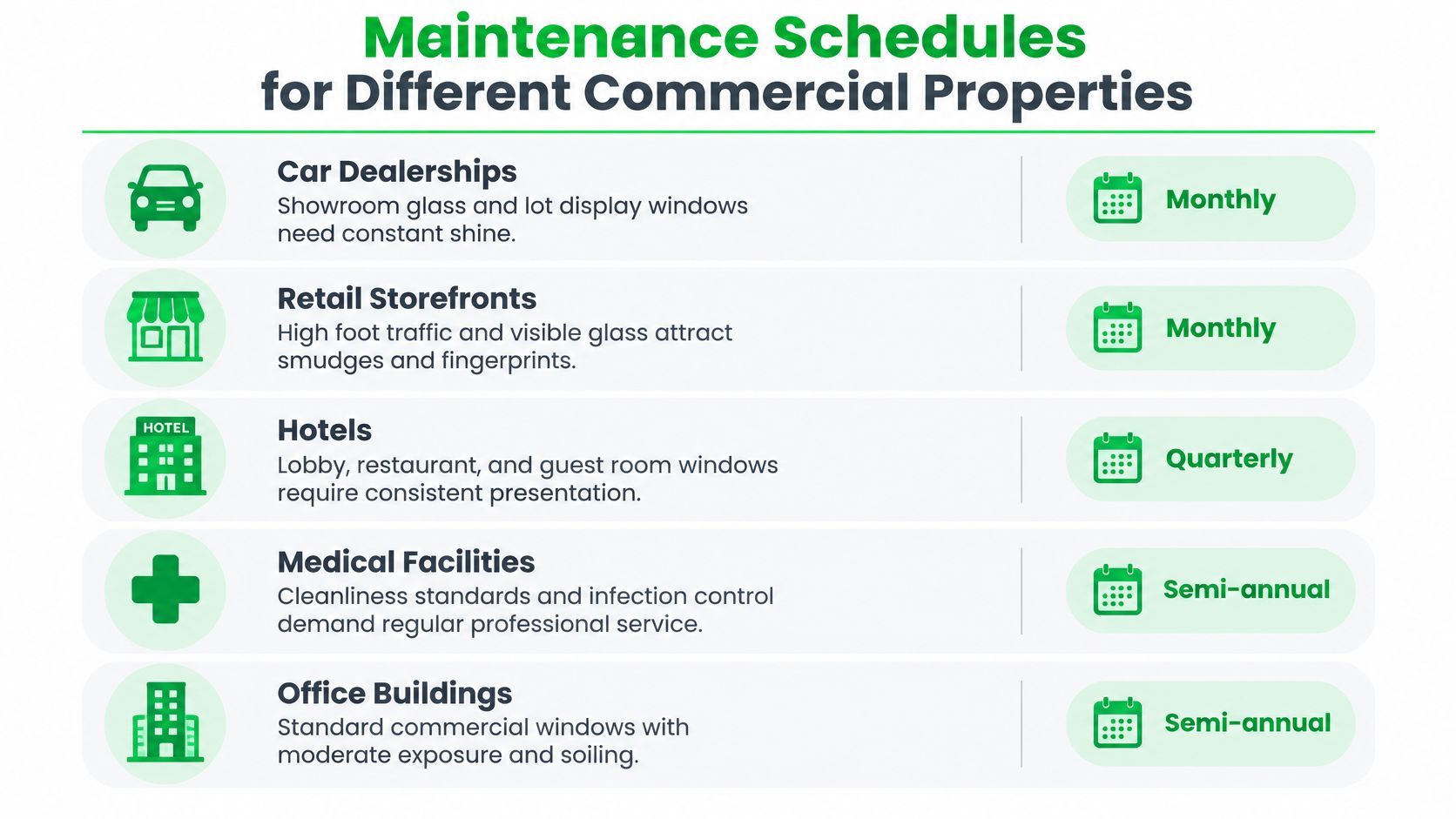
A usable rhythm by property
- Car dealerships and retail storefronts: Plan monthly service for showroom and entry glass. Fingerprints, lot dust, and road film sit exactly where buyers judge the business.
- Hotels: Plan quarterly full service, with more frequent attention to lobby, restaurant, and entry glazing between full visits.
- Medical facilities and office buildings: Plan semi-annual full exterior cycles as a baseline, then add entry and lobby touch-ups based on traffic, complaints, and inspection readiness.
- Campuses: Time major work around academic breaks when access is easier and interior disruption drops.
Seasonal triggers should move dates, not just fill a calendar. Schedule exterior glass and screens before heavy spring pollen settles in, inspect after monsoon storms drive dust and debris against lower panes, and assess residue after smoke events instead of waiting for the next routine visit. Snow and ice also affect safe access, footing, and lift placement in Flagstaff winters, so build weather flexibility into the contract.
Post-construction cleaning belongs outside the recurring schedule. Paint, adhesive, concrete dust, and label residue require different tools, more time per pane, and closer inspection for damage. Pricing it as routine work invites scratched glass and arguments.
For a deeper breakdown by building type, compare your draft cadence with this guide to how often commercial windows should be cleaned. Then walk your property monthly for one season and note which elevations fail first. Your own observations will refine the schedule faster than any generic recommendation.
Screens, Air Quality, and the Details Most Crews Skip
Screens expose sloppy work. A pane can look clear while the screen behind it holds dust and pollen, and a poorly reseated screen leaves the window unusable. Our standard is straightforward on every service where screens are present: remove the screen, clean it separately, inspect it for damage, and reinstall it after the glass is complete.
That workflow is a service standard, not a legal mandate, and honest providers should say so. It matters because it respects the customer's property. In homes we protect floors and furnishings and leave windows ready to open. In commercial buildings the same discipline protects patient rooms, guest rooms, offices, and classrooms from drips, bent frames, and screens left leaning in a hallway.
Chemistry belongs in the air-quality conversation
Cleaning products don't stop mattering once the glass dries. The U.S. Environmental Protection Agency guidance identifying cleaning supplies as a source of volatile organic compounds recommends increasing ventilation when using products that emit volatile organic compounds, or VOCs, and following label precautions. In a sealed clinic, hotel room, or office, unnecessary spraying can raise occupant exposure and trigger odor complaints even when results look perfect.
A managed program uses the least hazardous effective formulation, follows safety data sheets for dilution and protective equipment, and checks compatibility with coated glass, films, frames, and sealants. Crews should avoid aerosolizing product near air intakes and schedule interior work during low-occupancy periods when ventilation can increase.
Window decisions also interact with outdoor air. Research summarized in a review of windows, building envelopes, and indoor particulate pollution describes how faulty envelopes contribute to indoor particles and notes a study in which winter natural ventilation produced indoor PM2.5 concentrations about 4.9 times higher than fresh-air equipment. Cleaning more often isn't always the answer. During smoke, heavy pollen, or dust events, keeping operable windows closed and coordinating with HVAC operation may protect occupants better than opening windows for fresh air.
Clean exterior glass and screens before pollen peaks, document seal and frame defects you find, and don't treat an open window as harmless during poor outdoor-air conditions.
Those details turn a visit into preventive maintenance. Technicians who handle every screen and inspect every frame spot torn mesh, failing seals, and water staining early, while they're still cheap problems for facilities staff to address.
Choosing a Qualified Commercial Window Cleaning Provider
Price per pane tells you almost nothing about risk. Two bids can describe the same glass count while one includes trained technicians, inspected lifts, pedestrian controls, and records, and the other includes hope. Procurement should test documentation before anyone arrives.
Compliance pressure is real for facilities teams. A 2025 survey of 190 built-environment professionals in which 77% viewed compliance as at least a moderate challenge also found 14% were unsure they could meet requirements. A vendor who can't produce consistent paperwork adds to that burden.
Due-diligence checklist
- Insurance and scope: Request current certificates and a written scope naming interior, exterior, screens, frames, access methods, and exclusions.
- Training records: Ask who is trained for ladders, lifts, scaffolds, or rope systems, and who supervises work at height.
- Equipment inspections: Request lift and access-equipment inspection processes, plus criteria for removing damaged gear.
- Site-specific plan: Require hazard assessment, pedestrian exclusion zones, weather limits, chemical handling, emergency contacts, and incident reporting.
- Closeout evidence: Expect completion sign-off, notes on damaged seals or glass, and photo records for disputed or hard-to-inspect areas where appropriate.
Standards give you language for those questions. OSHA fall-protection standards recognizing ANSI/IWCA 1-14.1 for window cleaning sit alongside general-industry rules for ladders, scaffolds, and rope-descent systems. Membership in the International Window Cleaning Association doesn't prove competence by itself, but it signals a company at least operates in the professional conversation. References from comparable hotels, campuses, dealerships, or medical buildings matter more.
Local history should be verifiable, not inflated. Our business dates to 1999, and company materials identify Flagstaff native David Kaminski as its Flagstaff-associated owner and describe the company as Flagstaff's largest window cleaning company. Treat that largest-company wording as the company's own description, then verify the things that protect you: training, equipment, insurance, and references for buildings like yours.
You can compare those credentials against the criteria in this review of what makes a qualified commercial window cleaning provider. The cheapest bid often costs the most when your team has to chase certificates, reschedule around missing equipment, or explain an incident that a documented plan would have prevented.
Why Commercial Window Cleaning Is Part of Building Operations
Treating glass as cosmetic misses why this trade became specialized in the first place. As skyscrapers rose, owners needed dedicated crews, access systems, and weather planning. A history of New York window cleaners and the Empire State Building's roughly 6,500 windows notes that by 1931 the city reportedly had 2,000 to 3,000 window cleaners, and eight workers in two teams could take about a month to complete that building in favorable weather.
Glass curtain walls after the 1950s intensified the need because fixed panes can't be opened and cleaned from inside. Your building may be smaller, but the operational logic is identical. Access, safety, occupant impact, and documentation determine whether the work helps or disrupts the property.
What you're actually buying
You're buying a recurring inspection point on the building envelope. Technicians see failing seals, damaged screens, water staining, and frame problems while they're close to glass other vendors never touch. You're also buying indoor-environment judgment about chemistry, ventilation timing, pollen, smoke, and when operable windows should stay closed.
You're buying a defensible paper trail. Scope, access method, inspections, training, and completion records answer questions from tenants, auditors, insurers, and your own leadership. Clean glass is the visible result. Managed risk is the product underneath it.
That operational view pairs well with broader planning, including the 2026 commercial maintenance tips from Purified Air Duct Cleaning, which property teams can use alongside window schedules when coordinating vendors, HVAC work, and seasonal building care. Put window service on the same preventive-maintenance calendar as those systems instead of buying it as an emergency appearance fix.
Start with one walkthrough. Map elevations, access, screens, occupancy constraints, and seasonal triggers, then require bidders to price that plan. You'll get clearer glass, but more importantly, you'll know exactly who's on your building, how they'll reach it, and what evidence they'll leave behind.
If you manage a hotel, dealership, medical building, campus, or storefront in Northern Arizona and want commercial window cleaning handled with documented safety, professional squeegees, poles, pure-water brushes, lifts, and full screen removal, cleaning, and reinstallation, request a walkthrough and free estimate from Pine Country Window Cleaning. We'll map the access, schedule around your occupants, and leave your property cared for and ready for business.