

A lot of property managers start in the same place. You've got a building budget to build, windows that need attention, and an online commercial window cleaning cost calculator promising a fast answer. You plug in a few details, get a number, and then wonder whether it's realistic for a storefront on Route 66, a hotel near NAU, or a multi-level property dealing with Flagstaff wind, dust, pollen, and winter grime.
That uncertainty makes sense. A calculator can help with rough budgeting, but window cleaning isn't a flat commodity. The price depends on access, window style, service scope, safety setup, and whether the job is simple squeegee work from the ground or a far more involved project with poles, ladders, lifts, or pure-water brushes.
Decoding Commercial Window Cleaning Costs
A commercial window cleaning cost calculator is useful in the same way a rough website budget can be useful. It gives you a starting point, not a final contract. If you've ever looked into understanding website expenses for a business project, the pattern is similar. The simple quote rarely captures the details that drive the total cost.
In Northern Arizona, that gap shows up fast. A facility manager may be budgeting for a one-story retail frontage, then realize the property also has high entry glass, screens, side panels, dusty frames, and scheduling limits because tenants open early. The calculator's number might still be helpful, but it won't reflect the actual field conditions.
That's why experienced contractors look beyond the raw pane count. They consider access, traffic patterns, safety requirements, the condition of the glass, and whether the work is exterior only or inside and out. They also look at whether the building needs broader exterior care at the same time, which often changes how a property manager plans maintenance. For some facilities, it makes sense to pair window service with commercial building exterior cleaning so the whole property presents well at once.
What building owners usually want to know
Most customers aren't asking for abstract pricing theory. They want clear answers to practical questions:
- What's the likely range? Enough to budget responsibly before requesting bids.
- What changes the number? Height, access, screens, buildup, and service frequency usually matter more than people expect.
- When does a quick estimate stop being reliable? Usually when the property has multiple stories, unusual glass, restricted access, or specialty equipment needs.
A calculator gives you a budget number. A site visit gives you a job number.
That distinction matters in Flagstaff because buildings vary so much. Downtown storefronts, medical offices, hotels, schools, dealerships, and mountain properties don't clean the same way, and they shouldn't be priced as if they do.
The Logic Behind a Cost Calculator
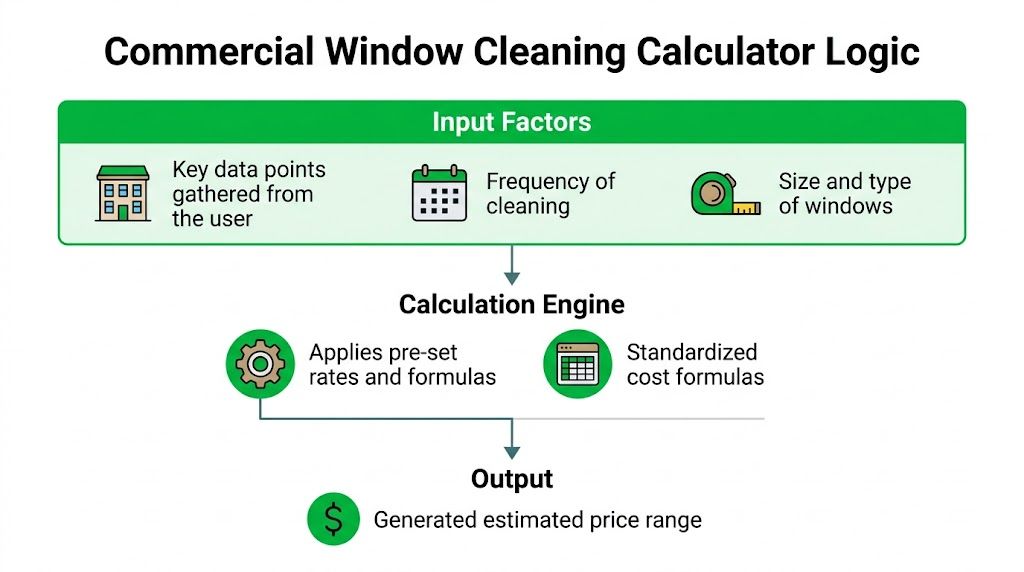
At its core, a commercial window cleaning cost calculator runs on a simple model. It takes a few inputs, applies preset pricing assumptions, and returns an estimate. The problem isn't that the math is wrong. The problem is that the math only knows what you tell it.
Two common pricing models
Most calculators use one of two frameworks.
Per-window or per-pane pricing works best when the building is straightforward. Industry guides commonly place commercial window cleaning at about $5.50 to $15.00 per window, with an average near $10 per window, while some specialty commercial services are priced at $2 to $5 per windowpane according to commercial window cleaning pricing benchmarks.
Hourly pricing fits jobs where access and setup matter more than simple counting. The same industry reference notes that standard commercial work is often priced at $35 to $60 per hour, while larger or more specialized work, especially high-rise properties, may be quoted at $50 to $100 per hour.
What the calculator is actually doing
Estimating commercial window cleaning is similar to pricing catering. When ordering boxed lunches, a simple per-head cost works effectively. However, for a large event involving custom preparation, setup, and specific timing constraints, labor and logistics influence the final invoice more significantly than the total item count.
A calculator usually follows a sequence like this:
- Count the service units. Windows, panes, or sometimes square footage.
- Apply a baseline rate. That may be per window, per pane, or per hour.
- Add broad modifiers. Interior and exterior service, building height, or frequency.
- Generate a range. Usually broad enough to avoid being obviously wrong.
That's why calculators are best for planning, not precision.
Where the model works and where it breaks
For a low-rise office with standard glass, a calculator can be surprisingly useful. For a mixed-use building with upper-story access issues, it can miss the mark by a lot because setup time, safety planning, and route efficiency are hard to reduce to a few dropdown fields.
That same issue shows up in other business decisions too. Teams that care about return from digital work often use structured frameworks instead of gut feel, which is why some marketers rely on modern tools for evaluating content revenue rather than a single vanity metric. Window cleaning estimates work the same way. Better inputs produce better decisions.
Practical rule: If the property can be cleaned mostly from the ground or a ladder, per-window pricing often makes sense. If equipment, staging, or access coordination drive the work, hourly or project pricing usually fits better.
Key Factors That Influence Your Final Price
The biggest mistake in a generic commercial window cleaning cost calculator is treating every piece of glass as if it takes the same effort to clean. It doesn't. A ground-floor storefront and a difficult atrium job may both involve windows, but the labor profile is completely different.

Access changes everything
The most overlooked pricing driver is access. As noted in this discussion of commercial cleaning calculators and access difficulty, calculators usually don't answer well when a job shifts from simple ladder work to a lift, rope-access setup, or atrium work. That's the point where estimates can change fast.
A buyer usually asks, “What's the cost per window?” The better question is, “What does access require to clean those windows safely?”
That distinction matters because the crew may need different tools, more setup time, and tighter safety procedures. On some buildings, the glass itself isn't the hard part. Reaching it is.
For readers who want to see what that equipment looks like in practice, this overview of commercial window cleaning equipment shows why not every property can be priced with a basic pane counter.
The other cost drivers calculators miss
Access is the biggest variable, but it's not the only one.
- Window design matters. Large fixed panes move quickly. Divided panes, deep frames, and specialty shapes slow production down.
- Glass condition matters. Dust, hard water spotting, construction residue, and long-neglected buildup all add time.
- Service scope matters. Exterior only is different from interior and exterior. Screens also affect labor because they have to be removed, cleaned, and reinstalled properly.
- Scheduling matters. Some commercial clients need work before opening, after hours, or around tenant use. That affects production.
A strong estimate accounts for all of that instead of hiding it.
This short video gives a feel for the difference between basic cleaning and work that requires more planning and technique.
What works in the field
Clean pricing starts with a clear site assessment. Contractors who rely only on broad online calculators often underprice difficult work or overprice simple work. Neither helps the customer.
What works better is a field-first review:
- Start with access. Ground, ladder, pole, lift, or specialty setup.
- Then assess the glass. Standard panes, divided panes, high dust load, or stain issues.
- Finish with scope. Exterior only, inside and out, screens, tenant coordination, and frequency.
If a property needs a boom lift, scissor lift, or atrium access, that's not a small adjustment. It changes the job plan.
In Flagstaff, local conditions add another layer. Windblown dust, pollen, snowmelt splash, and seasonal buildup don't always look dramatic from the parking lot, but they affect labor once the crew is on the glass.
Sample Commercial Window Cleaning Calculations for Flagstaff
Pricing gets clearer when you look at real property types. In Flagstaff, the right model depends less on “commercial versus residential” and more on how the work is performed.
Three common Northern Arizona scenarios
A downtown storefront is often the cleanest fit for a unit-based estimate. The windows are visible, accessible, and easy to count. A calculator can get you in the ballpark because the work is repetitive and access is simple.
A mid-rise hotel or office property is different. Here, the technician may spend a meaningful part of the day on setup, safety checks, route planning, and equipment positioning. In that case, counting panes alone doesn't describe the job well.
Then there are larger custom homes, lodges, and mountain properties around places like Pine Canyon or Forest Highlands. They may not be commercial accounts on paper, but the work can resemble commercial service because of terrain, oversized glass, custom architecture, and complex access.
Why production-based thinking is more reliable
According to this explanation of high-rise window cleaning estimating, calculators are most accurate when they convert the work into a measurable production model rather than relying on a simple per-window guess. The same source notes that operators often build estimates from labor + materials + overhead + profit, then divide by pane count so the margin stays intact when setup, coordination, or restricted hours increase the workload.
That's exactly why one property can look simple from the street and still price differently once the full job is mapped.
On a straightforward building, pane count can drive the quote. On a constrained building, production time drives the quote.
Sample Pricing Models in Flagstaff
| Building Type | Typical Pricing Model | Estimated Flagstaff Price Range | Key Cost Driver |
|---|---|---|---|
| Downtown storefront with ground-level glass | Per-window estimate | Often tracks with common commercial ranges such as $5.50 to $15.00 per window when the job is simple and accessible | Number of windows and whether service is exterior only or both sides |
| Mid-rise hotel, office, or campus building | Hourly or project-based estimate | Often aligns more closely with commercial hourly pricing such as $35 to $60 per hour, or higher when specialized access is involved | Lift access, safety setup, restricted work hours, and route efficiency |
| Large custom home or mountain property with commercial-style complexity | Hybrid estimate using scope and production time | Usually requires a custom quote rather than a simple calculator output | Window shape, terrain, screens, height changes, and detailed care requirements |
The point isn't that every Flagstaff job falls neatly into a chart. It doesn't. The point is that different properties need different logic. That's where a generic commercial window cleaning cost calculator starts to run out of useful answers.
Why a Custom Quote Beats Any Calculator
An online calculator can't see mineral residue on west-facing glass. It can't notice landscaping that limits ladder placement. It can't tell whether your entry canopy blocks access or whether your tenants need quiet work before opening. Those are field conditions, not form fields.

Budgeting tool versus real quote
For rough planning, broad market data can help. One 2026 reference notes that Angi's average window-cleaning visit is $221, with a typical range of $150 to $302, which is useful for general budgeting before bids are requested, especially because larger properties can shift substantially when hourly labor, square footage, or special access come into play, as summarized in this window washing price calculator review.
That number still doesn't replace an on-site commercial quote. It only confirms what most property managers already suspect. A rough average is not the same thing as a property-specific price.
What a site visit actually reveals
A professional estimator isn't just counting windows. They're evaluating the full service picture.
- Glass condition and care needs. Standard maintenance cleaning is not the same as restoration-oriented work.
- How the crew will work the site. Squeegees, poles, ladders, pure-water brushes, lift access, and safe walk paths all matter.
- Included details. Screens, frames, entry glass, and protection of surrounding surfaces affect labor and care.
That field review protects both sides. The customer gets a realistic price and a clear scope. The contractor gets enough information to perform the work safely and correctly.
Better questions lead to better quotes
Property owners often get better estimates when they provide better intake details up front. That's true in service businesses generally, which is why teams often use a structured guide to lead qualification strategies before moving toward a final proposal. The same principle applies here. The more clearly the property, access, and goals are described, the more useful the estimate becomes.
A good quote isn't just accurate on price. It's accurate on method, scope, timing, and care for the property.
That matters in Flagstaff, where dust, weather exposure, elevation, and building layout can turn a “simple” cleaning into a more specialized project once someone walks the site.
Get a Clear Price for Your Flagstaff Business
A commercial window cleaning cost calculator has a place. It helps you frame a budget, compare basic scenarios, and decide when it's time to request bids. That's valuable. It just isn't the end of the process.
Actual costs stem from the details calculators often fail to quantify accurately. Access methods, glass condition, screens, service scope, scheduling limits, and safety planning all shape the final number. In Northern Arizona, those details matter even more because properties range from simple retail fronts to hotels, campuses, mountain homes, and buildings with difficult terrain or height changes.
If you're comparing vendors locally, it helps to review what separates a reliable provider from a generic listing. This overview of a trusted local commercial window cleaning company near you is a useful reference point for what to look for in responsiveness, equipment, and real local experience.
The best approach is simple. Use a calculator to set expectations. Then get a custom quote from a company that understands how buildings in Flagstaff are cleaned.
A good estimate should tell you more than price. It should tell you how the work will be done, what's included, what access challenges exist, and how the contractor will protect your property while delivering clear, professional glass.
If you want a clear, no-obligation estimate from a local team that's served Northern Arizona since 1999, contact Pine Country Window Cleaning. They clean with professional tools like squeegees, ladders, poles, lifts, and pure-water brushes, remove and clean screens with every service, and bring the kind of local knowledge that helps businesses budget accurately and keep their properties looking sharp.