
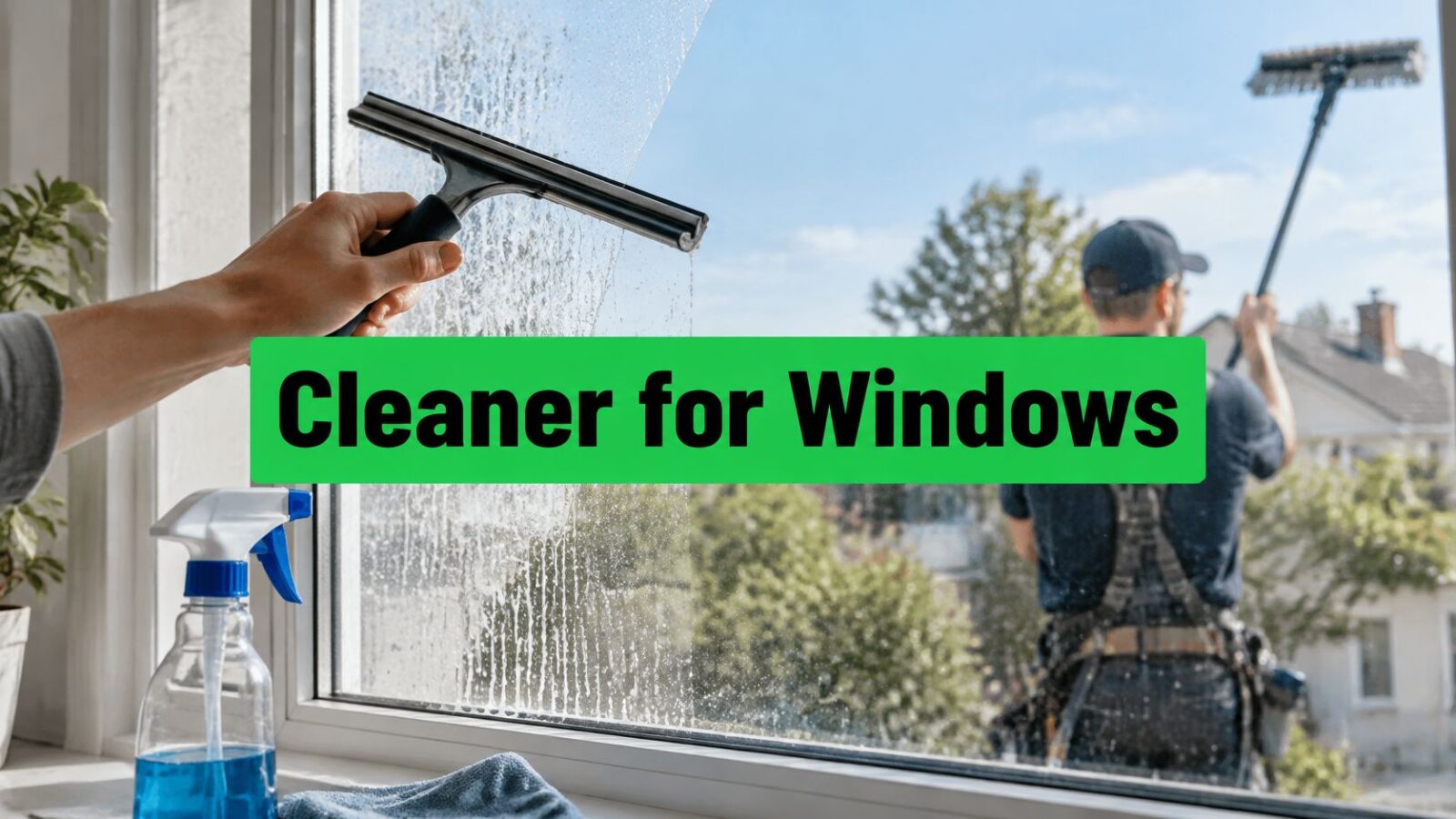
The low sun hits the west-facing windows around five o'clock, and that's when the whole story shows up. A fan of dried sprinkler spots along the bottom third. A grey film across the middle where the dog leans on the glass. A smeary patch at hand height where somebody tried a paper towel and made it worse.
Three different problems are sitting on one pane, and no single bottle fixes all of them. That's the part most cleaning advice skips. It jumps to a brand name and a promise about streaks, when the questions that matter are what's on the glass, what the glass is coated with, and how you're going to reach it.
A cleaner for windows is a tool selected for a job, the same way you'd reach for a putty knife instead of a screwdriver. Match it correctly and the work goes fast. Match it badly and you spend an afternoon pushing haze around a pane that looked fine from indoors.
Which Window Cleaner Type Fits Your Job
| Cleaner type | Best for | Main trade-off | Check before buying |
|---|---|---|---|
| Ready-to-use glass spray | Quick touch-ups between full cleans | Over-spraying leaves residue and drifts onto frames | Safer Choice or low-VOC label |
| Concentrate diluted in water | Frequent whole-house or commercial cleaning | Wrong dilution causes streaks or wasted product | Mixing ratio on the label |
| Mild detergent solution | Heavy film, fingerprints, pollen and road grime | Needs a thorough rinse to avoid soap streaks | Whether the label allows residue-free rinsing |
| Mild acid cleaner (citric or acetic acid based) | Mineral spotting and hard-water film | Can etch sensitive coatings if left on too long | Compatibility with coated glass and a dwell-time limit |
| Pure-water final rinse | Tall panes and hard-to-reach glass where drying spots form | Needs filtration equipment; no detergent in the rinse | Filtered or deionized water with a soft brush on a pole |
| Specialty coated-glass cleaner | Low-E, tinted or film-coated glass | Usually costs more per bottle | Manufacturer approval for that coating |
Why the Type Beats the Brand
Read down the trade-off column and a pattern appears. The products that are easiest to grab are the ones most likely to leave something behind, and the products that leave nothing behind need equipment or a little knowledge to use well.
Ready-to-use sprays earn their place as a touch-up tool. They flash off fast, which is what you want on a storm door, and exactly what you don't want across a big hot pane where the product dries before the squeegee gets there. Concentrates are the economical pick for anyone cleaning a whole house or a building on a schedule, but the arithmetic matters: mix too strong and you fight residue, mix too weak and you're just moving water. Use the ratio on the label and mix in a marked container. A mild detergent solution handles heavy film, pollen and road grime for pennies, and demands a clean-water pass afterward so soap doesn't dry into a rainbow haze.
Mild acid cleaners are for mineral deposits, not dirt, and they need a clock on them. Pure-water rinsing is the professional answer for tall glass because filtered water leaves nothing behind when it dries. Coated-glass formulas cost more because low-E, tinted and film-coated panes don't tolerate the same chemistry as plain float glass.
The rule that outranks any brand name: match the cleaner to the dirt and to the glass before you match it to the bottle.
Volatile organic compounds are the part of that selection you can't see on the glass. The EPA's greener cleaning products guidance identifies VOCs in cleaning products as contributors to indoor-air pollution and outdoor smog formation, and its Safer Choice standard restricts VOC content and excludes hazardous air pollutants except under defined safety criteria. That matters in cabins, short-term rentals, hotel rooms and medical suites, where repeated cleaning compounds indoor exposure. Favor a certified low-VOC product, apply the minimum effective amount, and ventilate enclosed rooms during and after. Our guide to non toxic window cleaner covers which certifications are worth trusting.
How to Clean Glass With a Squeegee Step by Step
The squeegee is the tool that separates clean glass from polished glass. A sharp rubber blade pulls a sheet of water off the pane in one motion, so nothing is left to evaporate and leave minerals behind. Everything else in the sequence exists to protect that final pass.
Western Window Systems recommends rinsing glass with clean water before cleaning to remove dirt and dust particles that could scratch the surface, as their window care and maintenance guide sets out. That single instruction prevents more damage than any product choice.
Here's the sequence at a glance, then the reasoning behind each step.
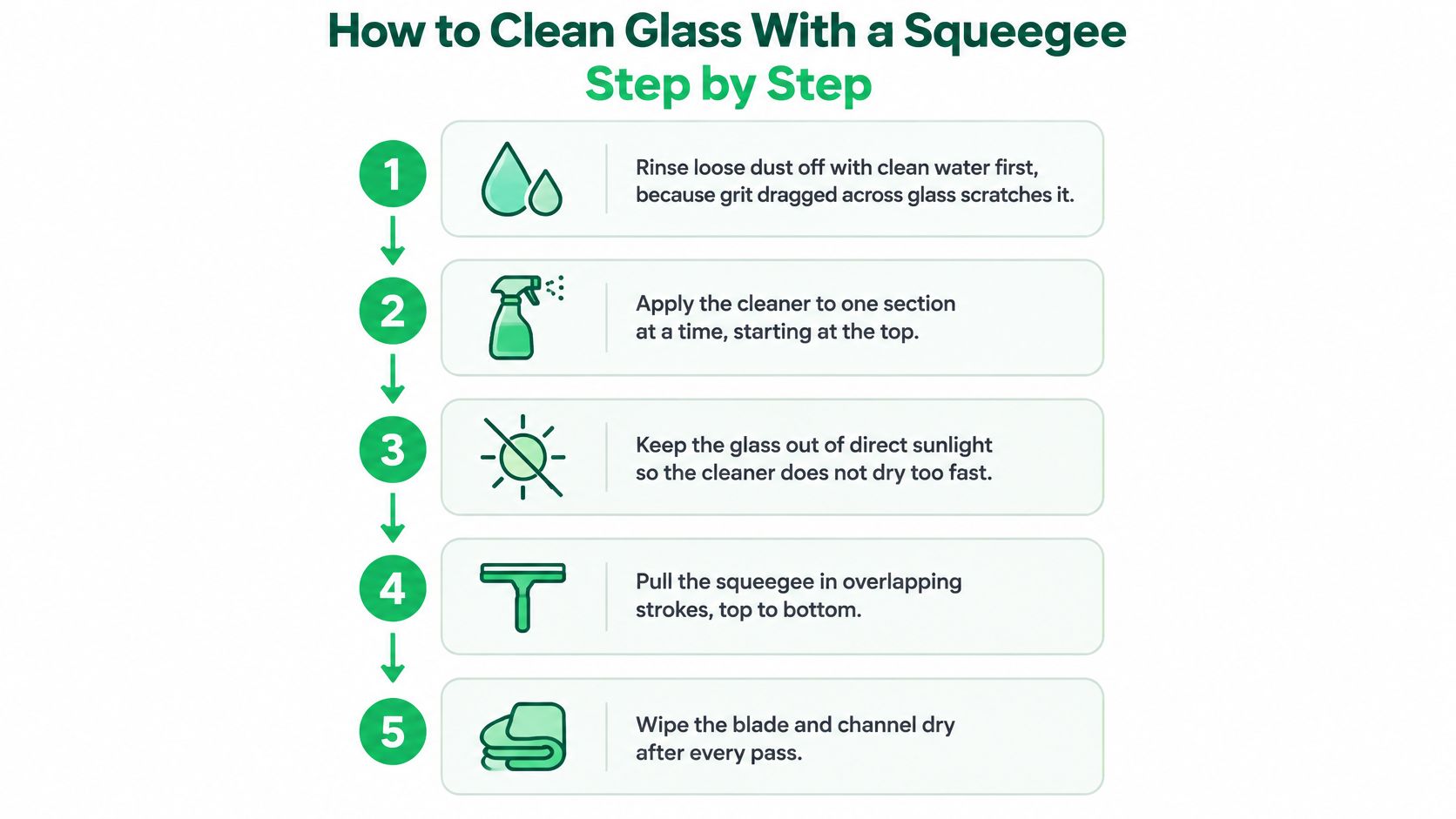
- Rinse the loose grit off first. Dust, pollen and grit dragged under a blade or a scrubber abrade glass permanently, and no cleaner repairs a scratch.
- Work one section at a time, starting high. Gravity carries your water down the pane, so the top edge gets cleaned with fresh solution instead of runoff.
- Keep the glass out of direct sun. Solution that dries before the blade arrives leaves a film that takes a second full pass to remove.
- Agitate with a soft pad or strip washer. Light overlapping passes lift film; abrasive scrubbers dull coatings and frames.
- Pull the squeegee in overlapping S-strokes, blade at a slight angle. Overlap prevents a dry stripe between passes, and the angle keeps the rubber edge flexed against the glass.
- Wipe the blade and channel after every pass. A loaded blade drags dirty water back across the section you just finished.
- Wipe edges, sills and frame bottoms with a separate cloth. Detailing last means drips from the frame don't run back down clean glass.
- Inspect at an oblique angle with the sun behind you. Side light reveals streaks and missed patches that vanish when you look straight on.
Where Panes Go Wrong
Three mistakes account for most streak complaints. Using too much cleaner turns a controlled wet edge into drips that dry unevenly. Working with a dirty or nicked blade leaves a line down the middle of every pass and requires a new blade, not more effort. Cleaning in full sun or wind dries the solution before the squeegee arrives, and the fix there is scheduling, not chemistry.
A finished pane is clear and even, with no film showing when light rakes across it at an angle. If you can see the outline of your passes in side light, the blade was dirty.
Matching Cleaner to Glass Type and Coating
| Glass or surface | Compatibility risk | Suitable approach | Avoid |
|---|---|---|---|
| Standard float glass | Low | Mild detergent or ready-to-use spray with a squeegee | Abrasive pads and scouring powders |
| Low-E or tinted glass | Medium | Non-abrasive pH-neutral formula, tested in a hidden corner first | Strong acids and ammonia-heavy cleaners |
| Laminated or safety glass | Low to medium | Mild cleaner, with a light squeegee touch at the edges | Metal scrapers near the laminate edge |
| Glass with film or privacy coating | High | Manufacturer-approved cleaner only | Razor scrapers and abrasive pads |
| Aluminum or vinyl frames | Low | Mild soap solution and a soft brush | Harsh scouring and solvent-based cleaners |
| Painted or wood frames | Medium | Gentle soap, dry promptly, no soaking | Standing water and high-pressure spray |
Standard float glass is the easy case. It shrugs off mild detergent, most ready-to-use sprays and a normal squeegee pass, which is why so much advice is written for it and why that advice fails on the pane beside it.
Low-E and tinted glass carry real risk. Strong acids and ammonia-heavy formulas can attack the coating, and an abrasive pad scratches the coating and the glass in the same stroke. Laminated and safety glass needs a light touch at the perimeter, where a blade catches the edge of the interlayer. Film-coated privacy glass is the highest-risk surface in the table: if the manufacturer names a cleaner, use that one and nothing else.
Frames and Seals Count Too
Sealed insulated glass units let moisture into the seal if the edge is soaked repeatedly, so apply cleaner to the pane and keep the perimeter dry rather than flooding the whole unit. Frames react differently as well. Aluminum and vinyl tolerate mild soap and a soft brush. Painted and wood frames want a damp cloth, prompt drying and no standing water at the sill, because the finish fails long before the glass does.
Before you commit to a formula, run a short test on a hidden corner: apply the cleaner, wait a few minutes, rinse, dry and inspect under side light. A west-facing tinted window that bakes all afternoon often needs a gentler product than a shaded north-facing clear pane on the same wall. One bottle can be right for one and wrong for the other.
Diagnosing Hard Water and Stubborn Film
A white spot that survives a soapy squeegee pass is usually mineral, and it has a cause worth finding before you reach for a stronger product. When water carrying dissolved calcium, magnesium or other minerals evaporates off glass, the nonvolatile solids stay behind as crystalline residue, and repeated wetting and drying can convert removable deposits into permanent surface alteration, as this guide to hard water stains on windows explains.
Fresh deposits come off with a mild acid and a light touch. Established etching needs a controlled assessment, because scrubbing harder only adds scratches to a surface that is already altered. Citric or acetic acid dissolves carbonate-rich scale well, while abrasive pads and uncontrolled pressure mark the glass, the seals and the frames in the same pass. Silica-rich or chemically altered deposits may not respond to any routine cleaner at all, and recognizing that early saves a pane.
Find the Water Source Before You Treat It
Sprinkler overspray, irrigation heads, construction runoff and unfiltered rinse water keep feeding the problem. A glass door under a lawn sprinkler will spot again within days of every cleaning until the spray pattern is changed, and no acid product fixes a repeating cause.
The workflow that holds up in the field:
- Identify the water source and correct it if you can.
- Test a small area in a low corner.
- Apply a compatible nonabrasive method with a defined dwell time.
- Rinse thoroughly so no acid residue stays on the frame or seal.
- Inspect under oblique light for etching before repeating.
| Symptom | Likely cause | First fix | Call a pro when |
|---|---|---|---|
| White chalky spots | Hard-water mineral deposits | Mild acid solution, then thorough rinse after a test patch | Spots return within days or etching shows at an angle |
| Gritty, smearing film | Mineral or soap buildup | Pure-water rinse followed by squeegee passes | Film remains after two careful attempts |
| Streaks on every pane | Dirty squeegee blade or leftover residue | Clean the blade, wipe edges and re-pass | Streaks persist across the whole building |
| Paint, sticker or adhesive marks | Construction paint or label adhesive | Gentle specialist remover on a test patch | Glass is scratched or coated and the mark will not lift |
| Dull haze that no cleaner removes | Chemical etching or altered surface | Check at an oblique angle before any further treatment | Etching is visible from several angles |
Etching is where DIY stops being safe. Aggressive compounds and blade work on an altered surface trade a haze for a scratch pattern, which is why services like Pine Country Window Cleaning bill hard water removal, paint removal and track detailing as extras rather than folding them into a standard wash. A technician deciding how to remove hard water stains from windows tests the deposit, checks the coating and picks the least aggressive method that works.
Cleaning improves the appearance of etched glass. It does not restore the surface, which is why early maintenance and post-construction cleanup cost less than repeated restoration attempts.
Screens, Frames and Tracks in Practice
A screen is not a window. It's a woven mesh in a thin frame, and treating it like glass can tear the mesh and bend the frame. The two most common screen problems become clear once you take the panel out.
The Pet-Hair Screen and the Gritty Track
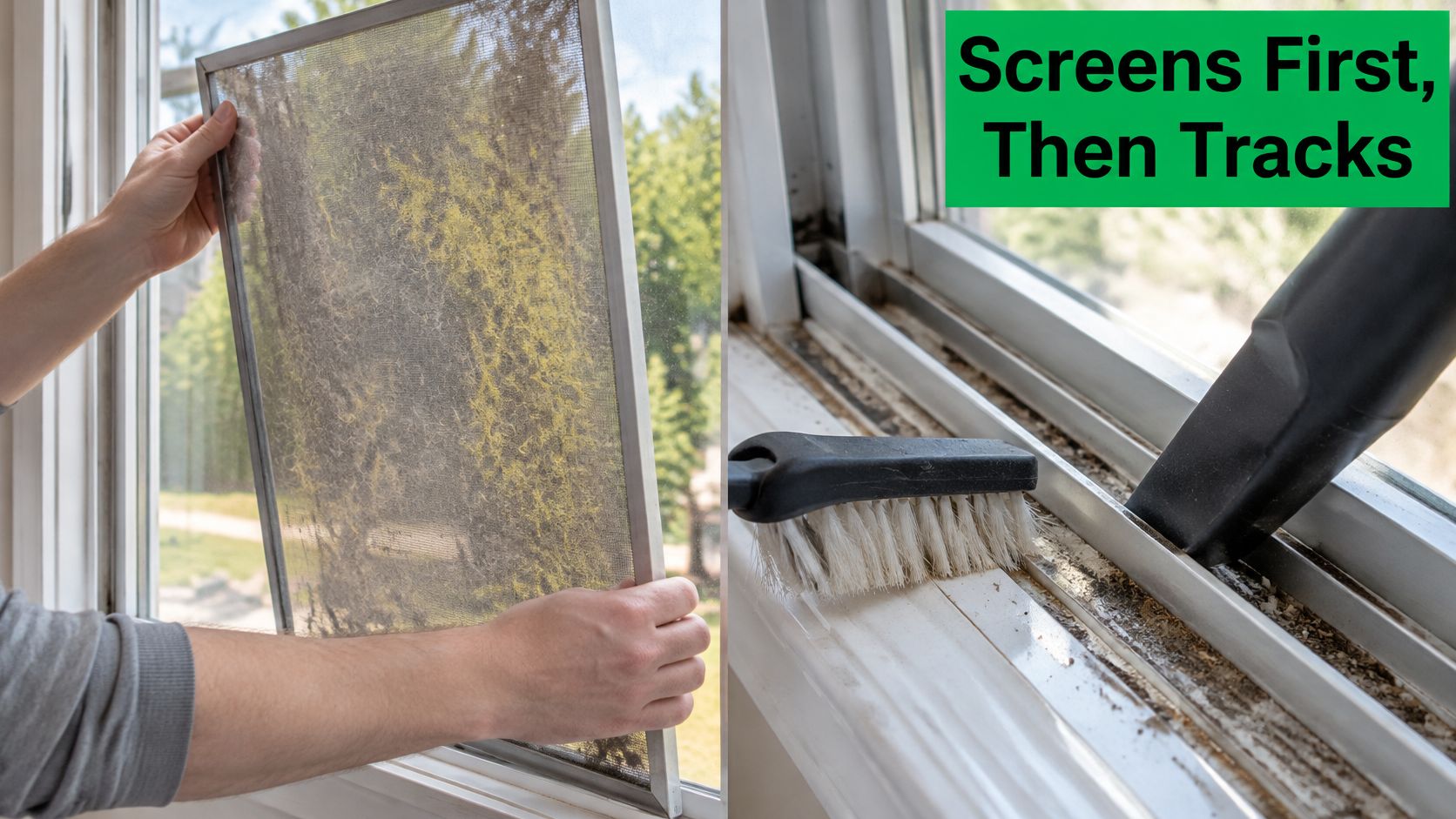
A bug screen clogged with pet hair and pollen looks opaque from inside, and the instinct is to blast it. Don't. WAREMA's insect screen cleaning guidance advises removing loose dirt with a soft brush or vacuum attachment, washing with water and a mild cleaning agent, rinsing carefully and letting the screen dry, and it specifically cautions against rough brushes and high-pressure washers because they damage fine mesh.
The order matters: lift the screen out carefully so the frame doesn't twist, lay it flat on a clean surface, brush or vacuum the loose material off both faces, wash with mild soap and water, rinse gently, then let it dry completely before it goes back in.
A gritty sliding track is the same story with different tools. Vacuum the loose grit first, brush the channel with a soft brush, then wipe. Skip the vacuum and you grind that grit into the track and the screen edge every time the window slides.
Three Rules That Cover Every Screen
Soft tools only. A stiff brush on powder-coated frames leaves scratches that never buff out. Mild soap, minimal water. Strong streams can force water past the frame and into the wall cavity. Dry completely before reinstalling. A damp screen traps moisture against the frame and the sill.
Forcing a screen out of its groove bends the spring tabs, and once those lose tension the panel rattles or falls out. Lift and compress, never pry.
Here's the same process in motion, including the track work:
Cleaning Windows During Smoke Season
Smoke season splits into two jobs that get confused with each other. Removing ash deposited on glass, sills and frames is cleaning. Stopping smoke from entering the building is a filtration and building-operation problem, and washing glass does neither.
The EPA's wildfire smoke exposure factsheet supports a condition-based approach rather than a fixed calendar date. During poor outdoor air quality, keep windows closed. When the air improves, briefly open windows or run the HVAC fresh-air intake to air the building out, and check filters often, replacing them when they're dirty.
Why filters come before squeegees: a loaded HVAC filter keeps recirculating the same particles you just wiped off the sills, so the cleaning looks like it failed when the filter did.
Fine particles enter through open windows, mechanical ventilation and small gaps around closed windows and doors, so closing up reduces infiltration without eliminating it. EPA reports that with windows and doors closed but no portable air cleaners, indoor PM2.5 during wildfire events can still average roughly 55% to 60% of outdoor levels, per its indoor air quality guidance for smoke events. Clean glass and healthy indoor air are separate outcomes, and clarity in the view is not a measurement of air quality.
For cabins, vacation rentals, hotels and multi-unit properties, the working sequence is filters, then glass, then screens. Log the smoke days, postpone exterior work while ash is still falling, and book the cleaning for after conditions stabilize. Coordinate it with a filter change and HVAC settings so the building isn't pulling smoke back in through the vents the same afternoon.
When to Clean Yourself and When to Call a Pro
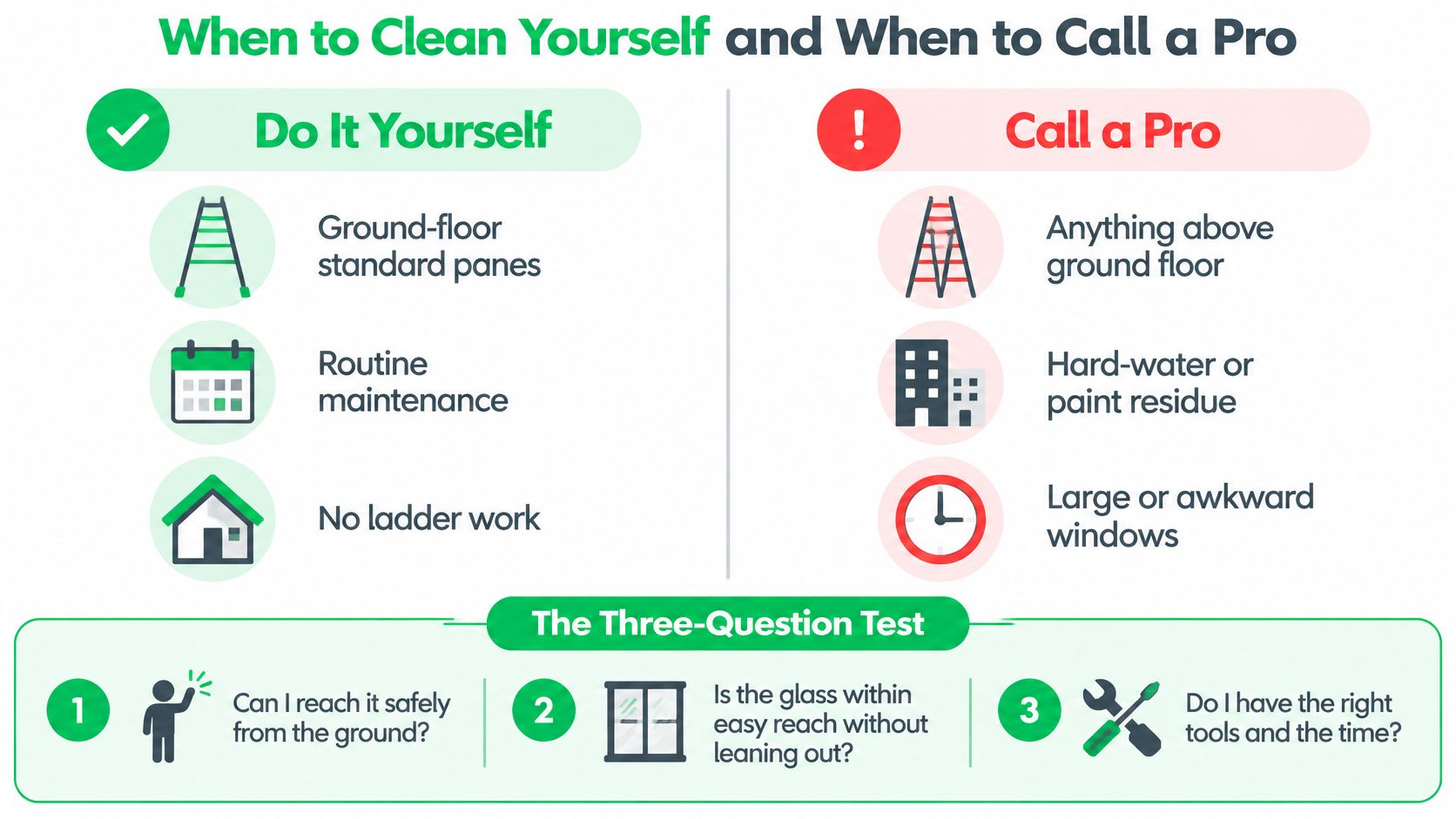
Ground-floor panes, standard glass, no ladder work: that's a do-it-yourself job. A squeegee, a bucket and an hour will beat any bottle-and-rag routine.
Everything else deserves three questions.
The Three-Question Test
Can I reach it safely from the ground? If the honest answer involves a chair, a lean out over the sill, or a walk on the roof, it's a no. Is the glass standard? Tint, film, coated panes and laminated edges all narrow what you can safely put on them, and a cleaner that works fine on plain float glass can haze a coated one. Do I have the time to do it properly? A rushed pass on hot afternoon glass leaves more streaks than it removes.
Two no answers and you've found your professional list. One no and the call is yours.
Where DIY Stops Being Safe
Height is the dividing line, and it isn't a soft one. The OSHA accident search for window washers records multiple fatal window-washing incidents in 2021, 2022 and 2023, including a worker killed after falling about six stories in October 2022 and an employee who fell approximately four stories and died in April 2023. In a Boston case reported in that same search, investigators found the employer failed to ensure personal fall-protection systems and a rope-descent system were properly inspected and that defective equipment was removed from service, drawing proposed penalties of $447,087 across two willful, four serious and two repeat violations.
The lesson transfers directly to a homeowner on a ladder: access equipment and inspection are the controls that prevent falls, not caution and balance. Height isn't the only trigger. Multi-story and atrium glazing, skylights, post-construction residue, deep mineral etching and a whole house worth of screens each push a job into crew territory, and each for a different reason. Construction debris scratches glass when it's scraped wrong. Etched mineral film needs products that damage coatings in untrained hands. Screens have to come down, get washed on their own and go back up, which doubles the labor on a two-story house.
Professional crews bring pole systems, lifts, pure-water rinsing and trained staff, which turns an afternoon of risk into a scheduled visit. If you'd rather hand off the whole list, our professional window cleaners handle interior and exterior glass with squeegees, poles and pure-water brushes. Pine Country Window Cleaning has served Northern Arizona since 1999 as a locally owned and operated company. On a home visit the crew cleans outside and inside glass, removes, cleans and reinstalls the bug screens, and wipes the frames inside and out along with the inside sills; window tracks and extras like hard-water removal are priced separately. The technicians are background checked and industry safety trained. Book online or call (928) 527-0671.
Your next step is a list. Walk the property, note each window's height, glass type and screen count, run the three questions, and book a visit for the ones that fail.
Pine Country Window Cleaning brings the right cleaner, the right tool and the right access to every pane, inside and out. If your glass has hard-water film, smoke ash or second-story windows you'd rather not lean toward, a staff member will walk the property with you before anyone picks up a squeegee. Visit Pine Country Window Cleaning or call (928) 527-0671 to get on the schedule.