

Gutter cleaning is the scheduled removal of leaves, twigs, pine needles, sediment, and roof granules from gutters and downspouts so rainwater flows off the roof and away from the foundation. Done right, it also serves as a full drainage check, clearing hidden clogs at elbows, flushing outlets, and catching loose brackets before seasonal storms or dry wildfire weather arrive.
If your gutters look empty from the driveway, why can rainwater still soak your fascia boards, or why can a single windblown ember ignite your roofline during a bone-dry Northern Arizona summer? Most homeowners who search what is gutter cleaning expect a quick chore list about scooping autumn leaves out of aluminum troughs. That narrow view misses how a roof-drainage system works.
In forested mountain communities around Flagstaff and Munds Park, gutters carry snowmelt, summer monsoon downpours, and year-round pine needle drop. Treating the job as a routine inspection of the entire drainage path protects both your foundation from water intrusion and your eaves from dry-season ember ignition.
What Gutter Cleaning Involves
A gutter system moves water the way a sink drain moves dishwater: the horizontal trough is the basin, and the downspout is the drainpipe that carries flow safely away. Leaves, pine needles, gritty granules shed from asphalt shingles, and windblown mud narrow that basin until heavy rain or melting snow has only one exit, over the rim.
The FEMA Roof Drainage System Maintenance guidance treats gutter and downspout cleaning as routine roof-drainage maintenance that reduces leak paths and keeps runoff from saturating soil next to the foundation. Around Flagstaff homes and cabins, pine needles raise the stakes because they weave into dense, waterlogged mats that shrink the gutter's effective channel, plug narrow outlets fast, and leave dry fuel sitting along the eaves when summer humidity drops.
Following the Water Path Step by Step
A two-story cabin after an autumn windstorm shows why order matters. Water is backing up near the back patio even though the front eaves look clear, so the work has to follow gravity from the high end of the channel to the ground discharge point.
- Clear the horizontal trough by hand or scoop. Work in short, reachable sections, dropping packed needles, twigs, and roof grit into a bucket instead of flinging mess onto flowerbeds or walkways. Wet sludge left behind adds dead weight and feeds the next blockage.
- Open the downspout inlet mechanically. Compacted needles and small cones wedge right at the drop outlet where the horizontal trough meets the vertical pipe. Push a flexible plumbing rod or auger down the neck to break up dense plugs before running any water.
- Flush the entire run with a garden hose. Start at the high end opposite the outlet and let water carry remaining sediment down the channel. The run is clear when a steady stream shoots out the bottom discharge pipe with zero water backing up at the top elbow.
- Check outlet flow and ground extensions. Watch where the water lands once it exits the pipe. Extensions or splash blocks need to steer runoff well clear of the foundation perimeter rather than dumping it beside the footing.
- Inspect hangers, seams, corrosion, and slope. Removing debris alone won't fix a structural or hydraulic fault. Look for pulled spikes, rusted brackets, separated corner miters, and sagging bellies where standing water pools after the hose shuts off.
- Log blocked sections and take photos before and after. Recording repeat clog zones, bent brackets, and outlet flow creates a maintenance history. That record helps homeowners, short-term rental owners, and commercial property managers track gradual wear before a small leak becomes a repair bill.
Turning One-Off Cleanings Into Repeatable Upkeep
For managers overseeing several vacation cabins, storefronts, or campus buildings, the harder problem is coordination: remembering which outlets clog first, getting a crew back before the next storm, and using tools that book appointments automatically with AI when recurring service slips between tenant turnovers.
A clean trough can still dump rainwater straight onto siding if the pitch runs backward or a corner seam has separated. True gutter cleaning is preventive maintenance for the whole rainwater-management system.
Why Clogged Gutters Lead to Water Damage
Many homeowners assume water damage only happens during a torrential storm when a trough is visibly overflowing with wet leaves. In reality, moisture intrusion develops over dozens of ordinary showers and snowmelt cycles.
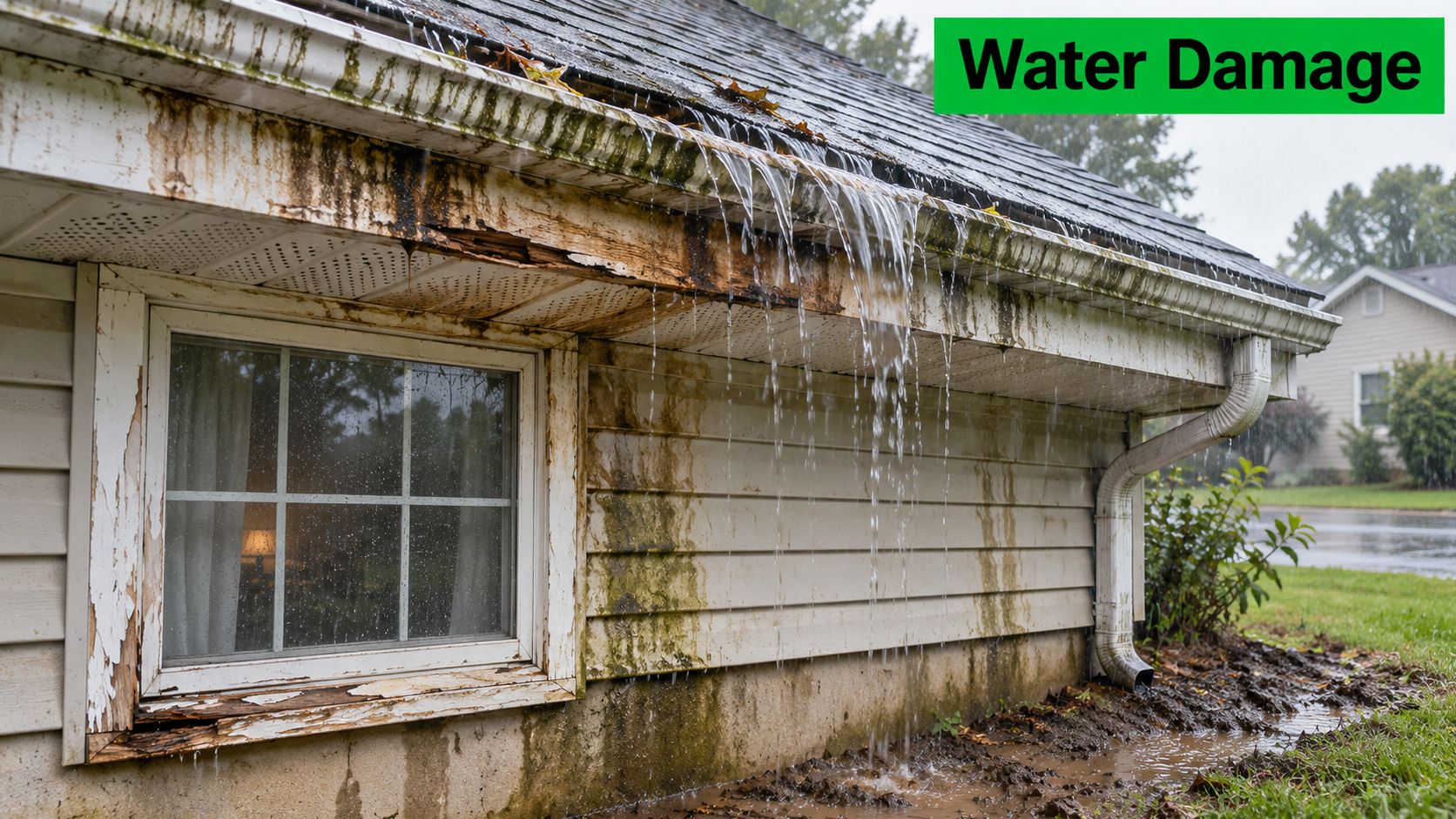
When water spills over the front or back lip of a blocked trough, it runs straight across fascia boards, soffits, exterior siding, and window surrounds before soaking the soil beside the foundation. Repeated wetting accelerates wood rot along the roofline, leaves dark mineral stains on masonry, weakens exterior caulk and sealants, and raises the odds of moisture seeping into basements or crawlspaces.
That pattern shows up clearly in insurance records. An independent study published in Natural Hazards and Earth System Sciences that analyzed about 3,100 water-related home-insurance claims identified roof and wall leakage as the most frequent precipitation-related failure mechanism, with blocked roof gutters and downpipes ranking right behind it alongside melting snow and sewer flooding.
When a channel backs up during a storm, water takes the shortest path down the siding and trim, as shown below.
Cold-Weather Loads and Hidden Drainage Flaws
In cold, high-elevation climates, retained water and saturated debris don't just sit harmlessly in the trough. Overnight freezes turn that trapped muck into solid ice, adding heavy weight that pulls fasteners loose from the fascia and triggers ice-related drainage backups along the eave.
Catching small exterior clues early saves far more money than replacing rotted trim or repairing settled foundation walls later. Match what you see around your eaves against the common causes below.
| Symptom | Likely cause | What it means for the building |
|---|---|---|
| Water pours over the gutter edge during rain | Clogged channel or blocked downspout | Water is running against fascia, siding or soil |
| Stains or peeling paint under the gutter line | Repeated overflow | Wood or paint is being wetted over time |
| Soil washes out near the foundation | Downspout discharges too close to the wall | Foundation area is saturated |
| Gutter sags or pulls away from the fascia | Heavy debris, ice load or loose hangers | Brackets or fasteners may be failing |
| Water still drips after cleaning | Poor pitch, undersized gutter or disconnected downspout | Cleaning alone did not fix the drainage problem |
Notice that last row. A trough can be completely empty and still fail if it's undersized for the roof plane feeding it, hung without proper slope toward the outlet, disconnected at a seam, or discharging directly against the wall.
On commercial buildings, hotels, campuses, and vacation cabins, document repeat overflow locations after each rain or melt. Prioritize building entrances, public walkways, and lower porch roofs where dripping runoff can freeze into slip hazards or force repeated water intrusion around doorways.
How Often Each Property Needs Cleaning
Cleaning twice a year, once in spring before rainy weather and once in autumn after leaves fall, is a solid starting point for a house on a clear lot. Still, no single calendar rule fits every building.
Four site factors decide how fast blockages form: canopy density overhanging the roof, roof surface area funneling runoff into each downspout, local storm intensity, and winter snow exposure. A small bungalow on an open parcel accumulates mostly shingle grit and dust, while a steep mountain home tucked beneath tall pines can fill a channel in a single windy week.
Matching Your Schedule to Property Conditions
Across Flagstaff neighborhoods like Forest Highlands, Pine Canyon, and Flagstaff Ranch, mature ponderosa pines drop needles steadily rather than in one short October burst. Once rain or early snow hits those needles, they pack into heavy mats at downspout necks, turning a minor layer of litter into a solid plug.
High-wind events create a second wild card. Gusty afternoons can knock loose fresh branches, rip away hanger spikes, or shift a downspout elbow out of alignment long before your next scheduled autumn visit. For a closer look at seasonal timing across different roof types and tree canopies, check our detailed guide on how often gutters need cleaning in Northern Arizona.
Use the table below to match your property's actual exposure to a realistic maintenance interval and early check triggers.
| Property situation | Suggested interval | Check sooner when |
|---|---|---|
| Open lot with no nearby trees | Twice a year, spring and autumn | Heavy rain or snowmelt is forecast |
| Under deciduous trees | After leaf drop, at least once in autumn | Gutters fill again before the leaf drop ends |
| Pine needles over the roof (Flagstaff area) | Before fire season and after needle drop | Needles are wet and matted, or dry debris sits in downspout outlets |
| Storm or high-wind season | Inspect within weeks of the event | Gutters are displaced, sagging or loose |
| Before a hard freeze | Once before the first freeze | Water sits in gutters or ice forms along the eave |
| Rental, cabin or short-term property | Before each occupancy season | Water stains or overflow appear after guests leave |
Two Quick Ground Checks Between Visits
You don't need a ladder to tell when your schedule needs to move up. Walk the perimeter during the next steady rainstorm and watch the eaves; if water cascades over the front lip instead of exiting cleanly at the downspout base, a blockage is already active. On dry days, scan the roofline from the yard for tufts of pine needles, leaves, or small sprouts peeking above the gutter edge.
Condition-based rule: If tall trees overhang your roof, let debris buildup and weather events set your cleaning schedule instead of waiting blindly for spring or fall.
Gutter Cleaning and Wildfire Risk in Northern Arizona
A cabin in Munds Park sits ringed by ponderosa pines. Spring storms were light, summer rain has not arrived, and drainage feels like a low priority. Meanwhile, dry pine needles and windblown forest litter have drifted into the roof valleys and settled along the eaves, baking in the afternoon sun right against the wooden fascia.
Dry debris along a forested roofline turns an ordinary drainage channel into a shelf of fuel perched directly on the structure.
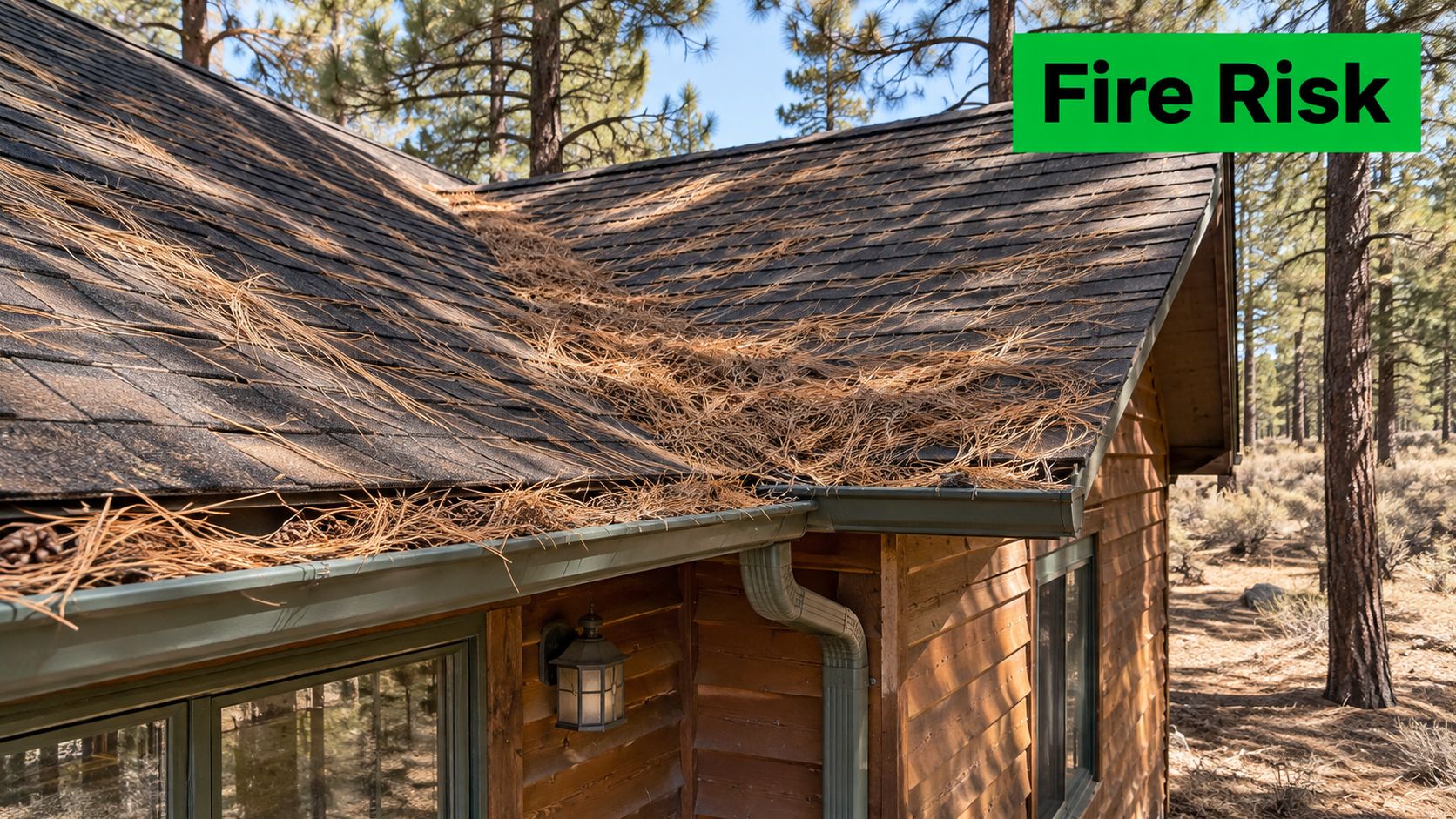
Most generic home-maintenance guides treat gutters strictly as rain gear. In Northern Arizona, they also play a direct role in wildfire preparedness. The City of Flagstaff Wildfire Preparedness guidance identifies rain gutters as potential ember entry points and advises homeowners to inspect them regularly and strip out combustible material.
Regional drought raises the stakes on that dry-season habit. After prolonged stretches with little precipitation, grasses, needles and forest litter dry out across the area, and the same material sitting in your gutters cures into ready-made tinder. Rain is not part of the equation at all. Wind carries glowing embers well ahead of a wildfire's flame front, and a single ember landing in a packed trough can smolder for hours before igniting the fascia and the roof edge.
What to Remove and Where Gutter Cleaning Stops
Clearing dry fuel from the roofline works best as one piece of a wider defensible-space plan, not a stand-alone shield. Focus on four areas during dry-weather checks: scoop dry litter out of the gutter channel, sweep needles out of roof valleys where two slopes meet, clear dry buildup lodged at downspout outlets, and lift or inspect beneath gutter guards where fine tinder gets trapped. Pair that roofline work with trimming overhanging branches and clearing ground litter away from the siding.
Be clear about the limit here. Cleaning your gutters cuts ember-ignition risk at the roof edge, yet it won't make a home fire-safe by itself without broader roof maintenance and defensible yard spacing.
Watch this short overview on keeping rooflines clear as part of home wildfire readiness.
To stay ahead of dry fuels on cabins and forested properties, anchor your inspections to three simple cues:
- After heavy needle drop: Clear compacted needles before warm, dry breezes turn them into tinder along the fascia.
- Before peak fire season: Schedule a full sweep of channels, valleys, and outlets ahead of late spring and early summer wind events.
- After a dry windstorm: Check the roofline within days of strong gusts, since wind strips fresh twigs and dead needles straight onto the eaves even without rain.
Do Gutter Guards Replace Cleaning
Once homeowners walk through the steps of scooping, snaking, and flushing a roofline, one question comes up immediately. If you install leaf guards, can you cross gutter cleaning off your list for good?
No. Guards cut down how many whole leaves and large twigs drop into the channel, which lowers how often you'll haul out heavy buckets of muck. They don't turn a drainage system into a zero-maintenance fixture.
Even the FEMA Home Builder's Guide to Construction in Wildfire Zones from 2008, which recommends installing noncombustible leaf guards in wildfire-prone areas, still instructs property owners to inspect gutters regularly because vegetation collects around covered channels.
In pine country, guards commonly still need attention in three situations. First, pine needles and asphalt roof granules settle right on top of the guard screen, forming a damp shelf that sends rainwater sheeting straight past the gutter edge. Second, fine-mesh guards can plug tightly when wet needles weave across the tiny perforations. Third, small twigs and grit slip underneath loose guard lips along the roofline, trapping debris inside the channel where normal rain can't flush it through.
If your property sits beneath tall conifers, screen design matters a great deal, as covered in our comparison of gutter guards for pine needles.
Open Gutters vs. Guarded Gutters
Comparing the two setups side by side clarifies what changes when you add covers:
- Open gutters require hand clearing of the horizontal trough each season, clearing the downspout mouth, and flushing the full line to verify discharge.
- Guarded gutters require brushing debris off the top of the screen, checking the seam along the fascia and under guard edges for hidden needles, and flushing the downspout outlet to confirm free flow.
Treat leaf guards as a tool that reduces heavy scooping between visits, never as a replacement for seasonal inspection and flushing.
Ladder Safety, Professional Help and Cost
Scooping dry leaves from a single-story eave at chest height is a weekend chore. Wrestling wet pine needles out of a second-story downspout elbow while balanced on an extension ladder is where fall risk lives, so ladder rules come before any tool touches the trough.
According to the OSHA Portable Ladder Safety QuickCard, anyone climbing a ladder should maintain three-point contact at all times (two hands and one foot, or two feet and one hand). When an extension ladder reaches a roofline or higher landing, its side rails must extend at least 3 feet above the landing or point of support, and the top three rungs stay off limits for standing.
Setup geometry matters as much as climbing form. The OSHA Ladders Module 4 training manual outlines the 4-to-1 setup rule, placing the ladder base 1 foot out from the wall for every 4 feet of vertical height, and warns never to move, shift, or extend a ladder while someone is standing on it. Reaching sideways for one last handful of needles is how ladders tip, so climb down and reposition the base instead. Our guide to ladder safety requirements for exterior maintenance walks through these fundamentals in more detail.
When to Call a Professional Instead
If even one condition below applies to your property, leave the ladder in the garage and hire a trained crew:
- Steep or unstable roofs where footing slips or fragile shingles crack under weight.
- Multi-story heights that push household extension ladders near their limits or sit above sloped yards.
- Wet, icy, or windy conditions common during Northern Arizona shoulder seasons.
- Overhead power lines running close to the eaves or service drop.
- Clogged downspouts at height that demand two hands and mechanical rods rather than careful balance.
- Commercial buildings and public walkways where safe work requires lifts, ground spotters, pedestrian exclusion zones, and written defect logs.
A professional visit doubles as a drainage check for the whole system. Before you request a quote, take five minutes to walk the exterior from ground level and note dark overflow stains on siding, visibly sagging brackets, or corners that spill during rain. Sharing that list tells the technician exactly where the system fails first.
Typical Service Costs and Choosing Local Care
HomeGuide reported in 2025, as summarized in MeasureScout's gutter cleaning cost guide, that professional gutter cleaning generally costs $100 to $250 per service, with an average price near $175. Final pricing depends on roofline height, linear footage, downspout access, and how heavily packed the debris is, so ask for an upfront quote before work begins.
When storm season hits and homeowners call for fast help, prompt communication makes all the difference. Across home-service trades, teams work hard to keep lines responsive during peak rushes, similar to how Mercateer answers plumbing calls so urgent property requests don't get stuck in voicemail.
Here in Northern Arizona, Pine Country Window Cleaning has cared for customers and their homes since 1999 as Flagstaff's top-rated window cleaning provider. The company provides gutter cleaning and pine needle cleanup with the tools and equipment to finish the job fast, including in-house boom lifts, scissor lifts, and a 95-foot atrium lift for tall residences, cabins, and commercial buildings.
That same care for siding, trim, and landscaping carries into residential and commercial window work, where background-checked, safety-trained technicians use professional squeegees, ladders, extension poles, and soft-brush poles fed by pure filtered water, and they remove, clean, and reinstall bug screens with every service. Pine Country offers a free estimate when you call to schedule, and you can book online or reach the team directly at (928) 527-0671.
Protect your roofline, foundation, and defensible space before the next windstorm, monsoon, or freeze hits Northern Arizona. The crew handles gutter cleaning, pine needle cleanup, and exterior window care with the right ladders, lifts, and attention to your home's trim and landscaping. Call (928) 527-0671 for your free estimate or schedule online directly with Pine Country Window Cleaning.