
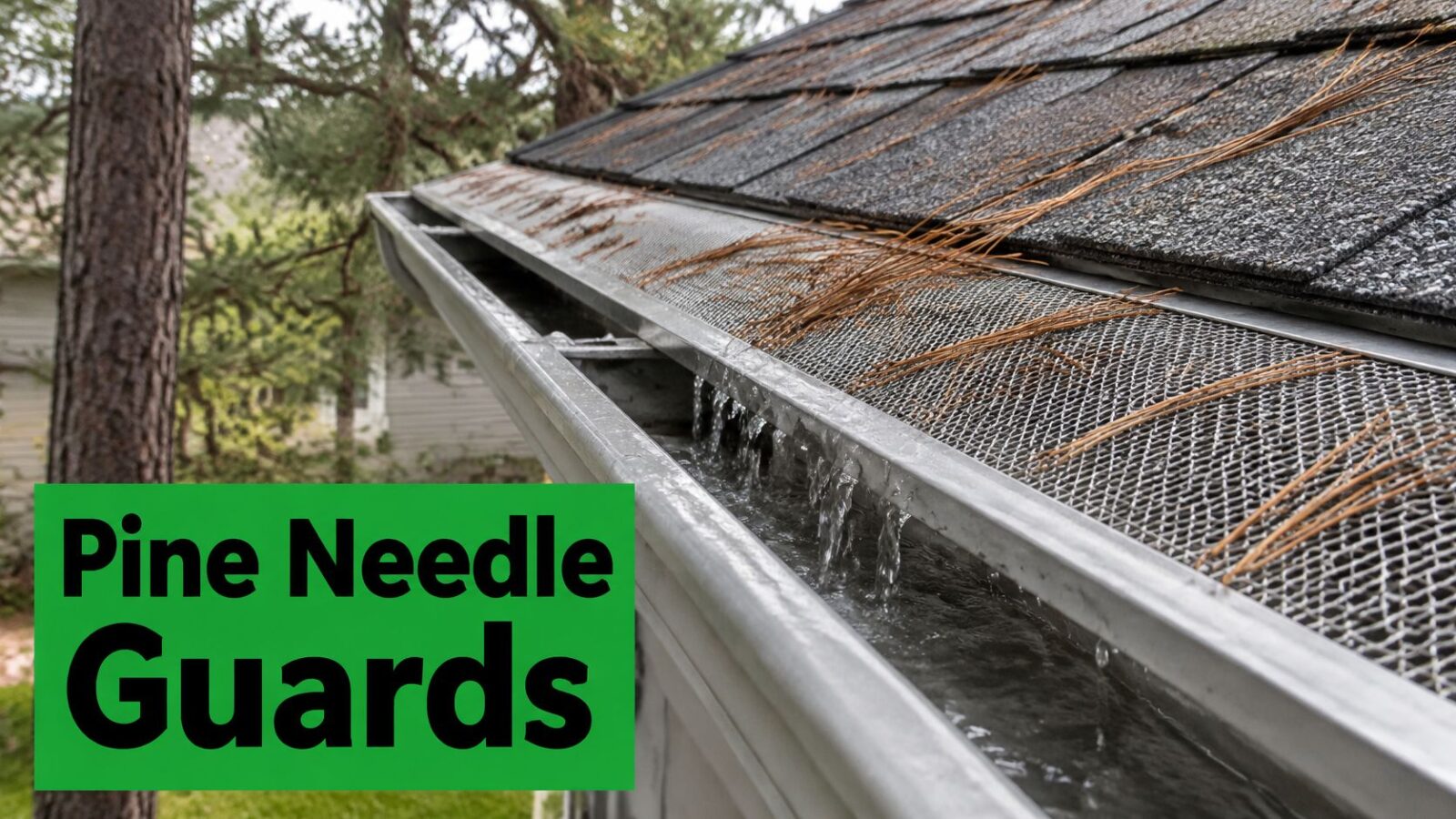
The usual advice is to buy the finest mesh you can afford and stop worrying about pine needles. That misses the key buying decision. A gutter guard shifts maintenance to the guard surface, roof edge, seams, and downspouts. It doesn't make the needles disappear.
For homes and cabins in Flagstaff and Munds Park, the best gutter guards for pine needles are the ones you can inspect and clean without dismantling the drainage system. Needle exclusion matters, but so do water intake, roof fit, and the work required when debris eventually collects.
Which Gutter Guard Type Handles Pine Needles Best
For heavy needle fall, start with a metal micro-mesh guard or a diverter hood with an accessible seam. For light exposure, a cheaper screen can be reasonable if you're willing to inspect it yearly and clear it when needed.
These ratings are relative comparisons, not guarantees. Installation, roof runoff, and the condition of the gutter can change how any style performs.
Gutter guard styles compared for pine-needle properties
| Guard style | Pine needle performance | Debris on the guard | Inspection and cleaning access | Best fit |
|---|---|---|---|---|
| Micro-mesh screen | Strong | Fine needle dust can build up | Moderate | Heavy needle fall |
| Reverse-curve or surface-tension hood | Strong when the edge is clean | Needles can sit on the hood | Moderate | Mixed roofs with clean edges |
| Solid or perforated hood with diverter channel | Strong | Low on the hood, debris can collect at the seam | Harder to lift | Long-term low maintenance |
| Foam insert | Weak to moderate | High, needles lodge in the foam | Easy to remove | Short-term or budget fixes |
| Brush insert | Moderate | High, bristles trap needles | Easy to pull out | Light needle fall |
| Basic plastic or vinyl screen | Weak against fine needles | Moderate to high | Easy | Light needle fall and budget projects |
What those ratings mean on a roof
Stainless-steel micro-mesh or fine aluminum screening offers a useful balance of needle exclusion and water intake when the surface is clear. The trade-off is surface cleaning. Fine fragments and dust can lodge across the openings, so the installer must leave a practical way to brush the face and inspect underneath.
A reverse-curve hood directs water around its nose into an inlet. Loose needles can slide away, but the edge must stay clean and the fit must be right. Don't accept a demonstration on a sample board as proof that the same hood will capture runoff from your roof valleys.
A diverter-channel hood separates the debris path from the water path. That can be useful under sustained needle fall, but a hard-to-remove cover makes hidden debris more expensive to reach. Its low-maintenance appeal only makes sense when service access is built into the installation.
Foam and brush inserts are simple to fit, but they put material inside the gutter where needles can lodge. Foam can deteriorate under sun exposure; brushes hold fragments among their bristles and need to be pulled and cleaned. A basic plastic or vinyl screen costs less upfront, but fine needles can pass through openings that stop leaves.
Buying rule: Choose the guard you can maintain on your actual roof, not the one that looks cleanest in a sales demonstration.
For a pine-heavy cabin, I'd favor accessible micro-mesh over an enclosed system nobody can explain how to open. For a lightly exposed garage, a removable budget screen may be enough.
Why Pine Needles Defeat Guards That Work on Leaves
Needles aren't leaves. A broad leaf rests across a screen, while a slender needle can enter tip-first, bridge an opening, or catch beneath an overlapping edge.
The difference is easier to see side by side.
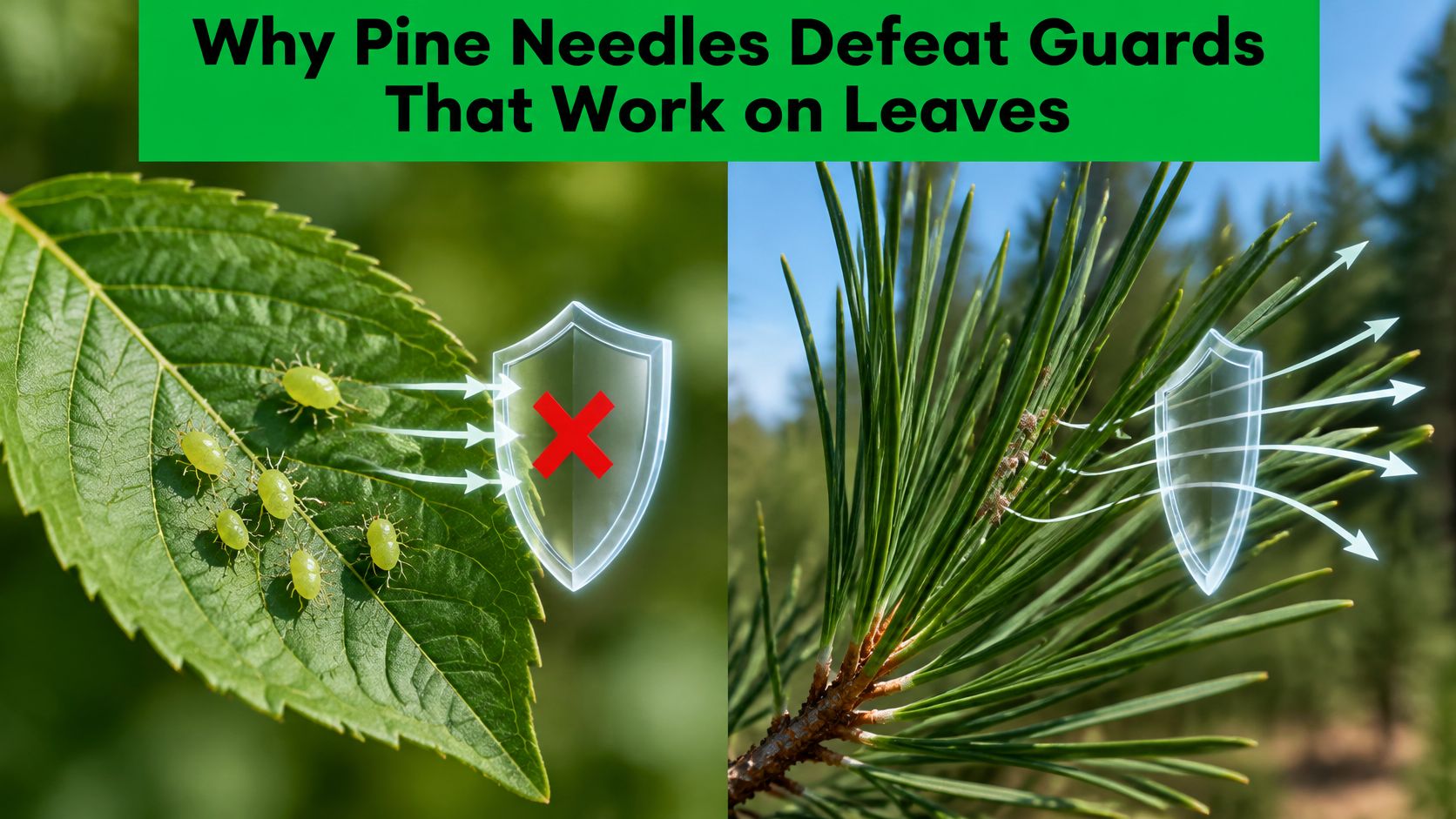
Once needles collect, they interlock. Rain wets and compresses that layer, reducing the open area available for water intake. During a hard storm, runoff can cross the debris instead of entering the gutter, even when the channel underneath isn't packed full.
The trouble spots aren't limited to the middle of a screen. Look at the roof-to-guard seam, overlapping sections, end caps, and downspout entrances. Each change in direction gives needles somewhere to catch.
A long-running design problem
The U.S. patent record for gutter-guard technology identifies an earlier guard filed in 1945 and published in 1947, along with later needle-shedding designs, including a 2007 invention that separates the needle-shedding surface from a water channel. Those competing approaches show why there's no single geometry that suits every roof.
The practical distinction is where each design sends the water and where it leaves the debris. A filter holds needles outside the gutter. A hood tries to carry them beyond the inlet. Neither approach excuses a poor fit at the roof edge.
For a closer look at debris around shingles and roof drainage, Artisan Quality Roofing's guide to pine needle roof damage provides useful roof-level context.
This video offers another visual reference for evaluating guard designs.
Test the whole drainage path
Don't judge success by whether needles stay out of the trough alone. Watch where runoff lands, whether it enters at valley outlets, and whether the downspouts discharge freely.
A guard that handles broad leaves may still struggle through needle season. Evaluate it after real exposure before assuming the installation has solved the problem.
How to Judge a Guard Before You Buy
Bring a sample of the needles from your property to the estimate. Ask the installer to show you the underside, mounting points, and removal method, not just the finished top surface.
Questions to answer on site
- Are the openings suited to needles? Compare the sample with the mesh and inlet gaps. Ask whether the product's testing involved pine needles rather than only broad leaves. Smaller openings help with exclusion, but the assembly still needs adequate water intake.
- Where will debris sit? Have the installer identify likely collection points on top and beneath the back edge. Material hidden under a lip is harder to spot and may require opening the guard rather than brushing it.
- How will it be fastened? Look for secure attachment and a profile compatible with the roof edge and gutter slope. The installation shouldn't create a pocket where water ponds or require careless disturbance of shingles.
- Can it be opened without damage? Ask for a demonstration of lifting or removing a service section. Find out which fasteners and tools are needed, and whether repeated access risks bending the cover.
- Is the gutter ready for a cover? Check the channel, hangers, end caps, valley outlets, and downspout entrances first. Covering a sagging run or an existing obstruction only makes the underlying repair harder to reach.
- What does the warranty cover? Read the provisions for pine-needle clogs, surface cleaning, ice, snow, and service labor. Ask whether the installer will inspect the fit after the first needle season and whether that visit costs extra.
Use this visual checklist while comparing proposals.

Answers that should stop the purchase
Rule out a guard if the installer can't explain how to reach the gutter beneath it. Be equally cautious when a proposal ignores existing overflow, leaves valley runoff unaddressed, or treats a clog warranty as a promise that cleaning will never be necessary.
A serviceable installation comes with an access method, not just a warranty booklet.
For a second home, request written maintenance instructions that a property manager can follow. Photos showing service openings and fastening locations are more useful than a vague assurance that the system is easy to maintain.
What Pine-Needle Gutter Guards Cost
Price the cover, then price the work that cover creates. A guard shifts debris from the trough onto the mesh, the roof edge, and the downspout mouths. I would buy the style that is easy to open, inspect, and clear, not the one marketed as blocking the most needles.
For a typical 150-linear-foot home, gutter-guard materials fall between $75 and $975, based on the $0.50 to $6.50 per linear foot range reported by Forbes in 2024. That article also flags maintenance challenges for properties exposed to many pine needles.
A narrower product reference comes from Bob Vila's 2025 micro-mesh review, which priced a tested product suitable for pine-needle homes at $1.49 per linear foot, equivalent to $223.50 for 150 linear feet.
Gutter guard material cost reference points
| Reference point | Cost per linear foot | Cost for 150 linear feet | Source |
|---|---|---|---|
| Lowest gutter-guard materials | $0.50 | $75 | Forbes, 2024, cited above |
| Micro-mesh product tested for pine-needle homes | $1.49 | $223.50 | Bob Vila, 2025, cited above |
| Highest gutter-guard materials | $6.50 | $975 | Forbes, 2024, cited above |
Budget beyond the cover
Measure the gutter runs that need protection, then multiply that length by the chosen material's per-foot price. Keep installation labor, old-section removal, roof-edge repairs, and a yearly inspection and cleaning allowance on separate lines in the proposal. A low guard price can hide expensive preparation or a cover that is slow to service.
Cheap material with labor-heavy upkeep is usually the poorer buy under heavy pines. Compare the cost of opening, cleaning, and reinstalling each system, not just the cost of attaching it. A screen you can lift in short sections stays cheaper to live with than a tighter cover that needs full removal every time needles pack the edge.
For another perspective on estimate components, Two States Exteriors LLC's 2026 gutter guard price breakdown can help you prepare questions. Use a property-specific Northern Arizona estimate for the purchase decision rather than treating another contractor's breakdown as a local quote.
Why Pine Needles Raise Wildfire Risk Around Your Home
A gutter guard isn't a wildfire fix. It may keep combustible material out of the trough while leaving that same material on the cover or roof edge.
A U.S. Forest Service publication examining residential destruction in Los Alamos, New Mexico described a continuous ponderosa-pine canopy in many areas with destroyed homes, associated with a continuous pine-needle fuel bed and needles deposited on roofs and in gutters. That finding supports clearing accumulated fuel, not promising that a particular cover prevents home ignition.
The publication doesn't establish a universal fire-risk reduction from installing gutter guards. No defensible recommendation turns needle exclusion into a guarantee of wildfire protection.
Clear fuel before fire season
Flagstaff's Wildland Fire Action Guide recommends removing dead leaves, debris, and pine needles from roofs and gutters because they can catch embers, places this work within its 0–5-foot home-ignition-zone strategy, and describes gutter-cleaning tools and assistance of up to $600 for eligible mitigation work. Confirm current availability and eligibility before planning around assistance.
Keeping needles away from the property and out of gutters is especially important during the dry summer months. Don't wait for the autumn cleanup if combustible debris is already collecting before fire season.
Use a fire-season inspection to identify:
- Exposed fuel: Needles lying on guards, roof edges, and accessible roof surfaces.
- Hidden pockets: Debris tucked beneath cover edges or trapped where roof planes meet.
- Other collection areas: Roof valleys, decks, vents, and the immediate area around the building.
Make the plan usable when you're away
For a Munds Park cabin or a Flagstaff short-term rental, assign someone responsibility for checking conditions between owner visits. A dated photograph and a note confirming removal give the next caretaker something concrete to work from.
Fire-season priority: Remove the accumulated fuel. Don't let a clean-looking gutter cover substitute for checking the surrounding roof and property.
Choose a guard that permits this work without damage, and pair it with broader defensible-space maintenance. A gutter cover doesn't remove needles from roofs, valleys, decks, or vents, and it shouldn't be sold as though it does.
Safe Ways to Clear Gutters Yourself
Start by deciding whether you can work from the ground. A telescoping gutter scoop or suitable pole attachment may reach a low run without climbing; our guide to gutter cleaning without a ladder explains that option.
Before you climb
- Check the footing. Use firm, level ground, keep pedestrians and vehicles clear, and inspect the ladder's feet, locks, and condition.
- Set the angle correctly. OSHA's ladder setup guidance recommends positioning a straight or extension ladder approximately 1 foot out for every 4 feet of ladder height. Secure it against displacement, and never move or extend it while occupied.
- Respect the access limits. OSHA's ladder safety guidance calls for extension ladders accessing a raised surface to extend at least 3 feet above the landing, prohibits standing on the top three rungs, and recommends three-point contact while climbing. Face the ladder, stay within its rails, and use a tool belt or hand line rather than carrying tools in your hands.
- Move instead of reaching sideways. Descend and reposition the ladder before working beyond a comfortable reach. Don't brace the ladder against a lightweight guard or an unstable gutter.
- Keep roof access separate. Cleaning from a ladder doesn't require stepping onto the roof. Leave steep roofs and difficult upper runs to a professional.
When to hire the work out
For two-story homes, awkward access, or unstable footing, use a trained crew with appropriate ladders, poles, and ground-based tools. On wet or icy days, postpone the work rather than treating professional equipment as permission to climb.
Inspection Schedule and Debris Disposal for Pine-Heavy Properties
Build the maintenance routine around actual needle accumulation, weather, and access. The guard surface and the gutter beneath it both need attention: FEMA's gutters and downspouts fact sheet specifically warns that mesh-style guards can accumulate pine needles on the screen or within the gutter.
For absentee owners, put the routine in the property's maintenance calendar and identify who records completion. Our guidance on gutter cleaning frequency can help you organize that schedule around the property's exposure.
A practical seasonal routine
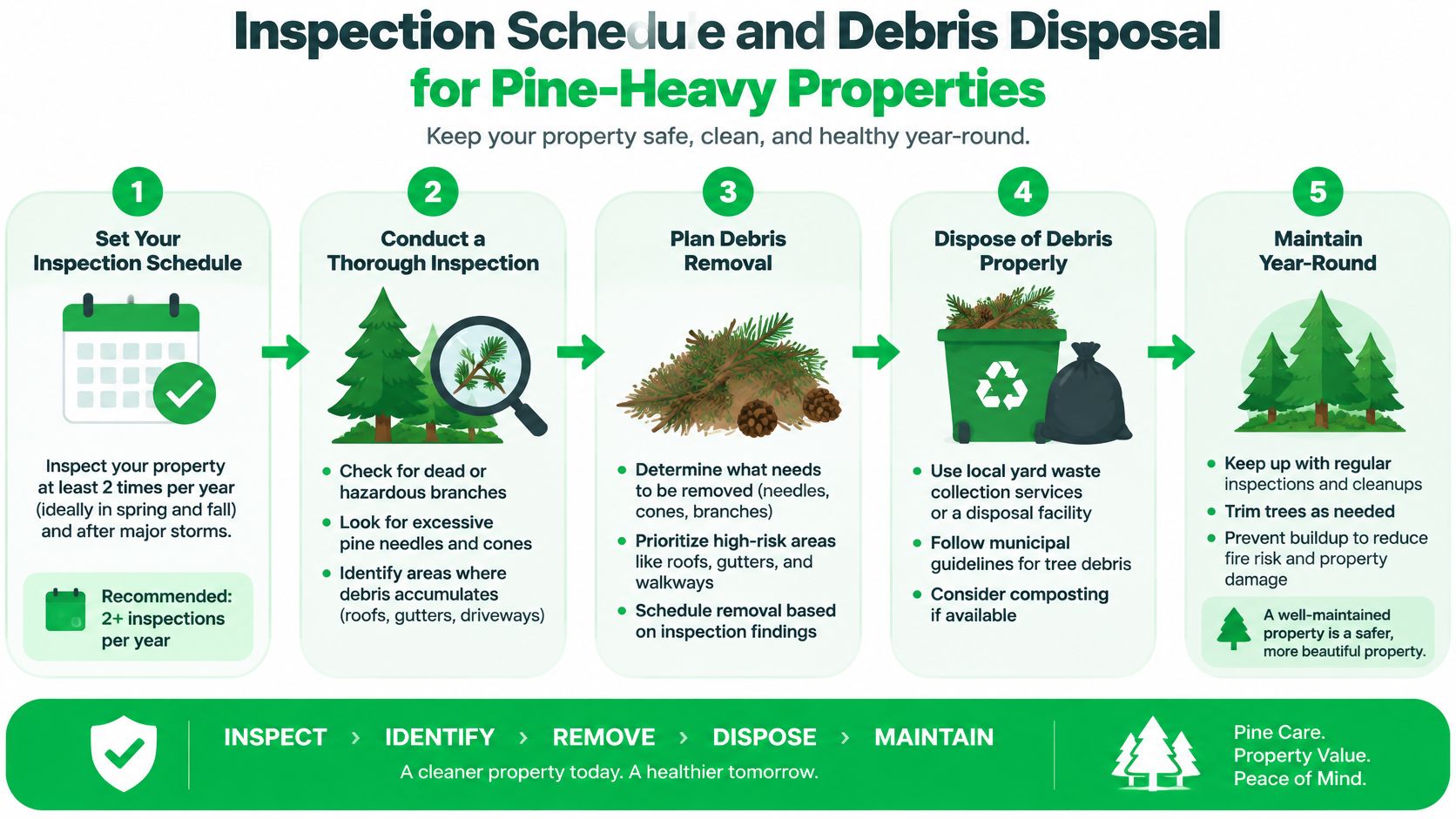
Inspect after the main autumn needle drop. Check the actual roof and guard, not just the ground beneath the trees. Photograph collection points so the next visit can distinguish new accumulation from a spot that wasn't fully cleared.
Return before wet or freezing weather. Clear damp material before it freezes into an obstruction. If the autumn drop and incoming weather overlap, don't postpone necessary cleaning while waiting for every needle to fall.
Open the designated service seam. Look beneath the back edge and inside the channel for packed material. Use the manufacturer's removal method rather than prying at a sealed joint or bending the cover to make an opening.
Flush each downspout with a hose. Observe the discharge, including extensions where fitted. If water backs up, check the inlet and elbows rather than forcing more water into a blocked run. Don't consider the job finished because the top surface looks clear.
Check transitions individually. Inspect end caps, valley outlets, and downspout entries. These locations deserve a close look because the direction and concentration of runoff change there.
Brush and collect the surface debris. Use a soft brush compatible with the guard and lift mats away by hand while wearing gloves. Avoid pushing fragments through the openings or using aggressive pressure that can distort fine mesh.
Separate the waste before loading it. Keep gutter debris apart from clean yard needles. Bag or contain it so grit and fragments don't scatter across the driveway or blow out during transport.
Use the visual process as a reminder, but inspect every part of the drainage path.
Confirm disposal before transport
Flagstaff's neighborhood pine-needle drop-off notice describes collection for pine needles and small green waste and warns against mixing household or other nonorganic waste into the dumpsters. Check current locations, operating dates, and acceptance rules before taking material to a collection site.
Gutter waste isn't automatically clean mulch. It can contain roof grit, shingle granules, moss, animal waste, and discarded fasteners. Describe that mixture when confirming disposal requirements rather than assuming a green-waste program accepts everything removed from a roof edge.
For managed properties, retain photos and a short record of cleared outlets, observed defects, and disposal. A guard can reduce the amount of work, but this inspection and removal schedule still applies after installation.
Book Your Next Service Before Needle Season
A gutter guard shifts maintenance to the guard surface, roof edge, and downspouts. Schedule a pre-season inspection, then leave room for cleanup after the needles drop. The right guard is one that can be inspected and cleared without unnecessary difficulty.
Pine Country Window Cleaning is a top-rated, locally owned and operated provider serving Northern Arizona since 1999. It offers gutter cleaning and pine needle cleanup, with tools and equipment to complete the job efficiently.
Prepare for the scheduling call
For gutter cleaning and pine needle cleanup, ask what the service will cover for your guard style and roof access. Have the gutter length, roof type, and photos of the guard ready, along with any pictures showing past overflow. These details help clarify the work without requiring you to climb for more information.
Call (928) 527-0671 for a free estimate, or schedule online. If the property is an occupied home, second home, or managed rental, explain how access should be arranged.
Pine Country Window Cleaning serves Flagstaff and has a location in Munds Park. Book before needle season, and plan for a follow-up check after the drop.